429. The Introvert’s Guide to Surviving Other People

A coworker recently told me that his fiancée sleeps at parties. Instead of socializing, she finds a sofa and takes a nap.

“That’s a good strategy,” I declared, nodding my approval. “I’ll have to remember that one.”

My own strategy for social events is to search for coffee. (Yes, I’m serious. No, I don’t have a problem.) Having a plan for unfamiliar or uncomfortable situations gives me a sense of structure and predictability. I hate standing around awkwardly with nothing to do. When I have a purpose, such as finding the nearest coffeepot, I feel less self-conscious and more in control of my circumstances.

Besides, I really like coffee. Its warm strength is the best kind of moral support, as it is written in Scripture: Coffee is our refuge and strength, a very present help in trouble. (I may have taken slight liberties with the original verse.)

I don’t care much for social situations. I am an introvert, which is a fancy way of saying I like being alone. This doesn’t mean I dislike my fellow human beings. Like Linus from the Peanuts comic, I love humankind.

It’s people I can’t stand.
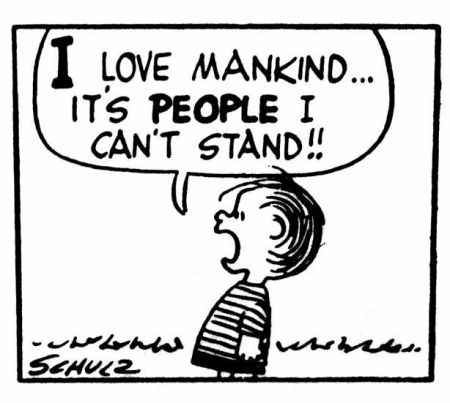
People I can't standNah, I’m only joking. I like people just fine. (Well, I like some people just fine.) Introverts aren’t necessarily shy or antisocial. We’re simply exhausted by spending time with other people. We recharge by being alone.

Of course, being alone isn’t always an option. It is for times such as these that introverts develop strategies for survival, or else suffer self-consciously through awkward social events.
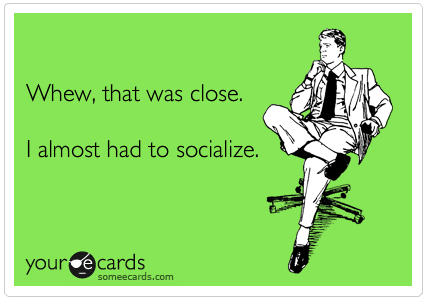
Almost had to socialize...

After years of weddings, parties, dinners, church gatherings, small groups, and miscellaneous events, I’ve picked up a few tricks. Here are a few strategies to help introverts survive painful social obligations.

  • Find that one person with whom you feel comfortable, and try to start a long discussion. With a bit of luck, you’ll be able to while away the time in comfortable conversation. This one is great for family gatherings, but useless at events where you don’t know anyone.
  • Find the hosts and offer to help with the event. If you set up chairs, serve food, wash dishes, or seem busy in some other way, other people are less likely to pester you. By helping you give yourself a defined purpose, make a good impression, and benefit others. You also give yourself an excuse not to linger in idle chatter or awkward silences!
  • Meet the local wildlife. This crafty blogger spends parties with the resident pets, leaving the cool people to do… whatever cool people do at parties. Heck if I know.
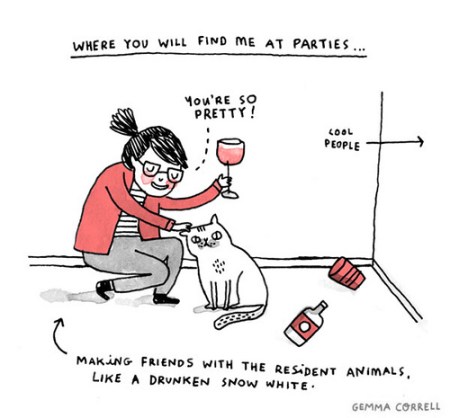
Drunken Snow White

  • Find something to do with your hands. For an introvert, the worst part of social events can be having nothing to do. Grab a plate of food. Bring a pen and doodle on the napkins. Learn a few papercraft tricks before the event, and wow everyone by turning those napkins into little birds or tuxedos. At social events, I try to keep at least one hand occupied with a drink, preferably coffee.
  • Don’t be afraid to excuse yourself early by saying, “I’m afraid I have plans after this.” It’s an important-sounding excuse, and you don’t have to tell anyone that your plans are to go home and read a book.
  • Plan to treat yourself to something nice after the event, and keep reminding yourself of that plan. Maybe you’ll grab a milkshake on the way home, or take a bath, or watch some Netflix. Look forward to something.

Whatever else you do, always be friendly and polite! You may feel exhausted, anxious, or simply irritated, but a grouchy attitude won’t fix anything.

Well, I’m going to look for some coffee.
426. I Want to Make You Feel

I recently announced my decision to revive the Lance Eliot saga, my greatest and most personal writing project. Today I will tell you why I made that big decision, but there is something else, something important, I must discuss first.

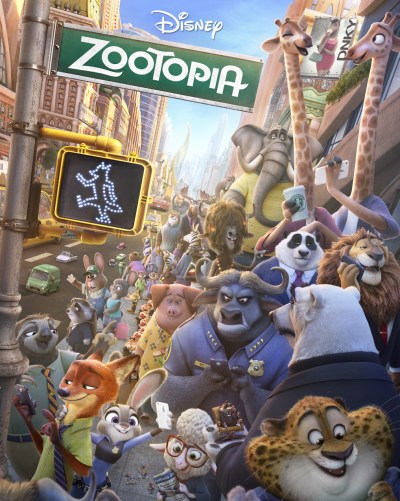
Excuse me, Sir or Madam, but have you heard the good word about Disney’s Zootopia?

Zootopia movie poster

Not far from my home in the little town of Berne there stands a cozy cinema called the Ritz Theatre. (I discovered it when I ventured forth to see The Lego Movie a couple of years ago.) The Ritz has two theater rooms, one of which is fairly small, and an old-timey lobby with a big plaster model of an Oscar trophy. I love the Ritz Theatre. It wraps the sound and fury of Hollywood movies in the charm of a friendly small business.

My younger brother and I recently made a pilgrimage to the Ritz Theatre to see Zootopia, Disney’s latest animated movie. It was fantastic. However, as much as I would love to spend this blog post explaining why the movie is fantastic, that’s not really the point. (Seriously, though, go watch Zootopia.)

The point is that Zootopia made me feel things. It evoked far deeper feelings of catharsis and happiness than any kids’ movie has any right to do. I am not an emotional person. I am, despite my sense of humor and typically sunny disposition, pragmatic and logical.

Thus, when the feels hit me, they hit me hard.

HRRRNNNGGG

I just can’t take the feels, man.

Zootopia is far from the first story to make me make me feel things. Heck, nearly every new animated Disney film since Bolt back in 2008 has left an emotional impression. For some reason, while movies for adults appeal to my intellect, movies for kids are the ones that appeal to my feelings. (Disney, Pixar, and Studio Ghibli, I’m looking right at you.)

I like positive feelings. Most people do. I’m not often emotionally overwhelmed by a story, but when I am, it’s an amazing experience. It’s a fleeting encounter with the power of storytelling: as J.R.R. Tolkien suggested, “a far-off gleam or echo” of a happy ending to our own story, which is being told by the greatest Storyteller of all.

Speaking of Tolkien, I admit few stories have made me feel as much as The Lord of the Rings. Tolkien’s masterpiece, especially the last chapters of its final book, The Return of the King, warms even my impassive old heart.

I haven’t read The Lord of the Rings since 2009 or so, and much of it had faded from my memory, but something happened last year to change that.

A few days after Christmas, my brother and I visited a family friend. I’ll call him Socrates here. (In real life, I call him Barabbas. It’s a fun story.) After welcoming us into his home, Socrates made snacks and put on the film adaptation of The Return of the King. It had been almost as long since I had seen the film as it had since I had read the book!

Return of the King movie poster

Something happened that night. The movie was as good as I remembered, but beyond that, something woke up inside me. I felt an overwhelming peace and happiness: the nostalgia of fond memories in harmony with the catharsis of seeing beloved characters reach a happy ending. It was then I realized something: I knew I once wanted to write a story of my own, but I had forgotten why.

This was why.

That night reminded me of why I decided to write stories in the first place: I wanted to feel, and I wanted to make other people feel, too. Stories like Zootopia and The Return of the King gave me moments of cathartic happiness, peace, and comfort. I wanted to give someone else those moments.

I still do.

That’s my story and I’m sticking to it. That’s my excuse for picking up the Lance Eliot saga once this blog bites the dust. I want to make you feel.

Blame Tolkien and Zootopia.

422. Lance Eliot Is Not Dead

A long time ago, I declared the death of a dream. My attempts to tell the tale of Lance Eliot, a sarcastic and reluctant hero, had finally failed. I pronounced Lance Eliot dead… well, mostly dead.

I announce today that Lance Eliot is alive… well, somewhat alive. (I thought about titling this blog post Lance Eliot Is Alive, but that seemed much too optimistic, so we’ll have to settle for Lance Eliot Is Not Dead.)

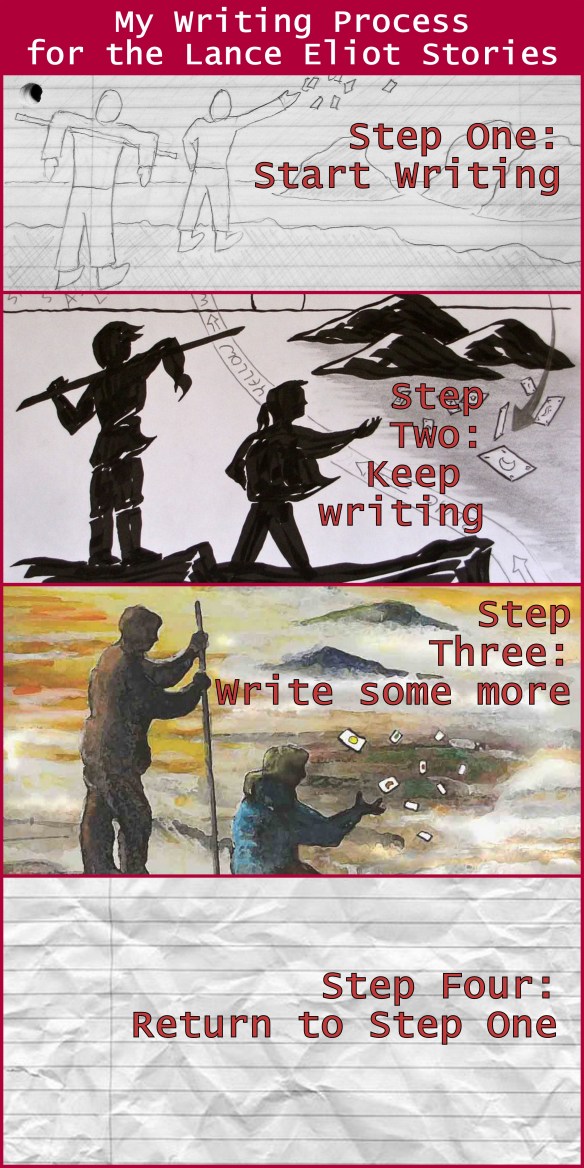
After Typewriter Monkey Task Force concludes later this year, I will rewrite the first part of Lance’s story, The Trials of Lance Eliot, before moving on to its two sequels.

At any rate, that’s the plan. God only knows how many years it will take me to write the Lance Eliot saga, or whether I shall even finish it. I don’t know if I can, but I suppose I’ll try.

The Lance Eliot story cycleAt this point there are three questions I should probably answer. Why am I rewriting The Trials of Lance Eliot instead of working directly on its sequels? Why am I revisiting Lance Eliot’s story instead of starting something totally new? And who the heck is Lance Eliot anyway?

Let’s start with that last one.

Who the heck is Lance Eliot?

From pretty much the moment I could read, I wanted to write a book. Years later, in middle school, I steeped my impressionable imagination in the fantasy novels of J.R.R. Tolkien, C.S. Lewis, and Stephen R. Lawhead; I also played a lot of fantasy games, such as the outstanding Legend of Zelda series. It was then, during my awkward transition from boy to slightly-taller-and-less-chubby-boy, that my vague dream of writing a book crystallized into a clear ambition of writing a fantasy novel.

It wasn’t until my sophomore year of high school that I stumbled upon a decent idea for a story. People in fantasies and fairy tales are often summoned from one place to another by magic. What if a magician summoned the wrong person by mistake? What she tried to summon, say, Lancelot from the Arthurian legends, but got some unsuspecting loser instead?

Over the next six years, the idea became a short story, and then a completed novella, and then one or two incomplete manuscripts, and then finally a published novel—and then it failed spectacularly, failing even to recoup the expenses of publication. I struggled for a year or so to make progress on its sequels, and finally gave up.

This brings us to the next question.

Why am I revisiting Lance Eliot’s story?

I no longer dream of publishing novels. Even if I finish all three parts of the Lance Eliot saga, which is by no means guaranteed, I may not bother publishing them. If I do take another stab at publication, I will probably self-publish instead of working with a literary agent or trying to court a major publishing house.

My reason for revisiting Lance Eliot’s story is a simple one: it’s a story I want to tell. In the vast scheme of things, it isn’t remotely special. It won’t be particularly deep or clever or original. I have no delusions of grandeur this time around. The Lance Eliot saga won’t be a masterpiece. It will be nothing more than a story I want to tell—a story I feel compelled to tell—a story I’ve struggled for more than a decade to tell.

I’ve already told part of it, but not very well. This leads to the final question.

Why am I rewriting The Trials of Lance Eliot instead of moving on to its sequels?

A few people have said ridiculously nice things about my novel; in response, I’m touched, flattered, and grateful. When I look at it, however, I see an embarrassing number of clichés, oversimplifications, cheap coincidences, and lackluster characterizations.

I believe I can do better. There are so many things I want to change about the story, including some I haven’t mentioned. Instead of writing reluctant sequels to a failed novel, I want to start over with more experience and creative freedom, and less emotional and literary baggage.

Am I excited to revisit the Lance Eliot saga? Nah, not really. What I feel is a mixture of resignation, determination, nervousness, and cautious optimism.

After four or five manuscripts, one failed novel, and more than a decade of hard work, I am now almost ready to begin working on the Lance Eliot saga. Oh, boy.

Here I go again.

421. The Beginning of the End

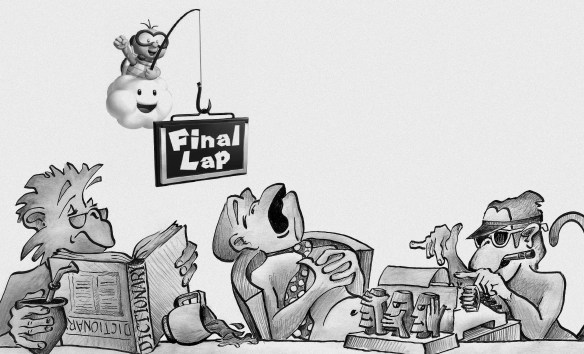
Well, dear reader, this is it. This is the beginning of the end. After four and a half years of caffeinated rants and geeky ramblings, Typewriter Monkey Task Force is starting its final laps.

Final lap! (Watch out for banana peels.)

Final lap! (Watch out for banana peels.)

I’m ending this blog, but not quite yet. TMTF shall conclude with its five hundredth numbered post, which will probably be published toward the end of this year. I don’t yet have an exact date for that post; it depends on how many more breaks I take from blogging.

(You know, this bittersweet blog post could use an appropriately bittersweet soundtrack, such as “The Best Is Yet to Come” from Metal Gear SolidHere you go. No need to thank me.)

Why am I ending this blog? Well, that’s a good question. (I’m glad I asked.) Ending TMTF is a big decision, and I’m not the only one it affects—if you follow this blog, it probably affects you, too.

You may be a little saddened by TMTF’s impending demise. If you’ve enjoyed something over a long time, it can be hard to see it end. (Gravity Falls ended just a few days ago, so believe me, I know the feeling.)

Then again, you may just be wondering why I didn’t put this blog out of its misery ages ago.

There are a few reasons for my decision to end TMTF.

It’s getting harder for me to come up ideas for new posts.

As I think of posts to write for this blog, I feel like I’m beginning to scrape the bottom of the barrel. I would much rather give TMTF a respectable finish than drag it out endlessly: as Tolkien put it, “like butter scraped over too much bread.”

TMTF has lost its purpose.

I began this blog years ago with a strong sense of purpose. TMTF originally had three clear objectives.

  1. I wanted to build up an audience for the novel I was finishing at the time.
  2. I wanted to make some sort of positive difference with my God-given talents for writing, humor, and creativity.
  3. I wanted to try something new and exciting.

At this point, TMTF has either completed or failed these objectives; either way, they hardly matter anymore.

  1. My novel failed, and it won’t be getting sequels anytime soon, so there is no longer any point in finding an audience.
  2. At this point, I think TMTF has made pretty much all the difference it can. I’ve said most of the things I really wanted to say… except for the word pulchritude, of course, and now I’ve said it.
  3. After four and a half years, TMTF is neither new nor exciting. Writing this blog has been a great experience, but I’ve lost my passion for it.

When I started TMTF, I was motivated to write blog posts by a sense of purpose. Now I write them because I have to keep the blog’s publishing schedule. I’m trying to live more purposefully; it’s one of my resolutions for this year. My writing should be driven by a sense of purpose, not feelings of obligation. I owe that much to my readers, and to myself, and to God.

I want to work on a new project.

I could say more, but that’s another post for another day.*

I’m thankful for this blog, and I don’t regret the time and effort I’ve put into it. Working on TMTF over the years has brought me satisfaction, laughter, gleams of insight, and moments of catharsis… not to mention quite a lot of harmless fun.

I’ve met a number of amazing people through this blog whom I would never have met otherwise: JK Riki, the animator and creativity expert; Tom Zuniga, the wandering blogger; Rev Kev Niebuhr, the manliest Methodist of our generation; and more. I’ve also had the privilege of collaborating with awesome folks like Paul McCusker, a veteran writer for Adventures in Odyssey; Kevin McCreary, a YouTube and podcast creator; and colorful YouTube personalities like DRWolf and Crowne Prince, among many others.

This blog motivated me to write a fantasy novella and some short stories, not to mention hundreds of pointless rants thoughtful reflections upon faith, writing, video games, literature, TV, movies, life, the universe, and everything. With the help and support of its fabulous readers, TMTF raised hundreds and hundreds of dollars for charity. I even invented a holiday on this blog: Be Nice to Someone on the Internet Day—which is coming up on March 4, by the way!

I’m thankful for Typewriter Monkey Task Force—and it ain’t over yet, folks! It shall continue yet for months and months, and there’s one thing I want to make very clear about its end. I’m not abandoning this blog. I’m finishing it.

Finally: Thank you, my dear readers. Thanks for the past four and a half years. I welcome you to stick around for whatever is left, and for whatever comes after!


*And that day shall be Friday.

Sandwiches

There comes a time in the life of every blogger when he must blog about sandwiches. That day has come. This, dear reader, is my destiny.

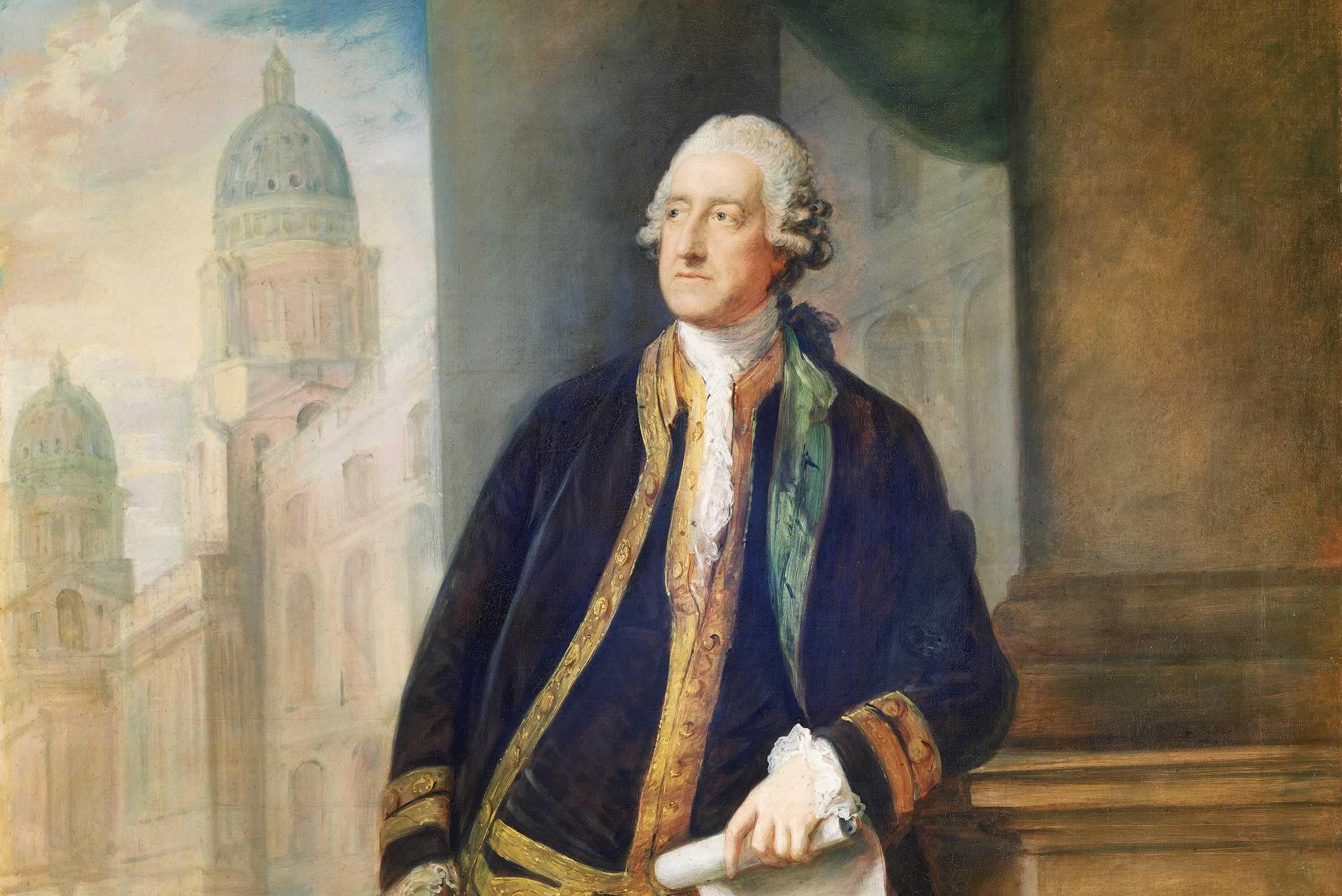
I consider sandwiches the crowning achievement of humankind, surpassing such modest inventions as the printing press, the steam engine, and the Internet. The sandwich was bestowed upon the human race by John Montagu, an eighteenth-century British statesman. Montagu was the fourth Earl of Sandwich, and possibly the greatest man of his millennium.

I salute you, Lord Montagu. Long may your name be remembered and your namesake be relished!

I salute you, Lord Montagu. Long may your name be remembered and your namesake relished!

As the story goes, the Earl of Sandwich wanted to eat while working without making a mess. (A popular version of the story suggests Montagu didn’t want meals to divert him from playing cards.) He asked his servants to bring him meat between pieces of bread so that he could eat without using silverware or getting his hands dirty. Montagu’s culinary triumph was eventually named after him, and the rest is history—shining, glorious history.

I have had the privilege and pleasure of sampling many sandwiches in my twenty-something years. (Heck, I ate a sandwich just an hour or two ago.) The possibilities are endless. There are hundreds of varieties of bread, and thousands of ingredients to mix and match. Whether you prefer a simple turkey and Swiss on whole wheat, a sweet honey and butter on white, a robust blend of meats and vegetables on an Italian sub, or any other of the millions of combinations out there, there is a sandwich for you.

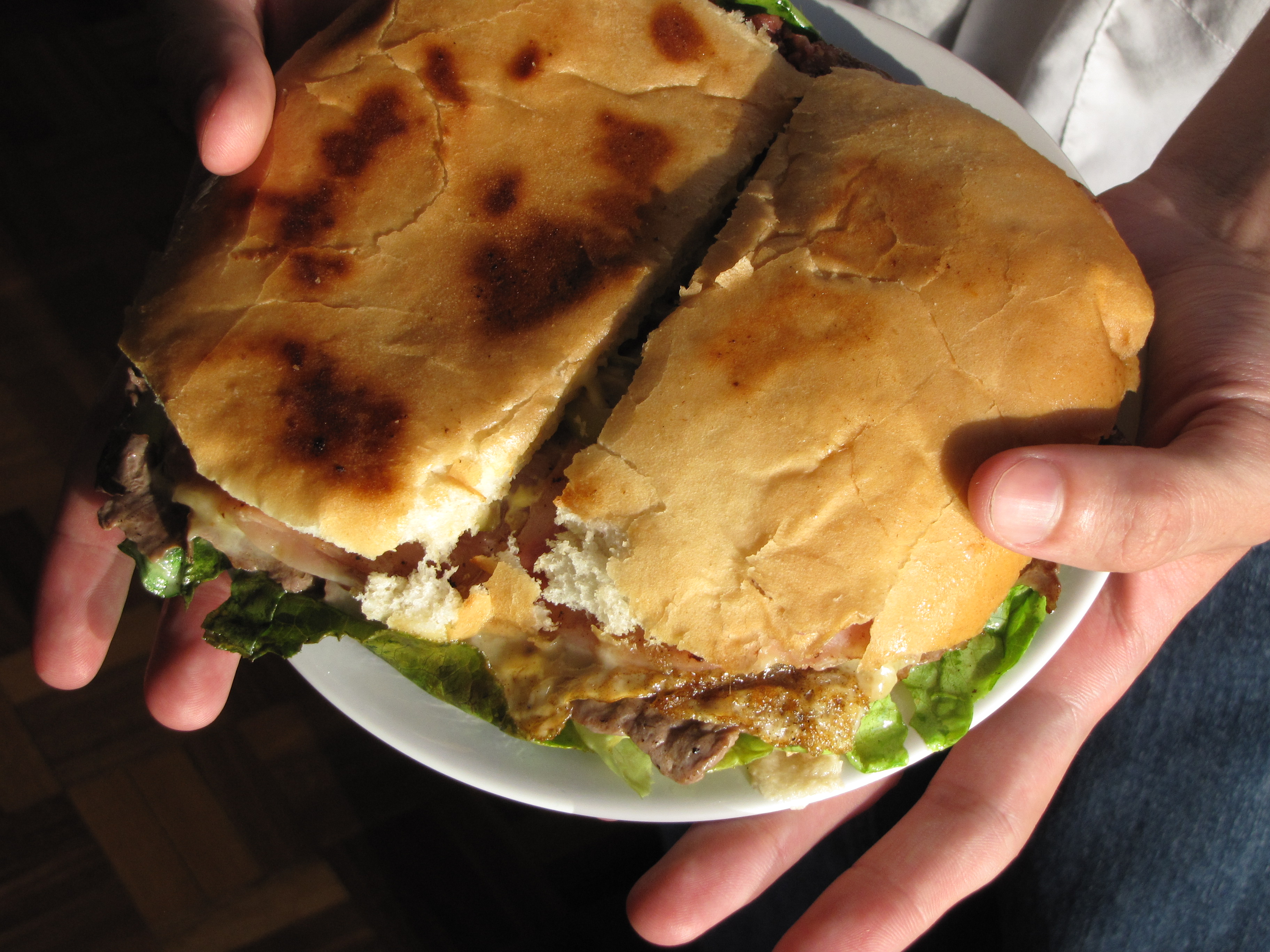
My personal favorite is the chivito.

As it is written, "Man shall not live by bread alone." I'm certain this ancient Scripture refers specifically to this sandwich.

It is written, “Man shall not live by bread alone.” I’m pretty certain this ancient Scripture refers specifically to this sandwich.

The chivito is a sandwich popular in Uruguay, where my parents live and work. In Spanish, the literal meaning of chivito is small male goat, which is a misnomer in the case of the sandwich: the Uruguayan chivito contains beef, eggs, lettuce, tomatoes, and occasionally mayonnaise, bacon, onions, peppers, olives, or cheese.

Chivitos are the best sandwiches I’ve ever tasted, and I spent three and a half years in college working part-time in a sandwich shop. I know sandwiches. The chivito is by far my favorite sandwich, and possibly my favorite food.

While visiting my parents in Montevideo, I dissected a chivito prior to eating it. For science.

While visiting my parents, I dissected this chivito prior to eating it. For science.

I haven’t tasted a chivito in years: my quiet corner of Indiana boasts no such exotic sandwiches. All the same, I continue to enjoy old favorites such as turkey and cheddar, peanut butter and jam, grilled cheese, and a variety of subs from local Subway restaurants.

Now if you’ll excuse me, I need a sandwich.


This post was originally published on March 13, 2015. TMTF shall return with new content on February 22, 2016!

417. Working on Self-Respect

A while back, a resident of the nursing home where I work thanked me for helping her with something. “Sure thing,” I replied. “They don’t pay me to stand around looking grumpy, you know.”

The resident laughed, and I added, “I am pretty good at it, though. If being a grump were a paying profession, I’d be the best in my field.”

“Don’t say that,” said the resident, suddenly serious. “You’re too hard on yourself.”

I briefly considered explaining my tendency toward self-deprecating humor, but decided against it for two reasons. First, I had other people to assist. Second, the resident is in her nineties and can’t even remember my name, so an explanation didn’t seem worth the effort.

I like to make people laugh, and put-downs are an easy form of humor. Since other people are hurt by mockery, I mock myself. I don’t think there’s any harm in that. Heck, some of the people whom I admire most, including family members, poke fun at themselves all the time.

Taking a break

Besides, when it comes to cheerful self-deprecation, I’m an awfully easy target.

However, if I’m honest with myself, some small part of my self-deprecation is a response to low self-esteem. Poking fun at myself allows me to point out some of my own faults before anyone else gets the chance. It’s a way of telling others, “Look, I know I have problems. You don’t have to tell me. I already know.”

Low self-esteem seems to run in the family. Many of my relatives on both sides have struggled to maintain a sense of self-worth. Fortunately, however little a person might esteem or value himself, he can choose to respect himself. Self-esteem depends on mood or circumstances, but self-respect is a choice.

Self-respect is a powerful weapon for overcoming life’s obstacles. (Specifically, self-respect is a sharp katana blazing with purple flames… according to the movies, anyway.) I may not be able to wish away feelings of low self-worth, but I try to maintain self-respect in my day-to-day life.

How am I trying to maintain self-respect? Well, I’m glad I asked.

I’m trying to keep my home neat and clean.

In this chaotic, broken mess of a world, my home is the only place over which I have complete control. When I allow it to become cluttered or dirty, I feel like I’m losing what little respectability and self-discipline I have. I may sometimes feel like a mess, but I can at least make sure my immediate surroundings aren’t messy.

Oddly enough, I’m not even slightly bothered by the messiness of other people. Their clutter is their concern. Only my own messes bother me. When I stay in other homes, or other people stay in mine, I’m satisfied to keep my own stuff neat. It’s only when I become untidy that my self-esteem plummets.

I’m trying to keep myself neat and clean.

This is pretty much the same principle as the one above, but applied to my person instead of my surroundings. I don’t wear elegant clothes or obsess over my appearance. However, I do wear clean clothes that fit, match, and have no obvious rips, holes, or stains. I try to look respectable, and to smell clean. Heck, I even shave occasionally. Neatness and cleanliness are basic virtues, but important ones for maintaining self-respect.

I don’t look particularly nice, but I’ll settle for vague respectability.

I feel lazy and slovenly when I stop caring about my appearance. Even when I feel like a failure, I sure as heck don’t want to look like one.

I’m trying not to blame myself for things that aren’t my fault.

I tend to blame myself when things go wrong. After all, I have to blame someone, and I feel guilty blaming other people. Thus, when my car breaks down, or someone steals a package I ordered, or a person at work is rude, I assume it’s somehow my fault. I could have avoided it, right? I could have done something better, and I should have done it. This assumption makes it awfully hard to stay positive. I make enough mistakes without blaming myself for everything else.

As I blunder onward, I’m trying to be more rational in acknowledging that stuff isn’t always my fault—or at least, it isn’t always all my fault. In one of the Harry Potter books, as Dumbledore confesses a terrible mistake, he admits it was “almost entirely my fault—I will not be so arrogant as to claim responsibility for the whole.” There’s a lesson there.

I’m trying not to procrastinate.

Putting off commitments and responsibilities leaves me feeling stressed and guilty. Completing them promptly gives me a warm feeling of satisfaction, and allows me to feel ever so slightly more in control of my life. I’m trying not to procrastinate. I’m not really succeeding—I didn’t know what I was going to write for this post, let alone start writing it, until the day before it was due—but I sure am trying.

I’m trying to balance work and rest.

I feel stressed and helpless when I’m too busy, and anxious and guilty when I’m not busy enough. Both extremes damage whatever self-esteem I have. It’s when I reach a healthy balance of work and rest that I feel like a respectable, well-adjusted human being.

Are my attempts to maintain self-respect working? I think so, though it doesn’t always feel like it. Fortunately, self-respect isn’t a feeling, but a choice. However my self-esteem may rise or fall, I choose to believe I’m a worthwhile human being, and to act like one.

(I don’t have a flaming katana yet, but I’m getting there.)

414. There Is No Bed in My Bedroom

A week or two ago, I realized I needed a new bookcase. I acquire books with disquieting frequency and almost no effort. Heck, I hardly ever buy books these days; people just give ’em to me. I’m a book magnet. (Judging by my relatives on both sides, this is a family trait.)

Yes, it was time for a new bookcase, so I acquired one from Wal-Mart about a week ago. Putting it together was not a particularly fun experience, compelling me to vent my feelings on Twitter:

At last the bookcase joined Marvel’s Avengers in the Things That Have Been Assembled category. I placed the bookcase in my bedroom, which also contains a desk, two chairs, a nightstand, an old chest, some geeky decor, and a ridiculous number of machetes.

One thing my bedroom doesn’t contain is a bed, which is a little ironic if you think about it.

I sleep in a sleeping bag on my bedroom floor. Before that, I slept on an air mattress, which eventually sprung a leak and took on the spongy feeling of a stale marshmallow. (You can understand why I switched.) I haven’t owned a bed since… well, now that I think about it, I’ve never actually owned a bed.

There are reasons for this. Beds are expensive; sleeping bags are cheap. I enjoy the novelty of a bedroom without a bed. (I’m a bit strange, you see.) There is one more reason I haven’t bought a bed, and I’ve been thinking about it lately.

When I settled into my apartment a few years ago, I assumed it wasn’t to stay. My situation was temporary. My job was just a stepping stone to greater and higher things. I had never spent more than a few years in one place, and I assumed my latest situation was as temporary as all the others had been. I didn’t dare buy a bed. What would I do with it when I moved in a year or two?

That was almost three and a half years ago. I haven’t moved. My younger brother now lives with me. (He has a bed.) I have a cat and furniture and houseplants and more bladed weapons than most medieval armies. What I don’t have is clear plans for moving on.

For me, 2013 and 2014 were years of survival. I endured. I slowly, painfully learned the basics of being an independent adult. The year 2015 was one of change. I left my old job, found a new one, cut my hair shorter, grew a beard, and left behind the debris of previous years. As the year ended, I wondered what 2016 would bring.

So far, this year has been one of stability. My life is no longer full of upheaval and unpredictability. My job isn’t bad. My situation has become consistent. After three and a half years of not daring to put down roots or even buy a bed, I’m beginning to wonder whether I’m not here to stay… for another couple of years, at least.

I’m still not buying a bed, though. Beds are expensive, man.

410. Looking Ahead, and Hoping for the Best

It’s a new year! By the grace of God, Planet Earth and its population of grouchy humans staggered through 2015. The year 2016 has begun, promising new adventures and opportunities, and also a new Legend of Zelda game.

This is going to be a good year. At any rate, that’s what I keep telling myself.

Zelda Wii U

Nothing brightens up a new year like the promise of a new Legend of Zelda title!

For me, 2015 was a year of change. I quit a lousy job, found a better one, changed job positions, lost a dear friend, grew a beard, and acquired a cat. What lies ahead this year? God only knows. I begin 2016 hopeful, highly caffeinated, and armed with several New Year’s resolutions.

In my last post, I reviewed my old resolutions for 2015. What are my resolutions for the new year? Well, I’m glad I asked. Here they are!

I will be more purposeful.

I’m easily distracted, and my life is full of distractions. Consider my cat, Pearl, who jumped onto my lap while I was trying to write this blog post and began licking my arm. I’m not sure whether to be flattered or concerned. Is the licking a gesture of affection, or is she making up her mind whether to eat me?

Do you see what I mean? I try to make a point about distractions, only to end up worrying about my cat. In my day-to-day life, I often drift from meaningful activities to worthless ones. I spend too much time reading random articles on Wikipedia and brooding over frivolities, and too little time reading books and writing stuff that matters to me.

I work in a nursing home. Surrounded by old people, I realize that I too shall be old someday (assuming my cat doesn’t eat me first). At that time, I don’t want to look back with anguish, regret, and gnashing of teeth. (Heck, I may not have any teeth left to gnash.) When I’m old, I want to look back on a life well spent.

That must begin now, here, today, this year, with purposeful living. It begins with little day-to-day decisions. I have to start somewhere, right?

I will value prayer more.

As an orthodox Christian, I believe prayer is the most important, powerful, significant thing I can do, yet I don’t spend as much time in prayer as in years past. Why is this? There are a number of reasons, but I won’t discuss them today. What I will say is this: I need to value prayer, and to pray faithfully.

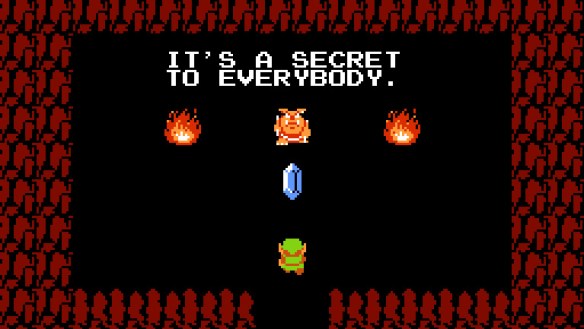
It’s a secret to everybody.

My final resolution is a well-kept secret, locked carefully in a well-kept chest in the tidy depths of a well-kept dungeon. (I like to keep things neat.)

It's a secret to everybody

Today is a day for Legend of Zelda references. I regret nothing.

If I make enough progress on this resolution, I’ll announce it later this year. At this point, it’s either a surprise I don’t want to spoil, or a plan I won’t reveal in case it fails; take your pick.

These are my resolutions for 2016. Yes, I know there are only three, and in years past I’ve had six. As 2015 reminded me, six is too many. The more resolutions I set, the easier it is for me to forget or ignore them. By setting only three, I’m more likely to remember and keep them.

At any rate, that’s the plan.

Do you have any resolutions for this year? Let us know in the comments!

409. Looking Back, and Wanting to Set Stuff on Fire

New Year’s Eve is almost here. A new year lies ahead, full of promise and possibility. As this year draws to a close, we take down Christmas decorations, make resolutions, and burn effigies in the streets.

Burn, año viejo, burn!What? We don’t do that in America?

This country is no fun.

As a kid in Ecuador, one of my favorite holiday traditions was the burning of the año viejo, or old year. Every New Year’s Eve, families gather to burn their own año viejo: a crude effigy of a person stuffed with sawdust, fitted with a papier-mâché mask, and doused in something flammable. Popular likeness for año viejo masks include superheroes, cartoon characters, and (of course) politicians.

In addition to sawdust, some people stuff a few firecrackers into their año viejo. Such effigies do not go gentle into that good night. They go with roaring flames and an irregular series of bangs. Man, I miss Ecuador.

The burning of the año viejo is a beautiful tradition: a symbol of letting go of the past year’s troubles and failures. (It’s also fun for pyromaniacs.) My dad, ever the creative missionary, used an año viejo one New Year’s Eve to share a lesson from the book of Romans: “For we know that our old self was crucified with him so that the body ruled by sin might be done away with, that we should no longer be slaves to sin—because anyone who has died has been set free from sin.”

I’m sorry to say my little Indiana town probably won’t let me set fire to stuff on the streets, even as a cherished symbol of moving forward. Since I can’t burn an año viejo, I’ll have to settle for making some New Year’s resolutions. Before I do, however, I should probably review the old ones.

Here are my resolutions for 2015. Did I keep them? Before they go up in a metaphorical cloud of smoke, let’s find out.

I will be more intentional in keeping my New Year’s resolutions.

Yeah, no. As usual, I kept several of my New Year’s resolutions, but it was only by dint of trying generally to be a better person. I had to look up my old resolutions in order to write today’s blog post, which means I failed to keep this one.

I will work on my Spanish.

I kept this one, but not exactly on purpose. My plan was to watch Avatar: The Last Airbender in Spanish, which I definitely didn’t do. However, since starting work as a CNA in a nursing home earlier this year, I’ve spoken Spanish regularly with one of the residents. I declare this resolution sort of kept.

I will practice spinning an old broomstick.

I didn’t keep this one. My talent for twirling a broomstick like some sort of janitorial ninja went mostly unpracticed this year. Sometimes, when I spin my broomstick in the local park, Amish kids stare at me fixedly with blank expressions. It’s a little creepy. I wish I could find a more private place for stick-twirling.

I will have a more positive attitude.

I actually kept this one, thanks in no small part to my resignation from a horrible job. (It’s so much easier to think positively when you aren’t crushed every day by impossible expectations, thankless conditions, and toxic people.) So much changed this year: much of it for the better. I still don’t know what I’m going to do with my life, but things seem a little more hopeful.

I will research career options.

I sort of kept this one, but not really. I researched the steps required to become a Certified Nursing Assistant—and promptly became one—but that isn’t exactly a step forward. It’s more like a step sideways. I also did a tiny bit of research into editing and did some preliminary editing for a friend’s manuscript… that counts, right?

I will value prayer more.

I… didn’t keep this one. I’m sorry to say I valued prayer less this year than in years past. I’m working on it.

What are my resolutions for 2016? That shall wait until next time!

Did you keep your resolutions this year? Let us know in the comments!


We did it, guys. WE DID IT! Operation Yuletide reached its fundraising goal thanks to the staggering generosity of a few awesome people! The fundraiser is still going, and it’s not too late to donate—every dollar helps, and there are rewards for donors! Check it out here!

408. Christmas Is Not the End

Today is Christmas. (I mention this in case, y’know, you hadn’t noticed.) This day finds each of us in a different place. Some of us are rejoicing. Some of us are burdened, lost, hopeless, or heartbroken. Some of us are drinking a fifth cup of coffee and thinking about The Legend of Zelda. (All right, that last one might just be me.)

I like to think I’m pretty good with words. Whatever my faults—and they are many—I can generally think of something funny or clever to say. It’s on days like this one, when words matter most, that I can’t seem to find the right ones. Anyhow, I can’t seem to express my feelings without sounding like those insincere messages printed in holiday cards, which is one of the most embarrassing things that can happen to a writer.

Today is Christmas, and even if it means sounding like a generic holiday card, I want to say just a few things.

Still not relevant

This photo is hardly relevant to this blog post, but I’m adding it anyway because it’s adorable.

To those who are rejoicing today, I say this: I’m happy for you. I hope your Christmas is full of nostalgia for the past, contentment in the present, and hope for the future. May your day be filled with laughter, loved ones, and cookies. May the year ahead be the best and brightest you’ve ever had.

To those who are grieving today, I say this: I’m sorry. May you find whatever joy and comfort you can this Christmas, and may the year ahead bring you healing, peace, happiness, and hope.

Christmas tree

Wherever you are today, may your Christmas be bright.

All right, I’m done with the holiday card stuff, but there’s one more thing I want to say.

For those of us who live far north of the Equator, Christmas comes and goes in the freezing darkness of winter. The holiday season is like a candle flame, burning bright and warm, extinguished in a moment. We clear away the wrapping paper, take down the Christmas trees, and resume our ordinary little lives. The nights, no longer lit by colored lights, are still long. Without the excitement and bustle of the holidays, the cold seems ever more oppressive. Winter loses its charm. The warm feelings of Christmas disappear like last week’s snow.

Relient K puts it well: “No more lights glistening. No more carols to sing. But Christmas—it makes way for spring.”

The celebration was brief when Christ was born. Then it was back to a time as dark and bitter as any winter. God seemed to have abandoned Israel. There were no more prophets. The Roman Empire ruled over God’s nation with disdain. The first Christmas was over, and it was back to life as usual.

In the end, Christ gave his life for us all, and then promptly took it up again in history’s greatest miracle. A new age began. The church grew and spread. Winter was done. Spring had come.

002

Colored lights and ornaments are nice, but nothing makes a tree more beautiful than spring.

Wherever you are today—happy or sad, rejoicing or grieving, surrounded by loved ones or far from home—I pray that your own winters end quickly. May the life, light, and warmth of spring be never far from you, and may this Christmas be a hopeful prelude to something even better.

God bless you, dear reader.