464. Something Bookish This Way Comes

I’m attending a writing conference today. At this very moment, I’m probably scribbling notes, clutching a half-empty bottle of overpriced coffee, and being awkward and self-conscious. Such is the lot of introverts at social events.

Seriously, though, I’m excited to attend this conference. In preparation, I read Networking with Penguins, and also bought a lot of coffee. (I consider it an investment in my future as a writer.) I hope to learn more about marketing, social media strategy, book proposals, and all the other stuff I should have known before publishing a book.

After the conference, my family and I will spend a week on vacation. We plan to travel, visit friends and relatives, and eat many doughnuts. It will be glorious.

I should be able to connect to the Internet on our vacation, so regular blog updates shall continue. (If I take any more long breaks from the blog, I shan’t be able to finish it by the end of this year as I’ve planned.) Today’s post is a short one since I have to finish vacation preparations, but I’ll conclude with a sneak peek at a future post.

The next Adam’s Story post shall introduce the characters in my story project. I’m really excited, guys. Now that the preliminary stuff is out of the way, I can begin to explore some of the project’s other concepts, such as reworked characters.

I leave you with an early glance at the worried, whiskered face of Lance Eliot.

Lance Eliot early concept

I’m sure my own expression at today’s conference will be equally uncertain and wary. Fortunately, unlike Lance Eliot, I’ll have the moral support of coffee, so that’s something!

How Games Tell You What to Do

Link partners

Video games create vast worlds for players to inhabit, and offer endless opportunities for interaction. That’s pretty cool. It also poses a problem unique to video games as a medium.

It’s easy to get lost.

With only a few unconventional exceptions, other media guide their audience along one specific path. When I read The Lord of the Rings, for example, I’m given a clear story to follow—the one Tolkien wrote. As he describes Frodo’s journey to Mordor, I can’t choose to see what’s happening back in Hobbiton or Rivendell. Either I read Tolkien’s story, or I don’t. I merely experience it. I don’t create it.

Video games are different. A game allows players to interact with its world, giving them a hand in creating the story. Maybe, as I play a Legend of Zelda game, I’m supposed to rescue Princess Zelda, but choose to smash pots and attack chickens instead. The protagonist, Link, is only a hero if I want him to be.

Games give players an amazing degree of freedom, with many potential paths to take. It’s only natural, then, for games to guide the player toward the path their developers intended.

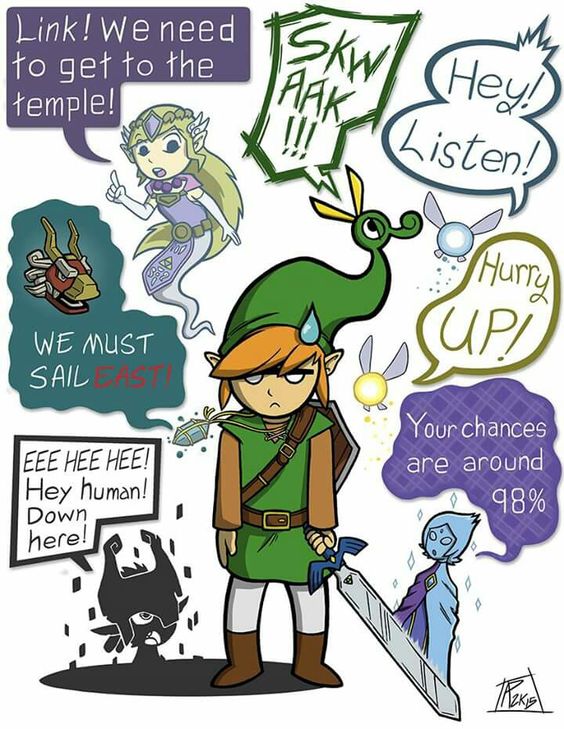
There are many approaches to guiding the player. The Legend of Zelda series often gives Link companions, as seen in the picture above. (I wanted to attribute it, but couldn’t find the artist.) These range from the traditional (a fairy) to the bizarre (a talking hat). These partners give Link advice on where to go and what to do next, guiding the player toward the game’s intended objectives.

This approach works pretty well, but can become irritating as Link’s companions boss him around or spell out every little step of his journey. The latest Legend of Zelda game doesn’t seem to have a partner system, which should allow players to wander more freely.

Other systems for guiding the player include marking objectives on a map, offering text or audio cues, or structuring game environments to direct the player toward the next goal. Some games are straightforward enough not to offer any guidance: Tetris and Pac-Man are good examples.

When I pick up a new game, I’m always interested to see how it tells me what to do.

463. Goodbye, Beatrice

I’ve been reading about hell, and thinking of the girls I liked in my younger days. There’s a connection here, but… probably not the one you think.

In preparation for my story project, I’ve been rereading Dante’s Inferno, a centuries-old poem about a man who journeys through hell. The poem starts with Dante meeting the soul of Virgil, an ancient Roman poet. Virgil rescues Dante from a dark wood, giving him both good and bad news.

Inferno

Oh, hell.

The bad news is that they must pass through the nightmarish depths of hell. The good news is that Dante’s love, the dearly departed Beatrice, has interceded for him from heaven. After braving hell and purgatory, Dante will meet her there.

In the poem, Dante represents Beatrice as a savior: a lady of perfect beauty and saintly goodness. In real life, Dante apparently met Beatrice twice. He barely knew her as a person. Instead, he obsessed over her as an idea—a vision that had poetic power but was disconnected from reality.

Beatrice married another man, and died young. Dante obsessed over her memory for the rest of his life, thinking of her even after marrying another woman and having children. He himself acknowledged Beatrice as “the glorious lady of my mind,” a vision barely grounded in reality. In Dante’s mind, Beatrice was an angelic being of compassion and redemption.

Beatrice

To Dante, Beatrice was all clouds and halos.

It makes me wonder what Beatrice was like in real life. Did she think twice about Dante? Did she even read poetry? What were her favorite foods? Did she have a secret crush of her own?

Beatrice is a fascinating character in Dante’s work—a fictional character. She plays an invaluable role in Dante’s Divine Comedy, of which Inferno is the first part, but the role owes everything to Dante’s imagination and practically nothing to Beatrice herself. Dante’s Beatrice was an idea, not a person.

Like Dante, I’ve had secret crushes on gals I’ve known. Most of them are now happily married to other dudes, and good for them. I wish them the best.

It’s just hard to let go sometimes.

There’s one gal in particular—I’ll call her Socrates—who is rather like my own Beatrice. I could share more details, but won’t in case she ever reads my blog. How awkward would that be? (Answer: Soul-rendingly awkward.) I haven’t seen my old crush in years, but when I think of Dante’s Beatrice, I imagine her looking just like Socrates.

Penguin!

I won’t post a picture of Socrates, so please accept this photo of a penguin instead.

I’m a sentimental person. It’s hard for me not to treasure my memories of Socrates, and even to idealize them. She has become my own “glorious lady of my mind,” disconnected from the real Socrates. The real Socrates, wherever she is now, is a living person. She has her own likes and plans and interests. She has her own life. At this point, it isn’t romantic for me to idealize Socrates—it’s disrespectful, really. It makes for great poetry but lousy living.

I sometimes can’t help but wonder whether my life would be different if I had told Socrates that I liked her all those years ago. This can become just as disrespectful as idealizing her, and for the same reason. It replaces a person with an idea. I stop thinking of Socrates as an actual person, and think of her instead as a missed opportunity. It isn’t respectful, and it frankly isn’t healthy.

I’m still a stubbornly single dude. Even so, I figured that at some point I would grow up and stop having crushes on pretty girls. I haven’t. (Of course, I still watch cartoons and occasionally make faces in the mirror, so maybe I failed the whole growing-up thing.) At the moment, I’m letting go of another crush on another Beatrice. Like Socrates, she is also an actual person with her own life to live, and I need to respect that.

I live in a complicated world. It’s tempting to reduce human beings to trite, comforting ideas, but it isn’t right. People are people. They deserve to be respected as people, not reimagined according to my own romantic notions.

Dante wrote some great stuff, but I have to wonder whether he was happy. He was haunted by the memory of a girl he met twice. Is that any way to live?

My Beatrices have their own lives to live, and I have mine. I had better live it.

I’m now going to eat peppermint fudge and watch Steven Universe. Take that, Dante.

462. About Storytelling: Subverting Expectations

Not long ago, I began playing a little game titled Recettear: An Item’s Shop’s Tale, and promptly decided it may be the best thing in the universe.

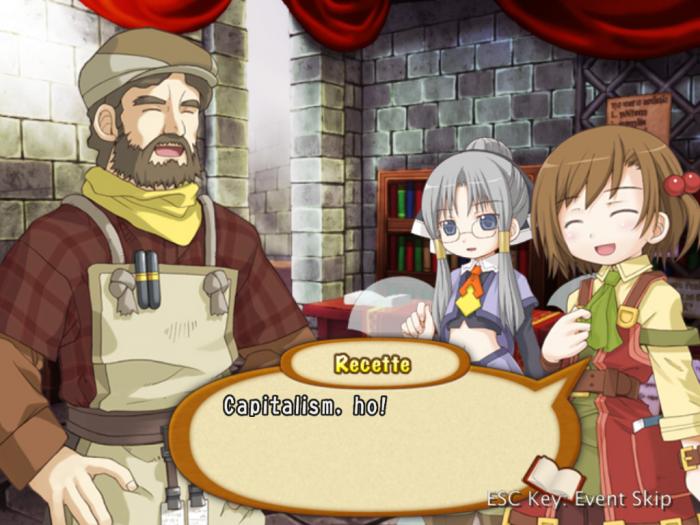
I exaggerate, but Recettear is delightful all the same. It’s set in a standard fantasy world of monsters, swords, and magic, with one important twist: the player doesn’t control an adventurer. The player controls a shopkeeper: a sweet, chipper girl named Recette who must pay off her absent father’s debts. Recette’s motto: “Capitalism, ho!”
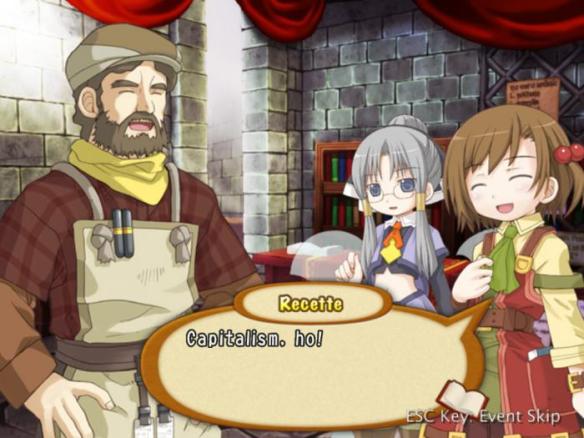
Capitalism, ho!

Capitalism has never been cuter.

Fantasy games have always had shops. They’re a ubiquitous feature in the manner of inns, dungeons, and bosses. Gamers accept them without thinking. Heck, off the top of my head, I can’t think of a single fantasy game that doesn’t have some kind of shop.

Recettear turns the cliché of the fantasy-game shop on its head. This time around, the player isn’t fighting to save the world—he’s fighting to make that next debt payment. A player can’t just waltz into dungeons; she must hire an adventurer to keep her safe while she searches for items to sell. Recettear shows the behind-the-scenes struggles of keeping a fantasy-game shop open for business, providing a twist on a well-worn trope.

Recettear: An Item Shop’s Tale represents a brilliant creative tactic: subverting expectations.

After a certain number of stories, we begin to see patterns. The good guys win. Things end badly for the villain. Depending on the story’s tone, either romance happens, or it doesn’t—either way, we can usually see it coming. If Sean Bean is in a movie, his character probably dies. We expect these things. We figure out that stories usually work a certain way.

It’s neat, then, when stories come along that work differently.

Consider, for example, how Disney’s Frozen handles the love-at-first-sight cliché. In many previous Disney films, the guy and the girl fall in love hilariously fast. I mean, seriously, the prince in Cinderella decides to marry the eponymous heroine before he even knows her name. They dance for one scene, and then he wants to get married. It’s actually kinda creepy.
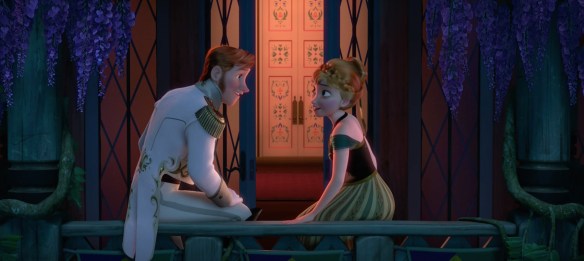
Love is an open door, I guess

Will you marry me? Oh, and what’s your name?

Frozen is different. (Spoilers ahead, in case anyone cares.) The movie sets up the love-at-first-sight cliché between Princess Anna and her crush, Prince Hans. Shortly after meeting, they decided to get married. I mean, they sing a cute song and everything. When they share the news, however, they’re met with incredulity and derision. “You can’t marry a man you just met,” declares Anna’s sister flatly. Later on in the film, Kristoff reacts in pretty much the same way.

When I watched Frozen, I wasn’t expecting the movie—a Disney movie about princesses, mind you—to mock the love-at-first-sight cliché. But it did. And it was refreshing, funny, and simply delightful to see.

Let’s look at a more literary example: Father Brown, the mystery-solving priest from the stories by G.K. Chesterton. Detectives in fiction are often marked by certain characteristics, which are best exemplified in Sherlock Holmes, the most famous detective of all: intelligence, logic, curiosity, emotional distance, and a strong sense of justice.

Father Brown subverts practically all of these.

Father Brown (alt)

He isn’t your garden-variety sleuth.

He’s a perfect foil to Sherlock Holmes—the Anti-Holmes, if you will. Holmes is tall, thin, emotionless, and just. His brilliance is painfully obvious. By contrast, Father Brown is short, stout, deeply empathetic, and merciful. His intelligence is belied by his humility and simpleminded manner. Holmes solves mysteries by careful reasoning; Father Brown solves them by common sense and an intuitive understanding of human nature. Holmes kills his greatest enemy; Father Brown redeems and befriends his own archnemesis.

Everyone expects Holmes to be brilliant. In a charming subversion, everyone dismisses Father Brown as a superstitious simpleton, which makes it all the more satisfying when he apologetically solves the mystery right under their noses. It’s another terrific subversion of audience expectations, and it makes for great reading.

We’ve all come to expect certain things from fiction. How exciting when fiction gives us things we don’t expect!

Mad Max: Fury Road Is Still Awesome

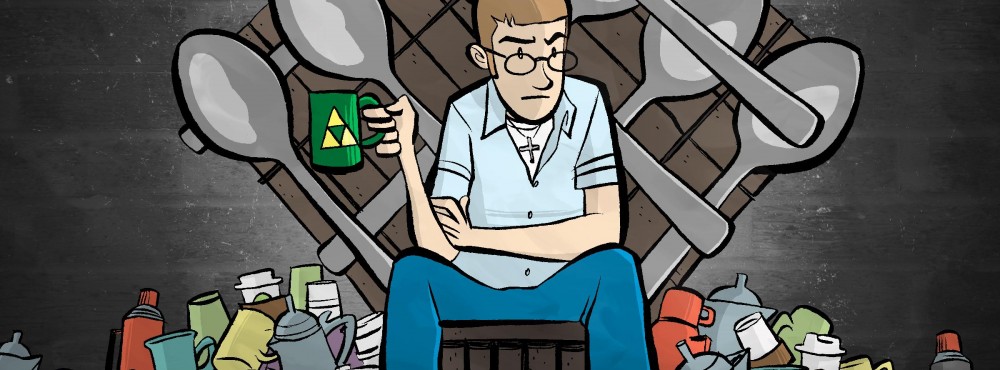
If you haven’t seen Mad Max: Fury Road yet, you should. It’s good. I mean, seriously, it’s really good. At any rate, it’s better than a film about spiky death cars has any right to be.

Why is the latest Mad Max considered a masterpiece? I’ve already written about it in a couple of blog posts, but I can boil it down to just a few points: narrative minimalism, sparse dialogue, practical effects, striking color saturation, flawless cinematography, and flame-spewing electric guitars. (Maybe not that last one.)

Seriously, though, the cinematography is superb. The film’s editing guides the audience’s eyes, tracing a clear path through the maelstrom of explosions, gunshots, dust clouds, and Tom Hardy’s scowls.

Incidentally, I still wonder whether the film’s villain, Immortan Joe, is secretly Donald Trump.

Immortan Trump

I’m thinking… probably.

It was a red-letter day when my brother and I trekked to our local movie theater to see this movie on a whim. Oh, what a day. What a lovely day!

461. Adam Does Dark Rock

Yeah, this song again. What can I say? I like it.

The band Disturbed produced a dark rock cover of “The Sound of Silence,” and when I stumbled upon a karaoke track for it, I took a stab at recording a cover of my own. My timing isn’t very consistent, and the key change partway through doesn’t sound great, but I’ve sung worse.

Toward the end of the track, there are prerecorded background vocals for a single line. I tried to mask them with vocals of my own, but they still sound out of place. Ah, well. I prefer the original version anyway.

Speaking of which, at some point my dad and I may sit down and record a cover closer to Simon & Garfunkel’s original, with a guitar and two voices. My cover above is either a warm-up or a consolation project, depending on whether we actually get around to recording.

I read somewhere that it’s best to record standing up, so I perched my microphone atop a stack of books to give it some height. The summer heat was fierce—I kept the door and window shut to keep out ambient noise—so I blasted my laptop with a cooling breeze from my fan at intervals to keep it from overheating. Thanks to the experience I picked up from my last recording session, this one was a lot easier despite the ungodly heat.

My dad snapped the photo in the video somewhere in Uruguay—Punta Colorada, I think, but I don’t remember for sure. I’m the silhouette on the right, gazing out over the gleaming sea, and probably thinking of sandwiches.

In other news, it is so flipping hot outside. In fact, looking out the window, I think I just saw one of the local geese burst into flame.

I’d better turn on that fan again.

460. Adam’s Story: The Premise

For anyone new to Adam’s story, here’s an introduction.

We begin with the basics today. The finer points of story planning really ought to wait until I’ve said a thing or two about my story’s fundamental premise.

Here we go.

Alone

Death! What a cheerful way to start a story.

Lance Eliot is dying, and he’s not terribly happy about it. Death is unexpectedly complicated. (Seriously, have you ever tried it? The legal paperwork is horrendous.) As he resignedly puts his affairs in order, Lance sits down to write a memoir of his adventures. He doesn’t expect anyone to believe it, but his story deserves to be told, and he’ll tell it if it’s the last thing he does… which it probably will be. Man, death is a nuisance.

This is his story.

Long before his death, Lance Eliot is a college student in the little town of Crossroads, Indiana. He’s eager to go home for Christmas break, but one thing stands in his way. He must confront a professor nicknamed the Skeleton—a gaunt, ill-tempered instructor of literary criticism—and plead for a passing grade in his class.

After a torturous discussion of Dante’s Inferno, Lance escapes the Skeleton, staggers to the nearest coffee shop, and buys a drink. Then, with no warning whatsoever, he disappears from Crossroads and reappears in a strange new world. Lance is lost and alone. Worst of all, when he vanished, he left behind his drink.

Spiritual coffee

Never mind Lance dying. Losing his coffee is the real tragedy here.

Lance eventually learns that he was transported to this unfamiliar world by an arcane power called aer… or as he puts it, “basically magic.” He’s now stranded in the kingdom of Guardia, a tropical nation tucked between two vast empires. Its society is antiquated, but not primitive; Lance later compares it to the Renaissance.

In some ways, Guadia seems too fantastical to be true. Aer, that mystical power, is channeled by a gifted few known as aerists. Stories abound of El Enthroned, the Greater God, and of his servants, the Twelve Seraphs. Dragons exist, apparently. Lance is skeptical, and not exactly pleased. “I’m stranded in a fantasy novel,” he grumbles. “Great.”

His mood only worsens when he learns why he was brought to Guardia. The kingdom stands upon the brink of annihilation. A young aerist, eager to help, tried to summon Lancelot, the legendary knight of Camelot… but got Lance Eliot instead. It’s hard to say who’s more upset: Lance Eliot, or the people who got him instead of the hero they wanted.

Now trapped in Guardia, Lance must face many trials to find a way home, and he’ll have to do it all without coffee. Even if he manages to get back to Crossroads, he’ll still have to face the Skeleton. Lance would frankly rather face the dragons.

Thus begins begins the story of Lance Eliot, which is also kind of my story. I did name this series of blog posts Adam’s Story for a reason, y’know. The next post in the series will probably focus on the setting or characters. We’ll see.

Thanks for reading!

The Force Is Strong with This One

The Force is strong with this one

Good gosh, do I ever miss Sam and his Obi-Wan impressions. He occasionally did other movie impressions, too.

Sam reclining

“Draw me like one of your French poodles.”

After spending many happy years with my family in Ecuador and Uruguay, Sam stayed in Uruguay with some dear friends. I have a cat now, and she’s all right, but I still miss the Sam-pup. Man’s best friend, indeed.

Sam curled up

459. That Time I Started a Church Ministry by Accident

Today’s story is a testimony, I suppose, but not mine. It’s the story of a pastor who founded a ministry, and of a congregation that supported it. My part in the story is actually very small. It’s kind of an anti-testimony, really.

Once upon a time, my laziness inspired the creation of a church ministry called Change the World. It gathers donations in the form of spare change and small bills, and then uses this money to support charity projects across the world.

At one point, when I was in college, I acquired about forty-five dollars in loose change. That’s a lot of coins, guys. Seriously, that’s like five flipping pounds of money, stuffed haphazardly into a sagging resealable bag.

Spare change

Spare change is kind of a nuisance, really.

This little fortune was more of a nuisance than a blessing. Where was I going to spend five pounds of change? I couldn’t use it at a store or restaurant—no sane server or salesclerk would accept a bag of coins. I was too lazy to put them in paper wrappers for deposit at the bank. How was I going to get rid of them?

In the end, I sheepishly handed over the bag of change to my pastor. In my defense, I was transparent about my own laziness. Giving the money to my church was the easiest option; I didn’t pretend otherwise.

My pastor—I’ll call him Socrates—accepted the coins, apparently unfazed by my laziness and ineptitude at being a capable adult. Instead, he realized how much spare change people tend to have scattered around, and decided to redeem it for the kingdom of heaven.

Together with the church’s leadership team, Socrates founded Change the World, which redirects donations of loose change toward a new charitable project every month. A number of church members supported the project enthusiastically. It continues to this day.

In college, I served that church in a number of capacities, from mowing its lawn to running its soundboard to whacking bongo drums during its worship services. I find it hilarious that my only enduring impact on that church was not only completely accidental, but openly lazy.

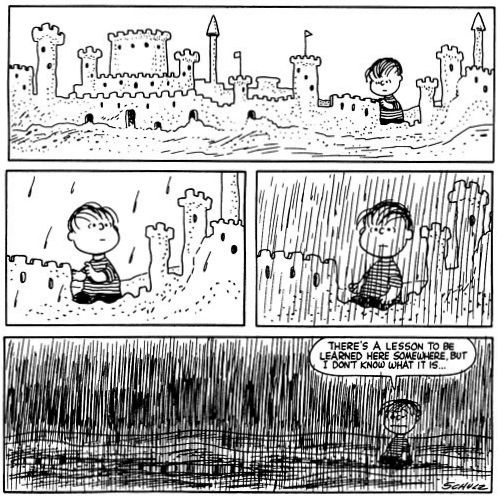
As Linus from the Peanuts comic once put it, “There’s a lesson to be learned here somewhere, but I don’t know what it is.”

A lesson here somewhere

Peanuts by Charles Schulz.

My accidental involvement in the Change the World project reminds me of a story from the book of Numbers. It’s the tale of the wicked prophet Balaam, who was sharply criticized by a donkey. (It’s a funny story.) That donkey probably wasn’t planning to get involved in the work of God, but then neither was I.

My legacy of laziness endures to this day. I hope it has done the world a little good.

Welp, I’m going to take a nap or something.

458. The Initial Stage of Writing: 5 Ways to Improve Your Skills

Today’s post was written by Alyssa Johnson, a blogger and freelance writer who stands by this credo: “No matter who you are, no matter what you did, no matter where you’ve come from, you can always change, become a better version of yourself.” You can find more from Alyssa here!

Guest post image

Firstly, it should be noted that strong writing skills come only from practice. Nobody is born as a great writer so it will take time to advance your skills in writing. We all have different reasons to start thinking about improving our writing skills. It can be related to your work or business, your classes in university or just your self-confidence.

Writing is an inseparable part of our lives! You can see this through your everyday doings: sending emails to friends or relatives, responding to official business letters, leaving notes on the mirror for a loved one or just writing papers for university classes.

So here are five simple and fun ways to become a well-skilled writer:

5. Your own space is your comfort zone

It’s easy to understand: the place where you write should be within your comfort zone! Just find it! And be sure that everyone you know has such a piece of paradise where she or he feels safe. For some people, it’s a quiet and clean spot, while others need music or a TV playing in the background. The first step is finding a cozy corner where you can put your thoughts on paper.

4. Find your muse

We all know that “Muse” is a specific source of admiration that inspires writers to create their masterpieces. Even the ancient Greeks told us the “Muse” could have different forms and definitions. The writer can find it in his daily life, in the world full of inspiration—cafes with dozens of people, trains coming and going every minute in the subway, and even reading a newsfeed on Instagram can bring a wonderful idea. You have to be prepared  to see all the small details around you. Don’t miss your own “Muse”!

3. Just pick a topic

You should start practicing every day to turn writing into a habit. It means that writing becomes natural and even something you look forward to. This gives a rise for such questions as “Where can I take a topic?” The answer you may know—write about things you do, things you hear or see, even about your cat’s favorite spot. You will never create exciting stories if you never try.

2. Your friend is your best editor

Why do we need friends? Of course, to have a look at our writing! Just kidding! Our friends are those who can sit for hours listening to mistakes we have made. Is it any different to put our thoughts on paper and give it to them to read? Having another set of eyes makes finding errors which you missed easier.

1. Online help

We live in the age of the Internet. Anytime, anywhere and anything you want you can find on the web, so it can be very useful for those who want to improve their writing. A lot of people use the Internet in search of information. Businessmen try to find samples of official email letters, students research college essays or even housewives share their recipes for apple pies on forums. For many writers, the biggest problem is grammar. So don’t be afraid to use online grammar tools to help you answer grammar questions when they come up!  Additionally, there are a lot of forums and blogs for writers where you can find a soul mate or real professional to discuss issues.