A Collection of Fabulous Video Game Mustaches

Stache Stash

Clockwise, beginning at the top right: Yang (Final Fantasy), Mario (Super Mario Bros.), Dr. Eggman (Sonic the Hedgehog), Dr. Wily (Mega Man), Wario (Super Mario Bros.), Naked Snake (Metal Gear Solid), Don Paolo (Professor Layton) and Marvin Grossberg (Ace Attorney).

This is a collection of magnificent video game mustaches: a stache stash, if you will. Which is best? My money is on Mario’s mustache. It lacks the extravagant flair and staggering size of the competition, yet it boasts an understated charm.


This post was originally published on May 8, 2013. TMTF shall return with new content on April 20, 2015!

The Mark of Cain

A Short Story

I first saw Cain Adamson when I was eight years old. He wore a dirty overcoat over jeans and a hideous Christmas sweater. (I think he must have rescued it from a dumpster somewhere.) His clothes were shaded by an enormous hat. As he trundled a wheelbarrow along the old train tracks behind my house, he looked like any other vagrant.

One detail made him stand out, however—Cain was young. Most of the hobos who drifted past my house were grizzled old men. Even at the innocent age of eight, I could tell at a glance that the world had not been kind to them. They were lost, adrift in a cold, hungry world, and their faces showed it.

Cain looked like a man in his twenties. He looked, in fact, like someone impersonating a hobo for a stage play. His costume was perfect, from the muddy coat to the hat fluttering in the breeze. (I expected the wind to snatch it off his head and send it sailing into the sky like a paraglider.) Cain had a convincing prop in the form of his wheelbarrow, which was speckled in rust and covered with an old blanket.

Even the stage was ideal. My house stood on the outskirts of my little Indiana town, and not ten feet past my backyard ran an old set of train tracks. A line of trees lay beyond the tracks, and a cornfield beyond that. Those old tracks were the hobos’ highway: easy to navigate, somewhat sheltered from the wind, and out of sight of the police.

The costume, prop, and stage were flawless. The only problem was with the actor. Cain didn’t make a believable vagrant. He walked with a sense of purpose and urgency that none of his aimless contemporaries shared.

I saw him from my bedroom window, and watched him until he and his wheelbarrow passed out of sight. He made quite an impression on my young mind. My imagination suggested ten thousand stories for this mysterious wanderer. Could he be an undercover detective, or a criminal on the run? Was he a disinherited prince (unlikely in Indiana, but still exciting) or foreign spy?

Imagine, then, my wonder when he walked along those very tracks, going in the same direction, three years later, and again two years after that. His clothes had changed—he wore a beanie cap and leather jacket instead of the hat and overcoat—but I recognized him instantly.

Years passed as steadily as the traffic of vagrants along the tracks behind my house. I drifted from junior high to high school to college. At the weary age of twenty-one, I returned home from college one spring to visit my parents over a long weekend. It was then, as I sat on my back porch drinking coffee early in the morning, that I saw a familiar figure plodding through the mist along the tracks.

Cain had a new wheelbarrow—well, a less ancient wheelbarrow. It was newer than his old one, yet probably older than I. He wore a duster over a bathrobe (which looked exactly as ridiculous as it sounds) and a sweatshirt with slacks, and a cloth cap. As he passed my yard, I stared at his face. It hadn’t changed a bit.

To this moment, I’m not sure what came over me. It was unreal to glimpse this apparition from my childhood, and I suppose I didn’t want him to vanish again until I had found some answers. I set down my coffee, leaped off my porch, and ran out to the tracks to meet Cain Adamson.

“Good morning,” I said.

He looked me up and down. “You smell like coffee,” he said. His voice was as young as his face. “Spare a cup for an old man?”

I returned his searching glance. “Sure,” I replied. “You don’t seem dangerous—or old, come to that. Come on over to my porch, and I’ll get you some breakfast.”

Cain touched the brim of his cap. “I’ll stay just a few minutes,” he said.

“You’re welcome to stay all day.”

“A few minutes,” he repeated. “That’s all I can spare.”

“Well, excuse me,” I scoffed. “I didn’t realize you had such a full schedule, Mr.…?”

“Adamson. Cain Adamson.”

“Well, Mr. Cain Adamson, if you’ll deign to give me a few minutes of your valuable time, I’ll set you up with a bagel and some coffee.”

Cain parked his wheelbarrow in the grass next to my porch. I brought out a bagel, an extra cup, and the coffeepot. “Milk or sugar?” I asked.

“Surprise me,” said Cain, and then sank his teeth into the bagel.

“You’re welcome,” I said. I sat down and motioned to the other porch chair. “Have a seat, Mr. Adamson.”

“I can’t,” he mumbled through a mouthful of bagel.

I felt a touch of annoyance. “Have it your way, then: standing room only. At the very least, will you take off your cap?”

My guest shook his head, and I gave it up.

The sun was beginning to shine through the line of trees across the tracks from my house. Its beams stabbed the mist and crept across the wet grass toward Cain’s wheelbarrow.

“What have you got in there?” I asked.

Cain dusted bagel crumbs from his duster. “See for yourself. May I have another?”

After fetching more bagels, I stepped off the porch and grabbed the blanket covering the wheelbarrow. “Are you sure?” I asked.

Cain shrugged.

I yanked off the blanket. The wheelbarrow contained an incredible jumble of books, jewelry, pictures, and miscellaneous junk, with a sword for good measure.

“Where’d you get this?” I asked, picking up the blade. It was one of the Japanese weapons called katanas—elegant, curved swords used by samurai.

“That old thing?” said Cain with visible pride. “That’s one of Miyamoto Musashi’s swords.”

“Nice try,” I said, smiling, “but there’s no way. Musashi is a legend. This is a nice old sword, but it’s not Musashi’s.”

“It is,” insisted Cain. “He gave it to me.”

It was then I realized Cain must be mentally unbalanced. Many vagrants are.

“Musashi lived hundreds of years ago,” I said. “He lived in Japan. That’s a long way from here.”

“It was 1644,” said Cain.

I stared at him as he selected another bagel. “I bumped into Musashi-san in a cave called Reigandō. Lovely place. Pity I couldn’t stay long. He gave me one of his swords and told me there was honor in wandering, the poor deluded fool.”

I was sure the only deluded fool in the whole business was Cain, but put back the sword without comment. He was clearly out of his mind, and I felt a little resentful that the wanderer from my childhood was nothing more than a crazy hobo. Cain had lost his mystique. Disappointed, I sifted through his treasures in the hope of finding something more interesting than their owner.

“What’s this?” I asked, flipping through a book. “The Rime of the Ancient Mariner. Whose autograph is that in the front? Who is—” I paused, squinting at the signature. “—Stephen Wright? I’ve never heard of him.”

“He’s the Ancient Mariner,” said Cain.

I chuckled bitterly. “Of course he is. Cain, The Rime of the Ancient Mariner was written centuries ago. Your edition of the book was printed in 1984. Even if the Mariner had been a real person, which he wasn’t, he would have died ages ago.”

“You haven’t actually read the poem, have you?” asked Cain. “As penance for his sin, the Mariner is cursed to wander the world and tell his story. He’s still wandering, waiting for the Final Judgment.”

I tossed the book back into the wheelbarrow.

“Careful!” said Cain. “That’s my only copy.”

“Where did you meet the Mariner?” I asked sardonically. “Neverland?”

“I met him in Ecuador last year,” replied Cain. “We bumped into each other in a park in Quito—that’s in the Andes Mountains, in case you didn’t know—and kept each other company till we reached Guayaquil on the coast. The book was a parting gift.”

“So you’ve been wandering for hundreds of years,” I concluded, and laughed. “You’re looking pretty good for your age, Cain.”

My guest frowned.

“Have you met many other old wanderers?” I persisted. “I’m guessing Stephen Wright wasn’t exactly a young man—he’s called the Ancient Mariner, after all.”

“I know you’re making fun of me,” said Cain. “For God’s sake, I’m not an idiot. Oh, don’t worry,” he added as I lost my grin, “I’m used to it. At least you’re feeding me. A bit of light mockery is a small price to pay for bagels.”

“I’m sorry,” I said. “I recognized you from when I was a kid, and I was hoping you were, I don’t know, a spy or an exiled prince or something. You’re just a man, and I was taking out my disappointment on you. I was sure you were someone special—I mean, you haven’t changed a bit in all these years!”

Cain Adamson took a long, contemplative drink of coffee. “I’ve changed a lot,” he murmured. “You just can’t see it.” He took a bite out of his bagel and continued, chewing, “To answer your earlier question, I’ve met a few immortals in my time. There was the Ancient Mariner of course, and the Wandering Jew, and Odysseus.”

“I’ve heard of the Wandering Jew,” I said. “He was cursed to wander forever after mocking Christ on his way to the Crucifixion. Odysseus is another story. He made it safely home to his family. I know it—I’ve read The Odyssey.”

“But have you read Dante’s Inferno?” inquired Cain. “Dante missed a few details, but he got two things right: Odysseus abandoned his home and family for more adventures, and his travels didn’t end well. What Dante never learned was that Odysseus was cursed to wander the earth till its end for his unfaithfulness to his family.”

The sun had risen higher, and the mist was clearing. For a few minutes, Cain and I sat in silence. I drank more coffee. He quietly finished off the last bagel.

“I’m seeing a pattern here,” I said at last. “Your imaginary friends are cursed to wander the world for all time.”

“I wish we were imaginary,” said Cain, and took a final swig of coffee. “Better not to have been born than to spend thousands of years walking back and forth, never stopping for more than a meal or a night’s rest, driven onward by the curse of God! We all deserve it. That doesn’t make it any less hellish. Ah, well,” he sighed. “At least I have my souvenirs.”

I glanced at his rusty wheelbarrow and its jumble of rubbish.

“I’ve been collecting for millennia,” said Cain. “Of course, I’ve thrown away most of it. Gathering souvenirs is hard when all you’ve got is a wheelbarrow! Still, it’s quite a collection. I’ve got a gold piece from Rumiñawi’s lost treasure, and Amelia Earhart’s compass, and an autographed picture of Morgan Freeman. None of it matters, but everyone needs a hobby.”

I stared at him as he rose from his chair, adjusted his duster over his bathrobe—it still looked ridiculous—and moseyed from the porch to his wheelbarrow.

“Goodbye, Cain,” I said. “One last thing before you go. I don’t believe your tall tales of immortal wanderers, but that doesn’t mean I’m not interested. What’s your story? How did you end up cursed to wander forever?”

Cain covered his wheelbarrow with its blanket, and then turned to me. “I killed a man,” he said. “Thanks for breakfast,” he added, and lifted his cap in gratitude. For an instant, I saw an ugly mark on his forehead before it was covered again by the dirty cap.

Cain Adamson trundled his wheelbarrow away from my yard, followed the train tracks, and passed out of my life back into legend.


Author’s Note:

Eternal wanderers are an intriguing literary motif. As far back as the book of Genesis in the Bible, people are forced to wander as punishment for their sins. I couldn’t help but notice the way this trope appears throughout literary history, from the Wandering Jew to the unlucky protagonist of The Rime of the Ancient Mariner. (“Yes, I’ve read a poem. Try not to faint.”)

The motif of the cursed wanderer begged a question: What if these stories were all true? What if the earth were full of cursed sinners wandering until doomsday? Would they know each other? Would they form a club? How would they cope?

My original intention was to write a novel, perhaps titled Professional Wanderers, with the Wandering Jew as the protagonist and Cain as the villain. In the end, not having the time, I settled for this short story. I like the idea, though. Maybe, when I’m between jobs, I’ll expand this short story into a book… once I write The Eliot Papers and that detective novel, of course.

(I need more time to write.)

This short story was written as a backer reward for a donor to TMTF’s charity fundraiser. My thanks to that gentleman for allowing me to share the story here on the blog!
350. Your Questions Are Answered!

A couple of weeks ago, I invited my dear readers to ask me anything. Today I answer those questions, and conclude by making an announcement about this blog.

Here we go!


Kristi asks: Since choosing to not continue with the books following the one you published, have you regretted or reconsidered that decision? Do you continue to write in that world, even if you have no plans for publication?

The unfinished tale of Lance Eliot is near and dear to my heart, yet I’ve neither regretted nor reconsidered my decision to let it go. The first novel was a commercial disaster, I didn’t have time to continue writing fiction, and Lance Eliot’s story was exhausting me. I believe it was right for me to set it aside.

Someday, if I have the time, I may try again. I would like to rework the first novel, The Trials of Lance Eliot, and then write its two sequels at my own pace. Then, with all three novels completely finished, I could focus on getting them published.

In this chapter of my life, I already feel overwhelmed by work, blogging, and other commitments. In order to write The Eliot Papers, I would have have to stop working or blogging… and I doubt I’ll be quitting either of those any time soon!


ferrettt55 asks: I’ve kind of been wondering why you wrote your book under the name M.L. Brown. Any particular reason? A story behind it, perhaps?

I had two reasons for using a pen name. The first is that I liked the idea of being an anonymous success: a literary superhero with a secret identity. (In retrospect, this was a stupid reason.)

My other reason for calling myself M.L. Brown was to build a frame story around the tale of Lance Eliot. I wasn’t Adam Stück, the author of novels—no, I was M.L. Brown, the supposed “editor” of Lance Eliot’s “memoirs.” Brown was eventually going to appear as a minor character in the last book. (The author who called himself Lemony Snicket did something similar in A Series of Unfortunate Events.)

In the end, I regret not using my real name. It would have made marketing my novel much, much easier, and perhaps sold a few more copies.

Fun fact: The initials M.L. stand for Michael Lewis. In full, my pen name alluded to the archangel Michael, the author C.S. Lewis, and the detective Father Brown.


JK Riki asks: If you had unlimited resources (time, money, skill, whatever necessary) what is the one thing you would do that you’ve either always wanted to or felt called to do? (It can be a silly answer like “Eat a taco with both chicken AND beef” but I’m kind of plumbing for a deeper response here with some real meaning and thought. Your choice, though.)

If I had boundless time and money, I would first celebrate with pizza! I would then take a few weeks to plan my next steps, pray, and confer with trusted friends and relatives. In the end, I would probably move to a cozy apartment somewhere on America’s west coast, donate most of my money to churches and charities, and spend my time writing fiction, volunteering, blogging, and drinking too much coffee. (Some things never change.)

If I had limitless talents, I would probably become a professional author and an ambassador for a charitable organization or relief agency. I would also drink too much coffee, natch.


Socrates asks: Where are your monkeys from (and I DON’T mean Amazon.com)? I mean, where were they actually born (are any of them from, y’know, THE Amazon?), what schools did they attend, are any of them related (to each other, I mean), had you met any of them before finding them on the internet?

I didn’t know any of my typewriter monkeys before I purchased them from Amazon.com, but I’m pretty sure they have ties to criminal cartels, and at least two of my monkeys have spent time in Colombian prisons.

Listen, sometimes it’s best not to ask these kinds of questions.


Some Guy asks: Do you know anyone actually named Socrates? Have you seen Bill and Ted’s Excellent Adventure? It’s not that great of a film, but I am reminded of it whenever you refer to Socrates. What is the plural of Socrates? You play and review video games, but what are your favorite non-video games? I’m thinking board and card games, but other categories are fair too (tag, dodgeball, darts, etc.)

Sadly, I don’t know any Socrateses. (I’m guessing Socrateses is the plural of Socrates.) Socrates is my go-to pseudonym because I respect the ancient Greek philosopher, and also because I’m too lazy to come up with a new pseudonym every time I need one.

I’ve heard of Bill and Ted’s Excellent Adventure, but I haven’t seen it. Doctor Who has satisfied my desire to see someone travel through time in a phone box!

Confession: I… um… I don’t like non-video games. Competition stresses me out.

Mind you, I have absolutely nothing against sports or board games. In fact, I’ve played quite a lot of them: Monopoly, cards, bowling, Munchkin, darts, Sorry, checkers, Risk, fútbol (or soccer, if you want to be American about it), and badminton, among others. As much as I appreciate these games, I seldom enjoy competition. (Mario Kart is an exception, of course.) I prefer relaxing pastimes such as one-player video games, going for walks, and climbing trees.


Thomas Mark Zuniga asks: Do you have other awesome hats like the one depicted here? What is your hat-wearing to non-hat-wearing ratio? I’ve always been intrigued by hats and hat-people.

I’m honored to be called a hat-person.

When shopping or running errands, I generally wear my cherished cloth cap. I occasionally wear a fez at home, especially when watching Doctor Who or Gravity Falls, which are my reasons for owning a fez in the first place. (I have no regrets.) My other hats include a couple of beanies, a leather flat cap, a baseball cap, and a gaudy jester hat promoting Ecuador’s national fútbol team.

I once shared pictures of my hats in a post on this blog… which promptly received more views than nearly any two of my other posts combined. As a blogger, I was humiliated to be outperformed by a bunch of hats.


I would like to thank everyone who submitted a question for this Q&A! (Without you, this would have been a really short post.) I would also like to make a quick announcement about this blog.

TMTF will be taking a three-week break, returning with new posts on April 20. The blog will not go dark during the break; I’ll post an original short story on Monday, followed by old posts on the usual schedule (Monday, Wednesday, Friday) until TMTF resumes in a few weeks.

We’ll be back with new content on Monday, April 20. Thank you for reading!

349. TMTF’s Top Ten Video Games for People Who Don’t Play Video Games

Most of my dear readers aren’t really into video games. If you’re one of those readers, this post is for you!

Like most bloggers, I glance at my blog’s statistics from time to time. My blog host, WordPress, tracks views for each post on TMTF. I’ve noticed that posts about video games are among the least popular on this blog. This realization points to one logical course of action.

What’s that? I should stop writing blog posts about video games? Don’t be ridiculous! If my posts about games aren’t popular with my readers, there is clearly just one rational solution: I must encourage my readers to play more video games!

(Yes, I’m joking.)

Here are ten video games I recommend for anyone who doesn’t play video games. Most of these titles are easy for casual gamers to pick up and play, with a few must-play classics sprinkled in for good measure. These games—which represent a variety of genres and gaming generations—are upbeat, accessible, and fun to play.

The game is afoot, ladies and gentlemen, as TMTF presents…

The TMTF List of Top Ten Video Games for People Who Don’t Play Video Games!

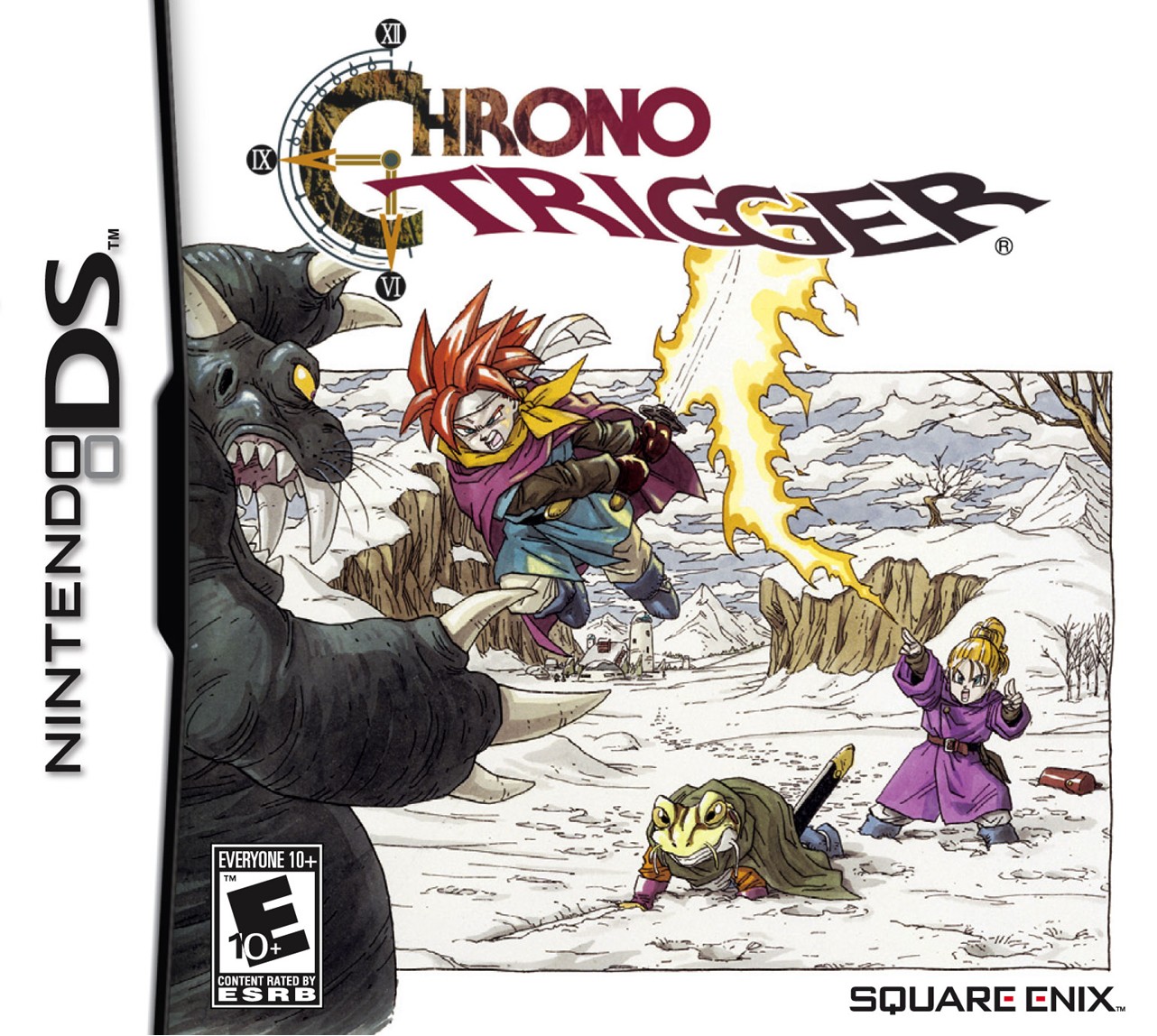
10. Chrono Trigger (Nintendo DS)

Chrono Trigger DSWe’re starting with a masterpiece, which is low on this list because it’s also a bit of a challenge for beginners. I tried to find a short, easy RPG (Role-Playing Game) for casual players, but the easy ones aren’t really worth playing. Chrono Trigger is a little complex, yet simpler than most classic RPGs—and dang if this isn’t a beautiful game.

Chrono Trigger is probably the best RPG I’ve ever played. It was revolutionary in its time, and it has aged well. The music, graphics, characters, and battle system are all superb. I recommend the Nintendo DS version above all others: the translation is vastly improved, a few handy features are added, the game can be played on the go, and it’s far easier to find than previous versions. If you play no other RPG in your lifetime, play this one!

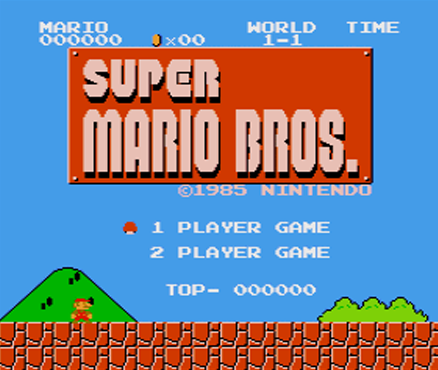
9. Super Mario Bros. (Nintendo 3DS/Wii U eShop)

Super Mario Bros.This is where it all began. Super Mario Bros. hearkens back to the early days of video games, when it launched Mario into his shining career as the most famous character in the industry. The game has aged brilliantly: after thirty years, it’s still tons of fun and pretty easy to play.

This is the world’s most recognizable platformer: an iconic iteration in the Jumping on Stuff genre of video games. Nearly all platformers that followed, including greats like the earlier Sonic the Hedgehog games, owed it all to this one. Super Mario Bros. isn’t merely a classic game. It is, unequivocally, the classic game.

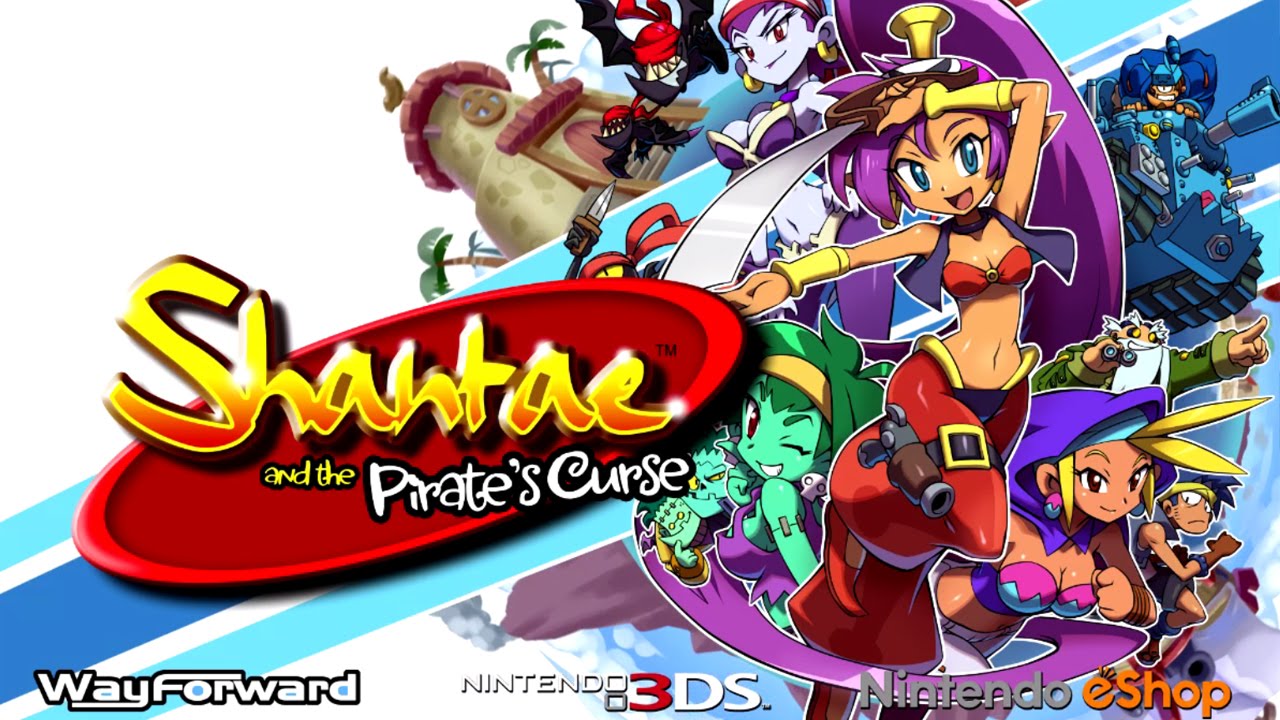
8. Shantae and the Pirate’s Curse (Nintendo 3DS/Wii U eShop)

Shantae and the Pirate's CurseShantae and the Pirate’s Curse is a short, sweet, funny introduction to the action-adventure genre: a blend of exploring, fighting, and puzzle-solving. Available on Nintendo’s eShop, the game offers all the retro-styled joy of classics like Metroid, Mega Man, and Cave Story without their nail-biting difficulty and frustration.

This game is superb: a love letter to the games of yore that adds an upbeat tone and zany style. Shantae and the Pirate’s Curse is relatively short, an advantage for casual players. I must also give it bonus points for being absolutely freaking adorable.

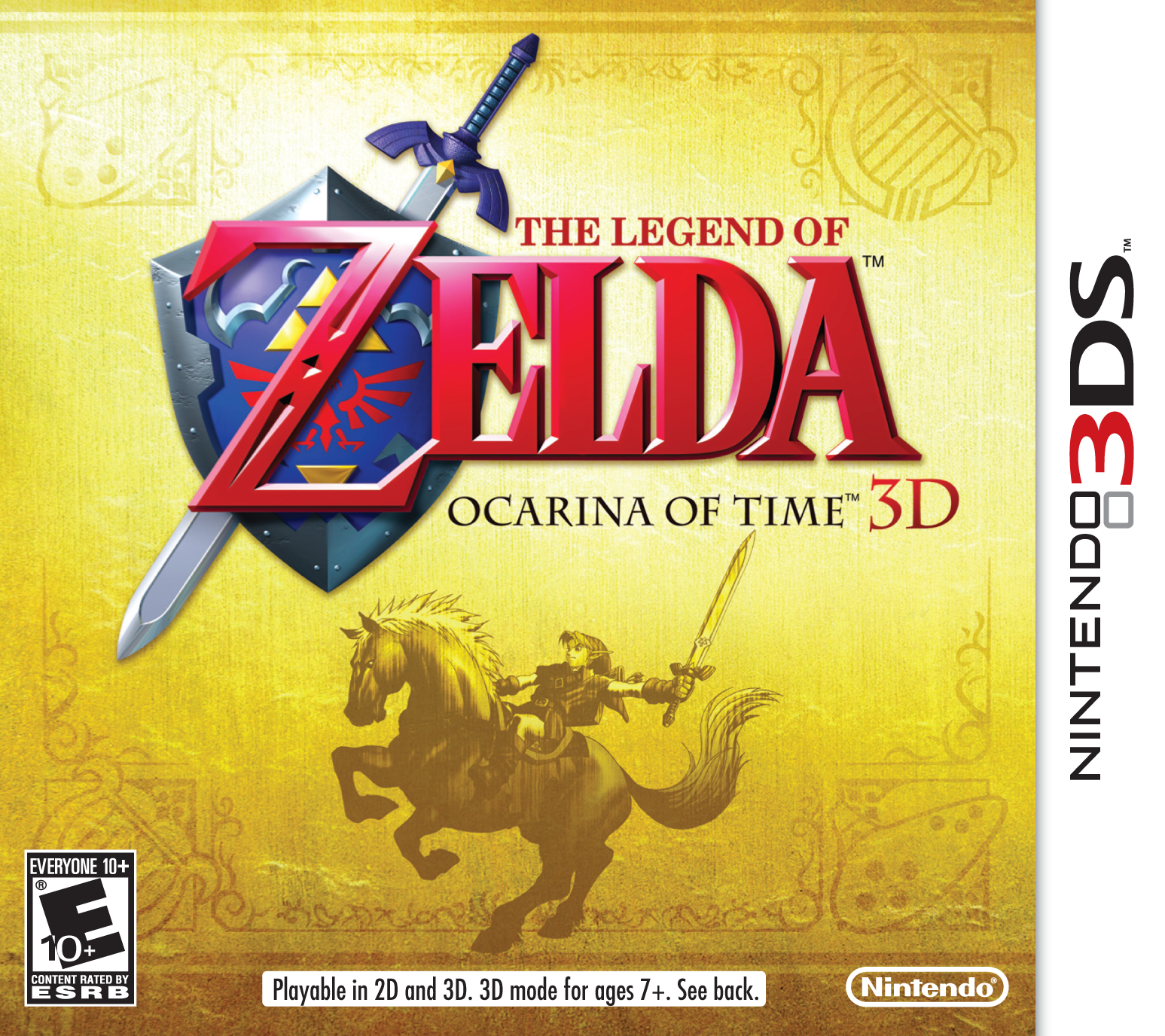
7. Ocarina of Time 3D (Nintendo 3DS)

Ocarina of Time 3DConsidered by many to be the greatest video game ever made, The Legend of Zelda: Ocarina of Time is the quintessential adventure game. I can hardly overstate its excellence. It defined both a genre and a generation.

The original version of Ocarina of Time shows its age, but the Nintendo 3DS version makes the game accessible by putting it on a mobile system with better graphics, redesigned menus, and an elegant hint system to help casual players. Even the Water Temple, a stage of infamous difficulty, has been streamlined. Ocarina of Time may be the world’s best video game, and this is certainly its best version.

6. Elite Beat Agents (Nintendo DS)

Elite Beat AgentsElite Beat Agents is pleasantly bonkers. Imagine someone putting a lot of popular songs (“September,” “Y.M.C.A.,” and “Material Girl,” among others) in a blender along with comic books, Japanese anime on VHS tapes, and disco fashion. This rhythm game is the result, inviting players to tap their way through more than a dozen absurd scenarios.

The premise of Elite Beat Agents is that a secret government agency assists desperate people through the inspirational power of song. It’s every bit as wacky as it sounds, and any player with a sense of rhythm (and a sense of humor) will probably enjoy it.

5. Portal (Microsoft Windows/Xbox 360/PlayStation 3)

PortalPortal puts players in the high-tech boots of Chell, a woman who wakes up in an abandoned research facility with only a deranged (and delightfully funny) computer for company. Chell must escape armed only with an Aperture Science Handheld Portal Device that opens interconnected gates in three dimensional space. (It’s cooler than it sounds.)

Portal is a puzzle game, and probably the best example I’ve seen of a video game as art. The portal concept seems complicated for the first few minutes, but quickly becomes intuitive as the game puts players through puzzles on a gentle difficulty curve. Portal is brilliant, funny, sophisticated, and conveniently short at just a few hours long. While its sequel, the legendary Portal 2, is the better game, Portal is the perfect place to start.

4. Mario Kart: Double Dash!! (Nintendo GameCube)

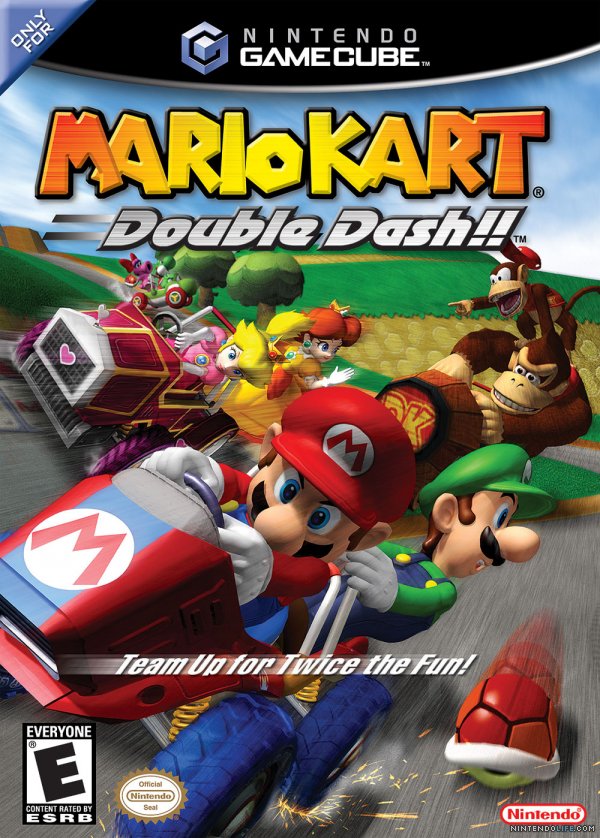
Mario Kart - Double Dash!!Mario Kart games are one part racing, one part warfare, and all parts fun. The games are all about beating competitors to the finish line… and also beating them with an assortment of damaging objects. Watch out for banana peels, explosives, and high-speed projectiles! Mario Kart games are a blast, sometimes literally.

Mario Kart: Double Dash!! is, in my humble opinion, the best of the bunch. The controls are straightforward and finely tuned. The racetracks are well-designed. Best of all, having two racers per go-kart allows for cooperation between players, not just competition. Newer players can pair up with more experienced ones.

3. Wii Sports (Wii)

Wii SportsThis is the ultimate casual game. All it requires is the ability to wave a controller that looks like a TV remote, and the willingness to look silly doing it. Wii Sports isn’t a deep game, but it doesn’t need to be. It offers fun, simple activities like golf and bowling. They won’t keep you hooked for hours, but they’re quite enjoyable in short sessions or with friends.

The real joy of Wii Sports is in getting up and moving. Motion controls are usually a cheap gimmick, but Wii Sports is one of the few games to use them really well. It may not be long or complex, but it’s an inviting place for casual gamers to start.

2. Phoenix Wright: Ace Attorney – Dual Destinies (Nintendo 3DS eShop)

Ace Attorney - Dual DestiniesWhen I first played an Ace Attorney game, I expected it to be dull—how could a video game about the legal profession be any fun at all? I was absolutely wrong. Ace Attorney is a series of interactive murder mysteries, with some courtroom drama and a ton of humor thrown in for good measure.

In the pretentiously-titled Phoenix Wright: Ace Attorney – Dual Destinies, the courts have entered a “dark age” in which suspicion and corruption run rampant. Wright and his team must defend their clients—including, in one memorable case, an innocent killer whale—as they unravel the mystery behind the dark age of the law. Dual Destinies is the best the Ace Attorney series has to offer, with polished mechanics and stellar storytelling. It’s also a great starting point for players new to the series, demanding no knowledge of previous games.

1. Professor Layton and the Last Specter (Nintendo DS)Professor Layton and the Last SpecterHave you ever picked up a book of puzzles—you know, a collection of mazes, word searches, riddles, math questions, brainteasers, and crosswords? The Professor Layton games are basically those puzzle books, but a thousand times more charming. They also feature tales of intrigue and mystery, all starring the top-hatted Hershel Layton.

Professor Layton and the Last Specter is the first chapter of Layton’s story, but not the first game in the series. By this point, the series has hit its stride. The puzzles are delightfully varied, the style is charming, and the Professor himself is a refreshingly polite, kindhearted alternative to more traditional video game heroes. For those who don’t play video games, I can offer no higher recommendation than the good Professor’s puzzles!

What casual games do you recommend? Let us know in the comments!

348. About Storytelling: Getting Drunk on Milk

In fiction, as in real life, bad things happen. When tragedy strikes, fictional characters sometimes try to drown their grief in alcohol.

We’ve all seen this in the movies. In one scene, a man loses his job or girlfriend; in the next, we find him drinking or drunk. It’s an age-old trope of storytelling. Heck, even I’ve used it. Lance Eliot, the protagonist in my novel, is quite a drinker.

What about stories for children? Here we have a problem. A story may need its characters to drink away their sorrows, but that sure ain’t appropriate for the kiddos! Storytellers, crafty creatures that they are, have discovered a family-friendly alternative to getting drunk on alcohol: getting drunk on nonalcoholic things, of course!

(In writing this blog post, I discovered this trope actually has a name: drunk on milk. Thanks, TV Tropes.)

Here are some examples of characters in family-friendly media drowning their sorrows in things that aren’t alcohol.

Tea (Toy Story)

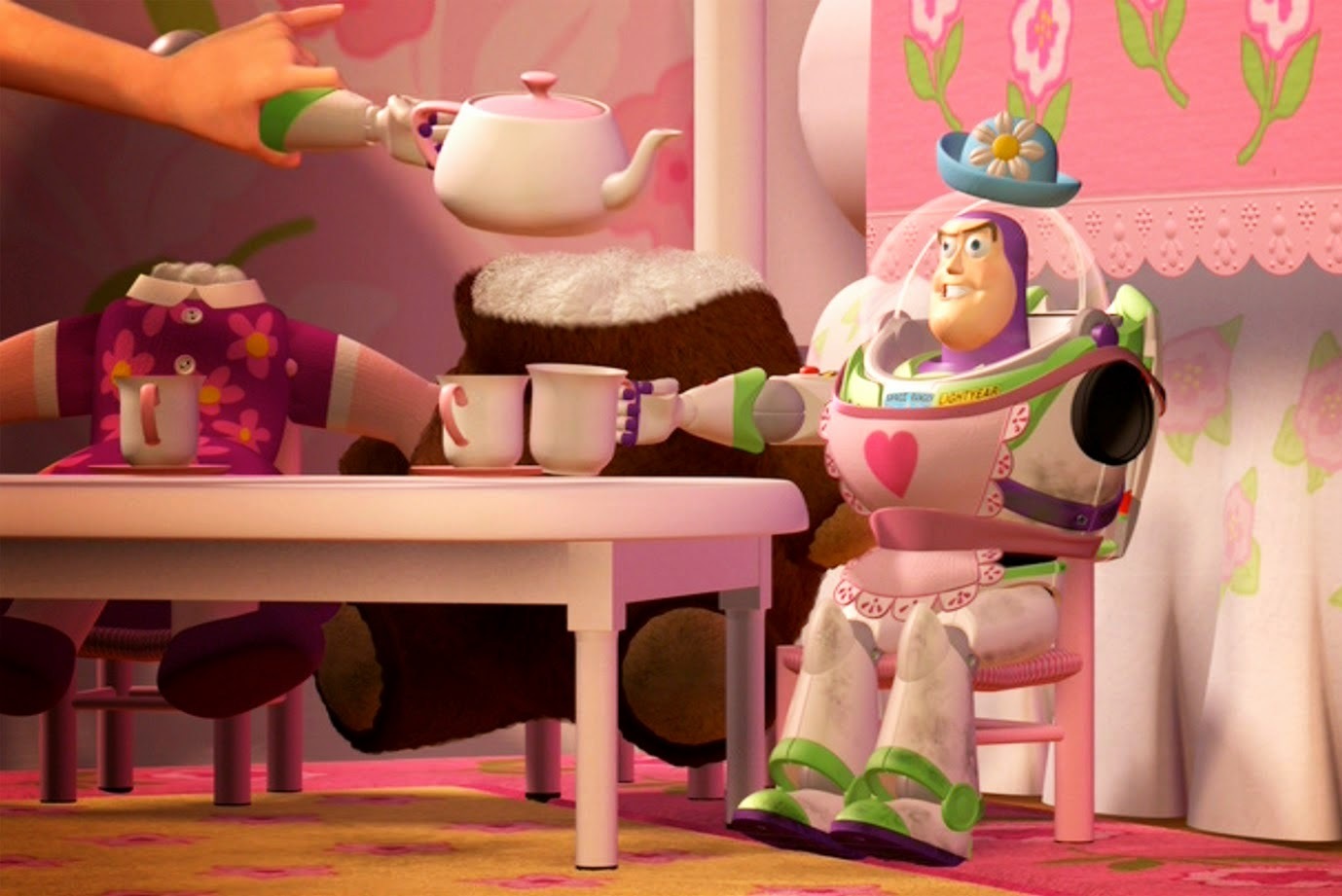
Tea drunkI’ve drunk Darjeeling tea before, and let me tell you: the stuff Buzz Lightyear drinks (or pretends to drink) in Toy Story is like no Darjeeling I’ve ever tasted. Whatever is in those teacups, Buzz gets buzzed. (Pun intended. I’m so, so sorry. By the way, in case one bad pun isn’t enough for you, “Buzz” is pronounced “booze” in a Hispanic accent.) Buzz’s, um, tea is strong enough that he doesn’t seem to mind being called “Mrs. Nesbitt,” which must be humiliating for an intergalactic hero. Darned Darjeeling!

Doughnuts (My Little Pony: Friendship Is Magic)

Drunk 'n' donutsA happy cartoon about magical rainbow ponies can’t show its characters consuming alcohol, despite the fact that one of its protagonists is apparently named after a hard liquor. The alternative? Doughnuts. When Spike the dragon is left behind by his pony pals, he hits the local doughnut shop—the name of which, I can only presume, is Drunk ’n’ Donuts. (Pun intended, but I’m not sorry for this one!) Spike may not get a hangover from his excesses, but I don’t envy him the inevitable sugar crash.

Ramen noodles (The Legend of Korra)

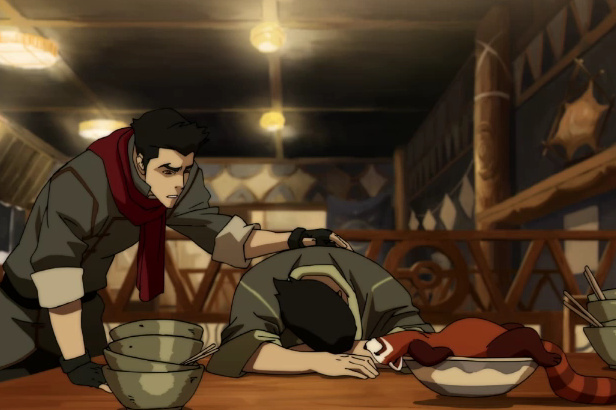
Bowls and BolinBolin—the young man passed out on the table in the picture above—deals with romantic rejection as heartbroken men do: by heading to the local ramen joint and eating too many bowls of noodles. This early scene from The Legend of Korra makes me chuckle; I’m especially amused by Bolin’s pet ferret lounging in an empty bowl. The Legend of Korra is a good show… I should catch up with it someday.

Milk (The Legend of Zelda: Majora’s Mask)

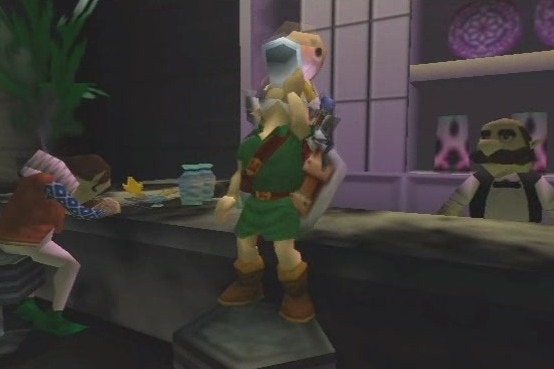
Milk drunkThe Legend of Zelda: Majora’s Mask is, without question, one of the greatest games I have ever played. It’s also one of the few to feature a milk bar. (Yes, I’ve seen a milk bar in more games than this one!) Open late at night, the milk bar caters exclusively to adults and offers both live entertainment and a variety of dairy drinks. I think the Shakespearean-looking gent in the picture above says it best: “Milk… It’s miiiilk… Can you get tipsy from something like milk?!? Hic!”

Ice cream (VeggieTales)

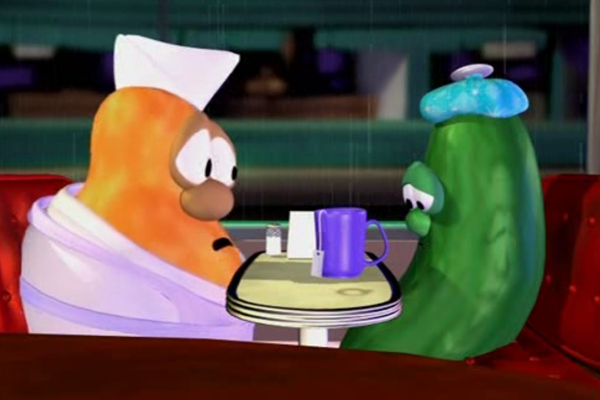
Ice cream drunkI’m digging deep into my childhood memories for this one. At one point, Larry the woebegone cucumber responds to bad news by eating too much ice cream at a diner. (VeggieTales is not just a kids’ show, but a Christian kids’ show, so they really had to keep it family-friendly!) In the picture above, Larry recovers with a warming cup of tea. Let’s hope it’s not Darjeeling.

Juice boxes (Jan Animation Studios)

Bar buddiesAll right, I’m kinda reaching here, but I suppose this short video counts. Bar Buddies, a brief animation from the brony community, has a kid getting wasted on juice boxes. Apple juice, apple cider, applejack—what’s the difference? They’re all made of apples, right? This one makes me laugh because of the disparity between the well-dressed, hard-drinking guy on the left and the silly kid on the right.

What’s drunk-on-milk scenarios did we miss? Let us know in the comments!

If Pixar Made a Video Game

I don’t plan to play this game, but dang if this isn’t the most entertaining video game trailer I’ve ever seen.

After a brief, faux-propaganda introduction, the trailer for Overwatch shifts to a style more like Pixar or Disney: let us say, The Incredibles meets Big Hero 6. There’s a gorilla wearing glasses, a sprightly gunslinger, a couple of brave kids, and (of course) some explosions. I really enjoyed this trailer.

The video game industry is full of games with guns. (These games are widely known as shooters.) They’re nearly always gritty and gory. Some of them are actually quite good, yet their unrelenting doom and gloom are depressing… and some of the people who play games with guns are just mean. Bullying is common among players of shooters.

It’s nice to see the developer of Overwatch, Blizzard, taking the games-with-guns genre in a brighter, friendlier direction.

Chris Metzen, a developer for Blizzard, shared a refreshingly positive philosophy for the game: “Is it even possible to build a shooter that doesn’t feel cynical, that doesn’t feel cruel, that doesn’t feel nasty? Can you build one that really promotes teamwork and relationship and having fun with your friends, and not getting killed with a thrown knife from halfway across the map as soon as you jump in?”

I hope it’s possible. Overwatch seems like a great step in the right direction. At any rate, I must give it bonus points for the gorilla.

347. Ask Me Anything!

My name is Adam, and I am a man of mystery. Majestic and silent as a mountain, I shroud my life in secrecy—but no more! The time has come, dear reader, for answers.

No one comprehends the mysteries behind this inscrutable face.

Who knows what secrets are concealed by this inscrutable man?

Yes, I’m being sarcastic. No, I’m not much of a mystery. I am, in fact, generally an open book. Far from being silent and enigmatic, I rant, ramble, and reminisce—in fact, I talk too much. (If you’ve followed this blog for more than five minutes, you’ve probably noticed.)

I may not be quiet or mysterious, but if any of my dear readers have questions, I’ll be happy to answer them!

As TMTF hits three hundred and fifty posts next week, it seems like a great opportunity for a blog Q&A—or as we Internet people call it, an AMA. (For the uninitiated: AMA stands for Ask Me Anything.)

From today, March 16, until Thursday, March 26, you may ask me anything! I will accept all kinds of questions by any means of communication: comments on this post, notes via the Contact page, emails, Twitter or Facebook messages, handwritten letters, or smoke signals. (Well, I may not respond to smoke signals.)

If you wish to submit a question anonymously, preface it with the following words: Socrates asks. For example: Socrates asks, What is the airspeed velocity of an unladen swallow?

On Friday, March 27, I will answer your questions, however many or few. Ask away!

346. Sandwiches

There comes a time in the life of every blogger when he must blog about sandwiches. That day has come. This, dear reader, is my destiny.

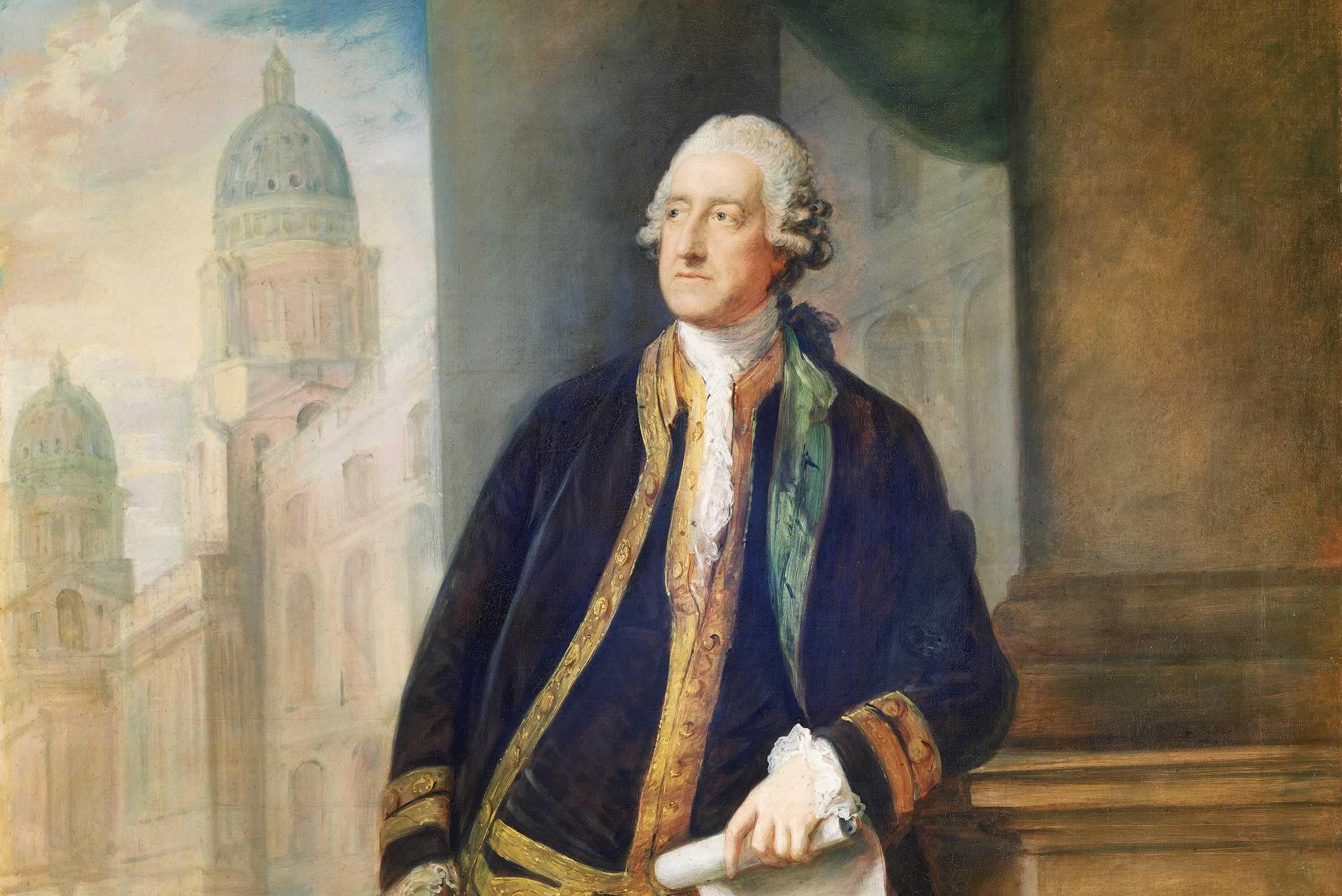
I consider sandwiches the crowning achievement of humankind, surpassing such modest inventions as the printing press, the steam engine, and the Internet. The sandwich was bestowed upon the human race by John Montagu, an eighteenth-century British statesman. Montagu was the fourth Earl of Sandwich, and possibly the greatest man of his millennium.

I salute you, Lord Montagu. Long may your name be remembered and your namesake be relished!

I salute you, Lord Montagu. Long may your name be remembered and your namesake relished!

As the story goes, the Earl of Sandwich wanted to eat while working without making a mess. (A popular version of the story suggests Montagu didn’t want meals to divert him from playing cards.) He asked his servants to bring him meat between pieces of bread so that he could eat without using silverware or getting his hands dirty. Montagu’s culinary triumph was eventually named after him, and the rest is history—shining, glorious history.

I have had the privilege and pleasure of sampling many sandwiches in my twenty-something years. (Heck, I ate a sandwich just an hour or two ago.) The possibilities are endless. There are hundreds of varieties of bread, and thousands of ingredients to mix and match. Whether you prefer a simple turkey and Swiss on whole wheat, a sweet honey and butter on white, a robust blend of meats and vegetables on an Italian sub, or any other of the millions of combinations out there, there is a sandwich for you.

My personal favorite is the chivito.

As it is written, "Man shall not live by bread alone." I'm certain this ancient Scripture refers specifically to this sandwich.

It is written, “Man shall not live by bread alone.” I’m pretty certain this ancient Scripture refers specifically to this sandwich.

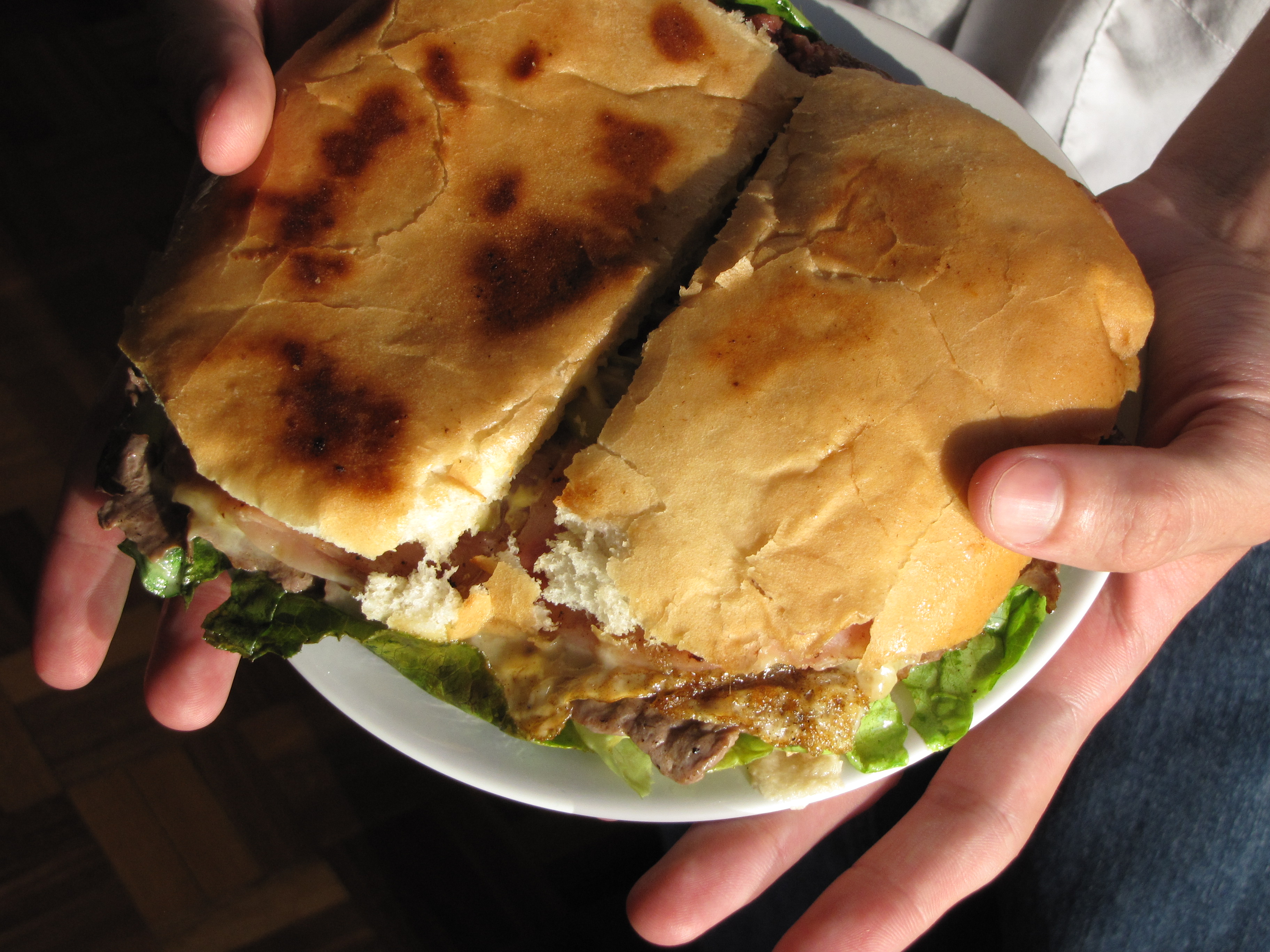
The chivito is a sandwich popular in Uruguay, where my parents live and work. In Spanish, the literal meaning of chivito is small male goat, which is a misnomer in the case of the sandwich: the Uruguayan chivito contains beef, eggs, lettuce, tomatoes, and occasionally mayonnaise, bacon, onions, peppers, olives, or cheese.

Chivitos are the best sandwiches I’ve ever tasted, and I spent three and a half years in college working part-time in a sandwich shop. I know sandwiches. The chivito is by far my favorite sandwich, and possibly my favorite food.

While visiting my parents in Montevideo, I dissected a chivito prior to eating it. For science.

While visiting my parents, I dissected this chivito prior to eating it. For science.

I haven’t tasted a chivito in years: my quiet corner of Indiana boasts no such exotic sandwiches. All the same, I continue to enjoy old favorites such as turkey and cheddar, peanut butter and jam, grilled cheese, and a variety of subs from local Subway restaurants.

Now if you’ll excuse me, I need a sandwich.