369. Review Roundup: Fairy Tale Edition

Once upon a time, in the faraway land of Indiana, Adam the blogger enjoyed a number of whimsical stories and contemporary fairy tales. Here are his impressions of three animated films, a video game, and an anime: Inside OutBraveBrother Bear, Ni No Kuni, and Monthly Girls’ Nozaki-kun.

These are the stories of a plucky princess, an Inuit tribesman, a brave little boy, a Japanese manga artist, and the personifications of a girl’s emotions. Do they live happily ever after?

Let’s find out.

Inside Out

Inside Out

Inside Out brought me closer to weeping openly in a movie theater than any other film has done. (Fortunately, I have a heart of stone, sparing myself and my younger brother the embarrassment of annoying our fellow theatergoers.) This is a brilliant movie, and I have literally nothing bad to say about it.

Pixar’s Inside Out pictures the human mind as a control room operated by five engineers, each representing an emotion: Joy, Sadness, Anger, Fear, and Disgust. In the mind of Riley, a girl from Minnesota, her emotions struggle to keep her happy as she moves with her parents to California. When an accident sends Joy and Sadness to the farthest reaches of Riley’s mind, these unlikely partners must make it back to the control center before Riley breaks down.

This film boasts the usual Pixar polish, with top-notch animation, writing, and performances. Beyond that, Inside Out is the first Pixar movie in years to feature a truly original concept. (Of the past four Pixar films, two were sequels, one was a prequel, and one had the style of a traditional fairy tale—more on that last one in just a bit.) The movie’s concept of the mind is creative, clever, and—importantly—consistent. The way the mind works in Inside Out isn’t hard to understand, and the film does a fine job of sticking to it.

As I hinted above, this is a film with emotional punch. Pixar has a gift for depicting emotion with heartfelt sincerity and simplicity: Carl’s irritable despondency in Up, the toys’ sense of loss in Toy Story 3, Mike’s resignation to his limitations in Monsters UniversityInside Out is quite literally a film about emotions, so you can bet it hits the viewer—at any rate, this viewer—with feels.

This is pretty much how I felt at the end of the film.

This is pretty much how I felt at the end of the film.

Inside Out is a fantastic film. Somewhere deep inside my mind, my sense of Joy is fiddling with whatever knobs and buttons affect my actions, willing me to recommend this film. Watch it. Your own sense of Joy will thank you.

Brave

Brave

Here’s another Pixar classic, this time telling the age-old story of a princess who falls in love with a prince and—what’s that? She doesn’t fall in love with a prince? Well, that’s different.

Brave is an original fairy tale. Set in Scotland, it tells the tale of a princess named Merida, who decides she doesn’t want to let her parents marry her off to any of the local chieftains’ sons. Merida tries to change her fate… and accidentally transforms her mother into a bear. Mother and daughter must shelve their pride, settle their differences, and somehow make things right.

The film’s independent, self-reliant heroine is a refreshing change of pace from the mild princesses of other fairy-tale movies, and I appreciate the way the Merida and her mother learn to understand, respect, and trust each other. Merida’s family is a colorful bunch. Even the chieftains and their sons, who could easily have been throwaway characters, have some personality.

As a Pixar movie, Brave doesn’t feel particularly, well, brave. It’s a fairy tale. Even with its feminist undertones and emphasis on family relationships, it treads a lot of familiar ground. It’s a fine film nevertheless, and I appreciate it as a deeper alternative to the princess-flavored romances Disney loves so much.

By the way, does the Scottish setting of Brave give anyone else flashbacks to How to Train Your Dragon? No? I guess it’s just me, then.

Brother Bear
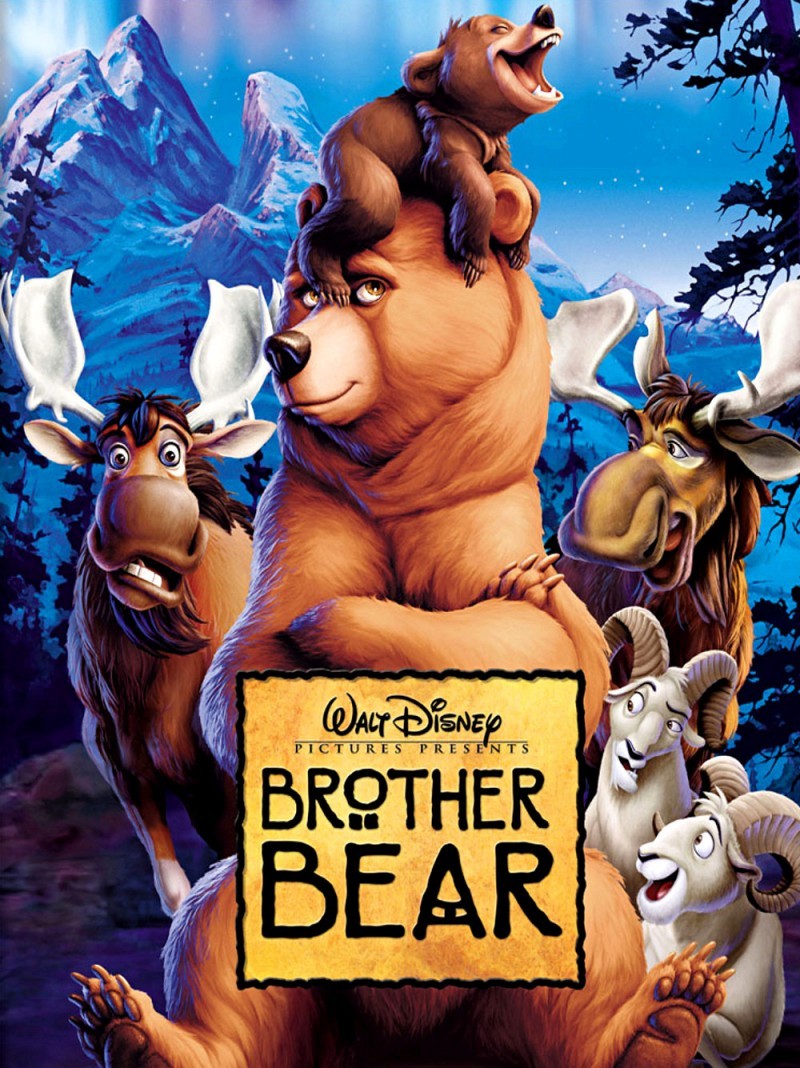
Brother Bear

Here’s another animated movie about people turning into bears. Why do people keep turning into bears? I just can’t bear it. (I’m so, so sorry.)

Brother Bear is a Disney animated film from the early two thousands: that nebulous stretch of Disney history whose movies nobody remembers. In the film, an Inuit tribesman named Kenai seeks revenge on a bear that killed a loved one, and is turned into a bear for his trouble. He must go on a quest, and learn the power of love, and—y’know, forget it. If you’ve ever seen a Disney film, you know where this is going.

This is not a bad movie. The Canadian wilderness is a great setting, and Inuit culture is largely unexplored in pop fiction. The acting, animation, and story were all perfectly adequate. I just couldn’t help feeling that this film didn’t really need to be made. Brother Bear is an uninspired blend of other Disney movies. Its plot borrows heavily from The Emperor’s New Groove: a man turned into an animal finds a buddy and goes on a trip to regain his (literal and figurative) humanity. The film’s music channels the soundtrack of Tarzan, down to a song from Phil Collins. It’s all been done before.

Brother Bear does have its moments. A couple of moose with heavy Canadian accents wander in and out of the movie, providing comic relief and stealing every scene in which they appear. The movie lacks a traditional villain, which is a refreshing change from Disney’s usual black-and-white morality.

In the end, however, Brother Bear is nothing special. I recommend The Emperor’s New Groove instead: pretty much the same story, but much funnier.

Ni No Kuni: Wrath of the White Witch

Ni No Kuni cover

Flipping heck, this game is amazing. I’ve already discussed the excellence of Ni No Kuni, so I’ll try not to ramble!

Ni No Kuni is a beautiful fairy tale. (It also happens to be a JRPG for the PlayStation 3.) It tells the story of Oliver, a little boy who sets out on a quest to save his mum. Accompanied by Drippy, the “Lord High Lord of the Fairies,” Oliver must mend broken hearts, defeat an evil jinn, and rescue a parallel world.

That world is one of the most charming and beautiful places I’ve seen in a video game. The look of Ni No Kuni was based on the work of the legendary Studio Ghibli, which handled the game’s animated cutscenes. This a lovely game. Apart from the cutscenes, which are nothing less than I expected of the Oscar-winning animation studio, the game itself is gorgeous.

I mean, look at it. Just look at it.

This is a gameplay screenshot, not an animated cutscene. This is what the game looks like. Ain't it pretty?

This is a gameplay screenshot. This is what the game looks like, more or less. Ain’t it pretty?

Ni No Kuni is visually appealing, but its excellence doesn’t stop there. The music, composed by renowned film composer Joe Hisaishi and performed by a live orchestra, is fantastic. Most importantly, the game is flipping fun to play.

The gameplay blends the fighting and adventuring of Final Fantasy games and the creature-catching of Pokémon. Oliver and his companions command familiars, adorable monsters that handle most of the fighting. Like Pokémon, familiars can be caught, trained, and metamorphosed into stronger creatures. Outside of battle, exploration is fun and sidequests abound.

Ni No Kuni even includes the full text of an original book, The Wizard’s Companion, which contains maps, spells, descriptions of familiars, old-fashioned illustrations, runes to decipher, and fairy tales. Yes, this fairy tale contains fairy tales of its own, and they’re delightful. In fact, The Wizard’s Companion is so good that I wish I owned a hard copy. As Oliver travels, he gathers the book’s scattered pages, unlocking more reading material.

Alas, Ni No Kuni is not quite perfect. It’s hard to read The Wizard’s Companion on a television screen, and flipping through its pages is a pain.

By far the biggest flaw of Ni No Kuni is its ending. Without spoiling anything, I must admit that it feels tacked on. The game reaches a satisfying conclusion, with Oliver reaching his goal and finishing his character arc… and then the game goes on for another four to six hours, limping doggedly to an anticlimax. Although the game’s final chapter answers some lingering questions, a little rewriting would have tied up those loose ends sooner, giving the game a stronger finish.

Despite its weak ending, this game is one of the finest I’ve ever played. RPGs aren’t for everyone, but for anyone with the patience, Ni No Kuni is a gem.

Monthly Girls’ Nozaki-kun
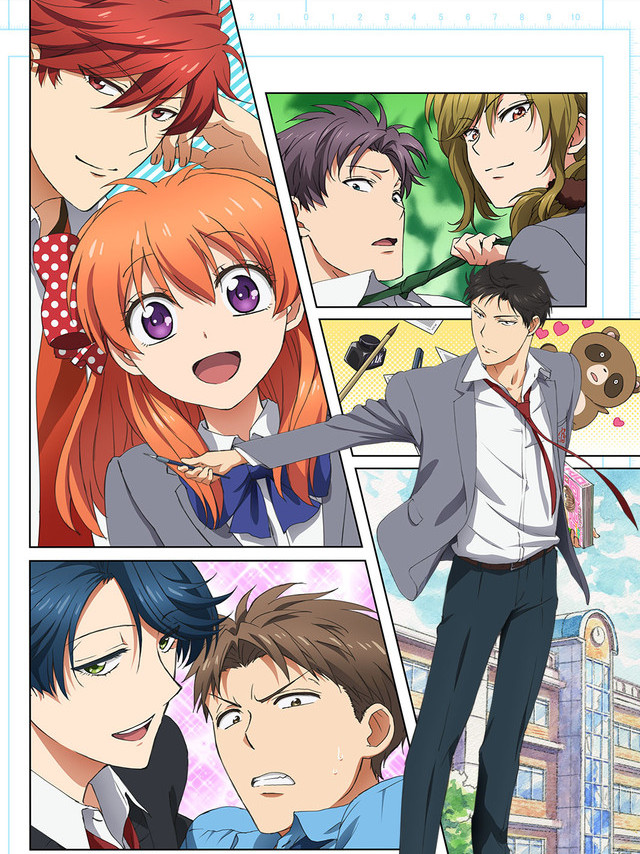
Monthly Girls' Nozaki-kun

I can’t decide whether Monthly Girls’ Nozaki-kun is a heartwarming parody or a self-aware romantic comedy. Either way, it’s brilliant.

In Japan, there is a genre of manga (comics) called shojo. This genre is aimed at teenage girls, generally focusing on romance and emotional characters. Monthly Girls’ Nozaki-kun is the story of a high school student named Sakura. When she tries to confess romantic feelings for Nozaki, one of her classmates, he mistakes her for a fan of his work. You see, Nozaki—an analytical, unromantic wet blanket—is secretly the writer and artist behind a popular shojo manga series, Let’s Fall in Love. When Nozaki invites Sakura to be his assistant, she agrees, hoping to get closer to him.

This twelve-episode series is a hilarious deconstruction of romantic comedies. The eponymous Nozaki-kun is intrigued by romance, but only from an academic point of view. For example, he loves St. Valentine’s Day, but only because observing romantic couples gives him ideas for his manga series. The thought of actually being romantic never crosses his mind. This makes for some delightful moments when Sakura is convinced he is finally falling in love with her… only to realize he’s testing out ideas for his manga.

For example, Nozaki realizes it’s romantic for a man and woman to share a bicycle, but he doesn’t understand why. He tests the scenario repeatedly with Sakura, eventually acquiring a tandem bike and riding down city streets with Sakura reluctantly in tow. Once he figures out the most romantic method for sharing a bike, he reasons, he can use it in his story for optimal effect.

Romantic, I guess

This is romantic, right? Right?!

As Sakura becomes acquainted with Nozaki and his other assistants, she realizes how much of his manga is based on people she knows. For example, the heroine of Let’s Fall in Love is based on Mikoshiba, a flirtatious male friend of Nozaki’s who is secretly very insecure.

Monthly Girls’ Nozaki-kun deconstructs rom-com clichés, yet the series is never bitter or mean-spirited. I was also pleasantly surprised by the show’s family-friendly tone. Japanese anime is notorious for its inappropriate content. As I began this anime about high school romance, I resigned myself to the saucy innuendos and panty shots that plague other series. Monthly Girls’ Nozaki-kun rises above cheap lewdness, keeping things at a PG level. I found the show’s innocence added to its charm, which is already considerable.

Like many anime, this one offers fascinating glimpses into Japanese culture. I was particularly interested by the creative process of writing and drawing manga, which is gradually shown in the series as Nozaki enlists more assistants.

I highly recommend Monthly Girls’ Nozaki-kun to anyone who likes anime or romantic comedies. I’m not a particular fan of either, yet I really enjoyed it.

What books, films, shows, or video games have you enjoyed lately? Let us know in the comments!

359. Rain

Rain was falling when I awoke a few days ago. I lay on my floor, tangled up in a sleeping bag and a light blanket, slipping in and out of consciousness, listening to the soft roar of the rain, and remembering.

The sound of the rain took me back to the jungles near Shell Mera, the town famous for Operation Auca and the brave men who lost their lives for the Gospel of Christ. When we lived in Ecuador, my family and I vacationed in a cabin with a corrugated metal roof. The rain thundered when it fell. I drank tea made from fresh hierba luisa leaves, lay in a hammock, and read a book or played a video game as rain beat the metal roof like a titanic drum.

Mangayacu cabin view

The view out of the cabin was beautiful, even when it was blurred by heavy rain.

A few days ago, as I lay listening to the rain, I recalled the rainstorms that hit my grandparents’ home in Florida. Once, after a heavy rain, I saw a rainbow rising from the yard next to the house where my family and I were staying. The rainbow disappeared when I got too close, but I was able to pinpoint more or less where it touched the earth. There was no pot of gold, but it was still exciting.

I was once privileged to visit the Galápagos Islands for my high school biology class. (Being a missionary kid has its perks!) As my classmates and I snorkeled in a rocky bay in a small island, a squall swept over us: driving sheets of warm rain that limited visibility to about fifteen or twenty feet. (It didn’t help that I wasn’t wearing my glasses at the time.) I treaded water, looking in all directions, seeing only water, hearing only the rain. It was one of the most magical moments of my life.

In Montevideo, where my parents now reside, rain is often preceded or followed by spectacular displays of lightning over the horizon. When the rain falls, it falls hard. I used to walk the dog in the rain—well, I used to try. My parents own a dachshund named Sam, known alternatively as Samwise, Samurai, or the Sam-pup. He doesn’t like getting wet, and he hates thunder. During my visits to Montevideo, I had to drag him outside by his leash when it rained. I loved the wet weather. The city blocks, lined with trees, seemed cleaner and lovelier when rain fell.

Rain washed away the grime of this dirty street and made it a corner of Eden.

Rain made this dirty street a corner of Eden.

A few days ago, I lay awake and listened to the rain: remembering, reminiscing, and—if I may borrow my younger brother’s word—nostalgifying. I love the sound of rain. No matter where I go, the gentle roar of rain never changes.

It reminds me of a line from the Kingdom Hearts games. (Although the story of these games is ridiculous, it has many moments of disarming pathos.) In a touching scene, a character raised near the ocean becomes stranded on a dark, deserted island. He has no hope of escape. There is only an empty beach, jagged outcrops of black stone, gloomy fog, and the soft swish of waves. It’s a bleak place, but the castaway finds a shred of comfort.

“At least the waves sound the same.”

A few things in my life have never changed. I love looking up at the stars. I joke that my childhood home is a particular video game, but it’s not really a joke: The Legend of Zelda: Ocarina of Time has been more of a constant in my life than any place on earth.

Then there’s the sound of rain. In all these years, and in all these places, it has never changed. As I recently lay awake, I found myself thinking, “At least the rain sounds the same.”

Rain reminds me of the immutability and faithfulness of God. It exists in a state of constant motion, yet it never changes. Rain is beautiful, and it comforts me.

At any rate, it’s better than snow.

356. princess rescuers r us

Today’s post was written by Matt Hill and originally published on Christian media website Hollywood Jesus. Matt brings something new to TMTF by discussing Ico (which I have not yet played) in free verse (which I never write). Matt is a musician, writer, and pop culture aficionado. You can read more of his free-verse pop-culture wanderings on Hollywood Jesus. (While you do that, I’ll think about playing Ico and its spiritual sequel, Shadow of the Colossus.)

me n my kids totally rescued a princess together yesterday . .
well, kind of . .

the princess was maybe not a real princess
and her name was yorda
and she was a character in this really great video game called *ico*
that originally came out for ps2 (and i played it then)
and then was re-released in hd for ps3 a while back (so i bought it recently)

and i suppose it wasn’t technically us who rescued her . .
it was our onscreen avatar named ico . .

and, if you want to be technical about it, my kids didn’t really
do any of the actual controlling of ico and so technically
didn’t rescue yorda themselves,
just through me – their real life avatar . .

and, technically, is yorda really rescued at the end of that game?

but, however, transition,
on a better/deeper/realer/more interesting level,
my kids and i *totally* completed that game together,
rescuing yorda together,
defeating the wicked queen together,
escaping the castle together,
walking that post-credits
serene and surreal
beach together at the
end
only to discover yorda had accompanied us even there (right?) . . . ….. .. . . .

they experienced what i did: the drama, the struggle, the tension, the
climax,
the resolution . .
they saw what i saw, thought through what i thought through,
asking questions, giving advice along the journey,
loving the adventure of it as i did (twice now) . .

by the end, they knew that escape was imminent (immanent?),
that the queen would soon have to get hers,
that when yorda speaks her final words (in another, untranslated language),
what she said probably meant “thank you” or “i love you,”
which, in my estimation, is right on . .
and good final thoughts to a game, or anything else . .

i made this experience with my kids happen because:
it teaches them creative thinking skills,
problem-solving skills,
how to understand and relate to characters in a story,
how narratives work,
justice and fair play and perseverance and courage and . . .
(on
and
on)

i made this experience happen because:
it’s an experience that we now share,
that we’ll now remember,
together . .

i made this experience happen because:
on a better/deeper/realer/more interesting level,
though i think/hope the above was that too,
a hero-rescuing-the-princess story,
imho,
is *the* story of this universe . .
the story of God becoming man to rescue
us princesses from the clutches
of that wicked queen
(you know the one) . .
the story that,
imho,
all other stories – princess rescuing ones and the rest –
echo and emulate and imitate
on
and
on

and now,
i’m hoping that somehow, someday,
the fact that
me n my kids
(princess rescuers r us)
are actually *in* that story *together*
—– – as you and i are too,
though not as intimately
(it’s happening right now! this is the story! . . you and i are in it! . .
but what do we do with it?! . . ) —— – — –
will be understood by them,
and acted upon by them in faith,
just as,
in faith,
we offed that wicked queen and rescued yorda from the castle together yesterday

TMTF’s Top Ten Hats in Video Games

I recently learned of an indie game titled Fez. The game’s protagonist wears a fez, presumably because fezzes are cool. (We all know this.) This game reminded me that characters in video games have some pretty sweet hats.

As a gamer, blogger and proud owner of several hats, I believe it’s my solemn duty to decide which video game hats are the best.

The following rules apply: I’ll choose hats only from games I’ve played, and I’ll select no more than one hat from any game series. Only original video game hats are permitted: no hats from licensed characters like Indiana Jones or Donald Duck. Hoods, helmets, headbands, ribbons and all headgear except hats and caps are disqualified from this list.

Now, ladies and gentlemen, hats off as TMTF proudly presents…

The TMTF List of Top Ten Hats in Video Games!

10. Quote’s Baseball Cap (Cave Story)

Quote's Baseball Cap

Quote, the amnesiac hero of indie classic Cave Story, manages to look quite heroic in a simple baseball cap. The hat isn’t particularly fancy or elegant, but its bright white and red design helps Quote’s pixelated figure stand out against the muted blacks and browns of Cave Story‘s subterranean locales. On an entirely different note, do the buttons on Quote’s hat remind anyone else of Mickey Mouse’s shorts?

9. Cormano’s Sombrero (Sunset Riders)

Cormano's Sombrero

This Mexican gunslinger, who has been described as “either groundbreakingly inclusive or an offensive stereotype, take your pick,” is a playable character from Sunset Riders for the SNES. The game consists mostly of shooting stuff. Cormano’s skill with a rifle is belied by his sombrero, which is colored bright magenta and shaped like a taco. Never has the Old West been so fabulous!

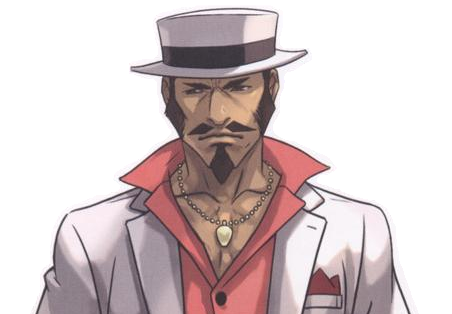
8. Shadi Smith’s Pork Pie Hat (Apollo Justice: Ace Attorney)

Shadi Smith's Pork Pie Hat

Not since Buster Keaton has anyone looked so good in a pork pie. Despite being a shifty character with questionable ethics, Shadi Smith is a really sharp dresser. There are many fantastic hats in the Ace Attorney series, from magician’s top hats to policewomen’s berets, but none seems more stylish or elegant than Shadi Smith’s classy pork pie hat.

7. Carmen Sandiego’s Fedora (Where in the World is Carmen Sandiego?)

Carmen Sandiego's Fedora

As a child, I played Where in the World Is Carmen Sandiego? on my family’s ancient black-and-white Apple Macintosh. (I’m pretty sure the above picture of Ms. Sandiego comes from another game in the series, but it’s the best I could find.) It was educational gaming at its finest: besides learning about geography and national flags, I got a taste of fashion from Carmen Sandiego’s criminally fabulous fedora.

6. Red’s Baseball Cap (Pokémon FireRed)

Red's Baseball Cap

This one was a toss-up between the hats worn by Red from Pokémon and Ness from Earthbound. Red won because his baseball cap is quite a bit cooler. (Besides, Red’s cap in the original Pokémon Red was the inspiration for Ash Ketchum’s iconic hat in the Pokémon anime.) Like Quote, Red takes a common item of casual apparel and makes it seem dashing and even heroic.

5. Agent Chieftain’s Stetson (Elite Beat Agents)

Agent Chieftan's Stetson

Elite Beat Agents is a wonderful rhythm game for the Nintendo DS in which government secret agents assist people in desperate need by invoking the inspirational power of song and dance. (Yes, the game is every bit as weird—and awesome—as it sounds.) Agent Chieftain, a senior agent of the Elite Beat Agency, flaunts a flashy Stetson that adds a dash of cowboy flair to his plain suit and tie.

4. Red Mage’s Wizard Hat (Final Fantasy III)

Red Mage's Wizard Hat

Although the Black Mages from the Final Fantasy series have neat hats, the Red Mages earn this place on the list with their gorgeous crimson hats adorned with snowy feathers. Other Final Fantasy characters have clunky helmets, dull hats or plain hoods. Red Mages alone uphold the lofty standards of fashion while defending their worlds from demons, dragons and other monsters.

3. Mario’s Flat Cap (Super Mario 64)

Mario's Flat Cap

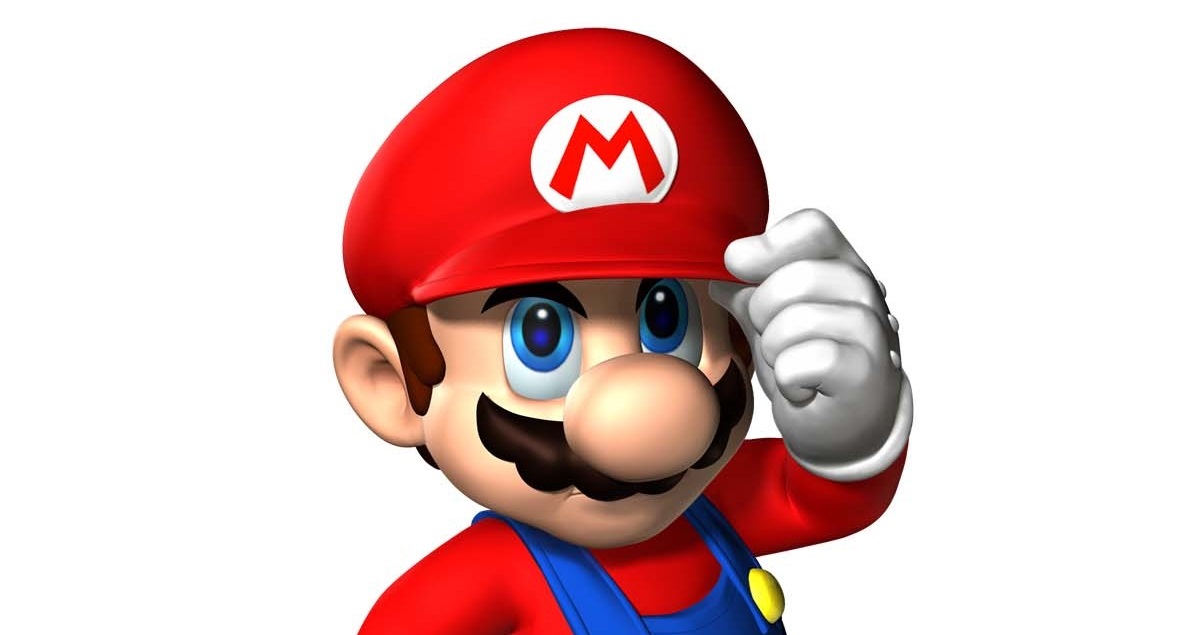
How could I not include Mario’s cap? It’s indisputably the most famous video game hat in the world, and definitely one of the neatest. Mario’s cap from Super Mario 64 deserves special mention for giving Mario superpowers, including flight. Few things in video games have been more fun for me than soaring around the game’s locales with Mario’s winged cap. Like its owner, this hat is remarkable.

2. Professor Layton’s Top Hat (Professor Layton and the Curious Village)

Livewire-AGE

I have absolutely nothing to add.

1. Link’s… Cap? (The Legend of Zelda: The Minish Cap)

Link's... Cap

Link’s cap is one of the most iconic elements of the Legend of Zelda series. It’s instantly recognizable—seriously, how many legendary heroes wear green pointed caps? Link achieves an incredible feat in every Zelda game by looking cool in a hat that wouldn’t seem out of place on one of Santa’s elves. As much as I like it, I wouldn’t give Link’s cap the number one spot on this list if it weren’t for one detail: it talks. In The Legend of Zelda: The Minish Cap, Link is joined on his quest by Ezlo, an enchanted hat who gives advice, grumbles, cracks jokes and turns out to be one of the most engaging characters in the entire Zelda series. For its iconic status, surprisingly cool appearance and amusing dialogue—I can’t believe I’m saying this about a hat—Link’s cap is TMTF’s pick for the best hat in a video game.

O people of the Internet, what great video game hats would you add to this list? Let us know in the comments!

This post was originally published on April 8, 2013. TMTF shall return with new content on April 20, 2015!

349. TMTF’s Top Ten Video Games for People Who Don’t Play Video Games

Most of my dear readers aren’t really into video games. If you’re one of those readers, this post is for you!

Like most bloggers, I glance at my blog’s statistics from time to time. My blog host, WordPress, tracks views for each post on TMTF. I’ve noticed that posts about video games are among the least popular on this blog. This realization points to one logical course of action.

What’s that? I should stop writing blog posts about video games? Don’t be ridiculous! If my posts about games aren’t popular with my readers, there is clearly just one rational solution: I must encourage my readers to play more video games!

(Yes, I’m joking.)

Here are ten video games I recommend for anyone who doesn’t play video games. Most of these titles are easy for casual gamers to pick up and play, with a few must-play classics sprinkled in for good measure. These games—which represent a variety of genres and gaming generations—are upbeat, accessible, and fun to play.

The game is afoot, ladies and gentlemen, as TMTF presents…

The TMTF List of Top Ten Video Games for People Who Don’t Play Video Games!

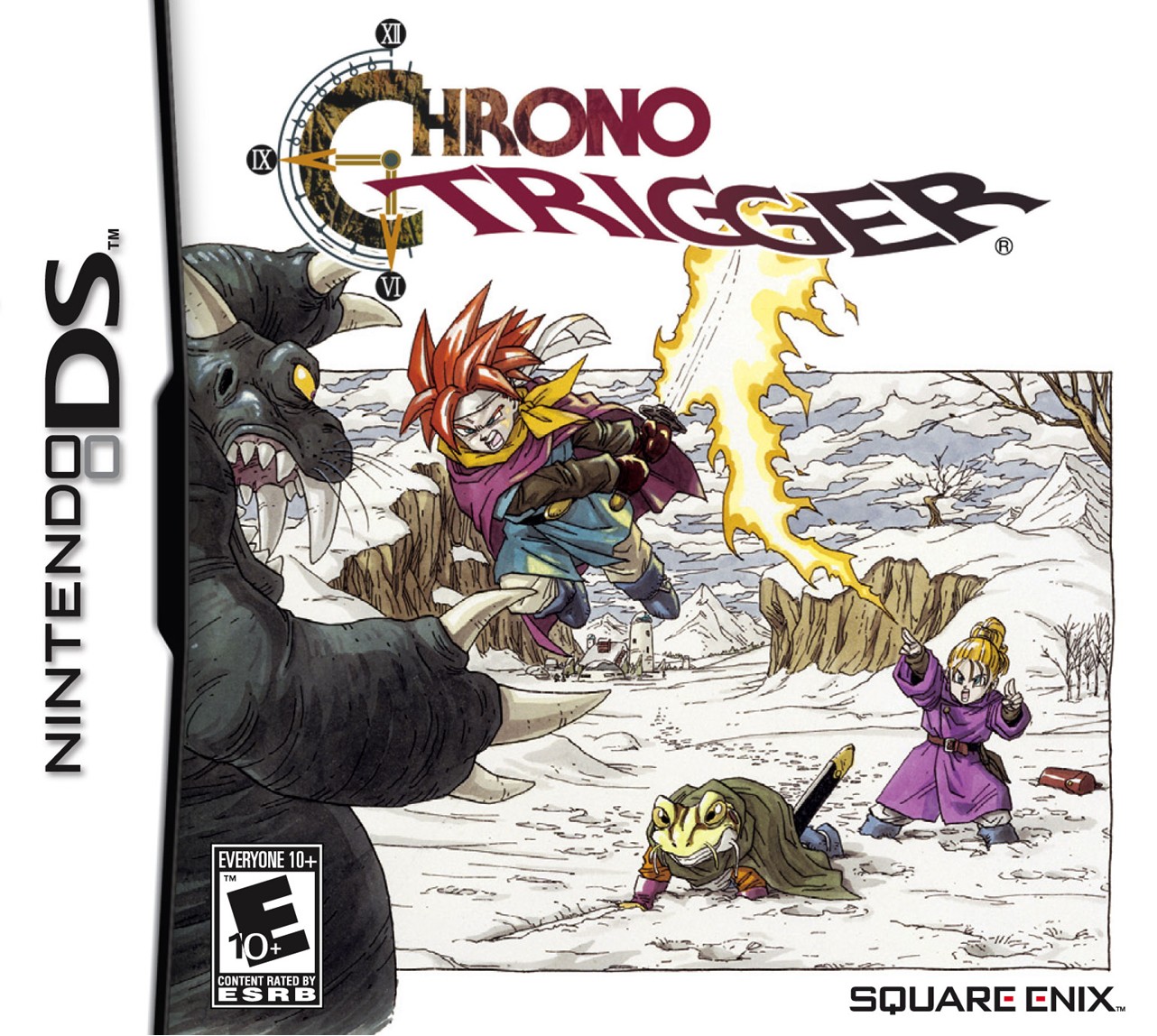
10. Chrono Trigger (Nintendo DS)

Chrono Trigger DSWe’re starting with a masterpiece, which is low on this list because it’s also a bit of a challenge for beginners. I tried to find a short, easy RPG (Role-Playing Game) for casual players, but the easy ones aren’t really worth playing. Chrono Trigger is a little complex, yet simpler than most classic RPGs—and dang if this isn’t a beautiful game.

Chrono Trigger is probably the best RPG I’ve ever played. It was revolutionary in its time, and it has aged well. The music, graphics, characters, and battle system are all superb. I recommend the Nintendo DS version above all others: the translation is vastly improved, a few handy features are added, the game can be played on the go, and it’s far easier to find than previous versions. If you play no other RPG in your lifetime, play this one!

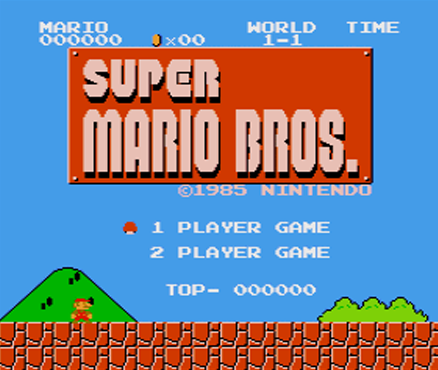
9. Super Mario Bros. (Nintendo 3DS/Wii U eShop)

Super Mario Bros.This is where it all began. Super Mario Bros. hearkens back to the early days of video games, when it launched Mario into his shining career as the most famous character in the industry. The game has aged brilliantly: after thirty years, it’s still tons of fun and pretty easy to play.

This is the world’s most recognizable platformer: an iconic iteration in the Jumping on Stuff genre of video games. Nearly all platformers that followed, including greats like the earlier Sonic the Hedgehog games, owed it all to this one. Super Mario Bros. isn’t merely a classic game. It is, unequivocally, the classic game.

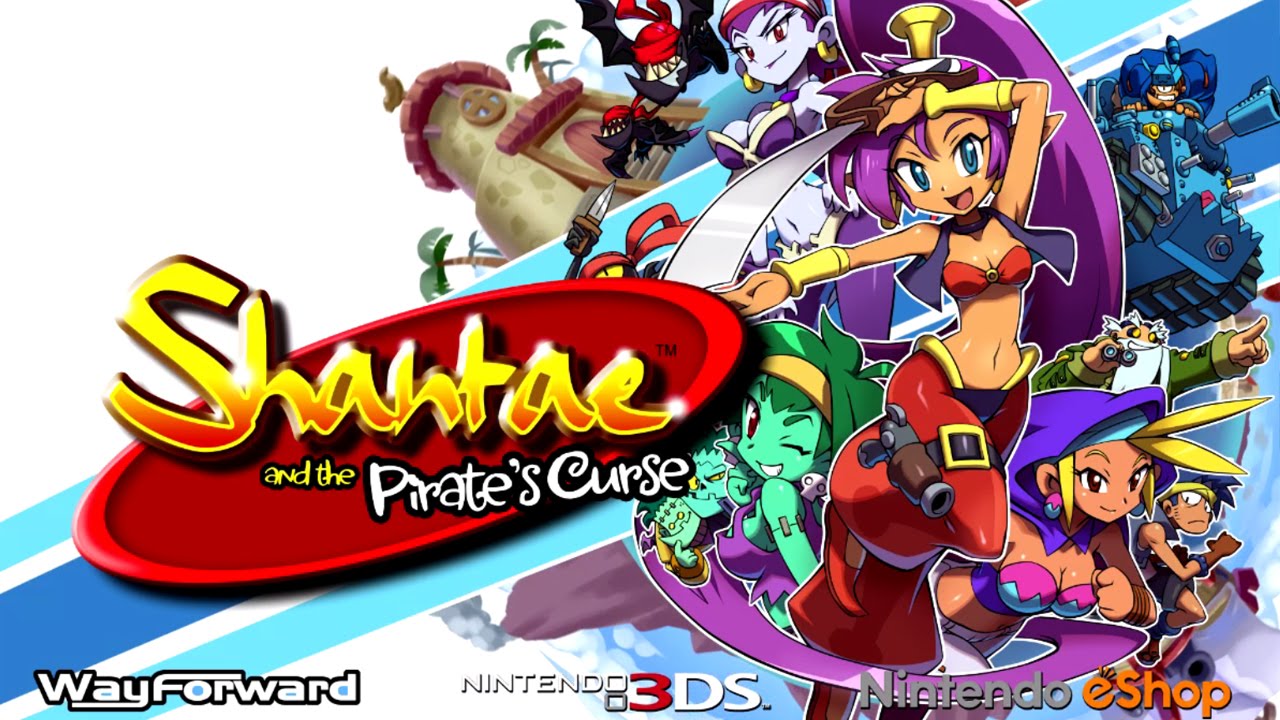
8. Shantae and the Pirate’s Curse (Nintendo 3DS/Wii U eShop)

Shantae and the Pirate's CurseShantae and the Pirate’s Curse is a short, sweet, funny introduction to the action-adventure genre: a blend of exploring, fighting, and puzzle-solving. Available on Nintendo’s eShop, the game offers all the retro-styled joy of classics like Metroid, Mega Man, and Cave Story without their nail-biting difficulty and frustration.

This game is superb: a love letter to the games of yore that adds an upbeat tone and zany style. Shantae and the Pirate’s Curse is relatively short, an advantage for casual players. I must also give it bonus points for being absolutely freaking adorable.

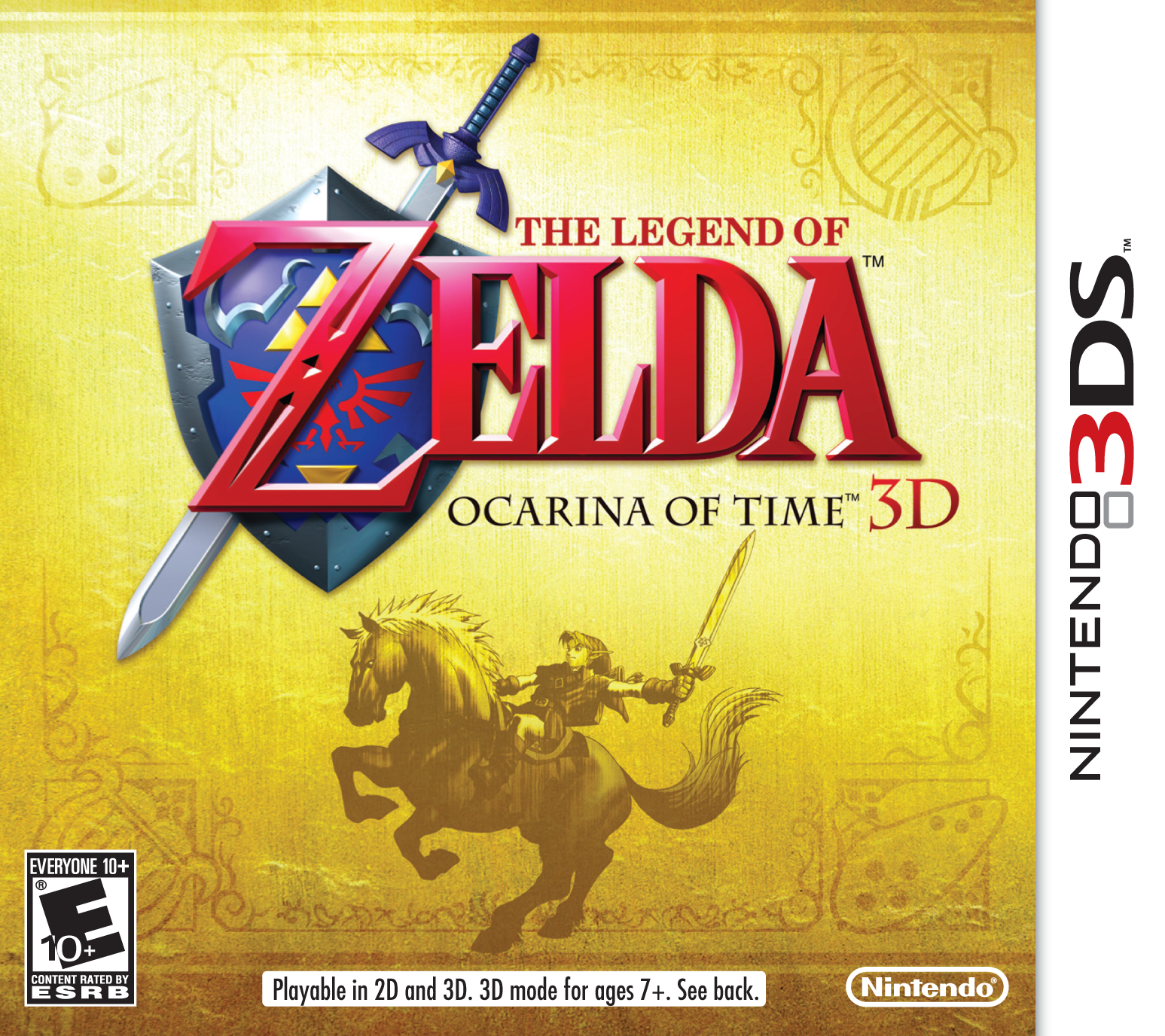
7. Ocarina of Time 3D (Nintendo 3DS)

Ocarina of Time 3DConsidered by many to be the greatest video game ever made, The Legend of Zelda: Ocarina of Time is the quintessential adventure game. I can hardly overstate its excellence. It defined both a genre and a generation.

The original version of Ocarina of Time shows its age, but the Nintendo 3DS version makes the game accessible by putting it on a mobile system with better graphics, redesigned menus, and an elegant hint system to help casual players. Even the Water Temple, a stage of infamous difficulty, has been streamlined. Ocarina of Time may be the world’s best video game, and this is certainly its best version.

6. Elite Beat Agents (Nintendo DS)

Elite Beat AgentsElite Beat Agents is pleasantly bonkers. Imagine someone putting a lot of popular songs (“September,” “Y.M.C.A.,” and “Material Girl,” among others) in a blender along with comic books, Japanese anime on VHS tapes, and disco fashion. This rhythm game is the result, inviting players to tap their way through more than a dozen absurd scenarios.

The premise of Elite Beat Agents is that a secret government agency assists desperate people through the inspirational power of song. It’s every bit as wacky as it sounds, and any player with a sense of rhythm (and a sense of humor) will probably enjoy it.

5. Portal (Microsoft Windows/Xbox 360/PlayStation 3)

PortalPortal puts players in the high-tech boots of Chell, a woman who wakes up in an abandoned research facility with only a deranged (and delightfully funny) computer for company. Chell must escape armed only with an Aperture Science Handheld Portal Device that opens interconnected gates in three dimensional space. (It’s cooler than it sounds.)

Portal is a puzzle game, and probably the best example I’ve seen of a video game as art. The portal concept seems complicated for the first few minutes, but quickly becomes intuitive as the game puts players through puzzles on a gentle difficulty curve. Portal is brilliant, funny, sophisticated, and conveniently short at just a few hours long. While its sequel, the legendary Portal 2, is the better game, Portal is the perfect place to start.

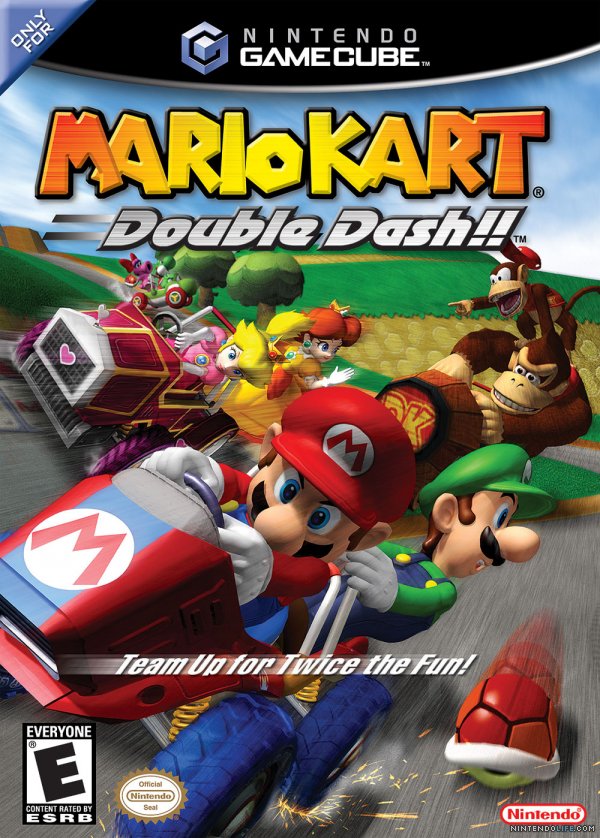
4. Mario Kart: Double Dash!! (Nintendo GameCube)

Mario Kart - Double Dash!!Mario Kart games are one part racing, one part warfare, and all parts fun. The games are all about beating competitors to the finish line… and also beating them with an assortment of damaging objects. Watch out for banana peels, explosives, and high-speed projectiles! Mario Kart games are a blast, sometimes literally.

Mario Kart: Double Dash!! is, in my humble opinion, the best of the bunch. The controls are straightforward and finely tuned. The racetracks are well-designed. Best of all, having two racers per go-kart allows for cooperation between players, not just competition. Newer players can pair up with more experienced ones.

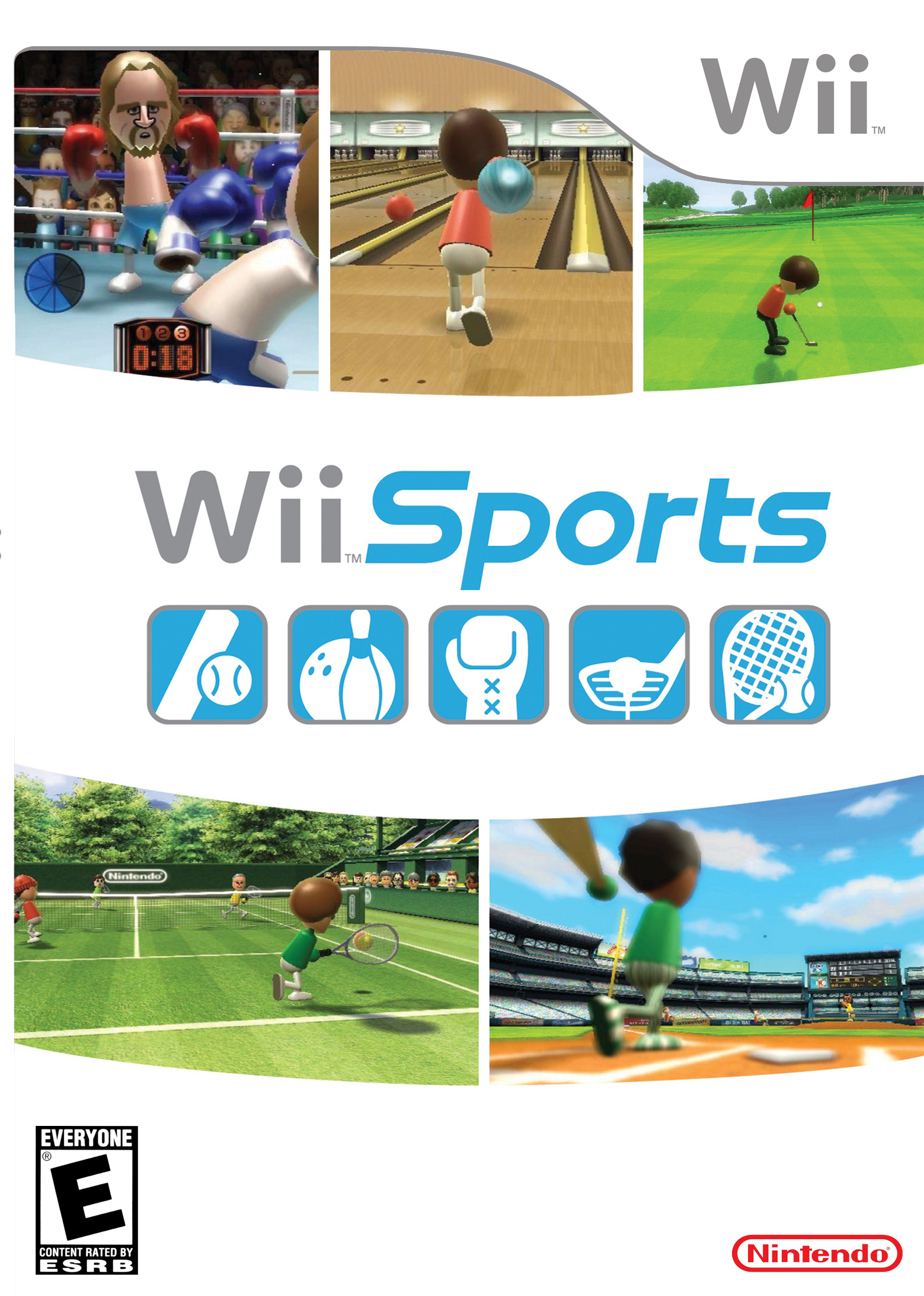
3. Wii Sports (Wii)

Wii SportsThis is the ultimate casual game. All it requires is the ability to wave a controller that looks like a TV remote, and the willingness to look silly doing it. Wii Sports isn’t a deep game, but it doesn’t need to be. It offers fun, simple activities like golf and bowling. They won’t keep you hooked for hours, but they’re quite enjoyable in short sessions or with friends.

The real joy of Wii Sports is in getting up and moving. Motion controls are usually a cheap gimmick, but Wii Sports is one of the few games to use them really well. It may not be long or complex, but it’s an inviting place for casual gamers to start.

2. Phoenix Wright: Ace Attorney – Dual Destinies (Nintendo 3DS eShop)

Ace Attorney - Dual DestiniesWhen I first played an Ace Attorney game, I expected it to be dull—how could a video game about the legal profession be any fun at all? I was absolutely wrong. Ace Attorney is a series of interactive murder mysteries, with some courtroom drama and a ton of humor thrown in for good measure.

In the pretentiously-titled Phoenix Wright: Ace Attorney – Dual Destinies, the courts have entered a “dark age” in which suspicion and corruption run rampant. Wright and his team must defend their clients—including, in one memorable case, an innocent killer whale—as they unravel the mystery behind the dark age of the law. Dual Destinies is the best the Ace Attorney series has to offer, with polished mechanics and stellar storytelling. It’s also a great starting point for players new to the series, demanding no knowledge of previous games.

1. Professor Layton and the Last Specter (Nintendo DS)Professor Layton and the Last SpecterHave you ever picked up a book of puzzles—you know, a collection of mazes, word searches, riddles, math questions, brainteasers, and crosswords? The Professor Layton games are basically those puzzle books, but a thousand times more charming. They also feature tales of intrigue and mystery, all starring the top-hatted Hershel Layton.

Professor Layton and the Last Specter is the first chapter of Layton’s story, but not the first game in the series. By this point, the series has hit its stride. The puzzles are delightfully varied, the style is charming, and the Professor himself is a refreshingly polite, kindhearted alternative to more traditional video game heroes. For those who don’t play video games, I can offer no higher recommendation than the good Professor’s puzzles!

What casual games do you recommend? Let us know in the comments!

348. About Storytelling: Getting Drunk on Milk

In fiction, as in real life, bad things happen. When tragedy strikes, fictional characters sometimes try to drown their grief in alcohol.

We’ve all seen this in the movies. In one scene, a man loses his job or girlfriend; in the next, we find him drinking or drunk. It’s an age-old trope of storytelling. Heck, even I’ve used it. Lance Eliot, the protagonist in my novel, is quite a drinker.

What about stories for children? Here we have a problem. A story may need its characters to drink away their sorrows, but that sure ain’t appropriate for the kiddos! Storytellers, crafty creatures that they are, have discovered a family-friendly alternative to getting drunk on alcohol: getting drunk on nonalcoholic things, of course!

(In writing this blog post, I discovered this trope actually has a name: drunk on milk. Thanks, TV Tropes.)

Here are some examples of characters in family-friendly media drowning their sorrows in things that aren’t alcohol.

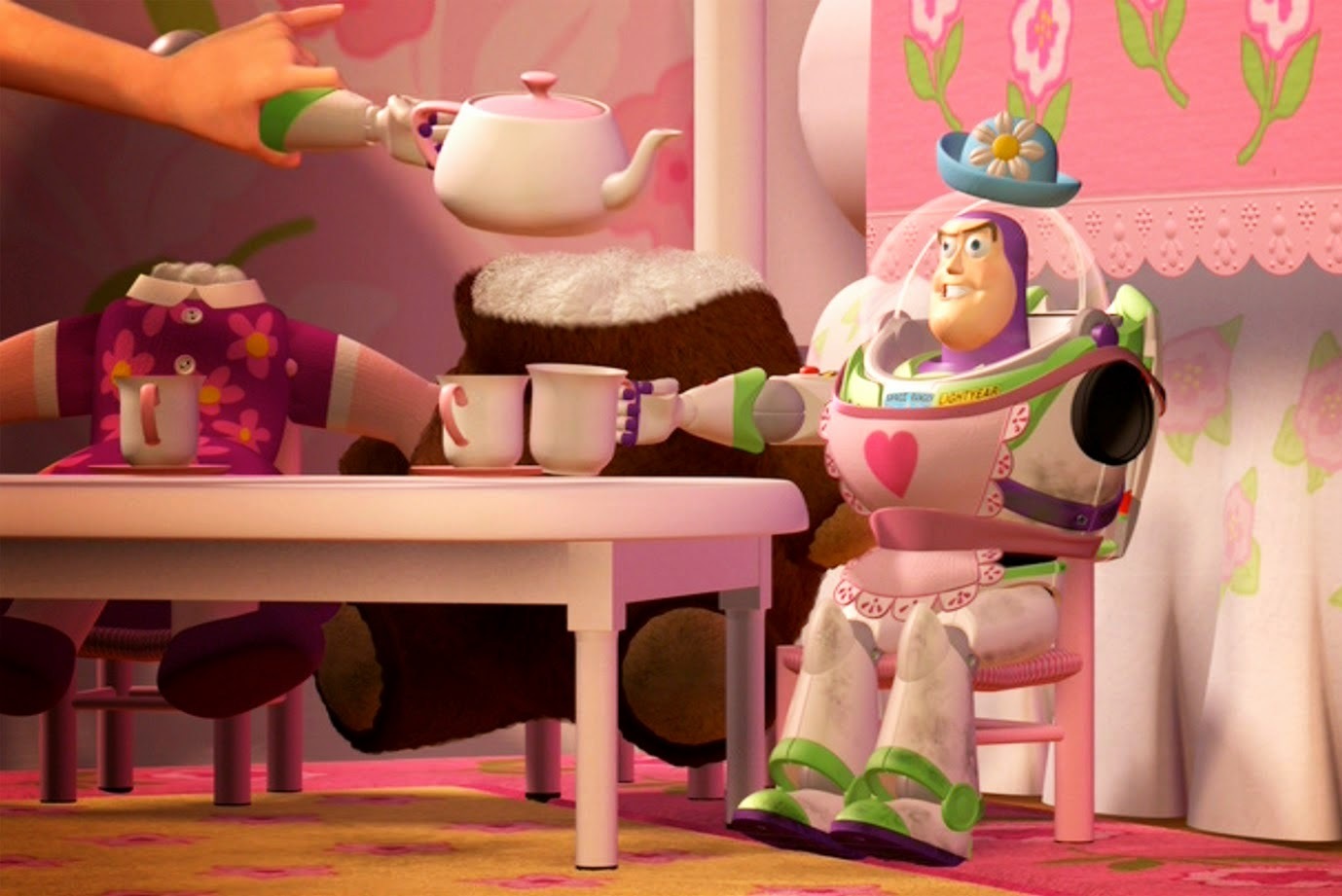
Tea (Toy Story)

Tea drunkI’ve drunk Darjeeling tea before, and let me tell you: the stuff Buzz Lightyear drinks (or pretends to drink) in Toy Story is like no Darjeeling I’ve ever tasted. Whatever is in those teacups, Buzz gets buzzed. (Pun intended. I’m so, so sorry. By the way, in case one bad pun isn’t enough for you, “Buzz” is pronounced “booze” in a Hispanic accent.) Buzz’s, um, tea is strong enough that he doesn’t seem to mind being called “Mrs. Nesbitt,” which must be humiliating for an intergalactic hero. Darned Darjeeling!

Doughnuts (My Little Pony: Friendship Is Magic)

Drunk 'n' donutsA happy cartoon about magical rainbow ponies can’t show its characters consuming alcohol, despite the fact that one of its protagonists is apparently named after a hard liquor. The alternative? Doughnuts. When Spike the dragon is left behind by his pony pals, he hits the local doughnut shop—the name of which, I can only presume, is Drunk ’n’ Donuts. (Pun intended, but I’m not sorry for this one!) Spike may not get a hangover from his excesses, but I don’t envy him the inevitable sugar crash.

Ramen noodles (The Legend of Korra)

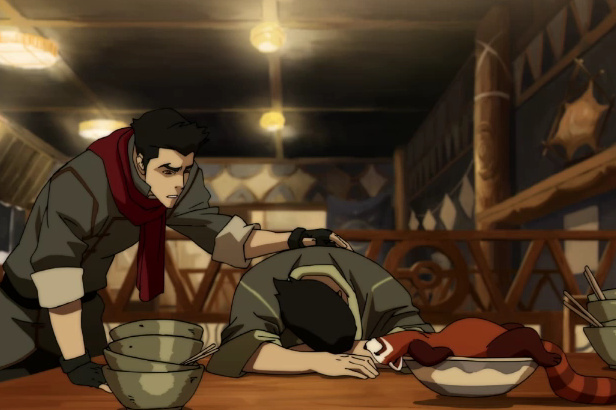
Bowls and BolinBolin—the young man passed out on the table in the picture above—deals with romantic rejection as heartbroken men do: by heading to the local ramen joint and eating too many bowls of noodles. This early scene from The Legend of Korra makes me chuckle; I’m especially amused by Bolin’s pet ferret lounging in an empty bowl. The Legend of Korra is a good show… I should catch up with it someday.

Milk (The Legend of Zelda: Majora’s Mask)

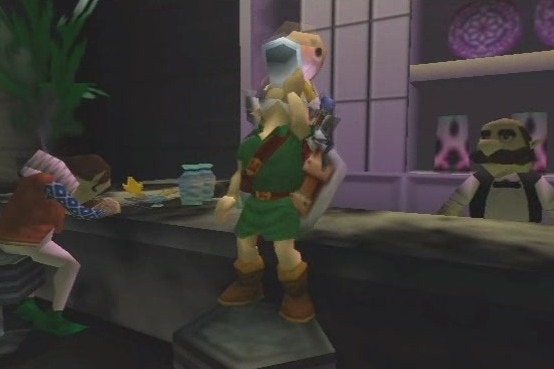
Milk drunkThe Legend of Zelda: Majora’s Mask is, without question, one of the greatest games I have ever played. It’s also one of the few to feature a milk bar. (Yes, I’ve seen a milk bar in more games than this one!) Open late at night, the milk bar caters exclusively to adults and offers both live entertainment and a variety of dairy drinks. I think the Shakespearean-looking gent in the picture above says it best: “Milk… It’s miiiilk… Can you get tipsy from something like milk?!? Hic!”

Ice cream (VeggieTales)

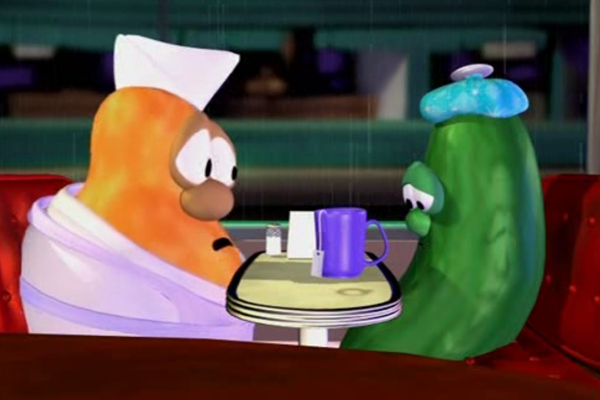
Ice cream drunkI’m digging deep into my childhood memories for this one. At one point, Larry the woebegone cucumber responds to bad news by eating too much ice cream at a diner. (VeggieTales is not just a kids’ show, but a Christian kids’ show, so they really had to keep it family-friendly!) In the picture above, Larry recovers with a warming cup of tea. Let’s hope it’s not Darjeeling.

Juice boxes (Jan Animation Studios)

Bar buddiesAll right, I’m kinda reaching here, but I suppose this short video counts. Bar Buddies, a brief animation from the brony community, has a kid getting wasted on juice boxes. Apple juice, apple cider, applejack—what’s the difference? They’re all made of apples, right? This one makes me laugh because of the disparity between the well-dressed, hard-drinking guy on the left and the silly kid on the right.

What’s drunk-on-milk scenarios did we miss? Let us know in the comments!

338. Strange American Valentine Rituals

The United States of America has many strange customs and holidays, and I consider it my duty to research them. With St. Valentine’s Day taking place tomorrow, I set my studies of Halloween and Thanksgiving behind me in order to give this latest holiday the anthropological scrutiny it deserves.*

My findings were… dark. Despite its popular image as a time for giving gifts and expressing romantic love, St. Valentine’s Day represents bloodstained history and wanton consumerism.

Verily, of the various letters vividly visible above, the very first veers vaguely toward the visual vibe of a violent yet entertaining film I once viewed.

Verily, of the various letters vividly visible above, the very first veers vaguely toward the visual vibe of a viscerally vicious and violent film I once viewed: V for Valentine, or some variation.

As the holiday is named for a historical figure, my first task was to research St. Valentine himself. Little is known of this ancient Roman martyr, whose death is celebrated every year in America by the sale and distribution of gifts such as flowers, chocolates, cookies, cards, jewelry, and frilly undergarments. St. Valentine, who is known as Valentinus in some accounts, is surrounded by legends, but few facts remain.

Upon finding the study of this dead saint to be a dead end, I turned my researches toward the holiday itself, and discovered a sordid celebration of Valentine’s demise.

The name of the event, St. Valentine’s Day, is generally shortened to Valentine’s Day by the disgraceful omission of Valentine’s hagiographic title. Just as the Christmas season is marked by certain colors (viz. red and green), so Valentine’s Day is recognized by the colors red and pink.

The significance of these colors is open to speculation. Given what little is known of St. Valentine’s personal history, the color red may represent his violent death as a martyr. Pink generally represents love or sweetness; its association with the bloody red of Valentine’s death demonstrates a disturbing veneration of violence.

More than fifteen centuries after Valentine’s tragic end, why is it celebrated by the giving of gifts? Why is romantic love the legacy of Valentine’s martyrdom? What aspect of his brutal death inspired sappy cards, heart-shaped candies, and other mawkish gifts?

These are distressing questions, and my best researches have yielded no answer.

Do you know what else is distressing? These awful pills. I don't know what kind of medication they contain, but they taste awful.

Do you know what else is distressing? These awful tablets. I don’t know what kind of medication they contain, but they taste awful.

Perhaps it would be prudent for me to narrow the lens of my researches from the purpose of the holiday to its specific observances.

The greatest tradition of Valentine’s Day seems to be buying things, such as the aforementioned flowers, candy, cookies, cards, jewelry, and lingerie. This eclectic assortment of romantic items has no discernible connection to Valentine himself, leaving me to surmise that their popularity as Valentine’s Day gifts is prompted by the theme of romantic love that has left its indelible and inexplicable mark upon the remembrance of that saint’s death.

Never mind the occasion—coffee is always an appropriate gift.

Never mind the occasion—coffee is always an appropriate gift.

Although these gifts are generally exchanged by romantic partners, it is common for celebrants of Valentine’s Day to distribute cheaper and less intimate gifts among friends, classmates, and coworkers; candy and cards are among the most popular options. Other Valentine’s Day traditions observed in America include going on dates or to parties.

A romantic card or letter given on Valentine’s Day is known as a valentine. This eponymous designation is shared by any person to whom such a card or letter is given.

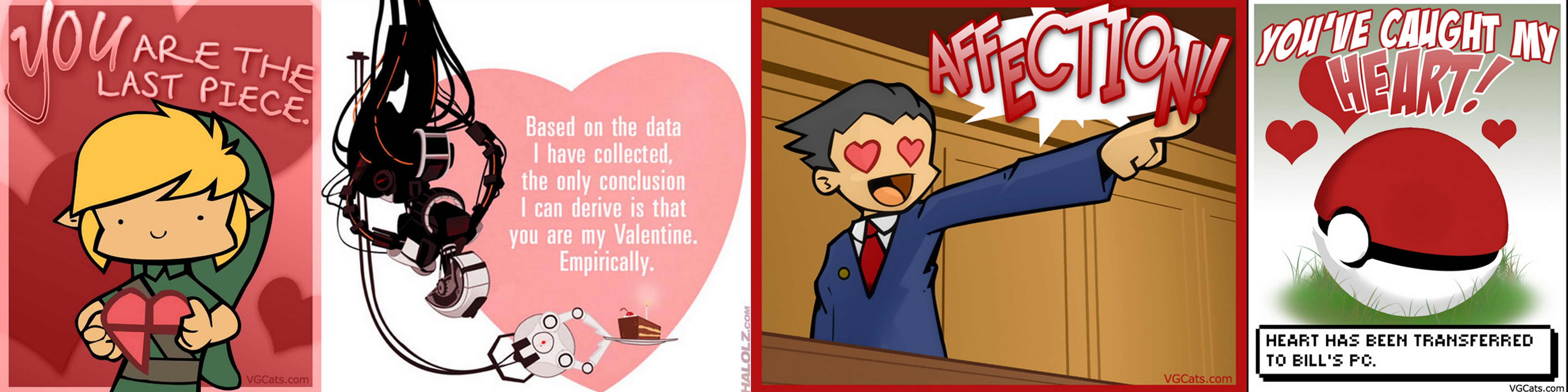
(If I may permit a personal view to interfere with my serious studies of American holidays: I strongly opine that video game valentines are the best valentines.)

If you recognize all of the games represented in these Valentine's Day cards, you deserve a cookie.

If you recognize all of the games represented in these valentines, a winner is you!
In conclusion, Valentine’s Day seems to celebrate the violent death of a good man, associating it (for dark, unknown reasons) with romantic sentimentality. I acknowledge, regardless, the importance of the virtues venerated by the holiday—to wit, love and friendship.

Thus, with sincerity and due caution, I wish you a happy St. Valentine’s Day.

*I should remind my dear readers that my studies of American holidays are silly, sarcastic, and absolutely not serious. This blog post is a joke. Please don’t take it seriously!

334. TMTF Reviews: Shovel Knight

Shovels and video games are not a promising combination. In fact, one of the worst catastrophes in the history of electronic games was the Atari game burial, when thousands of unsold games were buried in a landfill. This set a precedent for the term shovelware, which TMTF once defined as “Badly-designed games fit only for taking up space in landfills.” No, shovels and video games don’t mix well.

Thanks to one brave little knight, however, that may be changing. Shovel Knight is a game I really wanted to play. Last month, I finally picked it up and played it.

Did I unearth a treasure in Shovel Knight, or should I have left it buried?

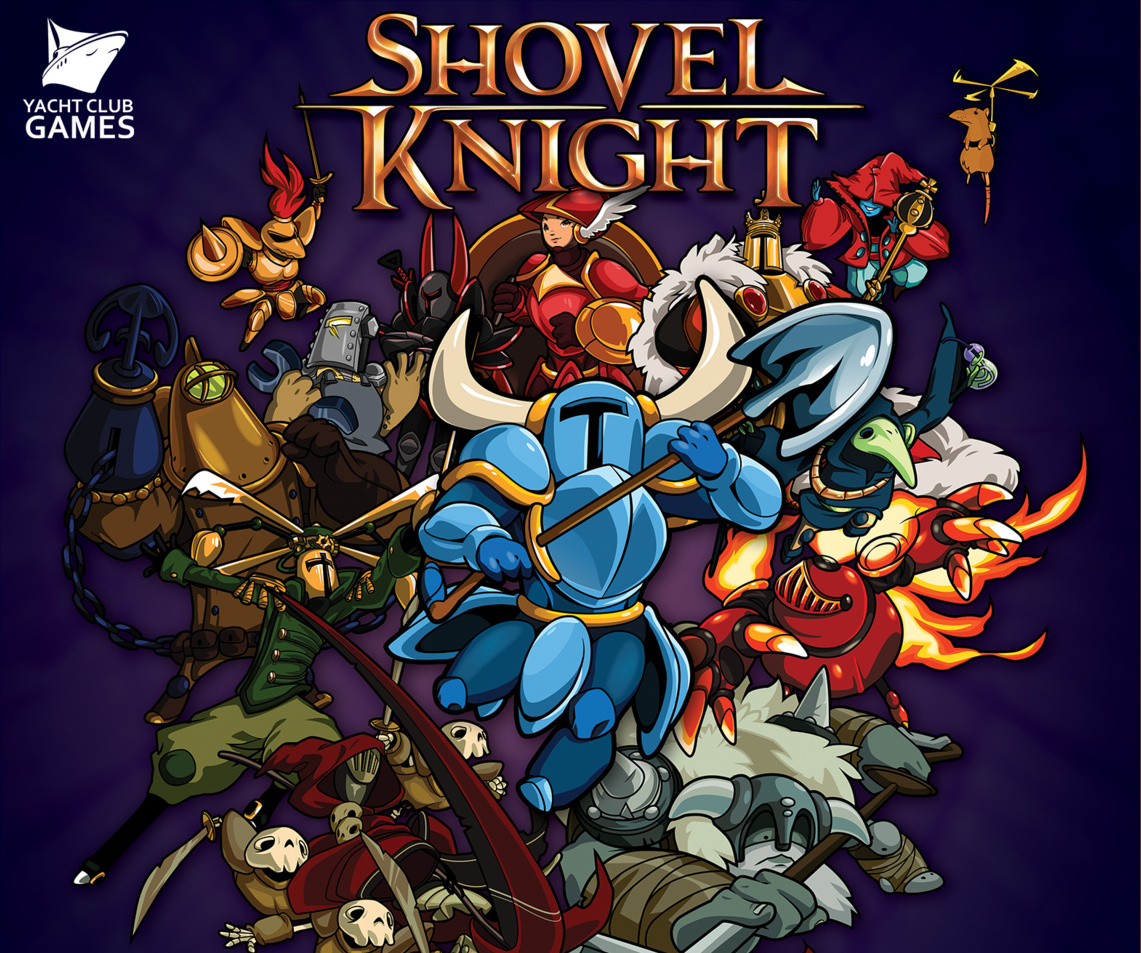
Shovel Knight

Shovel Knight (PC, Nintendo 3DS/Wii U eShop; 2014)

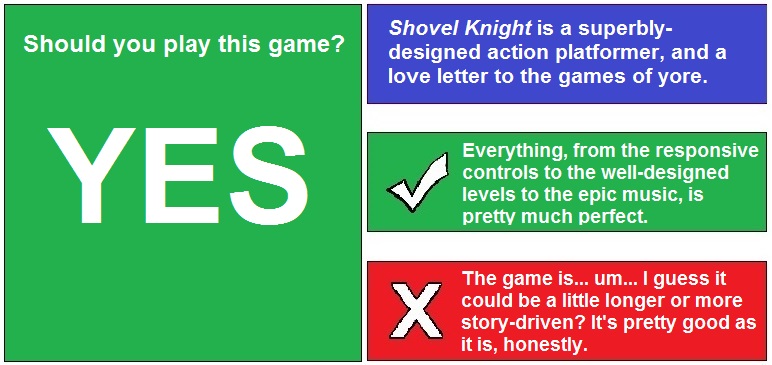
Shovel Knight is a near-perfect blend of responsive controls, challenging level design, retro-styled visuals, and whimsical humor—to wit, I really dig this game.

TMTF Reviews - Shovel Knight

Of Shovels and Chivalry

Once upon a time, Shovel Knight and Shield Knight roamed the world in search of treasure and adventure. Tragedy struck, however, when a cursed amulet stole Shield Knight, driving Shovel Knight to a life of grief and solitude. Time has passed. An evil Enchantress has arisen. Her ruthless Order of No Quarter, a band of eight wicked knights, terrorize the land. In his quest to find Shield Knight and rescue the realm, Shovel Knight must take up his tool and fight.

Shovel Knight, like the Shantae games, is heavily inspired by the games of yore. (Shovel Knight and Shantae have much in common; the same composer and some of the same developers worked on both.) Shovel Knight borrows its level designs and basic gameplay from the Mega Man games, its map from Super Mario Bros. 3, its towns from Zelda II: The Adventure of Link, and one of its moves from that improbably awesome DuckTales game.

(Fun fact: The original DuckTales has a remake scored by the same composer as both Shovel Knight and Shantae—the guy really gets around!)

My point is that Shovel Knight is built on the solid foundation of older games, and that’s a good thing. In fact, it makes me rethink my criticism of Shantae and the Pirate’s Curse for being “awfully familiar.” It’s important to innovate in game development, as in any other creative medium, but there’s also something to be said for perfecting what has been done before. Shovel Knight is built of old parts, but they come together to make something really special. What it lacks in innovation, it makes up in technical excellence.

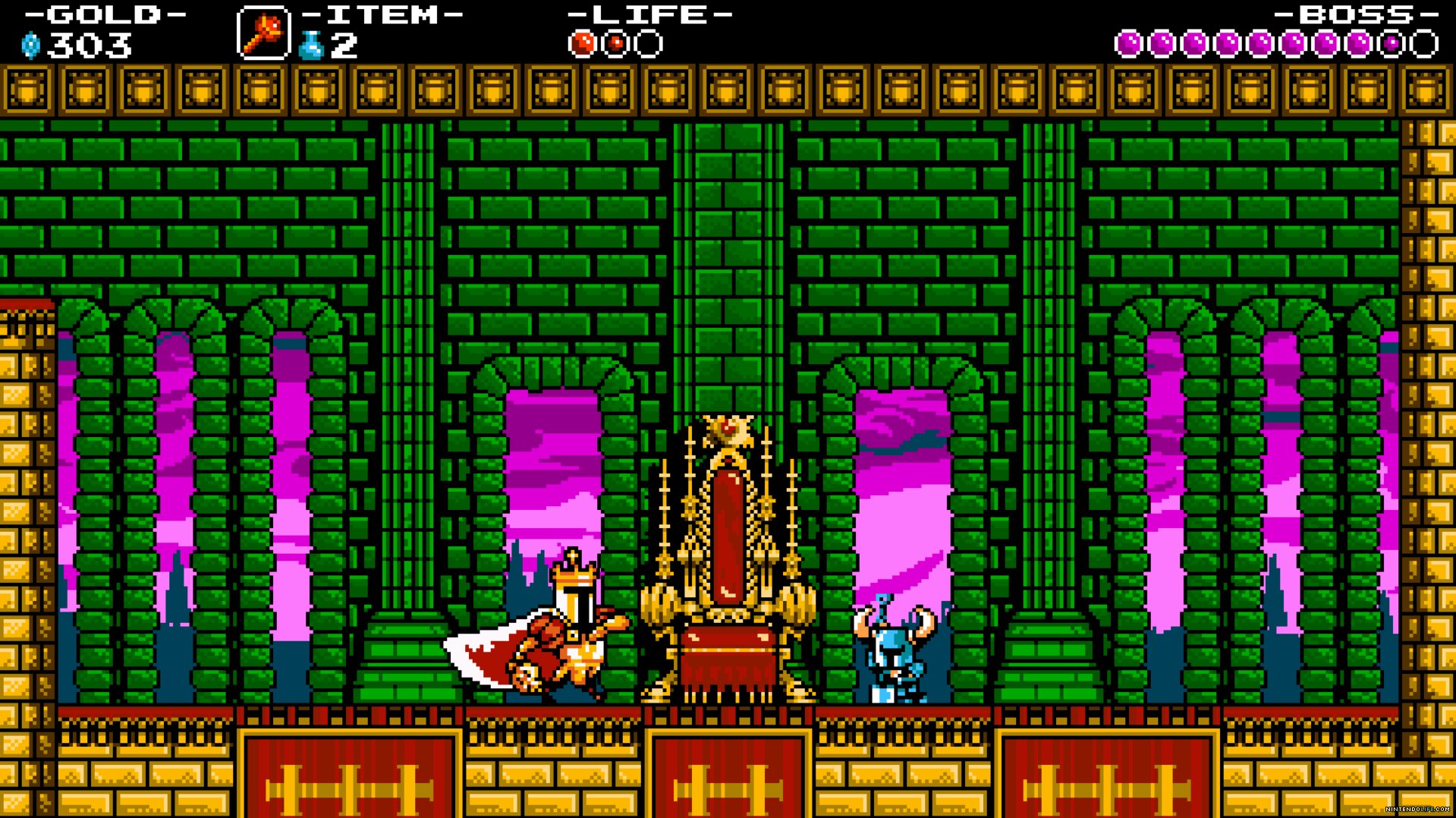
Shovel Knight screenshot 2

The controls in Shovel Knight are tight and responsive, allowing the eponymous hero to slash, hack, jump, thrust, and bounce with perfect precision. That’s fortunate, for the levels are extremely challenging. The platforming can be tricky; traps, enemies, and obstacles only make things more difficult. I was relieved, however, by how fair the game is. It doesn’t sabotage the player with poor controls, obtuse level design, or deliberate tricks. Shovel Knight can be a hard game, and most players will die a lot, but they’ll have no one but themselves to blame for it.

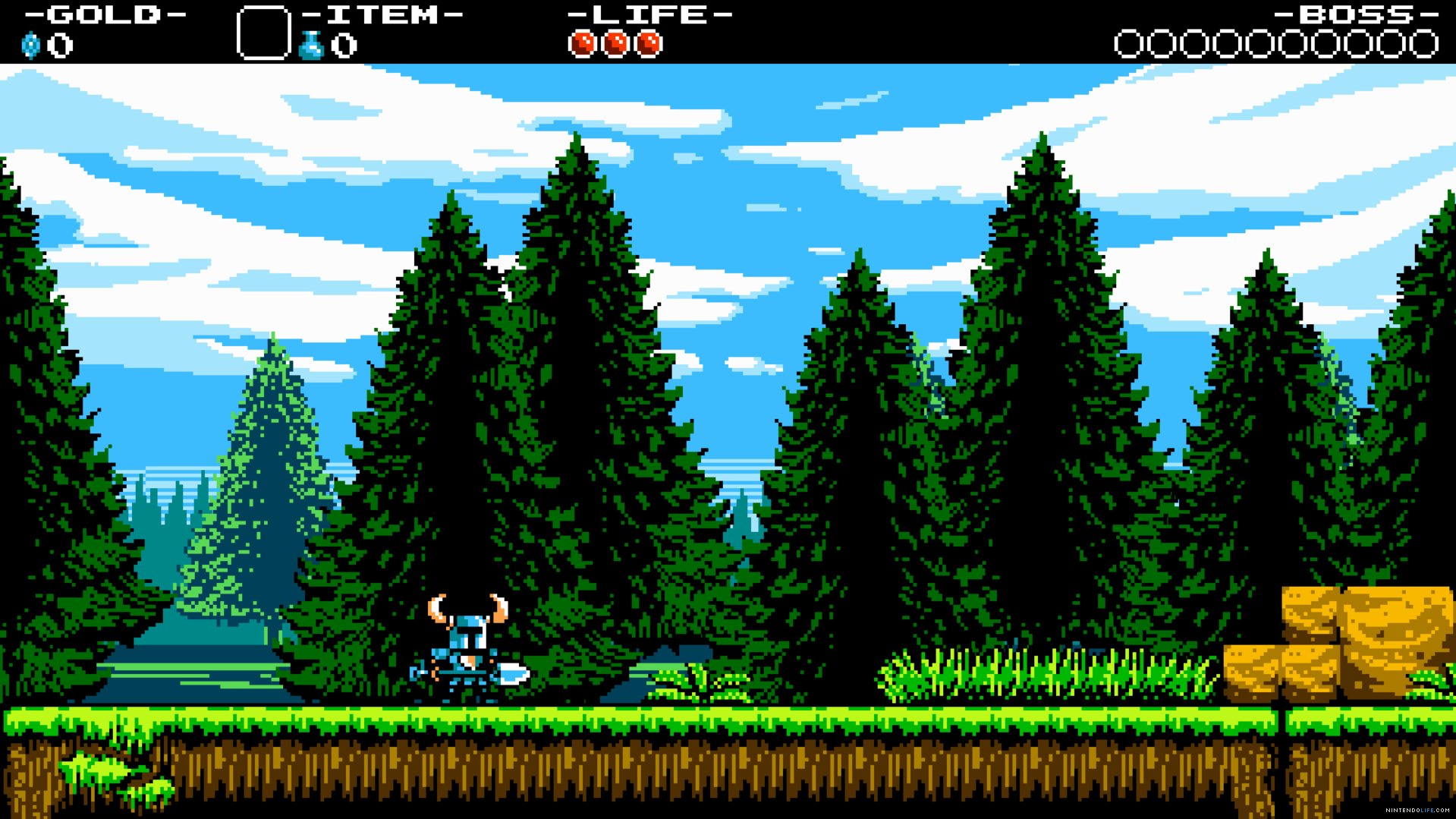
The levels are terrific. They scroll horizontally and vertically, and not a screen is wasted: every room and area has some new challenge, and there are plenty of secrets to find. Visually, the game boasts pixelated, old-timey visuals on the same color palette as the old Nintendo Entertainment System. Shovel Knight looks (and plays) like a long-lost NES game, plus a few modern tweaks and minus the bad writing ubiquitous in the old days.

Shovel Knight screenshot

Besides his namesake weapon, Shovel Knight wields relics, a wide assortment of weapons and equipment bought from Chester, a wandering merchant who hangs out inside treasure chests (get it?) hidden in most levels. Money can also be used to buy shovel upgrades, new suits of armor, health boosts, and other bonuses.

Among other collectibles, Shovel Knight allows players to gather sheets of music that can be exchanged for songs and in-game cash. Speaking of music, the game’s soundtrack is phenomenal in a shrill, electronic sort of way. Seriously, listen to its main theme.

If that doesn’t give you feels, you may have no soul.

Adventure in Spades?

This is normally the part where I criticize a game for its flaws. With Shovel Knight, I have to look really hard. Prepare yourself, dear reader, for Adam at his most hypercritical.

NITPICKING POWERS ACTIVATED!

There’s not much story in Shovel Knight. It doesn’t need a complex story—the game is tons of fun to play—but more plot and characterization would have been nice. It’s sort of a Super Mario Bros. story: girl is taken, hero must rescue her, etc. There are one or two twists, and the Order of No Quarter are likable enough as characters, but the simplistic story feels like a missed opportunity.

Shovel Knight is a pretty short game. I actually appreciated that—I don’t have as much time for video games as I wish I had—but players expecting a long quest may be disappointed by its brevity.

Besides its difficulty, which is matter of preference, that’s pretty much everything I can find to criticize in Shovel Knight.

…And They Lived Happily Ever After, You Dig?

Shovel Knight is a game as pleasant and stalwart as its horned hero. It’s old-fashioned, challenging, and not for everyone; I know a couple of people who don’t much care for it. All the same, I love it, and I recommend it wholeheartedly.

The game is a well-written, beautifully-designed, gorgeously-scored love letter to the video games of the eighties. Like those games, Shovel Knight proves you don’t need fancy graphics, elaborate storytelling, or extravagant pageantry to make a game.

No, all you need is a shovel and a little courage.

326. TMTF Reviews: Socrates Jones – Pro Philosopher

Philosophy is a daunting subject.

Believe me, I know. One of my uncles is a philosophy professor. He has a tremendous beard, an office full of books, and a tendency to use words like epistemology in everyday conversation. I also have a bunch of cousins who studied philosophy. When my relatives on that side of the family gather for a meal or holiday, their conversations can get really academic.

(These relatives also talk a lot about football—I refer to soccer, by the way, not that violent American sport. Their discussions of sports are even harder for me to understand than their talks about philosophy.)

I’ve studied some philosophy, but I’m no expert. Thus I was intrigued when a reader of this blog graciously recommended a video game titled Socrates Jones: Pro Philosopher. As the name suggests, it’s an homage to Phoenix Wright: Ace Attorney. I love the Ace Attorney games, which bring together clever mysteries and bombastic melodrama, and the idea of a game in the same style about philosophy interested me very much.

That said, I must echo Hamlet and ask a big philosophical question: To play or not to play?

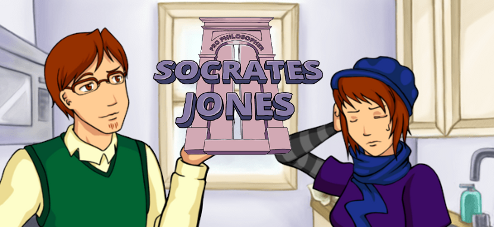
Socrates Jones title

Socrates Jones: Pro Philosopher (Available online, 2013)

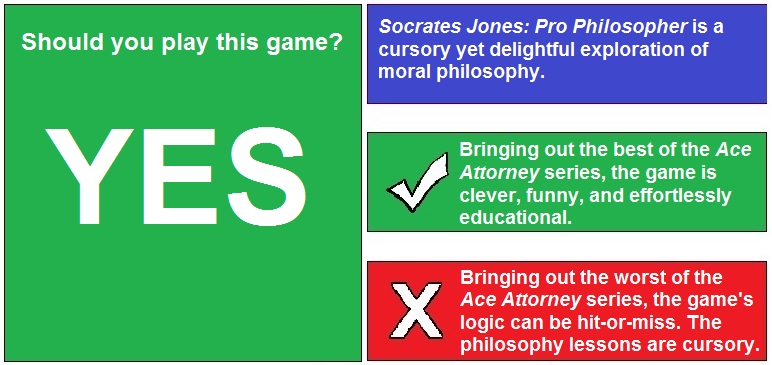
Bringing out both the best and worst of Ace Attorney games, Socrates Jones: Pro Philosopher is a cursory yet clever and entertaining exploration of moral philosophy.

TMTF Reviews - Socrates Jones

Give Me Philosophy or Give Me Death!

Socrates Jones, a simple accountant with an ordinary life, can’t understand his family’s obsession with philosophy. He prefers crunching numbers to arguing about abstract ideas. However, when a car crash lands him and his daughter Ariadne in an afterlife reserved for philosophers, Socrates gets one chance to reclaim their lives. He must debate a series of famous philosophers and resolve one of the Big Questions: What is morality and where does it come from?

I’ll be honest: Socrates Jones is basically a short Ace Attorney game that replaces attorneys with philosophers. Do you know what? That’s a really good thing.

For those unfamiliar with Ace Attorney, I should mention that each game has two main components: crime investigations and legal trials. Socrates Jones borrows the mechanics of the trials and makes a few key changes. Philosophers take the place of attorneys; philosophical theories are submitted instead of witness testimonies; ideas, not physical evidence, are presented as rebuttals. The courtroom structure of Ace Attorney works astonishingly well for philosophy.

Socrates Jones imitates not just the mechanics of Ace Attorney, but also its exaggerated style and sense of humor. Socrates and his opponents are funny, memorable, and well-written. I love how Ace Attorney‘s iconic cries of “OBJECTION!” are replaced in Socrates Jones by indignant exclamations of “NONSENSE!”

Socrates Jones screenshot

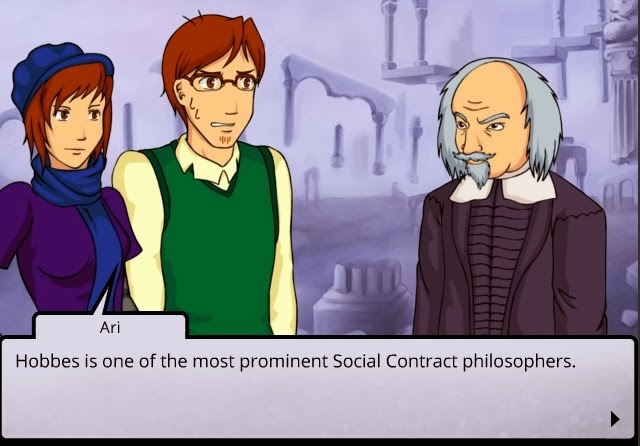
The philosophers themselves are a quirky bunch. When Socrates meets Thomas Hobbes, that famous thinker says gruffly, “You should know, Mr. Jones, that my mother gave birth to twins. Myself, and FEAR. By the end of the day, you will be thoroughly acquainted with both of us.” Immanuel Kant introduces himself in a similarly grandiose manner, only to add that he felt boasting was necessary “to fulfill the prerequisite grandstanding.”

For a game developed by philosophy students and Ace Attorney fans, Socrates Jones is remarkably well-crafted. The game even innovates upon its source material by adding a more robust system for questioning statements. In Ace Attorney, the player can question each statement in a testimony. Socrates Jones takes the system several steps farther by allowing players to ask three questions: Would you clarify your statement? Can you back up this statement? How is this statement related to your argument? By asking the right questions, Socrates trims away the flaws and irrelevancies of his opponents’ arguments.

This game is more than just a game—it’s the Sophie’s World of video games, a set of philosophy lessons wrapped in the appealing package of a good story. Socrates Jones does a pretty good job of setting up the arguments of historical philosophers, and then poking holes in them.

Speaking of poking holes in things….

The Value of the Imperfect

Toward the end of the game, Socrates makes a point that even flawed things can be good. “Things do not have to be ‘perfect’ to add value to the world,” he insists, and he’s absolutely right—fortunately for him. Socrates Jones: Pro Philosopher has two kind of problems. It’s imperfect as a game, and it’s also incomplete as a philosophy lesson.

The game’s faults aren’t severe—in fact, they’re the exact faults of the Ace Attorney series. Deconstructing a statement can be a matter of trial and error; the “right” questions and “correct” rebuttals, as decided by the game’s developers, may be counterintuitive to the player’s way of thinking.

Socrates Jones is a philosophy lesson, not just a game. The game’s arguments aren’t bad, but they have one unavoidable problem: they are scripted. The player is on rails, able to ask only preselected questions and reach predestined conclusions. Socrates Jones excels as brief exploration of moral philosophy, but it’s no substitute for a real discussion.

Short, Sweet, Funny Philosophy

Socrates Jones: Pro Philosopher is a short, fun foray into moral philosophy. It isn’t perfect as either a game or a philosophy lesson, yet succeeds in being both entertaining and educational.

Anyone interested in philosophy, the Ace Attorney series, or an enjoyable exercise in critical thinking should take two or three hours to play through the game. After all, Socrates Jones and his daughter are philosophizing for their lives, and they could use a little help!

Thanks for reading! If you have a moment, please check out TMTF’s charity fundraisers this month and make this Christmas awesome for a person in need!

324. I Want to Hug These Games

I don’t care much for hugs.

Well, I suppose some hugs aren’t so bad. I give my younger brother awkward sibling hugs all the time. For the most part, though, I’m about as easy to hug as a cactus. Hugs are a little too close and personal for me; I much prefer an affable fist bump.

However, I keep bumping into video games that are madly original and gloriously unique, and I want to hug them.

As much as I enjoy video games, I’m disappointed to see so many of them fall into the same clichéd categories. There are Games about Cars, Games with Guns, Games about Sports, Games with Swords and Magic, and games to fit nearly every other exhausted genre. The same problem is found in other media, from books to movies to music. New titles are hardly distinguishable from old ones; there is nothing new under the sun.

It’s important for me to make clear that genres aren’t necessarily bad. In fact, some of the best games I’ve ever played (including most of my favorites) fall into the broad categories mentioned above. All the same, I appreciate game developers who boldly go where no one has gone before, bringing color and creativity to a tired industry.

There are thousands of games about guns, zombies, cars, sports, or princesses in need of rescuing… and then there are a few odd, endearing games like Octodad.

I seldom borrow from other sources when writing for this blog, but nothing does Octodad justice like this understated description from its Wikipedia page: “The game consists of controlling the protagonist Octodad in completing chores typical of the mundane suburban father, but complicated by the fact that he is an octopus in disguise.”

Octodad, wryly subtitled Dadliest Catch, is the whimsical tale of a loving husband and father who happens to be an octopus pretending to be a human being. The fact that “nobody suspects a thing” when Octodad is clearly an octopus only makes the game that much funnier.

Shovel Knight is another title that caught my attention. It’s exactly what it sounds like: a game about a knight with a shovel.

Shovel Knight

I’m really digging this game. (Pun intended. I’m so, so sorry.)

Well, to be more precise, Shovel Knight is a retro-styled adventure game, in the tradition of Mega Man and Metroid, starring a warrior whose weapon of choice is a shovel. The knight valiantly swings, hacks, bounces, and yes, digs his way to victory. Swords? Bah! Who needs swords?

Then there’s Five Nights at Freddy’s and its sequel. These are horror titles, but they lack ghosts, zombies, demons, aliens, or any of the other monsters you’d expect from a scary game. No, these games have those animatronics from arcades and restaurants—you know, the ones designed to entertain defenseless little kids.

In these games, which I’m too nervous to play, the player assumes the role of a night watchman at Freddy Fazbear’s Pizza: a restaurant for kids and obvious nod to Chuck E. Cheese’s. The hapless watchman remains in his office, checking security cameras and monitoring the restaurant’s malfunctioning robotic mascots in order to avoid being murdered by them. The game looks terrifying.

I haven’t actually played any of these titles. To tell the truth, I don’t seem to have much time anymore for games what with work, household chores, and sundry commitments. (This blog won’t write itself!) It still delights me to see creative people defying conventions and making awesome, offbeat video games.

In conclusion, the game industry needs fewer guys with cars or guns, and more guys who are secretly octopuses.

Thanks for reading! If you have a moment, please check out TMTF’s charity fundraisers this month and make this Christmas awesome for a person in need!