Stupid, Stupid Rat Creatures

Stupid, Stupid Rat Creatures

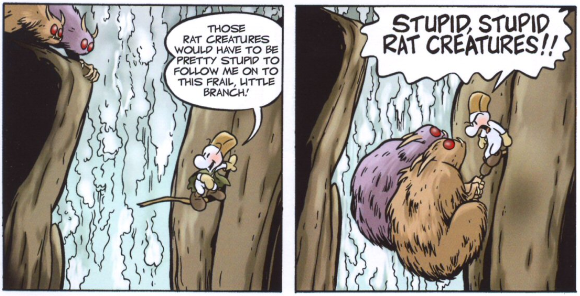
The panels above mark the exact moment at which I fell in love with Bone, the epic comic book series by Jeff Smith. I could provide story context, but really, none is needed. Stupid, stupid rat creatures.

As an artistic medium, comics face unique challenges, such as depicting action and movement in a limited number of small, silent, static panels. I’m sometimes amazed by the ingenious ways artists bring their comic panels to life, and have noticed a number of visual tricks and techniques used to tell stories in comics.

Absurd sound effects are one way, of course. Others include filter effects, blurred backgrounds, and squashing or stretching to represent movement. In Japanese comics (and animation), symbolic shorthand is common: for example, an oversized bead of sweat to represent anxiety or a throbbing vein to represent anger.

Manga iconography

Manga iconography is a visual shorthand for character emotion.

A thing that delights me in the Bone panels above is how economically the artist tells the story. Several actions must occur between the first and second panels, yet the artist doesn’t bore the reader with them. He sets up the joke and then immediately provides the punchline, assuming the reader is clever enough to infer what occurred between panels without having to be shown. It’s quick, efficient storytelling, and I really dig it.

Bone is an incredible comic series. There’s nothing else quite like it: an unlikely blend of The Lord of the Rings with the Pogo comic strip. It’s at once dark and lighthearted, serious and cartoony, and above all, quirky. There are bloodthirsty rat-monsters in one scene, and jokes about Moby-Dick in the next. Heck, one scene even pits the rat creatures against Melville’s novel. (The rat creatures lose.)

Moby Dick Vs. the Rat Creatures

I adore the rat creatures’ expressions in the third panel.

Jeff Smith self-published the first issues of Bone in the early nineties, helping kick start the indie comics movement, and eventually winning boatloads of awards. I was introduced to the series by the same kindly relative who occasionally sends me random books and comics. (I aspire to be that kind of person.)

I began reading Bone a year or so ago—at this point, I own the entire series—but had to set it aside halfway through due to busyness. At the moment, my reading list is dominated by background reading for my book project, but someday I’ll revisit Bone and read it from start to finish, stupid rat creatures and all.
Obligatory Goth Phase

I just realized this blog never went through a goth phase. Given how much I write about depression and other gloomy stuff, I think TMTF really needs a goth phase.

That said, I don’t really like goth music, so I’ll compromise with a hard rock cover of a Simon & Garfunkel song. That’s edgy, right? Simon & Garfunkel’s music is super dark and grim, isn’t it? Isn’t it?

And just watch the music video above. It has wrecked instruments, and ghosts, and, um, what I’m assuming is the river Styx. It’s all in black and white, and the singer seems angry at everything, so I’ll assume it all counts toward this blog’s goth quota.

In seriousness, I’m impressed by the singer’s stentorian voice and the guitar flourishes toward the end. I’m hardly a fan of heavy metal, but this cover manages to be darkly epic while respecting its folksy source material. The video ends on a faintly redemptive note, which is how this blog’s gloomiest posts generally conclude, so that’s apropos.

Welp, I suppose this counts as TMTF’s obligatory goth phase. Now I can go back to making coffee jokes and heavy-handed video game references, thank goodness.

Tadpole Treble

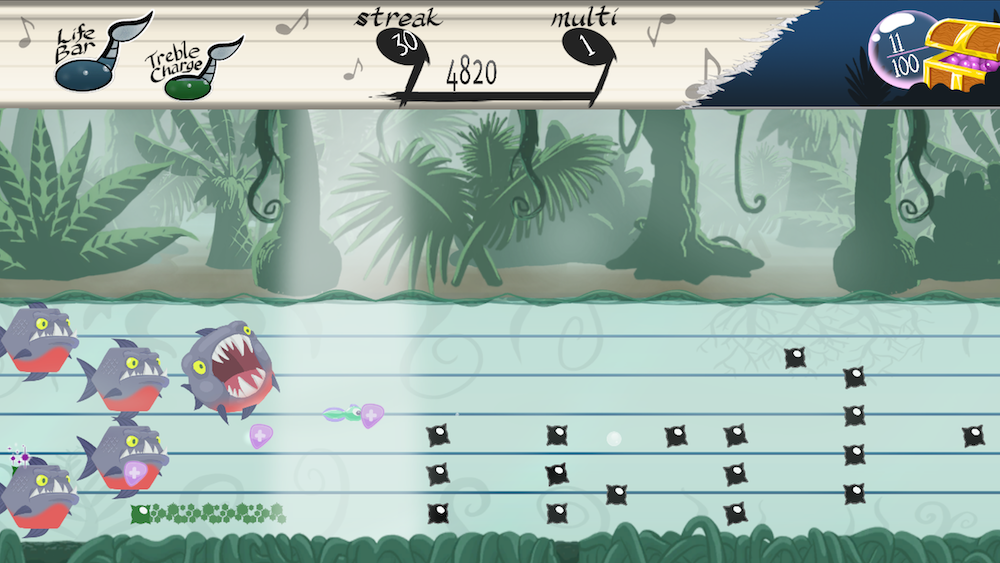
Tadpole Treble is the epic tale of a tadpole lost, alone, and far from home. This tiny amphibian must find her way back, dodging such dangers as piranhas, snapping turtles, and… musical notes.

Huh.

This quirky game is the work of Matthew Taranto, a man whose wise words I literally have framed and displayed on my desk. He created the Nintendo-themed webcomic Brawl in the Family, which ran for about six years. (I mourned its end on this very blog.) Upon concluding the webcomic, Taranto began working full-time on Tadpole Treble.

Each stage of the game is basically a long musical staff, along which players must dodge the notes of the stage’s musical score. It’s a neat intersection of music and gameplay: two elements of game design that are too often disconnected.

Tadpole Treble

The game will be released for Steam (a digital marketplace for video games) in just a couple of days. I’m holding out for the Wii U release later this spring. It was apparently a childhood dream of Taranto’s to make a game for a Nintendo system, and I’m glad he’s finally done it.

In other news, one of the game’s songs, “Thunder Creek,” has been stuck in my head for two weeks.

I don’t usually support indie projects, but when Tadpole Treble showed up on Kickstarter a year or two ago, I tossed a few dollars its way as a small thank-you to Matthew Taranto. Brawl in the Family helped me through one or two really dark days, and he seems like an incredibly nice dude.

If I were a rich man (yubby dibby dibby dibby dibby dibby dibby dum), I would consider donating toward more projects on Kickstarter, and also supporting creative people on Patreon. However, I’m definitely not a rich man, so I’ll have to settle for cheering them on.

Go, little tadpole!

Now This Is How You Teach English!

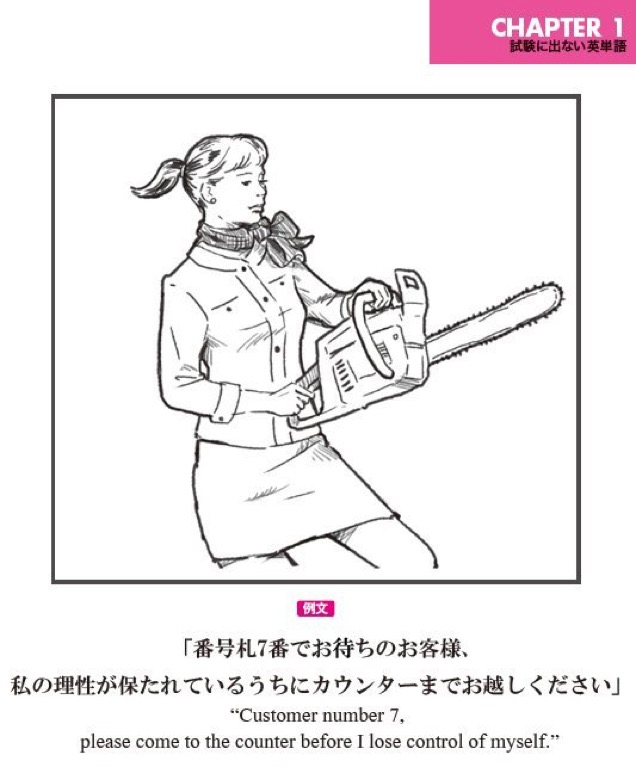
Learning English - Chainsaw

Learning a new language is hard. Fortunately, one brave little book is trying its best to make that arduous process easier, or at least funnier.

English Words That Don’t Appear on Tests is a book for Japanese-speakers learning the English language. It’s certainly… educational.

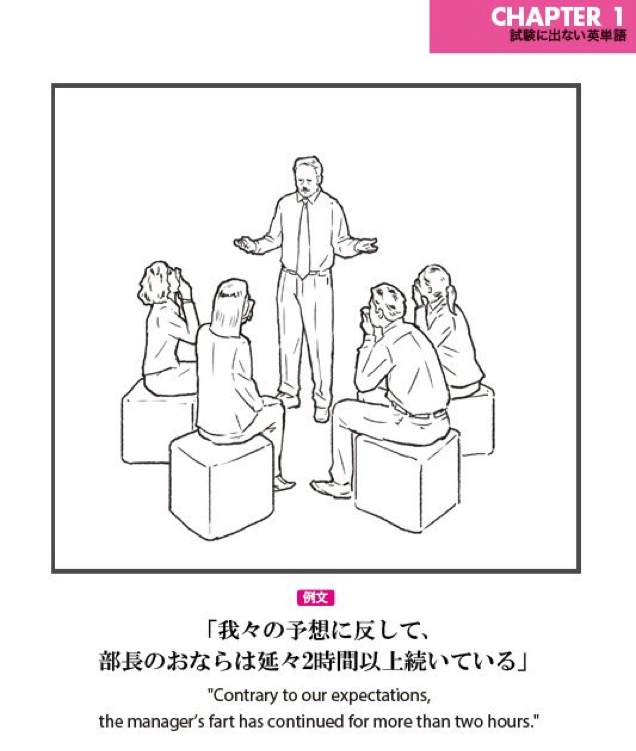
Learning English - FartThis book is apparently an actual thing that exists.

English Words That Don’t Appear on Tests

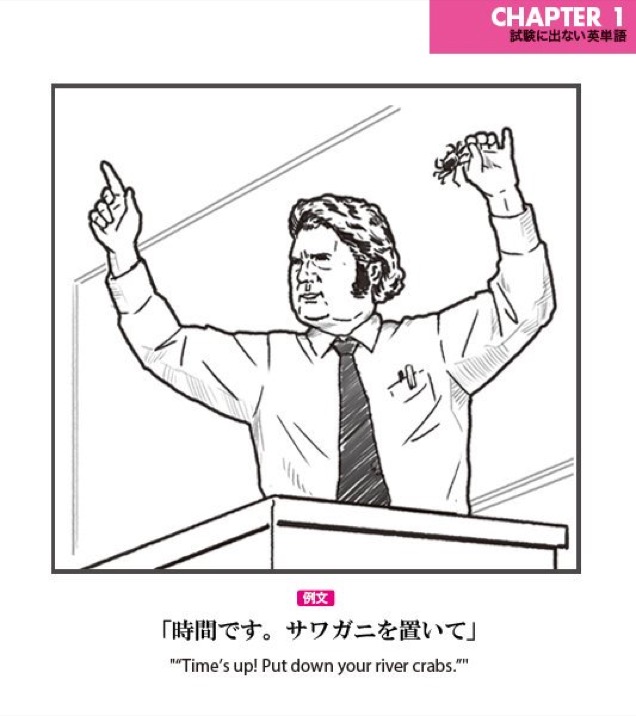
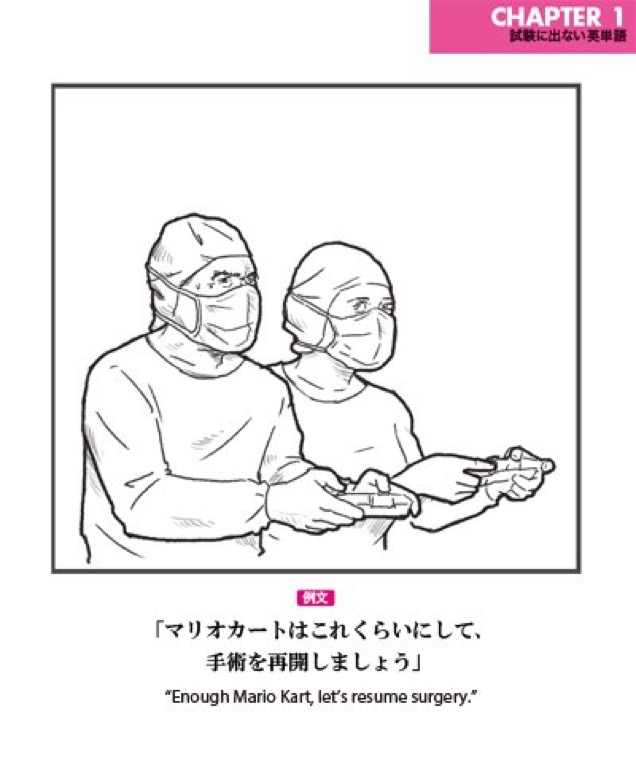
Here, in no particular order, are a few of my favorite pages.

Learning English - River crabs

Learning English - Bra

Learning English - Mario Kart

I have a degree in English Education—no, seriously, I do—and I approve these teaching materials. More can be found at this article on Kotaku. Learn, and enjoy.

Twitch Plays Pokémon; Anarchy Reigns

Cute little Helix

The Internet is a strange place. No, seriously—the Internet is weird, man. A couple of years ago, a social experiment took place that proved, beyond all shadow of possible doubt, that the Internet is really freaking weird.

This experiment, which enlisted hundreds of thousands of participants and amassed many millions of views, pitted anarchy against democracy, wove a surreal narrative of loss and victory, and gave rise to a god.

I speak of Twitch Plays Pokémon, that epic microcosm of Internet weirdness.

You can find the whole story on Wikipedia, so I’ll provide an abridged version. An anonymous programmer launched a “social experiment” on Twitch, a video streaming website. The experiment streamed a version of an old Nintendo Game Boy game, Pokémon Red, which the programmer modified to be controlled entirely by commands typed into the stream’s chat room.

Twitch Plays Pokémon [GIF]

Anyone could join the crowd playing the game by typing in commands, which the game carried out one at a time. As days passed and Twitch Plays Pokémon went viral, thousands of people participated, all typing in commands at the same time to play the game. Chaos and anarchy reigned. It was nuts.

The difficulties of thousands of people all controlling a game at once soon became obvious. Insignificant obstacles such as ledges became insurmountable setbacks. New Pokémon were caught and released more or less at random. (For those who don’t know, the game revolves around catching, training, and battling friendly monsters called Pokémon.)

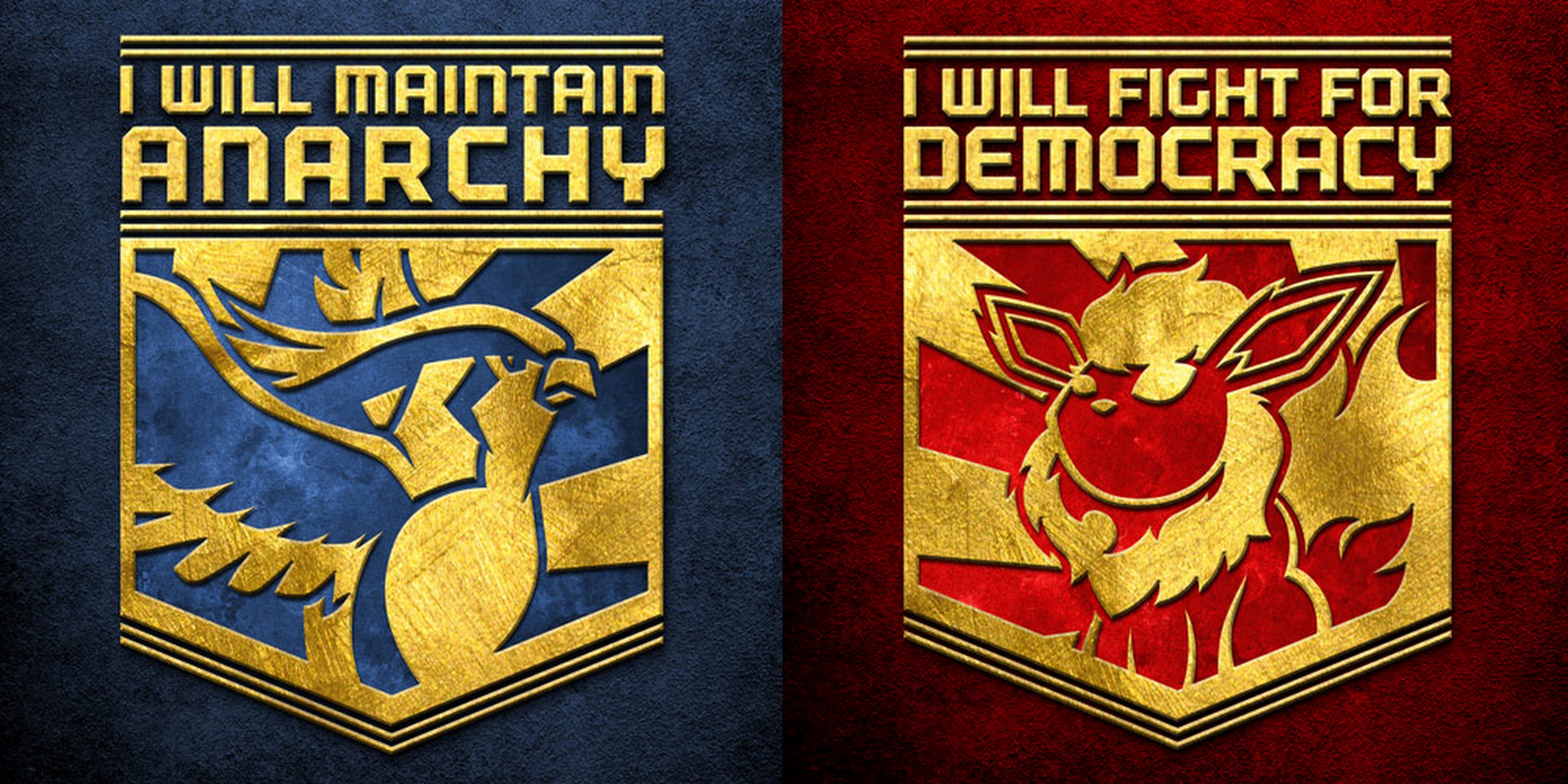
As the days wore on, the stubbornness of sincere players was matched against the sabotage of online trolls. Tweaks were made to Twitch Plays Pokémon to inject elements of democracy into the chaos, to the relief of some and the ire of others. Factions of players rose to support either side. Anarchy and democracy were each assigned specific Pokémon as emblems, and both factions fought for control of the game.

Anarchy Vs. Democracy

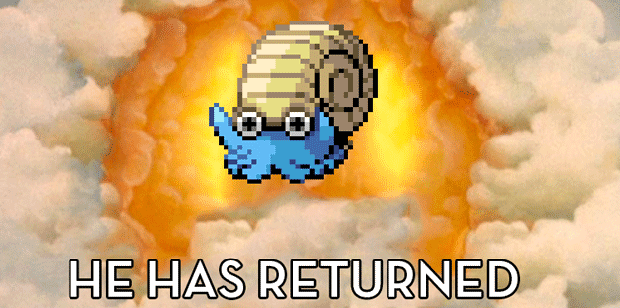
The actions of the game’s protagonist, Red, were understandably random and erratic. For example, due to the conflicting commands that poured into the game, Red frequently checked a useless item called the Helix Fossil during battles instead of fighting. This gave rise to the in-joke among players that he was consulting it for guidance. In turn, this led to the concept of the Helix Fossil as an idol or deity.

When the Fossil was finally revived into a living Pokémon later in the game, players declared the rebirth of a god.

Praise the Helix!As a narrative emerged from Twitch Plays Pokémon, players and viewers alike watched each new development with the obsessive interest of sports fans on the day of a big game. A number of valuable Pokémon were accidentally released in a debacle that became known as Bloody Sunday. New Pokémon were given names, backstories, and allegiances to the factions of Democracy or Anarchy. Memes, fan art, and in-jokes spread like goofy viruses.

All the while, dedicated players kept typing commands into the experiment’s chat box. Red inched ever closer to victory, persevering through all mishaps. Even the loss of the Helix Fossil, his guiding deity, didn’t faze him.

At last, Twitch Plays Pokémon ended in spectacular fashion—Twitch finished Pokémon.

I was vaguely aware of Twitch Plays Pokémon as it unfolded, but never wasted time watching Red’s halting progress through the game. A few days ago, however, I took time to read a brief history of the event, and was struck by its glorious weirdness.

In a way, Twitch Plays Pokémon is a perfect microcosm of many aspects of Internet culture. It was random, unpredictable, and packed with memes and wacky humor. Like YouTube or Wikipedia, it was driven by the involvement of ordinary people. It spawned endless conflicts. Finally, it inspired many intelligent people to treat something totally inane with resolute dedication and seriousness.

After playing Pokémon Red, that Twitch channel went on to play (and replay) many other Pokémon games. I’m pretty sure the Twitch Plays Pokémon project is still going, albeit with a diminished audience. Now that the novelty has worn off, most of the viewers and players have moved on to new things. There are always new things.

After all, this is the Internet.

Try Everything (Except Jelly Beans)

Many of Disney’s greatest hits have been musicals, from the early days of Snow White and the Seven Dwarfs to the golden age of The Lion King to the modern era of Frozen.

Disney’s latest animated movie, Zootopia, is definitely not a musical—in fact, at one point, its protagonist is even told, “Life isn’t some cartoon musical where you sing a little song and your insipid dreams magically come true.” Zootopia does feature one notable song, however: “Try Everything,” a pop number sung by the film’s least necessary character. (Did Disney’s executives assign the film a pop star quota? We may never know.)

“Try Everything,” like “Everything Is Awesome” from The Lego Movie, is simplistic but catchy. It doesn’t soar to the heights of Disney’s great musical numbers, but I like it anyway.

The fan-made version above swaps out the thudding beat and pop influences of the original for brisk percussion and a tropical vibe. I’m pretty sure I heard some marimba and bongos in there, and that’s definitely a samba whistle toward the end. (There’s also a bit of electric guitar, because electric guitars make nearly everything better.) This cover of “Try Everything” is uplifting and airy, and I dig it.

Here’s another take on “Try Everything,” this time as a rock song. Spoilers: It’s still really catchy.

In case anyone is inspired by this song actually to try everything, I recommend giving jelly beans a miss. They’re nasty. Try almost everything. Skip the jelly beans.

A Painting a Day Keeps the Art Block at Bay

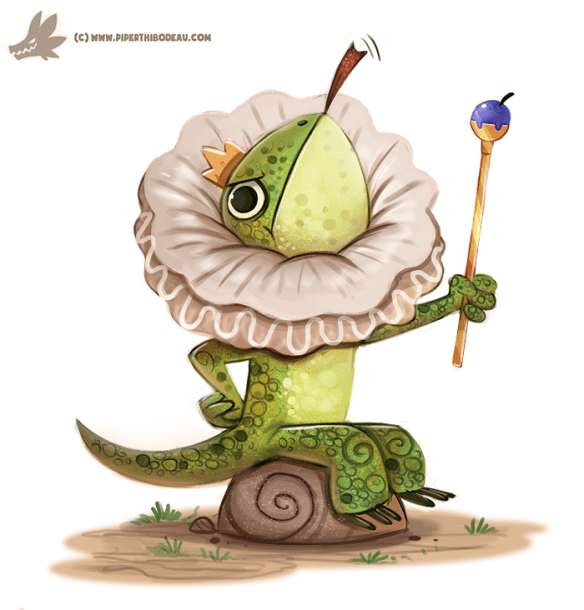
Frilled lizard

Yep, that sure is a frilled lizard. (Art by Piper Thibodeau.)

Art is hard. Art is really, really hard, yet here is an artist who paints a new picture every flipping day. There is a word for such people: dedicated.

Wait, that’s not the word I meant. Masochistic. That’s it. This artist is masochistic.

Nah, I’m only joking. I have nothing but respect for Piper Thibodeau, the artist who creates a brand-new digital painting every day to keep her artistic skills sharp. That’s just bonkers. I mean, heck, I thought writing two and a half blog posts a week was hard! It must take quite an imagination to come up with a new idea for a painting every single day.

A lot of Ms. Thibodeau’s paintings are visual puns. Some of my favorites include crab apples, a Capuchin’o monkey, a pheasant peasant, and a guaca’ mole. Cute art, impressive creativity, silly puns—what more can you ask for?

Geeks Vs. Nerds: A Dorky Comparison

Geek vs. nerd

Comic by Brian Gordon.

I am not a nerd. (At any rate, I like to think so.) I am, however, a dedicated geek. The difference is neatly explained in the comic above. I knew it already, but then I’m totally a dork, so that’s no surprise.

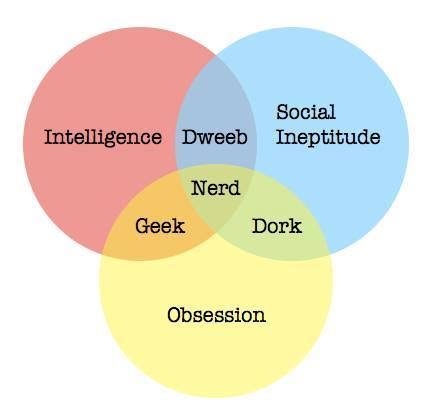
In another attempt to define the differences between such labels, some well-meaning nerd (or possibly dweeb) made the following diagram:

Nerd venn diagramAlthough the diagram was (presumably) made as a joke, it offers unexpected insight. Geeks, nerds, and their ilk are fascinating creatures. They are frequently lumped together in the same sociocultural category, but their differences are worth exploring.

By the way, did you notice that in the last panel of the comic above, the word preferred is misspelled? You didn’t? Huh. Maybe I am a nerd after all.

In Which a Cartoon Bunny Is Adorable

As you may have noticed, I recently saw Disney’s Zootopia. It was fantastic. In the video above, Byron Howard, a director of Zootopia, demonstrates how to draw Judy Hopps, the film’s bunny protagonist.

You apparently start with an S for snake—excuse me, I mean a shape like a gumdrop. Once you have sketched that gumdrop shape, you draw the rest of the bunny’s face. Simple, no?

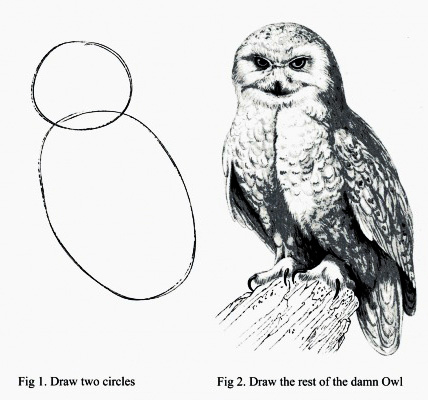
In this regard, drawing a cartoon bunny follows pretty much the same process as for drawing an owl:

How to draw an owlIn seriousness, the video gives excellent step-by-step instructions for drawing Disney’s most adorable character yet. It also gives a shout out to the great Glen Keane, who animated some of Disney’s most memorable characters.

My younger brother, who is quite an artist, has taken to drawing pictures on little pieces of notebook paper and leaving them for me on my desk. He decided to sketch Judy Hopps after watching this video. That picture is now tucked into my lampshade with some of his other sketches. At this very moment, backlit by my lamp, Judy Hopps beams down at me with bright benevolence, threatening to stop my heart with her staggering cuteness.

Heck, I shouldn’t have said that. It was insensitive, and I apologize.

Technology Is Confusing

I like to think I know a thing or two about technology. As a millennial, I consider myself competently tech-savvy, able to function in today’s high-tech world.

…Nah, whom am I kidding? I can’t even hook up my brother’s Wii U without his guidance. Why doesn’t it use the same AV cable setup as other devices? How do I make it connect to the Internet? Why are there so many downloads?! Back in my day, I just blew the dust out of the game cartridge, slammed it into the Super Nintendo, and turned it on.

I’ve become a relic of a bygone age, and I’m only in my twenties. I hate to think of how technologically illiterate I’ll be in fifty years. Maybe, at that point, I’ll have robots to hook up my electronics for me. We’ll see.