338. Strange American Valentine Rituals

The United States of America has many strange customs and holidays, and I consider it my duty to research them. With St. Valentine’s Day taking place tomorrow, I set my studies of Halloween and Thanksgiving behind me in order to give this latest holiday the anthropological scrutiny it deserves.*

My findings were… dark. Despite its popular image as a time for giving gifts and expressing romantic love, St. Valentine’s Day represents bloodstained history and wanton consumerism.

Verily, of the various letters vividly visible above, the very first veers vaguely toward the visual vibe of a violent yet entertaining film I once viewed.

Verily, of the various letters vividly visible above, the very first veers vaguely toward the visual vibe of a viscerally vicious and violent film I once viewed: V for Valentine, or some variation.

As the holiday is named for a historical figure, my first task was to research St. Valentine himself. Little is known of this ancient Roman martyr, whose death is celebrated every year in America by the sale and distribution of gifts such as flowers, chocolates, cookies, cards, jewelry, and frilly undergarments. St. Valentine, who is known as Valentinus in some accounts, is surrounded by legends, but few facts remain.

Upon finding the study of this dead saint to be a dead end, I turned my researches toward the holiday itself, and discovered a sordid celebration of Valentine’s demise.

The name of the event, St. Valentine’s Day, is generally shortened to Valentine’s Day by the disgraceful omission of Valentine’s hagiographic title. Just as the Christmas season is marked by certain colors (viz. red and green), so Valentine’s Day is recognized by the colors red and pink.

The significance of these colors is open to speculation. Given what little is known of St. Valentine’s personal history, the color red may represent his violent death as a martyr. Pink generally represents love or sweetness; its association with the bloody red of Valentine’s death demonstrates a disturbing veneration of violence.

More than fifteen centuries after Valentine’s tragic end, why is it celebrated by the giving of gifts? Why is romantic love the legacy of Valentine’s martyrdom? What aspect of his brutal death inspired sappy cards, heart-shaped candies, and other mawkish gifts?

These are distressing questions, and my best researches have yielded no answer.

Do you know what else is distressing? These awful pills. I don't know what kind of medication they contain, but they taste awful.

Do you know what else is distressing? These awful tablets. I don’t know what kind of medication they contain, but they taste awful.

Perhaps it would be prudent for me to narrow the lens of my researches from the purpose of the holiday to its specific observances.

The greatest tradition of Valentine’s Day seems to be buying things, such as the aforementioned flowers, candy, cookies, cards, jewelry, and lingerie. This eclectic assortment of romantic items has no discernible connection to Valentine himself, leaving me to surmise that their popularity as Valentine’s Day gifts is prompted by the theme of romantic love that has left its indelible and inexplicable mark upon the remembrance of that saint’s death.

Never mind the occasion—coffee is always an appropriate gift.

Never mind the occasion—coffee is always an appropriate gift.

Although these gifts are generally exchanged by romantic partners, it is common for celebrants of Valentine’s Day to distribute cheaper and less intimate gifts among friends, classmates, and coworkers; candy and cards are among the most popular options. Other Valentine’s Day traditions observed in America include going on dates or to parties.

A romantic card or letter given on Valentine’s Day is known as a valentine. This eponymous designation is shared by any person to whom such a card or letter is given.

(If I may permit a personal view to interfere with my serious studies of American holidays: I strongly opine that video game valentines are the best valentines.)
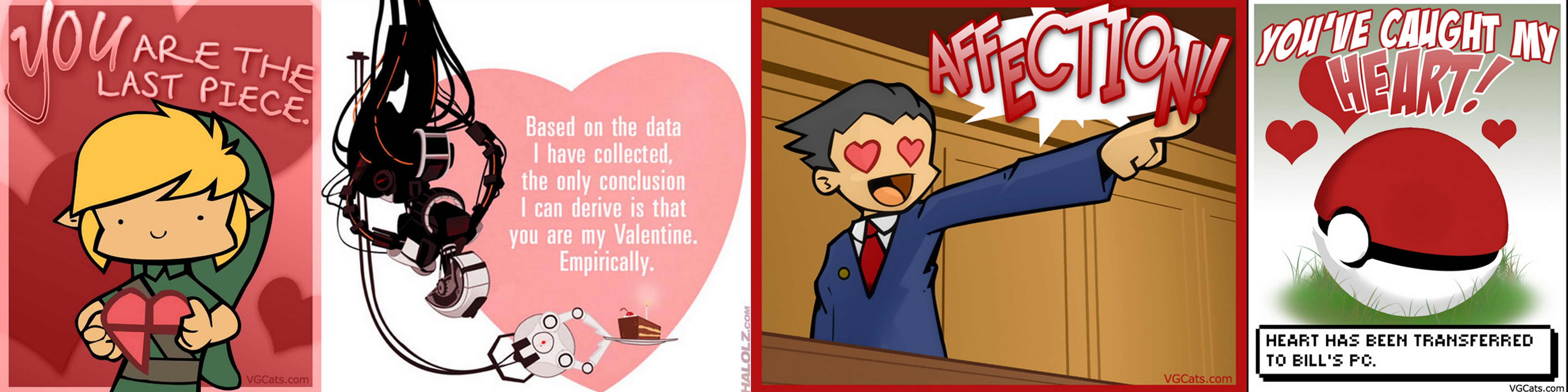
If you recognize all of the games represented in these Valentine's Day cards, you deserve a cookie.

If you recognize all of the games represented in these valentines, a winner is you!

In conclusion, Valentine’s Day seems to celebrate the violent death of a good man, associating it (for dark, unknown reasons) with romantic sentimentality. I acknowledge, regardless, the importance of the virtues venerated by the holiday—to wit, love and friendship.

Thus, with sincerity and due caution, I wish you a happy St. Valentine’s Day.

*I should remind my dear readers that my studies of American holidays are silly, sarcastic, and absolutely not serious. This blog post is a joke. Please don’t take it seriously!
A Caffeinated Romance

St. Valentine’s Day is coming up. (Yes, I insist on referring to the holiday as St. Valentine’s Day, because I am a grouchy traditionalist.) It’s a time for people in relationships to express their affections, and for single people to feel awkward. St. Valentine’s Day is also a time for coffee, but let’s be honest—it’s always time for coffee.

“Taylor the Latte Boy” is my all-time favorite romantic song. (Well, the video above actually features two songs: “Taylor the Latte Boy” and its response, “Taylor’s Rebuttal.”) What could be more romantic than a guy and a girl falling in love over coffee? The girl’s passionate tale of love, longing, and lattes is only slightly marred by the guy being absolutely not interested.

Coffee, love poetry, and the possibility of a restraining order: “Taylor the Latte Boy” has it all. This two-part song is on the longish side, but if you have time, I absolutely recommend it. The parts of Taylor and his admirer are performed well, and the differences between their points of view are hilarious.

In the end, I think we can all agree that caffeinated romances are the best kind.

337. Hello Darkness, My Old Friend

Do know what I hate?

Yes, I detest cockroaches. I despise butchered hymnsshady Internet ads, and the fact Black Friday happens one day after Thanksgiving. I dislike the Twilight books, and I loathe M. Night Shyamalan’s wretched film adaptation of Avatar: The Last Airbender. (I’m trying to forgive you, Shyamalan, but your abysmal Airbender movie tests even the Christian virtues of grace and mercy.) These are all awful things.

There is something I hate more than any of them.

I hate feeling bad and not knowing why.

Have you heard the (scientifically dubious) anecdote of the boiling frog? As the story goes, a frog placed in boiling water will jump out immediately, but a frog submerged in lukewarm water that is heated gradually will eventually be cooked to death.

Depression slowly boils me alive. It sneaks up on me so slowly and insidiously that I sometimes go days without realizing it. The world simply goes dark. I find it harder and harder to work, write, smile, relax, or do anything but slump in a chair and keep breathing. My descent into depression is so gradual that I don’t ask, “Why am I depressed?” My question is usually more like, “Has the universe always been this awful?”

Then, nearly always, there comes a moment—a blinding flash of hope and clarity when I realize, “Hold on a moment. I’m depressed. Huh, that explains a lot.” The moment I realize the universe isn’t really quite as dark and hopeless as it seems is generally the turning point in every bout with depression.

For my readers wondering how a person can be depressed without knowing it, I must ask a question. When you dream, do you realize you’re dreaming? Few people have the self-awareness to recognize a dream until they awaken. In the same way, I apparently lack the self-awareness to recognize depression right away.

Recognizing depression is generally my all-important first step in recovering from it. Depression makes it seem as though something is wrong with everything. When I realize I’m depressed, I understand there is merely something wrong with me. The problem no longer lies with the entire universe, but with one person in it. Believe me when I tell you that depression, however unpleasant, is a nicer problem than everything in existence being awful.

If I may put it so tritely: naming a fear is taming a fear. A problem is less scary when it’s a familiar one—especially when I know it’s one I’ve conquered before. When the world seems dark, I can smile grimly and echo the words of Paul Simon.

“Hello darkness, my old friend.”

I might add a few words to Mr. Simon’s and say, “I’m afraid you can’t stay long; I’ve got stuff to do.”

336. Four Quotes to Guide a Life

In the past few months, I’ve done some redecorating in my apartment. For example, on my desk—well, I suppose I should start by point out that I now use a desk. I had previously slumped in an armchair, balancing my laptop on my knees and probably causing gradual, irreparable damage to my spine.

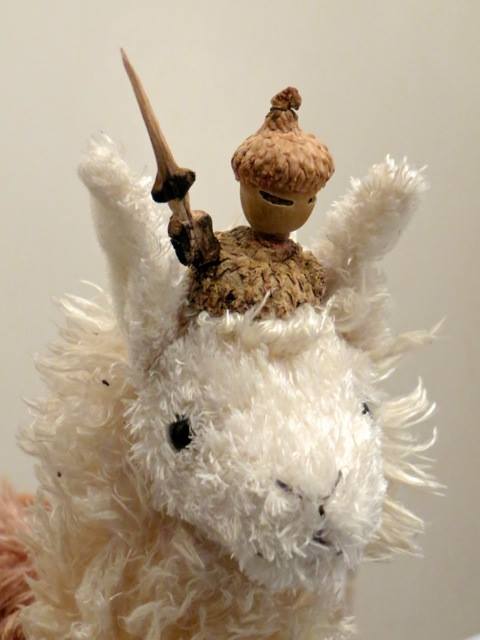
Yes, I’m now using a desk, and I’ve added a few personal touches. For example, a plush llama stands near my laptop. Beside it, a wooden warrior stands guard and holds his sword high; my dad cobbled together the brave little fellow from acorns and bits of wood.

Llama warrior

“CHARGE ’EM AND THEY SCATTER!”

My desk is decorated by one last personal touch: four quotes scribbled on a piece of paper and framed. The frame is cheap; I picked it up from Walmart a while back. The quotes, unlike their little frame, are invaluable. In past months, as I did my best to tidy up my life, each of these quotes made an impression on me.

I’m sharing these quotes today for a few reasons.

  1. Each of these quotes represents an idea I consider extremely important.
  2. I hope my readers may find these quotes helpful, inspiring, or meaningful.
  3. I didn’t feel like writing a proper blog post.

When I wrote down these quotes, I emphasized a few words because I read some comics recently and liked the way comic-book dialogue puts words in bold for emphasis. Don’t judge me.

With that, I’ll quit babbling and yield this post to four wise people: a web cartoonist, a saint, a writer, and a Savior. Their words inspire me, and I hope they inspire you.

“It is not about you. It is about everyone else.” ~ Matthew Taranto


“Not all of us can do great things, but we can do small things with great love.” ~ Mother Teresa


“If you continue to love Jesus, nothing much can go wrong with you, and I hope you may always do so.” ~ C.S. Lewis


“My grace is sufficient for you, for my power is made perfect in weakness.” ~ Jesus Christ

Moogle

Make it happen, Google.

For the uninitiated: Moogles are small, furry creatures from the Final Fantasy series of video games. They’re known for selling stuff, being adorable, and saying “kupo” a lot. (Don’t ask me what kupo means, or why moogles have antennae with fluffy pom-poms; I neither know nor care.)

Moogles are an important reminder that life isn’t all dragons, monsters, swords, and sorcery. At the end of the day, no matter how many friends you’ve lost or villains you’ve slain, it’s important to appreciate the things that are cute.

335. About Storytelling: Christians Are Evil

Those Christians, I tell you! They’re all so evil. All of them! If you don’t believe me, just switch on the television or go to the movies. Hollywood proves that Christians are evil, because Christians are often depicted as villains, and the media is always right.

Right?

Seriously, though—why are Christians so often portrayed as horrible people in the media? Why are books, movies, TV shows, and video games full of perverted priests, prejudiced pastors, and sinister ministers?

Consider Warden Norton from The Shawshank Redemption, a film based on a story by Stephen King. (I haven’t read any of his books, but I’ve heard Stephen King uses Bible-thumping Christians as a lot of his villains.) Warden Norton is an awful person. He mistreats prisoners in his care, denies them justice, accepts kickbacks, murders people, and generally makes himself unpleasant. All the while, he quotes the Bible and assumes God is on his side.

Evil warden

God loves you, but Warden Norton will probably shoot you in the face.

Even when Christians in fiction aren’t evil, they’re often well-meaning but ignorant simpletons. Take Marvel’s Agents of S.H.I.E.L.D. I really enjoyed the series, but one episode irritated me. It was the episode featuring a Christian, and she was a bland, weepy, superstitious ditz.

Why are Christians portrayed so badly in the media? There are actually quite a few reasons.

It can be ironic or scary when a supposedly “good” person is evil.

There’s an artistic irony when a righteous person is actually wicked. It’s also pretty freaking scary. Who isn’t disturbed when a good person turns out to be a bad one?

Religious people have power and influence, which makes them great villains.

Priest and pastors have influence over groups of people. What happens when religious leaders are evil? They command the loyalty of their followers—even when that loyalty is innocent or well-intentioned. Religious leaders have power and authority, which can be easily turned to wicked ends.

Religious people sometimes do horrible things.

I hate to say it, but there’s a little truth in the portrayal of priests as pedophiles and preachers as charlatans. Christians, and people who call themselves Christians, have done some awful things. The media reflects that.

No secular media group wants to be accused of proselytizing.

Media groups exist to make money. Unless they produce religious media, these companies don’t want to be accused of pandering to Christians or spreading religious propaganda. Creating a genuinely Christian character puts media groups at risk of seeming to push a religious agenda. It’s safer to fall back upon familiar stereotypes like the evil or ignorant Christian.

Some religious traditions are spooky.

Have you ever stepped into an old-fashioned cathedral? You should try it. Little noises are echoed and magnified. Candles light the vast, empty gloom. Stained glass windows depict sad, soulless saints. Somber Christs hang in perpetual agony on crosses and crucifixes. Some Christian customs and traditions are frankly a bit creepy. They really build an atmosphere for villainy.

Some people just hate religion.

I’m looking at you, Philip Pullman.

As much as I understand these reasons for creating lousy Christian characters, I’m tired of the stereotypes. Am I the only one who thinks most depictions of Christians in the media are offensive? If other groups were so badly stereotyped, there would be outrage. Why is it socially acceptable to portray Christians as universally evil or ignorant?

It’s a problem, and I have two suggestions for resolving it.

First, do your research and create Christian characters that actually represent Christianity.

I’ve already touched upon this, but I’ll say it anyway: religious stereotypes are not only offensive, but usually incorrect. Joss Whedon, God bless him, understands this. Whedon is an atheist, yet he created a character named Shepherd Book who is genuinely Christlike.

Shepherd Book demonstrates a good understanding of Christian doctrines, and an equally good sense of humor. He is devout, patient, kind, and generous. To put it simply, Shepherd Book is represented by the media as a great character and a good Christian. It can be done.

The good Shepherd

Learn from the good Shepherd.

I’m not asking anyone in the media to create religious propaganda. I’m asking everyone in the media to create Christian characters that aren’t shameless hypocrites, greedy shysters, arrogant bigots, filthy perverts, sociopathic lunatics, or well-intentioned idiots. Is that really so much to ask?

Second, it’s perfectly fine to create characters that are evil Christians—just don’t be lazy about it.

I occasionally recommend an anime called Trigun. Set on an arid planet in the distant future, Trigun is basically the Old West in space. My favorite things about the show are its two main characters, Vash the Stampede and Nicholas D. Wolfwood, and their strained friendship.

Vash is an expert marksman, unbridled optimist, and wandering hero. He lives by a philosophy of “love and peace,” refusing to kill anyone. “Ain’t it better if we all live?” he asks.

Vash and his philosophy are tested by Wolfwood, an itinerant preacher who carries a literal cross wherever he goes. (When a bystander remarks that the cross is heavy, Wolfwood quips, “That, my friend, is because it’s so full of mercy.”) Despite his merciful profession, Wolfwood’s philosophy is a harsh one. There’s an Old Testament justice in his actions. He won’t hesitate to execute a bad man.

The bad shepherd

You do not want to cross this man. (Pun intended. I’m so, so sorry.)

The thing about Wolfwood is that he himself is a bad man. He drinks, smokes, sleeps around, and kills quite a number of people. (Wolfwood’s cross is actually a machine gun with compartments for handguns, which is either blasphemous or awesome.) Even his theology is flawed. However, in spite of his faults, Wolfwood is a complex character. He sees violence as a necessity, and regards the world’s evils (and his own) with determined resignation.

To put it simply, Nicholas D. Wolfwood is a good bad Christian. He manages to be a Christian and a bad person without ever becoming an insulting stereotype. It doesn’t take offensive clichés to portray Christians as bad people. It can be done.

Christians are generally depicted very badly in the media. That needs to change. Christians—even the bad ones—can be treated fairly, and they deserve to be.

334. TMTF Reviews: Shovel Knight

Shovels and video games are not a promising combination. In fact, one of the worst catastrophes in the history of electronic games was the Atari game burial, when thousands of unsold games were buried in a landfill. This set a precedent for the term shovelware, which TMTF once defined as “Badly-designed games fit only for taking up space in landfills.” No, shovels and video games don’t mix well.

Thanks to one brave little knight, however, that may be changing. Shovel Knight is a game I really wanted to play. Last month, I finally picked it up and played it.

Did I unearth a treasure in Shovel Knight, or should I have left it buried?

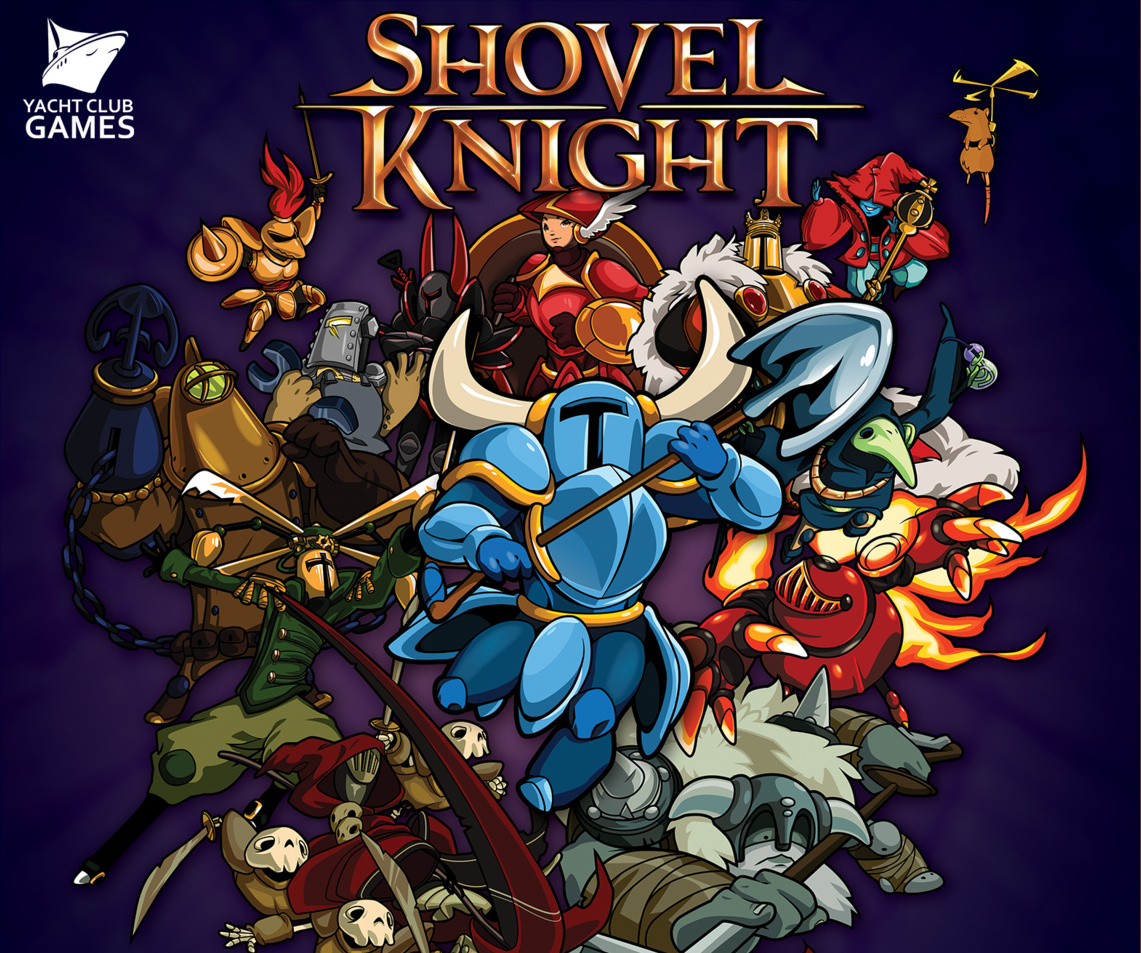
Shovel Knight

Shovel Knight (PC, Nintendo 3DS/Wii U eShop; 2014)

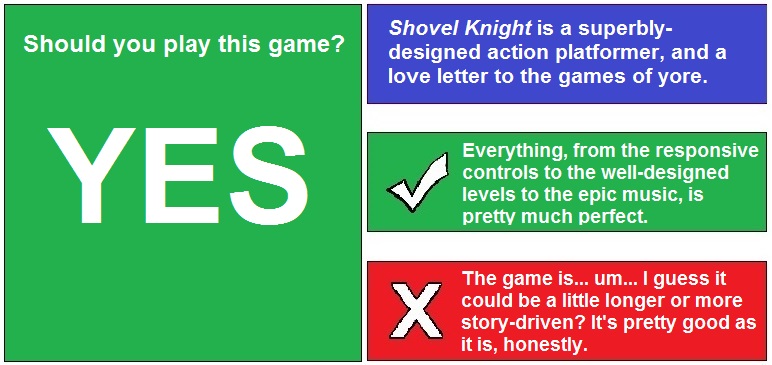
Shovel Knight is a near-perfect blend of responsive controls, challenging level design, retro-styled visuals, and whimsical humor—to wit, I really dig this game.

TMTF Reviews - Shovel Knight

Of Shovels and Chivalry

Once upon a time, Shovel Knight and Shield Knight roamed the world in search of treasure and adventure. Tragedy struck, however, when a cursed amulet stole Shield Knight, driving Shovel Knight to a life of grief and solitude. Time has passed. An evil Enchantress has arisen. Her ruthless Order of No Quarter, a band of eight wicked knights, terrorize the land. In his quest to find Shield Knight and rescue the realm, Shovel Knight must take up his tool and fight.

Shovel Knight, like the Shantae games, is heavily inspired by the games of yore. (Shovel Knight and Shantae have much in common; the same composer and some of the same developers worked on both.) Shovel Knight borrows its level designs and basic gameplay from the Mega Man games, its map from Super Mario Bros. 3, its towns from Zelda II: The Adventure of Link, and one of its moves from that improbably awesome DuckTales game.

(Fun fact: The original DuckTales has a remake scored by the same composer as both Shovel Knight and Shantae—the guy really gets around!)

My point is that Shovel Knight is built on the solid foundation of older games, and that’s a good thing. In fact, it makes me rethink my criticism of Shantae and the Pirate’s Curse for being “awfully familiar.” It’s important to innovate in game development, as in any other creative medium, but there’s also something to be said for perfecting what has been done before. Shovel Knight is built of old parts, but they come together to make something really special. What it lacks in innovation, it makes up in technical excellence.

Shovel Knight screenshot 2

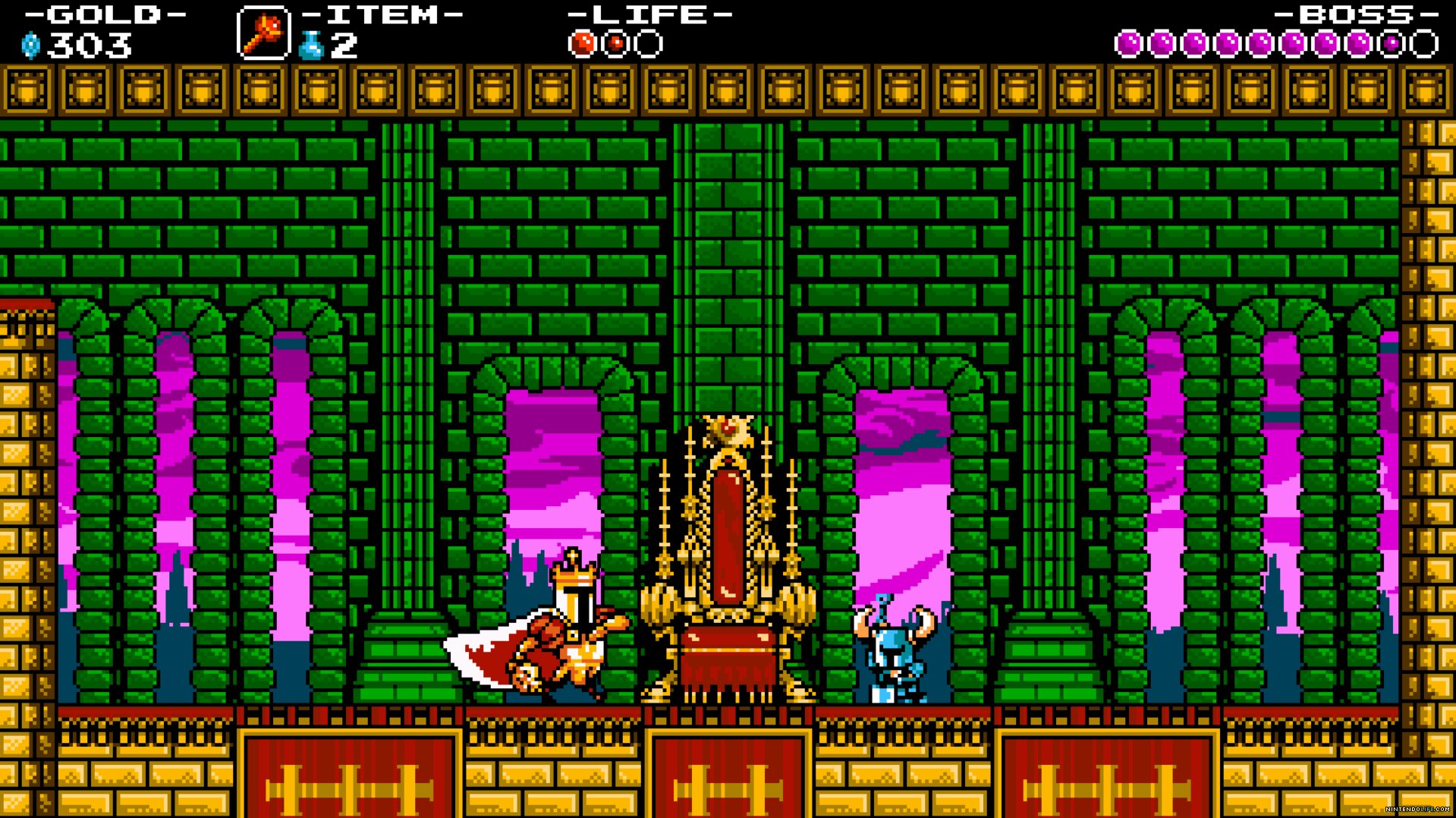
The controls in Shovel Knight are tight and responsive, allowing the eponymous hero to slash, hack, jump, thrust, and bounce with perfect precision. That’s fortunate, for the levels are extremely challenging. The platforming can be tricky; traps, enemies, and obstacles only make things more difficult. I was relieved, however, by how fair the game is. It doesn’t sabotage the player with poor controls, obtuse level design, or deliberate tricks. Shovel Knight can be a hard game, and most players will die a lot, but they’ll have no one but themselves to blame for it.

The levels are terrific. They scroll horizontally and vertically, and not a screen is wasted: every room and area has some new challenge, and there are plenty of secrets to find. Visually, the game boasts pixelated, old-timey visuals on the same color palette as the old Nintendo Entertainment System. Shovel Knight looks (and plays) like a long-lost NES game, plus a few modern tweaks and minus the bad writing ubiquitous in the old days.

Shovel Knight screenshot

Besides his namesake weapon, Shovel Knight wields relics, a wide assortment of weapons and equipment bought from Chester, a wandering merchant who hangs out inside treasure chests (get it?) hidden in most levels. Money can also be used to buy shovel upgrades, new suits of armor, health boosts, and other bonuses.

Among other collectibles, Shovel Knight allows players to gather sheets of music that can be exchanged for songs and in-game cash. Speaking of music, the game’s soundtrack is phenomenal in a shrill, electronic sort of way. Seriously, listen to its main theme.

If that doesn’t give you feels, you may have no soul.

Adventure in Spades?

This is normally the part where I criticize a game for its flaws. With Shovel Knight, I have to look really hard. Prepare yourself, dear reader, for Adam at his most hypercritical.

NITPICKING POWERS ACTIVATED!

There’s not much story in Shovel Knight. It doesn’t need a complex story—the game is tons of fun to play—but more plot and characterization would have been nice. It’s sort of a Super Mario Bros. story: girl is taken, hero must rescue her, etc. There are one or two twists, and the Order of No Quarter are likable enough as characters, but the simplistic story feels like a missed opportunity.

Shovel Knight is a pretty short game. I actually appreciated that—I don’t have as much time for video games as I wish I had—but players expecting a long quest may be disappointed by its brevity.

Besides its difficulty, which is matter of preference, that’s pretty much everything I can find to criticize in Shovel Knight.

…And They Lived Happily Ever After, You Dig?

Shovel Knight is a game as pleasant and stalwart as its horned hero. It’s old-fashioned, challenging, and not for everyone; I know a couple of people who don’t much care for it. All the same, I love it, and I recommend it wholeheartedly.

The game is a well-written, beautifully-designed, gorgeously-scored love letter to the video games of the eighties. Like those games, Shovel Knight proves you don’t need fancy graphics, elaborate storytelling, or extravagant pageantry to make a game.

No, all you need is a shovel and a little courage.

333. I Know Nothing

Today’s post was written by JK Riki: animator, blogger, and creator of Fred the Monkey. (FtM is a Homestar Runner-esque collection of web cartoons; I discovered the site a few years back.) As a blog run by monkeys, Typewriter Monkey Task Force is honored to share JK’s reflections on how little we know. For more great stuff from JK, check out his blog and Twitter. You may also want to swing by Animator Island, for which he writes.

I listed one of my 2015 goals on my blog as “Write a guest post for somewhere.” A big thanks to Adam for allowing me to commandeer his blog for the day.

In trying to determine what my goal-achieving guest post might be about, I poked around Typewriter Monkey Task Force to get a feel for its style and purpose. What I found was an amazing collection of thoughts and writings from a clearly deep individual. I started to worry whatever I came up with might not meet the level of aptitude already found on TMTF. (I included the word aptitude here specifically to try to elevate my game.)

[Editor’s note: I did not bribe JK to say nice things about my blog, I swear! He’s just a really kind person.]

Since there is no lack of depth in the topics of this blog, now seems as good a time as any to wade a bit deeper into the Great Pool of Thought and submit a few ideas that most people never bother with. A large number of our human species is content to go about the day-to-day and never really step back to consider alternative perspectives. I love alternative perspectives. Their greatest gift is a swift kick in the rear and exclamation of “There’s so much you don’t know, don’t forget that.”

So I share with you this simple truth: One of the best things you can ever achieve is the realization of how much you don’t know.

There’s a time and place for confidence, of course. If you’re performing brain surgery on someone, that might not be the best time to ponder string theory, dimensional variants, or that cutting into this person’s brain may be affecting atoms directly on another planet someplace light years away and who knows what havoc that is causing.

But when not engrossed in an activity where lives hang in the balance, consider stopping and thinking about how limited we are as humans. We can’t hear color. We can’t smell intention. We don’t know what we don’t know. Think about that. There are things we can’t imagine. They are beyond the scope of our understanding and reality. Yet that doesn’t mean they don’t exist. They could be (and very likely are) floating around us at this very moment, beyond our human senses.

What I discover any time I do this exercise of remembering how little I know is that suddenly I’m a lot more compassionate of everyone around me.

People who know more than me in some areas, and less in others, are in the same boat I am. We’re all on this journey of life, and all at different places on the road. Though it baffles me when I meet someone twice my age who hasn’t realized basic truths I’ve learned, I have more patience with them, knowing there’s plenty I have yet to realize myself. While it’s frustrating to speak with a teenager who “has it all figured out,” I’m able to remember I also once had “it all figured out,” sure that I knew everything there was to know. And in that moment I’m deeply grateful for the knowledge of how little knowledge I actually have. I never want to go back to thinking I knew it all. Dangerous pride lies in wait there.

Of course, any time you take a trip to the deep end of the pool it’s essential that you carry along a life preserver, and that you make certain it’s firmly attached to something that will not let you drown. When you take a swim in deeper thought, and consider the vastness of the universe seen and unseen, I highly recommend tossing the end of that rope to God. He never lets you drown, and He also knows what’s in the very depths of the pool. Plus He’s unbelievably patient. He won’t wander off and leave the rope tied to a fence post!

I have, in the past, handed the rope to people I trusted. Unfortunately, people fail. We’re only human. It is what it is. We don’t mean to let others drown, we just aren’t strong enough to pull them back, and we get distracted easily. So just be careful if you decide to sit and ponder today. The water is warm, but very deep, and we often overestimate our swimming abilities. Take along with you a helping hand, and by all means dive in and see what you see.

What you’ll find is truly amazing.

332. Geek Studies

Geeks are fascinating creatures.

Believe me, I should know. I’ve spent a lot of time among geeks, observing their behaviors and gathering data. In fact, in the interests of full disclosure and journalistic integrity… I must confess that I myself am totally a geek.

Yes, I can imagine the disbelieving astonishment in your expression. Who could have imagined that Adam Stück, of all solemn and serious people, has been a geek all along? I’ll give you a moment to get over your shock.

As I said, geeks are strange and marvelous creatures. Geeks, and the cultures they create, are worth studying.

Et-Webscout16

Geek culture, you say? Fascinating! I must science it immediately!

What is a geek? The simplest definition for a geek is a person with a strong interest in something. A geek is not a nerd, though a person can be both. A nerd is intelligent, generally introverted or asocial, and sometimes (but not always) socially inept. Although geeks are often stereotyped as nerds, anyone can be a geek. Sports fans, college professors, or motorcycle enthusiasts can be geeky about their respective interests.

Geeks are usually ordinary people with a passion for something trivial—a book, sport, hobby, video game, television series, or something else. Besides having a strong attachment to their objects of interest, geeks usually know a lot about them. Once you get geeks talking, it can be really hard to shut them up. Geeks can have more than one object of interest, of course. I have many!

The thing that fascinates me most about geeks is the instant solidarity and understanding that often springs up between them. A common interest, no matter how trivial, can unite people of all cultures, races, nations, languages, beliefs, and opinions. A shared love of soccer, Star Wars, or world history brings together the most unlikely people. Geeks frequently set aside personal differences; the wolf lives with the lamb; the calf and the lion and the yearling quit arguing about religion or politics and go out for coffee.

I’ve done a little informal research into geek culture, and I’d like to do more. Brief studies of geek culture shall join About Storytelling posts, TMTF Reviews, and Why [Insert Author Name] Is Awesome posts as an occasional feature on this blog.

Anthropology isn’t exactly my field, true, yet I have what Liam Neeson would call “a particular set of skills.” My skills, unlike Liam Neeson’s, mostly involve geeky things like winning Mario Kart races and rambling about J.R.R. Tolkien. I consider myself highly qualified to discuss geek culture. In fact, some time ago, I went so far as to create a geek studies tag for TMTF and add it to a bunch of old posts… which, I suppose, makes me guilty of retconning my own blog.

What’s that? You’re wondering what retconning means? Don’t worry about it. Retconning is a geek thing.