485. Out of Steam

I had planned to write a Serious Post for today, but instead spent my weekend hanging out with my family. I regret nothing.

My older brother and his family will return to the Dominican Republic in just a couple of days, and my parents will move to Spain a couple of days after that, so I’m glad I spent time with them.

It’s late, however, and I’m totally out of steam. Never fear! THE BLOG SHALL GO ON. It will take more than a busy weekend to slow TMTF’s ponderous march toward its imminent end. I’ll work on it this week.

For now, please accept my apologies, along with this picture of my cat.

Pearl-cat

484. I ♥ Majora’s Mask: A Halloween Special, Part 2

This post concludes a two-part Halloween special. You can read Part 1 here!

Let’s pick up with the characters.

The characters

As I mentioned in Part 1, the characters in Majora’s Mask are incredibly well-developed, thanks largely to the game’s three-day cycle. Many characters have their own stories that play out over the game’s span. As the player repeats the cycle, she can get to know these characters, and can even help them.

Over the game’s three-day span, the innkeeper waits faithfully for her lost love to return. Her lover hides in shame, unable to break a curse on his body. The circus troupe leader finds out that their event is canceled; unable to face his troupe, he tries to drink away his sorrows. An orphaned rancher loses her younger sister to creatures from the sky. The postman delivers letters to the very end, shaking in terror, unable to break his dedication to deliver the mail come rain or shine—or fiery death.

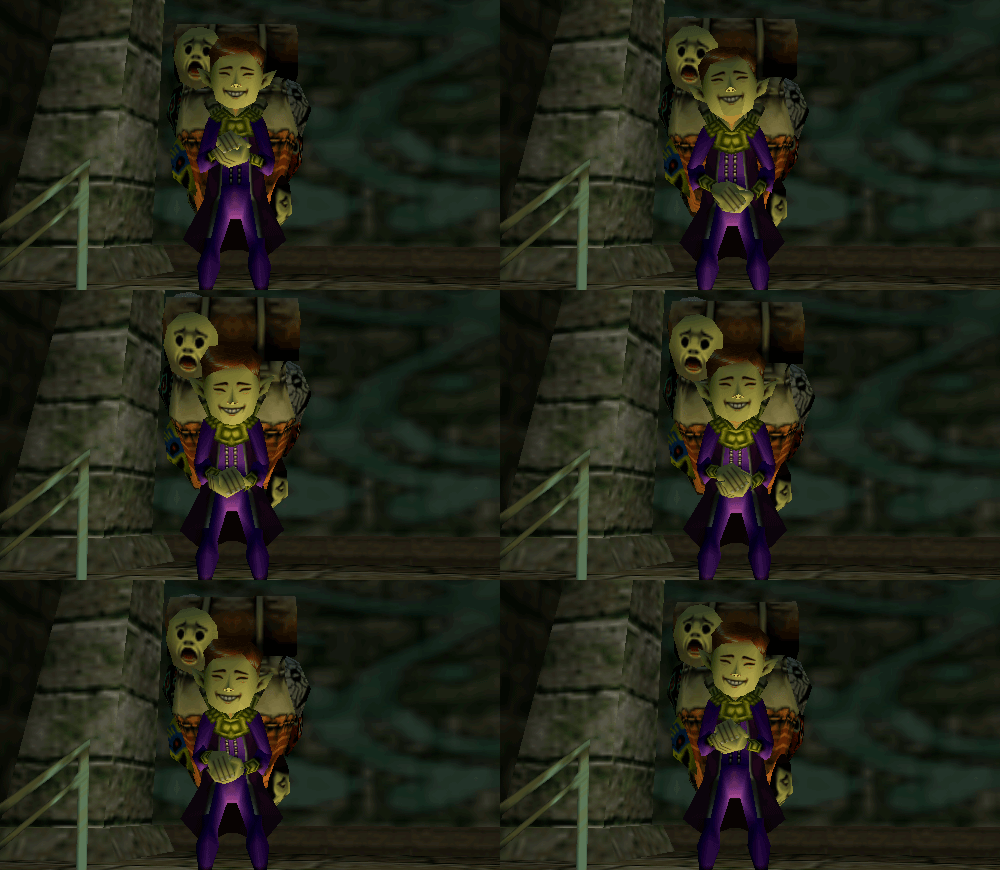
I could go on, and on, and on. The characters in Majora’s Mask are staggeringly well-developed. Heck, I haven’t even mentioned the mask salesman: the only character who seems to know exactly what’s happening.
mask-salesman

Yeah, he’s creepy. If the player watches the moon crash into the earth, the screen fades to black, only for the salesman to chuckle and ask, “You’ve met with a terrible fate, haven’t you?”

The time travel

Besides the falling moon, the land is afflicted by terrible woes, all caused by an imp wearing a mysterious mask: Majora’s Mask. The swamp reeks of poison. The mountain is caught in a deadly cold snap. Murky water fills the ocean, driving away the fish. An ancient curse fills the valley. Everywhere the player goes, things have gone wrong.

Fear not! This is a Legend of Zelda game! The player can save the day! In addition to resolving the major crises mentioned above, the player can help people on a smaller scale. Remember the characters I mentioned a few paragraphs back? The player can reunite the lovers, comfort the circus troupe leader, protect the rancher’s sister, rescue the postman, and help many more.

Here’s where things get nihilistic.

I’ve discussed the game’s three-day cycle. At some point, the player must rewind time to the dawn of the first day. Guess what happens to the people the player helped? Yep—they are back where they started. Everything resets. Whatever good the player did is undone. The only person to benefit is the player himself, who keeps whatever reward he received for helping others. Those he helped? Nah, they’re screwed.

This Sisyphean cycle reinforces a sense of helplessness. Nothing the player does really matters. Everyone is doomed anyway. Besides, the player can’t help everyone in a single three-day cycle. While she helps certain characters, the others continue to suffer. She can’t help them all.

This hopelessness makes Majora’s Mask a surprisingly dark game, especially for the Legend of Zelda series. It also makes the game’s eventual happy ending all the more cathartic and satisfying.

The unsettling moments

On top of its nihilistic tone, Majora’s Mask offers plenty of creepy moments, and even a few scares. Don’t worry, I won’t spoil them all. I’ll spoil just one.

The cursed valley of Ikana is populated by corpse-like monsters and vengeful spirits… and one little girl. Meet Pamela.

pamela

Adorable, right? Pamela is a sweet girl. She lives with her father, a paranormal researcher, in a cute little house shaped like a music box. It even plays a cheery carnival tune to drive away those pesky undead monsters. How nice!

Then, one day, something goes wrong. Something goes very wrong.

Pamela’s father gets a little too, um, wrapped up in his research. His daughter shuts him in a wardrobe in the basement. Right around this time, Pamela’s music box house stops playing its music. Monsters begin circling her home with slow, lurching steps. She locks the front door. There are monsters outside, and a monster in the basement.

Fortunately for Pamela, this is right when the player arrives to save the day… assuming the player isn’t busy saving the day somewhere else on this particular three-day cycle. (If that’s the case… rest in peace, Pamela.) The player reactivates the music box, drives away the ghouls, and sneaks into the house when Pamela isn’t looking—only to find a monstrous mad scientist in the basement.

The scene itself is pretty scary. When the player looks at it from Pamela’s point of view, it’s much scarier. It’s scariest to realize that she (presumably) dies a horrible death every single time the player spends the three-day cycle helping other characters.

This is the kind of thing that scares me about Majora’s Mask. I don’t find more traditional horror games all that scary. Jump scares? Zombies? Whatever. Majora’s Mask takes a more insidious, Lovecraftian approach, and it scares me more than practically any other game I’ve played.

The humor

Majora’s Mask balances its bleak tone and occasional scares with surprising amounts of heart and humor.

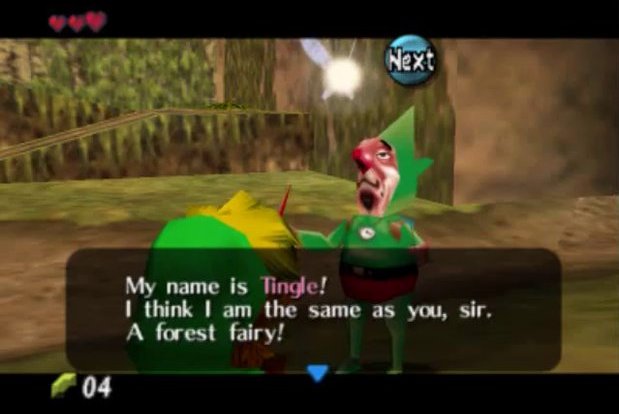
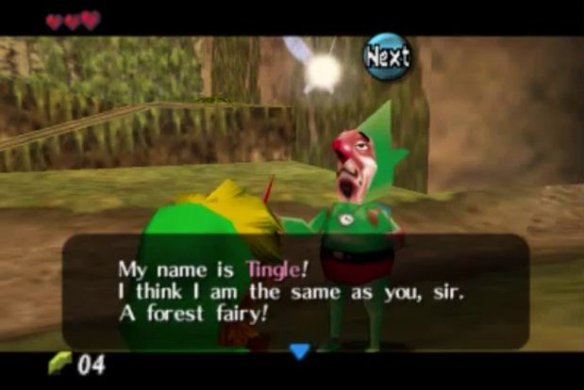
The innkeeper’s grandmother is perfectly sane, but feigns senility in order to avoid eating her granddaughter’s lousy cooking. A cutthroat thief prances daintily instead of walking, even when fleeing the scene of a crime. The local mapmaker, Tingle, is convinced he’s a forest fairy… despite being merely a thirty-five-year-old man wearing red briefs.
tingle

Majora’s Mask is frequently surreal, but not always in spooky ways. Its weird touches are sometimes endearing, even heartwarming, providing comic relief in a story that might otherwise be too dark.

Everything else

There’s so much I haven’t mentioned. This is a game with pirates, spirit foxes, Yorkshire Terriers, aliens, bobblehead cows, and a monstrous mechanical goat. Majora’s Mask is the very best kind of bonkers. It’s also designed with the same brilliance and loving care as the other greatest Legend of Zelda games, despite taking only one year to make.

This follow-up to The Legend of Zelda: Ocarina of Time had to do the impossible: live up to expectations set by a game considered by many, even to this day, the best ever made. Majora’s Mask did the impossible. It’s better than its legendary predecessor.

I consider Ocarina of Time the greater game of the two. It broke new ground. It was amazing first. However, Majora’s Mask is the better game of the two. It’s superior in practically every way.

It’s also pretty freaking scary. Happy Halloween, everybody.
Pipe Organs Are Creepy

Are you too happy? Is your life just too uplifting? Well, I can think of a song to fix that.

With Halloween just around the corner, and this blog discussing The Legend of Zelda: Majora’s Mask this week, today seems like a good day for ominous music. “Oath to Order,” one of the songs from the game, really lends itself to the hollow tones of a pipe organ.

I would wish you a happy Halloween, but such a wish defeats the point of this gloomy holiday, so I’ll wish you a safe, satisfying, and appropriately sinister Halloween instead!

483. I ♥ Majora’s Mask: A Halloween Special, Part 1

Halloween is nearly here. All across the United States of America, pumpkins are carved to look like severed heads. (Halloween is a weird holiday, man.) Horror movies flood theaters and fill bargain bins. ‘Tis the season for scares. Even the US government is participating—this year’s presidential election is positively frightening.

What better time could there be to discuss the scariest game I’ve ever played?

majoras-mask

I’ve wanted to write about this game for a long time—more than a year, in fact—but never found the right opportunity. With this blog ending in a couple of months and Halloween just around the corner, this seemed like the right time. I began writing. When I realized my ramblings were too long for one blog post, I decided to split it in two parts and call it a Halloween special. Every blog needs a holiday special at some point, right?

On the surface, The Legend of Zelda: Majora’s Mask doesn’t look like a scary game. Its visual are bright and colorful. Its world seems like a generic fantasy setting populated by generic video game characters. Heck, the game received the most child-friendly rating from the ESRBEVERYONE. (To be fair, the recent 3DS remake got a slightly higher EVERYONE 10+ rating, which is still pretty mild.) Don’t be fooled. This game is creepy as all heck.

Majora’s Mask is a game in the Legend of Zelda series, which consists mostly of lighthearted, well-crafted adventures. Zelda games are known not only for their legendary (no pun intended, I swear) quality, but also for their humor, charm, and kid-friendly action. Majora’s Mask is different. It has all the charm and humor of other Zelda games, but without their positive tone. Its tone is one of bleak, gnawing nihilism.

Believe it or not, I love this game. I ♥ Majora’s Mask. Can we put that phrase on a bumper sticker? Let’s put it on a bumper sticker.

i-love-majoras-mask

Why do I love this game? Oh, let me count the ways.

The moon

Most Legend of Zelda games follow a predictable formula: an evil sorcerer endangers a damsel, and the hero Link must save the day—generally by going on a quest to obtain the Master Sword, a holy weapon. Various Zelda games play with this formula, but seldom stray from it.

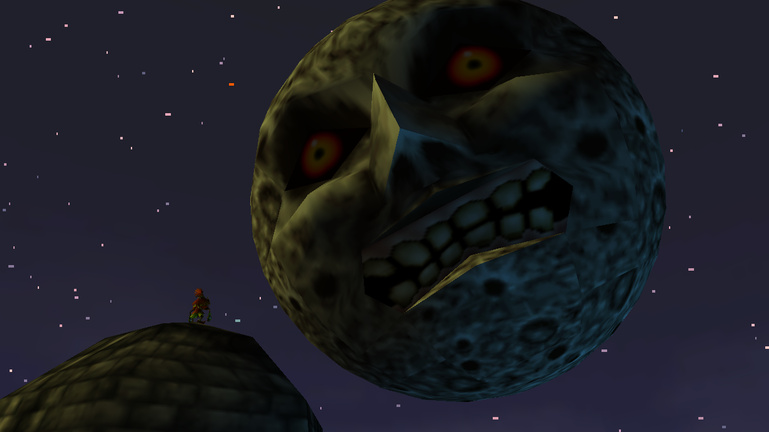
Majora’s Mask completely abandons the formula. It doesn’t task the player with rescuing a princess. Nope. The player must prevent a freakin’ moon from crashing into the land and annihilating literally everything. For reasons never explained, the moon has a face, which is frozen in an expression of rage. It’s a surreal touch, and kinda creepy.

hello-moon

As days pass in the game, the moon draws nearer and nearer the earth. Every time the player looks upward, there it is, a looming reminder that the end is near. Characters in the game react to their inexorable doom with a convincing range of emotional responses: apprehension, denial, panic, grief, resignation, defiance, and getting drunk on milk.

The player has only three days to stop the moon. Fortunately, the player is given the power to rewind time… only to watch the moon fall again, and again, and again. Characters repeat their cycles of grief and panic. And if the player doesn’t travel back in time before the moon hits the earth, well, it ends badly.

game-over-man

I hope you don’t mind watching a celestial body annihilate an entire land and everyone in it. Game over, man.

The masks

As its title suggests, Majora’s Mask makes masks an integral game mechanic. By wearing different masks, the player assumes different forms, each with its own set of powers.

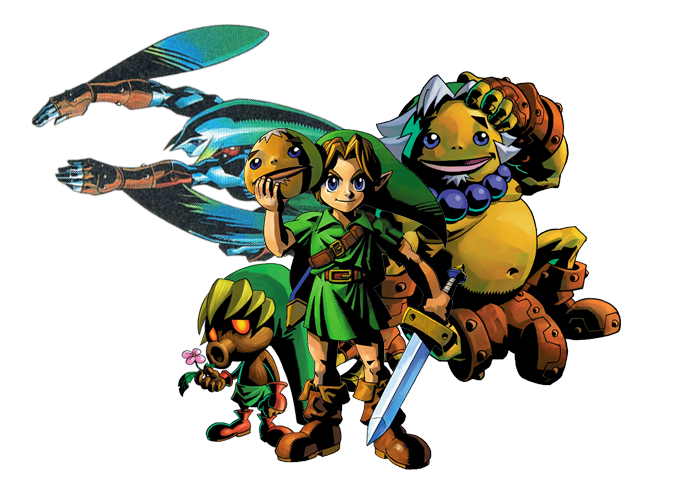
mask-transformations

The plant-like Deku form lets the player glide through the air. The rotund Goron form gives the power to roll around like a runaway tire, and the sleek Zora form zips through water with graceful ease. These mask transformations would be cool as mere game mechanics, but each one also represents a story.

Each mask transforms the player into the likeness of a character who died with regrets. The Deku child became separated from his father and died alone. The Goron died in an unsuccessful attempt to save his people, and the Zora perished trying to save his true love’s unborn children. The player earns each mask by healing its owner’s soul and easing his regret; when the spirit rests in peace, the mask is left behind.

It’s a beautifully macabre twist on a game mechanic that’s already pretty sweet.

Come back on Friday for Part 2 of this Halloween special!

482. What Should I Name My Hypothetical Newsletter?

This blog shall end in just a couple of months. I’ll move on to another personal project, and send my typewriter monkeys packing. (Hurrah!) For the first time in more than five years, I’ll be blog-less. It will be the end of an epoch.

A few people seem mildly interested in the life and times of Adam Stück, so I’m thinking of starting a personal newsletter after TMTF bites the dust. It wouldn’t follow any kind of schedule. After years of writing scheduled blog posts, I want a nice, long break from deadlines! I would write a newsletter whenever I felt like it, which probably wouldn’t be too often.

I’ve thought of a couple of titles for my hypothetical newsletter: The Brewsletter and Up and Adam. The first celebrates my love of coffee; the second, my fondness for bad puns.

‘Tis the season for voting. Cast a vote in the poll below and let me know which title you prefer for my hypothetical newsletter! And if you have your own title to suggest, let us know in the comments!

The Story of Japan (in Nine Minutes)

The video above tells the story of Japan in nine minutes, and it is glorious.

The video is glorious, I mean, though Japan’s history is also impressive. (That said, sensitive readers should be advised that the video has a few swearwords.) This nine-minute history of Japan combines tongue-in-cheek narration and humorous oversimplifications with manic, colorful editing. The end result is not only hilarious, but quite informative. Huh. Maybe this, not the history of Nintendo, is history’s greatest history lesson.

I have a strong interest in Japan, which is rivaled only by my lifelong interest in Great Britain. These island nations have a lot in common. Each was once the seat of an empire, and both have made incredible contributions to the arts.

Many of my favorite storytellers and creative people are Japanese: Hayao Miyazaki, the legendary filmmaker; Shigeru Miyamoto, who worked on many of the greatest video games ever made; Shūsaku Endō, the writer of such heartbreaking novels as Silence and The Samurai; and many more. For such a small country, Japan has made a vast cultural impact, giving us everything from anime to beckoning cat figurines.

Oh Japan, where would we be without you?

I would love to visit Japan someday. I would also love to see Great Britain. Of course, I want to return to Ecuador for a visit, and to visit Canada, and to take an epic road trip around the United States of America.

Man, I wish I were free to travel more. At least I have books and the Internet!

481. Clutter

I spent hours yesterday sifting through clutter in my apartment: books, blowgun darts, office supplies, ocelot pelts, papers, outdated foreign currency, clothes, and centuries-old trinkets of carved stone and bone.

It occurs to me that my life is kind of strange.

My parents, who are missionaries, have used my apartment as their home base during their slow transition from working in Uruguay to working in Spain. Since they plan to depart for Galicia in a few weeks, we began sorting through their stuff yesterday in preparation for packing. It was an… interesting process.

My dad grew up in the jungles of Ecuador, and my mum loves antiques. Between the two of them, my family has accumulated a ton of awesome junk, much of it very old. I found a toucan beak, a stone axe head of incalculable age, an armadillo shell, and an ancient Incan figurine, among other things. I felt like I was reorganizing the office of Indiana Jones; I could almost hear him say, “This belongs in a museum!” (In case you were wondering, my parents are nothing like Indiana Jones; sorry to disappoint.)

My parents have spent time in the state of Indiana. Does that count?

Of course, these exciting souvenirs were merely sprinkled over heaps of modern, ordinary items such as clothes, books, and kitchenware. My apartment currently contains my stuff, my younger brother’s stuff, my parents’ stuff, and even a little bit of my older brother’s stuff.

My apartment is, um, a tiny bit cluttered at the moment.

Gathering my parents’ possessions uprooted some of my own, like unto the parable of the wheat and the weeds. This is actually a good thing. In a month, when my parents are bound safely for the rainy shores of Spain, I intend to take inventory of my worldly goods, and then to get rid of some.

Since my parents are missionaries, we moved around a lot. We never got a chance to accumulate much clutter. Every move to a new place stripped away all the stuff we couldn’t take with us. I learned to live light.

At any rate, that’s what I thought.

O’Hare International Airport proved me wrong. When I traveled from Ecuador to the US for college, I carried all of my worldly goods with me in a backpack, a carry-on, a computer bag, and two duffel bags the approximate size of adult male hippos.

Artist interpretation of Adam’s duffel bags.

On that day the air traffic controllers of O’Hare decided, in their infinite wisdom, to make my plane unload its luggage at one end of the airport, and its passengers on the other. This required me to walk approximately two hundred sixty extra miles along dingy airport hallways, and I had a bus to catch. Of course I did.

So I ran—well, I shuffled—dragging my carry-on, with my pack and computer bag slung across my back, and a duffel bag dangling from each shoulder. As I stepped, my duffel bags swung with the ponderous force of battering rams. Straps cut into my back and shoulders. I kept stepping—well, shuffling—wishing for a luggage cart, or a team of porters, or the sweet release of death.

That experience shaped my guiding philosophy for owning stuff: If it isn’t worth moving, it isn’t worth having. I want to live without clutter or extra weight. When I move somewhere new, which I’m sure I will sooner or later, I want moving to be as easy as possible. If I wouldn’t move something to a new home, I probably don’t need it right now, and should probably get rid of it.

For the most part, my clutter-free philosophy has worked well. (At any rate, it has left enough empty space in my apartment for my parents’ worldly goods.) A minimalist approach makes it easier for me to keep things organized, and helps me to appreciate my individual possessions. I feel lighter, freer, and calmer without so much stuff.

My friend JK wrote a blog post about tidy living. Henry David Thoreau wrote, “Simplify, simplify.” Even Jesus Christ said, “Be on your guard against all kinds of greed; life does not consist in an abundance of possessions.”

It will be cathartic to take inventory of my possessions later this year, and to give away the stuff I don’t really want. I hope the nearest donation center doesn’t mind books.

480. Adam’s Story: The Politics

For anyone new to Adam’s story, here’s an introduction.

I’m tired of real-life politics at the moment, so why don’t we talk about fictional politics instead?

If we have to discuss a bad political situation, let’s at least look at a fictional one.

In previous versions of the Lance Eliot saga, the politics of my imaginary kingdom were simplistic. This time around, I want to craft a more complex political situation for Lance and his companions to navigate.

If this sounds boring, don’t worry! The Lance Eliot saga shan’t be a political thriller, but an adventure story with a sprinkling of political drama. I’m still planning dragons, swordfights, and Other Cool Stuff that I won’t discuss yet; it shan’t all be politics! I just want to create a setting for Lance’s adventures that’s more believable than a generic fairy-tale kingdom.

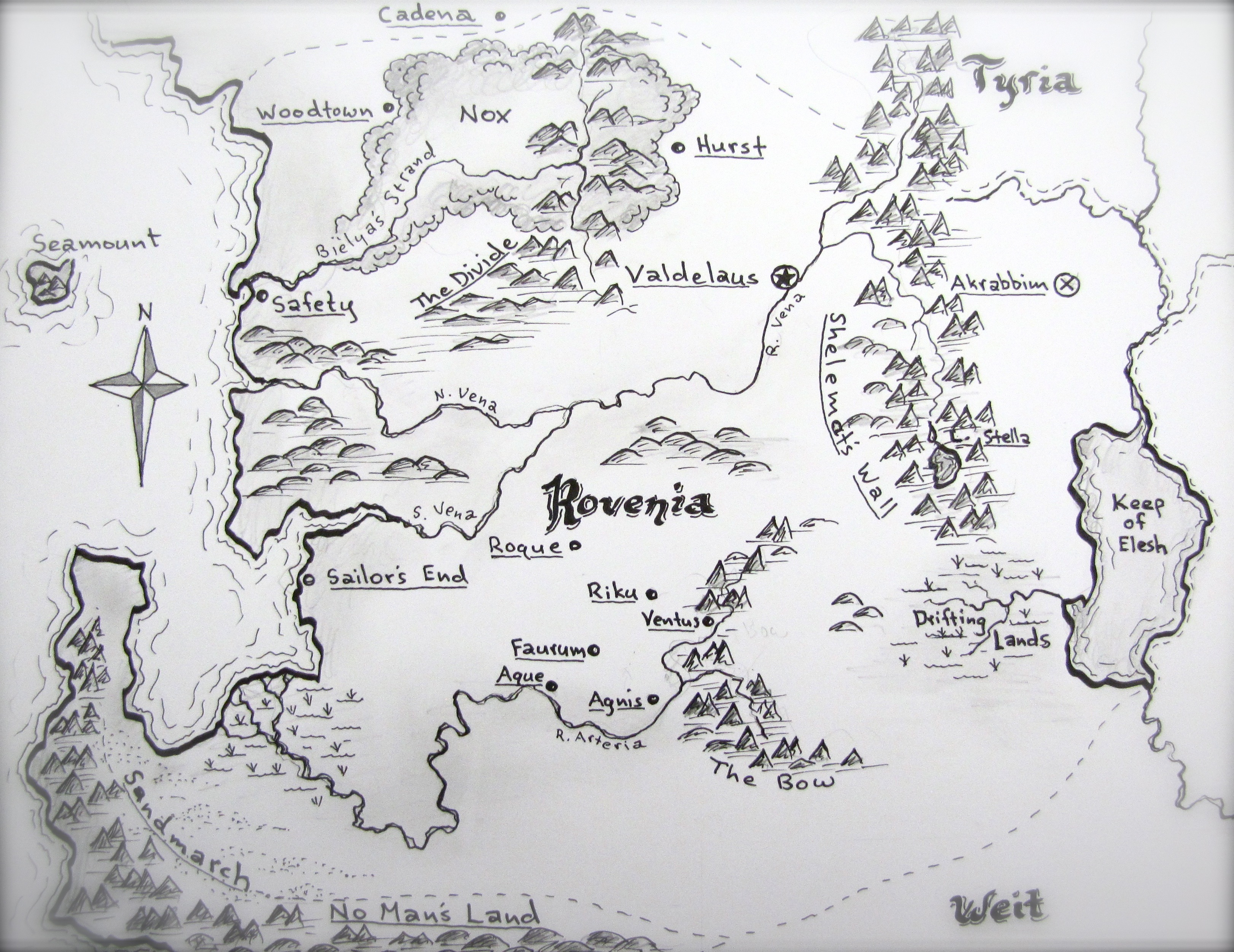
The Lance Eliot saga takes place mostly on Fyrel, an hourglass-shaped continent in the world of Gea. The northern and southern landmasses are joined at the equator by an isthmus. This strip of land, bordered by ocean on the east and west, is the kingdom of Guardia: a gateway between the northern and southern lands.

I’m working on an updated map for Guardia. For now, here’s the map I used for previous versions of the Lance Eliot story.

Guardia is bordered by two vast empires: Tyria to the north, and Sanguin to the south. These world powers expanded over centuries to completely conquer the northern and southern landmasses. Only the ocean and the little kingdom of Guardia separate them.

For such a small nation, Guardia is remarkably defensible. Its northern border is largely blocked by mountains and dense jungles; the southern border consists mostly of mountains, deserts, and dangerous marshes. The south is also bordered by a narrow strip of territory known as the Noman’s Land: a lawless neutral zone.

Thanks to its place between two empires, Guardia regulates trade and traffic between North and South. Money, goods, merchants, and travelers—all carefully supervised—flow through the kingdom like sand through the neck of an hourglass. Guardia’s economy, built painstakingly over centuries, depends almost entirely on trade.

The healthy economy funds a strong navy and military to protect the kingdom. Guardia exists in a delicate balance, suspended between two warlike empires, trusting neither, but depending on both.

Tyria and Sanguin are both eager to expand, but conquest is earned by war, and Guardia is the only avenue through which war can be fought. As long as it remains free, shielded by its hostile terrain and strong military, Tyria and Sanguin can’t attack each other.* These empires are locked in a cold war. If either declares war on Guardia itself as a prelude to further conquests, the other empire will immediately fight to defend it.

It’s sort of like the Cold War, but without the nukes.

Guardia’s status as a merchant nation, protected by its military and impenetrable borders, are all that prevents a world war.

None of this has anything to do with Lance Eliot. He doesn’t really care—he’s just a college student in a little Indiana town. Guardia’s politics are not his problem. Gea isn’t even his world. His journey to Gea was a mistake: a supernatural screw-up by someone who tried to invoke Lancelot, the hero of Camelot, but got Lance instead.

Lance Eliot was summoned to Guardia on the order of Eisen, a military leader forced into early retirement by Demas, the King. Eisen retreated to the city of Faurum and founded the Guardian Peace Committee. The purpose of this secret society is to maintain Guardia’s independence, preventing war between the North and South.

King Demas has reigned for decades, keeping the peace with both empires, but rumors have reached Eisen that the King is considering a secret deal to surrender Guardia to Tyria in exchange for personal favors. If Tyria annexes Guardia, Sanguin will retaliate, and war will erupt.

If the King is not stopped, Guardia will become a battleground: a land of blood and ashes trampled by armies.

Eisen doesn’t have a lot of resources. The Guardian Peace Committee has only a small military force of its own. (This includes Tsurugi, a disgraced soldier in Eisen’s service.) With few options, Eisen employs the supernatural gifts of a young woman, Maia, to search beyond Gea for someone—anyone—who can help.

Lancelot can help, right? Right?!

Enter Lancelot of Camelot. By all accounts, this legendary knight of Earth possessed both martial prowess and political savvy. If Maia can use her powers to summon Lancelot and break the language barrier, perhaps he can offer Eisen support, or at least some advice.

Of course, Maia makes the mistake of summoning Lance Eliot instead of Lancelot, and the rest is history… or shall be history once I get around to writing it.


*Neither Tyria nor Sanguin can wage war with the other entirely by sea: it’s far too costly to transport entire armies, with provisions and war machines, hundreds of miles in boats. Apart from the dangers of sea travel, any force small enough to travel in ships would be quickly outnumbered in enemy territory, unable to retreat. The only viable strategy for waging war is through Guardia.

479. TMTF’s Top Ten Detectives in Fiction

Who are the greatest detectives in fiction? I’m no sleuth, but this is one mystery I might be able to solve.

From a young age, I’ve enjoyed detective fiction. I watched Scooby-Doo cartoons as a young child. Almost immediately after learning to read, I devoured stacks of Hardy Boys books. I read the entire Sherlock Holmes canon in my early teens, and picked up a number of classic mysteries in college. Yes, I love a good detective story.

Of course, such a story is only as good as its detective. Here are ten of my favorite mystery-solvers, because top ten lists are my beat.

The game is afoot, ladies and gentlemen, as TMTF presents…

The TMTF List of Top Ten Detectives in Fiction!

10. C. Auguste Dupin

auguste-dupin

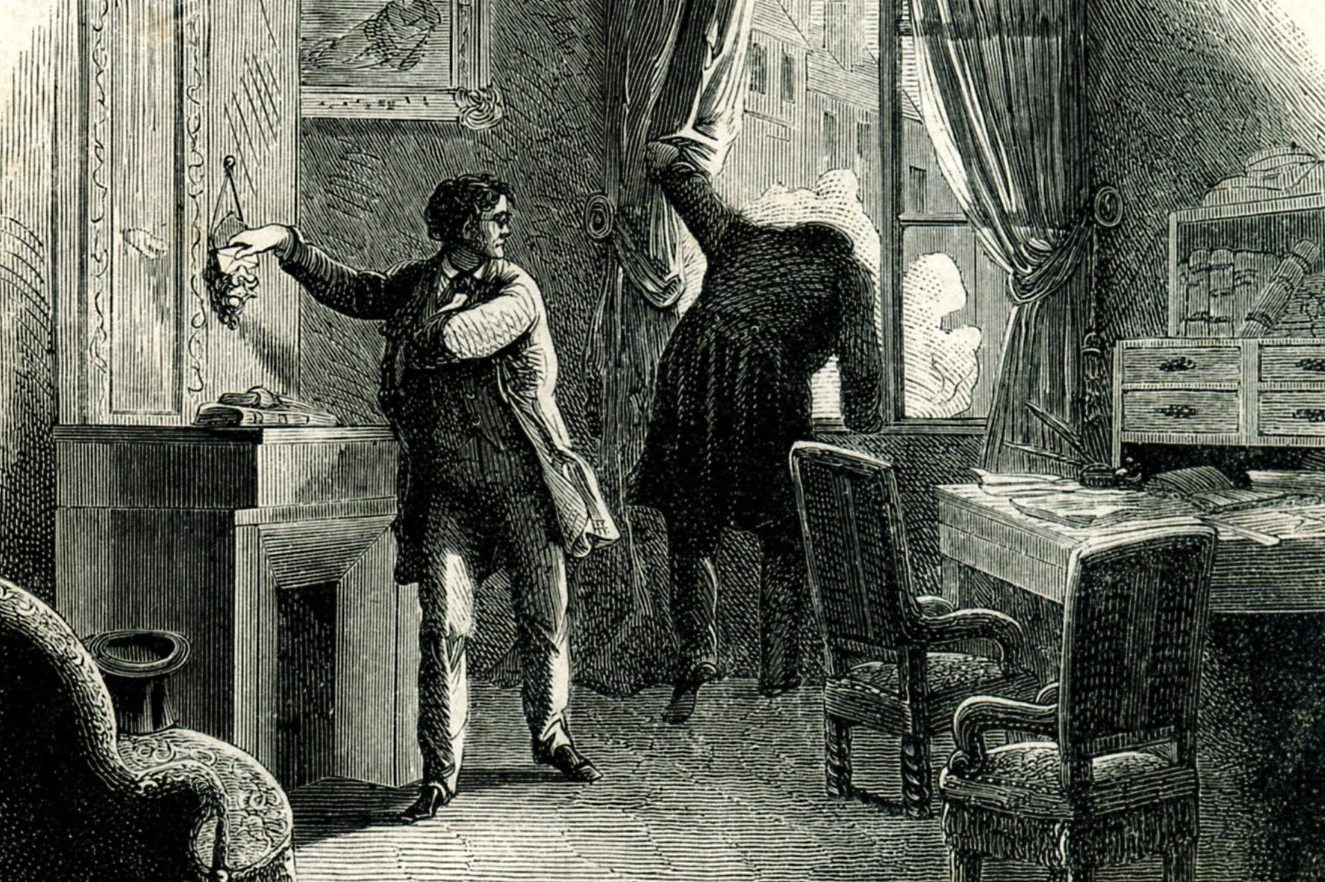
Although C. Auguste Dupin appeared in only three short stories, he makes history as one of the earliest fictional detectives. When Edgar Allan Poe created Dupin, the word detective had not even been coined. Heck, the character is even mentioned in the very first Sherlock Holmes story: Watson compares Holmes to Dupin. Sherlock Holmes may be the father of detective fiction, but C. August Dupin is its grandfather. The character’s sharp intellect and analytical methods helped create an archetype for fictional detectives.

9. Batman

worlds-greatest-detective

I was going to put Hercule Poirot on this list, but then remembered that I’ve read only two of his mysteries, and disliked one of them. Who could possibly replace the legendary Poirot, created by the legendary Agatha Christie, in a list of great detectives? The correct answer is Batman. (The correct answer is always Batman.) When he isn’t busy punching bad guys or brooding over his tragic past, Batman earns his nickname of World’s Greatest Detective by dabbling in forensics, solving crimes, and catching bad guys… whom he generally punches before brooding some more. Batman’s gotta Batman.

8. Lord Peter Wimsey

lord-peter-wimsey

Lord Peter Wimsey has the intelligence of a detective like Holmes or Poirot, along with his own gift: an easygoing sense of humor. In a series of novels and short stories by Dorothy Sayers, this British nobleman makes a hobby of solving crimes. Wimsey’s relationship with his valet, the solemn and hyper-competent Bunter, echoes the partnership of Jeeves and Wooster in the stories by P.G. Wodehouse—and believe me, any comparison to Wodehouse is a good thing. Wimsey has all the skill of other famous detectives, and a heck of a lot more charm.

7. Professor Hershel Layton

professor-layton

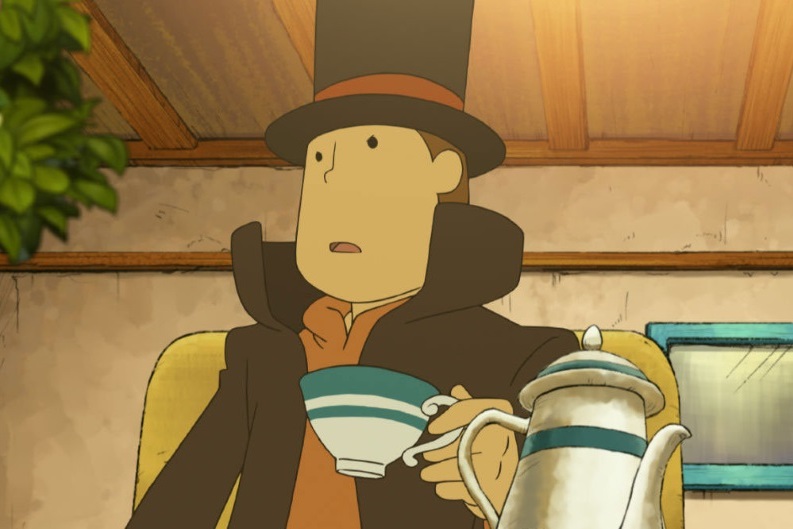
Hershel Layton, the star of the Professor Layton games, wears many hats… figuratively speaking. (The only literal hat he would ever deign to wear is his beloved topper.) Layton is not only a professor of archaeology, but also a puzzle enthusiast, true gentleman, and amateur detective. Even inspectors from Scotland Yard have sought Layton’s help with tough cases. The strangeness of these mysteries is matched only by his ingenuity in solving them. The good Professor is clever and kind, and have I mentioned his magnificent hat?

6. Shawn Spencer

shawn-spencer

Shawn Spencer, the star of television’s Psych, is a “psychic detective” who handles cases too small, sensitive, or just plain weird for the police. Shawn’s alleged psychic powers are actually a front for rigorous training and a photographic memory. Since he’s an immature goofball, his clients find it easier to believe that Shawn has supernatural gifts than to accept that he’s just, y’know, really smart. He runs his detective agency with the help of his friend Gus; their chemistry is easily the best thing about the show, though Shawn’s quips and pop culture references are also a lot of fun.

5. Dick Gumshoe

dick-gumshoe

Dick Gumshoe, the hapless police detective from the Ace Attorney games, is easily the least competent sleuth on this list, but he gets the job done. (His musical leitmotif, which I wish were my own theme music, is aptly titled “I Can Do It When It Counts, Pal!”) What Gumshoe lacks in smarts, he makes up in dedication, tenacity, and fierce loyalty to his friends. There’s a heart of gold under that shabby coat, and a determination behind those bewildered eyes to see justice done. It’s just a shame he can’t afford any meal more expensive than ramen noodles!

4. Edogawa Conan

conan-edogawa

Kudo Shinichi is still in high school, but has already built a reputation as a crime-solving prodigy who has worked with the Tokyo police. However, when he interferes with a criminal syndicate known as the Black Organization, its attempt to murder him with an experimental drug causes an unexpected side effect: Shinichi awakens in the body of a child. Now calling himself Edogawa Conan, he moves into a local detective agency, and solves its cases from behind the scenes as he searches for a lead on the Black Organization. The manga and anime series Detective Conan (known as Case Closed in the West) boasts some of the cleverest mysteries I’ve ever seen, all solved by this adorable little guy. Edogawa Conan is cooler than an action hero and cuter than a kitten—often at the same time!

3. Adrian Monk

adrian-monk

Adrian Monk is afraid of dentists, snakes, nudity, elevators, death, milk, and mushrooms, not necessarily in that order. These are just a few of his phobias, which, along with his obsessive-compulsive disorder, make it hard for the star of television’s Monk even to leave his home, let alone solve crimes… yet he solves them. Monk’s phobias make for terrific comedy, but also create a character whose strength lies in overcoming his worst fears every single day. Adrian Monk is the rare character who can make you laugh in one scene, only to turn on a dime and make you cry in the next.

2. Father Brown

father-brown-alt

He may not have claimed the top spot on this list, but Father Brown is probably my all-time favorite character in fiction. This gentle Roman Catholic priest stars in a number of short stories by G.K. Chesterton. I’ve already written about Father Brown: “He’s a perfect foil to Sherlock Holmes . . . Everyone expects Holmes to be brilliant. In a charming subversion, everyone dismisses Father Brown as a superstitious simpleton, which makes it all the more satisfying when he apologetically solves the mystery right under their noses.” Father Brown’s quiet brilliance, boundless compassion, and no-nonsense worldview make him not only a great detective, but something rarer and more admirable: a good man.

1. Sherlock Holmes

sherlock-holmes

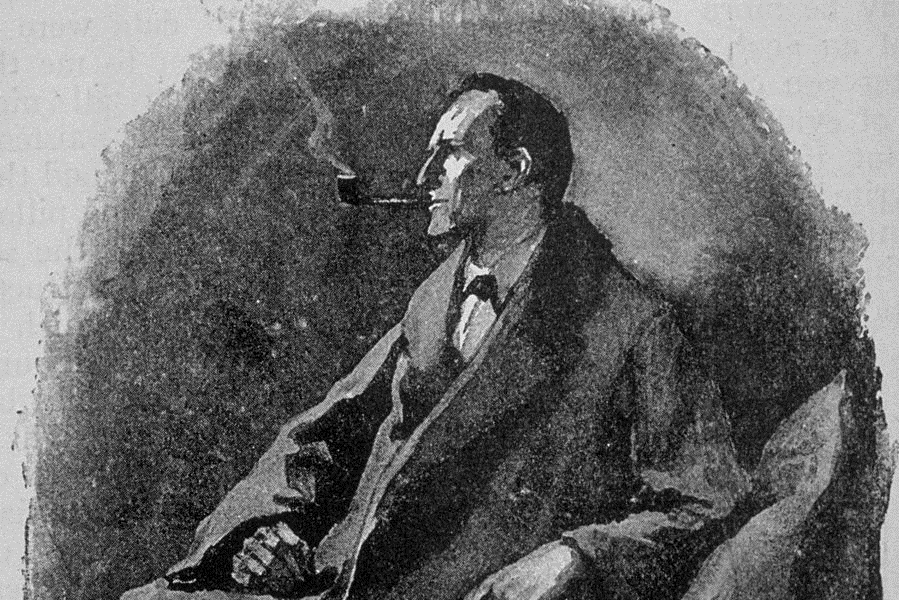
Throughout this blog post, I’ve repeatedly mentioned Sherlock Holmes. How could I not? Sherlock Holmes is the world’s most famous detective, and the standard by which all others are measured. His ruthless logic, unshakable calm, numerous connections, and eclectic talents make him capable of solving practically any crime. In addition to his gifts, Holmes possesses, or is possessed by, a strong determination to use them. (He doesn’t handle boredom well.) This combination of passion and ability make Holmes an unstoppable detective. In addition to the original character in the novels and stories by Sir Arthur Conan Doyle, television’s Sherlock offers an updated take on Holmes that’s perfectly delightful.

Who is your favorite fictional detective? Give us a clue in the comments!