246. TMTF Reviews: Heart of Darkness

A few days ago, a coworker and I had an interesting discussion about lunatic asylums, survival horror games and Joseph Conrad’s Heart of Darkness.

My coworker had just finished a survival horror game set in an insane asylum. (Survival horror is a scary genre of video games.) It reminded me of an article that questioned the use of lunatics in horror fiction. While some victims of mental illness are certainly dangerous, it’s unfair to stereotype them all as murderers, cannibals or psychopaths. Most lunatics are innocent people suffering from mental disorders. Compassion, not fear, is the appropriate response.

My coworker’s game was apparently an excellent (and terrifying) artistic work, but its scares came at the cost of demonizing and dehumanizing an entire group of people.

That reminds me of something.
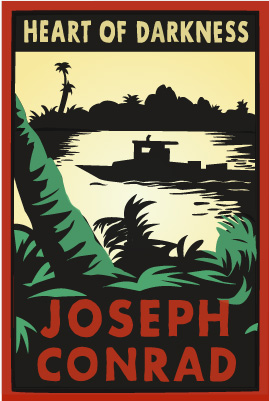
Heart of DarknessJoseph Conrad’s Heart of Darkness is a great book, but not a good one. Its impressive style and thematic complexity come at the cost of human dignity.

Heart of Darkness is the tale of Charles Marlow, a nineteenth-century sailor who tells of his fateful trip up an African river in search of ivory. Marlow captained a steamboat deep into the dark, wild heart of the inscrutable African continent, meeting indolent Europeans and barbaric Africans—and one very terrible man, the tortured Mr. Kurtz. It is Kurtz who embodies the eloquence of Europe and the savagery of Africa, and Kurtz whose ambition and cruelty are finally summed up in four whispered words: “The horror! The horror!”

As I told my coworker, I thought Heart of Darkness was a fine artistic work, just like his game. My book made its point about human depravity; his game was very scary; both works achieved their ends. However, both works accomplished their goals only by exaggerating and debasing a group of people. His demonized the lunatic. Mine demonized the African.

At first, I didn’t think twice about Conrad’s stereotyped Africans. Racism was almost universal among the Europeans of his day. It was my cousin who recommended this thought-provoking essay by Chinua Achebe. Achebe, an African, showed me how Heart of Darkness creates a stark, racist contrast between the white European and the black African. Kurtz is horrifying because he—a cultured European—descends into the savage brutality of those wild Africans.

I get it. For Heart of Darkness to work, it needs that contrast. For savagery to seem savage, it must be compared to sophistication. Kurtz has fallen from Point A to Point B, and the reader can’t appreciate how far he falls unless she sees both points. Sane, sensible Marlow is Point A. There must be a cruel, primitive Point B—and Heart of Darkness makes Africans its Point B. The book debases Africa’s people not out of malice, but out of necessity.

That doesn’t make it right.

That is my fundamental criticism of the book. How could it have been fixed? Well, Marlow might not have sought Kurtz in the dark heart of Africa—the dark heart of London would have sufficed. There were plenty of debased, primitive Europeans in Conrad’s day.

Heart of Darkness makes its point very well. Kurtz is a fascinating character, and he’s prefigured so well throughout the story that I was almost as eager as Marlow to meet him. While the book’s contrast of Europe and Africa is morally questionable, I’ll be the first to admit that it’s artistically excellent.

The book’s style is either great or horrible, depending on the reader. Conrad’s writing is dense and slow. Thoughtful readers will probably savor it. Impatient readers will hate it. Conrad has a tendency to wax meditative for pages and then say something crucial to the plot in just a few sentences. I repeatedly overshot important information because Conrad’s style had lulled me into a literary stupor.

Heart of Darkness is a great literary work—but is it a good book? I don’t think so.

A Geek Love Song

A better version of this song sans video can be heard here.

Well, St. Valentine’s Day is nearly upon us. ‘Tis the season for glitter-encrusted cards, nagging advertisements, candy hearts that taste like quinine, romantic comedies and grocery store aisles decked out in pink, red and white. It is a time for single people to feel self-conscious, and for people in relationships to feel stressed.

These are the times that try men’s souls. It is on such dark, hopeless occasions as St. Valentine’s Day—yes I am being sarcastic—we need the encouragement and strength of a love song for geeks. Debs and Errol, geeky musicians extraordinaire, are here to help!

In the video above, Errol sings of how to say I love you in various geeky languages. Anyone can say it in English, but how about Sindarin, Pig Latin, Huttese, lolcat (which I consider a legitimate dialect) or binary?

Geeky humor aside, in this season of candy hearts and commercial hype, I think we sometimes forget to let our loved ones know we love them. It’s no bad thing to be reminded to say “I love you” occasionally… though I suggest saying it in English!

245. That Time I Stayed in the World’s Worst Motel

My family and I share a number of memories over which we laugh from time to time. We’ve been through a lot, and many of our experiences are funny in retrospect. Of course, not all of them were funny at the time.

Perhaps the most notorious of these was That Time I Stayed in the World’s Worst Motel, a harrowing experience that bound my family together in suffering and endurance. After all, the deepest love and brightest humor are forged in the fiery crucible of such trials. Nothing brings a family together like a bad motel!

I wish I could say the Motel of Despair, whose official name was something unassuming like The Dollar Inn, was fronted by a sign that spelled out HELLO in red neon lights, and that the O had burned out, but that would not be strictly true to the facts.

It would, however, have been a fair description.

My memories of that fateful night are pretty hazy. I suspect this is because my subconscious is trying to protect my fragile psyche by repressing all recollections of that motel. I remember a dingy room with a damp, moldy carpet. There was a television, I recall, dating from approximately 1943, which gave us dozens of channels of static. I seem to recall finding a crumpled chip bag and half a bottle of soda beneath the bed.

Then there was the bathroom. It… it was… that bathroom…

The horror! The horror!

The water was rust-colored, I think, and the floor teemed with fascinating specimens of molds and fungi. There may have been insects or arachnids lurking in the shadows, but I honestly don’t remember.

I do remember that the “pool” promised by the motel’s brochure was a rectangular hole in the ground, not much larger than a couple of bathtubs side by side, built of concrete. The “continental breakfast” offered by the motel was one or two packets of instant oatmeal, supplied grudgingly in the office by the motel staff.

I have stayed in resorts, hotels, motels, cabins, inns and hostels in several countries across three continents. Many of these were not fancy or luxurious. Some lacked hot water; most lacked television; practically all lacked Internet. In one memorable set of cabins—which, may I add, my family and I visited regularly over many years—we found, on separate occasions, a snake slithering across the floor and an enormous frog lurking in the toilet.

However, no place I have ever stayed was worse than The Dollar Inn. It may not have been the world’s worst motel, but it was certainly the worst I have ever seen. I consider myself fortunate to have survived it, and blessed to have had the moral support of my parents and brothers. Whatever else our stay in that motel may have been, it was memorable. We have certainly never forgotten it.

244. Many Are Cold, Few Are Frozen

Many Are Cold, Few Are FrozenI hate cold weather. There is a reason Dante put ice in the inmost circle of hell. When this blog froze—literally froze—last month, I felt pretty miserable, and very cold.

(My younger brother felt perfectly fine. He’s impervious to cold. It’s like a superpower.)

Late in January, when my typewriter monkeys got out of prison (don’t ask) and returned to my apartment, the cold was insufferable. It was then I decided to give my readers a glimpse into the trials of a chilly blogger and his assistants. Thus my dad sketched the Typewriter Monkey Task Force at work, depicting my monkeys typing with aching fingers, tails kinked by cold, fur specked with frost, muffled in parkas and muttering bitterly.

(Yes, I tried turning up the heat in my apartment, but my building’s feeble furnace was no match for winter’s insidious chill. Warm clothes were all that stood between us and the cruel ferocity of winter weather.)

I had planned to share my dad’s full sketch, but there was… a problem. My typewriter monkeys—pyromaniacs, every last of them—decided the best way to keep warm was to start a fire in my living room.

Well, a huge patch of my carpet has gone up in smoke, and my typewriter monkeys are back in the clink for arson, and only fragments of my dad’s lovely picture remains. I have shared this single scrap, singed and brittle, in gratefulness toward my parents for supporting my blog and in bitterness toward the Typewriter Monkey Task Force for burning a hole in my carpet.

Ah, well. I hope my monkeys are warmer in prison than they were in my apartment. Now, if you will excuse me, I should probably seek treatment for frostbite and hypothermia. I hope you’re warm, dear reader, wherever you are!

243. Solidarity Ends

Long ago, I had a teacher named Mr. Quiring: a dignified, solemn gentleman, like one of the Old Testament patriarchs without a beard, who taught upper-level high school English classes. His bookish manner belied a wicked sense of humor, which manifested itself in unexpected and unusual ways.

Mr. Quiring once pelted his students with Snickers bars—a rare treat in Ecuador—while bellowing “FEAST!” On another occasion, while explaining the infinitive form of verbs, he climbed onto a chair, leaped into the air and shouted, “To infinitives and beyond!” I will never forget the day he interrupted a discussion of ritual sacrifices in ancient Judaism to brandish a meat cleaver at me.

Besides his memorable jokes, I owe much to Mr. Quiring. He opened my eyes to the world of contemporary literature. Mr. Quiring also encouraged me to write a book for a contest, which won a college scholarship and motivated me to keep writing. Finally, it was Mr. Quiring who invited me to Solidarity and began to break my heart.

Solidarity was a weekly prayer meeting that met on Thursdays to focus on religious persecution. I was staggered to realize persecution isn’t a relic of bygone eras, but an ongoing tragedy. It is, in fact, a greater problem now than it has ever been.

In the years that followed, I started a prayer letter that highlighted persecution cases and offered suggestions on how to pray for the victims. I called the prayer letter Solidarity and sent it nearly every Thursday. Solidarity eventually transitioned from a prayer letter to a blog. A couple of years ago, I realized hardly anyone visited the blog, and so began updating it every two weeks instead of weekly.

For half a decade, Solidarity has existed in some form: a prayer letter, a blog, a fading hope that someone would care.

This week, after all these years, Solidarity ends.

I hate to let it go. The problem of persecution breaks my heart. I wanted to spread awareness and help people through the Solidarity blog, but I can’t keep spending hours every two weeks researching, writing and maintaining a blog no one reads. In past weeks, the blog published two posts, each representing hours of work—and received only one view.

I desperately want to help victims of religious persecution, to stand in solidarity with them, but I can’t invest so much time and effort in a project that makes no difference. Good intentions help no one. If nobody glances at the Solidarity blog, I can hardly justify keeping it.

My efforts seem to have failed, but I’m not bitter or angry. Solidarity was never a personal project, like The Eliot Papers or this blog. It was meant to be a ministry. It was meant to help people. I’m sad to see it end, and sorry it wasn’t very useful.

What next?

Solidarity may no longer exist as a blog, but I’ll use Twitter and Facebook every Thursday to share a single persecution case and request for prayer for its victims. I’ll keep up with news about religious persecution, and I’ll keep praying.

God bless you all!

242. TMTF Reviews: Metal Gear Solid

I seldom care for spy fiction, war stories or anything involving guns. Tales of modern warfare are uncomfortably familiar in this tragic age of child soldiers and terrorist attacks. Fantasies interest me more than thrillers, especially in video games. I prefer swords over grenades and AK-47s.

Every now and then, however, there comes a war story so fascinating that I can’t help but be interested. Metal Gear Solid is such a story.

It stars this guy.

Cardboard SnakeThis may not be the most flattering picture of our hero. Sorry. Let me try again. Metal Gear Solid stars this guy.

Solid SnakeSolid Snake is a retired operative with a cigarette addiction, a penchant for hiding in cardboard boxes and a gift for sneaking around unseen. His retirement comes to an abrupt end when the US government forcibly recruits him for a top-secret mission on Shadow Moses Island, a nuclear weapons disposal facility in Alaska’s Fox Archipelago. Terrorists have seized the facility. Oh, and did I mention Metal Gear—the colossal armored vehicle armed with nuclear warheads? Snake must rescue two hostages and prevent a nuclear strike… and get out alive, if possible.

I played the Nintendo GameCube version of the game, Metal Gear Solid: Twin Snakes. (The original game was released for the PlayStation.) My version apparently features better graphics and a few gameplay tweaks, but remains pretty much the same game.

I had a sneaking suspicion I’d like this game, so I decided to give it a try. Is Snake’s mission worth it, or should players keep off Shadow Moses Island?

MGS

For players with a lot of patience, Metal Gear Solid is an absolute gem. Players wanting a fast-paced, action-packed game should look elsewhere. This is not a game for people with short attention spans.

In the first place, Snake does a lot of sneaking. There are firearms in this game—heck, there are even grenades and rockets—but the player who runs around with guns blazing will die very quickly. Metal Gear Solid does not reward brute force. It requires finesse, perseverance and a willingness to hide in ventilation shafts until enemy soldiers give up looking and go away.

Fortunately, Snake has a lot of tools at his disposal. Some of these are what you’d expect from a spy thriller: a silenced pistol, for example, and a sniper rifle. However, some of his gear is a little less… conventional. Snake uses cigarette smoke to detect security lasers. A well-placed magazine distracts hostile guards long enough for him to sneak past them, and let’s not forget his ever-useful cardboard boxes!

Getting past a room full of watchful guards and security cameras is difficult, even with Snake’s arsenal of handy tools. Players will die a lot. All the same, Metal Gear Solid is a fair game. Progressing takes trial and error, but there’s great satisfaction in figuring out a safe route or foolproof strategy.

Snake has some additional help from teammates via his Codec, a covert communications system. Colonel Campbell, Snake’s commanding officer, gives useful directions and tactical advice. Mei Ling, a data analyst, saves Snake’s progress. (She also shares Chinese proverbs and quotations from Western literature.) Other characters offer sundry kinds of advice. When the player gets stuck—and sooner or later, he will get stuck—he can turn to his teammates for help.

These Codec conversations are not just useful, but amusing and interesting. The player gets to know several engaging characters by chatting with them over the Codec.

The game’s story is a weird and wonderful mix of gritty realism and superhero absurdity. Metal Gear Solid is like a cross between a Batman comic and a novel by Tom Clancy. The plot involves genetics, military history and international politics; the story is often believable and remarkably smart. On the other hand, Metal Gear Solid also includes a giant robot, a cyborg ninja and a band of villains with names like Revolver Ocelot and Psycho Mantis.

Speaking of Mr. Mantis, I must mention the game’s tendency to break the fourth wall in really clever ways. Psycho Mantis, a psychic, reads Snake’s mind—and then seems to read the player’s. “You seem to like The Legend of Zelda, don’t you?” he asked me when I played. (The game read the data on my GameCube’s memory card. All the same, it was impressive—and a bit freaky—to hear this fact from a “psychic” villain.) Psycho Mantis also instructs the player to put her controller on a flat surface so that he can demonstrate his “psychokinetic power,” and then causes the controller to move. (The GameCube controller has a built-in vibrator, but still!)

The game is actually a bit too clever for its own good. The fight with Mantis is unbeatable without using an odd trick, and a Codec frequency earlier in the game is inaccessible to players who don’t have the game’s original packaging. (I suppose this is why we have the Internet.)

Although players are encouraged to sneak instead of shooting, Metal Gear Solid is a violent game. People die. There is blood. The bad guys have no aversion to wanton slaughter. One villain specializes in torture. Other negative elements include Snake smoking like a coal train, a cowardly hostage wetting himself and one busty female character braving the frigid Alaskan weather in a skimpy jacket. This is a great game, but not one for kids.

Metal Gear Solid has its rough edges. The game has a steep difficulty curve. Cutscenes are ridiculously long. Voice acting is decent, except for one or two characters whose accents are laughably bad. There’s some tedious, Metroid-style backtracking through familiar areas. Finally, as I pointed out, the game requires a good deal of patience. There’s no rushing through this one.

On the whole, Metal Gear Solid is a fine game. Snake and his boxes will always be welcome in my home, so long as he doesn’t smoke any of those filthy cigs.

Tolkien on Fantasy

It was a beautiful golden harp, and when Thorin struck it the music began all at once, so sudden and sweet that Bilbo forgot everything else, and was swept away into dark lands under strange moons, far over The Water and very far from his hobbit-hole under The Hill.

J.R.R. Tolkien

There are a few works, just a few, which have given me glimpses of Fantasy.

Sure, I’ve read and seen and played plenty of fantasies. Few have shown me Fantasy. You see, Fantasy is a realm beyond our own: a mysterious, beautiful, dangerous place we are seldom privileged to see. Tolkien called it Faerie.

The realm of fairy-story is wide and deep and high and filled with many things: all manner of beasts and birds are found there; shoreless seas and stars uncounted; beauty that is an enchantment, and an ever-present peril; both joy and sorrow as sharp as swords. In that realm a man may, perhaps, count himself fortunate to have wandered, but its very richness and strangeness tie the tongue of a traveller who would report them. And while he is there it is dangerous for him to ask too many questions, lest the gates should be shut and the keys be lost.

There are worlds we know, the worlds of Tolkien and C.S. Lewis and The Legend of Zelda and Final Fantasy: Middle Earth, Narnia, Hyrule, Spira, Ivalice and others. None of these are Fantasy, yet all of them have given me glimpses of it. Like Thorin’s golden harp, they carried me to faraway places full of danger and beauty and mystery: snowy peaks and tangled forests and mines whose gems shine like stars in the dark heavens.

I enjoy escaping to Fantasy. My brief trips there are never planned, sadly. They just happen, and I think they’re a good thing. Consider these words from Tolkien:

I do not accept the tone of scorn or pity with which ‘Escape’ is now so often used. Why should a man be scorned if, finding himself in prison, he tries to get out and go home? Or if he cannot do so, he thinks and talks about other topics than jailers and prison-walls?

In my ordinary life, I appreciate my fleeting visits to Fantasy. It’s nice to get away!

241. Things Don’t Fall Apart

Things fall apart; the centre cannot hold;
Mere anarchy is loosed upon the world.

~ William Butler Yeats

In these few well-chosen words, Mr. Yeats neatly sums up one of my greatest fears: things falling apart.

A few weeks ago, I was sick. I think it was a cold. It felt like ebola virus disease. I spent days shuffling around my apartment in a fevered delirium, coughing painfully and waiting for the sweet relief I assumed only death could bring. My younger brother generously made me hot chocolate and compassionately refrained from smacking me every time I whined about how awful I felt.

At the same time as my sickness, and probably for the same reasons, I had a bout with really severe depression. For my readers who’ve suffered depression—I’m sorry. I’m so, so sorry. For my readers who haven’t suffered depression, you probably have no idea how blessed you are. Depression sucks. I’m not sure I can overstate this. Depression sucks.

The worst part of all this wasn’t the fever, the fatigue or even the bleak hopelessness.

The worst part was the helplessness.

The prospect of going back to work was terrifying. Hang it, the mere thought of leaving my apartment scared me. I couldn’t make any progress on this blog, and wondered why the ruddy heck I ever thought having a blog was a good idea in the first place. It felt like there was nothing good, useful or meaningful I could possibly do. I was reduced to a shadow of myself, and I was sure it was only a matter of time before things fell apart.

Things didn’t fall apart.

They never do.

As usual, I survived. I took some time off work, took a break from this blog and drank a lot of tea. With God’s help, I made it.

The Apostle Paul had a lot to say about suffering. I admire Paul very much, I suppose because he’s so darn sensible. Books like 1 John are full of baffling statements echoed endlessly. Revelation is full of incomprehensible visions. The Bible is packed with vague poetry and dense theology… and then there’s dear, simple, sensible Paul. I wish he were still around, so that I could hug him.

As I was reading the first chapter of Paul’s second letter to the Corinthians, I was arrested by the following words.

We were under great pressure, far beyond our ability to endure, so that we despaired of life itself. Indeed, we felt we had received the sentence of death. But this happened that we might not rely on ourselves but on God, who raises the dead. He has delivered us from such a deadly peril, and he will deliver us again. On him we have set our hope that he will continue to deliver us.

A few weeks ago, I felt as pleasant and cheerful as death.

It is well, then, that my God is the God who raises the dead.

I’m not sure why I had to spend days being utterly miserable and absolutely useless. Perhaps it was to remind me of two things.

First, I’m not in control.

Second, God is.

I may not be able to hold things together, but God will always be there to keep them from falling apart.

240. TMTF Chills Out

This blog has frozen. No, really. Even the Internet is not immune to the record-breaking cold that swept over America last week, and TMTF is encased in a thick layer of ice. My readers assure me they’re still able to navigate this blog, fortunately, but updating TMTF will be nearly impossible until it warms up. The ice is too thick, and a flock of penguins keeps getting in the way.

Penguin!

Typewriter Monkey Task Force: Now Featuring 100% More Penguins!

Since TMTF is on ice, this seems like a fine opportunity to take a break. I feel like I’ve taken too many breaks from this blog, but I have good reasons.

1. TMTF has frozen.

See above.

2. My typewriter monkeys are serving two weeks for arson, public indecency and possession of illegal pyrotechnics.

Don’t ask.

3. The past four months have been crazy.

Since September, I gained a housemate and gave up a project on which I had worked for nearly eight years. My car, Tribulation, lived up to its name and spent more than a month on the fritz. I had bouts with sickness and depression; in fact, at this very moment, I’m recovering from a really bad cold.

Most significantly, my job became very difficult.

I don’t write much about my employment in a home for gentlemen with disabilities. It’s a great job, but the last thing I want to do in my free time is to blog about work. However, without going into tedious details, I’ll share just a little.

Four major complications arose at my workplace in October. Months later, my coworkers and I are still feeling their effects. There have been a few days (and nights) in past months when my job has seemed kind of awful.

My life appears to be calming down at last—thank God! All the same, I could use a couple of weeks to rest, work ahead on this blog and finish the Ace Attorney game I started way back in October.

4. I have resolved to keep up with this lousy blog.

Keeping up with this blog is one of my resolutions for 2014, and I intend to keep it. I think giving myself a head start early in the year, even if it means taking a break, is the most sensible plan.

To tell the truth, I feel insecure when I take breaks from blogging. I have an irrational fear that readers will abandon TMTF the instant it stops updating regularly, or that it will fall apart the second I look away. It is at times such as these that I must reorder my priorities and remind myself that importance and urgency are not the same thing. This blog is important to me, but it doesn’t have to be urgent.

I think TMTF should chill out for a while.

We’ll be back on Monday, January 27. Here’s hoping this blog has thawed out by then!