359. Rain

Rain was falling when I awoke a few days ago. I lay on my floor, tangled up in a sleeping bag and a light blanket, slipping in and out of consciousness, listening to the soft roar of the rain, and remembering.

The sound of the rain took me back to the jungles near Shell Mera, the town famous for Operation Auca and the brave men who lost their lives for the Gospel of Christ. When we lived in Ecuador, my family and I vacationed in a cabin with a corrugated metal roof. The rain thundered when it fell. I drank tea made from fresh hierba luisa leaves, lay in a hammock, and read a book or played a video game as rain beat the metal roof like a titanic drum.
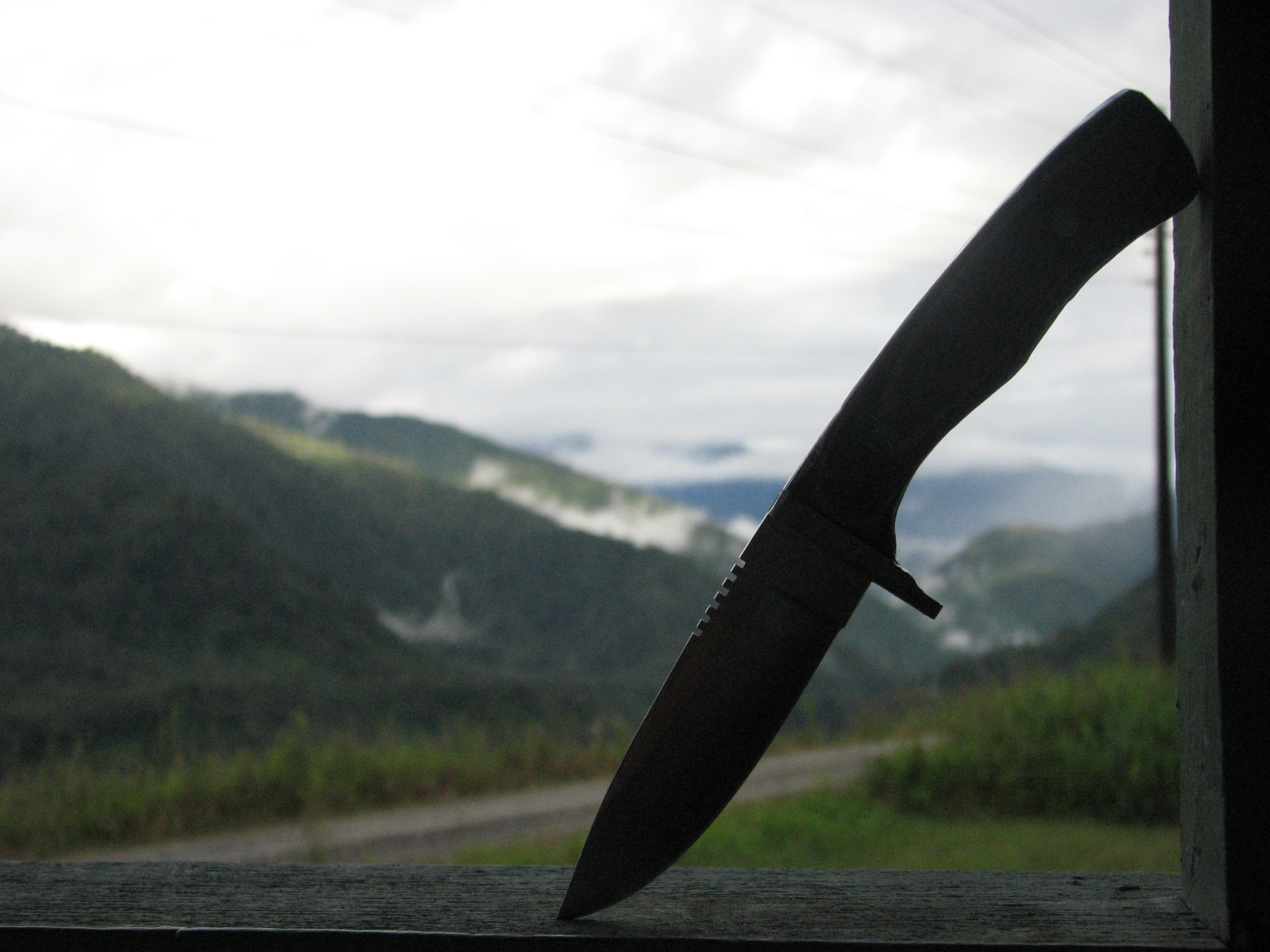
Mangayacu cabin view

The view out of the cabin was beautiful, even when it was blurred by heavy rain.

A few days ago, as I lay listening to the rain, I recalled the rainstorms that hit my grandparents’ home in Florida. Once, after a heavy rain, I saw a rainbow rising from the yard next to the house where my family and I were staying. The rainbow disappeared when I got too close, but I was able to pinpoint more or less where it touched the earth. There was no pot of gold, but it was still exciting.

I was once privileged to visit the Galápagos Islands for my high school biology class. (Being a missionary kid has its perks!) As my classmates and I snorkeled in a rocky bay in a small island, a squall swept over us: driving sheets of warm rain that limited visibility to about fifteen or twenty feet. (It didn’t help that I wasn’t wearing my glasses at the time.) I treaded water, looking in all directions, seeing only water, hearing only the rain. It was one of the most magical moments of my life.

In Montevideo, where my parents now reside, rain is often preceded or followed by spectacular displays of lightning over the horizon. When the rain falls, it falls hard. I used to walk the dog in the rain—well, I used to try. My parents own a dachshund named Sam, known alternatively as Samwise, Samurai, or the Sam-pup. He doesn’t like getting wet, and he hates thunder. During my visits to Montevideo, I had to drag him outside by his leash when it rained. I loved the wet weather. The city blocks, lined with trees, seemed cleaner and lovelier when rain fell.

Rain washed away the grime of this dirty street and made it a corner of Eden.

Rain made this dirty street a corner of Eden.

A few days ago, I lay awake and listened to the rain: remembering, reminiscing, and—if I may borrow my younger brother’s word—nostalgifying. I love the sound of rain. No matter where I go, the gentle roar of rain never changes.

It reminds me of a line from the Kingdom Hearts games. (Although the story of these games is ridiculous, it has many moments of disarming pathos.) In a touching scene, a character raised near the ocean becomes stranded on a dark, deserted island. He has no hope of escape. There is only an empty beach, jagged outcrops of black stone, gloomy fog, and the soft swish of waves. It’s a bleak place, but the castaway finds a shred of comfort.

“At least the waves sound the same.”

A few things in my life have never changed. I love looking up at the stars. I joke that my childhood home is a particular video game, but it’s not really a joke: The Legend of Zelda: Ocarina of Time has been more of a constant in my life than any place on earth.

Then there’s the sound of rain. In all these years, and in all these places, it has never changed. As I recently lay awake, I found myself thinking, “At least the rain sounds the same.”

Rain reminds me of the immutability and faithfulness of God. It exists in a state of constant motion, yet it never changes. Rain is beautiful, and it comforts me.

At any rate, it’s better than snow.

358. Well, I Have a Job

Not long ago, I announced that I was resigning from my job. The time I spent unemployed was pleasant, relaxing, and surprisingly brief.

Yes, I have rejoined the working class. You see, I occasionally have to eat, and I like having a home with walls and a roof. These things cost money. Honest work seemed preferable to begging or robbing banks, so I found employment at a local nursing home.

My work consists mostly of washing dishes. As you can imagine, it’s wet work. (No, not that kind of wet work.) I’ve been on the job for just a few days, but I like it. My coworkers have been friendly, welcoming, and kind. The work itself isn’t terribly demanding; I’m even permitted to pick up a book when I run out of things to do. Employees are given free meals, and (most importantly) there is coffee in abundance. So far, I have nothing but good things to say about my employer. My job is ideal in many ways.

It is a truth universally acknowledged that the coffee station is by far the most important feature of any workplace.

It is a truth universally acknowledged that the coffee station is by far the most important feature of any workplace.

However, there is one way in which my job has disappointed me—though to be fair, my disappointment has hardly anything to do with the work itself, and nearly everything to do with me. Washing dishes is not a step forward in my career; it’s more like a step sideways. It will pay the bills, I hope, but it puts me no closer to my dream of working in writing or publishing.

To be painfully honest, I’m going through a bit of a rough patch. I don’t know where to go from here. As I toil at the mind-numbing task of rinsing dishes and sending them through a dishwasher, I find myself wondering, “Is this really why I went to college? After all my exciting years overseas, have I really resigned myself to such a mundane existence? What’s the point of anything? Who wrote the book of Hebrews? Is there any difference between flotsam and jetsam? Will Beyond Good & Evil ever get a sequel?” (I am easily distracted.)

At the decrepit old age of twenty-five, I feel that I really ought to have settled in a career by now—or at least figured out what career I want to pursue. I feel humiliated to be working another dead-end, blue collar job. This feeling is shameful and arrogant, but I can’t help but feel it, especially when I consider how many of my peers have settled into successful careers. My work doesn’t merely wound my pride. It cuts my pride into tiny pieces, pours gasoline over those pieces, and then sets them on fire.

Flipping heck, when did I get to be so old?

Flipping heck, when did I get so old and bitter?

My pride is in ashes. My clothes are damp with dishwater. My career is… well, it isn’t. I feel endlessly disappointed in myself, but I have decided one thing for certain.

I won’t give up.

My job is a fine opportunity for me to learn humility. I’m trying hard not to be an arrogant git, enjoying the free coffee, and washing the heck out of those dishes. Honestly, I’m thankful to be working. I hope to move on eventually and figure out what the heck I’m supposed to do with my life—and until then, I mean to make the best of things.

Ni No Kuni Is Flipping Amazing

All right, guys, I’ll do my best to contain my excitement for this game, but MY GOSH NI NO KUNI IS AMAZING. I’m trying not to shout, but WHO AM I KIDDING IF ANY GAME DESERVES ALL CAPS IT’S THIS ONE.

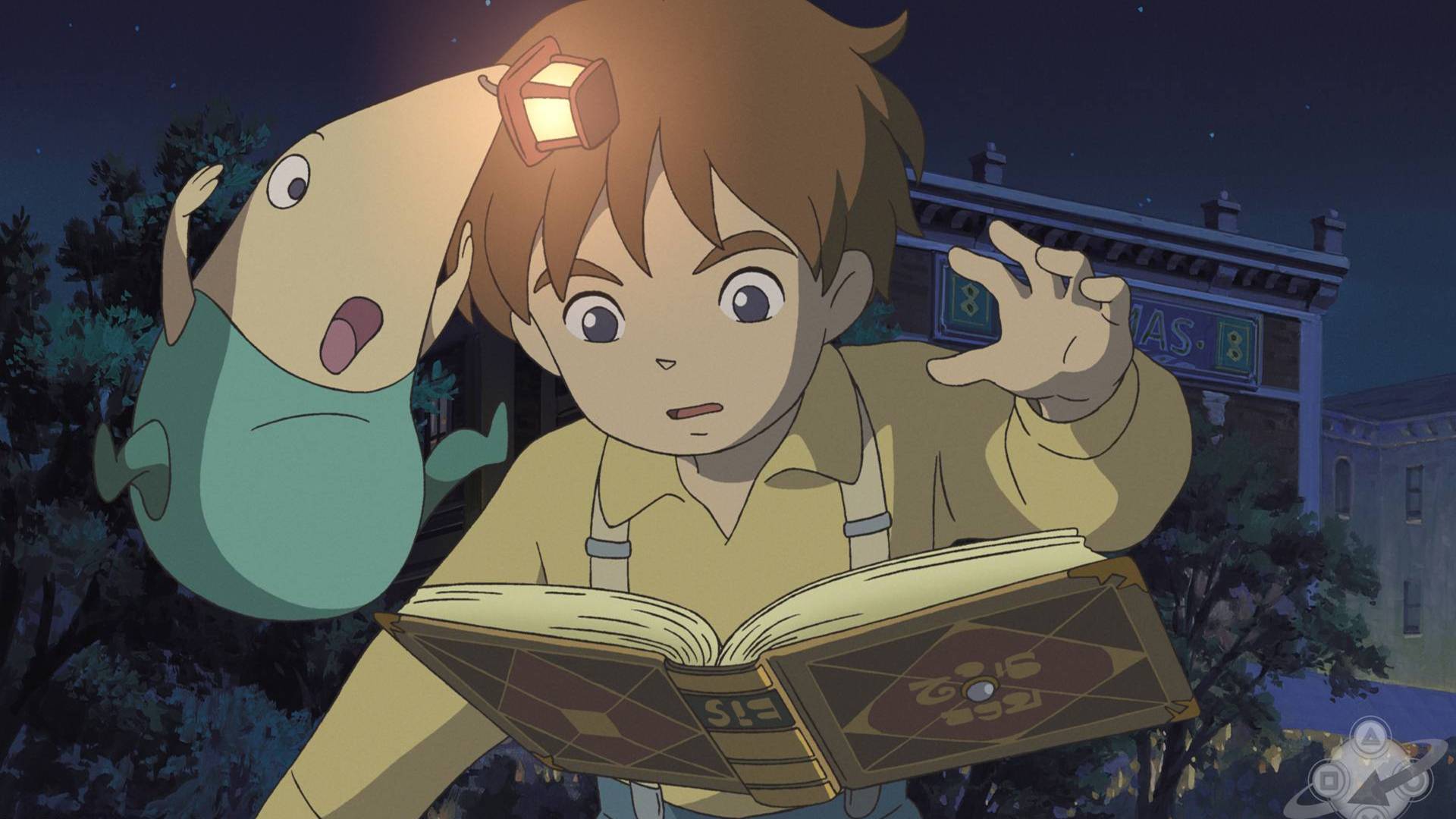
Ni No Kuni: Wrath of the White Witch is a PlayStation 3 game: an RPG (Role-Playing Game) about a little boy named Oliver who tries to save his mother by rescuing a parallel world from an evil jinn. (Ni No Kuni means Second Country in Japanese.) After Oliver’s mum dies, the heartbroken boy meets Drippy, the “Lord High Lord of the Fairies,” a little fellow with a winning Welsh accent and a lantern dangling from his nose.

Ni No Kuni

Drippy explains that he comes from a parallel world: a fairy-tale realm threatened by a dark wizard named Shadar. If Oliver defeats Shadar, he may be able to rescue his mum. Oliver and Drippy set out to save the world, meeting all sorts of colorful characters along the way.

The first thing that stands out about the Ni No Kuni is its visuals. Most blockbuster video games these days are drenched in drab colors: gray, brown, black, white, and occasionally dark green. By contrast, Ni No Kuni boasts bright colors and a cartoony aesthetic.

This brings me to my next point: The cutscenes in Ni No Kuni are animated by Studio Ghibli. Yes, I mean the Studio Ghibli: the legendary filmmaker behind such masterpieces as My Neighbor Totoro and Spirited Away. Besides the cutscenes, all of the visual designs in Ni No Kuni are influenced by Ghibli’s distinctive style.

Much of the game’s music was written by Joe Hisaishi, the renowned film composer, and performed by the Tokyo Philharmonic Orchestra. Needless to say, the music is fantastic.

Of course, none of this would matter if the game were not fun to play. It is. I’ll spare my dear readers all of the technical details, but Ni No Kuni is easily one of the best RPGs I’ve ever played. It’s in the same league as masterpieces like Final Fantasy VIChrono Trigger, and Paper Mario: The Thousand-Year Door. I hardly ever play RPGs these days because they demand so much time, but I’ve cheerfully made an exception for this one.

The last thing I love about Ni No Kuni is that it is so darn charming. It has so many silly puns and funny moments. A cat king is addressed as “Your Meowjesty,” except by Drippy, who prefers to call him “Kingface.” Speaking of the Lord High Lord of the Fairies, Drippy uses all sorts of adorable colloquialisms, saying things like, “That’s flipping fantastic, mun, en’t it? It’s proper tidy!”

Ni No Kuni is colorful, beautiful, heartwarming, charming, and just a little bonkers. It’s easily one of the finest games I’ve ever played. If you have a PS3, like RPGs, or have a soul, I give it my highest recommendation.

357. The Reviews They Are a-Changin’

For years, I have reviewed books and video games for this blog. What can I say? I have a talent for being snobbish and judgmental. Finding fault with things comes naturally to me. It’s a gift. For that reason, TMTF Reviews have long been a feature on this blog.

This is about to change. I’ve decided to replace TMTF Reviews with a new feature: Review Roundups.

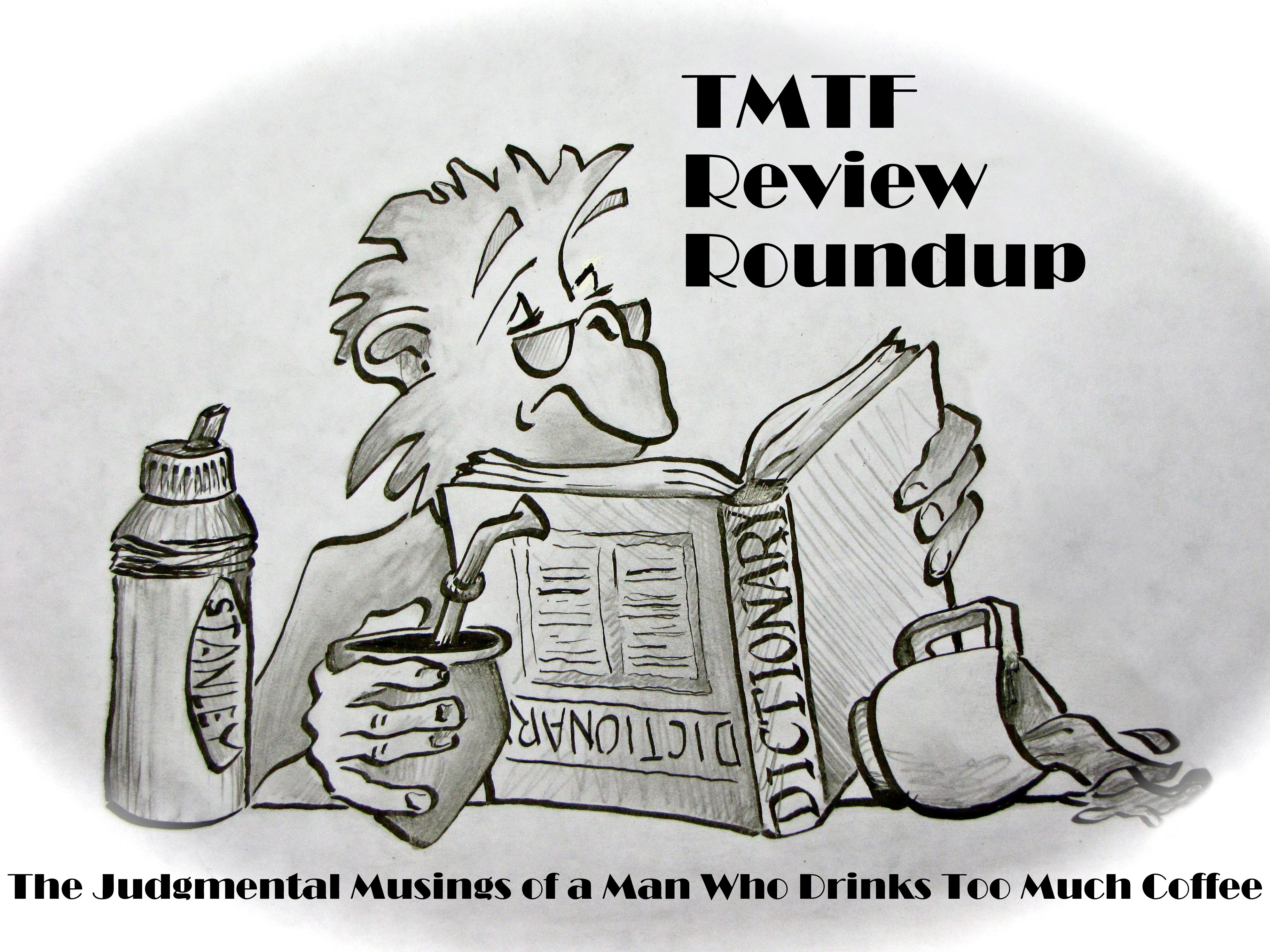
TMTF Review Roundup title cardTMTF Reviews are in-depth critiques of individual books or video games. By contrast, Review Roundups will assess several books, games, or films at a time. Roundups will be less formal than the old Reviews, offering brief impressions instead of long, detailed analyses.

Why are TMTF’s reviews a-changin’? The short answer is that comprehensive reviews are not much fun to write, and probably not much fun to read. As satisfying as it is to critique a book or video game at length, it’s also a bit tedious. Review Roundups will give me the opportunity to review more media without going into exhaustive (and exhausting) detail.

Review Roundups won’t be terribly frequent: maybe once a month or so. They certainly won’t take over this blog or steal the spotlight from… whatever it is we do around here. I don’t know.

Why do I review things at all? I suppose it’s for the same reason I write this blog—it’s fun! That said, I’m excited to continue nitpicking reviewing media for this blog.

356. princess rescuers r us

Today’s post was written by Matt Hill and originally published on Christian media website Hollywood Jesus. Matt brings something new to TMTF by discussing Ico (which I have not yet played) in free verse (which I never write). Matt is a musician, writer, and pop culture aficionado. You can read more of his free-verse pop-culture wanderings on Hollywood Jesus. (While you do that, I’ll think about playing Ico and its spiritual sequel, Shadow of the Colossus.)

me n my kids totally rescued a princess together yesterday . .
well, kind of . .

the princess was maybe not a real princess
and her name was yorda
and she was a character in this really great video game called *ico*
that originally came out for ps2 (and i played it then)
and then was re-released in hd for ps3 a while back (so i bought it recently)

and i suppose it wasn’t technically us who rescued her . .
it was our onscreen avatar named ico . .

and, if you want to be technical about it, my kids didn’t really
do any of the actual controlling of ico and so technically
didn’t rescue yorda themselves,
just through me – their real life avatar . .

and, technically, is yorda really rescued at the end of that game?

but, however, transition,
on a better/deeper/realer/more interesting level,
my kids and i *totally* completed that game together,
rescuing yorda together,
defeating the wicked queen together,
escaping the castle together,
walking that post-credits
serene and surreal
beach together at the
end
only to discover yorda had accompanied us even there (right?) . . . ….. .. . . .

they experienced what i did: the drama, the struggle, the tension, the
climax,
the resolution . .
they saw what i saw, thought through what i thought through,
asking questions, giving advice along the journey,
loving the adventure of it as i did (twice now) . .

by the end, they knew that escape was imminent (immanent?),
that the queen would soon have to get hers,
that when yorda speaks her final words (in another, untranslated language),
what she said probably meant “thank you” or “i love you,”
which, in my estimation, is right on . .
and good final thoughts to a game, or anything else . .

i made this experience with my kids happen because:
it teaches them creative thinking skills,
problem-solving skills,
how to understand and relate to characters in a story,
how narratives work,
justice and fair play and perseverance and courage and . . .
(on
and
on)

i made this experience happen because:
it’s an experience that we now share,
that we’ll now remember,
together . .

i made this experience happen because:
on a better/deeper/realer/more interesting level,
though i think/hope the above was that too,
a hero-rescuing-the-princess story,
imho,
is *the* story of this universe . .
the story of God becoming man to rescue
us princesses from the clutches
of that wicked queen
(you know the one) . .
the story that,
imho,
all other stories – princess rescuing ones and the rest –
echo and emulate and imitate
on
and
on

and now,
i’m hoping that somehow, someday,
the fact that
me n my kids
(princess rescuers r us)
are actually *in* that story *together*
—– – as you and i are too,
though not as intimately
(it’s happening right now! this is the story! . . you and i are in it! . .
but what do we do with it?! . . ) —— – — –
will be understood by them,
and acted upon by them in faith,
just as,
in faith,
we offed that wicked queen and rescued yorda from the castle together yesterday

The Joker

The Joker is one of the greatest comic-book villains of all time. I consider him to be the best of the worst: one of the most iconic and interesting baddies in pop culture.

Why is Batman’s greatest foe such a great character? Part of it, I suppose, is that he is a perfect foil. Like Batman, the Joker has no superpowers. They are mere men, driven to opposite extremes by their obsessions. The Dark Knight fights for order and justice; the Joker stirs up chaos and violence. Batman wants to see Gotham happy and safe; the Joker wants to watch Gotham burn.

In the video above, Kevin McCreary lists a few facts you may not know about the Joker. (This is the same Kevin with whom I performed a rap battle back in the day. He’s a really cool dude.) The video follows the recent reveal of the Joker’s latest incarnation for the forthcoming Suicide Squad movie, which reimagines the classic killer clown as a goth rocker with a headache.

FOR THE LOVE OF COMICS GIVE ME SOME TYLENOL!

I NEED TYLENOL!

I’m not impressed by this edgy take on Batman’s iconic foe. I think comedian Brock Wilbur put it well in a recent tweet: “oh wow I can tell this version of the Joker is a real bad dude because his origin story involves falling into a vat of hot topic.”

This Joker is a disappointment after Heath Ledger’s chilling performance as the Clown Prince of Crime in The Dark Knight. Ledger’s mirthless Joker was excellent, but my favorite version of the character is Mark Hamill’s gleeful, unhinged Joker. Hamill’s cackling psychopath scares me far more than Ledger’s mumbling criminal.

Why is the Joker scary? It may be because he loves violence and cruelty for their own sake. He is impulsive, childish, sadistic, and—this is what disturbs me most—maniacally cheerful. The Joker is an evil guy with a strong sense of humor, and that’s creepy.

355. What I Want to Change about The Trials of Lance Eliot

I once wrote a novel titled The Trials of Lance Eliot, and readers have asked me whether I plan to write sequels. I may continue Lance’s story someday, but what I really want to do is rewrite its first part.

Well, I don’t want to rewrite The Trials of Lance Eliot completely. (That would take a lot of work.) However, having put a couple of years between myself and my novel, I’ve realized there are quite a number of things I want to change.

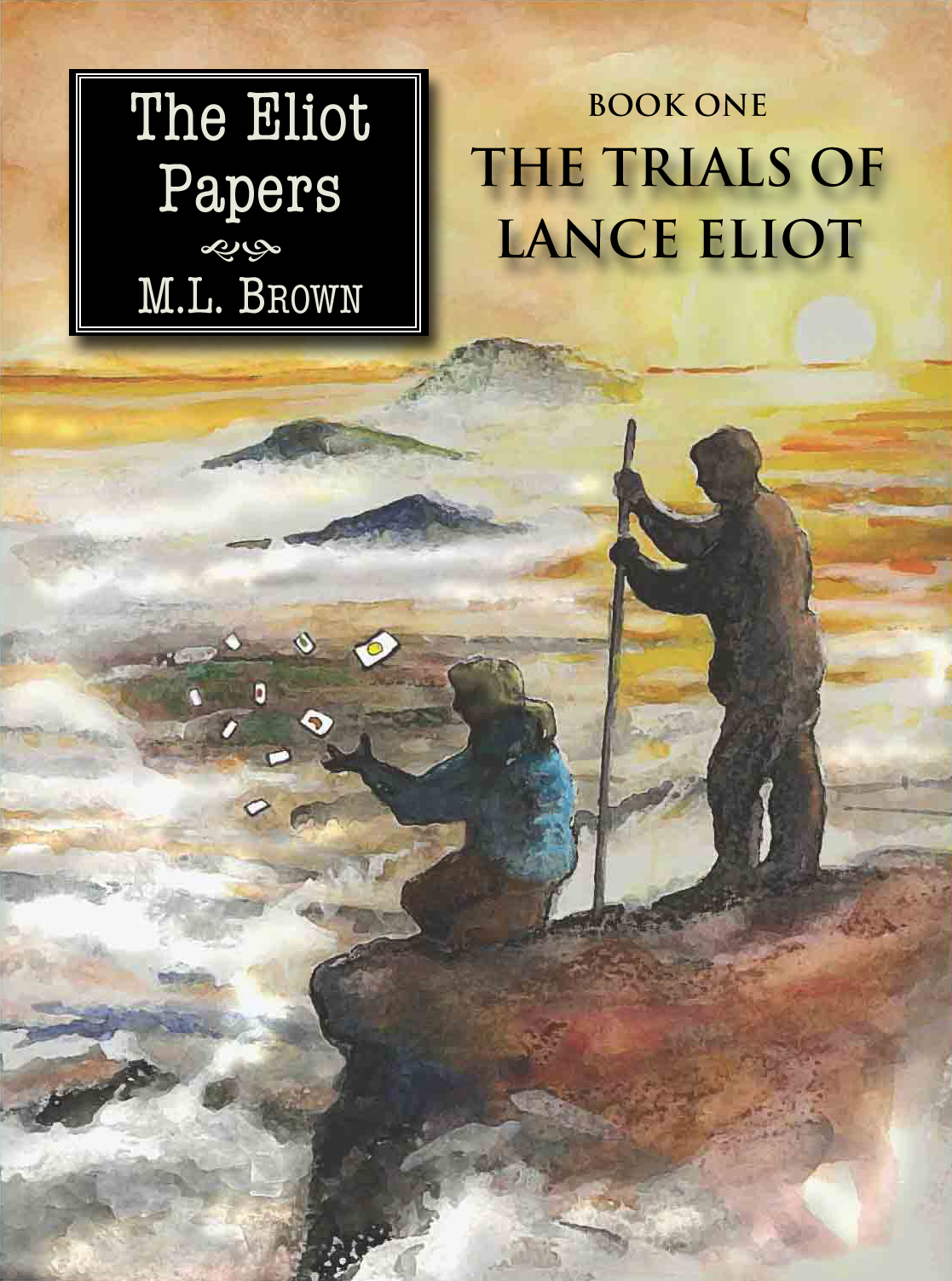
The Trials of Lance EliotHere’s what I want to change about The Trials of Lance Eliot.

In case anyone is interested in reading my little book, be ye warned: There be major spoilers ahead!

I want to remove Miles and a few other characters.

When I wrote the novel, I had big plans for Miles. He is a traveling companion to Lance, Regis, and Tsurugi, and I wanted him to balance the group by being a foil for each of them. With his soft heart, strong work ethic, and childlike faith, Miles was supposed to challenge Lance’s selfishness, Regis’s irresponsibility, and Tsurugi’s cynicism.

In the end, however, Miles doesn’t contribute much. He drops out of the story partway through, making a halfhearted encore toward the end. I don’t think the novel needs him. A few other characters could be just as easily removed: Atticus, for example, could be replaced by Petra. I think The Trials of Lance Eliot has too many underdeveloped characters, and could benefit from the removal of the unnecessary ones.

I want to clear up the disappearance of Maia and Kana.

The supposed deaths and eventual reappearances of both Kana and Maia make me cringe more than almost anything else in The Trials of Lance Eliot. Fake deaths are horribly clichéd.

However, the apparent deaths and subsequent reappearances of these characters are necessary for the story. The deaths of Maia and Kana drive the development of Lance and Regis, respectively: Lance becomes depressed, and Regis resolves to become an honest man. Maia and Kana must be reintroduced later in the story: Kana to rescue Lance, and Maia to send him home. I can think of no easy way to dodge these fake deaths.

However, I can be less coy about Maia and Kana’s disappearances. I want to state merely that they are “missing,” not that they are necessarily dead. That would still provide some tension, while making their inevitable revivals seem less contrived.

I want to start the story in the US instead of in the UK.

Full disclosure: I started the story in Oxford only because J.R.R. Tolkien and C.S. Lewis, my favorite fantasy writers, lived there. I’ve never actually been to the UK. Most of what I know about contemporary British culture comes from watching Sherlock and Doctor Who. I don’t know enough about the UK to make it a convincing start to Lance’s story.

Indiana, a place with which I’m all too familiar, would be a perfectly adequate place for the start of The Trials of Lance Eliot. If anything it would be better: a small Indiana town is far less interesting than Oxford, which would make Lance’s adventures seem more exciting by contrast.

I want to make Regis a girl.

Not long ago, someone on Twitter shared the following quote from Noelle Stevenson: “When you write a male character, think ‘does this character have to be male? Why?'”

Like The HobbitThe Trials of Lance Eliot is overstuffed with male characters. (I love The Hobbit, but its lack of female characters is appalling.) It wasn’t my intention to discriminate against female characters; I wrote mostly male ones because, well, I happen to be a guy. In the end, The Trials of Lance Eliot had only three female characters with any depth, and only one of them (Maia) received much characterization.

I’m no feminist, but I’ve realized it isn’t fair for my characters to be men by default. Of all the characters in my novel, Regis has probably the fewest reasons for being male. I want to rewrite the character as a young lady. I suppose that means I would have to change the name, wouldn’t it?

I want to change the orphanage in Valdelaus to a home for persons with disabilities.

Orphanages have become a cliché in storytelling. A home for persons with disabilities would offer far better opportunities for both pathos and comedy—believe me, I know!

I want to publish the book under my own name.

I’ve already discussed this, and have nothing to add.

I want to use exposition more evenly.

An early chapter of my novel is mostly exposition as Kana explains things to Lance. Perhaps Kana could offer his explanations incrementally across a couple of chapters? Whatever my solution, the early chapters should strike a better balance between action and exposition.

I want to rewrite some of the dialogue.

I prefer to use good grammar, but that isn’t how ordinary people talk. My characters should speak less like Adam writing and more like people actually talking.

I want Lance to swear like a normal person.

Lance’s dated British euphemisms are a bit silly. People don’t say things like “dash it” and “what in blazes” anymore. (Well, I do, but I do a lot of strange things.) My novel may be a case in which mild profanity would be justified. Ordinary swearwords like “damn” and “hell” would believably convey Lance’s lack of moral fiber toward the beginning of his journey.

These are the changes I would make to The Trials of Lance Eliot… and then, maybe, I could go back to planning its sequels. Maybe.

354. Get a Grip and Stop Whining

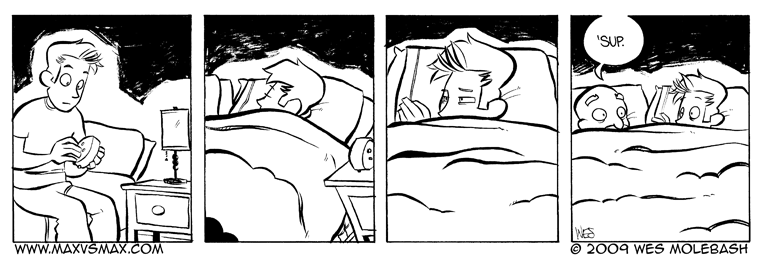
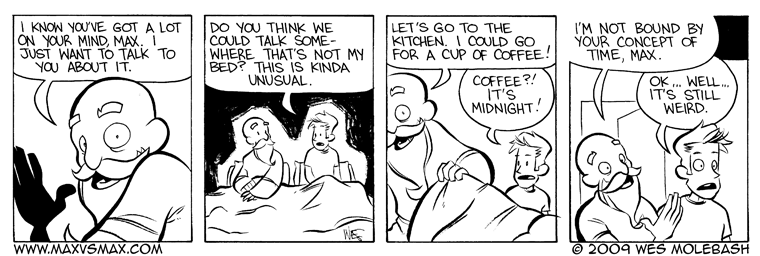
Once upon a time, when this blog was new and I had just finished college, I shared a series of comic strips by the inimitable Wes Molebash. They were part of a comic titled Max Vs. Max: the unexpectedly funny story of a man working through the guilt of his recent divorce. In this series of strips, Max wakes up to find himself in bed with God.

Yup. You read that right.

Max vs. Max, 1Max immediately realizes the whole thing is a dream. “I’m dreaming about sleeping in bed with God,” he mumbles, awestruck. “I think… I probably need therapy.” Fortunately, the Almighty doesn’t seem at all bothered. He just wants to chat.

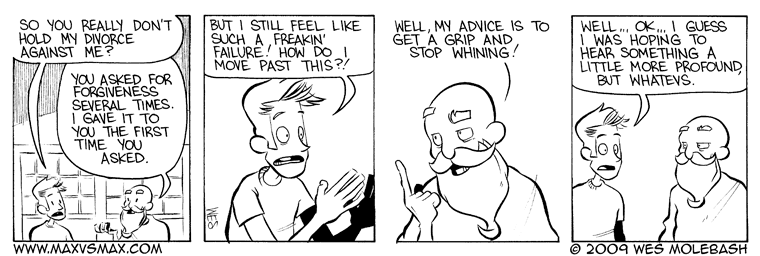
Max vs. Max, 3In the kitchen, Max admits to feeling guilty about his divorce, even though God has forgiven him. “I still feel like such a freakin’ failure!” he exclaims. “How do I move past this?!”

God, in his perfect and infinite wisdom, has one suggestion for Max: “Well, my advice is to get a grip and stop whining.”

Max vs. Max, 6I remembered these fantastic comic strips a few days ago. (If you have not yet read them, leave this post and check them out. Go on. I’ll wait for you.) God’s advice to Max really stood out to me. As Max struggles with feelings of failure, God suggests letting go of self-pity and moving forward. It’s a simple solution, but not an easy one.

God’s advice for Max is, well, for Max. It doesn’t apply universally to every person and circumstance. In the wrong situation, such blunt words cause more harm than good. I won’t presume to offer anyone this advice, with one exception: I know of one person in the world who definitely needs it.

I, of course, am that person. I occasionally suffer from depression, and it sucks. My future seems a bit scary right now, and my faith is often shakier than I care to admit. I wrestle with doubt and fear and selfishness. I sometimes find myself echoing Max and admitting that I feel like such a freakin’ failure.

When I can’t help echoing Max, I must also echo God—well, God as he is imagined by Mr. Molebash: “Get a grip and stop whining.” Sometimes—not always, but sometimes—it is as simple as that. Self-pity is easy. Courage and humility are hard, but they are also necessary to move forward.

Like Max, I am sometimes my own worst enemy. (Adam Vs. Adam has a nice ring to it, don’t you think?) When I find myself wallowing in regret or self-pity, I must get a grip and stop whining—and keep pressing onward.

How It Feels to Grow Up

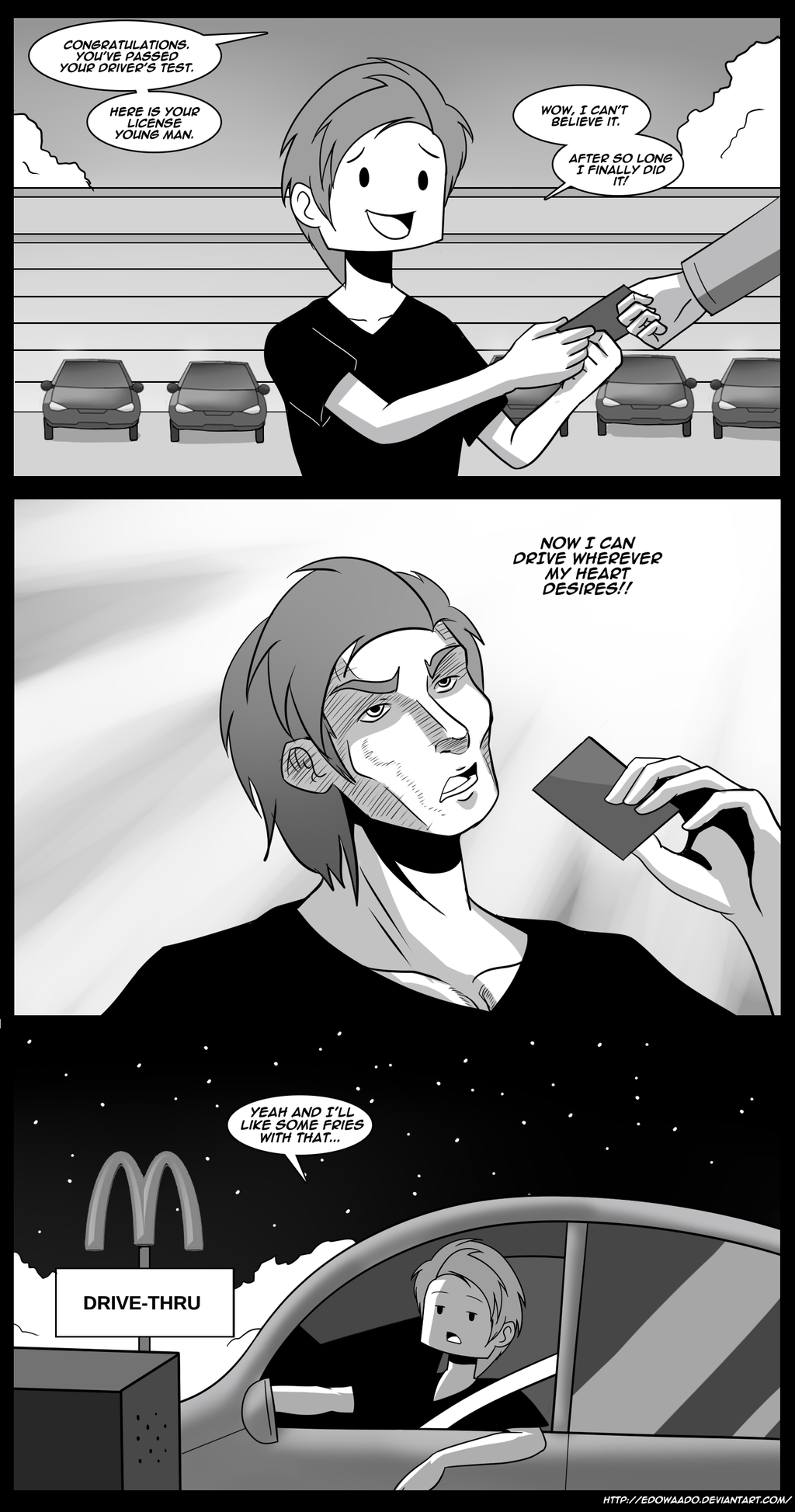
I dislike many things about adulthood, but I’ll be the first to admit it has its perks. As an adult, I get to eat anything I want. (What I want, apparently, is apples, sandwiches, and the occasional pie.) I am the master of my household, free to arrange and decorate my apartment however I like. (What I like, it seems, is machetes, plushies, and video game posters.) Like the young gentleman in the comic above, I have both a car and the license to drive “wherever my heart desires.” (What my heart desires, more often than not, is to stay home.)

Being a grownup is exciting. It brings freedom and independence. In time, however, the privileges of adulthood become commonplace. No longer a triumphant emblem of autonomy, my car has become the quickest way to run errands, get to work, or grab burgers at McDonald’s. While never losing their value, the perks of growing up lose some of their magic.

All the same, I must say, being a grownup is pretty sweet.

353. Apples

In the past few years, apples have gradually taken over my life. It began innocently enough. I began buying apples as a healthy snack. The next thing I knew, I was eating applesauce every morning with breakfast, drinking apple cider most evenings, and occasionally snacking on apple pie. Just as the first Adam was enticed by the fruit of Eden, so this Adam seems to have ensnared by apples.

Honestly, I never meant to become an apple aficionado. The fruit crept stealthily into my diet, and it was only a month or two ago that I realized how much of my daily intake was apple-based. I suppose there are worse vices.

My kitchen is perpetually stocked with apples.

This is basically what my kitchen counter looks like. (I may be exaggerating just a bit.)

After realizing my fondness for apples, I resolved to find the perfect variety. I had favored Gala apples for a couple of years, having chosen them over other varieties simply because I liked the name. It was time for me to abandon old habits and explore new possibilities. It was a journey—the Quest for the Perfect Apple.

From the start, I shunned Red Delicious apples. These deceptively-named fruits are disgusting. Their thick, bitter skins cover fruit with the texture of wet cardboard and no particular flavor. I also avoided Granny Smith apples. These emerald-green fruits are perfect for baking, but too sour to eat raw.

Thus my quest began with Jazz apples, which were tart but tough. I moved on to Pink Lady apples. These were more yellow than pink, and not particularly tasty. As much as I wanted to try Fuji apples, which are renowned for their sweetness and crispness, I couldn’t find any at the local grocery store.

In the end, I returned to Gala apples. These crisp, sweet, nice-smelling fruits are tasty, healthy, and relatively inexpensive. I average about one apple daily. “An apple a day keeps the doctor away,” and doctors have kept their distance so far. (There is one Doctor I wouldn’t mind meeting, but he once claimed that “apples are rubbish,” so I’m not sure we would get along.)

I’ve already mentioned my liking for applesauce and pie; I also enjoy apple butter, fritters, and dumplings. For a few wonderful, all-too-short weeks every year, a nearby Amish market sells fresh-pressed apple cider by the gallon. There are a ridiculous number of ways to enjoy this delicious fruit.

In conclusion, apples have really grown on me. (Pun intended. I’m sorry.) I am an apple fanatic to the core. (I’m so sorry.) In this case, the phrase “Adam’s apple” is perfectly apple-poe—I mean, apropos. (I’m so, so sorry.) If you disbelieve my fondness for the fruit, this blog post is full of examples—just check out them apples! (I’m so, so, so sorry.) I hope these puns haven’t left any of my readers upset or apple-plectic—apoplectic, I mean. (I’m so… never mind.)

For the record, bananas and avocados are also pretty good.