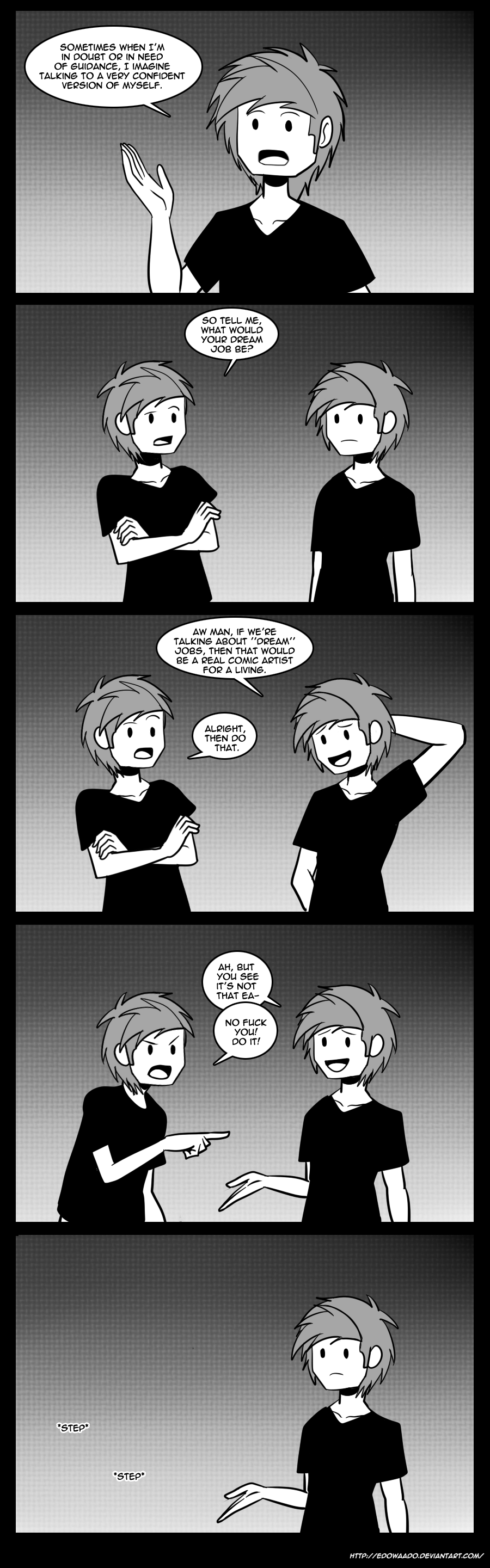
From the cartoonist who perfectly expressed how it feels to grow up comes his latest step toward being a successful adult. I sometimes have the same conversation with myself, except that I want to do something in writing or publishing instead of being a comic artist, and my language is a little less coarse.
Edowaado has a point: Starting a successful career isn’t as easy as it sounds. His imaginary self also has a point: Everyone has to start somewhere.
I hope Edo is able to achieve his dream of becoming a comic artist. In the meantime, he’ll keep making comics, and people will continue enjoying them. I may someday find a niche in writing or publishing. I may not. Either way, I’ll continue writing. The nice thing about creativity is that it isn’t reserved for professionals!
If you’re a living human being—which, if you’re reading this, you probably are—I invite you to set aside five and a half minutes from your busy schedule whenever you can spare them. Then grab your hot beverage of choice, lean back in your chair, close your eyes, and listen to some relaxing piano.
The video above offers a soothing melody from Studio Ghibli’s Castle in the Sky, my all-time favorite film, but it may not be to your taste. That’s perfectly fine. I invite you, in that case, to pull up whatever song relaxes you, and listen to that instead.
“What is the way to the abode of light? And where does darkness reside? Can you take them to their places? Do you know the paths to their dwellings? Surely you know, for you were already born! You have lived so many years!”
~ Job 38:19-21
I’m often sarcastic, but that’s okay. God is sarcastic, too.
In the book of Job, God allows a righteous man to be tormented as a test of faith. It’s a paradoxical book, at once uplifting in showing the ultimate power and benevolence of God, and disturbing in depicting a God who allows a good person to suffer without any explanation. I’ve already said a thing or two about Job, and there’s more I could say, but for now I’ll simply point out how the book of Job proves that God can be really sarcastic.
Job spends most of the book arguing with his friends, defending his innocence as they accuse him of wrongdoing. If Job were innocent, they reason, why would God allow him to suffer? Job isn’t impressed by their arguments, and he proves to be quite sarcastic himself: “How you have helped the powerless!” he snaps in the twenty-sixth chapter. “How you have saved the arm that is feeble! What advice you have offered to one without wisdom! And what great insight you have displayed! Who has helped you utter these words? And whose spirit spoke from your mouth?”
Job’s biting sarcasm is surpassed only by God himself, who shows up a few chapters later. God doesn’t offer explanations or answer Job’s questions. Instead, he emphasizes his own absolute power and wisdom. However incomprehensible God seems, he knows what he’s doing. It’s not a terribly satisfying answer, but it’s enough for Job, and the book ends on a happier note with Job’s life restored.
God’s response to Job seems really harsh, especially when the Almighty gets sarcastic. After asking Job a long series of unanswerable questions, he adds, “Surely you know, for you were already born! You have lived so many years!” His sarcasm only emphasizes how little Job—or any human being, for that matter—can comprehend of God’s nature.
There’s another lesson here: God uses sarcasm, which I cheerfully accept as license to be as sarcastic as I like. After all, Christians are commanded to be like God: Jesus Christ said, “Be perfect, therefore, as your heavenly Father is perfect.”
In other words, by being sarcastic, I’m obeying the all-important commandment to be like God. Sarcasm is my moral and religious duty.
No, I’m not being serious. Yes, I’m being sarcastic, but not from any sense of religious obligation. Please don’t bombard me with angry emails or heavy stones! After all, it’s important to have a sense of humor, for as Jon Acuff reminds us, “Laughter is a gift from God. If we take it for granted and act like Christians can’t be funny, he’ll take it back. Like the unicorns.”
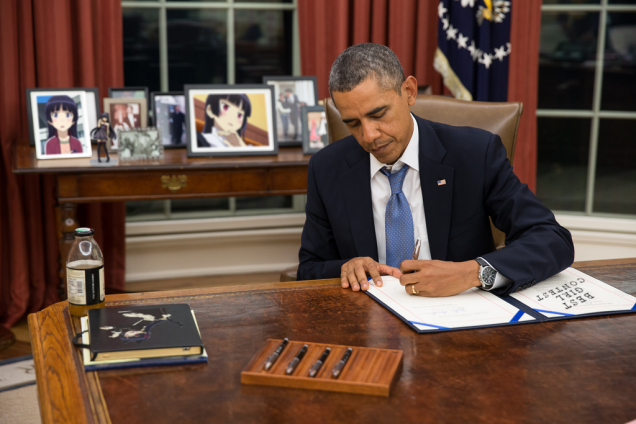
It has become a running joke on the Internet that Barack Obama, the President of the United States of America, is a hardcore otaku obsessed with manga and anime. (For the sensible readers who keep a safe distance from geek culture: an otaku is an obsessive geek, manga is a style of Japanese comics, and anime is a kind of Japanese animation.) The Internet, in its vast and incomprehensible wisdom, has given the US President a fierce love of all things geeky and Japanese. His obsession with anime has been duly documented in a long series of (digitally altered) photos and GIFs.
Politics is a touchy subject. I know people who admire President Obama; I know people who think he might be the Antichrist. When it comes to a subject as volatile as the US president, it’s nice to see geeky jokes for a change instead of arguments, accusations, and insults.
Although his love of anime is just an Internet joke, President Obama did thank Japan (on behalf of America’s young people) for manga and anime. I swear I am not making this up.
This song gives me chills nearly every time I listen to it. From the slow buildup underscored by static, to the epic crescendo and thrashing drums shortly after the two-minute mark, to the soaring conclusion backed by choir and strings—this song is odd and exciting and beautiful, and I love it.
This music comes from Metal Gear Solid 2 of all places. (It’s a strange game.) The creator of the Metal Gear Solid series, Hideo Kojima, is basically the video game industry’s Quentin Tarantino. Like Tarantino’s movies, Kojima’s games are violent and campy as all heck, yet stylish, complex, and compelling. This song, with its unusual blend of orchestra, drums, and electronic music, suits Metal Gear Solid perfectly.
I hear Kojima recently left the Metal Gear Solid series, which is a shame. I also realize I have yet to play Metal Gear Solid 4. One of these days.
As its title suggests, Heart of Darkness is not a cheerful book. It shows how dark and depraved the human heart can be. (It’s also boring and kinda racist, but still a worthwhile read.) Although I haven’t touched the book since reviewing it, I recently found myself contemplating one of its most famous lines.
Most of Heart of Darkness is spent slowly building up to an enigmatic man named Kurtz. When Kurtz finally appears, he turns out be a madman at death’s door. I can think of many adjectives for the genius, artist, and monster that is Kurtz: tortured, eloquent, gifted, brutal, terrifying, insane. He is not a good man, but in some ways, he is a great one. His final words—“The horror! The horror!”—are among the most famous in literature.
At last, Kurtz dies… only for his death to be announced insolently, almost comically, by an African boy: “Mistah Kurtz—he dead.”
The more I think about this scene, the more it impresses me. At the end of his life, Kurtz the visionary receives neither comfort nor honor, but only the flat acknowledgment that “he dead.” He dies alone, shrouded in darkness and overwhelmed by despair. This great man’s death is met with scathing derision and a muddy burial. Kurtz was cruel, but how much crueler is the world that shrugs and says, “Mistah Kurtz—he dead.”
The death of Kurtz is, to borrow the narrator’s words, “so beastly, beastly dark.” The death of Kurtz is an outstanding moment not only in Heart of Darkness, but in literature.
This goofy song would be the perfect opening theme for an eighties-style cartoon. Imagine Hyper Camelot, a show based very loosely on the Arthurian legends, in which King Arthur, Lancelot, and the other Knights of the Round Table fight with courage, chivalry, and the power of friendship™ to protect Avalon from the forces of evil. Pandering to misplaced nostalgia for the cartoons of our childhood, such a show would be packed with terrible one-liners, cheesy life lessons, and spectacular explosions.
All right, guys, I’ll do my best to contain my excitement for this game, but MY GOSH NI NO KUNI IS AMAZING. I’m trying not to shout, but WHO AM I KIDDING IF ANY GAME DESERVES ALL CAPS IT’S THIS ONE.
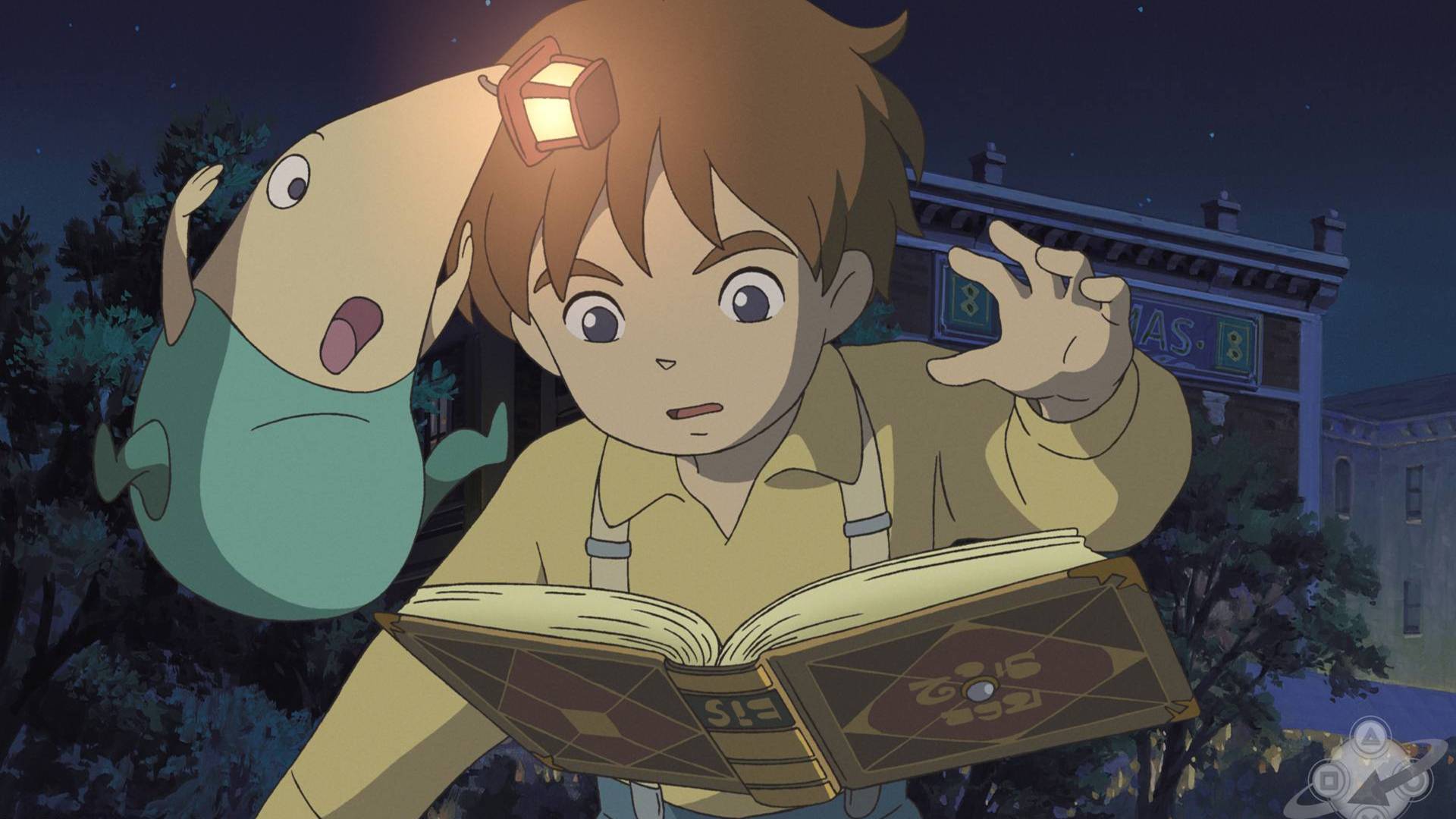
Ni No Kuni: Wrath of the White Witch is a PlayStation 3 game: an RPG (Role-Playing Game) about a little boy named Oliver who tries to save his mother by rescuing a parallel world from an evil jinn. (Ni No Kuni means Second Country in Japanese.) After Oliver’s mum dies, the heartbroken boy meets Drippy, the “Lord High Lord of the Fairies,” a little fellow with a winning Welsh accent and a lantern dangling from his nose.
Drippy explains that he comes from a parallel world: a fairy-tale realm threatened by a dark wizard named Shadar. If Oliver defeats Shadar, he may be able to rescue his mum. Oliver and Drippy set out to save the world, meeting all sorts of colorful characters along the way.
The first thing that stands out about the Ni No Kuni is its visuals. Most blockbuster video games these days are drenched in drab colors: gray, brown, black, white, and occasionally dark green. By contrast, Ni No Kuni boasts bright colors and a cartoony aesthetic.
This brings me to my next point: The cutscenes in Ni No Kuni are animated by Studio Ghibli. Yes, I mean the Studio Ghibli: the legendary filmmaker behind such masterpieces as My Neighbor Totoro and Spirited Away. Besides the cutscenes, all of the visual designs in Ni No Kuni are influenced by Ghibli’s distinctive style.
Much of the game’s music was written by Joe Hisaishi, the renowned film composer, and performed by the Tokyo Philharmonic Orchestra. Needless to say, the music is fantastic.
Of course, none of this would matter if the game were not fun to play. It is. I’ll spare my dear readers all of the technical details, but Ni No Kuni is easily one of the best RPGs I’ve ever played. It’s in the same league as masterpieces like Final Fantasy VI, Chrono Trigger, and Paper Mario: The Thousand-Year Door. I hardly ever play RPGs these days because they demand so much time, but I’ve cheerfully made an exception for this one.
The last thing I love about Ni No Kuni is that it is so darn charming. It has so many silly puns and funny moments. A cat king is addressed as “Your Meowjesty,” except by Drippy, who prefers to call him “Kingface.” Speaking of the Lord High Lord of the Fairies, Drippy uses all sorts of adorable colloquialisms, saying things like, “That’s flipping fantastic, mun, en’t it? It’s proper tidy!”
Ni No Kuni is colorful, beautiful, heartwarming, charming, and just a little bonkers. It’s easily one of the finest games I’ve ever played. If you have a PS3, like RPGs, or have a soul, I give it my highest recommendation.
The Joker is one of the greatest comic-book villains of all time. I consider him to be the best of the worst: one of the most iconic and interesting baddies in pop culture.
Why is Batman’s greatest foe such a great character? Part of it, I suppose, is that he is a perfect foil. Like Batman, the Joker has no superpowers. They are mere men, driven to opposite extremes by their obsessions. The Dark Knight fights for order and justice; the Joker stirs up chaos and violence. Batman wants to see Gotham happy and safe; the Joker wants to watch Gotham burn.
In the video above, Kevin McCreary lists a few facts you may not know about the Joker. (This is the same Kevin with whom I performed a rap battle back in the day. He’s a really cool dude.) The video follows the recent reveal of the Joker’s latest incarnation for the forthcoming Suicide Squad movie, which reimagines the classic killer clown as a goth rocker with a headache.
I NEED TYLENOL!
I’m not impressed by this edgy take on Batman’s iconic foe. I think comedian Brock Wilbur put it well in a recent tweet: “oh wow I can tell this version of the Joker is a real bad dude because his origin story involves falling into a vat of hot topic.”
This Joker is a disappointment after Heath Ledger’s chilling performance as the Clown Prince of Crime in The Dark Knight. Ledger’s mirthless Joker was excellent, but my favorite version of the character is Mark Hamill’s gleeful, unhinged Joker. Hamill’s cackling psychopath scares me far more than Ledger’s mumbling criminal.
Why is the Joker scary? It may be because he loves violence and cruelty for their own sake. He is impulsive, childish, sadistic, and—this is what disturbs me most—maniacally cheerful. The Joker is an evil guy with a strong sense of humor, and that’s creepy.


 Typewriter Monkey Task Force