359. Rain

Rain was falling when I awoke a few days ago. I lay on my floor, tangled up in a sleeping bag and a light blanket, slipping in and out of consciousness, listening to the soft roar of the rain, and remembering.

The sound of the rain took me back to the jungles near Shell Mera, the town famous for Operation Auca and the brave men who lost their lives for the Gospel of Christ. When we lived in Ecuador, my family and I vacationed in a cabin with a corrugated metal roof. The rain thundered when it fell. I drank tea made from fresh hierba luisa leaves, lay in a hammock, and read a book or played a video game as rain beat the metal roof like a titanic drum.

Mangayacu cabin view

The view out of the cabin was beautiful, even when it was blurred by heavy rain.

A few days ago, as I lay listening to the rain, I recalled the rainstorms that hit my grandparents’ home in Florida. Once, after a heavy rain, I saw a rainbow rising from the yard next to the house where my family and I were staying. The rainbow disappeared when I got too close, but I was able to pinpoint more or less where it touched the earth. There was no pot of gold, but it was still exciting.

I was once privileged to visit the Galápagos Islands for my high school biology class. (Being a missionary kid has its perks!) As my classmates and I snorkeled in a rocky bay in a small island, a squall swept over us: driving sheets of warm rain that limited visibility to about fifteen or twenty feet. (It didn’t help that I wasn’t wearing my glasses at the time.) I treaded water, looking in all directions, seeing only water, hearing only the rain. It was one of the most magical moments of my life.

In Montevideo, where my parents now reside, rain is often preceded or followed by spectacular displays of lightning over the horizon. When the rain falls, it falls hard. I used to walk the dog in the rain—well, I used to try. My parents own a dachshund named Sam, known alternatively as Samwise, Samurai, or the Sam-pup. He doesn’t like getting wet, and he hates thunder. During my visits to Montevideo, I had to drag him outside by his leash when it rained. I loved the wet weather. The city blocks, lined with trees, seemed cleaner and lovelier when rain fell.

Rain washed away the grime of this dirty street and made it a corner of Eden.

Rain made this dirty street a corner of Eden.

A few days ago, I lay awake and listened to the rain: remembering, reminiscing, and—if I may borrow my younger brother’s word—nostalgifying. I love the sound of rain. No matter where I go, the gentle roar of rain never changes.

It reminds me of a line from the Kingdom Hearts games. (Although the story of these games is ridiculous, it has many moments of disarming pathos.) In a touching scene, a character raised near the ocean becomes stranded on a dark, deserted island. He has no hope of escape. There is only an empty beach, jagged outcrops of black stone, gloomy fog, and the soft swish of waves. It’s a bleak place, but the castaway finds a shred of comfort.

“At least the waves sound the same.”

A few things in my life have never changed. I love looking up at the stars. I joke that my childhood home is a particular video game, but it’s not really a joke: The Legend of Zelda: Ocarina of Time has been more of a constant in my life than any place on earth.

Then there’s the sound of rain. In all these years, and in all these places, it has never changed. As I recently lay awake, I found myself thinking, “At least the rain sounds the same.”

Rain reminds me of the immutability and faithfulness of God. It exists in a state of constant motion, yet it never changes. Rain is beautiful, and it comforts me.

At any rate, it’s better than snow.

358. Well, I Have a Job

Not long ago, I announced that I was resigning from my job. The time I spent unemployed was pleasant, relaxing, and surprisingly brief.

Yes, I have rejoined the working class. You see, I occasionally have to eat, and I like having a home with walls and a roof. These things cost money. Honest work seemed preferable to begging or robbing banks, so I found employment at a local nursing home.

My work consists mostly of washing dishes. As you can imagine, it’s wet work. (No, not that kind of wet work.) I’ve been on the job for just a few days, but I like it. My coworkers have been friendly, welcoming, and kind. The work itself isn’t terribly demanding; I’m even permitted to pick up a book when I run out of things to do. Employees are given free meals, and (most importantly) there is coffee in abundance. So far, I have nothing but good things to say about my employer. My job is ideal in many ways.

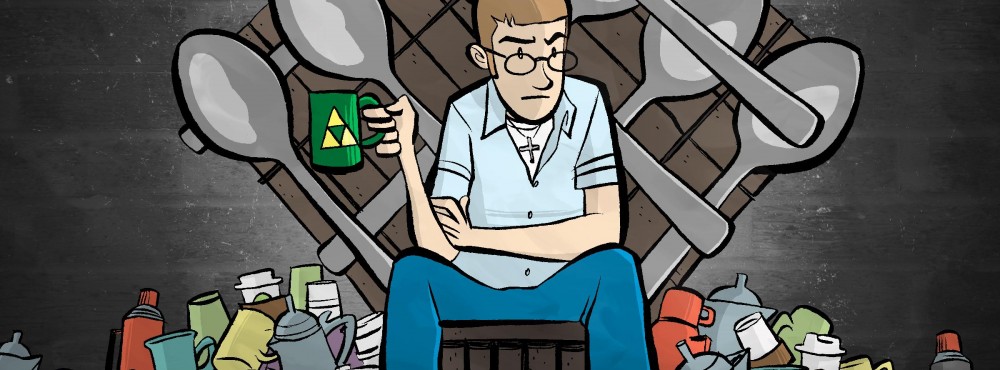
It is a truth universally acknowledged that the coffee station is by far the most important feature of any workplace.

It is a truth universally acknowledged that the coffee station is by far the most important feature of any workplace.

However, there is one way in which my job has disappointed me—though to be fair, my disappointment has hardly anything to do with the work itself, and nearly everything to do with me. Washing dishes is not a step forward in my career; it’s more like a step sideways. It will pay the bills, I hope, but it puts me no closer to my dream of working in writing or publishing.

To be painfully honest, I’m going through a bit of a rough patch. I don’t know where to go from here. As I toil at the mind-numbing task of rinsing dishes and sending them through a dishwasher, I find myself wondering, “Is this really why I went to college? After all my exciting years overseas, have I really resigned myself to such a mundane existence? What’s the point of anything? Who wrote the book of Hebrews? Is there any difference between flotsam and jetsam? Will Beyond Good & Evil ever get a sequel?” (I am easily distracted.)

At the decrepit old age of twenty-five, I feel that I really ought to have settled in a career by now—or at least figured out what career I want to pursue. I feel humiliated to be working another dead-end, blue collar job. This feeling is shameful and arrogant, but I can’t help but feel it, especially when I consider how many of my peers have settled into successful careers. My work doesn’t merely wound my pride. It cuts my pride into tiny pieces, pours gasoline over those pieces, and then sets them on fire.

Flipping heck, when did I get to be so old?

Flipping heck, when did I get so old and bitter?

My pride is in ashes. My clothes are damp with dishwater. My career is… well, it isn’t. I feel endlessly disappointed in myself, but I have decided one thing for certain.

I won’t give up.

My job is a fine opportunity for me to learn humility. I’m trying hard not to be an arrogant git, enjoying the free coffee, and washing the heck out of those dishes. Honestly, I’m thankful to be working. I hope to move on eventually and figure out what the heck I’m supposed to do with my life—and until then, I mean to make the best of things.

354. Get a Grip and Stop Whining

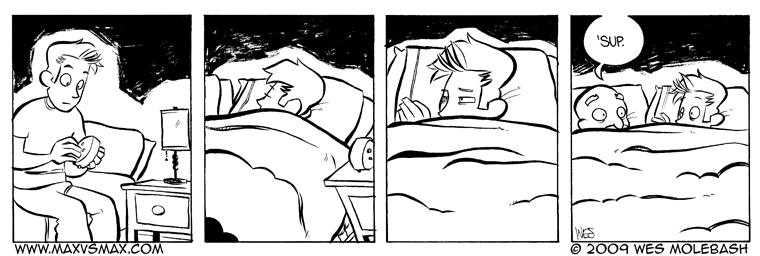
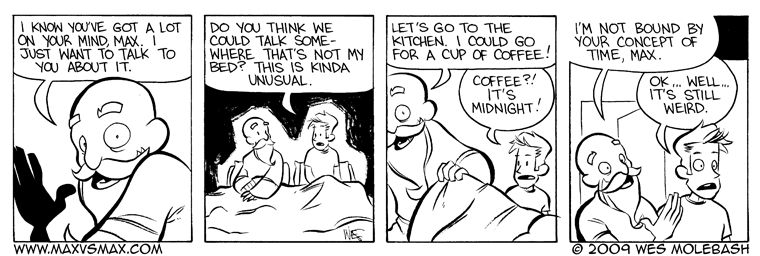
Once upon a time, when this blog was new and I had just finished college, I shared a series of comic strips by the inimitable Wes Molebash. They were part of a comic titled Max Vs. Max: the unexpectedly funny story of a man working through the guilt of his recent divorce. In this series of strips, Max wakes up to find himself in bed with God.

Yup. You read that right.

Max vs. Max, 1Max immediately realizes the whole thing is a dream. “I’m dreaming about sleeping in bed with God,” he mumbles, awestruck. “I think… I probably need therapy.” Fortunately, the Almighty doesn’t seem at all bothered. He just wants to chat.

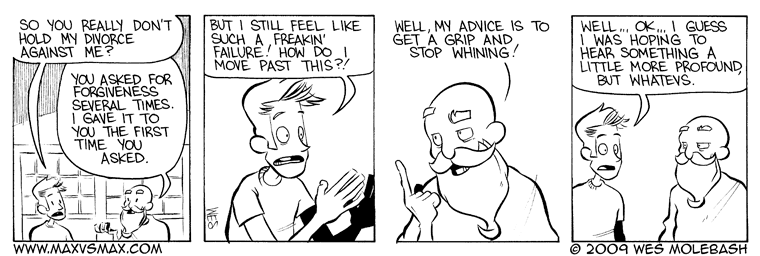
Max vs. Max, 3In the kitchen, Max admits to feeling guilty about his divorce, even though God has forgiven him. “I still feel like such a freakin’ failure!” he exclaims. “How do I move past this?!”

God, in his perfect and infinite wisdom, has one suggestion for Max: “Well, my advice is to get a grip and stop whining.”

Max vs. Max, 6I remembered these fantastic comic strips a few days ago. (If you have not yet read them, leave this post and check them out. Go on. I’ll wait for you.) God’s advice to Max really stood out to me. As Max struggles with feelings of failure, God suggests letting go of self-pity and moving forward. It’s a simple solution, but not an easy one.

God’s advice for Max is, well, for Max. It doesn’t apply universally to every person and circumstance. In the wrong situation, such blunt words cause more harm than good. I won’t presume to offer anyone this advice, with one exception: I know of one person in the world who definitely needs it.

I, of course, am that person. I occasionally suffer from depression, and it sucks. My future seems a bit scary right now, and my faith is often shakier than I care to admit. I wrestle with doubt and fear and selfishness. I sometimes find myself echoing Max and admitting that I feel like such a freakin’ failure.

When I can’t help echoing Max, I must also echo God—well, God as he is imagined by Mr. Molebash: “Get a grip and stop whining.” Sometimes—not always, but sometimes—it is as simple as that. Self-pity is easy. Courage and humility are hard, but they are also necessary to move forward.

Like Max, I am sometimes my own worst enemy. (Adam Vs. Adam has a nice ring to it, don’t you think?) When I find myself wallowing in regret or self-pity, I must get a grip and stop whining—and keep pressing onward.

353. Apples

In the past few years, apples have gradually taken over my life. It began innocently enough. I began buying apples as a healthy snack. The next thing I knew, I was eating applesauce every morning with breakfast, drinking apple cider most evenings, and occasionally snacking on apple pie. Just as the first Adam was enticed by the fruit of Eden, so this Adam seems to have ensnared by apples.

Honestly, I never meant to become an apple aficionado. The fruit crept stealthily into my diet, and it was only a month or two ago that I realized how much of my daily intake was apple-based. I suppose there are worse vices.

My kitchen is perpetually stocked with apples.

This is basically what my kitchen counter looks like. (I may be exaggerating just a bit.)

After realizing my fondness for apples, I resolved to find the perfect variety. I had favored Gala apples for a couple of years, having chosen them over other varieties simply because I liked the name. It was time for me to abandon old habits and explore new possibilities. It was a journey—the Quest for the Perfect Apple.

From the start, I shunned Red Delicious apples. These deceptively-named fruits are disgusting. Their thick, bitter skins cover fruit with the texture of wet cardboard and no particular flavor. I also avoided Granny Smith apples. These emerald-green fruits are perfect for baking, but too sour to eat raw.

Thus my quest began with Jazz apples, which were tart but tough. I moved on to Pink Lady apples. These were more yellow than pink, and not particularly tasty. As much as I wanted to try Fuji apples, which are renowned for their sweetness and crispness, I couldn’t find any at the local grocery store.

In the end, I returned to Gala apples. These crisp, sweet, nice-smelling fruits are tasty, healthy, and relatively inexpensive. I average about one apple daily. “An apple a day keeps the doctor away,” and doctors have kept their distance so far. (There is one Doctor I wouldn’t mind meeting, but he once claimed that “apples are rubbish,” so I’m not sure we would get along.)

I’ve already mentioned my liking for applesauce and pie; I also enjoy apple butter, fritters, and dumplings. For a few wonderful, all-too-short weeks every year, a nearby Amish market sells fresh-pressed apple cider by the gallon. There are a ridiculous number of ways to enjoy this delicious fruit.

In conclusion, apples have really grown on me. (Pun intended. I’m sorry.) I am an apple fanatic to the core. (I’m so sorry.) In this case, the phrase “Adam’s apple” is perfectly apple-poe—I mean, apropos. (I’m so, so sorry.) If you disbelieve my fondness for the fruit, this blog post is full of examples—just check out them apples! (I’m so, so, so sorry.) I hope these puns haven’t left any of my readers upset or apple-plectic—apoplectic, I mean. (I’m so… never mind.)

For the record, bananas and avocados are also pretty good.

351. I Am Quitting

A lot has happened since I took a break from this blog three weeks ago. I watched Marvel’s Daredevil on Netflix and acquired a beckoning cat figurine—oh, and I quit the job I’ve held for nearly three years.

Yeah, a lot has happened since I last wrote a blog post. This means today’s post is an extremely personal one. Brace yourself.

Well, first things first: my beckoning cat is wonderful. I’ve christened it Kogoro. It sits upon my bookshelf and waves its paw with leisurely dignity, welcoming high fives from passersby.

Maneki-neko

My maneki-neko, or beckoning cat, is supposed to bring good luck or something, but I use it mostly as a high-five machine.

That’s that for my beckoning cat, and I suppose I’ll save my thoughts on Marvel’s Daredevil for my next post. That brings me to the trivial matters of my impending unemployment and future plans.

For nearly three years, I’ve worked in a group home for gentlemen with disabilities in Berne, Indiana. I have been sort of a nurse, sort of a cook, sort of a housekeeper, and sort of a therapist, but mostly I’ve been a clown and a punching bag for eight special, needy, wonderful gentlemen. I’ll be officially resigned from this job by the beginning of May.

I have a number of reasons for quitting, but this is no place for me to describe them at length. I will state, for the record, that my decision has been pending for a long time. The gentlemen from the group home are one reason I’ve kept my job for so long, but a more selfish reason has been my fear of the future.

In spite of my English Education degree and teacher’s license, I’ve realized I don’t want to spend the next four decades teaching English. I want to work in writing, editing, and publishing.

However, since reaching that conclusion, I’ve been busy enough with work, blogging, and other commitments that I’ve made hardly any progress toward a long-term career. It has been hard enough maintaining the status quo of my day-to-day life: working, paying bills, helping support my younger brother, blogging, and drinking exorbitant amounts of coffee.

However, my workplace, which has always been stressful and a bit dysfunctional, has finally reached a point at which I can no longer meet its competing demands and unrealistic expectations. (In past months, I’ve occasionally been tempted to storm into my supervisor’s office, slam my hands against the desk Ace Attorney-style, and bellow “RAGE QUIT!” at the top of my lungs. I like to think my actual resignation is a little more dignified.) I think it’s time for me to let it go. I’ve mostly put off planning for the future, but my job is finally nudging me to move on.

What’s next?

For now, I’m applying for a part-time job while I look into career options. I’d like to build up freelance writing and editing on the side, and I’ll look for publishing internships willing to accept college graduates. With more time on my hands, I may write some fiction; anything is possible. I’ll continue to help support my younger brother. For as long as I remain in Berne, I’ll visit the gentlemen in the group home. Finally, I’ll continue blogging and drinking coffee and being silly—these things will probably never change.

I’m relieved to be moving on from my job, and excited to seek new opportunities. I’m also really scared. I am scared as heck, guys. It’s the same fear I felt upon graduating from college, and felt again upon ending my post-college visit to Uruguay and returning to Indiana. It’s a lost, shamed, lonely feeling—a nagging conviction that I really ought have it all figured out by now, or at least know where I should go from here. This feeling isn’t fair or rational, but I sure feel it, and it sucks.

I think Jon Acuff has the right idea when he suggests punching fear in the face. As scared and insecure as I feel, I mean to keep moving forward. At the very least, I mean to try. To echo my favorite apostle: I will always trust, always hope, and always persevere.

Long ago, when this blog was new, I wrote a post in which I quoted Anne Shirley from Anne of Green Gables: “My future seemed to stretch out before me like a straight road. I thought I could see along it for many a milestone. Now there is a bend in it. I don’t know what lies around the bend, but I’m going to believe that the best does.”

I’ve reached another bend in the road. What lies beyond? God only knows. Fortunately for me, I still trust God after all these years, so that thought is a comforting one.

Now, if you’ll excuse me, I need to think about my future and give my beckoning cat a high five.

A Lesson from Doctor Who

I often discover lessons in unexpected places. True, I learn from the Bible and wise people, but I also learn from Batman and webcomics about video games.

The Doctor from Doctor Who is not particularly wise—in fact, he has all the tact and maturity of a twelve-year-old boy—but he recently taught me an invaluable lesson.

This is not the face of a wise man.

This is not the face of a wise man.

I work in a group home for gentlemen with mental and physical disabilities. As you can imagine, my job is often amusing, sometimes heartbreaking and never predictable.

When I began working in a group home, I felt pity for some of its residents. Their lives are often dark and difficult. Some endure chronic physical pain. Most suffer from depression. Few are ever visited by friends or family. All of them are hurting in some way and few of them understand why.

At first I pitied only these gentlemen, but as months passed I realized they aren’t the only ones deserving of compassion.

Most of my coworkers are hurting. Some are divorced. Some have family issues. Many struggle with financial woes or health problems. I’ve heard tearful stories, bitter complaints and vicious arguments I wish I could forget.

Apart from work, I have friends facing heartrending difficulties: divorce, debt, depression, loneliness and grief.

I’m constantly surrounded by people whose problems I can’t solve, and I hate it.

At one point in Doctor Who, the Doctor and his friend learn that a person whose life they tried to save committed suicide. The Doctor’s companion is overwhelmed with grief. “We didn’t make a difference at all,” she says.

“I wouldn’t say that,” replies the Doctor, blinking back tears. He adds:

The way I see it, every life is a pile of good things and bad things. The good things don’t always soften the bad things, but vice versa, the bad things don’t necessarily spoil the good things or make them unimportant. And we definitely added to his pile of good things.

I may not be able to fix someone’s life, but nothing will ever prevent me from adding to his pile of good things.

I can’t fix my coworker’s marriage. I can’t take away the pain of the gentleman with arthritis or the hopelessness of the gentleman with depression. I can’t promise healing to a hurting friend.

I can, however, be patient. I can listen. I can pray. I pretend to be terrified when the gentlemen with whom I work tell me there are mummies in the cupboards or a mouse in my shoe.

On an afternoon a few weeks ago, just a day or two after I remembered this lesson from the Doctor, I was administering medications at work when a resident of the group home ambled up to me.

“This is for you,” he said with a grin, holding out a cup of coffee.

It occurred to me in that moment that I’m not the only one trying to add to the piles of good things around me.

Sometimes other people, even hurting people, add to mine.


This post was originally published on May 10, 2013. TMTF shall return with new content on April 20, 2015!

For When the World Seems Dark

In the centuries since the invention of the printing press, Christians everywhere have perfected the fine art of writing in their Bibles.

Some readers of Scripture create complex systems involving symbols or different colors of highlighter markers. Others cram notes, observations and questions into the margins.

I write in my Bible, though my notations are pretty simple. A couple of years ago, for example, I labeled the psalms in order to keep track of them. I came upon the seventy-seventh psalm a few days ago. Its label intrigued me.

For when the world seems dark

The psalm begins: I cried out to God for help; I cried out to God to hear me. When I was in distress, I sought the Lord; at night I stretched out untiring hands and my soul refused to be comforted.

Well, that’s cheerful.

Moving forward a few verses: Will the Lord reject forever? Will he never show his favor again? Has his unfailing love vanished forever? Has his promise failed for all time? Has God forgotten to be merciful? Has he in anger withheld his compassion?

What a bright, happy psalm this is turning out to be.

As I read the first few verses, I was wondered why I’d given Psalm 77 a title like For when the world seems dark. When the world seems dark, I want it to seem lighter—not more depressing!

Then the theme of the psalm takes an abrupt turn: I will remember the deeds of the Lordyes, I will remember your miracles of long ago. I will meditate on all your works and consider all your mighty deeds.

The psalmist goes on to describe one of God’s great miracles, and ends with these words:You led your people like a flock by the hand of Moses and Aaron.

Some great Christian thinker (I don’t remember which) once wrote, “Do not forget in the darkness what you have learned in the light.”

The psalmist didn’t forget. When God seemed far away, he paused to remember two things: the great deeds God had done, and the great love God had shown.

Psalm 77 came at a good time. At the moment, I’m under some emotional strain. Leaving loved ones, adjusting to a new place, facing an uncertain future—these things are hard. It’s easy to lose perspective and become lost in depression, anxiety or fear.

It’s at times like these that I must stop and remind myself of two things: the great deeds God has done for me, and the great love he’s shown toward me.

I remember those scholarships that allowed me to graduate from Bethel College. I remember how, when I was depressed during my third semester, I enjoyed the much-needed blessing of a long, solitary Thanksgiving break spent writing, watching Disney movies and playing Final Fantasy VII. I remember the glorious evenings spent watching Avatar: The Last Airbender and drinking tea with my friends from college. I remember all those mornings my old man brought me coffee in bed, and all those times my mum told me, “You’re a treasure.”

I remember how often God has made things right.

When the world seems dark, remember what you’ve learned in the light.


This post was originally published on June 8, 2012. TMTF shall return with new content on April 20, 2015!

350. Your Questions Are Answered!

A couple of weeks ago, I invited my dear readers to ask me anything. Today I answer those questions, and conclude by making an announcement about this blog.

Here we go!


Kristi asks: Since choosing to not continue with the books following the one you published, have you regretted or reconsidered that decision? Do you continue to write in that world, even if you have no plans for publication?

The unfinished tale of Lance Eliot is near and dear to my heart, yet I’ve neither regretted nor reconsidered my decision to let it go. The first novel was a commercial disaster, I didn’t have time to continue writing fiction, and Lance Eliot’s story was exhausting me. I believe it was right for me to set it aside.

Someday, if I have the time, I may try again. I would like to rework the first novel, The Trials of Lance Eliot, and then write its two sequels at my own pace. Then, with all three novels completely finished, I could focus on getting them published.

In this chapter of my life, I already feel overwhelmed by work, blogging, and other commitments. In order to write The Eliot Papers, I would have have to stop working or blogging… and I doubt I’ll be quitting either of those any time soon!


ferrettt55 asks: I’ve kind of been wondering why you wrote your book under the name M.L. Brown. Any particular reason? A story behind it, perhaps?

I had two reasons for using a pen name. The first is that I liked the idea of being an anonymous success: a literary superhero with a secret identity. (In retrospect, this was a stupid reason.)

My other reason for calling myself M.L. Brown was to build a frame story around the tale of Lance Eliot. I wasn’t Adam Stück, the author of novels—no, I was M.L. Brown, the supposed “editor” of Lance Eliot’s “memoirs.” Brown was eventually going to appear as a minor character in the last book. (The author who called himself Lemony Snicket did something similar in A Series of Unfortunate Events.)

In the end, I regret not using my real name. It would have made marketing my novel much, much easier, and perhaps sold a few more copies.

Fun fact: The initials M.L. stand for Michael Lewis. In full, my pen name alluded to the archangel Michael, the author C.S. Lewis, and the detective Father Brown.


JK Riki asks: If you had unlimited resources (time, money, skill, whatever necessary) what is the one thing you would do that you’ve either always wanted to or felt called to do? (It can be a silly answer like “Eat a taco with both chicken AND beef” but I’m kind of plumbing for a deeper response here with some real meaning and thought. Your choice, though.)

If I had boundless time and money, I would first celebrate with pizza! I would then take a few weeks to plan my next steps, pray, and confer with trusted friends and relatives. In the end, I would probably move to a cozy apartment somewhere on America’s west coast, donate most of my money to churches and charities, and spend my time writing fiction, volunteering, blogging, and drinking too much coffee. (Some things never change.)

If I had limitless talents, I would probably become a professional author and an ambassador for a charitable organization or relief agency. I would also drink too much coffee, natch.


Socrates asks: Where are your monkeys from (and I DON’T mean Amazon.com)? I mean, where were they actually born (are any of them from, y’know, THE Amazon?), what schools did they attend, are any of them related (to each other, I mean), had you met any of them before finding them on the internet?

I didn’t know any of my typewriter monkeys before I purchased them from Amazon.com, but I’m pretty sure they have ties to criminal cartels, and at least two of my monkeys have spent time in Colombian prisons.

Listen, sometimes it’s best not to ask these kinds of questions.


Some Guy asks: Do you know anyone actually named Socrates? Have you seen Bill and Ted’s Excellent Adventure? It’s not that great of a film, but I am reminded of it whenever you refer to Socrates. What is the plural of Socrates? You play and review video games, but what are your favorite non-video games? I’m thinking board and card games, but other categories are fair too (tag, dodgeball, darts, etc.)

Sadly, I don’t know any Socrateses. (I’m guessing Socrateses is the plural of Socrates.) Socrates is my go-to pseudonym because I respect the ancient Greek philosopher, and also because I’m too lazy to come up with a new pseudonym every time I need one.

I’ve heard of Bill and Ted’s Excellent Adventure, but I haven’t seen it. Doctor Who has satisfied my desire to see someone travel through time in a phone box!

Confession: I… um… I don’t like non-video games. Competition stresses me out.

Mind you, I have absolutely nothing against sports or board games. In fact, I’ve played quite a lot of them: Monopoly, cards, bowling, Munchkin, darts, Sorry, checkers, Risk, fútbol (or soccer, if you want to be American about it), and badminton, among others. As much as I appreciate these games, I seldom enjoy competition. (Mario Kart is an exception, of course.) I prefer relaxing pastimes such as one-player video games, going for walks, and climbing trees.


Thomas Mark Zuniga asks: Do you have other awesome hats like the one depicted here? What is your hat-wearing to non-hat-wearing ratio? I’ve always been intrigued by hats and hat-people.

I’m honored to be called a hat-person.

When shopping or running errands, I generally wear my cherished cloth cap. I occasionally wear a fez at home, especially when watching Doctor Who or Gravity Falls, which are my reasons for owning a fez in the first place. (I have no regrets.) My other hats include a couple of beanies, a leather flat cap, a baseball cap, and a gaudy jester hat promoting Ecuador’s national fútbol team.

I once shared pictures of my hats in a post on this blog… which promptly received more views than nearly any two of my other posts combined. As a blogger, I was humiliated to be outperformed by a bunch of hats.


I would like to thank everyone who submitted a question for this Q&A! (Without you, this would have been a really short post.) I would also like to make a quick announcement about this blog.

TMTF will be taking a three-week break, returning with new posts on April 20. The blog will not go dark during the break; I’ll post an original short story on Monday, followed by old posts on the usual schedule (Monday, Wednesday, Friday) until TMTF resumes in a few weeks.

We’ll be back with new content on Monday, April 20. Thank you for reading!

347. Ask Me Anything!

My name is Adam, and I am a man of mystery. Majestic and silent as a mountain, I shroud my life in secrecy—but no more! The time has come, dear reader, for answers.

No one comprehends the mysteries behind this inscrutable face.

Who knows what secrets are concealed by this inscrutable man?

Yes, I’m being sarcastic. No, I’m not much of a mystery. I am, in fact, generally an open book. Far from being silent and enigmatic, I rant, ramble, and reminisce—in fact, I talk too much. (If you’ve followed this blog for more than five minutes, you’ve probably noticed.)

I may not be quiet or mysterious, but if any of my dear readers have questions, I’ll be happy to answer them!

As TMTF hits three hundred and fifty posts next week, it seems like a great opportunity for a blog Q&A—or as we Internet people call it, an AMA. (For the uninitiated: AMA stands for Ask Me Anything.)

From today, March 16, until Thursday, March 26, you may ask me anything! I will accept all kinds of questions by any means of communication: comments on this post, notes via the Contact page, emails, Twitter or Facebook messages, handwritten letters, or smoke signals. (Well, I may not respond to smoke signals.)

If you wish to submit a question anonymously, preface it with the following words: Socrates asks. For example: Socrates asks, What is the airspeed velocity of an unladen swallow?

On Friday, March 27, I will answer your questions, however many or few. Ask away!

346. Sandwiches

There comes a time in the life of every blogger when he must blog about sandwiches. That day has come. This, dear reader, is my destiny.

I consider sandwiches the crowning achievement of humankind, surpassing such modest inventions as the printing press, the steam engine, and the Internet. The sandwich was bestowed upon the human race by John Montagu, an eighteenth-century British statesman. Montagu was the fourth Earl of Sandwich, and possibly the greatest man of his millennium.

I salute you, Lord Montagu. Long may your name be remembered and your namesake be relished!

I salute you, Lord Montagu. Long may your name be remembered and your namesake relished!

As the story goes, the Earl of Sandwich wanted to eat while working without making a mess. (A popular version of the story suggests Montagu didn’t want meals to divert him from playing cards.) He asked his servants to bring him meat between pieces of bread so that he could eat without using silverware or getting his hands dirty. Montagu’s culinary triumph was eventually named after him, and the rest is history—shining, glorious history.

I have had the privilege and pleasure of sampling many sandwiches in my twenty-something years. (Heck, I ate a sandwich just an hour or two ago.) The possibilities are endless. There are hundreds of varieties of bread, and thousands of ingredients to mix and match. Whether you prefer a simple turkey and Swiss on whole wheat, a sweet honey and butter on white, a robust blend of meats and vegetables on an Italian sub, or any other of the millions of combinations out there, there is a sandwich for you.

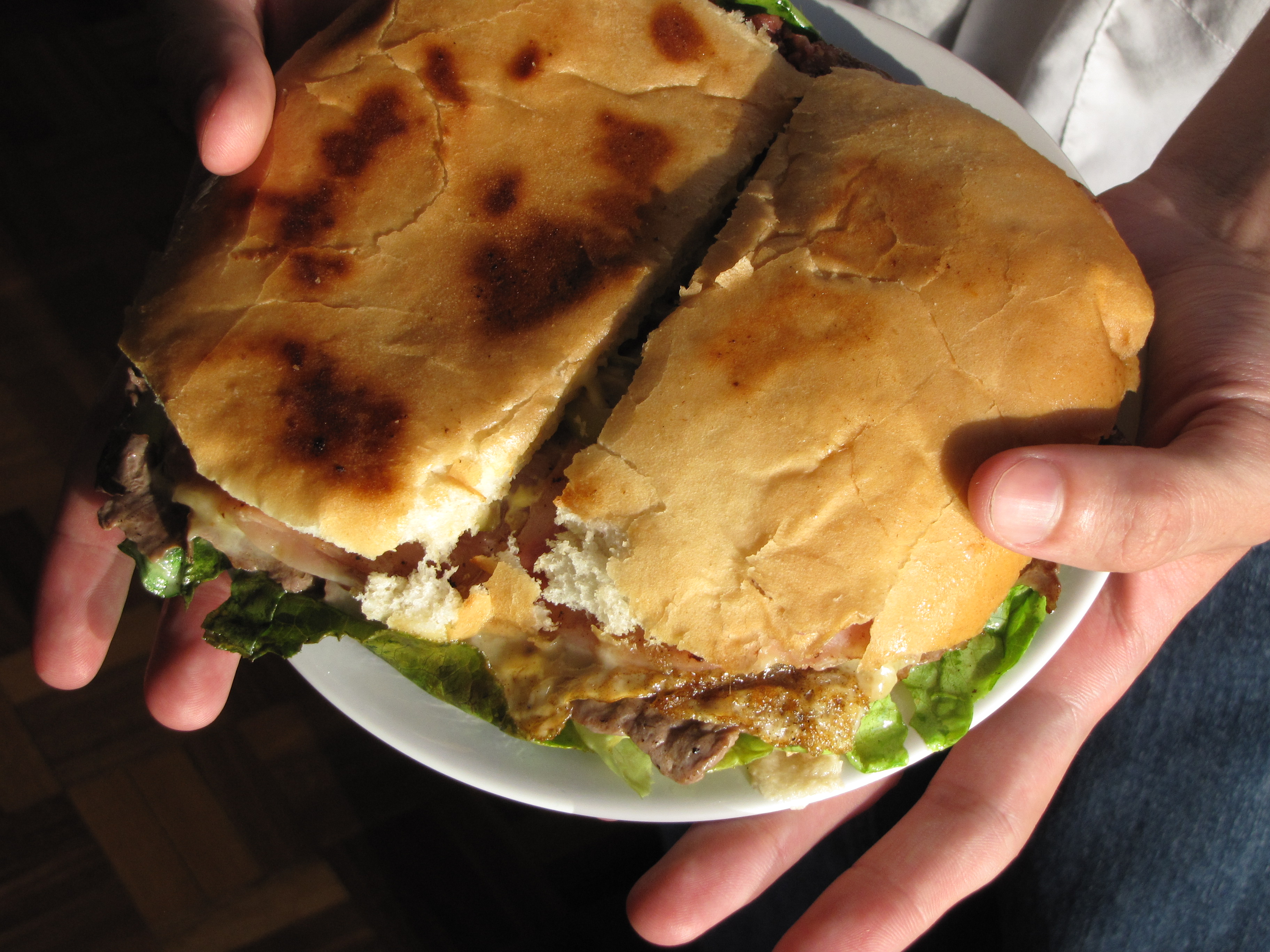
My personal favorite is the chivito.

As it is written, "Man shall not live by bread alone." I'm certain this ancient Scripture refers specifically to this sandwich.

It is written, “Man shall not live by bread alone.” I’m pretty certain this ancient Scripture refers specifically to this sandwich.

The chivito is a sandwich popular in Uruguay, where my parents live and work. In Spanish, the literal meaning of chivito is small male goat, which is a misnomer in the case of the sandwich: the Uruguayan chivito contains beef, eggs, lettuce, tomatoes, and occasionally mayonnaise, bacon, onions, peppers, olives, or cheese.

Chivitos are the best sandwiches I’ve ever tasted, and I spent three and a half years in college working part-time in a sandwich shop. I know sandwiches. The chivito is by far my favorite sandwich, and possibly my favorite food.

While visiting my parents in Montevideo, I dissected a chivito prior to eating it. For science.

While visiting my parents, I dissected this chivito prior to eating it. For science.

I haven’t tasted a chivito in years: my quiet corner of Indiana boasts no such exotic sandwiches. All the same, I continue to enjoy old favorites such as turkey and cheddar, peanut butter and jam, grilled cheese, and a variety of subs from local Subway restaurants.

Now if you’ll excuse me, I need a sandwich.