380. A Personal Update & Some Blog Stuff

Things have changed in the life of Adam Stück.

Well, some things have changed; others remain adamantly (no pun intended, I swear) the same. I’m still reading, writing, watching cartoons, drinking too much coffee, and striving (with typically mixed results) to follow Christ and live a worthwhile life. However, the Adam of today is not quite the same fellow as the Adam of yesteryear. What has changed?

I am happy. Quite unexpectedly, after prolonged misery, I am consistently happy.
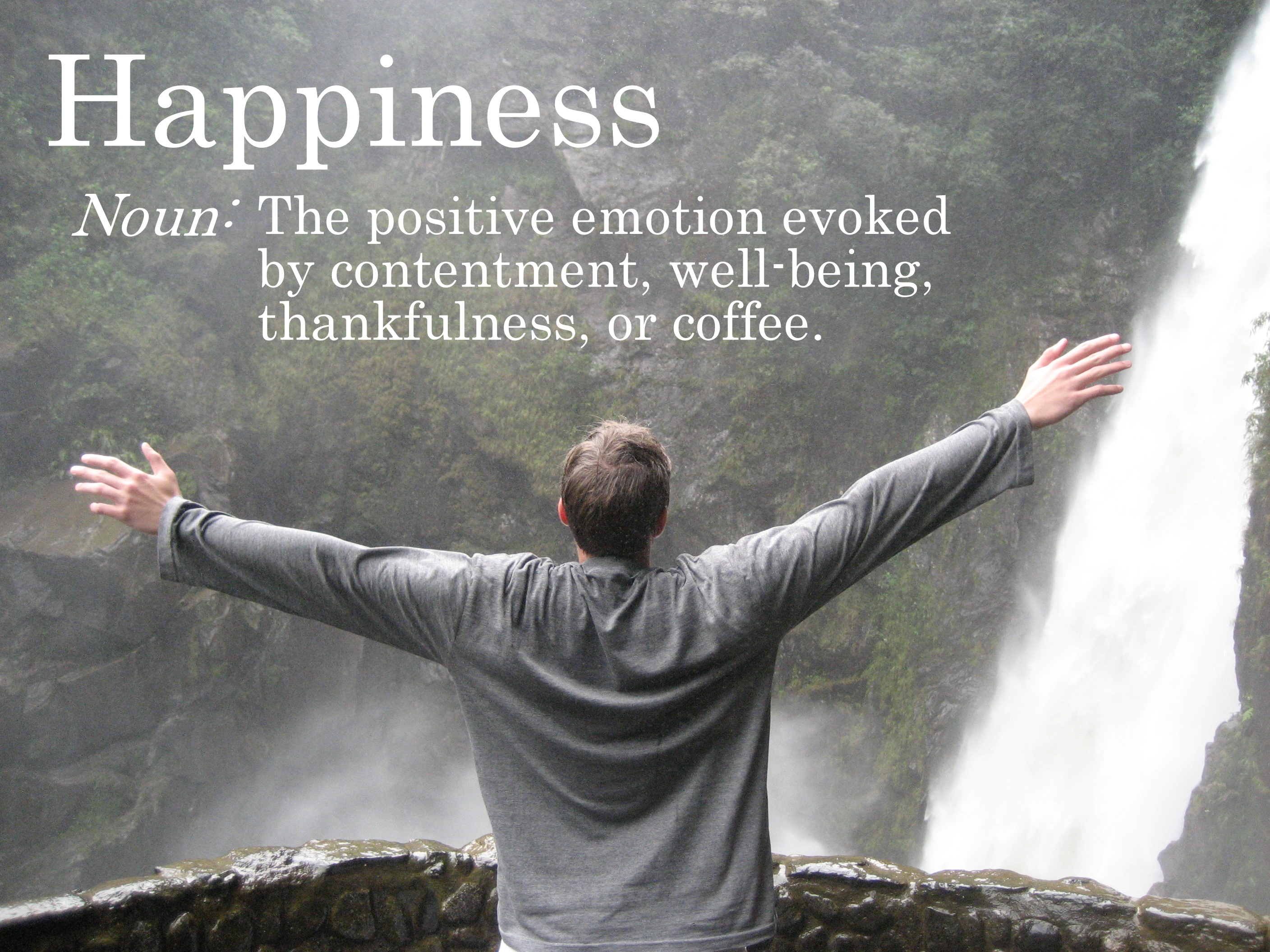
HappyIt’s been a few months since I left my old job at a group home for disabled gentlemen, shaking the dust off my feet as a testimony against it. I love those guys—in fact, I visit ’em regularly—but that workplace had become as dysfunctional as all heck. That job, which was never easy, had become unbearable; its toxic influence had reached even the farthest corners of my life. I felt almost constantly tired, stressed, and gloomy. Only since moving on have I realized just how bad things were.

In many ways, my new job has been awesome. It ain’t glamorous, but my workplace is functional, my responsibilities are reasonable, and my coworkers and managers treat me with the respect due a living human being. It has been a vast improvement, and I’m consistently happier than I’ve been in years.

Of course, “happier than I’ve been in years” is not quite the same thing as “happily ever after.” Life is still complicated. Depression comes and goes.

Things aren’t perfect, but they are better. Thank God, things are better.

Why am I writing any of this? Well, I ramble a lot about distant memories and geeky nonsense, but hardly ever about how I am now. For now, I seem to be happy and highly caffeinated, and I am okay with that.

All right, so much for the personal update. Have some news about this blog.

TMTF will be taking a two-week break, returning with new content on August 24. During the break, I’ll dust off old posts and republish them on the blog’s usual schedule, because recycling is good for the environment.

Here, in no particular order, are several reasons for the break.

  • I’ll soon be switching positions within my job, moving from my starting position in the kitchens to a position as a CNA (Certified Nursing Assistant). I’ll be doing pretty much all the same stuff as in my previous job, but in a functional workplace. In preparation for the switch, I’ll have to take CNA classes on top of my usual work shifts, so I’ll be busier than usual for a while.
  • I have a wedding to attend this weekend in northern Indiana—in fact, if you’re reading this blog post on the day it’s published, I’m probably on a highway heading northward right now.
  • I have some editing to do for a friend, and I am embarrassingly far behind. I could use some extra time to work on it.
  • My typewriter monkeys decided yesterday to celebrate summer with a bonfire, and today there is a smoldering ruin where my town’s post office used to be. (Don’t ask.) While I’m traveling north for the wedding, my monkeys have skipped town and are on their way south to avoid charges of arson. They plan to lay low in Florida until the whole thing blows over. I hope they are eaten by alligators.

TMTF shall return with new content on Monday, August 24. As always, thanks so much for reading!


374. Feeling Bad for Feeling Bad

Well. If it isn’t the slouchiest blogger I know.

Get out, you miserable git.

I’m wounded, Adam. You’re a lot of awful things, but rude isn’t usually one of them. Insecure, yes; selfish, sure; useless, absolutely; but not rude. Not on a daily basis, anyway.

I’m not in the mood for you right now.

Are you ever?

No, but that doesn’t ever seem to stop you.

You shouldn’t slouch in your desk chair, Adam. It’s bad for your back. I care for your well-being, you know. That’s why I visit occasionally. Because I care.

If you had a face, I would punch it.

Oh, I have a face. And you’re welcome to punch it, but that seems just a bit self-destructive. Anyway, before you get violent, we need to talk about something.

Oh, joy.

You’re depressed, and you need to stop it.

Of course! Why didn’t I ever think of that? I’ll just stop being depressed. Problem solved. Anti-Adam, you’re a flipping genius. What would I ever do without you?

Adam, just shut up. Shut up your face. You know exactly what I mean. Don’t pretend you don’t.

Yes, I know what you mean.

You, Adam, are one of the most ridiculously fortunate people in the universe. You have a loving family. You had a happy childhood. Your cozy little life is full of blessings and creature comforts. Your health is perfect—

Except for chronic depression.

Shut up. Your health is perfect. You have no trauma in your life, no toxic relationships, no awful tragedies. Your old job kinda sucked, sure, but the new one is easy by comparison. Everything about your life is awesome… and here you are, slouching at your desk, whining about how depressed you feel. What is wrong with you?

I don’t feel depressed—I am depressed. There’s a world of difference.

Has it ever occurred to you that maybe the thing you call depression is what everyone else in the world calls being alive? Life can be hard, and that’s a fact. Everyone has bad days. You blame it on depression, and wallow in it.

I do not.

You sure don’t do anything useful, that’s for sure. You just sit around being depressed. And then you feel guilty for wasting your time and potential, moping when you could be writing novels, building a career, or doing something useful with your life.

Are you done?

I could go on, and on, and on, but that’s enough for one day.

Good. Go away.

You’re not going to argue? Fine. I accept your silence as tacit acknowledgment that I’m right.

I wasn’t arguing because—in case you haven’t been listening—I am seriously flipping depressed right now. Do you have any idea how hard it is to function when you’re depressed?

Stop making excuses.

You don’t want excuses? Fine. Have some facts. Depression is a mood disorder, not an emotion. Depression is not a choice. I can choose whether to treat depression, but I can’t choose whether to have it. My life circumstances, good and bad, affect my depression, but they can’t prevent it.

How do you know you have chronic depression? Have you been diagnosed by a doctor?

Nope.

So you’re guessing.

I’m paying attention. I have most of the symptoms of depression: low mood, abysmal self-esteem, lethargy, inability to find pleasure in things I normally enjoy, lack of focus, inability to function—

All right, yeesh, sorry I asked. If you really think you’re so broken, why don’t you take medications or get counseling?

Who needs counseling when I have you?

Shut up. Seriously, though, if you’re going to insist on having depression, shouldn’t you insist on needing help?

My depression isn’t that bad, thank God. Not anymore. I think I’m doing all right. My depression comes and goes. It doesn’t stay. I won’t worry about my depression unless it lasts more than a couple of weeks at a time. Besides, meds and counseling are expensive.

So that’s it. You insist your depression is authentic, and you’re just accepting it.

Yup. I won’t feel guilty for being depressed, no more than I’ll feel guilty for having a cold or headache. I won’t let you blame me. I won’t feel bad for feeling bad. At least, I’ll try not to feel bad for feeling bad. When my mood and self-esteem are low, it’s an uphill battle.

You’re a fool. And you should stop slouching.

It’s nice to know you care.

358. Well, I Have a Job

Not long ago, I announced that I was resigning from my job. The time I spent unemployed was pleasant, relaxing, and surprisingly brief.

Yes, I have rejoined the working class. You see, I occasionally have to eat, and I like having a home with walls and a roof. These things cost money. Honest work seemed preferable to begging or robbing banks, so I found employment at a local nursing home.

My work consists mostly of washing dishes. As you can imagine, it’s wet work. (No, not that kind of wet work.) I’ve been on the job for just a few days, but I like it. My coworkers have been friendly, welcoming, and kind. The work itself isn’t terribly demanding; I’m even permitted to pick up a book when I run out of things to do. Employees are given free meals, and (most importantly) there is coffee in abundance. So far, I have nothing but good things to say about my employer. My job is ideal in many ways.

It is a truth universally acknowledged that the coffee station is by far the most important feature of any workplace.

It is a truth universally acknowledged that the coffee station is by far the most important feature of any workplace.

However, there is one way in which my job has disappointed me—though to be fair, my disappointment has hardly anything to do with the work itself, and nearly everything to do with me. Washing dishes is not a step forward in my career; it’s more like a step sideways. It will pay the bills, I hope, but it puts me no closer to my dream of working in writing or publishing.

To be painfully honest, I’m going through a bit of a rough patch. I don’t know where to go from here. As I toil at the mind-numbing task of rinsing dishes and sending them through a dishwasher, I find myself wondering, “Is this really why I went to college? After all my exciting years overseas, have I really resigned myself to such a mundane existence? What’s the point of anything? Who wrote the book of Hebrews? Is there any difference between flotsam and jetsam? Will Beyond Good & Evil ever get a sequel?” (I am easily distracted.)

At the decrepit old age of twenty-five, I feel that I really ought to have settled in a career by now—or at least figured out what career I want to pursue. I feel humiliated to be working another dead-end, blue collar job. This feeling is shameful and arrogant, but I can’t help but feel it, especially when I consider how many of my peers have settled into successful careers. My work doesn’t merely wound my pride. It cuts my pride into tiny pieces, pours gasoline over those pieces, and then sets them on fire.

Flipping heck, when did I get to be so old?

Flipping heck, when did I get so old and bitter?

My pride is in ashes. My clothes are damp with dishwater. My career is… well, it isn’t. I feel endlessly disappointed in myself, but I have decided one thing for certain.

I won’t give up.

My job is a fine opportunity for me to learn humility. I’m trying hard not to be an arrogant git, enjoying the free coffee, and washing the heck out of those dishes. Honestly, I’m thankful to be working. I hope to move on eventually and figure out what the heck I’m supposed to do with my life—and until then, I mean to make the best of things.

354. Get a Grip and Stop Whining

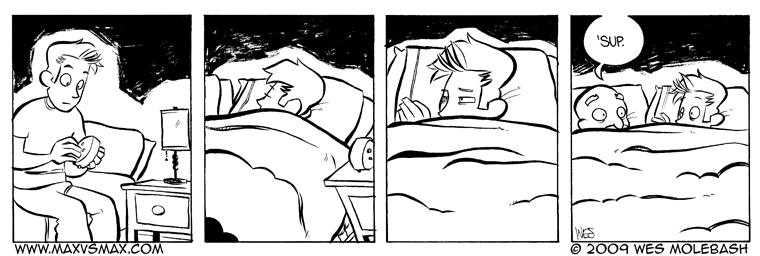
Once upon a time, when this blog was new and I had just finished college, I shared a series of comic strips by the inimitable Wes Molebash. They were part of a comic titled Max Vs. Max: the unexpectedly funny story of a man working through the guilt of his recent divorce. In this series of strips, Max wakes up to find himself in bed with God.

Yup. You read that right.

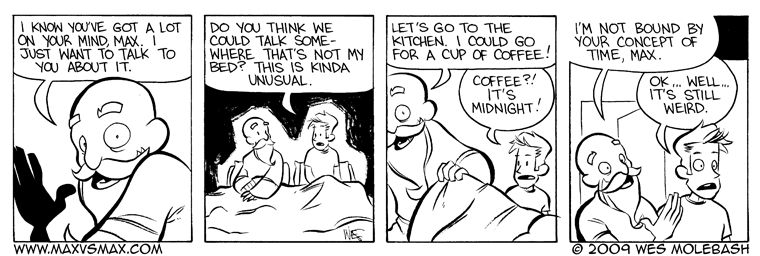
Max vs. Max, 1Max immediately realizes the whole thing is a dream. “I’m dreaming about sleeping in bed with God,” he mumbles, awestruck. “I think… I probably need therapy.” Fortunately, the Almighty doesn’t seem at all bothered. He just wants to chat.

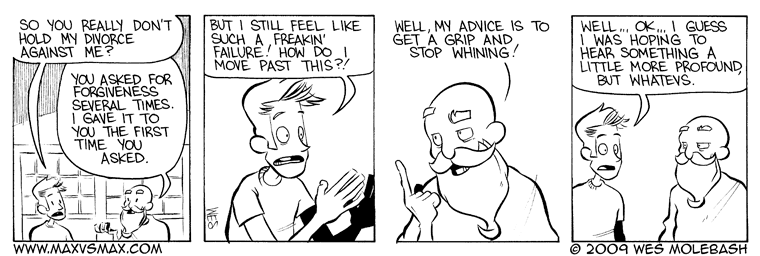
Max vs. Max, 3In the kitchen, Max admits to feeling guilty about his divorce, even though God has forgiven him. “I still feel like such a freakin’ failure!” he exclaims. “How do I move past this?!”

God, in his perfect and infinite wisdom, has one suggestion for Max: “Well, my advice is to get a grip and stop whining.”

Max vs. Max, 6I remembered these fantastic comic strips a few days ago. (If you have not yet read them, leave this post and check them out. Go on. I’ll wait for you.) God’s advice to Max really stood out to me. As Max struggles with feelings of failure, God suggests letting go of self-pity and moving forward. It’s a simple solution, but not an easy one.

God’s advice for Max is, well, for Max. It doesn’t apply universally to every person and circumstance. In the wrong situation, such blunt words cause more harm than good. I won’t presume to offer anyone this advice, with one exception: I know of one person in the world who definitely needs it.

I, of course, am that person. I occasionally suffer from depression, and it sucks. My future seems a bit scary right now, and my faith is often shakier than I care to admit. I wrestle with doubt and fear and selfishness. I sometimes find myself echoing Max and admitting that I feel like such a freakin’ failure.

When I can’t help echoing Max, I must also echo God—well, God as he is imagined by Mr. Molebash: “Get a grip and stop whining.” Sometimes—not always, but sometimes—it is as simple as that. Self-pity is easy. Courage and humility are hard, but they are also necessary to move forward.

Like Max, I am sometimes my own worst enemy. (Adam Vs. Adam has a nice ring to it, don’t you think?) When I find myself wallowing in regret or self-pity, I must get a grip and stop whining—and keep pressing onward.

345. Always Winter but Never Christmas

I’m tired, guys.

I look out my window at a desert of old snow. Once soft and shining, it has become an icy crust over withered grass and frozen mud. The sun shines now and then, melting snow, only for the water to freeze overnight into slick, dangerous patches of ice. I haven’t had even a glimpse of green leaves in months. The landscape is a gloomy muddle of white and brown and gray. Overhead, the sky is a weary, faded blue… when it isn’t covered by clouds. It’s cold.

I’m so tired.

Work has been ghastly. We’ve been short-staffed, putting everyone under pressure. My workplace has become toxic with complaints, accusations, gossip, and abusive remarks. No matter how hard I work, I seem to take an unfair share of blame. I often feel unappreciated at work, but I’m beginning to feel unwanted. It hurts.

At the end of the day, exhausted, I go to bed, trying not to think about work, blogging, or any of the things on my to-do list. That list never seems to get any shorter: like the hydra, which grows two heads for each one cut off, my to-do list defies my attempts to conquer it.

I’m so, so tired.

C.S. Lewis once described a curse that made it “always winter but never Christmas.” I’m amused by the childlike clarification about the holiday. After all, when confronted by eternal winter, only children would be concerned by its effect on Christmas; the grownups would be too busy worrying about food, warmth, shelter, and the collapse of Society As We Know It.

C.S. Lewis knew a thing or two about winter.

I feel cold just looking at this picture.

All the same, I admit that “always winter but never Christmas” paints a bleak picture. It suggests gloom, bitterness, and suffering with no consolation. There are no holidays to brighten the darkness: no parties, presents, or carols to keep hope alive. “Always winter but never Christmas” is an awful thing. It wears away a person.

In the end, though, that curse was broken. No winter lasts forever. Sooner or later, spring melts the snow and breathes life into the grass and trees. Spring is a resurrection. Spring is a promise, echoing the very words of God: “I am making everything new!”

I should also point out, for the record, that I had a very nice Christmas.

As it happens, beyond the holidays, my winter hasn’t lacked for blessings. I haven’t run out of coffee. I grumble about winter from the warmth of a cozy apartment. My job has hit a rough patch, yet I’m thankful to be employed. My life isn’t really “always winter but never Christmas.” It’s occasionally winter and sometimes Christmas, and there’s one more consolation.

Spring is coming.

002

This tree stands outside my window: at this moment, a desolate skeleton sticking out of the snow. As this photo reminds me, spring will make it new.

I’m waiting to see some blossoms on the skeletal trees outside my apartment. I’m trusting, hoping, and persevering—at least, I’m trying. (I’m certainly drinking a lot of coffee, so that helps.) Spring will arrive with warmth and sunshine and explosions of pink petals. I know it will.

As I blunder onward, one day at a time, I’m trying not to forget it.

337. Hello Darkness, My Old Friend

Do know what I hate?

Yes, I detest cockroaches. I despise butchered hymnsshady Internet ads, and the fact Black Friday happens one day after Thanksgiving. I dislike the Twilight books, and I loathe M. Night Shyamalan’s wretched film adaptation of Avatar: The Last Airbender. (I’m trying to forgive you, Shyamalan, but your abysmal Airbender movie tests even the Christian virtues of grace and mercy.) These are all awful things.

There is something I hate more than any of them.

I hate feeling bad and not knowing why.

Have you heard the (scientifically dubious) anecdote of the boiling frog? As the story goes, a frog placed in boiling water will jump out immediately, but a frog submerged in lukewarm water that is heated gradually will eventually be cooked to death.

Depression slowly boils me alive. It sneaks up on me so slowly and insidiously that I sometimes go days without realizing it. The world simply goes dark. I find it harder and harder to work, write, smile, relax, or do anything but slump in a chair and keep breathing. My descent into depression is so gradual that I don’t ask, “Why am I depressed?” My question is usually more like, “Has the universe always been this awful?”

Then, nearly always, there comes a moment—a blinding flash of hope and clarity when I realize, “Hold on a moment. I’m depressed. Huh, that explains a lot.” The moment I realize the universe isn’t really quite as dark and hopeless as it seems is generally the turning point in every bout with depression.

For my readers wondering how a person can be depressed without knowing it, I must ask a question. When you dream, do you realize you’re dreaming? Few people have the self-awareness to recognize a dream until they awaken. In the same way, I apparently lack the self-awareness to recognize depression right away.

Recognizing depression is generally my all-important first step in recovering from it. Depression makes it seem as though something is wrong with everything. When I realize I’m depressed, I understand there is merely something wrong with me. The problem no longer lies with the entire universe, but with one person in it. Believe me when I tell you that depression, however unpleasant, is a nicer problem than everything in existence being awful.

If I may put it so tritely: naming a fear is taming a fear. A problem is less scary when it’s a familiar one—especially when I know it’s one I’ve conquered before. When the world seems dark, I can smile grimly and echo the words of Paul Simon.

“Hello darkness, my old friend.”

I might add a few words to Mr. Simon’s and say, “I’m afraid you can’t stay long; I’ve got stuff to do.”

320. Hope

Last month, my parents took a break from being awesome in Uruguay to spend a few weeks being awesome in Indiana. I have possibly the best parents in the universe, and I don’t get to spend much time with them—we live about fifty-five hundred miles apart—so I cherished every moment of their visit.

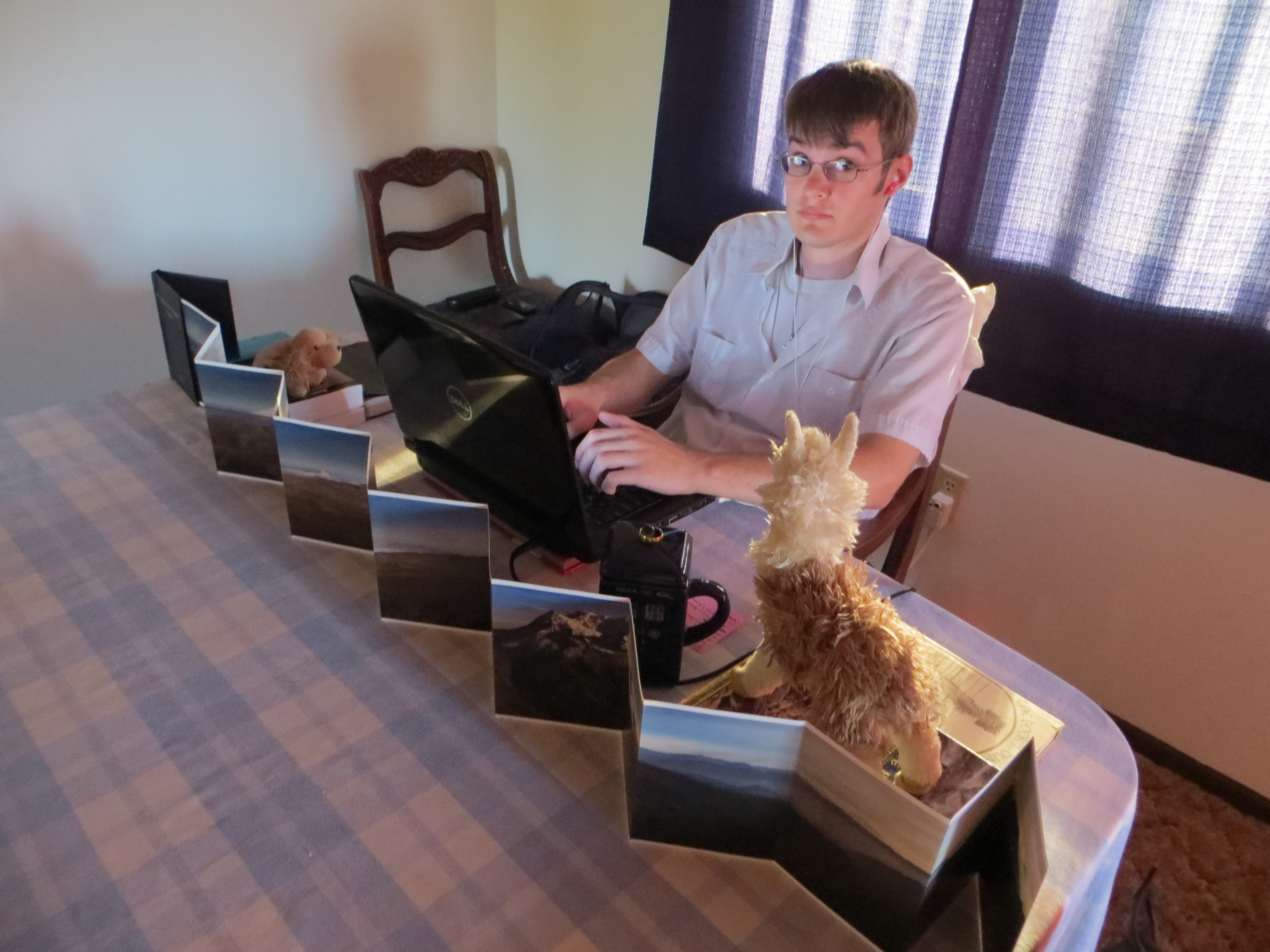
Of course, it was challenging to pack four people into a one-bedroom apartment. I relinquished my bedroom to my parents and set up camp around the dining room table with my sleeping bag, laptop, laundry basket, and assorted plush animals.

IMG_8456

When he must, a blogger can rough it with the best of them.

In this and other ways, my parents’ visit made my life messy. My routines and habits were disrupted. I had to improvise. We also spent a few days on the road, leaving behind my home in the little town of Berne. My life was extremely different for a few weeks, and it was really refreshing.

When my parents departed, leaving little gifts and pleasant memories, I faced the daunting task of putting everything back in its proper place. I had routines to reestablish and an apartment to reorganize. Then a funny thing happened: I kept finding opportunities for improvement. Having abandoned my ordinary lifestyle for a while, I could now look at it more critically.

I began changing things.

For a month and more, I tidied up my life. I swept through my apartment like a whirlwind, reorganizing drawers, cabinets, cupboards, and closets; I altered my diet, adding more vegetables and cutting out certain unhealthy snacks; I replenished my wardrobe, ditching holey socks and buying geeky T-shirts; I did some redecorating, adding five machetes and a plush llama to my bedroom decor; I reordered my priorities, putting first things first.

A few days ago, I reflected upon the changes I’ve made. My life has definitely improved. There is still room for improvement, however, which prompted me to ask myself: What else needs to change? What else do I need?

It was then I realized I could use a more hopeful attitude.

For several reasons, I often live with an attitude of defeat. My recurring depression makes it hard to have a positive outlook. Winter has arrived with its dark days, barren scenery, and bitter cold. Not least of all, my life situation is humbling.

From my early teens onward, I wanted to be an English teacher. I was convinced it was my calling. I went to college, attended classes, completed my student teaching, and earned both an English degree and a teacher’s license. This was all well and good, but there was one concern.

During my last semester, after three full years of study, I had second thoughts. My student teaching utterly demoralized me. I was no longer sure I wanted to spend my life teaching. Thus I eventually found myself in Indiana, using neither my degree nor my teacher’s license, working a low-wage job.

That was two years ago.

I’m still working the same job, and it looks like I won’t be moving on any time soon. (I have reasons for staying.) Heck, I don’t even know where I would go. I may end up teaching; I may not. Many of my peers are using their education to pursue great careers. It’s humbling for me to be so far behind. I’m not sure whether I’ll ever use my college degree or teacher’s license for anything.

I just don’t know.

My ambitions of becoming an English teacher have faltered. I don’t know whether I’ll ever put my college studies to use. My attempts to become an author failed; that particular childhood dream is extinguished. As I work a job that seems to be going nowhere, worrying about the future, struggling with depression, freezing in the icy darkness of winter, I realize what I’ve been missing despite all my earnest attempts at self-improvement.

I sure could use a more hopeful attitude.

Hope is a simple solution, but not an easy one. Hope is hard. As I blunder onward, I’m trying to look back. My life—even the past two years—hasn’t been wasted. I’m trying to look forward. The future is uncertain, yet full of unforeseen opportunities. Above all, I’m trying to look around at my life as it is now.

Setting aside my insecurities and uncertainties, I remain sincerely convinced that I am where I need to be—for the time being, at any rate. My life is full of blessings. I’m surrounded by awesome people. My coffeemaker still works. God’s grace never fails, and I’m comforted by these words from C.S. Lewis: “If you continue to love Jesus, nothing much can go wrong with you.”

These are things I mustn’t ever forget.

314. The Parable of the Monkey’s Whiskers

When I shared on Monday about my struggles to cope with depression, I promised today’s post would be less gloomy. Not only shall my reflections today be more cheerful, but they’ll also feature pictures of cute monkeys!

(Don’t be surprised. This blog is called Typewriter Monkey Task Force, after all. The pictures belong to my dad, who graciously dug them out of his archive at my request.)

Here’s an old African parable. There were once two monkeys; I’ll name them Apollo and Socrates after two of my typewriter monkeys.

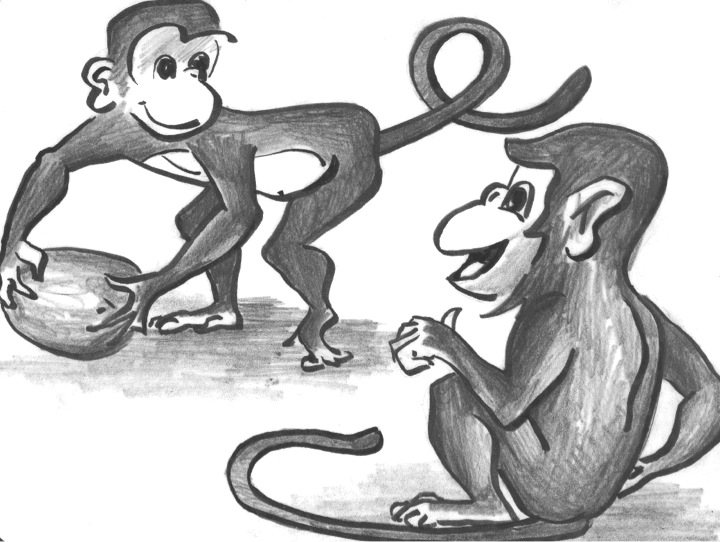
Monkey Parable - Playful monkeyApollo and Socrates frolicked across the savanna one day, tossing around a coconut and being adorable. Neither monkey realized they were playing near a foul swamp. (As I know from long experience, monkeys aren’t very bright.) Apollo and Socrates tossed their coconut back and forth until Socrates missed a catch. The coconut landed in sticky mud far from the bank.

As the monkeys sat on the bank, staring forlornly at the coconut, Apollo nudged Socrates as if to say, “You go first.”

Monkey Parable - Sinking monkey

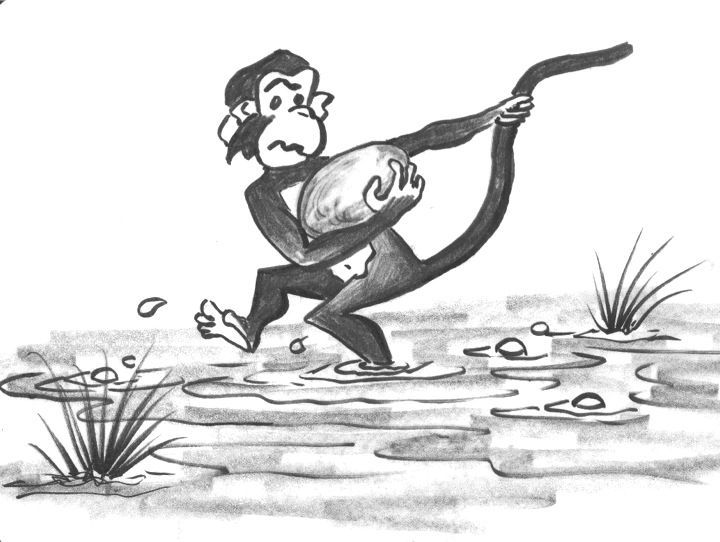
Socrates stepped into the swamp and trudged toward the coconut, holding up his tail to keep it from trailing through the stinking mud. At last he picked it up, tried plodding back to the safety of the bank, and realized he was stuck. The clinging muck held him fast by the ankles… and slowly pulled him downward.

Socrates let go of his tail, dropped the coconut, and tried pulling a foot out of the mud. It didn’t even budge. He tried the other foot. It was hopeless. The little monkey was trapped, and the mire sucked him steadily down, down, down into the gloom.

Monkey Parable - Desperate monkey

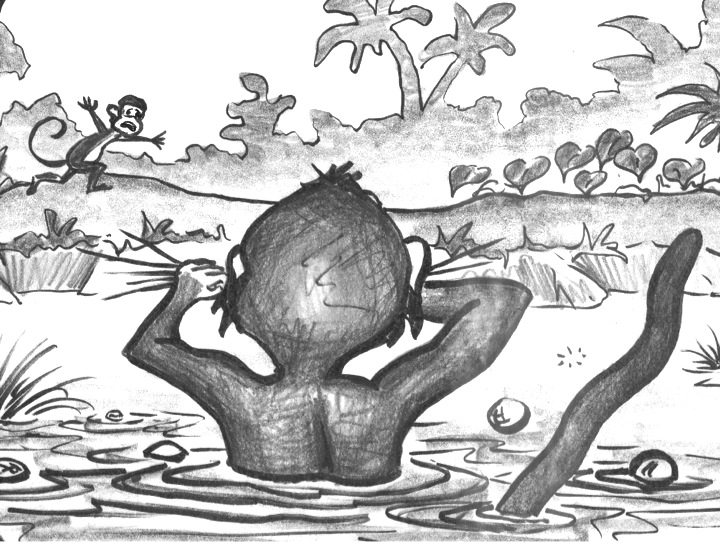
Apollo began running back and forth on the bank, waving his little arms helplessly. There were no branches, no vines, nothing that could be used as a bridge or lifeline. If only there were something to which Socrates could hold—something to keep him from sinking.

Then Apollo had an idea. He chattered at Socrates (now waist-deep) to get his attention, and then tugged on his own whiskers. Of course! Socrates didn’t need a lifeline. He could pull himself out of the swamp by his whiskers! The solution to his problem was literally right under his nose.

Socrates understood and began pulling his whiskers. He pulled and pulled and pulled, trying to raise himself out of the slimy mess drawing him into its reeking depths.

Monkey Parable - Drowned monkey

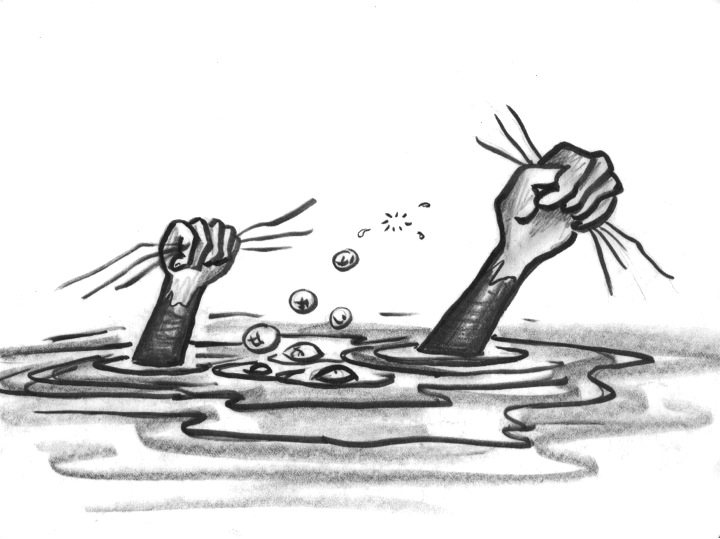
The last Apollo ever saw of Socrates was a pair of paws, twitching faintly and grasping handfuls of monkey whiskers.

Wait. That wasn’t a happy story, was it? Dash it, this is embarrassing. I promised my readers today’s post would be more hopeful. Well, it’s not too late to make a few changes to this parable. Let’s give it a happier ending!

Monkey Parable - Noticed monkey

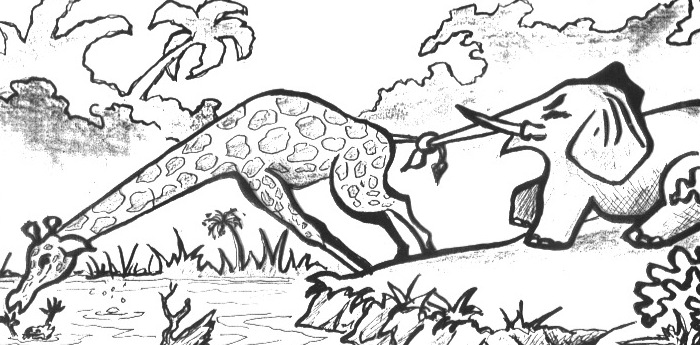
As Socrates yanked vainly on his whiskers, a nearby giraffe glanced over and saw the little monkey struggling in the swamp. Art Garfunkel Giraffe was this noble creature’s name. (Art’s parents were huge fans of folk rock.) He galloped away to find his friend Ringo Starr Elephant. (Ringo’s parents were more into classic rock and roll.) Art and Ringo reached the swamp just as Socrates’ head was about to slip beneath the mud.

Monkey Parable - Rescued monkeySocrates was saved! The animals, who never went near a swamp again, all went out for coffee and lived happily ever after.

There. Was that better?

On Monday, I mentioned that I hate my inability to cope with depression. I also pointed out that many of us struggle to win our private battles. Why have I shared a parable about monkey whiskers?

Some problems have no easy fixes.

As much as I want to find the perfect strategy for coping with depression and anxiety, it may not exist. There may be no easy fix for these problems. My best intentions may be no more useful than a monkey trying to lift himself up by his own whiskers.

Oddly enough, this comforts me. I tend to blame myself for every failure to cope with my depression. The parable of the monkey’s whiskers suggests the possibility that I may not always be able to rescue myself. Some battles may be beyond my power to win… and that means I can stop blaming myself for losing. I can feel depressed without feeling guilty.

If depression is a problem my best intentions can’t fix, should I just give up?

Well… no.

We can’t rescue ourselves—but others can help.

Depression is a private battle. All the things I mentioned on Monday—addiction, self-loathing, broken relationships, self-destructive impulses, and so on—are things we hide. They’re private. They’re shameful. They’re embarrassing. They’re also things we don’t have to face alone.

In fact, facing them alone may be as stupid as a monkey trying to haul himself out of a swamp by his whiskers.

We all need help from others. Some of us could benefit from professional counseling, antidepressants, or therapy. We all need hugs. Some of us need hugs. We feel better for talking or going for walks or playing Mario Kart with loved ones. It’s amazing to share a private battle with someone and hear them say “I love you” or “I’m praying for you” or even “That really sucks; I hope things get better.”

In my struggles, few things have brought me greater hope or healing than people listening to me, praying for me, encouraging me, or simply acknowledging that they know I’m struggling. Maybe that’s what the Apostle Paul, bless him, meant when he wrote, “Carry each other’s burdens, and in this way you will fulfill the law of Christ.”

We can look to others for help, and we can always look to God. As it is written, “Cast all your anxiety on him because he cares for you.” He listens when no one else will.

We all have our battles to fight. What we must always know is that we never have to face them alone.

313. Coping with Depression

About a week ago, an acquaintance was asked how she planned to spend her evening. She replied, “Oh, I’ll go home,” and added in an undertone, “I’ll probably curl up and cry my eyes out.”

I assumed my acquaintance—I’ll call her Socrates—was being sarcastic, yet her tone was very matter-of-fact. “Will you really?” I inquired.

This was not a polite question. All the same, it led to a frank conversation about depression and the ways we try to deal with it. Socrates apparently cries a lot. I would never have guessed. She’s considerate, friendly, and helpful; she never seems depressed. As she talked about her struggles, I felt a sobering sadness.

I can’t pretend to understand her perfectly after one brief conversation, but I’m certain of at least one thing: Socrates is a very brave person. She fights her private battle with a courage that fooled me into thinking she was quite happy. She smiles, storing up her tears.

Socrates reminded me that depression is a common struggle. Most of us have hidden problems of some kind, whether depression, self-loathing, addiction, self-destructive impulses, broken relationships, or other issues. We all try to cope in different ways. Socrates cries. I write, drink too much coffee, and spend hours or days being antisocial and unproductive.

Trying to cope

Look, I’m really depressed. I can’t deal with people right now. Go away! Begone! Go read some other blog!

I don’t like depression, but what I really hate is not knowing how to deal with it.

My depression comes and goes. When I’m not depressed, it seems like a mere nuisance. In fact, in these brighter times, I feel slightly guilty talking or writing about it. I feel like I’m exaggerating a small problem.

Then depression creeps over me, darkening my life slowly and imperceptibly. (The process is so gradual that I sometimes feel depressed for days before realizing it.) Depression robs me of the ability to enjoy and appreciate good things. It sucks the hope and meaning out of life, leaving the universe a dismal, empty place.

Fortunately, my bouts with depression are neither frequent nor injurious, and seldom last more than a week or two—thank God! In the end, no matter how dark my depression, God carries me through it.

All the same, I wish I were better at coping. I want to be more self-aware in recognizing the symptoms of depression. I remind myself that what I do matters more than what I feel. I try not to blame myself, but to recognize depression as a sickness. Like Socrates, I smile and keep my struggles to myself.

As I look back on the battles I never won, I can’t shake a sense of regret. I feel guilty for being unproductive and unsociable. I rue time wasted, opportunities lost, and blessings unappreciated.

Depression really sucks.

Why am I writing all this? I have two reasons.

First, I know I’m not the only one who doesn’t win these battles. There are many people like me and Socrates. I want the readers fighting their own private battles to know they’re not alone.

Second, I have more to say. This is the darker half of a two-part discussion. I’ll end these reflections on a brighter note next time. Come back on Friday for the conclusion!

277. Adam Breaks Down

Saturday – June 7, 2014

My friends are awaiting my arrival in Mishawaka, and it has been a pleasant trip so far from the little town of Berne. The sun is shining. A bottle of coffee is within reach. Tribulation, my scrap heap of a car, hasn’t broken down yet. I feel cautiously optimistic. The highway curves gently to the left, flanked by weeds and picturesque trees.

Everything seems fine, but I’m not quite at ease. Things went badly the last time I took Tribulation for a long drive. It broke down, smoking like a cigar and reeking of melted plastic. My younger brother and I were left stranded on the highway in the searing heat, and I missed an important job interview. Trib has been repaired, but I’m reluctant to take it on any long trips.

I have to be honest. I’m not reluctantI’m anxious. I struggle with depression and anxiety. The last time I strayed far from my home, my car troubles only made these problems worse.

I’m touched my friends invited me to visit today, and I want to see them, but… I don’t want to go.

Well, I suppose it’ll be fine. I can’t let anxiety control me. It’ll be good to spend time with my friends. They’re wonderful. I miss them. This’ll be worth the trip, and Tribulation was just fixed—I doubt it will have more problems anytime soon.

Bang!

Something that looks horribly like a deflated tire flies into my peripheral vision and vanishes. Tribulation jolts and bangs its way to a tired stop beside the highway. I hang my head, gripping the steering wheel. My heart sinks until it can sink no more.

Not again.

After putting on the brakes and hazard lights, I get out and survey the damage. Trib’s front-right tire has completely lost its tread—that must have been the fragment of tire I saw whizzing past my window. It tore off a strip of plastic from the door in its violent flight, leaving a scar of discolored paint and white plastic fasteners. The tire is ruined. My anxieties have been affirmed. It was a bad idea to leave home.

I phone my friends and let them know I won’t make it. I pray. I phone my younger brother to apprise him of the situation, and to ask him to pray. I phone my older brother to ask his advice. Things look grim. I’ve never changed a car tire before. My driving directions take me only to Mishawaka and back to Berne—without them, having to turn back, I’m completely lost. Oh, a police car is pulling up behind me. Fantastic.

An hour later, Tribulation limps to the nearest Wal-Mart on a spare tire the approximate size and shape of a doughnut. “Dash it, Tribulation,” I cry, striking the steering wheel. “Can’t I take you anywhere?”

Monday – June 9, 2014

I’ve been at work about an hour, and I’m frankly amazed I’ve lasted so long. I feel bad. No, I feel awful. I can’t remember the last time I felt so depressed. It’s all I can do to keep breathing, let alone deal with eight needy gentlemen.

The last time I worked, I was cursed and threatened and nearly smacked. Those kinds of behaviors are sometimes part of my job—occupational hazards. I’m not usually much fazed by them, but tonight is different.

Wait, what? We’re going to be short-staffed tonight? Of course. Oh, and we’re having an emergency drill? On top of everything else? Of course, of course.

What a fine shift this turning out to be.

Things are quiet for the moment, so I sit and bow my head and begin mumbling. “Father in heaven… I don’t know how I’m going to do this. I can’t do this. You must.” I add a few words, finish my panicked prayer and stand.

I’m going to make it.

Friday – June 13, 2014

Well, I’m home. This is my day off. There’s a pot of coffee on the desk beside me. Birds are chirping outside my window, the weather is beautiful and my younger brother is cooking sausages for breakfast. It may be Friday the thirteenth, a day of ill repute, but I’m feeling pretty good.

I made it.

When Tribulation’s tire was ruined on Saturday, I was quick to remember how my car had previously broken down. I was a little less quick to remember how God worked out everything all those weeks before. My car was towed to an auto shop and repaired, and generous relatives paid a majority of expenses. The interview I missed was rescheduled. My younger brother and I didn’t have long to wait until we were rescued. While we waited, I had coffee, cookies and a book to keep me going. Before any of our problems were resolved, God gave me and my brother courage, humor and a positive attitude.

My car broke down that day, but I didn’t.

Tribulation gave me trouble again on Saturday, but God made things right. I arrived safely home with two new tires at a pretty good price. My brothers were supportive and encouraging over the phone. My friends accepted my absence magnanimously. There was even coffee.

My tire was shredded; my nerves were not. My tire was ruined; my hope remained intact.

Even Monday’s paralyzing depression and daunting difficulties turned out not to be so bad. After two or three really bad hours, things improved. I felt almost recovered by the time I left work.

There are times I don’t feel well. Sometimes, I come uncomfortably close to breaking down. Depression and anxiety are frightful things, and it’s always easy for me to panic. I always remember the problems.

What I forget is the wonderful way my Father has never failed to resolve them.

I’m pretty bad at remembering things, but the faithfulness of God is something I’m trying hard not to forget.