179. Of Pink Ponies and Civil War Nurses

I like making top ten lists. (You may have noticed.) For whatever reason, I enjoy organizing the best (or worst) things together in groups.

I once made a list of my top ten favorite books. The Bible was there, of course, along with classics like The Lord of the Rings and The Innocence of Father Brown (because J.R.R. Tolkien and G.K. Chesterton are awesome). In fact, there was only one surprise: a very short, very impromptu series of autobiographical sketches by a nurse who called herself Tribulation Periwinkle.
Hospital Sketches

Tribulation Periwinkle may be the best name ever.

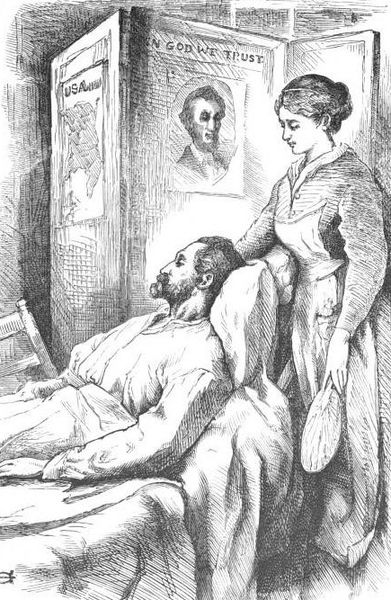
Tribulation Periwinkle was really Louisa May Alcott, who is best known for her novel Little Women. When the American Civil War broke out, she enlisted to care for wounded soldiers in Washington D.C. as a volunteer nurse: an experience she described in a cheerful little book titled Hospital Sketches.

War is horrible. I’ve never been in a battle, but I’ve seen and read and heard enough to understand that armed conflicts are unspeakably dreadful things. General Sherman, who fought in the American Civil War, famously declared, “I tell you, war is hell!”

Written from such tragic circumstances, Hospital Sketches is unexpectedly hilarious. It may not be very accessible for modern readers—the book is crammed with old-fashioned words, archaic idioms and references to classical literature—but I find it hysterically funny.

What really impresses me is how Alcott found humor in the bleakest situations. When confronted with an unappetizing meal, she cheerfully compared the bread to sawdust and observed how much the stewed blackberries looked like preserved cockroaches. Listening to her injured patients snore late at night, she declared them a “band of wind instruments” and restrained herself from breaking out in John Brown’s favorite hymn: “Blow ye the trumpet, blow!”

This incredible optimism and humor in the face of difficulty reminds me of something G.K. Chesterton once wrote: “Always be comic in a tragedy. What the deuce else can you do?”

It also reminds me of a certain pink pony.

Pinkie Pie

I’m pretty sure real ponies don’t come in pink, but whatevs.

Pinkie Pie is a character from a popular cartoon called My Little Pony: Friendship Is Magic, of which I am a fan. She breaks the fourth wall, blurts out non sequiturs and generally does things that make me laugh.

Pinkie also finds humor in miserable circumstances. Surrounded by horrific demon trees? She giggles at their twisted expressions and makes faces at them. Trapped in a surreal nightmare by an ancient spirit of discord? She points out the advantages: “Eternal chaos comes with chocolate rain, you guys! Chocolate rain!”

I’m a pessimist. A pessimist is not a fun thing to be. Louisa May Alcott and Pinkie Pie seem to have discovered a brighter outlook: finding glimmers of hope and humor in dark times.

Perhaps I should try to be positive, even when my circumstances are not.

An Evil Scientist Explains Band Names

Starting this week, Geeky Wednesdays are officially a thing.

From Kicking Crickets to Closet Vikings, I’ve come up with a staggering number of awful band names. Dave Barry, a humorist and master of rock band nomenclature, is the one from whom I picked up the bad habit of turning odd phrases from everyday life into absurd names for rock bands.

Seriously, though, what’s with band names? A few make sense. Peter, Paul and Mary is refreshingly simple, and The Beatles is a clever pun on beat and beetle. But what about Pink Floyd and ZZ Top and other strange band names? Are such bizarre names the result of nonconformist intellect, warped humor or reckless drug use? And why do Doofenshmirtz’s explanations seem so reasonable?

151. Bronies

As much as I like cartoons, I never expected to become a fan of a show about magical rainbow ponies. It’s strange that I did, I suppose, but something far stranger happened.

I became a fan of its fans.

The community inspired by My Little Pony: Friendship Is Magic, though often regarded with suspicion or loathing, is the most creative, quirky, compassionate group of fans I’ve ever seen. Combining bro and ponies in a portmanteau word, these weird, wonderful people are known as bronies.

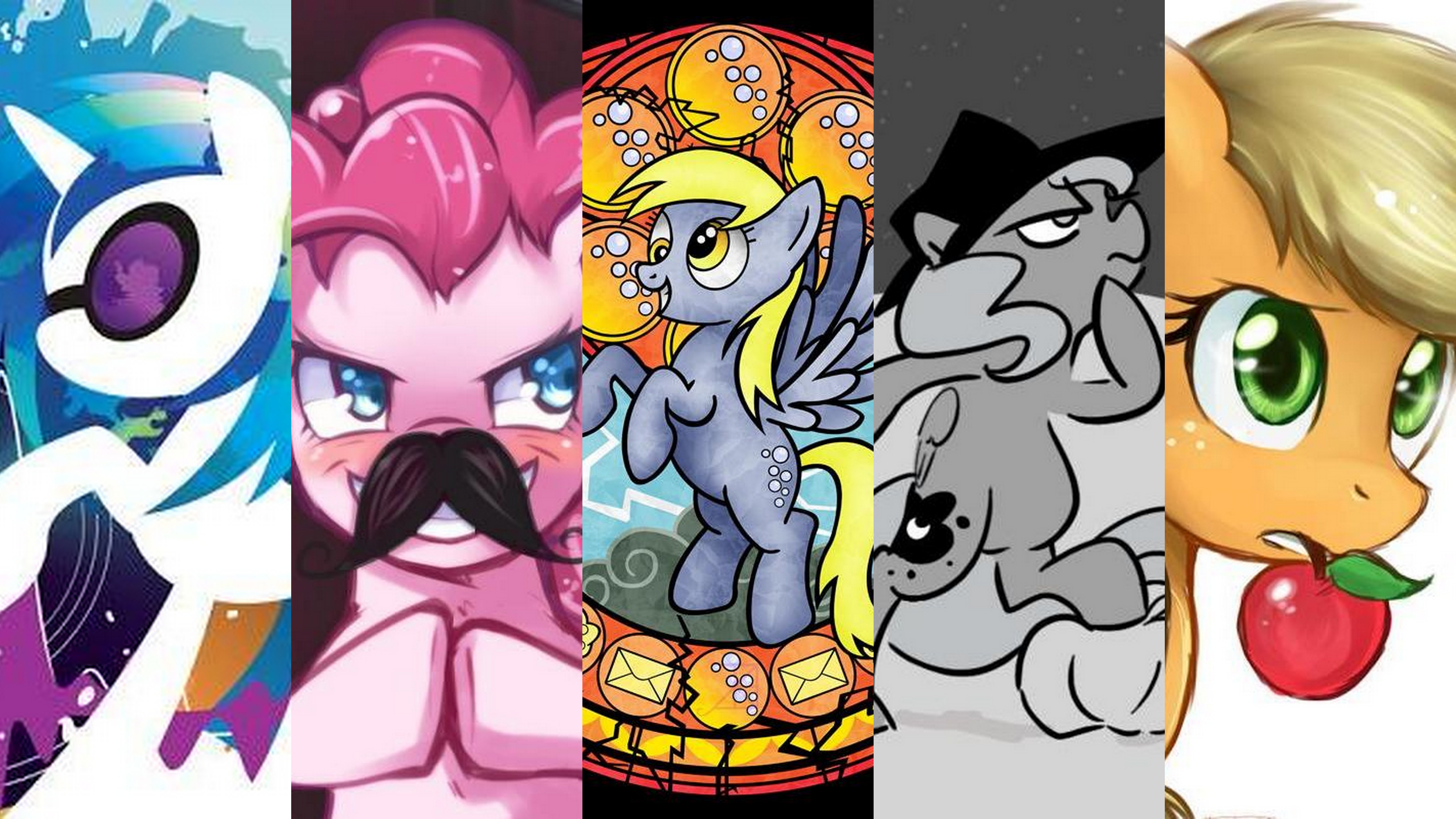
There is a ridiculous number of artists in the brony community. Besides creating art inspired by the show, they sometimes reimagine real or fictional peopleincluding bloggersas ponies.

Not many people know this, but I'm actually a pony.

Not many people know this, but I’m actually a pony.

The artwork produced by bronies takes innumerable forms: comics, sketches, paintings, woodcuts, stained glass and more. Name any kind of visual art, and bronies are guaranteed to have used it.

I have a sudden, inexplicable urge to buy a fedora. And to grow a mustache.

I have a sudden, inexplicable urge to buy a fedora. And to grow a mustache.

There are nearly as many musicians in the brony community as there are artists, and their music is no less diverse. Besides remixing music from the show, bronies have produced a staggering number of original songs in every style imaginable. Classical? Electronic? Classical remixed as electronic? Progressive bluegrass? Symphonic rock? Bronies have them all covered.

Brony musicians even cover music by other bronies. “Discord,” a catchy Eurobeat song about a villain from the show, has been arranged for orchestra, jazz, electronic and other genres.

I won’t even begin to cover the animations and video games created by bronies. While some are amateur efforts, others are literally of professional quality.

Even my typewriter monkeys (Thanks again to # of deviantArt!)

The Typewriter Monkey Task Force can’t handle the incredible creativity of bronies.
(Special thanks to Derpy Hooves for making a guest appearance!)

The creativity of the brony community seems to know no end, but the thing that impresses me most about bronies is their compassion.

Through fundraisers, auctions and special events, a charity called Bronies for Good recently paid for the construction of an orphanage in Uganda. Bronies for Good is currently funding clean water projects in Uganda and Tanzania. Another charity, the Brony Thank You Fund, is working to endow a scholarshiptentatively titled the Derpy Hooves Scholarship in Animationto the California Institute of the Arts. (Tim Burton, John Lasseter and many notable animators graduated from CalArts, which was founded by Walt Disney.) Various brony initiatives have raised many thousands of dollars for Kiki Havivy, a little girl diagnosed with a brain tumor.

The list of charitable projects goes on and on. It’s ridiculous.

Nothing is perfect, of course. The brony community has its share of conflicts, problems, crude artwork and tasteless fan fiction. In the end, though, it remains the most amazing group of fans I’ve ever seen.

I am, I admit, slightly embarrassed to be a fan of My Little Pony: Friendship Is Magic. It’s a cartoon for little girls, after all.

I am not, however, embarrassed to be a brony.

149. Why I Watch Cartoons

As many of my readers have probably noticed, I like cartoons.

Well, I like some cartoons. Others I would watch only on pain of death, and perhaps not even then. (I’m looking at you, SpongeBob SquarePants.) Besides loving many animated films—for example, classic Disney movies and everything directed by Hayao Miyazaki—I enjoy television shows produced for kids.

I also like literature, especially the classics. Explosions? Car chases? Sultry romances? Bah! Humbug! To blazes with such nonsense! Give me meaningful themes, compelling characterization and well-crafted plots.

Thus I decided to take no fewer than three literature classes in one semester when I was in college. (Where was Admiral Ackbar when I needed him?) For months, I was hammered by grim novels like Silence, a bleak story about the silence of GodOne Hundred Years of Solitude, a fantastical history of a disturbing, sordid society; The Penelopiad, a cynical postmodern perspective on The Odyssey; and several more depressing books.

It was not a happy semester.

Some notable literature is lighthearted—I thank God for cheerful authors like P.G. Wodehouse—but the good stuff is mostly depressing. Even stories by humorists like Mark Twain and James Thurber have tragic undertones. Thurber once wrote, “To call such persons ‘humorists,’ a loose-fitting and ugly word, is to miss the nature of their dilemma and the dilemma of their nature. The little wheels of their invention are set in motion by the damp hand of melancholy.”

I like cartoons because they’re innocent, bright and funny, and they’re unapologetic about it.

Do cartoons give a balanced view of the world? Of course not—but then, neither does much of the best literature. Cartoons remind me that the world can be a pleasant, cheerful place, even as literature reminds me that it can be a dreadful, hopeless one.

For me, cartoons are a kind of escapism.

Is escapism wrong? When balanced with realism, I don’t believe it is. To quote J.R.R. Tolkien, who is awesome, “I do not accept the tone of scorn or pity with which ‘Escape’ is now so often used. Why should a man be scorned if, finding himself in prison, he tries to get out and go home? Or if he cannot do so, he thinks and talks about other topics than jailers and prison-walls?”

A Farewell to Arms tells me there is suffering in the world. My Little Pony: Friendship Is Magic tells me there is good in it. The Great Gatsby tells me happiness can’t be bought with money or popularity. Phineas and Ferb tells me happiness can be found by two kids sitting in the shade of a tree on a summer day. Animal Farm tells me the good guys sometimes lose. Avatar: The Last Airbender tells me the good guys sometimes win.

The other reason I watch cartoons is because, well, they’re fun to watch.

101. Magical Rainbow Ponies?

When I took time off from this blog last week, I suddenly had some free time on my hands. I spent some of it researching the unprecedented rise of the brony fandom—to wit, the inexplicable attraction of young men to a television show produced for girls, My Little Pony: Friendship Is Magic.

I felt it was my duty to investigate this enigma. For science.

We begin with the visuals. My Little Pony: Friendship Is Magic uses a vivid color palette. Although the animation looks suspiciously like something made with Adobe Flash, HomestarRunner.com-style, it’s expressive and charming.

The show follows the adventures of six ponies: Twilight Sparkle, Rarity, Pinkie Pie, Rainbow Dash, Fluttershy and Applejack.

(I can only suppose Applejack is named for the liquor—an odd choice for a kids’ show.)

Following my investigations, I think I may know why magical rainbow ponies are so popular with men in their twenties and thirties.

There are at least three reasons.

First, My Little Pony: Friendship Is Magic is surprisingly funny in a goofy, geeky, adorably cheesy sort of way. The writing is good, and the show is very self-aware. It never strays too far into ridiculous sentimentality.

Second, the show has become an Internet meme, and it’s therefore socially acceptable for men to enjoy a show about magical rainbow ponies.

Third, the show is pleasant. There are disagreements and arguments and tragic ironies, but things always work out. People—well, ponies—get hurt, but hurts are healed. Lessons are learned. Friends are reconciled. The show’s moral values are remarkably strong.

C.S. Lewis wrote, “A mature palate will probably not much care for crème de menthe: but it ought still to enjoy bread and butter and honey.” Grownups can enjoy complicated dramas or sophisticated tragedies, but there’s no reason they can’t also enjoy lighthearted stories about magical rainbow ponies.

I think a lot of guys are tired of living in a cynical world. There are tragedies on the news every day. Films, novels, video games and music are full of cursing, violence, sexual perversity and bad attitudes. People use these media anyway, but I think there’s still a longing for things like simplicity, goodness, honesty and loyalty.

Guys watch Saw and play God of War and listen to Metallica, but some of them probably miss those Saturday morning cartoons they watched as kids. Shows like My Little Pony: Friendship Is Magic and Phineas and Ferb (another hit with older guys) evoke nostalgia, balancing sentimentality with enough edgy humor to be, well, not lame.

I think that’s why magical rainbow ponies have become so popular with the menfolk. There could be deeper, darker reasons, but I doubt it.

Now I’m going to watch some cartoons. For science.

82. About Writing: Rhythm

Before I share my thoughts about rhythm, here are a few words from Phineas Flynn and Ferb Fletcher. (They’re mostly from Phineas. Ferb doesn’t talk much.)

All right, it’s important to have a sense of rhythm. But what does that mean for writers?

It’s a mistake to use the same kinds of sentences. A paragraph full of identical sentence structures is boring. Sentences should be varied. Sentences should not become monotonous. That kind of writing sounds boring and choppy. That kind of writing is worse if consecutive sentences begin or end with the same words because it sounds boring and choppy.

That last paragraph was, as one of my brothers would say, an abomination. It committed pretty much all the transgressions against which it warned. The structures of its sentences were similar, and it repeated certain phrases. It sounded—forgive the repetition—boring and choppy.

It’s easy to use the same sentence structures over and over. In fact, I do it all the time without realizing it. Writers need to vary the rhythm of their writing, and deliberately use different kinds of sentences.

I won’t go into the technical details of dependent and independent clauses, compound sentences, complex sentences or any of those other ghastly things.

Let us instead learn by doing. Here’s a lousy paragraph, one that ain’t got rhythm.

Uproariously, the typewriter monkeys chattered as Adam dictated a blog post to them. He told them to listen, but they wouldn’t. He shouted, but they only yanked the ribbons out of their typewriters. Clutching his head, Adam went into the kitchen to make tea. Unhappily, he returned and surveyed the devastation.

We have two basic sentence structures repeated in this paragraph: Adverb or adverbial phrase, blah blah blah and Blah blah blah, but blah blah blah.

(A real professional would use proper grammatical terms to describe these sentence structures, but I ain’t real professional.)

Let us rewrite the paragraph with a little more rhythm.

The typewriter monkeys chattered uproariously as Adam dictated a blog post to them. Although he told them to listen, they wouldn’t. He shouted, but they only yanked the ribbons out of their typewriters. Adam went into the kitchen to make some tea, clutching his head, and returned to survey the devastation unhappily.

Behold! With a few words changed and a few phrases shifted around, the paragraph has gone from being monotonous to readable.

Rhythm is important, and syntax—the order in which words are arranged—matters. (Syntax is not a tax extorted from sinners, to quote one of my high school teachers.) Writing that ain’t got rhythm isn’t nearly as powerful as writing that has it.

27. Breast Cancer Awareness Month

I’ve become acquainted with a nice old custodian who works at the school at which I’m student teaching. It was quite a surprise to run into him a week or two ago and discover that his beard had turned a shocking shade of neon pink.

He told me he colored his beard because October is Breast Cancer Awareness Month and he wanted to show support. He hasn’t been the only person at the school to sport pink hair this month. A number of students have added pink highlights or extensions to their hair, and one of my MEC students colored his Mohawk pink.

It’s been touching to see the support for the fight against breast cancer. It’s also been a little jading. Dyeing hair pink or wearing I Boobies bracelets doesn’t do much to help cancer victims—at least not directly. Rocking the bracelets and pink hair does raise awareness of the problem, and awareness of the problem brings us a little closer to solving it.

Since I’m only a few days away from finishing student teaching—and consequently busy and exhausted—I’m going to wrap up this post with a short cartoon from JKR over at Fredthemonkey.com.

(For the record, Fred is no relation to any of my monkeys.)

The cartoon, aptly titled The Important Things, presents its protagonist with several dilemmas. How can he scrounge up the money for a new Nintendo DS game? (The game he mentions is awesome, by the way.) Can he get his true love to go on a date with him? And could there possibly be more important things than buying a new video game?

Enjoy the cartoon here!