127. Please, No More Advice!

Imagine a man dressed in rags and standing ankle-deep in snow, shivering in the gale blasting from a winter sky and peering through a window into a warm living room. On the other side of the glass, a man wrapped in a bathrobe sips hot chocolate and gazes curiously at the visitor outside his window.

“I have a question,” says the man in the bathrobe, speaking loudly enough for the man in rags to hear through the glass. “Would you please describe exactly how it feels to be cold?”

If you were the man in rags, how would you answer? Words like icy and frigid are meaningless to someone who has never felt cold, and adjectives like horrible and painful are too vague.

If you’ve never been severely depressed, I’m afraid I can’t describe it any more than the man in rags can tell the man in the bathrobe what cold feels like. The best explanation I can give is that depression is like lying on the very bottom of the ocean. Everything is cold and dark, and a suffocating pressure makes the simplest action ten times more difficult.

Not long ago, I read an article in which the writer described his struggle with depression, insecurity and suicidal thoughts. He has my utmost sympathy. If I ever met the man, I’d offer him a cup of tea and tell him how much I admire his courage in getting out of bed every morning.

Some of the people who commented on the article had other ideas.

“Depression. Who needs it. I say, if you’re upset and sad then own it.”

“Depression eh? Been there, done that years back. A large part of it is physical. My recommendation, eat fruits and veggies … Get some exercise … Join a gym.”

“You are what you are, you seem to accept you have issues, work on them and things will get better.”

The writer made himself vulnerable, confessing his personal struggles. Some of his readers responded by telling him, You’re obviously getting it wrong, so let me show you how to get it right. More vegetables! Better attitudes!

I suspect many of these readers are like the man in the bathrobe. They see, but they don’t understand. They look through the window at the man in rags, but they can’t begin to imagine how it feels to be cold.

To my relief, some of the people who commented on the article took a more compassionate approach.

“Thanks for sharing … Hopefully you’re also able to disregard all the ‘advice’ comments from people who don’t actually know what you’re going through.”

“I hope you win your battle. I have to say, I don’t understand it at all, but I know it seems to be very real for many people.”

“In a world filled with selfish, lazy, disgusting, and greedy [obscenities] that make all of us lose hope in the world, it is people like you that give me the strength to live on. Thank you for sharing a bit of yourself with us.”

Which kind of comment do you think the writer of the article found more helpful?

I need to make one thing very clear—advice can be compassionate, useful and awesome. In many circumstances, it’s the best thing you can offer. Advice can be a powerful, practical gift, even to people who may not want to hear it.

The reason I’m writing this blog post is that, in many circumstances, advice isn’t the best thing you can offer. It’s the worst.

In most cases, the person giving advice genuinely wants to help. However, there are times when advice—even wise, honest, well-meaning advice—isn’t helpful. Those who are humble, brave and honest enough to confess their struggles and mistakes deserve compassion, not lectures. If lectures must be given, compassion must come first.

What’s the best way of figuring out whether or not to give advice? In my experience, it’s one question.

Will this advice actually help this person?

If not, it’s probably best not to give it.

That’s my advice, and I hope it helps.

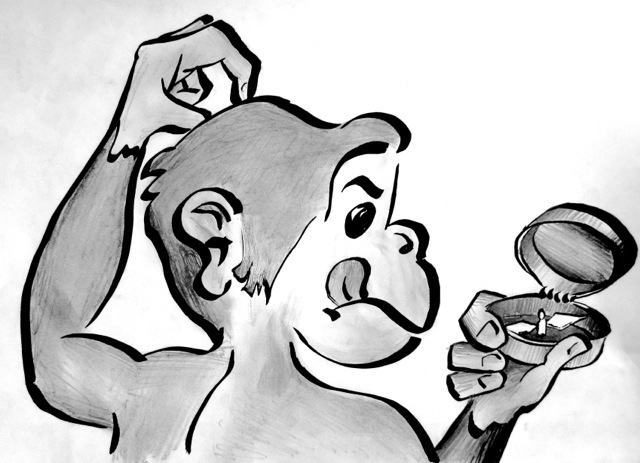
A Portrait of the Artist as a Performing Monkey

A Short Story

“Never send to know for whom the bell tolls; it tolls for thee,” muttered Gabriel Green, rummaging in his pocket for his cell phone.

“Gabe!” boomed the voice on the other end of the line. “Hello, hello, hello! This is your friendly neighborhood agent.”

“Good morning, Phil,” replied Gabriel, holding the phone several inches from his ear and looking around the café to see whether anyone else was bothered by the noise. “What do you want?”

“Vampires, Gabe, vampires!”

“If you’re looking for an introduction, I can’t help you,” said Gabriel, and sipped his coffee. “I don’t know any vampires.”

Raucous laughter rang from the phone’s speakers. “Ah, Gabe, you’re such a wit. No wonder you’re my favorite author. Are you working on a manuscript?”

“Yes, I’ve begun a novel—”

“Drop it and write me a book about vampires. Gabe, what was that noise? Did you choke?”

“That,” said Gabriel, “was the sound of your favorite author scoffing at you.”

“Vampires are hot right now,” said the voice on the phone. “We’ve got to build up your author cred. Vampires will do the trick—no publisher can resist a juicy vampire novel. You’re choking again, Gabe.”

“Scoffing,” corrected Gabriel. “Phil, explain to me exactly how a shoddy vampire novel will build up my literary credibility.”

“Your stuff is great, but it’s all niche,” said the voice on the phone, as though explaining to a toddler. “We’ve got to expand your platform. People read vampires. You write vampires. Bam! We’ve got magic. Anything you write about vampires will be a hit, or my name’s not Phil Lector.”

Gabe, realizing sips were no longer adequate, gulped his coffee. “Tell me, Phil. After writing this vampire novel, can I get back to my current manuscript?”

“Absolutely,” replied the voice on the phone.

“Fine,” said Gabriel, and swigged his coffee with the violent, jerking motion generally associated with men slugging vodka from small glasses. “You’ll get a vampire novel.”

“One teensy detail I forgot to mention,” said the voice on the phone. “I’ll need a chapter to show publishers as proof of concept. I want to see Chapter One of your novel on my desk by Tuesday morning.”

“Next Tuesday?”

“This Tuesday.”

Gabriel, who was swallowing the last of his coffee, choked.

“Don’t scoff at me, Gabe.”

“I was choking, Phil. Do you realize tomorrow is this Tuesday? I can’t write an entire chapter in one day.”

“Good luck,” said the voice on the phone, followed by a click ending the connection.

Ten minutes later, the proprietor of the café found Gabriel Green staring desolately into his coffee cup.

“You don’t look so good, pal,” he said. “Anything I can get for you?”

“Coffee,” rasped Gabriel. “Just leave the pot on the table.”

By evening, Gabriel Green had read seven encyclopedia articles about vampires, taken three walks in the park, drunk seventeen cups of coffee and written zero words. Deciding it was time for a break, he went to the kitchen to brew more coffee.

“I’m a performing monkey,” he told the coffeemaker.

The coffeemaker made no reply, except to gurgle softly as the coffee brewed.

“When my agent says, ‘Write a vampire story,’ I drench my pen in blood and write a vampire story. When my agent says, ‘Hold a book signing,’ I set up a table and hold a book signing. When my agent says, ‘Dance a polka,’ do you know what I do?”

The coffeemaker growled.

“That’s exactly right,” said Gabriel. “I dance a blasted polka. A performing monkey is exactly what I am. I need more coffee. Are you done?”

The coffeemaker, which was not done, growled again and hissed at him.

An impatient man would have raged at the appliance. Gabriel Green, being a man of mild temper, merely glowered at it until the coffee was ready.

Returning to his chair with the coffeepot, Gabriel sat down and tapped his desk with an irregular rhythm like the beating of a worn-out heart. A blank notebook page lay before him.

“Theirs not to make reply,” he mumbled. “Theirs not to reason why, theirs but to do and die. Into the valley of Death rode the six hundred.”

With that, he stopped tapping, picked up a pen and wrote It at the top of the page.

A minute passed, and the tapping resumed. Gabriel’s face was as empty as the page on the desk before him.

“It what?” he asked. “It was a dark and stormy night? Clichéd. It is well with my soul? Not particularly true tonight. It is a truth universally acknowledged—merciful God, no. Come on, Gabriel. What about it?”

Apart from the tapping, there was complete silence in Gabriel’s apartment. An ardent believer in creating the right mood for writing, he had switched off all the lights except the lamp over his desk. A moth dancing around the bulb sent a vast shadow swooping about the bedroom, but he failed to notice. His attention was riveted on two little letters.

It took three more cups of coffee, but Gabriel finally succeeded in picking up his pen and writing is.

“It is,” he said, and repeated the phrase several times. “What is it? What in the blazes is it?”

Gabriel pulled out another sheet of paper and doodled stick figures fighting with rapiers. The figure of a princess with a flowing gown watched the duel, clutching her blank face with stick hands. A blazing sun appeared over the scene. Hills sprang up in the background.

As he drew a knight riding to the rescue on a stick horse, Gabriel remembered the words It is and felt a fresh wave of panic.

“I’ve never had writer’s block,” he mused, crumpling his drawing and hurling it across the bedroom. “It was always a problem that affected other people and left me alone, like cancer or car accidents.”

The crumpled drawing ricocheted off the far wall and landed on the bed where it lay like a pale, pathetic, papery cabbage.

Gabriel sat back in his chair and rubbed his temples. “What’s wrong with me? Gabriel Green doesn’t get writer’s block. No real writer gets writer’s block. Do performing monkeys get writer’s block?”

An hour passed, and he returned to the kitchen to make another pot of coffee.

“Twenty-two cups,” he informed the coffeemaker. “A record.”

The page lay upon his desk with its two solitary words. They leaped out at Gabriel like an accusation as he sat down and picked up his pen. A cataract of words began to pour through his mind, but none of them completed the phrase he had begun.

An appropriate word occurred to him at last. He scribbled it, signed the page and went to bed.

Phil Lector came into his office on Tuesday morning to find a single notebook page in his inbox. Puzzled, he picked it up and read it.

It is impossible. Gabriel Green.


Author’s Note:

My grandfather told me that James Thurber, the famous humorist, once sat down to write something under pressure. He jotted down The and then stared at the paper for a long time, trying to think of more words to write. At last, unable to think of anything, he scribbled a curse word and went to bed.

Apart from Thurber’s influence, this story demonstrates my love of coffee, loathing of shoddy vampire fiction and discontent with the publishing industry, which too often values marketability over good writing.

Thanks for reading!

126. TMTF’s Top Ten RPGs Everyone Should Play

What is an RPG, you ask?

Maybe you don’t ask, but I’ll tell you anyway.

An RPG, or Role-Playing Game, is a genre of video game in which the player controls a character or group of characters that becomes stronger by vanquishing enemies. Besides fighting, most RPGs feature great music, engaging stories and vast worlds to explore.

I love RPGs. They offer deep, challenging gameplay and some of the best storytelling I’ve seen in video games. Since TMTF features top ten lists occasionally, I decided to list the top ten RPGs every person on Earth—well, every gamer on Earth—should play.

A few discerning readers may note an egregious lack of The Elder Scrolls, Dragon Age and other Western RPG franchises.

Western RPGs tend to be non-linear, allowing the player to create the story with his or her actions. Japanese RPGs tend to be linear, giving the player fewer opportunities to shape the story. Both approaches are valid, but I prefer the powerful, carefully-scripted stories of Japanese RPGs to the malleable—but often weaker—stories of Western RPGs.

This top ten list demonstrates my preference for Japanese RPGs. My apologies in advance to all the gamers whose favorites didn’t make the cut.

Without further explanation, TMTF is proud to present…

The TMTF List of Top Ten RPGs Everyone Should Play!

10. Final Fantasy VII (PlayStation)

This game hasn’t aged as gracefully as the others on this list, but I had to include it anyway. Despite poor graphics, a slightly confusing story and horrendous localization, Final Fantasy VII is a classic, featuring a huge world to explore, memorable characters, impossibly large (and proportionately awesome) swords and several really touching moments.

9. Mario & Luigi: Bowser’s Inside Story (Nintendo DS)

This is a good game with things like music and graphics and gameplay, but Fawful is the best thing. Fawful, a villain who is evil, stylishly mangles the language of English. His dialogue sparkles with the brilliance of shiny goldfish. Quirky, funny writing is the ham on the delicious sandwich of this game, and Fawful is the mustard on that ham—the mustard of awesome! Fawful guarantees that a winner is you if you play Mario & Luigi: Bowser’s Inside Story.

8. EarthBound (Super Nintendo Entertainment System)

RPGs almost always feature either a medieval or steampunk setting, with a few futuristic sci-fi games rounding out the genre. EarthBound is different. Its world is very much like our own, and its hero is a boy named Ness who goes on a journey with his friends—children wielding baseball bats, frying pans, bottle rockets and psychic powers—to save the world from a malevolent entity known as Giygas. Bright visuals, quirky humor and some surprisingly dark turns make EarthBound one of the most memorable games I’ve ever played.

7. Radiant Historia (Nintendo DS)

With a creative take on time travel, Radiant Historia gives a secret agent named Stocke the ability to travel between two alternative timelines, exploring possible futures in his quest to find “true history” and prevent the world from turning to sand. The story begins slowly and characterization could be stronger, but Radiant Historia gives players clever battle mechanics and two intriguing plotlines. The game feels both new and familiar, blending tradition and innovation in one truly excellent adventure.

6. Final Fantasy Tactics Advance (Game Boy Advance)

In Final Fantasy Tactics Advance, a tactical RPG, a boy named Marche and several of his friends are transported by a magic book into an illusory world imagined into existence by—metafictional plot twist!—a gamer who loves Final Fantasy games. Marche resolves to dispel the illusion, confronting friends and enemies alike in his quest to restore the real world. A compelling story, endless side quests and remarkably deep gameplay make this game a masterpiece.

5. Final Fantasy XII (PlayStation 2)

A refreshing change from turn-based RPGs, Final Fantasy XII uses a simple game mechanic to let players “program” characters to fight automatically and allows players to jump in at any instant and take direct control. This approach has met with mixed reactions, but I think it works well: it cuts out tedious fighting without sacrificing the need for strategy. Besides efficient battle mechanics, this game boasts exotic areas to explore, dangerous monsters to hunt, well-developed characters, superb acting and the best writing I’ve ever seen in a video game.

4. Kingdom Hearts (PlayStation 2)

I won’t lie: Kingdom Hearts is weird. This action RPG throws Disney films and Final Fantasy characters together into a bizarre, strangely captivating story. Its sequels feature gameplay improvements, but I recommend Kingdom Hearts because it’s the first chapter of the series. (The story is complicated enough without the player jumping in partway through.) The game’s presentation is superb, with great acting and catchy music. The gameplay is deeply satisfying. Even the confusing story has a number of poignant moments—and putting Cloud Strife and Donald Duck in a game together is nothing short of brilliant!

3. Paper Mario: The Thousand-Year Door (Nintendo GameCube)

It must be very hard to dislike this game. Bright, paper-like visuals and hilarious writing bring to life a story that never takes itself too seriously yet manages to be compelling. The turn-based battles never become tedious; players are kept engaged by timed button presses and quick tilts of the control stick. Apart from solid gameplay and delightful dialogue, Paper Mario: The Thousand-Year Door stands out as the only game in the world to turn the gaming industry’s most recognizable character into a paper airplane.

2. Final Fantasy VI (Super Nintendo Entertainment System, Game Boy Advance)

It’s hard to know even where to begin. This game refines the traditional turn-based battles of the Final Fantasy series. The characters—ranging from a world-weary gambler to an inquisitive feral child—are characterized brilliantly and developed carefully throughout the game. The music, from “Terra’s Theme” to “Battle,” is incredible. The story is haunting: a tale of friends searching for hope and for each other in a world gone mad. Although it may be a bit old-fashioned for gamers raised on modern RPGs, I can hardly recommend Final Fantasy VI enough. (Play the Game Boy Advance version; the localization of the original SNES release is notoriously bad.)

1. Chrono Trigger (Super Nintendo Entertainment System, Nintendo DS)

I thought long and hard about Chrono Trigger, trying to find some fault to complain about. In the end, the best I could come up with is that the original localization was weak—a problem fixed in the Nintendo DS rerelease—and the bonus content in the rerelease fails to live up to the excellence of the original game. That’s it. Everything else is perfect: epic music, ingenious battle mechanics, beautiful graphics, an eclectic cast of well-developed characters and a unique time-traveling story. Dinosaurs? Check. Enchanted knights? Check. Derelict robot factories? Check. Ancient civilizations and islands floating in the sky? Check and check. This game has everything. Play it!

O people of the Internet, what RPGs would you add to this list? Let us know in the comments!

125. Literary Criticism and Nonsense

When my academic adviser in college signed me up for a literary criticism course, I assumed it would teach me to criticize literature. I’m a literary snob, so I figured passing judgment on written works would be easy. Just give me a textbook and any book in the Twilight series and I’d be ready to roll.

As I soon found out, literary criticism is actually an attempt to find meaning in literature. In my (admittedly biased) opinion, it’s also an attempt in some cases to invent meaning and superimpose it on literary works.

There are many kinds of criticism, each with a distinct focus. Mythic criticism finds symbols and allegories in literature. Biographical criticism studies the writer’s personal experiences, and deconstructionist criticism tries to prove that everything is meaningless.

In my studies of literary criticism, I discovered two varieties that were kind of hilarious.

The first was Marxist criticism, which views literature through the red-tinted lens of Communist theory. To heck with myth, morality and religion. The working class shall prevail! Down with the bourgeois!

The other funny perspective was Freudian criticism, which finds sexual innuendo in everything. Is something longer than it is wide? It’s a phallic symbol. Is a man unhappy? At some level, he’s sexually frustrated.

What’s that? You disagree? Ha! I laugh at you, person of lesser intellect! Do you think you’re smarter than Sigmund Freud?

I was quick to discover that half of literary criticism was analyzing literature carefully, and the other half was making up stuff that sounded plausible.

You don’t believe me? I’ll prove it.

My final paper was a four-part analysis of The Lord of the Rings by J.R.R. Tolkien. I examined it from four perspectives: mythic, biographical, moral and gender studies. Much to my surprise, each approach illuminated some fascinating facet of Tolkien’s masterpiece. My appreciation for The Lord of the Rings, and for literary criticism, was deepened.

Weeks before, I wrote an essay on The Magician’s Nephew by C.S. Lewis. Just for the fun of it, I decided to pit Sigmund Freud against my favorite author and see what happened.

The resulting analysis determined the Wood Between the Worlds to be a place of sexual balance, Queen Jadis to be a faux mother figure and the three elements of the psyche—id, ego and superego—to be represented by Uncle Andrew, Digory and Aslan, respectively.

The essay, which received a B, was ridiculous, but not much more so than some of the Freudian analyses in my textbook.

My studies, silly and serious, impacted me deeply. Literary criticism even became a recurring theme in the novel I was writing at the time, The Trials of Lance Eliot. Its protagonist was a literary critic because it fit his character perfectly, and it gave me an opportunity to poke fun at the nonsensical side of literary criticism.

I’ll finish up this post with a friendly warning.

Watch out for phallic symbols. They’re everywhere.

124. A Battle Won by Surrender

It’s only a matter of time before most of my personal struggles become blog posts.

My readers may not appreciate the posts in which I confess my faults and pour out my woes, but I write them anyway. Writing about my struggles helps me to organize my thoughts.

Besides, personal posts are cathartic to write, and I hope some reader somewhere finds them encouraging—or at the very least, amusing. You may not learn from my mistakes, but you’re welcome to laugh at them.

I often overthink and overanalyze things, cluttering my mind with useless thoughts and pointless worries. My obsessive-compulsive tendency to think too much has wasted a ridiculous amount of time—not as much as, say, YouTube, but a considerable amount nonetheless.

My circumstances are sometimes beyond my control. My feelings are often beyond my control. As a neat, tidy, logical, organized, borderline obsessive-compulsive person, I hate not having control over any part of my life. I think my chronic compulsion to overthink things is an involuntary attempt to extend the illusion of control over my entire life.

I don’t have complete control over my life, but I know someone who does.

In the end, life is too full of mysteries and subtleties and complexities for me to comprehend it fully. Sometimes, I must stop trying to understand life and simply live, trusting God and blundering hopefully onward.

Worry is a paradox, really. It’s the one problem that goes away when it’s ignored. Thinking about worry only makes it worse. The only way to win the battle is to stop fighting.

Now if you’ll excuse me, I have some living to do.

123. And Here We Go!

Not long ago I posed a question to the reader (or readers; I’ll be optimistic) of this blog: What needs to change?

I suggested some changes and received quite a lot of encouraging, helpful feedback. This post will explain briefly what’s changing and what isn’t.

The Turnspike Emails are officially discontinued. I love the concept, but I’m afraid I’ve failed to do it justice. Besides, Turnspike Emails are deuced hard to write.

By popular demand, book reviews are here to stay. I guess that means I’ll have to stop rereading old favorites and pick up something new. I’ve been meaning to read Life of Pi and The Hunger Games, and Brave New World has been gathering dust on my bookshelf since I picked it up from a yard sale a few weeks ago.

My typewriter monkeys and I will choose the next book for review using the same process we use to make all major decisions about this blog: writing each option on a slip of paper, taping the slips to darts and throwing the darts at a picture of Friedrich Nietzsche. Our final decision is determined by which dart comes closest to striking the exact center of Nietzsche’s mustache.

This blog’s standard varieties of posts—About Writing lectures, That Time I _____ anecdotes, reflections upon the Christian faith, commentaries upon video games, totally biased flawlessly objective top ten lists and posts about random topics—will continue, and Why [Insert Author Name] Is Awesome posts will become a regular feature.

I’ll also post creative writing occasionally. Unlike usual posts, these creative pieces won’t be published according to any schedule. They’ll be posted occasionally on Wednesdays. My monkeys and I make no definite commitments.

When I moved into my apartment last month, I was relieved to find out that my typewriter monkeys are considered residents; I don’t have to pay a pet fee. They’ve taken up residence in the hall closet, which they have converted into a base of operations for nocturnal raids upon the refrigerator. I’m thinking of buying a lock for the fridge to keep out the monkeys, or possibly rigging a car battery to run electrical current through the refrigerator handle. The first option is more economical, but the second option is strangely appealing.

Now to be serious. It’s not too late to offer advice, criticisms and suggestions for this blog! TMTF will continue to grow and change over time. We’re always open to new ideas.

My sincere thanks to the folks whose feedback and encouragement have helped shape this blog.

And here we go!

122. True Gentlemen

I have a friend named Socrates. (His name is actually Steven, but I’m obligated to call him Socrates because of this blog’s time-honored traditions.) Socrates and I met during our freshman year of college, and we became housemates in later years.

Socrates is a gentleman: a fedora-wearing, tea-drinking young man who looks good in a suit, knots neckties effortlessly and opens doors for ladies. He’s chivalrous, affable, old-fashioned and awesome.

The world needs more gentlemen.

I’m not speaking of outward appearances. It’s well enough for someone to look dapper in a suit, fedora or necktie, but anyone can wear nice clothes. I’m not referring to sophisticated tastes. Drinking tea is sometimes considered a sign of refinement, but anyone can sip hot liquid.

No, I’m speaking of the things that mark a true gentleman.

A true gentleman respects himself, taking pride in his personal appearance. A true gentleman respects other men, putting their needs before his own. A true gentleman respects ladies, listening patiently and serving humbly.

A true gentleman is a paradox: refined and sophisticated, yet humble and unpretentious; confident and assured, yet modest and gracious; patient and kind, yet strong and brave.

I know a number of true gentlemen. Most of them don’t fit the gentlemanly stereotype. Few wear nice clothes. (At least one gentleman of my acquaintance despises neckties.) Many play video games, watch Disney films and enjoy other unsophisticated pursuits. Some even dislike tea.

Their attitudes are what matters. They are gracious, sensible, kind, cheerful, chivalrous, humble and selfless. In the end, a fedora is just a hat, a necktie is just a noose and tea is just a hot beverage. Defying stereotypes and outward appearances, these men modestly serve those around them.

They are true gentlemen, and the world needs more like them.

121. Literature Is a Luxury; Fiction Is a Necessity

I am deeply grateful for the feedback on the previous post! Before making any definite decisions about TMTF’s future, I’ll be taking suggestions, comments and criticisms for one more week. Please check out this post about the blog’s future and comment away!

My tastes aren’t particularly refined. I watch children’s cartoons, listen to video game music and drink cheap, generic blends of coffee.

There is one area, however, in which my tastes are pretty sophisticated: I like literature. Sensational horror tales, thrillers and romances don’t interest me. Give me the classics! Few things delight me as much as a deep, compelling story. I love engaging prose, dynamic characters, intricate plots, thought-provoking themes and clever concepts.

The problem with literature is that it’s not very accessible. The classics aren’t easy to read.

G.K. Chesterton knew all about literature, and he had this to say: “Literature is a luxury; fiction is a necessity.”

We might not all enjoy the classics, but most of us enjoy stories. Whether we see superhero movies, read novels about sparkly vampires or watch professional wrestling, we like fiction. Something about losing ourselves in a story is irresistible.

The ironic thing is how often simple stories succeed where fine literature fails.

When I was in college, I read One Hundred Years of Solitude for a literature class. The greatest work of a Nobel Prize-winning author, the novel features a meandering plot, intriguing symbolism, postmodern perspectives and an unforgettable blend of surrealism with matter-of-fact narration.

I appreciated One Hundred Years of Solitude. With almost every chapter, I found myself thinking, “Ah, I see what you did there, you Nobel Prize-winning author, you. That’s very clever.” Upon finishing the novel, I pronounced it a masterpiece.

The problem with One Hundred Years of Solitude is that it utterly failed to engage my emotions. Reading it was strictly an intellectual experience. It left an impression on my mind, but not on my heart.

More recently, a piece of fan fiction was brought to my attention. It’s impossible for me to be too disapproving of fan fiction because, I confess, I’ve dabbled in it myself from time to time.

All the same, I must point out that most fan fiction is badly written. It’s usually nothing more meaningful than wish-fulfillment. Rather than focus on telling a good tale, too many fans settle for turning their daydreams into stories. Fan fiction may have some trifling literary value, but it can’t begin to compare to original stories.

Some weeks ago, however, I stumbled upon a brief piece of fan fiction that intrigued me. I read it, expecting the usual mix of bad writing and clichéd ideas, and received quite a surprise. The story was actually touching. Reading it was cathartic. It wasn’t especially well written. Like all fan fiction, it shamelessly used situations and characters from an existing story. From a literary perspective, the story was completely unexceptional.

Even so, it made an emotional impact.

That experience set me thinking about the irony of fiction. As Chesterton pointed out, literature is a luxury, but fiction is a necessity. Few of us appreciate the classics, but we all find comfort in stories of one kind or another.

Sometimes a humble piece of fan fiction can touch someone in a way even a literary masterpiece cannot.

It’s a bonus if a story impresses the reader with its depth and complexity. In the end, it’s enough for a story to touch the reader’s heart.

I’m still critical of fan fiction, and I still love the classics deeply. Even so, I must admit that literature is a luxury. In the end, stories are all we need.

120. TMTF’s Future Is Yours to Shape!

Wait, which way to the future?

Stale is a nasty word. It makes me think of television shows or book series that have gone on too long, or even—oh, the horror!—packets of cheese crackers that have been opened and then forgotten in some obscure corner of the snack cupboard.

This blog has been up and running for more than a year, and I don’t want it ever to become stale. My typewriter monkeys and I are considering making some changes in direction for TMTF, and today’s post is to give you—yes, dear reader, you—an opportunity to shape this blog’s future!

I’m thinking of discontinuing the Turnspike Emails. These posts are TMTF’s version of The Screwtape Letters, a book by C.S. Lewis that explores Christian ideas from a demon’s perspective. I’ve used the Turnspike Emails to reflect upon (and sometimes to vent about) various spiritual issues. However, I’m not satisfied with the Turnspike Emails. I don’t feel like I’m doing C.S. Lewis’s excellent idea justice.

Shall I stop writing the Turnspike Emails?

I’m also considering discontinuing book reviews. While they’re fun to write, I haven’t been consistent enough in posting them to justify their existence as a regular feature of this blog.

Shall I keep the book reviews or stop writing them?

I intend to continue writing several categories of posts. The About Writing posts are here to stay, of course, as well as the That Time I _____ posts in which I share anecdotes of odd adventures I’ve had. (I’m running out of stories, but I still have a few up my sleeve.) I’ll definitely keep my reflections upon the Christian faith, my commentaries upon video games, my posts about random topics and, of course, TMTF’s ever-popular top ten lists.

Depending upon feedback, I may feature some of these categories of posts more or less often.

Which of these categories do you want to see featured more often? Which do you want to see featured less often?

I’m thinking of adding a new feature highlighting authors whom I appreciate. These posts would be titled Why [Insert Author Name] Is Awesome, and would introduce writers, explain what makes their writing significant and recommend one or two books with which a beginning reader can start.

Is this a good idea for a new feature?

I’d also like to feature more creative writing. While I probably won’t feature any more serials like The Infinity Manuscript for a long time, there are some short stories I’d like to share.

If I published creative writing on this blog, it would be on Wednesdays in order not to interrupt the usual Monday and Friday posts. In other words, creative writing pieces would be an addition to regular blog posts, not a replacement for them. Unlike blog posts, which are posted twice weekly, creative writing wouldn’t follow any kind of schedule. Rather, it would be posted only when I had something ready to post—probably once or twice a month.

What are your thoughts? Would the addition of stories make this blog better, or clutter it with unnecessary posts?

The stated purpose of this blog is “to impart hope or understanding or inspiration—or at the very least a healthy laugh—to someone who needs it.” I want this blog to make you think, or to make you smile.

This brings me to my final question.

What more do you want to see from this blog? How can my typewriter monkeys and I serve you?

My monkeys and I want to make this blog the best it can be. We want to brighten the lives of our readers, and we can’t do it alone.

Your suggestions, criticisms and advice are much, much appreciated. Please, comment away!

119. God’s Fool

A couple of weeks ago, a coworker informed me quite seriously that our workplace is haunted.

I laughed and told her I think I’d have noticed by now if the bogeyman, the Slenderman or any other kind of spook were lurking in our workplace.

Later in the evening, the garbage compactor went off by itself.

“See?” said my coworker, smiling nervously. “Nobody’s in that room. How do you explain that?”

“If I were a vengeful spirit,” I replied, “I think I’ve have better things to do than activate garbage compactors.”

The incident made me laugh at the time, but it later made me think seriously about the things we believe. My coworker believes our workplace is haunted. It would be easy for me to scoff at her beliefs, but I happen to believe in an invisible, all-powerful, everlasting God.

What sets apart my beliefs from hers? What’s the difference between faith and superstition?

The answer, of course, is evidence. There’s much more evidence to support the existence of God than there is to suggest dark spirits have taken possession of the garbage compactor in my workplace.

Many people don’t agree. I recently read an article claiming science will someday eliminate the need for God. The theory of intelligent design is frowned upon by many scientists. Naturalistic evolution is the de facto explanation for the origin of human life.

Honestly, both sides offer compelling arguments. No matter what atheists may say, there’s certainly evidence for God. Regardless of what Christians will tell you, there’s certainly evidence for atheism. To quote C.S. Lewis, an atheist who converted reluctantly to Christianity, “Now that I am a Christian I do have moods in which the whole thing looks very improbable; but when I was an atheist I had moods in which Christianity looked terribly probable.”

In the end, casting one’s lot with one side or the other isn’t just a matter of reason, logic and evidence. It’s a matter of faith, even for atheists.

There are things I don’t understand about the Christian faith, even though I’ve tried. Regardless, I’ve chosen Christianity. Based on the evidence, it makes sense. I speak not only of scientific, archeological and historical evidence, but also of the evidence of changed lives.

Some months ago, I wrote about gangster pastors: men who have been miraculously transformed from violent, drug-addicted criminals into loving husbands, fathers and church leaders. I know these men personally. I’ve heard numerous accounts of miraculous events. Most powerfully, I know many people whose lives are marked by something, a loving graciousness that goes far beyond mere altruism or friendly disposition.

For me, the best evidence is my own life. Ten years ago, I was a selfish, dishonest, insecure jerk. Eight years ago, I turned my life over to Jesus Christ. Today, while I’m not perfect, I’m a much, much better person than I was.

In the eight years I’ve been a Christian, I’ve seen too many answers to prayer, too many transformed lives and too many unbelievable circumstances for me to pretend it’s all just a series of coincidences—just as it’s possible for ten rolls of a die to yield only sixes, but my first guess is that the gambler who rolls ten sixes in a row is probably using a loaded die.

I’m sure some of my readers are nodding their heads and exclaiming, “Yes, yes.” Some of my readers are probably shaking their heads and saying, “This guy’s deluded,” and a few may have stopped reading once I switched topics from the Slenderman to the Christian faith.

Christians are sometimes considered foolish, and that’s fine. Christ’s own family thought he was out of his mind. (To those who believed he was just a Jewish carpenter, some of the things Jesus said and did must have seemed pretty strange.) The Apostle Paul, who wrote nearly half the New Testament, was accused of insanity.

If I’m crazy for being a man of faith, at least I’m in good company. If I’m a fool, at least I have the consolation of being God’s fool.

I’m not quite sure why I decided to compose this blog post. The subjects of faith, atheism and superstition (and the Slenderman) have been on my mind recently, and I suppose I just wanted to share my thoughts.