252. About Storytelling: Endearing Quirks

When I was in high school, I had a teacher named Mr. Quiring whose legendary silliness I have mentioned one or twice before on this blog.

For example, he once removed his necktie and unbuttoned his shirt during class to reveal a T-shirt emblazoned with the Batman logo. (He wasn’t really Batman, sadly.) At various times, Mr. Quiring pelted me with chocolate, brandished a meat cleaver and leaped off a chair shouting “To infinitives and beyond!”

The reason Mr. Quiring’s antics amused me so much is that he is not a silly person. Quite the contrary: Mr. Quiring is one of the most intelligent, dignified gentlemen I have ever known. It’s as though he compressed all the humor and silliness of ordinary people into short, intense bursts. Every time he did something outrageous, he reverted immediately afterward to his solemn self.

Mr. Quiring provides fine examples of endearing quirks: those funny little habits of real people or fictional characters that make us love them.

Some fictional characters are simply masses of endearing character quirks. Wooton Bassett, the mailman from Adventures in Odyssey, has too many odd habits to count: collecting fast food toys, expressing his feelings by the color of his slippers, baking jellybean casseroles and exiting his house via a slide. Wooton is fully capable of thoughtful introspection, but he’s mostly just hilarious.

Wooton BassettSome characters are less silly, balancing funny quirks with tragic flaws or struggles. Consider the Doctor from Doctor Who and Vash the Stampede from Trigun. The Doctor is an intergalactic goofball, bouncing around the universe with a beaming face and a slew of witty remarks. Vash is a gunslinger who obsesses over doughnuts, whines like a child and walks into a firefight with a trashcan lid on his head.
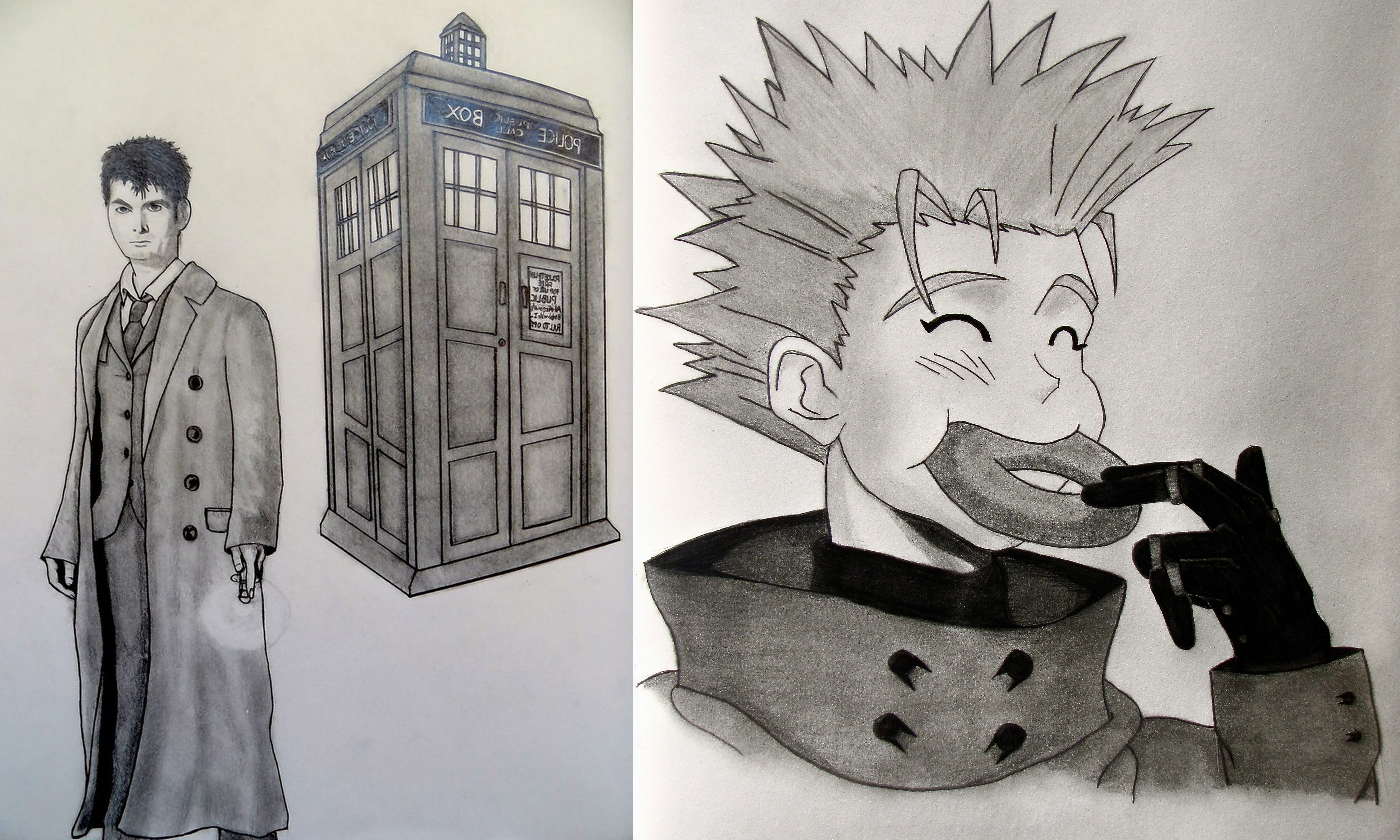
My thanks to my younger bro for permission to use his artwork!

My thanks to my younger bro for permission to use his artwork!

Vash and the Doctor seem sillier than Wooton, but their quirks mask profound inner turmoil. The Doctor despises himself. His travels throughout space and time are not a careless vacation, but his way of running away from past mistakes. Vash also has a lot to hide. The body beneath the overcoat is covered in horrific scars, and the man behind the goofy grin is tormented by regret for the lives he couldn’t save.

In the case of Wooton, endearing quirks are a form of comedy. The quirks of Vash and the Doctor serve a different purpose. Their odd habits hide sad struggles, and make the viewer feel more when their stories take turns for the tragic. After all, it’s easier to feel sorry for funny characters than for serious ones.

Then there is Miles Edgeworth, the friendly rival of Phoenix Wright from the Ace Attorney series. Like Mr. Quiring, Edgeworth is dignified, composed and intelligent.

Miles Edgeworth

Edgeworth also has a secret.

This respected prosecutor is secretly a fan of Steel Samurai, a cheesy show for kids about a futuristic warrior and his neverending fight for justice. Edgeworth vehemently denies liking the show, of course… but there’s his inexplicable knowledge of Steel Samurai trivia and the Steel Samurai action figure in his office.

In the case of super-serious people like Mr. Edgeworth, a single quirk can make a cold, distant character seem a little more human. Liking Steel Samurai is a weakness, but not a sin. We can respect Edgeworth, and we can also laugh at him.

Carelessly loading a character with endearing quirks is a mistake: too many odd habits, or quirks that seem out of place, are irritating. Used intentionally, however, endearing quirks can develop great characters—and make us laugh!

The Legendary Hayao Miyazaki

Art by Orioto on deviantART.

Art by Orioto on deviantART.

Hayao Miyazaki. If you’ve never heard of him, you’re most likely wondering who he is and why he’s important. If you’ve seen any of his films, however, you’re probably one of two things: a fan of his work, or else a person allergic to joy, creativity and childlike wonder.

Miyazaki is a Japanese filmmaker and one of the most influential animators of all time. There are a lot of adjectives I could apply to Miyazaki’s movies—breathtaking and awe-inspiring come to mind—but the best word for them is beautiful. Hayao Miyazaki makes beautiful films.

Miyazaki’s work is notable for its thematic complexity as well as its stunning animation. The conflicts in his stories are seldom black-and-white clashes of good and evil, but subtler disputes among flawed characters. Environmentalism, feminism and Japanese folklore are woven throughout Miyazaki’s movies—along with airplanes and airships, for some reason.

Miyazaki and his colleagues founded Studio Ghibli, the animation company behind movies such as My Neighbor TotoroKiki’s Delivery Service, Academy Award-winning Spirited Away and my all-time favorite film Castle in the Sky. (Studio Ghibli’s mascot is the adorable Totoro.) Miyazaki’s latest movie, The Wind Rises, was just released in the West and I want to see it so much.

This is supposedly Miyazaki’s final feature before his retirement, but I hope he continues working. He has “retired” at least two or three times since the release of Princess Mononoke, his first “last film,” in the late nineties. Whether or not he keeps making movies, his creativity and vision will continue to influence filmmakers all over the world.

Consider John Lasseter, director of classics like Toy Story and chief creative officer at Pixar and Walt Disney Animation Studios. Lasseter declared of Miyazaki’s work, “It is unbelievable, it is hand-drawn animation at its finest. Unbelievable.” (May it also be known that Toy Story 3 included a plush Totoro as an homage to Miyazaki.) Thanks to Lasseter and the good folks at Disney, Studio Ghibli’s films have escaped the hack localization and lousy dubbing from which so many foreign films suffer. The American versions of Studio Ghibli’s films are superb.

If you like animated movies and/or have a soul, I recommend watching at least one of Studio Ghibli’s films. Castle in the Sky is an epic fantasy adventure; My Neighbor Totoro and Kiki’s Delivery Service are slow, gentle family films; Grave of the Fireflies, directed by Isao Takahata, will break your heart; Spirited Away is Japan’s lovely answer to Alice’s Adventures in Wonderland; and Porco Rosso stars a flying pig. (Hey, don’t laugh! The hero of Porco Rosso is a legendary fighter pilot, thank you very much.) Watch just one of these films. Everyone needs a little Studio Ghibli.

Better yet, watch all of these movies!

A Blog Post with Many Exclamation Points!

Today is Be Nice to Someone on the Internet Day!

Go to someone’s Facebook profile, blog page, YouTube channel, deviantART page, Twitter profile or Tumblr account and leave a sincere, encouraging comment! Send someone an appreciative note, message or email! Find some other way to be nice to someone on the Internet!

Go quickly, before I run out of exclamation points! Let someone know he or she is appreciated! This is your mission!

That’s it, I’m out of exclamation points.

In seriousness, take a minute today to make the Internet awesome, and spread the word about Be Nice to Someone on the Internet Day.

In the meantime, I’ll order more exclamation points for this blog. I’m also short on the letters and K. I wonder why that is. I hardly ever use those letters. Oh, well.

Hey, here’s one last exclamation point. I’d better use it carefully.

Here goes: Go be nice to someone on the Internet!

251. Love Conquers Grumpy Cats

March 4 is Be Nice to Someone on the Internet Day. If you’ve never heard of this noble event, it may be because I totally made it up.

You see, the Internet is not always a nice place. It’s often a dreary minefield of arguments, insults, swearwords, misspellings and pervy pictures. The Internet is a place for creepers, hackers, perverts, jerks and trolls to make hurtful statements, propagate harmful spam and post pornographic depictions of cartoon characters.

To be fair, the Internet can be fantastic. It has Facebook, Wikipedia, Netflix and Strong Bad Emails, not to mention wonderful pictures, videos, blogs, articles, discussions and recipes for baking pie. Some of the people on the Internet are intelligent, gracious and kind.

It’s just a shame so many aren’t.

For all the blessings of the miraculous, invisible network we call teh internetz, it has a lot of problems. It could use some nice people. Just ask Grumpy Cat.

Grumpy Cat

Grumpy Cat, the solemn arbiter of the Internet, has spoken from the depths of her wisdom and sagacity. Let’s not be grumpy about the Internet and its problems. It just needs a little kindness.

Tomorrow, March 4, is Be Nice to Someone on the Internet Day. Tomorrow, go to someone’s Facebook profile, blog page, YouTube channel, deviantART page, Twitter profile or Tumblr account and leave a sincere, encouraging comment. Find someone you appreciate—whether an artist, a musician, a blogger, a friend or a total stranger—and let that person know he or she is appreciated.

I’ll post a reminder tomorrow on this blog for the event. In your own creative, unique, wonderful way, do something to make the Internet a better, nicer, kinder place—and please spread the word!

“Amor vincit Interretium,” said the ancient philosophers, and they spoke truly: Love conquers the Internet. Tomorrow, let’s prove them right. Tomorrow, let’s conquer insults and arguments and cruel words.

Tomorrow, dear reader, let’s make the Internet awesome.

250. Life Lessons from a Thirsty Blogger

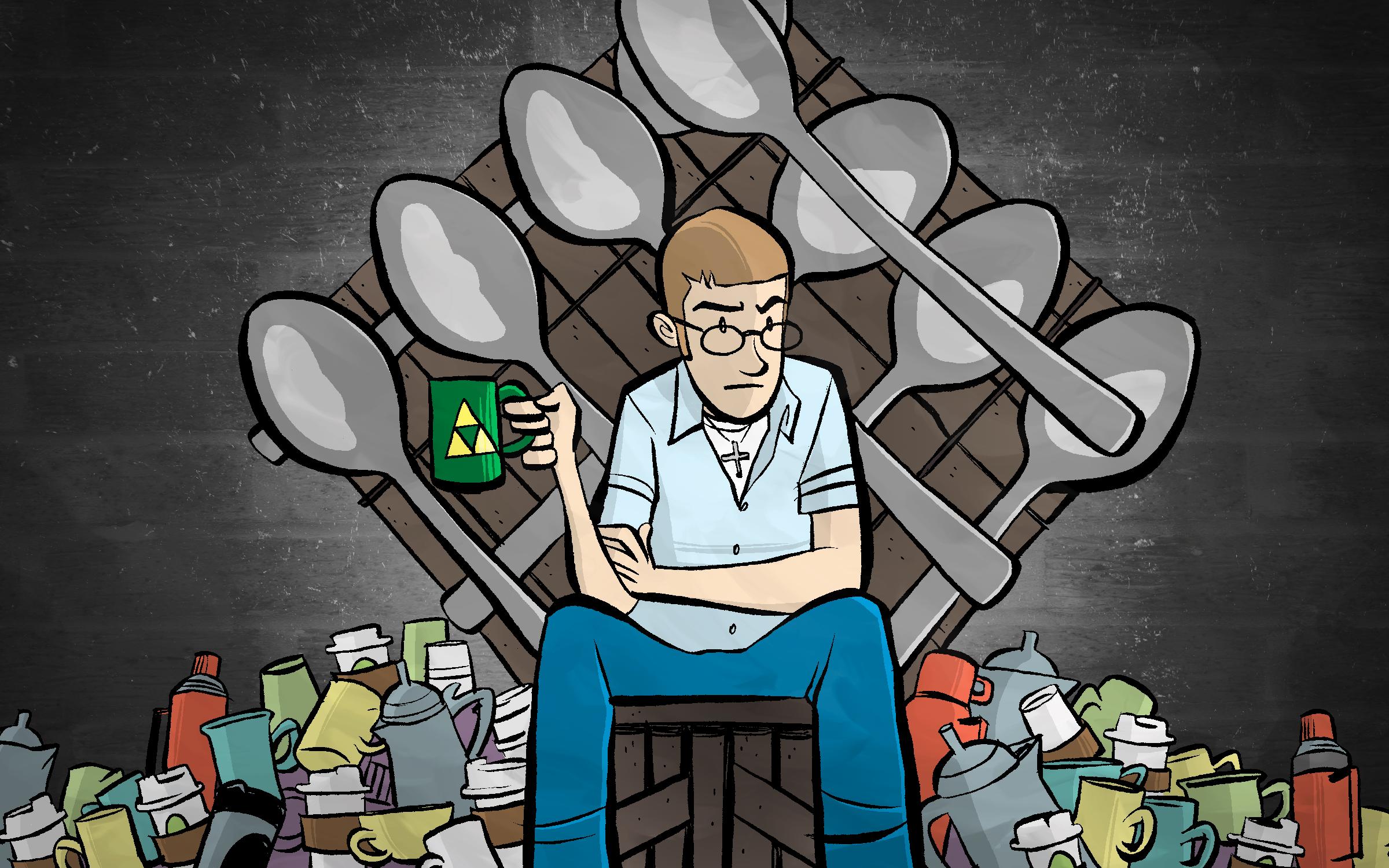
So I drink a lot of coffee. Don't judge me.

Yes, I drink a lot of coffee. Don’t judge me.

If anyone has ever wondered how I come up with ideas for this blog, the picture above tells the whole story: I sit and drink coffee and wait for something to happen. What can I say? Blogging is thirsty work.

(Due credit to the inimitable Wes Molebash for the splendid caricature, which has become my official Internet profile picture and a new banner for this blog.)

Today marks another milestone in the sunny existence of Typewriter Monkey Task Force: a blog fueled by coffee, sustained by geeky enthusiasm and buoyed by the support of loved ones. This blog has allowed me to share my passion for everything from God to tea to Tolkien. In good times and in bad, working on TMTF has brought me no end of satisfaction, comfort, encouragement, joy and pleasure. It has also given me the privilege of connecting with many fascinating, creative, generous people—writers, bloggers, artists and others—whom I would otherwise never have known.

In the two and a half years since starting this silly blog, I have gained a number of personal insights about life, the universe and everything. Today—as my typewriter monkeys and I celebrate this milestone with banana shakes and coffee, respectively—I’d like to share ten of the best lessons I’ve learned since TMTF began.

I must focus on today

I’m really good at brooding about the past, worrying about the future and generally thinking about all times but the present. God has given me today. Yesterday and tomorrow are in his hands, and I need to leave them there. My business isn’t to be burdened by worries or regrets, but to make the most of the time I have been given.

What matters is not what I feel, but what I do

For a long time, I made a simple assumption: If I felt bad, I was doing badly; if I felt good, I was doing well. I was wrong. Feelings are mostly beyond my control and largely unconnected to how well or badly I’m living my life. Depression isn’t proof of failure, nor does success does guarantee happiness. I should do my best under all circumstances, no matter what I feel.

I need sleep

I hate to say it, but I can’t shrug off sleep deprivation. Those late nights playing Ace Attorney or reading random Wikipedia articles seriously affect my concentration, mood and overall health. A long sleep can totally brighten my day; a short sleep can tip me over the brink into sickness or severe depression. In fact, I would go so far as to say sleep is almost as important as coffee.

Prayer and Scripture really, really make a difference

The past two years have taught me that prayer and Scripture are anchors. These commitments to God keep me rooted in my faith and focused on things that matter. When I quit praying and reading Scripture, I drift away from God. When I drift away from God, I become kind of a jerk. When I become kind of a jerk, everybody loses. Prayer and Scripture make an incredible difference in my life for good—even more than coffee, which is saying something.

I am not a great writer

I’m a pretty good writer, I think. Writing is one of my greatest talents, along with drinking coffee and having magnificent sideburns. I’m a good writer—but not a great one. When I was younger, I assumed my writing was brilliant. Working on this blog, failing to make The Eliot Papers a success and (above all) reading fantastic works by truly great writers have given me healthy doses of perspective and humility.

Things don’t fall apart

Heck, I wrote an entire post about this. No matter how I try to keep things together, I shall sometimes fail. It is well, then, that God is there to hold things together when my best efforts can’t keep them from falling apart.

I can’t fix people, but I can love them

If Doctor Who has taught me one thing, it is the importance of having epic sideburns. If the series has taught me a second thing, however, it is the value in simply showing kindness. “The way I see it, every life is a pile of good things and bad things,” the good Doctor reminds us. “The good things don’t always soften the bad things, but vice versa, the bad things don’t necessarily spoil the good things or make them unimportant.” The world is full of hurting people. I may not be able to take away their bad things, but nothing will ever prevent me from adding to their good ones.

I must be focused and intentional

It is so hard—so darn hard—to stay focused. I seem to live in a disorienting fog of distractions, diversions and complications. Depression and obsessive-compulsive impulses are only slightly greater obstacles to productivity than the Internet and its endless wealth of interesting articles and funny cat pictures. A useful, meaningful life doesn’t just happen. It takes intention, self-control and (in my case) a good deal of caffeine.

People are awesome

Human beings are amazing, awful, odd, ordinary, selfish, selfless creatures. In general, they’re pretty awesome. I’ve realized it’s worth getting to know people, and important to respect even those I don’t know.

I have good reasons for believing in God

When I began this blog, I felt conflicted about God and life and the universe in general. Many of my questions about God were unanswered. Some of them still are. It was while working on this blog that I reached a fundamentally important conclusion: I have my doubts about God and Christianity, but my evidence in their favor definitely outweighs my evidence against them. No worldview makes perfect sense to me, but Christianity makes the most sense.

Well, dear reader, thanks for reading this blog, putting up with our shenanigans and generally being awesome. My sincere thanks to everyone who has supported this blog, and to God for grace and coffee and stuff. Here’s to many more cheerful ramblings about faith, writing, video games, literature, life, the universe and everything!

The Best Is Yet to Come

I listen to music when working on this blog. My musical tastes are eclectic, eccentric and not very sophisticated, ranging from Relient K to My Little Pony to Peter, Paul and Mary. In past weeks, however, I’ve listened to a lot of music from the Metal Gear games.

The Metal Gear series is very cinematic, and much of its soundtrack is composed by Harry Gregson-Williams, the composer for films like Shrek and The Chronicles of Narnia: The Lion, the Witch and the Wardrobe. The Metal Gear games also feature some vocal music, such as the song above.

This song, “The Best Is yet to Come,” plays during the credits of Metal Gear Solid, a game I enjoyed. The song’s haunting melody and Irish lyrics hardly make sense in the context of the game, but they’re absolutely beautiful.

Other great Metal Gear melodies I’ve enjoyed include the incredible MGS2 theme and the faux-sixties “Snake Eater.” The latter is notable for its James Bond flair and memorable lyrics, such as “someday you feed on a tree frog.” My younger brother and I unanimously agree this is the best lyric ever penned by humankind.

Songs like “The Best Is yet to Come” encourage me to keep writing and blogging and being creative. They make me want to go out and do stuff. Despite their baffling references to amphibians, songs like these inspire me.

249. Share Your Blogging Wisdom!

I wish I knew more about blogging.

Seriously, I assumed I would have this blogging thing figured out by now. TMTF has been around for two and a half years. I’ve written nearly two hundred fifty posts—not counting a novella, some short stories, dozens of geeky commentaries, a handful of guest posts for other blogs and a series of reflections upon the Christian faith.

In all of this, I somehow managed to avoid learning anything.

All right, I may have learned a few things, but I want to learn more. I want to be a better blogger, and I’m asking for your help.

Today, dear reader, is your day! Today is the day you share your blogging wisdom! Tell me: If you have ever contributed to a blog or website, what is the most important insight, lesson, tip or trick you have learned?

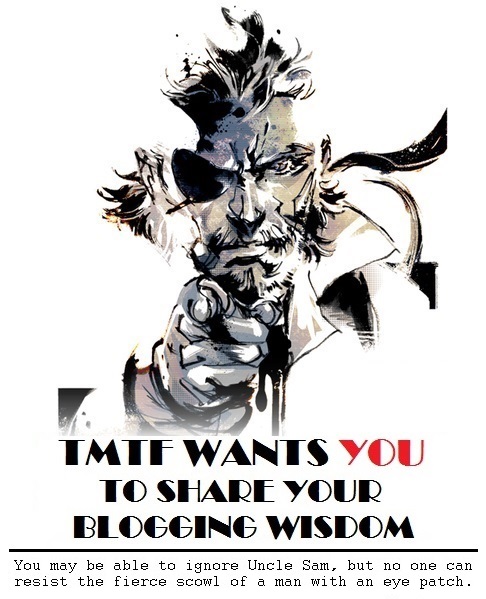
Big Boss Wants You!

I want to hear what you have to say! I ask, implore, beg, command, dare and/or defy every blogger reading this to share at least one piece of blogging advice. I especially want to learn how to build a stronger platform, so insights into reaching a wider audience are particularly appreciated!

Share your advice in the comments below! If you prefer not to comment, use this blog’s Contact page or find me on Twitter to share your thoughts. I want to hear what you have to say!

Ladies and gentlemen, the floor is yours. Today I am your student. Take it away!

248. The Problems of an Extrovert

Today’s post was written by Amy Green as a response to my introverted ramblings. For more great stuff from Amy, check out her previous guest post for TMTF and her blog The Monday Heretic, which covers such all-important subjects as God and bacon.

Hi, my name is Amy and I’m delighted to meet you and we probably have a lot in common that we should talk about for hours and hours.

Also, I’m an extrovert.

Like many extroverts, I need to be around people… but I don’t really know them.

Does that last part sound familiar? Maybe… exactly like what Adam said last week about introverts? That’s because it is. (I’m beginning to wonder if selfishness is the universal personality type.)

Of course, how this problem manifests itself is very different. Extroverts often struggle with having lots of somewhat shallow relationships. They wave to everyone they pass on campus, work the room at a company party, and seem to know everyone’s name at church.

That’s not a bad thing. There are many great things about being an extrovert. Extroverts often process verbally, meaning they think as they talk, so they seem to come to conclusions more quickly. They’re also often good leaders. And please, please do not tell me that extroverts aren’t capable of deep thought just because don’t give off the pensive philosopher air.

To be honest, society tends to gush over extroverts. Labels like “enthusiastic,” “assertive,” “generous,” and “sociable”—often applied to extroverts—seem much more positive than “thoughtful,” “introspective,” and “rational.”

However, sometimes that adjective-laden personality I haul into social situations is just a (slightly overwhelming) smokescreen. Sometimes when I’m in the middle of a monologue, I cringe because I know I’m talking over people, running them down like a conversational steamroller.

But I can’t stop because anything, anything would be better than silence.

In the silence, I have to face my doubts and inadequacies and fears about the future. The only person I have to talk to is myself, and sometimes I don’t really like myself.

But invite all of my friends over, and it’s okay. Because they all like me—see how much fun they’re having? So I must be likeable. I must be worth something.

But under every excited conversation, every party, every picture I post on Facebook of me with a dozen friends is the gnawing fear, “Please don’t abandon me to silence. Please don’t find out who I really am. Please don’t leave me.”

How can I love my neighbor as myself if I don’t love myself? And how can I love my neighbor when I’m constantly thinking about myself and how I’m being perceived?

This past year, I’ve learned to appreciate silence and have come to the conclusion that it’s not an enemy to attack with a barrage of words and jokes and laughter. It’s a way of choosing to believe I am worthy, even when I don’t feel like it, even without a constant stream of outside affirmation and approval.

I’m not saying that all extroverts struggle with putting up a façade for the rest of the world. But I have heard from many who admit it’s a significant problem.

Extroverts don’t have much trouble talking to people or meeting people or spending time with people—it gives us energy. But I think we have just as much trouble as introverts with loving people. That’s why God had to tell us over and over again to love each other. Because it’s hard and takes effort and none of us are good at it… but it’s important.

A Video Game Character, Lost and Found

Larry and Cid

These are two unrelated video game characters… or are they?!

Yeah, they really are.

All the same, my younger brother and I couldn’t help but notice a distinct similarity. On the left we have Larry Butz: the short-tempered, dimwitted Casanova wannabe from the Ace Attorney series. On the right, we have the well-meaning but cowardly Cid Randell from Final Fantasy Tactics Advance, a tragically underrated strategy game. Both men are losers, and their resemblance is striking. What if, we wondered, they were the same person?

I mean, just look at their in-game portraits.

Larry and Cid (Portraits)

Coincidence? Yes—they come from games developed by separate companies—but it’s still fun to imagine these losers are the same guy. I’ll be the first to admit our theory is absurd, but it springs from the same great question that lies at the heart of all great stories…

What if?

247. The Problems of an Introvert

I am an introvert. That said, go away. I wish to be left alone.

No, I didn’t mean it! Please come back!

Dash it, I didn’t mean to drive away my readers. Well, for those of you who haven’t left, I’ll admit being introverted isn’t a bad thing. Jesus Christ was an introvert. I scoff at the idea that introverts are broken extroverts. Some people simply enjoy being alone, and I’m one of them.

However, as an introvert, I often struggle to connect with people in a meaningful way. Sure, I’m amiable and polite. I get along just fine with coworkers and churchgoers and people at Wal-Mart. That’s not the problem at all.

The problem is that I don’t really know them.

It takes effort to get to know someone. Introverts don’t always enjoy getting to know people, so why make an effort? It’s much easier to be respectful and friendly, and then to go home to a cup of tea and a good book. This is a fine plan in the short term. In the long term, it leads to a life full of tea, packed with books and bereft of friends.

Making friends is hard, especially after high school and college. When something is hard, people generally feel disinclined to attempt it. For introverts, getting to know people is particularly exhausting.

This is why Facebook and other social media are so attractive to introverts. They require only brief visits and very little commitment. Facebook is convenient. It’s also shallow. Social media can enable deep discussions, but it’s mostly inundated with jokes and memes and rants and snippets of personal news. When I use social media, I feel like I’m standing in a crowd. I hear a little bit of everything from everyone, but meaningful conversations are difficult.

Facebook makes me feel connected because it gives me glimpses into the lives of people I love. I like a post here, leave a comment there and feel I’ve done my duty as a loyal friend. No need for emotional exhaustion: Facebook and Twitter bring relationships to the comfort of my armchair.

That’s the problem.

Facebook and Twitter are often blessings. Social media are wonderful way to keep in touch with people, hear their personal news and chuckle at their jokes. For introverts, however, social media can become a substitute for relationships or an excuse for not interacting with others. Social media may not be deep or meaningful, but they’re easy—certainly easier than meeting strangers, making commitments and spending time with people.

I never seem to have enough time, and I’m sometimes reluctant to spend it with others. People are exhausting. What I forget is that people are also awesome. More to the point, God has called me to love them. How can I love my neighbor when I don’t really know him?

As much as introverts struggle to relate to people, I’m sure extroverts have problems of their own. (Selfishly, I kind of hope they do; weakness loves company.) Check back next time for a guest’s thoughts on the problems of being an extrovert!