305. That Time My Vacation Held Me Prisoner

I begin a long vacation tomorrow, and I’m thankful. For weeks, work has been an exhausting, stressful, thankless grind. Dash it all, I am so, so thankful for a long break.

While musing upon vacations I had as a kid in Ecuador, I recently recalled That Time My Vacation Held Me Prisoner: an adventure equally restful and stressful, when my family and I were prevented from going home by barricades of burning tires. Ah, Ecuador, why did I ever leave you?

OLYMPUS DIGITAL CAMERA

Ecuador: land of dazzling natural beauty, diverse cultures, superb cuisine… and horrible, horrible cockroaches. I knew I had a reason for leaving.

In the jungles of Ecuador, east of the Andes, there is a little town called Shell Mera. (This tiny settlement made national news in the fifties due to the Auca incident, in which five missionaries were killed.) Near Shell Mera is a camp called Mangayacu. This motley collection of cabins, pastures, and the world’s best swimming pool was one of my family’s favorite vacation spots until we left Ecuador in 2008.

Mangayacu pool

Seriously, this pool is awesome: no chlorine, no life guards, and the exciting possibility of cutting open your feet on sharp rocks!

My family and I were once stranded in Mangayacu. This was a long time ago; I was somewhere between first and fourth grade, which would put this adventure in the late nineties. I’d nearly forgotten it; I’m very gifted at forgetting things.

My parents and brothers and I had finished our visit to Mangayacu and reluctantly packed up our things. After saying goodbye to our cabin, we took off in our dusty car and bumped along dirt roads in the direction of the town of Baños. (Yes, this happens to be Spanish for bathrooms. The word also means baths; the town is named after its hot springs.)

We were stopped by piles of burning tires. It was a paro (workers’ strike) shutting down the road. My dad got out of the car and pleaded our case to the strikers. They didn’t let us pass.

Back we went to the cabin we’d just left, delighted to enjoy a longer vacation, and apprehensive at how our vacation suddenly held us prisoner.
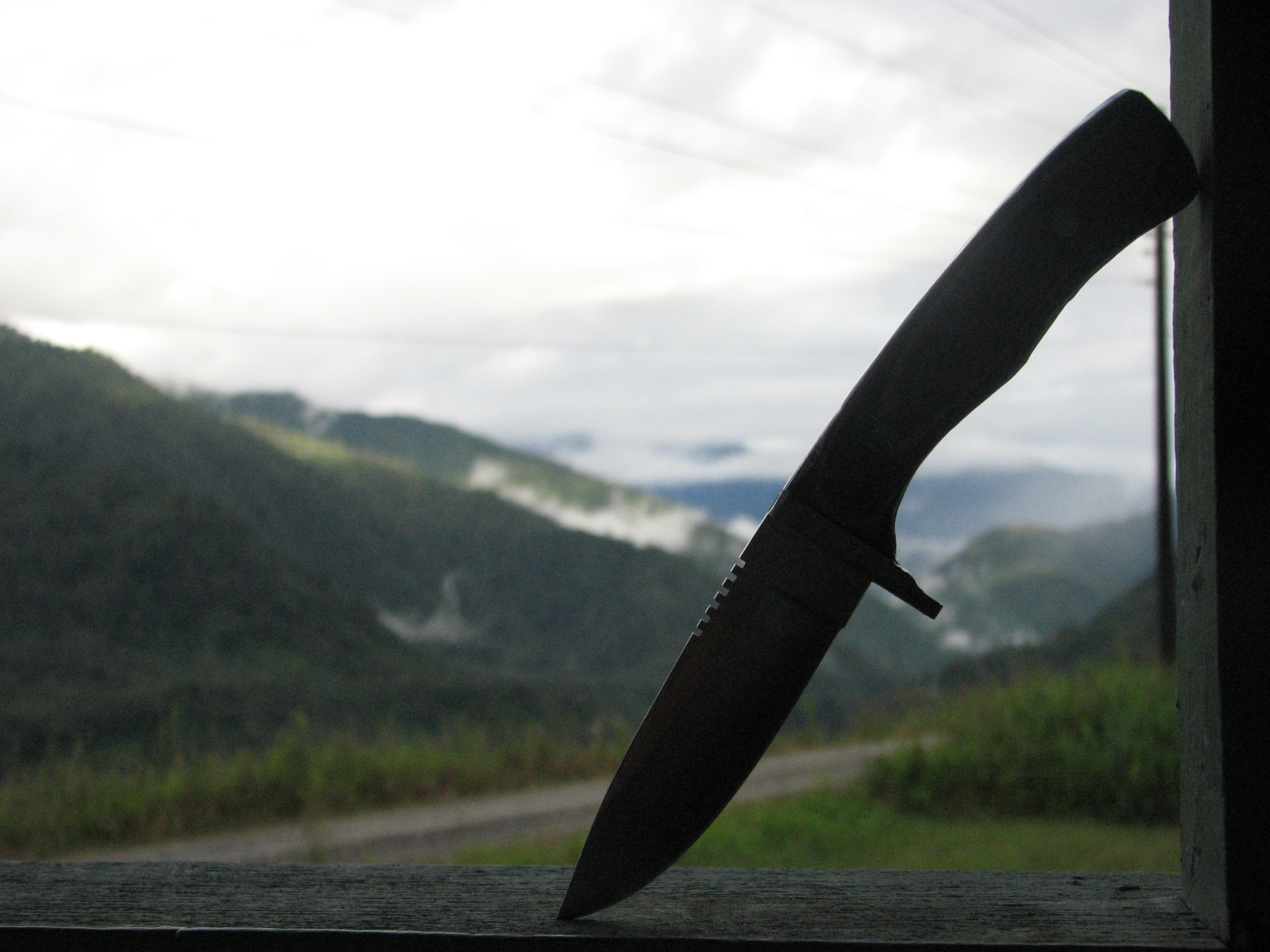
Mangayacu cabin view

I suppose there are worse prisons than the cabins at Mangayacu. At least the view is nice!

I don’t remember how many extra days we stayed at Mangayacu, but it was at least two or three. We scoured one or two tiny local shops for necessities like bread, and had a few meals at a local restaurant. I recall their stock running low because of the paro. As fun as it was at first to be stranded in a cozy jungle cabin, we felt more stressed with each new day. We wanted to go home!

At last, after my brother and I had missed at least a couple of school days, we made it safely back to our home in Santo Domingo de los Colorados. My older brother returned to Quito for school, and I resumed my studies at home.

Later visits to Mangayacu were undisturbed by paros and flaming tires. It was kind of fun to be held prisoner by our vacation, but I’m thankful it never happened again.

Every time I’m afraid I’ve run out of stories for these That Time I _____ posts, a memory of some odd adventure drifts back to me from the brightly-colored blur of the past twenty-something years. It’s surreal, and sweetly nostalgic. It makes me wonder what else I’ve forgotten.

Ah, well. It doesn’t matter. My latest vacation begins tomorrow, and I can’t wait. Here’s hoping this one doesn’t take me prisoner!
Where There Is No More Hope, Song Remains

“What can be done in a hell? They sang. For where there is no more hope, song remains.”

~ Victor Hugo

I’ve been reading the unabridged Les Misérables for much longer than I care to admit. (It’s kind of a heavy book.) I recently put it on hold in order to read some borrowed books I must soon return. As nice as it is to enjoy something a little lighter, I can hardly wait to dive back into the tale of Jean Valjean.

Les Mis is a novel sparkling with literary gems, and one jumped out at me a few pages before I put down the novel. “Where there is no more hope, song remains.”

I sing a lot. Although I’m no great singer, I find it oddly therapeutic. I frequently sing at work when my coworkers are out of earshot, and lately I’ve been singing more than usual.

My job has seemed stressful and thankless in the past few weeks. (I am so, so thankful to begin a vacation in a few days!) Besides coffee, which is an ever present help in trouble, few things in my job have encouraged and cheered me more than song.

The phrase above from Lez Mizzy reminded me of how thankful I am for the gift of singing. When work seems hard, life seems dark, or the coffeepot runs dry, song remains. I’m thankful for it.

304. Leviticus Is Really Bloody

Of all the books in the Old Testament, Leviticus has a reputation for being tedious. What nobody seems to remember is that it’s also really, really gory.

Rated M

The Holy Bible: Rated M for intense violence, blood and gore, and sexual content.

I’ve been revisiting Leviticus lately, and it’s a grim read. Among the dull regulations for religious rituals are rules for sacrifices, which involve slaughtering livestock, cutting them into pieces, burning them, and splattering their blood in all kinds of interesting and unexpected places.

I often picture places of worship in the Old Testament as peaceful, churchlike sanctuaries smelling of incense, where immaculately-dressed priests walk quietly and speak in whispers.

Examining what Scripture actually says gives quite a different picture.

Livestock were killed for a wide variety of offerings, and the priests did at least some of the slaughtering. I sometimes think of Old Testament priests as pastors, but they seem more like butchers. Israel’s places of worship were likely deafening with the frantic bleats of dying animals, pervaded by the smell of burning meat, and speckled with dried blood.

Revisiting Leviticus, and reading the Bible generally, challenges my faith. Christian culture hardly ever mentions, let alone dwells upon, the nastier bits of the Bible—and dang, the Bible sure can be nasty. It’s nicer to think about the Sermon on the Mount, or the Christmas story, or the pleasanter Psalms.

We so often have preconceived ideas of what’s in the Bible without ever taking a look, or bothering to think about what we find.

Do any of the Sunday school teachers who put up cutesy pictures of Noah’s Ark remember that the Flood drowned nearly every person on earth? Do any of the people who share inspirational verses from Job recall how his life was shattered, his health was broken, and his children were crushed to death? Anybody?

Leviticus troubles me. Yes, I know that “without the shedding of blood there is no forgiveness.” It costs something. In the end, forgiving us cost God everything in the death of Jesus Christ. I get that. All the same, I’m bothered by the thought of God commanding the incessant, daily slaughter of helpless animals as a form of worship.

These challenging chapters in Leviticus remind me that lot of things in Scripture trouble me, and some surprise me—and many give me unexpected comfort, peace, and hope. The Bible often refuses to match up to my expectations or the impressions some churches give of it.

The Bible is a book not to be judged by its cover, nor by incomplete impressions. Especially for those who call it God’s Word, the Bible is worth reading: even the tedious, boring, and bloody bits.

I suppose that includes Leviticus.

303. About Storytelling: Temporary Death

Death is one of life’s few absolute certainties. Others include taxes and the fact that every person will, at some point, step in a puddle of water on the bathroom floor while wearing socks. Yes, life can be cruel.

Death is inevitable. For the most part, even fiction acknowledges this. What some stories don’t guarantee is that characters will stay dead. I’ve discussed how to kill off fictional characters, and even mentioned temporary death as a video game cliché, but I think it’s still worth taking a look at how characters in some stories recover from death as easily as getting over a cold.

There are endless possibilities for cheating death in fiction, going all the way back to classical mythology. In Greco-Roman myths, death was a literal place from which a surprising number of people managed to escape: Heracles and Orpheus, among others.

The past few decades have given us an endless array of methods for cheating death, especially in geekier media like comics, video games, and fantasy fiction.

Here are some of my favorites.

Be ye warned, here there be minor spoilers.

Time travel

How often dead characters have been restored to life because someone went back in time to rescue them! Thanks to the butterfly effect, tiny decisions in the past can have huge consequences in the future. Probably my favorite example of time travel resurrecting a dead character comes from Chrono Trigger, pretty much the greatest RPG ever made, in which characters travel to the exact moment of a man’s death to save his life.

Superhero comics

There is no single explanation for this one—comic book characters are revived in such a staggering variety of ways that I can’t even begin to list them all. A mutant’s seeming death triggers her evolution into a more advanced mutant. A superhero’s innate healing abilities pull him back from the brink of death. A villain fakes his death by a stupidly elaborate scheme. Really, the possibilities are countless.

Magic

When in doubt, magic is the ultimate deus ex machina. Magic is mysterious and inexplicable by its very nature. If a writer resurrects characters by magic, who is there to argue? Miracles, such as the triumphant return of Aslan or Gandalf, fall into this category, which also includes medicines like the chocolate-coated pill from The Princess Bride.

Supposed to be dead

What? I’m supposed to be dead? Well, this is awkward.

Technology

By technology I mean magic as it is called in sci-fi stories. Let’s face it: advanced technology and supernatural magic are practically the same thing in some science fiction.

Reincarnation

This metaphysical concept has been lifted from various religions and adapted to everything from Avatar: The Last Airbender to Doctor Who. (The Doctor’s regeneration is basically sci-fi reincarnation.) Characters may technically die, but reincarnation allows the narrative to bring them back.

Afterlives

This brings us to ghosts, phantoms, and other not-alive states of being. Again, even if the story considers characters dead, they’re still fulfilling the roles of living persons by lingering as spirits.

Fake deaths

This one annoys me. (All the same, I’ve used it more often in my writing than I care to admit!) When a character seems to die, the narrative treats them as dead… until they turn out to have been alive all along. Fake deaths generally cheapen the reactions of living characters. Responses like mourning, grief, and anger become less meaningful when they’re revealed to have been unnecessary. Besides, fake deaths are generally predictable.

I think temporary death is a valid storytelling trope, but I prefer death in fiction to be permanent. Death is more realistic, and carries much more weight, when it’s treated as an everlasting reality instead of a fleeting condition.

Anyone who knows anything about video games probably knows that Aerith dies in Final Fantasy VII. Partway through the story, this cheerful flower vendor is impaled by the villain. That’s it. There’s no resurrection, no last-minute deus ex machina. In the game, she is dead. The other characters mourn her… and so does any player whose heart isn’t made of stone.

Death is tragic. It often seems meaningless. However, in storytelling, that miraculous medium which makes all things meaningful, death matters—especially when it lasts more than a few minutes.

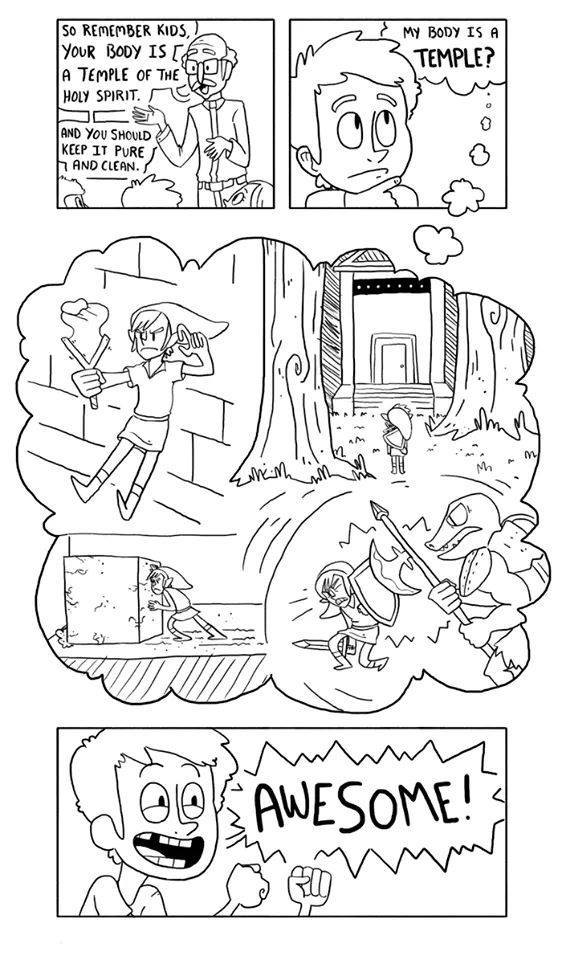
The Spirit Temple?

The Spirit TempleVery few readers will understand this comic, and that’s perfectly fine. I thought it was far too funny not to share.

If you don’t get the joke, there are two things you must do. First, you should read the Bible, which is the greatest book ever written. Second, you should play The Legend of Zelda: Ocarina of Time, which is basically the video game equivalent of the Bible.

Incidentally, always thought it was odd that the dungeons in Ocarina of Time were called temples. I mean, were they meant to be places of worship? If so, what deities were worshiped? Why are their temples full of monsters and death traps? What kind of eccentric deities would want such lousy temples? Am I overthinking things?

So many questions.

302. TMTF Reviews: TMTF Reviews

A long time ago, I began reviewing books. It’s a vice, I know. I can’t help it. Some time later, I started reviewing video games. Look, I know I have a problem. Don’t judge me for judging things.

I’ve been thinking lately of how to improve TMTF Reviews. It occurred to me that they could be more streamlined and better organized. It’s time for a change.

That said, today’s review is a little different. It’s shorter than usual, bizarrely meta, and unexpectedly significant. We’re going to figure out how to make these reviews more helpful and easier to read.

This time, TMTF reviews TMTF Reviews.

Wait, what?

TMTF Reviews

The Good…

Up to this point, TMTF Reviews have been bleak, black-and-white blocks of words broken only by the occasional picture. We’re adding titles! Besides breaking up the monotony of prose, titles will make navigating reviews quicker and easier.

The style and content of reviews shan’t change. I’ve always tried to give thoughtful evaluations of things. My reviews aren’t great, but at least they give unique, honest perspectives and impressions of books and video games.

We’re making one more major change to TMTF Reviews, but I’ll get to that one in just a bit.

The Bad…

TMTF Reviews have plenty of problems. I’m neither a gaming pro nor a literary expert, and my reviews are far from professional. In fact, TMTF Reviews mostly consist of me rambling about stuff I’ve read and played, and throwing my ramblings into the lives of innocent, unsuspecting readers.

And the Fabulous

All in all, TMTF Reviews are as much a part of this blog as personal reflections and Legend of Zelda references. I can hardly imagine TMTF without its reviews, despite their faults, and I’m excited to make them a little easier to read.

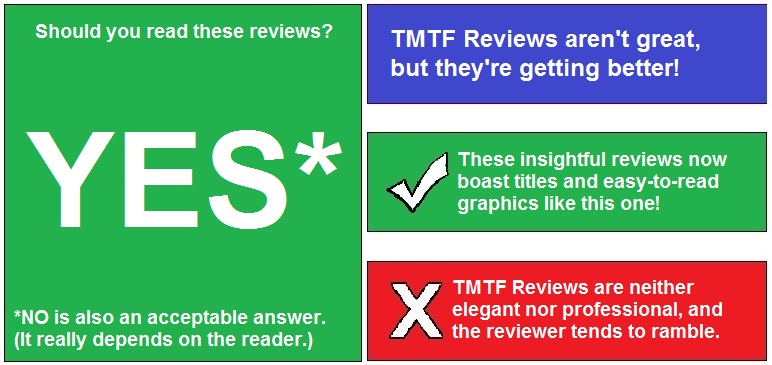
This brings me to that final change I mentioned before. Inspired by the superb reviewing format used by Kotaku, I’ve decided to summarize each TMTF Review in a simple, colorful, fabulous graphic!

TMTF Reviews - TMTF Reviews

All right, the graphic isn’t that fabulous. Still, I hope it helps. Now you don’t even have to read TMTF Reviews anymore! You can just skip to the summary for the most important information!

Wait… it’s probably a bad thing if readers quit reading my reviews. Ah, well. Alea iacta est. (That’s Latin for “Such is the price for fabulous things,” or something like that. I could be wrong.)

Having improved the format for reviews, I’m eager to review the heck out of things… but I suppose I’ll have to go read a book or a play a game first.

I should probably get a start on that.

301. Blogging Anarchy

In some distant, dusty corner of my mind, there is a list titled What Adam Wants to Be When He Grows Up.

I’ve spent the past half a decade or so crossing things off this list. Voice actor was the first to go, followed by Author and Professional blogger years later. My list seems to get a little smaller every year; at this point, it consists of English teacherCopy editor, C.S. Lewis, and G.K. Chesterton. Those last two probably aren’t realistic options, since they’ve already been taken by other people.

The latest profession to be removed from What Adam Wants to Be When He Grows Up was Video game journalist. Yes, video game journalism is a thing. Someone has to review all those games, interview game developers, and cover events like E3, after all!

In the past few years, I’ve delved into the fascinating world of video game journalism and found it awesome… and also kind of awful.

I love writing. I love video games. Video game journalism unites two of my greatest interests in one exciting career. For a few months, I seriously considered looking into the profession. Like voice acting all those years ago, video game journalism seemed almost too good to be true.

Well, like voice acting, video game journalism turns out to be a heck of a lot harder than it looks. It takes more than a knack for writing and a passion for gaming. Video game journalism has extremely tight deadlines and not much job security. The job requires extensive research, technical know-how, and a high tolerance for brutal, abusive reactions.

The video game industry seems to have more than its fair share of spiteful people: gamers prowling around like roaring lions seeking whom they may devour. Every controversy in the video game industry, and media coverage thereof, gets messy. Insults, accusations, and—I hate to say this—death threats are not uncommon.

Some gamers don’t even need controversies to be cruel. All it takes to kindle their fury is a dissenting opinion. Vicious arguments are started by mild statements like “I think Majora’s Mask is a better game than Ocarina of Time,” and woe to the journalist brave enough to discuss touchy subjects like religion or feminism in video games!

In this journalistic minefield, video game journalists are wary. They follow complicated regulations about transparency and conflicts of interest. (These rules are good, fair, and necessary, but definitely a headache.) Some journalists have been publicly shamed, and had to apologize, for honest opinions.

All of this makes me especially thankful for the anarchy of blogging.

Well, anarchy may not be the best word; freedom is probably a more positive one. As the world of video game journalism is shaken by GamerGate, a recent mess of controversies involving feminist criticisms and alleged conflicts of interest, I find myself more thankful than ever for the freedom to write whatever the heck I want to write.

One of many things that makes blogging fun is that is has so few regulations. Nearly every rule for this blog is self-imposed. TMTF has deadlines and guidelines and whatnot, but they’re all the ones I chose for it. Blogging isn’t a minefield whose navigation requires strict rules. All it takes to write a blog is passion, a little experience, and maybe just a hint of insanity.

I admire video game journalists. I hope the problems of GamerGate are quickly and peacefully resolved.

Most of all, I am so, so thankful for the anarchy of blogging.

The Liar Paradox (and Surviving the Robot Apocalypse)

This statement is false.

I don’t know about you, dear reader, but the statement above makes my head hurt.

Geeks and philosophers alike have puzzled over the liar paradox, in which a statement contradicts itself. If “This statement is false” is true, then it must be false. It can’t be both, which makes it nonsense.

In the event of a robot apocalypse—a catastrophic takeover of human society by artificial intelligence—my advice is to hurl liar paradoxes at the machines. With any luck, they’ll puzzle over these impossible statements until their circuits or microchips burn out, deactivating the robots and saving humankind.

A robot apocalypse is unlikely, but it doesn’t hurt to be prepared. I’ve seen The Matrix and The Terminator. I know how those revolutions end.

It Begins

It begins. (Comic by xkcd.)

Returning to the liar paradox, it reminds me of the “Knights and Knaves” riddles at which I’m so terrible. These puzzles feature people who tell only truths or only lies, requiring the puzzle-solver to distinguish the liars from the truth-tellers. Sifting through their conflicting statements requires exactly the kind of cool logic and steadfast patience I don’t have.

A contradiction similar to the liar paradox can be found in the denial of absolute truth. I believe some things are absolutely true, their truthfulness unaffected by my belief or disbelief. Denying this is silly. If “There is no absolute truth” is an absolute truth, then it’s self-contradictory. If “There is no absolute truth” is not an absolute truth, then it allows for absolute truth as an exception to the rule. Either way, the statement breaks down completely.

All this philosophy is making me thirsty. I’m going to go make some coffee, assuming my coffeemaker hasn’t become self-aware and begun planning the robot apocalypse.

I’d better get some paradoxes ready just in case.

300. Creative Counseling with DRWolf

In past months, I’ve felt burned out. Writing has been harder. I realized it was time for this blog to get some help, so I met with DRWolf—a creative thinker known for his work in the brony community—to discuss the problem. He was friendly, polite, and helpful. What I didn’t expect was for the good doctor actually to be… you know… a wolf.

I want to thank DRWolf for his time, consideration, and advice. I was sincerely interested in finding some answers, and he gave some really good ones. Keep up the fine work, Doctor. It was an honor to work with you.

I also want to thank Crowne Prince, animator extraordinaire, for the superb video. It’s absolutely fantastic, Ms. Prince. I appreciate your time and expertise!

As usual whenever I stumble over a blogging milestone, I have a few more words to say.

I owe a great debt of gratitude to my parents for their support and encouragement, and especially to my father for his tips and artwork. Without him, TMTF would probably not have lasted long. Thanks, old man. You’re the stoutest of Stout Fellas.

Next, a word to my typewriter monkeys: If you ever do that again, I will donate you to the zoo. I mean it this time.

Speaking of my monkeys, I guess they deserve some credit. Despite their laziness, pyromania, and extensive criminal record, I don’t know how I would keep TMTF up and running without my dirty dozen: Sophia, Socrates, Plato, Hera, Penelope, Aristotle, Apollo, Euripides, Icarus, Athena, Phoebe, and Aquila. Thanks, guys.

(I’m serious about the zoo, though. Behave yourselves for once!)

My readers have been far kinder to this blog than my monkeys ever have. To every person who has supported TMTF by commenting on it, sharing it, liking posts here or on Facebook, writing guest posts, celebrating Be Nice to Someone on the Internet Day, or simply reading the blog occasionally—thank you. Thank you so much. The greatest joy of a writer is to be read, and I appreciate every single one of you.

Finally—insofar as a blog about video games, Doctor Who, and exploding tomatoes can honor anybody—soli Deo gloria. Whatever my struggles, I hope these three words will always be my guiding principle for creativity.

On a less spiritual note… if I had a penny for every post I’ve written for this blog, I’d have enough money to go out and buy a cup of coffee. That’s pretty neat. All in all, thanks to all of you, it seems I haven’t quite run out of reasons to be creative.

I’d better keep writing.

299. I Am Not Batman

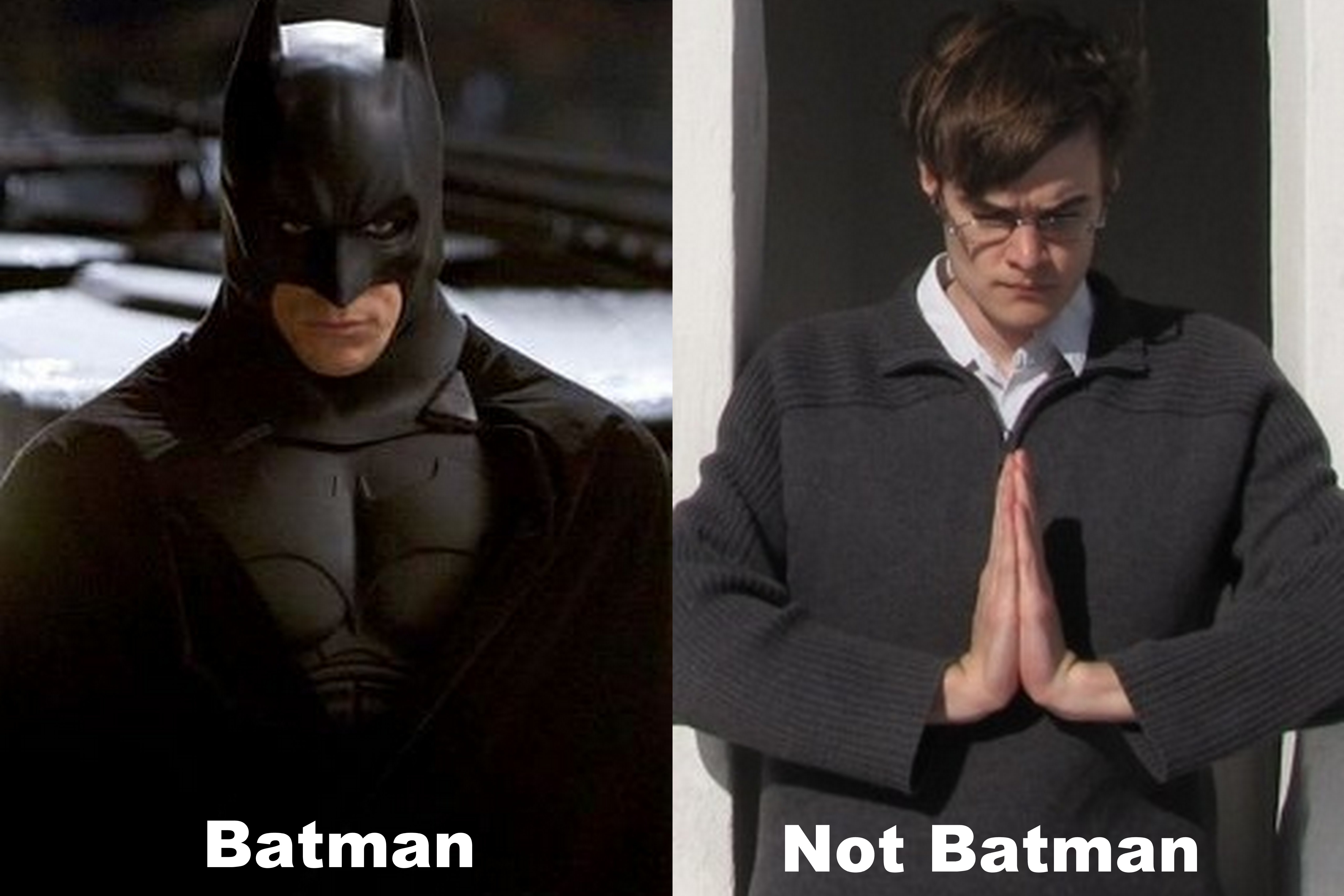
Yes, I know this may come as a shock to some of my readers. Some may have been so sure that I am secretly the Caped Crusader: the legendary vigilante who dresses as a bat for some reason. It is not so.

I am not Batman.

One of These Is Not Batman

All the same, I sometimes hold myself to impossibly high, Batman-esque standards. I also have Batman Syndrome, obsessing over my failures and allowing little mistakes to cancel out great successes. I demand much of myself. I have to be productive. I have to get stuff done.

I forget that I’m not Batman. He may be the pinnacle of human strength, will, and intelligence, but I am not. I’m a guy who needs sleep, gets sick, and needs a day off now and then.

A few days ago, I was reading the latest post from an animator’s blog. Something he said struck a chord with me.

And tomorrow I’m taking the day off from everything and not working on anything . . . It’s been a long time since I took a day completely off, so it’s due. We need downtime. Our society doesn’t like that because we’re not being productive members of society when we don’t do anything, but if we’re always on 24/7, we burn out.

This man has clearly learned a valuable lesson. He understands that he is not Batman. No ordinary person can be on the go all the time, working constantly, never taking a break, expecting nothing less than absolute effort. Normal, non-Batman human beings need days to take naps, read a book, or play Mario Kart. Without those days, we break down. It’s not weakness or self-indulgence to relax occasionally. It’s a necessity.

I’m often busy even when I don’t have to be. More often than I care to admit, I wear myself out working on things that aren’t urgent—things that can wait until I’ve had a cup of tea, a walk to the park, or a good night’s rest. I get so accustomed to being busy that I feel guilty or panicked if I spend too long without doing something “productive.”

There’s something in the Old Testament about taking a day off every week: the Sabbath day. I usually file it away with all those rules about burnt offerings and unclean foods as a religious law that has become obsolete. I’m no longer so sure. Besides being healthy and sensible, taking days off seems like an affirmation of faith—a way of saying, “I trust God enough to give him today.”

Sometimes, determination and coffee aren’t enough: “Man shall not live by caffeine alone,” or something like that. I am not Batman, and I sometimes need a break.

Unless you’re Batman—I’m guessing you’re probably not—you may sometimes need a break, too. Don’t be afraid to take one!