102. About Writing: Knowing How Language Works

There’s more to writing than understanding the mechanics of language. Grammar and spelling are no substitute for imagination, humor or a really good story.

All the same, serious writers should make an effort to understand their language. Only naïve writers think spelling, grammar and usage aren’t important. Even writers who use language inventively should know the rules before they break them!

Here are a few miscellaneous pieces of advice about spelling, grammar and proper usage of the English language.

Will and shall mean different things

Knowing the difference between will and shall could save your life.

Well, not really, but my grammar professor in college once told a story that illustrates the importance of understanding the difference between will and shall.

Two men fell into a swift river. The first man shouted, “Nobody will save me! I shall drown!” The bystanders immediately threw him a rope and rescued him. The second man shouted, “Nobody shall save me! I will drown!” The bystanders did nothing, and he drowned.

In the first person, will indicates intention and shall indicates inevitability. If I say, “I will drink coffee,” I mean, “It is my intention to drink coffee.” If I say, “I shall die someday,” I mean, “I’m going to die someday whether I like it or not.”

This pattern is reversed in the second and third persons. In the second and third persons, shall indicates intention and will indicates inevitability. If I say, “You shall bring me some coffee,” I’m issuing a command. If I say, “You will die someday,” I’m simply stating a fact.

According to these patterns, the first man who fell into the river expressed his fear that no one would save him, and the second man stated his intention to drown without anyone’s interference.

Remember the difference between will and shall. It might save your life someday.

Never, never, never use alot

It’s two words: a lot. You don’t use abunch, ahouse, acoffeecup or atypewritermonkey. Please, for the love of language, don’t use alot.

It’s improper to split infinitives

What is an infinitive, and why shouldn’t we split it?

To put it simply, an infinitive is a form of a verb consisting of to followed by the present tense of the verb: to eat, to drink, to be (or not to be) and so on.

It’s messy to split infinitives—that is, to insinuate other words into infinitive phrases. Consider the infinitive to drink in the phrase “to drink coffee happily.” I split the infinitive by moving the adverb happily into the middle of the infinitive phrase: “to happily drink coffee.”

Why is it improper to split infinitives? The grammatical rule was adapted into English from Latin, and it’s actually useless. There’s no practical, logical reason not to split infinitives. Some writers, even professional writers, split infinitives all the time.

However, it’s still grammatically proper not to split infinitives. (Notice I wrote “not to split infinitives” instead of “to not split infinitives.”) If you’re composing a formal essay—or writing dialogue for an educated character—it helps to be as grammatical as possible!

It’s improper to split phrasal verbs, but pronouns provide an exception

First infinitives and now phrasal verbs. Why can’t I split things? I want to split things!

A phrasal verb is simply a verb consisting of a phrase instead of a single word. Pick up is a good example. I can “pick up a phone,” but I can’t “pick a phone” or “up a phone.” The verb requires both words to retain its meaning.

It’s incorrect to split up a phrasal verb. I can “pick up a phone,” but I can’t “pick a phone up.”

However—and this is where it gets tricky—pronouns are an exception to the rule. A phrasal verb can be split by a pronoun. Let’s use pick up once more as an example. I can “pick you up from work,” but I can’t “pick up you from work.”

I know, it’s complicated. Welcome to the English language.

All right is more correct than alright

All right is standard. Alright is considered nonstandard and should be used sparingly.

Where indicates place, and in which indicates subject

Where describes a place. “I went to Ecuador, where I drank coffee.” Ecuador is a place.

In which describes a subject. “Going to Ecuador is a circumstance in which I will drink coffee.”

I do not say “a circumstance where I will drink coffee.” A circumstance is not a place. It’s equally incorrect to say, “a case where someone died” or “a situation where I panicked.” Cases and situations are not places. It should be “a case in which someone died” or “a situation in which I panicked.”

Don’t use emoticons, texting lingo, Internet slang or nonstandard abbreviations in formal writing

’Nuff said.

Be wary of common errors

Know the difference between to, too and two, and between theretheir and they’re, and between its and it’s. Common errors like these are the fleas that suck out a writer’s lifeblood. (Yes, that was a terrible metaphor, but I’m trying to make a point.)

Things are not always written the way they sound

Don’t ever use of as a verb instead of have: I can write, “I would have drunk coffee,” but I shouldn’t write, “I would of drunk coffee.” It’s not standard to use old fashion as an adjective: I can write, “Typewriters are old-fashioned,” but I shouldn’t write, “Typewriters are old fashion.” The correct way of writing something isn’t always the way it sounds phonetically.

And break the rules when you need to

Prepositions are sometimes the best things to end sentences with. And sentence fragments can be useful.

I could go on, but I think you get the idea.

Why do spelling, grammar and usage matter?

First, readers are quick to dismiss poor writing. A writer’s ideas or stories may be truly amazing, but many readers won’t bother reading them if they’re presented poorly. Writers owe it to their readers to give them their best possible work.

Second, understanding language can be helpful in writing fiction. One character might break all rules of grammar every time he opens his mouth, and another character might use language perfectly. So much can be done to develop a character using the mechanics of language.

Grammar and spelling and usage aren’t as much fun as, say, plot or setting or characterization, but they’re just as important.

No matter how talented a musician might be, her music won’t sound good if her instruments are out of tune. No matter how gifted a writer might be, his writing won’t succeed if his understanding of language is weak.

Even for artists, technical stuff matters.
100. An Important Post

Typewriter Monkey Task Force has featured one hundred regular posts! Today, my friends, is a great and solemn day. At least it would have been if my typewriter monkeys hadn’t gotten their paws on some fireworks.

This milestone post gives me the opportunity to revisit a few important posts and to make some announcements.

Beginning today, my monkeys and I are taking a week off from TMTF. Regular posts will resume next Monday, July ninth. I’m taking a break in order to focus on a bigger project, which brings us to the next announcement.

The Trials of Lance Eliot—my debut novel—comes out today!

Six years ago, I began working on the novel that would grow into The Trials of Lance Eliot, the first volume of a trilogy titled The Eliot Papers. The project has been my greatest passion as a writer, so I’m excited finally to be able to share it!

The novel is available for purchase!

A few months ago, I published The Infinity Manuscript, a fantasy in twelve parts, as a serial on this blog. The Infinity Manuscript isn’t nearly as polished as The Trials of Lance Eliot, but it’s available to read for free!

I also wrote a short but significant series of posts titled Help, I’m a Christian! in which I shared some of the most valuable lessons I’ve learned about relationships, faith and Christian living.

In addition to TMTF and the blog for my novel, I maintain a blog called Solidarity that shares reports of persecution against Christians. Please feel free to check out Solidarity or my explanation of why it matters.

I’d love to feature more guest posts on TMTF! If you’d like to write a post for this blog, check out these guidelines.

I’ve also been privileged to write a few guest posts for other blogs, including Stuff Christians Like, Social Biblia and Thomas Mark Zuniga’s blog. My typewriter monkeys and I are always delighted to write guest posts, so feel free to contact me if you’re ever in search of a guest blogger!

Finally, I need to thank some people for their assistance, encouragement and support.

Thanks to my typewriter monkeys—Sophia, Socrates, Plato, Hera, Penelope, Aristotle, Apollo, Euripides, Icarus, Athena, Phoebe and Aquila—for their work on the blog. I could never have kept up TMTF without you. Thanks, guys. Don’t ever buy fireworks again, okay?

Thanks to my parents for proofreading many of my posts, and special thanks to my old man for providing TMTF’s artwork. You guys are fabulous.

Thanks to the bloggers who have written guest posts for TMTF, and to my younger bro for allowing me to feature his drawings. I’ve been honored to share your work.

Thanks to God, whose love, grace and kindness are rocking awesome.

Finally, thanks to the readers and followers of this blog! Your likes and comments are so much appreciated. There is no greater honor for a writer than having his work read.

We’ll be back!

96. Author Stuff

My novel, The Trials of Lance Eliot, is less than a month away from publication, and I’m suddenly busy with author stuff. These miscellaneous tasks—setting up a book blog, creating a Facebook page, gathering reviews and so on—are essential to launching a writing career.

To be honest, author stuff and self-promotion make me feel uncomfortable. However, Doug TenNapel, a writer and artist, once made a statement that has helped me to see things in a different light.

“I have no problem with shameless self-promotion. It’s not for my good, it’s for you. I like making stuff. It’s not as fun to make stuff if people don’t see it. Entertainers entertain.”

No other project on which I’ve ever worked has been so important to me as The Trials of Lance Eliot, and I’d love for people to read it.

Even though self-promotion is kind of awkward, I’ve decided to throw myself wholeheartedly into author stuff. If the novel is successful, it will give me the freedom to keep writing novels—which would be amazing.

I began writing The Trials of Lance Eliot six years ago, when I was just a high school sophomore. The first draft was terrible, so I quit halfway through and started over. I actually finished the second draft of the novel. Realizing I could do much better, I set aside the second draft and began again. The third draft was nearly half done when I realized it had some major flaws. I started a fourth draft, which grew into the novel soon to be released.

I’ve invested a lot in The Trials of Lance Eliot—and I’m not the only one. My agent pitched the novel to a number of publishers. My old man created the novel’s artwork. Writers gave me critiques, readers gave me reviews and one kindly professor gave me a coffee cup.

Most recently, I’ve been honored and touched by the support my friends and acquaintances on Facebook have shown for the novel.

I want to make The Trials of Lance Eliot a success, but I can’t do it alone.

If you’re interested in giving the novel a boost—awesome. Spread the word! The novel is tentatively scheduled to be released on July 2 as an e-book online, and later as a paperback through Amazon.com.

One last thing: Lance Eliot would never have made it this far without the encouragement, help and support of many people. To all those people I’d like to say two things.

You’re awesome, and Thank you.

93. About Writing: Setting

Setting is one of the most important elements of a story. Besides supporting plot and characterization, it anchors fiction in reality.

The Lord of the Rings takes place in Middle Earth, an imaginary world full of magic and monsters, but Tolkien describes its woods and fields so vividly that the fantastical story becomes believable. In the case of more realistic fictions, the setting does even more to make the story seem true.

Here are a few things I’ve learned about creating settings.

Settings must be consistent

If you introduce details about a setting, stick to those details. Inconsistent settings are a jarring reminder to the readers that the story they’re reading is made up.

Know your setting

As mentioned before, The Lord of the Rings has an amazing setting. Tolkien didn’t just write a story. He created a world. For decades, he worked out every detail of Middle Earth, devising languages, drawing maps, creating numerous cultures and inventing tens of thousands of years of history, including minor touches like legends and genealogies.

You don’t have to be as meticulous as Tolkien, of course, but he sets a fantastic example to follow. Your story may depict only a few scenes within a larger setting, but you should have some idea of what’s going on beyond them. There’s a problem when the storyteller knows no more about the setting than the reader.

Research your setting

I hate research. One of the reasons I enjoy writing fantasy is that I get to make up stuff instead of confirming every background detail. Even for fantasy writers, however, research is important. How tall are oak trees? What does it take to forge a sword? If real-life details aren’t believable, imaginary ones won’t be. For writers of historical or literary fiction, research is even more imperative. Every inaccuracy distracts from the story.

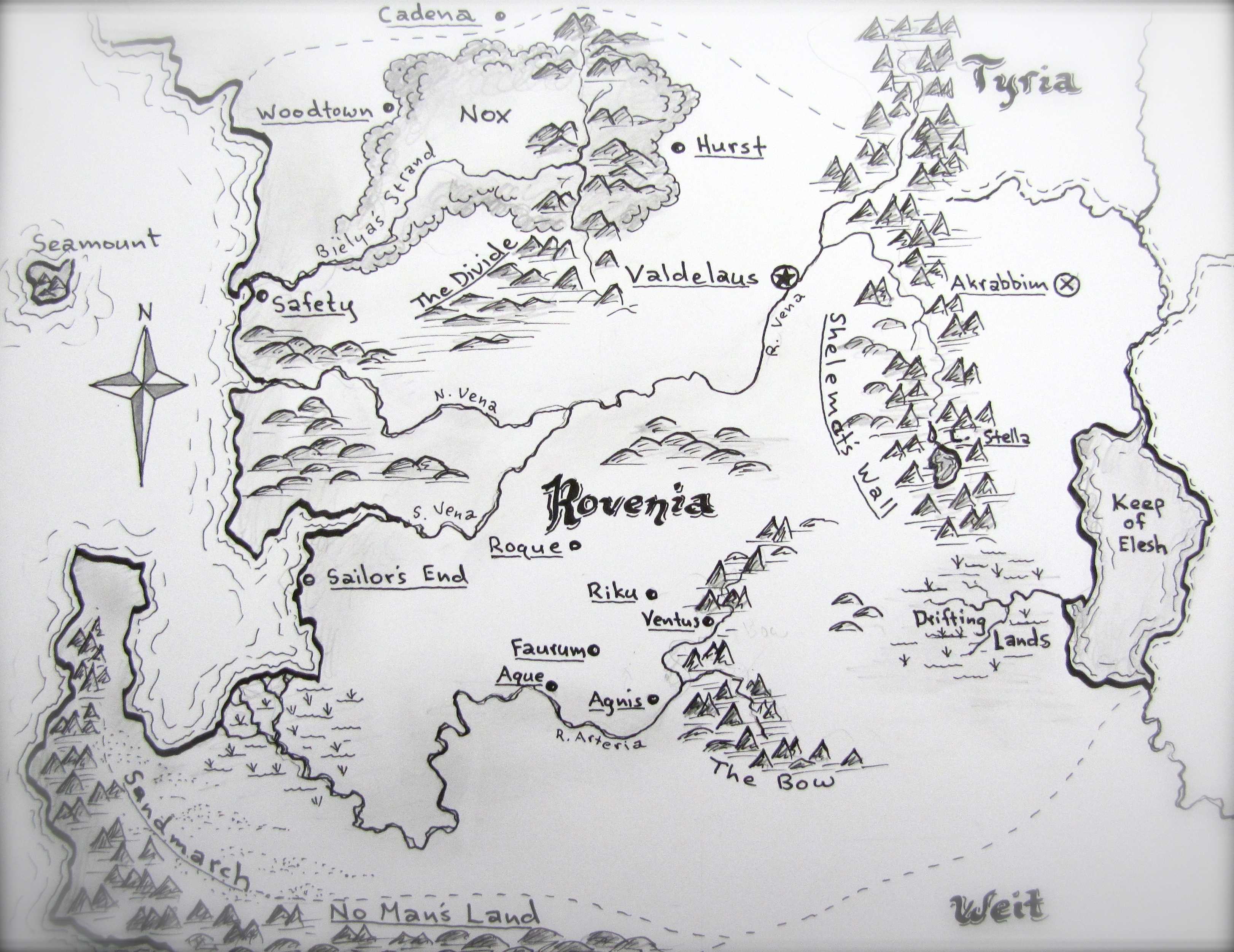
Consider drawing a map

Tolkien was a master of setting, which is why I’m using his work to illustrate so many of my points. (I’m also using him as an example because he is awesome.) I once read somewhere that Tolkien offered this advice to writers: When creating a story, draw a map. It doesn’t have to be an artistic masterpiece. Readers may never see them, yet maps are invaluable because they help writers keep track of details.

For my novel, The Trials of Lance Eliot, I sketched a rough map, which my old man recently transformed into this work of art:

I hope the map will intrigue readers and allow them to visualize the country described in the novel. In the end, however, I created this map for my own benefit. It was important for me to know how long it would take a person to travel between certain locations, and essential to know the relation of towns and landmarks to each other.

Convey more than visual details

When you step onto a farm, what are your first impressions? Yes, you might notice the red barns or the silos glinting in the sunshine, but the first things you notice are probably the smells: fresh earth, manure, grain, wood smoke or other scents. When writers describe scenes using only visual details, they’re giving a picture. However, when writers use all five senses, they’re conveying more than a picture—they’re conveying an experience.

Give impressions, not descriptions

There are writers (like Tolkien) whose long descriptions are interesting enough to be worth reading, but in most cases fewer details are best. In describing a scene, choose the most important and striking details. (The same principle applies to describing characters.) Your reader usually needs impressions, not exhaustive descriptions. Give your readers the significant details, and their imaginations will fill in the blanks.

The analogy is a little clichéd, but if writing a story is like building a house, the setting is the foundation. In a way, every other element of the story depends on it.

Do you have any advice for creating settings for stories? Let us know in the comments!

82. About Writing: Rhythm

Before I share my thoughts about rhythm, here are a few words from Phineas Flynn and Ferb Fletcher. (They’re mostly from Phineas. Ferb doesn’t talk much.)

All right, it’s important to have a sense of rhythm. But what does that mean for writers?

It’s a mistake to use the same kinds of sentences. A paragraph full of identical sentence structures is boring. Sentences should be varied. Sentences should not become monotonous. That kind of writing sounds boring and choppy. That kind of writing is worse if consecutive sentences begin or end with the same words because it sounds boring and choppy.

That last paragraph was, as one of my brothers would say, an abomination. It committed pretty much all the transgressions against which it warned. The structures of its sentences were similar, and it repeated certain phrases. It sounded—forgive the repetition—boring and choppy.

It’s easy to use the same sentence structures over and over. In fact, I do it all the time without realizing it. Writers need to vary the rhythm of their writing, and deliberately use different kinds of sentences.

I won’t go into the technical details of dependent and independent clauses, compound sentences, complex sentences or any of those other ghastly things.

Let us instead learn by doing. Here’s a lousy paragraph, one that ain’t got rhythm.

Uproariously, the typewriter monkeys chattered as Adam dictated a blog post to them. He told them to listen, but they wouldn’t. He shouted, but they only yanked the ribbons out of their typewriters. Clutching his head, Adam went into the kitchen to make tea. Unhappily, he returned and surveyed the devastation.

We have two basic sentence structures repeated in this paragraph: Adverb or adverbial phrase, blah blah blah and Blah blah blah, but blah blah blah.

(A real professional would use proper grammatical terms to describe these sentence structures, but I ain’t real professional.)

Let us rewrite the paragraph with a little more rhythm.

The typewriter monkeys chattered uproariously as Adam dictated a blog post to them. Although he told them to listen, they wouldn’t. He shouted, but they only yanked the ribbons out of their typewriters. Adam went into the kitchen to make some tea, clutching his head, and returned to survey the devastation unhappily.

Behold! With a few words changed and a few phrases shifted around, the paragraph has gone from being monotonous to readable.

Rhythm is important, and syntax—the order in which words are arranged—matters. (Syntax is not a tax extorted from sinners, to quote one of my high school teachers.) Writing that ain’t got rhythm isn’t nearly as powerful as writing that has it.

80. About Writing: Brevity

Shakespeare once wrote, “Brevity is the soul of wit.”

For those of us who don’t speak Shakespearean, what he meant was, “Good writing is brief.” The mark of a good writer is to express something clearly in as few words as possible. Too many words burden a piece of writing.

I didn’t really understand this until I began working on The Infinity Manuscript. Each part of the story, I decided, must not exceed two thousand words. This gave me only two thousand words in each part of the story to set the scene, introduce new characters, develop existing characters and progress the plot, and to do all these things in a way that didn’t feel rushed.

I’ve exceeded the two-thousand-word limit in the first draft of almost every part of the story so far, sometimes by as much as one or two hundred words. It was discouraging at first. However, when I went back and removed whatever dialogue and descriptions weren’t absolutely necessary, I realized the story was actually improved by these omissions. No longer slowed by unnecessary descriptions and wandering dialogue, the story moved along at a quicker pace.

When I began writing long ago, I believed more was better. Long descriptions gave readers a more vivid impression of each scene, and abundant dialogue helped establish characters more clearly, or so I thought.

The problem is that rambling dialogues and longwinded descriptions tend to be vague and pointless.

Anton Chekhov stated that if a gun is hung on the wall of a stage during a play, it should be fired by the end of the final act. In other words, the stage shouldn’t be cluttered with unnecessary props. Every prop should contribute something to the play.

In the same way, every element of a story should have a purpose. Every dialogue and description should develop the characters, explore the setting, move the plot or contribute to the story in some other way. If an element of the story has no purpose, it should probably be cut.

Smaller cuts can often be made as well. Adjectives and adverbs should be used sparingly. Descriptive words lose their impact if they’re used too often.

Take a wordy sentence: “Adam paused suddenly in the middle of a wordy paragraph to sip thoughtfully from a steaming cup of jasmine tea and gaze reflectively out the large window at the green trees swaying ponderously in the strong breeze.”

Awful, right? Let’s cut out those awkward descriptive words: “Adam paused in the middle of a paragraph to sip from a cup of tea and gaze out the window at the trees swaying in the breeze.” The shortened sentence conveys pretty much the same scene without all those cumbersome adverbs and adjectives.

I conclude with a story.

While dining with several other writers, Earnest Hemingway, an author whose brevity is legendary, bet them he could write a compelling story in only six words. They accepted his bet. Hemingway took out a pen and wrote the following words on a napkin.

“For sale. Baby shoes. Never worn.”

He won the bet.

79. Working on the Novel

I had planned the post the next part of The Infinity Manuscript today, but I’ve been too busy to work on it. I apologize for the delay.

One of the reasons I didn’t finish the next part of The Infinity Manuscript is that I’ve been working on my novel, The Trials of Lance Eliot, as it moves slowly toward publication. Since I wasn’t able to update the serial today, I decided to share some concept art my artist and I came up with for the cover of my novel.

'Trials' Polished Concept Art

The artist who sketched this concept art is none other than my old man, whose portrait of my typewriter monkeys graces the homepage of this blog. Materials used for this concept art include printer paper, permanent markers, mechanical pencils and several cups of tea.

The picture depicts a scene from The Trials of Lance Eliot, which is the first novel of a trilogy titled The Eliot Papers. I’ve chosen to publish the novel under the name of M.L. Brown; it will, I hope, be released sometime this year.

Now I’d better get back to work!

74. Guest Posts Welcome!

Update: This blog is finished, and no longer accepts guest posts. Thanks all the same!

John Donne once observed, “No blog is an island.”

I may possibly be misquoting him, but the basic principle is the same. Few people can survive apart from other people. Few blogs can exist independently from other blogs. Like most people, most blogs are part of a community.

I’d never have begun TMTF without inspiration from bloggers like Jon Acuff and Wes Molebash. Community can be extremely important for writers; bloggers are no exception. As I’ve said before, just because writing can be a lonely form of art doesn’t mean it should be.

I’d love to feature guest posts more regularly on TMTF. Quoth Uncle Iroh, “It is important to draw wisdom from many different places. If you take it from only one place, it becomes rigid and stale.”

TMTF has already featured great guest posts on creativity, literary dialogue and the things we find when we clean out our Bibles. I would be delighted to present guest posts on other humorous, useful or unusual topics.

What criteria are needed for a guest post to be featured on TMTF?

It should be about faith, writing, video games, literature, TV, movies, or meaningful personal experiences.

Possible topics for guest posts include creative writing tips, spiritual insights, literary musings or humorous observations about gaming culture. Posts about celebrity hairstyles, trigonometry or rubber bands will be instantly rejected.

It should be well-written.

Guest posts should be coherent, succinct and easy to read. Between four hundred to eight hundred words is the ideal length. Grammatical errors and spelling mistakes shall be met with the full fury of my righteous indignation.

It should be funny, insightful or both.

I try to make every post on TMTF entertaining or edifying. I don’t always succeed. That makes it even more important for guest posts to succeed where I fail!

It should be pleasant.

TMTF is not an edgy or controversial blog, and there are already enough disputes, arguments and insults on the Internet without adding more. The purpose of this blog is “to impart hope or understanding or inspiration—or at the very least a healthy laugh—to someone who needs it.” Guest posts should honor that purpose.

If a guest post meets the above criteria, TMTF will be honored to feature it.

How can guest posts be submitted?

Behold! TMTF now has a Contact page! If you’re interested in submitting a guest post, simply use the contact form.

I may not accept every single submission. Some guest posts, however well-written, may not be well-suited for TMTF. In some cases I’ll suggest changes to guest posts to make them more suitable. In all cases I’ll do my best to be respectful of the work submitted.

I’m going to be guilty of shameless self-promotion and admit my typewriter monkeys and I are always delighted to write guest posts for other blogs. If you’re looking for a guest post about faith, writing, video games, literature, life, the universe or everything, let us know using the Contact page!

68. About Writing: Attitude

There was once a young man whom I’ll call Socrates.

(For the record, this was not the same Socrates as the one who pretended to tear out my heart or the one who gave me an RNA or the one who invented the Socratic method. This is a different Socrates.)

Socrates was a creative writer. A couple of years ago, we had a discussion about our writing projects. It turned out that we had both written fantasy novels and were in the process of revising our work. When Socrates heard about my novel, he offered to read it and offer feedback. I accepted his offer gratefully and gave him a manuscript of my novel.

A few days later, he handed me the manuscript of his novel and told me he was looking forward to hearing my criticism. This came as a surprise to me. I didn’t mind criticizing his novel, but he hadn’t asked for criticism and I hadn’t offered it. He simply gave me the manuscript and expected feedback.

It occurred to me that Socrates might have offered to read my novel only for the sake of obligating me to read his.

Nevertheless, I believed creative writers should stick together. If another creative writer wanted my criticism, I was happy to give it. Thus I plunged into the novel Socrates had written, marking his manuscript with mechanical pencil and thinking about what feedback to give him.

It was not a good novel. The novel had its strengths, of course, but it also had many weaknesses. The most glaring of these were myriad misspellings and grammar mistakes: the sort of errors a spellcheck program wouldn’t catch. Apart from typographical errors, the novel had a number of significant problems.

When criticizing a piece of writing, I believe it’s important to be honest and kind. Honesty can be carried to the extreme of disparagement. Kindness can be carried to the extreme of flattery. Neither disparagement nor flattery are helpful to a writer. As I read the manuscript of the novel, I tried to think of criticisms that would be helpful to Socrates.

I finished the manuscript and sent Socrates an email in which I commended the novel’s strengths, pointed out a few of its faults and suggested changes that could be made.

Socrates replied with an email in which he thanked me for my feedback, responded offhandedly to a few of my criticisms and promised to return the favor by giving me feedback on my novel. (He never did.) Regarding his own novel, he mentioned his intention to “go and work on it once more before I try to find a publisher.”

To be honest, I was left with rather a poor impression of Socrates as a creative writer. The mediocre quality of his writing had little to do with it. When I began writing, the quality of my writing was unspeakably awful. Every writer has to start somewhere, and that somewhere is usually pretty bad. As Jon Acuff once observed, the road to awesome always leads through the land of horrible.

No, my poor impression of Socrates came from his attitude toward writing. In our exchanges, I noticed several problems with his attitude—problems that are common among writers—problems of which I myself have often been guilty.

Writers shouldn’t use other people

It’s extremely important for writers to seek help from others. There is a difference, however, between seeking help from someone and using someone. In my exchanges with Socrates, it seemed that he offered to read my manuscript only to manipulate me into reading his. Writers should never consider other people mere tools or resources. The writer who criticizes my manuscript isn’t a feedback machine. The readers who follow my blog aren’t a statistic. These people are human beings with feelings and opinions and gifts. Treating them as mere tools or resources is wrong.

Writers should respect their readers enough to give them their best work

It’s not a huge deal, but I prefer not to read a manuscript full of typographical errors. I would have enjoyed the manuscript Socrates gave me much more had he taken the time to make sure it was at least written correctly.

Writers should be willing to accept criticism, especially when they ask for it

I received the impression from Socrates that he didn’t really care much for my criticism. I wouldn’t have minded much, except for two things. First, I had taken a lot of time to read his novel and give the best feedback I could. Second, he had asked specifically for my criticism. To ask for it, and then not to accept any of it, seemed a little rude. Writers shouldn’t blindly accept every bit of criticism they receive, but they should at least consider it—especially when they’ve asked for it.

Writers should help each other

Socrates offered to read my novel and give feedback, but he never did. Granted, he may have forgotten or been too busy, but our exchanges seemed unfairly one-sided. If writers accept help from others, they should also be willing to give help.

Writers should be realistic

When Socrates informed me that his plan for his manuscript was to “go and work on it once more before I try to find a publisher,” I had to shake my head. Even if his manuscript weren’t full of typographical errors, he would have had to revise it at least a few more times before it was even close to being presentable to publishers. Then he would have to begin the arduous process of finding a publisher: research the market, find an agent, write a novel proposal, find a publisher, sign a contract, submit the manuscript for editing, make necessary revisions, format the manuscript, promote the novel and so on. Writers mustn’t be daunted or discouraged by the difficulties of publishing, but they mustn’t be unrealistic either.

If it seems like I’m being pretty harsh toward Socrates and his attitude toward writing, I need to point out that I’ve made all of his mistakes myself. I’ve used people. I’ve given other people less than my best writing, been unwilling to accept good criticism and refused to help other writers. As for being unrealistic, I’ve been ridiculously naïve about the quality of my writing and the difficulty of publishing.

Here are two more mistakes I’ve made.

Writers shouldn’t assume their writing is awesome

Writers have a tendency to fall in love with their own writing because it’s exactly the kind of thing they enjoy reading. I like wry, thoughtful writing. I also like fantasy fiction. My novel happens to be a wry, thoughtful fantasy. It’s the sort of novel I would enjoy reading—but it may not be the sort of novel everyone else in the world would enjoy reading. Writers need to follow the Apostle Paul’s good advice: “Do not think of yourself more highly than you ought, but rather think of yourself with sober judgment.”

Writers shouldn’t assume their writing is awful

Writers also have a tendency to give up because they assume their writing is bad. Sometimes it is, and they need to keep practicing. Sometimes it isn’t, and they need to keep writing well. It’s difficult for writers to assess the quality of their own writing, which is why seeking help from others is so important.

It’s essential for writers to have the right attitude: to persevere, to be humble, to be willing to seek help, to be willing to give help and so on.

Have you struggled with any of these attitude problems? How do you deal with them? Let us know in the comments!

62. About Writing: Dialogue

Today’s post was written by Amy Green, blogger and author of young adult fiction. For more thoughts on writing, faith and fiction, check out her blog!

If you want the safe version of this post, here are three simple tips to writing better dialogue: listen to others, know your characters well, and ask others for help with editing. You can stop right there. Go ahead. I won’t be offended. Really.

If you’re still reading, let me tell you something: there’s a problem with those three simple tips.

They’re not simple. And they probably won’t work.

How do I know? Because I am a selfish person, and I recently realized that the biggest obstacle to writing good dialogue is selfishness. Before you stone me with copies of Christian Writer’s Market Guide, here are the reasons why I came to this conclusion.

Selfishness keeps us from listening

I have a cartoon taped to my desk where a boy is going on a rant about how most people just “wait to talk” instead of actually listening. “You know you’ve met someone special if they can respond to what you’ve said without launching into something unrelated about themselves,” he says.

Ouch. Do you know how humiliating it is to be called out on selfishness by a one-inch tall line drawing?

Most of the time, I don’t really listen to what people are saying. I just hijack the conversation to get it to what I want to talk about. That makes me selfish, obviously, but it also makes me a bad writer, because unless I learn to listen to what others say—really listen—I won’t be able to write what others say.

Selfishness makes people into props

I have this really bad habit of using people as objects in my life. Like in the section above, they can be springboards to topics of conversations I’m interested in, or I can use them to make me feel good about myself (sometimes by showing off my excellent sense of humor at their expense).

This carries over to my writing, too. I occasionally dump characters haphazardly into a scene simply because my protagonist needs them for something. Or I start a story with an antagonist who I know as much about as a person I looked up on Facebook.

Then I wonder why my dialogue sounds unnatural or repetitive.

To sound convincing, characters have to be made from fragments of reality—quirks, passions, irrational fears, and annoying habits that make other people want to punch them sometimes. Writing them as people instead of props is what makes the dialogue come alive, and it’s hard for me to do that if, in real life, my relationships with others are two-dimensional or all about me.

Selfishness refuses to ask for help

I don’t like asking for feedback on my dialogue, partly because I think I can do it on my own, and partly because I’m secretly afraid the other person will laugh at me.

If I have a male narrator, I should probably ask a guy if I’m getting it right. If I’m writing about a five-year-old boy, I should go to a mom with small kids to get help with his lines. But I’m too afraid, because what if I got it wrong and they laugh at me and quote the worst part on their Facebook status and everyone comments about how awful it is and they happen to be friends with an editor who blacklists me from every publisher in the country….

So, I clearly have an overactive imagination. The point is, if I don’t know what’s wrong, I can’t fix it. I have to be willing to put away my rugged individualism and fear of failure and get a different perspective on what I write.

I still struggle with all three of these. But I’m working on it. And, hey, even the process of writing this post was humbling. Which means I’m getting better at dialogue while writing a post on getting better at dialogue. Top that!

Oh. That was a little arrogant and selfish, wasn’t it?

Oops.