273. TMTF Reviews: Resident Evil 4

I don’t like zombies.

Zombies are hideous creatures. They smell terrible. Worst of all, they’ve become one of the most tired clichés in pop culture. Like vampires, zombies are freaking everywhere. In the past two years, we’ve had The Walking DeadWorld War ZWarm Bodies and an endless slew of novels and video games featuring these lifeless imbeciles.

To put it simply: Zombies have been done to death. (Pun intended. I’m so, so sorry.) I’m tired of zombies. Heck, I never liked them in the first place.

That said, why on earth did I play a Resident Evil game?

Fortunately, Resident Evil 4 doesn’t have zombies. Well, maybe fortunately isn’t the right word. RE4 replaces shambling zombies with murderous peasants, and they’re pretty scary.

Ganados

Just your average Black Friday shoppers.

Nearly a decade ago, a friend in Ecuador recommended RE4. “It’s excellent!” he said, or words to that effect. When I told him I wasn’t a zombie enthusiast, he said something like, “The enemies aren’t actually zombies. And they shout at you in Spanish! How great is that?”

I’d heard of the Resident Evil games, which consist mostly of players shooting zombies with guns. Not only do I dislike zombies, but (contrary to the impression I’ve probably given in my past few reviews) I don’t care much for guns. Games with swords and magic, or no violence at all, are more my cup of tea.

For eight or nine years, however, praise for this game kept popping up. Nintendo Power (may it rest in peace!) named it one of the best games of all time. Everyone hailed RE4 as an enduring classic. It became a milestone in the game industry, influencing several major video game series being developed today.

At last, I submitted to the inevitable and got my hands on the game. It was time to see what the fuss was about, and also to be shouted at in Spanish.

Is this bloodstained game truly the masterpiece everyone claims it to be?
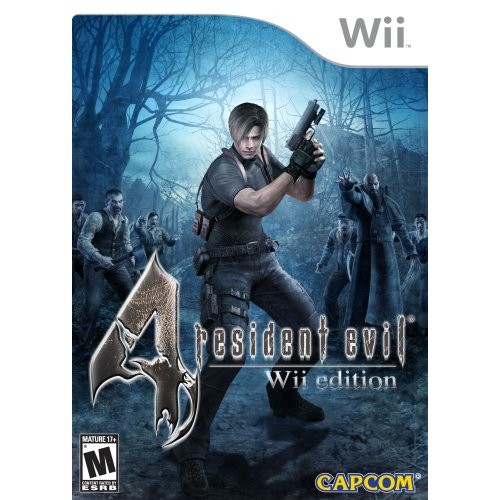
Resident Evil 4

It isn’t perfect, and it certainly ain’t pretty, but Resident Evil 4 is a remarkably good game.

RE4 begins with Leon S. Kennedy, a US secret service agent, dispatched to a remote village in rural Europe. The president’s daughter, Ashley Graham, has been kidnapped. Leon’s job is to get her back. Unfortunately for him, quite a lot stands between Leon and Ashley: crazed cultists, mutant abominations, scheming criminals and (of course) guys with masks and chainsaws.

The not-zombies of RE4 are called ganados. (That’s Spanish for livestock, by the way: a clever touch.) These peasants have gone murderously insane, and they’re actually pretty scary. I dislike zombies, but at least zombies move slowly. Ganados often run, brandishing axes and pitchforks, shouting threats in Spanish. (This may be scarier for those who don’t know Spanish; I found it funny when ganados sneaking up on me yelled things like, “Behind you, idiot!”) The madness of the ganados is eventually explained, but it remains unnerving to be constantly surrounded by crazed murderers. They look pretty normal, which makes their obsessive violence that much scarier.

The environments of RE4 are fantastically creepy: abandoned buildings, dying forests, unquiet crypts. The player is left with a frightening sense of isolation. There is no backup. There are only more ganados, with an occasional monster for variety.

This isn’t exactly a criticism, but I must point out the odd tonal shifts of the game’s environments. It starts in a dreary village surrounded by gray woods; the outdoorsy setting gave me Snake Eater flashbacks. Then the action shifted to a castle packed with puzzles, lava pits and suits of armor. It was like a level from a Legend of Zelda game. Then the game went all Metal Gear again with a high-tech military installation. These levels were creepy and well-designed, but they felt disconnected. I felt like a single character straying into two or three separate video games.

The core gameplay is superb. Shooting is simple with a useful (and apparently groundbreaking) over-the-shoulder perspective that allows for great precision. (I played the Wii version of the game, which allowed for convenient point-and-shoot motion controls.) Weapons can be upgraded, and items can be combined to increase their value or effectiveness. Treasures can be found and sold. Managing the inventory—usually a tedious chore—is a pleasant challenge, with players fitting items into a briefcase like blocks in a game of Tetris. Even a long-running escort quest, which I expected to be an excruciating nuisance, turned out to be kind of fun.

Best of all, Leon can suplex ganados. It isn’t as impressive as, say, suplexing a train, but it’s still pretty darn cool.

Then there’s the merchant. Oh, the merchant.
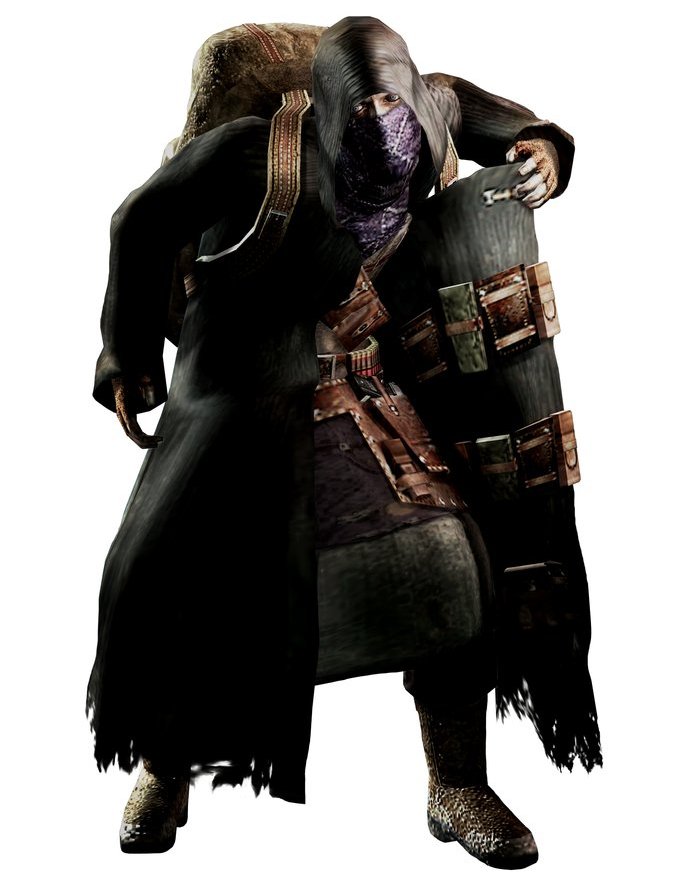
RE4 Merchant

“Whaddaya buyin’?”

This ubiquitous salesman shows up the most unlikely places, apparently unperturbed by the roaming hordes of homicidal ganados, and sells the player guns. I found his frequent appearances and exaggerated cockney accent hilarious. Every time I stumbled upon one of his strange little shops, I wanted to hug him.

In the end, I have only two major criticisms of the game.

First, there isn’t much story. What little plot makes it into the game is communicated by hammy action-movie dialogue and badly-written notes scattered for the player to find. The gameplay and setting are superb, but the story is utterly cheesy. It would have been nice to have some serious dialogue to complement the game’s grim environments and gallons of gore.

Second, the game consists almost entirely of fetch quests, and most of them make no sense. There are nearly a dozen doors that Leon must open by retrieving some meaningless relic: an insignia, a pair of goblets, fragments of art and other rubbish. Much of the game consists of finding stuff to open stuff in order to find more stuff to open more stuff. The brilliant gameplay, clever puzzles and superb level design keep the fetch quests from getting stale, but I still felt like an errand boy by the end of the game.

A final note: In case you hadn’t noticed, this is not a game for young players. There is some cursing (mostly in Spanish) and lots of blood. It’s worth playing—but I recommend it only for older, tougher gamers. This ain’t a game for the kiddies.

I’m glad to have played Resident Evil 4. Now, if you’ll pardon me, I’m going to find that merchant and give him a hug.
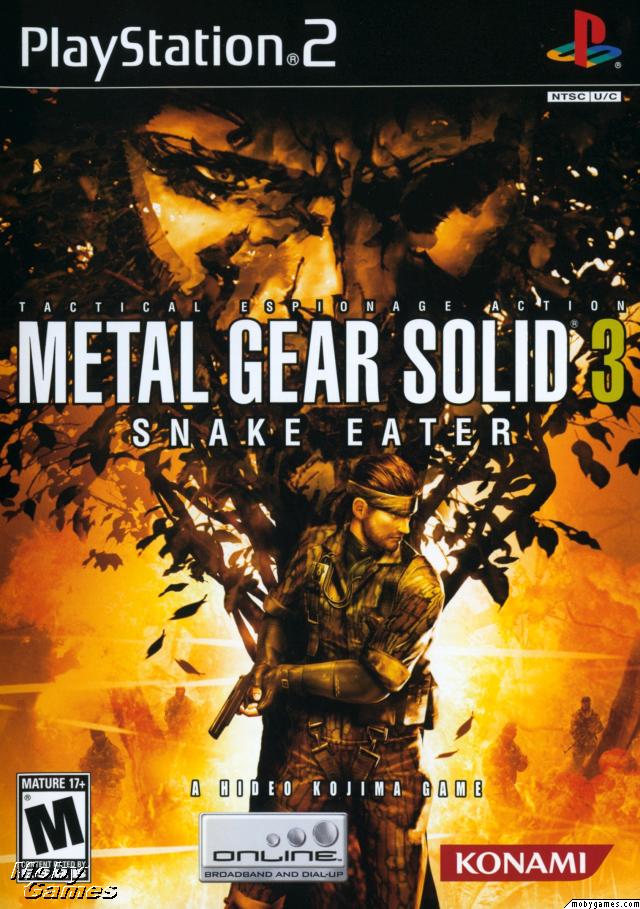
263. TMTF Reviews: Metal Gear Solid 3

The year is 1964. The Cold War, a state of political tension between the US and the Soviet Union, has pushed the world’s greatest military powers to the brink of nuclear warfare. All it will take to ignite a third World War is one wrong move.

When America’s most legendary soldier, The Boss, defects to the Soviet Union and hands over a nuclear weapon to a renegade Soviet colonel, things look pretty grim. The rogue colonel promptly nukes a Soviet installation, kidnaps a rocket scientist and develops an experimental tank known as the Shagohod. The USSR blames the US for these incidents, and World War III seems inevitable.

Then the Soviet Union gives America one chance to prove its innocence and avert nuclear war. A lone American operative must rescue the rocket scientist, destroy the Shagohod and kill The Boss. Only Naked Snake, The Boss’s tough-as-nails apprentice, can kill her and prevent nuclear catastrophe from consuming the world.

So, you know, no pressure.

Metal Gear Solid 3: Snake Eater is a prequel to Metal Gear Solid and Metal Gear Solid 2: Sons of Liberty, games I reviewed for this blog. It’s been fun, and it seems appropriate to end this blog’s run of Metal Gear reviews with the story that starts it all. (There are more Metal Gear games, but I’ll spare my readers further reviews.)

How does MGS3 stack up to its predecessors? Is it the same delightful mix of sneaking, shooting and hiding in cardboard boxes? Does its director, Hideo Kojima, give us the same storytelling problems, gameplay frustrations and pointless sexual objectification?

MGS3

It has its share of problems, yet Metal Gear Solid 3: Snake Eater is an exceptionally brilliant game.

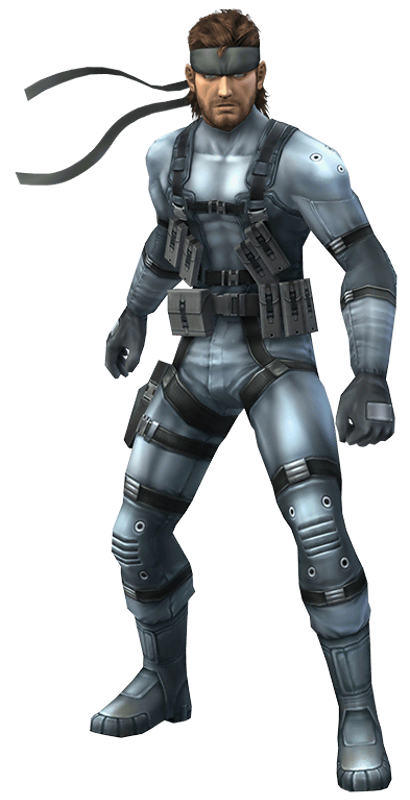
Naked Snake, forebear to Solid Snake from previous games in the series, is probably the toughest son of a gun I’ve seen in any video game—and speaking of guns, the game has its share of them. The older Snake uses the same weapons, equipment and moves as his successor… including hiding in cardboard boxes, those bastions of battlefield invisibility.

In a neat twist, MGS3 strips away many of the high-tech “luxuries” of previous games. There is no radar, for example, and silencers on guns wear out quickly. Naked Snake has to sneak around the old-fashioned way. Fortunately, he has a new trick—or an old one, technically speaking—up his sleeve: camouflage. Uniforms and face paints can be used to blend into environments.

This brings me to the next point of interest: MGS3 takes place mostly outdoors. Previous games took place in military bases and industrial plants. I was delighted to trade dreary hallways for swamps, jungles and mountains. It’s no longer enough for players to sneak around—they must survive.

To this end, MGS3 introduces two neat gameplay mechanics to the familiar Metal Gear formula of sneaking and shooting.

The first is a Stamina Gauge, which depletes slowly over time. Low Stamina prevents Snake from aiming steadily or recovering from injuries. He must scour his environments for food, eating everything from mushrooms to serpents. (The game is called Snake Eater. What did you expect?) Before you ask: Yes, Snake can feed on a tree frog.

The second clever gameplay twist is a Cure System. Players can no longer simply restore health—they must treat Snake’s individual injuries. Bullet wound? Dig out the bullet with a survival knife, disinfect the wound, stop the bleeding and put on a bandage. Severe burn? Apply ointment. Broken bone? Use a splint.

I loved the Stamina Gauge. It encouraged me to pay attention to my surroundings, searching for potential sources of food. The Cure System was a mixed bag. As much as I appreciated the (relative) realism of treating injuries over simply restoring health with items, it was a pain—especially during boss battles—to open up the Cure System screen repeatedly.

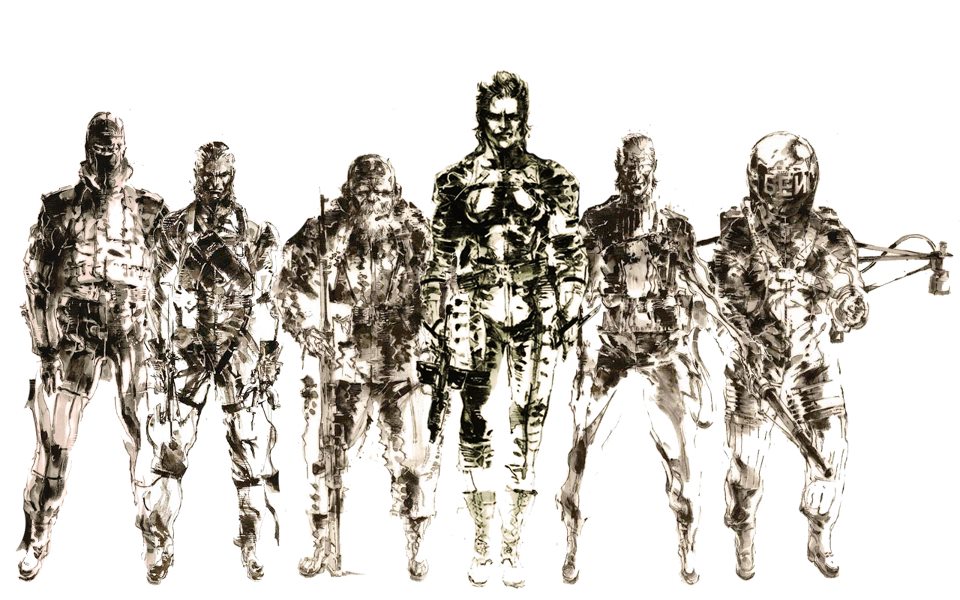
As for those boss battles, MGS3 has by far the best yet. Every Metal Gear game has its own band of memorable, supervillain-esque baddies. This game has the Cobra Unit, whose members are equal parts terrifying, ridiculous and that word I can’t use.

Cobra UnitEach battle is wonderfully different and totally absurd. Whether a deranged beekeeper was spitting bees at me or a Soviet cosmonaut was trying to burn me to ashes, I had a blast fighting the Cobras.

The best (and worst) battle was against The End: the old man with the sniper rifle in the picture above. It was probably the most creative boss fight I’ve ever experienced.

Most boss encounters are quick, spectacular and confined to small arenas. By contrast, The End disappears into a huge forest and attacks from great distances. There is no music, no obvious target and no clear strategy for winning. It’s a long game of hide-and-seek in which the player has only faint hints of where The End may be hiding: fading footprints, faint breathing, the glint from a rifle scope. It was frustrating to fight The End, but also totally unlike anything I’d ever played in a video game.

Previous Metal Gear games felt like futuristic Tom Clancy thrillers, packed with nanomachines and political conspiracies. MGS3 feels more like a classic James Bond movie, with larger-than-life villains, femme fatales and an oddly nostalgic atmosphere. I found the Cold War setting and numerous historical allusions fascinating.

MGS1 had a plot packed with twists and turns. MGS2 boasted a narrative that spun off in daring, postmodern and—dare I say?—incomprehensible directions. MGS3 outdoes both its predecessors. Its story is straightforward and occasionally laughable—equal parts James Bond films, Marvel comics and eighties action movies—yet ends with surprising poignancy. As a prequel to the Metal Gear series, it’s a fine place for players to start.

MGS3 certainly has its flaws. Like every other game by Hideo Kojima, the story gets unnecessarily complicated. There are objectionable elements such as drunkenness, skimpy outfits and mild vulgarity. The learning curve is steep. Oh, and in case you hadn’t guessed it, the game is kind of violent.

All the same, I enjoyed Metal Gear Solid 3: Snake Eater tremendously. It has enough history to be interesting, enough absurdity to be hilarious and enough good level design and brilliant gameplay to keep players engaged from beginning to end. MGS3 is a fine story and an even better game, so long as you have an appetite for snakes and tree frogs.

255. TMTF Reviews: Metal Gear Solid 2

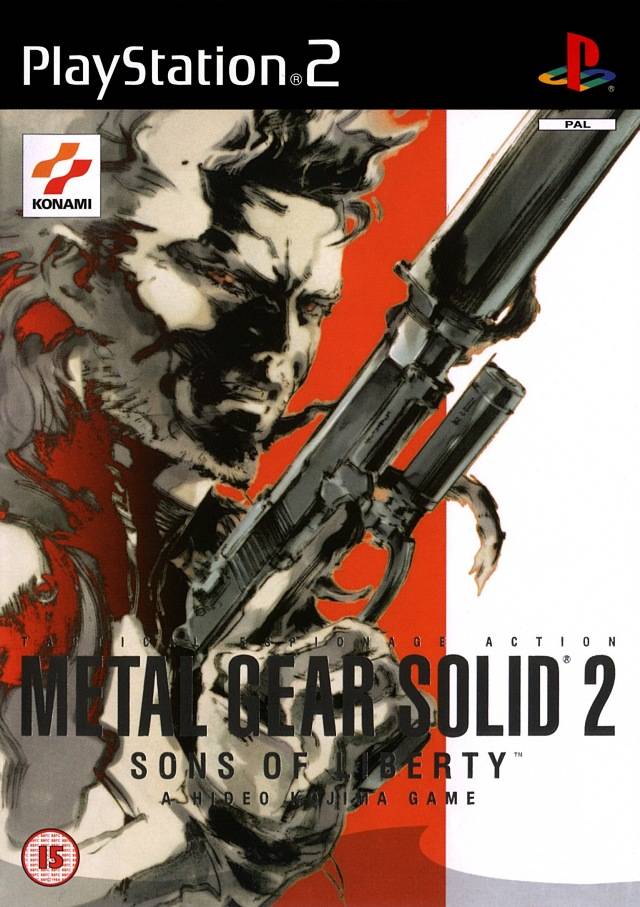
Not long ago, I played (and reviewedMetal Gear Solid, a game about war, loss, duty, giant robots and cardboard boxes. Now its chain-smoking hero, the stealth operative known as Solid Snake, is back for Metal Gear Solid 2: Sons of Liberty: a sequel packed with explosions, conspiracies, politics, over-the-top bad guys and—you guessed it!—stuff in which to hide.

Two years have passed since the Shadow Moses Incident, in which terrorists nearly got their devious hands on Metal Gear REX—a colossal armored vehicle equipped with nuclear warheads. Solid Snake stopped the terrorists, but the design for REX was leaked. Now military groups everywhere are building their own off brand Metal Gears. In response, Snake and his techie friend Otacon have founded Philanthropy, an organization devoted to stopping the proliferation of Metal Gear weapons. How does Snake achieve this goal? By sneaking around in a cardboard box, of course!

I enjoyed Metal Gear Solid so much that I was eager to dive into its sequel on the PlayStation 2. Is this game, like the first, an enjoyable experience of sneaking, shooting and fighting huge robots? Is this game an unplayable mess with an incoherent story? Is it a bit of both?

Metal Gear Solid 2This game is better than its predecessor. It’s also worse. As a game, it refines and polishes the gameplay of the original Metal Gear Solid and puts the player through some really creative challenges (and a few brief, regrettable sections of tedious gameplay). As a story, Metal Gear Solid 2: Sons of Liberty begins well but slowly loses track of itself and becomes a mess.

The first thing I’ll say about MGS2 is that a Major Plot Twist happens a couple of hours into the game. I won’t reveal it for two reasons. First, it’s an interesting turn for the story (and gameplay) to take; I don’t want to ruin it for anyone who might actually play the game. Second, I’m afraid that if I spoil the twist, the game’s director, Hideo Kojima, will sneak into my apartment and snap my neck while I’m sleeping.

Much of what I could say about this game I’ve said before. The player must sneak around, hiding in lockers, destroying security cameras, killing (or tranquilizing) enemy guards and avoiding detection at all costs. If the enemy finds the player, he is toast. Soldiers flood into the area with guns blazing during an alarm, leaving the player either to run and hide or to die with honor. The player’s chances of survival are helped by a arsenal of handy guns, gadgets and unconventional gear—including twice the number of cardboard boxes as in MGS1. Now you’re playing with power!

While the gameplay hasn’t changed much from MGS1, the game finds clever ways to use it. The first game gave players a pointless camera. This one requires players to take photos of a Metal Gear to expose its existence. MGS1 gave players a sniper rifle and hardly any open spaces in which to use it. MGS2 has an entire section in which the player must spot sensors rigged to bombs and shoot them out with the sniper rifle. Bravo, Kojima!

Not all of the gameplay twists in the game are positive, however. The player must explore flooded hallways, and swimming controls are horrendous. The player must also escort a cowardly hostage who is terrified of water, bugs and bullets. Guess what the player encounters? Flooded corridors, sea roaches and soldiers with guns. It is a truth universally acknowledged that escort missions are horrible. Why, Kojima? Why?

Then, in its final hours, the game gives the player a sword. Why? I don’t know. What I know is that the sword handles very differently from the guns and explosives the player has used for the entire game. Oh, and the player is forced to use this strange new weapon to defeat the game’s final boss. Bad idea, Kojima.

The story is a wonderful mixture of spy thriller cleverness and comic book nonsense. For every intelligent discussion of military tactics or nuclear proliferation, there’s a cyborg ninja or a bomber on roller skates. Sadly, the supervillain-esque bad guys of MGS2 are a bore compared to the ridiculous (and awesome) villains of MGS1.

Unfortunately, the story begins to unravel in its final chapters. MGS2 examines an astonishing number of complex ideas—social engineering, media censorship, virtual reality and existential angst, to name just a few—and they get muddled toward the end. Things begin to happen so quickly, with explosions and plot twists and colossal robots, that the player (at least, this player) is left asking, “What just happened?”

There are also moments that are simply odd. For example, the president of the United States grabs the player character’s crotch at one point in the game. It makes sense in context, but… still. Every time something bizarre happens in a Metal Gear game, my younger brother and I shake our heads philosophically and say, “Kojima wills it.” There can be no other explanation.

Anyone who enjoyed the strategic gameplay and engaging story of MGS1 will probably enjoy its sequel: the expanded gameplay and interesting plot more than make up for the tedious and confusing bits. Players new to the series will be perplexed by the story; I strongly recommend starting with the first Metal Gear Solid and taking it from there.

Will I play (and review) Metal Gear Solid 3: Snake Eater, the next game in the series? Yes. I must. Kojima wills it.

252. About Storytelling: Endearing Quirks

When I was in high school, I had a teacher named Mr. Quiring whose legendary silliness I have mentioned one or twice before on this blog.

For example, he once removed his necktie and unbuttoned his shirt during class to reveal a T-shirt emblazoned with the Batman logo. (He wasn’t really Batman, sadly.) At various times, Mr. Quiring pelted me with chocolate, brandished a meat cleaver and leaped off a chair shouting “To infinitives and beyond!”

The reason Mr. Quiring’s antics amused me so much is that he is not a silly person. Quite the contrary: Mr. Quiring is one of the most intelligent, dignified gentlemen I have ever known. It’s as though he compressed all the humor and silliness of ordinary people into short, intense bursts. Every time he did something outrageous, he reverted immediately afterward to his solemn self.

Mr. Quiring provides fine examples of endearing quirks: those funny little habits of real people or fictional characters that make us love them.

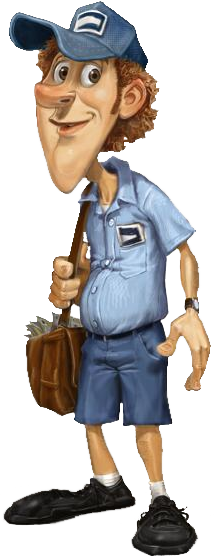
Some fictional characters are simply masses of endearing character quirks. Wooton Bassett, the mailman from Adventures in Odyssey, has too many odd habits to count: collecting fast food toys, expressing his feelings by the color of his slippers, baking jellybean casseroles and exiting his house via a slide. Wooton is fully capable of thoughtful introspection, but he’s mostly just hilarious.

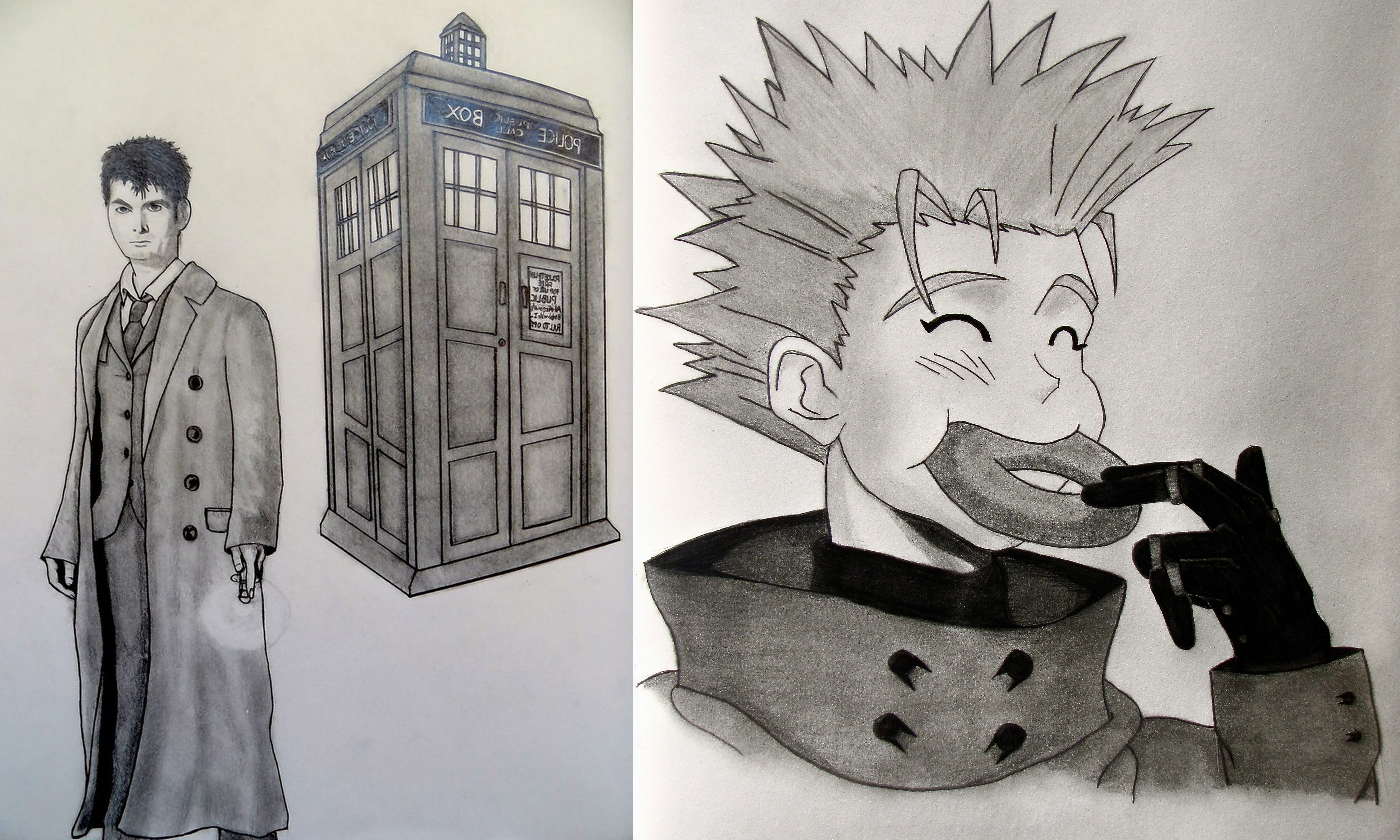
Wooton BassettSome characters are less silly, balancing funny quirks with tragic flaws or struggles. Consider the Doctor from Doctor Who and Vash the Stampede from Trigun. The Doctor is an intergalactic goofball, bouncing around the universe with a beaming face and a slew of witty remarks. Vash is a gunslinger who obsesses over doughnuts, whines like a child and walks into a firefight with a trashcan lid on his head.

My thanks to my younger bro for permission to use his artwork!

My thanks to my younger bro for permission to use his artwork!

Vash and the Doctor seem sillier than Wooton, but their quirks mask profound inner turmoil. The Doctor despises himself. His travels throughout space and time are not a careless vacation, but his way of running away from past mistakes. Vash also has a lot to hide. The body beneath the overcoat is covered in horrific scars, and the man behind the goofy grin is tormented by regret for the lives he couldn’t save.

In the case of Wooton, endearing quirks are a form of comedy. The quirks of Vash and the Doctor serve a different purpose. Their odd habits hide sad struggles, and make the viewer feel more when their stories take turns for the tragic. After all, it’s easier to feel sorry for funny characters than for serious ones.

Then there is Miles Edgeworth, the friendly rival of Phoenix Wright from the Ace Attorney series. Like Mr. Quiring, Edgeworth is dignified, composed and intelligent.

Miles Edgeworth

Edgeworth also has a secret.

This respected prosecutor is secretly a fan of Steel Samurai, a cheesy show for kids about a futuristic warrior and his neverending fight for justice. Edgeworth vehemently denies liking the show, of course… but there’s his inexplicable knowledge of Steel Samurai trivia and the Steel Samurai action figure in his office.

In the case of super-serious people like Mr. Edgeworth, a single quirk can make a cold, distant character seem a little more human. Liking Steel Samurai is a weakness, but not a sin. We can respect Edgeworth, and we can also laugh at him.

Carelessly loading a character with endearing quirks is a mistake: too many odd habits, or quirks that seem out of place, are irritating. Used intentionally, however, endearing quirks can develop great characters—and make us laugh!

242. TMTF Reviews: Metal Gear Solid

I seldom care for spy fiction, war stories or anything involving guns. Tales of modern warfare are uncomfortably familiar in this tragic age of child soldiers and terrorist attacks. Fantasies interest me more than thrillers, especially in video games. I prefer swords over grenades and AK-47s.

Every now and then, however, there comes a war story so fascinating that I can’t help but be interested. Metal Gear Solid is such a story.

It stars this guy.

Cardboard SnakeThis may not be the most flattering picture of our hero. Sorry. Let me try again. Metal Gear Solid stars this guy.

Solid SnakeSolid Snake is a retired operative with a cigarette addiction, a penchant for hiding in cardboard boxes and a gift for sneaking around unseen. His retirement comes to an abrupt end when the US government forcibly recruits him for a top-secret mission on Shadow Moses Island, a nuclear weapons disposal facility in Alaska’s Fox Archipelago. Terrorists have seized the facility. Oh, and did I mention Metal Gear—the colossal armored vehicle armed with nuclear warheads? Snake must rescue two hostages and prevent a nuclear strike… and get out alive, if possible.

I played the Nintendo GameCube version of the game, Metal Gear Solid: Twin Snakes. (The original game was released for the PlayStation.) My version apparently features better graphics and a few gameplay tweaks, but remains pretty much the same game.

I had a sneaking suspicion I’d like this game, so I decided to give it a try. Is Snake’s mission worth it, or should players keep off Shadow Moses Island?

MGS

For players with a lot of patience, Metal Gear Solid is an absolute gem. Players wanting a fast-paced, action-packed game should look elsewhere. This is not a game for people with short attention spans.

In the first place, Snake does a lot of sneaking. There are firearms in this game—heck, there are even grenades and rockets—but the player who runs around with guns blazing will die very quickly. Metal Gear Solid does not reward brute force. It requires finesse, perseverance and a willingness to hide in ventilation shafts until enemy soldiers give up looking and go away.

Fortunately, Snake has a lot of tools at his disposal. Some of these are what you’d expect from a spy thriller: a silenced pistol, for example, and a sniper rifle. However, some of his gear is a little less… conventional. Snake uses cigarette smoke to detect security lasers. A well-placed magazine distracts hostile guards long enough for him to sneak past them, and let’s not forget his ever-useful cardboard boxes!

Getting past a room full of watchful guards and security cameras is difficult, even with Snake’s arsenal of handy tools. Players will die a lot. All the same, Metal Gear Solid is a fair game. Progressing takes trial and error, but there’s great satisfaction in figuring out a safe route or foolproof strategy.

Snake has some additional help from teammates via his Codec, a covert communications system. Colonel Campbell, Snake’s commanding officer, gives useful directions and tactical advice. Mei Ling, a data analyst, saves Snake’s progress. (She also shares Chinese proverbs and quotations from Western literature.) Other characters offer sundry kinds of advice. When the player gets stuck—and sooner or later, he will get stuck—he can turn to his teammates for help.

These Codec conversations are not just useful, but amusing and interesting. The player gets to know several engaging characters by chatting with them over the Codec.

The game’s story is a weird and wonderful mix of gritty realism and superhero absurdity. Metal Gear Solid is like a cross between a Batman comic and a novel by Tom Clancy. The plot involves genetics, military history and international politics; the story is often believable and remarkably smart. On the other hand, Metal Gear Solid also includes a giant robot, a cyborg ninja and a band of villains with names like Revolver Ocelot and Psycho Mantis.

Speaking of Mr. Mantis, I must mention the game’s tendency to break the fourth wall in really clever ways. Psycho Mantis, a psychic, reads Snake’s mind—and then seems to read the player’s. “You seem to like The Legend of Zelda, don’t you?” he asked me when I played. (The game read the data on my GameCube’s memory card. All the same, it was impressive—and a bit freaky—to hear this fact from a “psychic” villain.) Psycho Mantis also instructs the player to put her controller on a flat surface so that he can demonstrate his “psychokinetic power,” and then causes the controller to move. (The GameCube controller has a built-in vibrator, but still!)

The game is actually a bit too clever for its own good. The fight with Mantis is unbeatable without using an odd trick, and a Codec frequency earlier in the game is inaccessible to players who don’t have the game’s original packaging. (I suppose this is why we have the Internet.)

Although players are encouraged to sneak instead of shooting, Metal Gear Solid is a violent game. People die. There is blood. The bad guys have no aversion to wanton slaughter. One villain specializes in torture. Other negative elements include Snake smoking like a coal train, a cowardly hostage wetting himself and one busty female character braving the frigid Alaskan weather in a skimpy jacket. This is a great game, but not one for kids.

Metal Gear Solid has its rough edges. The game has a steep difficulty curve. Cutscenes are ridiculously long. Voice acting is decent, except for one or two characters whose accents are laughably bad. There’s some tedious, Metroid-style backtracking through familiar areas. Finally, as I pointed out, the game requires a good deal of patience. There’s no rushing through this one.

On the whole, Metal Gear Solid is a fine game. Snake and his boxes will always be welcome in my home, so long as he doesn’t smoke any of those filthy cigs.

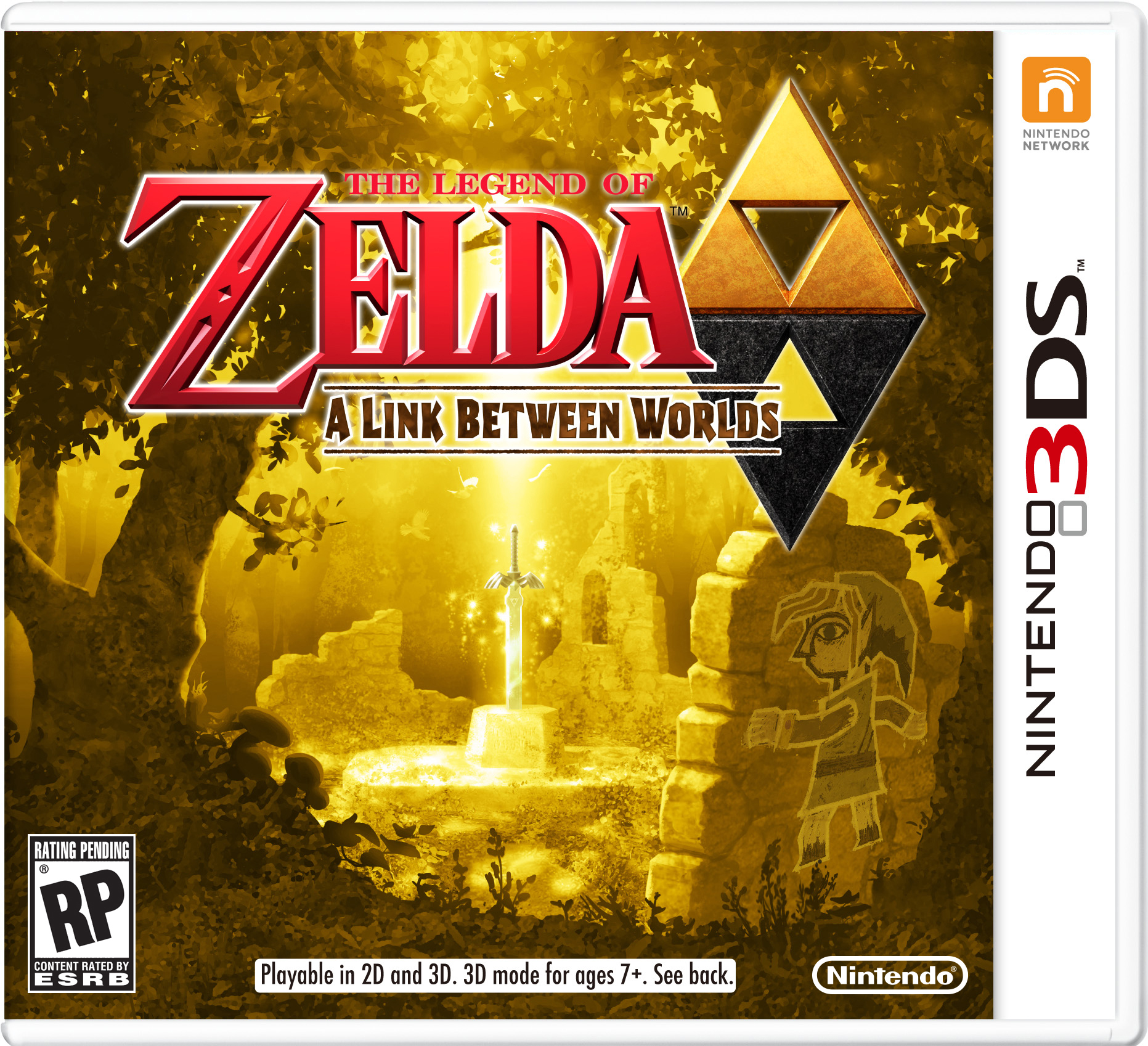
234. TMTF Reviews: The Legend of Zelda – A Link Between Worlds

This blog now reviews video games, because Zelda. I believe no further explanation is needed.

Well, I suppose a little explanation won’t hurt. The Legend of Zelda is a series of games by Nintendo in which a green-clad hero named Link explores the fantasy world of Hyrule: fighting monsters, solving puzzles, conquering dungeons and occasionally rescuing princesses. The Zelda series, which spans over twenty-five years and more than a dozen games, is possibly the most critically-acclaimed in the video game industry. Zelda games are generally classics at worst, and masterpieces at best.

(Except for… those games. We don’t speak of them.)

The Legend of Zelda: A Link Between Worlds for the Nintendo 3DS is the first new Zelda game in a couple of years. As a devoted fan of Zelda games, I was… not very excited.

A Link Between Worlds is an indirect sequel to The Legend of Zelda: A Link to the Past, a game released for the Super Nintendo Entertainment System more than twenty years ago. Even though the game is an undisputed masterpiece, I didn’t enjoy A Link to the Past as much as, well, pretty much any other game in the Zelda series.

I expected A Link Between Worlds to cash in on the longstanding popularity of A Link to the Past. I didn’t like the new game’s art style. What concerned me most of all were the game’s two biggest innovations: a new gameplay mechanic that seemed like a lame gimmick, and a largely nonlinear structure.

In short, I expected not to be impressed by A Link Between Worlds. I knew it would be a good game—heck, it’s Zelda, and Zelda never disappoints—but my expectations were (relatively) low.

How wrong I was. How very, very wrong.

A Link Between Worlds

In all the best possible ways, The Legend of Zelda: A Link Between Worlds feels like a very old game. There are no overbearing tutorials (a problem in recent Zelda games); rather, the player learns by doing, which is much more fun than being told what to do. A Link Between Worlds, like the earliest Zelda games, also takes a minimalistic approach to story. As much as I love a complex plot and nuanced characters, I’ll be the first to admit the game’s narrative simplicity works in its favor.

The game’s production values—music, graphics and all that sort of thing—are top-notch. Advanced graphics have never been Nintendo’s strong suit, but the game’s visuals have a charming storybook quality to them. (They’re especially lovely when viewed in 3D.) As for the music, well, Zelda music has always been superb. This game is no exception.

The basic gameplay in A Link Between Worlds is typically effective Zelda stuff: walk, swing sword, raise shield, etc. This game adds the usual oddball assortment of weapons and tools—bombs, boomerangs, magic rods and so on—but with a twist: they are now rented and bought.

See, there’s this longstanding Zelda tradition of each dungeon containing a tool of some kind, along with puzzles that can only be solved with that tool. It’s kind of a lock-and-key dynamic.

This game throws that tradition out the window. Almost every weapon, tool and item can be rented or bought right from the start of the game. I was skeptical at first of such a system—and frankly, I missed the joy of discovering each dungeon’s new tool—but it worked pretty well.

Since most tools are available to the player from the beginning, dungeons no longer have to be completed in any particular order. The player, after a certain point in the game, is given a map marked with a bunch of red Xs and told, “Those are dungeons. Have fun!” Now, I don’t mind linearity in games. There’s satisfaction in completing linear objectives, and I find it almost reassuring to have a set path to follow. Having such freedom in A Link Between Worlds, however, was awesome. I could go anywhere. With two kingdoms to explore—one light, one dark—that’s a lot of freedom.

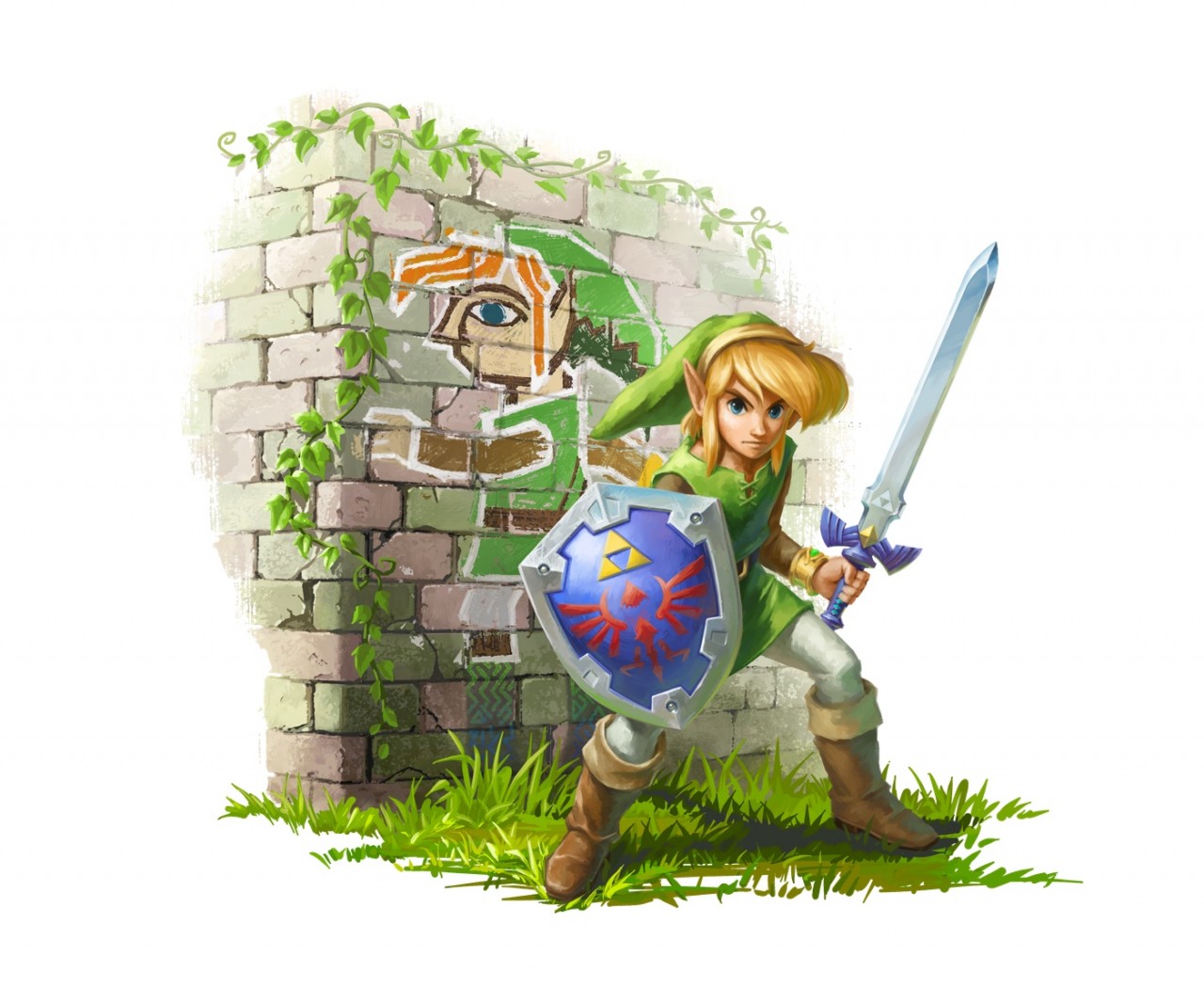
Heck, I could even switch dimensions. Players of A Link Between Worlds can merge into flat surfaces to become two-dimensional paintings.

Link with PaintingThis gimmick seemed really lame at first. Becoming a painting? Bah! Boring! Upon actually trying it, however, I realized this gameplay mechanic is brilliant. As painting, players can move around, pop in and out of walls and reach all kinds of unexpected places. Like the portals in the Portal games, this mechanic totally changed my perspective. It’s even used to switch universes; appropriately to the game’s title, it serves as a literal link between worlds.

The dungeons in A Link Between Worlds are, like all Zelda dungeons, excellent: packed with puzzles and monsters and treasures, with a boss (i.e. a uniquely challenging enemy) at the end.

This is not a game for players who hope simply to hack and slash their way to victory. No puzzle is painfully difficult, and there’s an unobtrusive hint system, but most players will do much more thinking than fighting.

And, of course, there’s the usual slew of minigames, side quests and stuff to collect. I should also mention how easy the map and item interfaces are to use; while buttons are used for most gameplay, the 3DS touchscreen is utilized for maps and menus.

Ironically, considering how low my expectations were at first for A Link Between Worlds, I can’t find much to complain about. The game seems just a bit short. I would have liked to have seen the setting and backstory fleshed out more, and the plot lacked the emotional oomph of other Zelda games. This game is one to be remembered for the gameplay, not the story or characters.

The Legend of Zelda: A Link Between Worlds is a great game—not merely a good game, but a truly great one. My only lasting regrets are that it’s over so soon, and I shall have to wait at least a couple of years for the next Zelda.

231. TMTF’s Top Ten Mad Scientists in Video Games

We’re all a little crazy.

Some of us, of course, are crazier than others. In video games, the craziest people generally fall into three categories: villains, mad scientists or both.

I find mad scientists particularly interesting. They abandon morality (and occasionally their own humanity) in their frenzied pursuit of knowledge or power. Like Adam and Eve snatching the forbidden fruit of Eden, these lunatics rebel against God and nature in the name of progress.

Mad scientists may not be good people, but they sure are good characters!

In listing ten remarkable mad scientists in video games, my usual rules apply: I won’t include characters from games I haven’t played (with one notable exception) and will include only one character per game series.

Let’s get crazy, ladies and gentlemen, as TMTF presents…

The TMTF List of Top Ten Mad Scientists in Video Games!

Be ye warned, here there be minor spoilers.

10. Andross (Star Fox series) Andross Andross was once a brilliant scientist, but experiments damaged his sanity and ruined his body. Although he doesn’t have much personality, Andross establishes himself as a notable villain by killing the father of the games’ protagonist and declaring himself emperor of the solar system. I also want to point out that Andross is apparently comfortable with sacrificing his body and becoming a disembodied head. That’s pretty crazy.

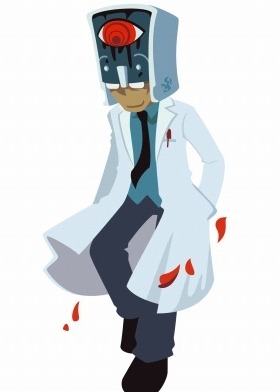
9. The Doctor (Cave Story) The Doctor (Cave Story) No, not that Doctor. This Doctor is actually a medical practitioner, albeit one with a terrifying lust for power and a violent disregard for the Hippocratic Oath. The Doctor is merciless, selfish and cruel. He also gets bonus points for using himself as a test subject and becoming a hideous mutant. Besides, I love that he carries around a pen. More villains need pens sticking out of their pockets.

8. E. Gadd (Super Mario Bros. series) E. Gadd Egad! This nutty little gentleman has the distinction of being pretty much the only good guy on this list. Professor Elvin Gadd is an inventor and paranormal researcher whose crowning achievement is a vacuum cleaner that sucks up ghosts. He’s cheerful, egotistical and blithely inconsiderate. He also sounds exactly like an Ewok from the Star Wars films. Coincidence? Yeah, probably. All the same, this pint-sized prof definitely has a few screws loose.

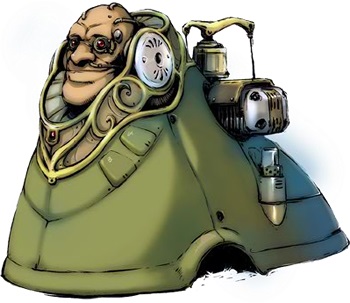
7. Fennel (Radiant Historia) Fennel Fennel is the head of a military research and development team. He’s also just a head. (There might be a body inside that slug-like machine, but I’m not sure.) Working for the warlike nation of Alistel, Fennel develops thaumatechnology: an arcane sort of machinery consisting mostly of weapons and other stuff that can kill you. He’s in love with his work, which takes place in a dim, ironclad labyrinth of underground chambers. Seriously, Fennel is kind of creepy.

6. Jean Descole (Professor Layton series) Jean Descole I haven’t actually played any of the games in which Jean Descole appears, but my brother insisted I put him on the list. (I’ll finish the Professor Layton series sooner or later.) Descole is cold, calm and cunning… except when he’s angry. Then he’s kind of scary. This archaeologist, master mechanic and self-proclaimed scientist manipulates others, shows no remorse and stops at nothing to achieve his goals. Don’t be fooled by that detached smile. Descole is not a sane man.

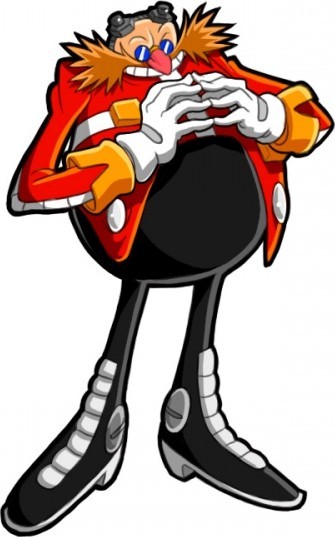
5. Doctor Eggman (Sonic the Hedgehog series) Doctor Eggman As his name and title suggest, Doctor Eggman is a doctor shaped like an egg. Despite being extremely intelligent, he is not particularly bright; his schemes for world domination are invariably foiled by either a hedgehog or his own incompetence. Eggman is short-tempered, egotistical and prone to bouts of maniacal laughter: defining characteristics of a mad scientist. Besides, dat stache.

4. Pamela’s Father (Legend of Zelda: Majora’s Mask) Pamela's Father This poor fool, who is never given a proper name, is so devoted to his study of supernatural phenomena that he moves to a desolate, haunted valley to study ghouls and ghosts… and takes his young daughter Pamela with him. When his research causes him to deteriorate into a monster, she traps him in the basement and bars the front door against the ghouls circling the house. Terrifying? Heck yes. Pamela and her father are eventually rescued and his humanity restored. Regardless, any scientist crazy enough to drag his daughter to an isolated wasteland to study monsters is, well, really crazy.

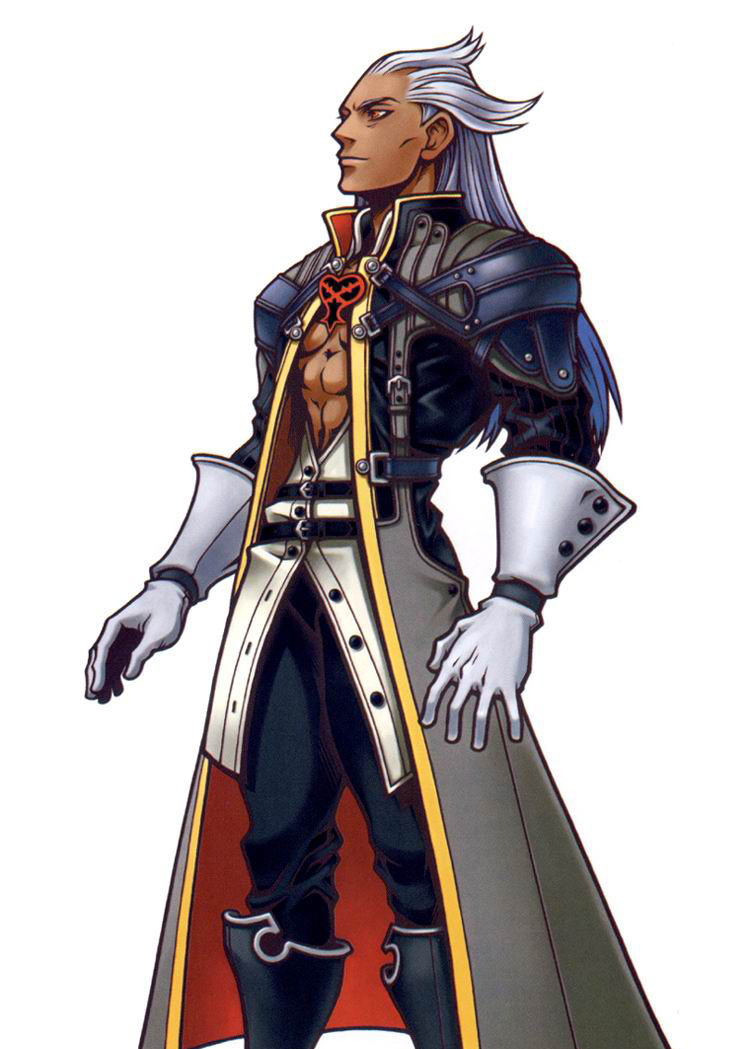
3. Ansem (Kingdom Hearts series) Ansem Without delving too deep into the convoluted lore of the Kingdom Hearts universe, I can confidently declare this man a lunatic. His research into the darkness of the human heart leads to the creation of Heartless, shadowy monsters that swarm across the universe to devour worlds. Ansem himself becomes a Heartless. Then—in the time-honored tradition of mad scientists—he tries to conquer everything. This tanned, stylish scientist gets extra points for inverting the stereotype of the pallid researcher in a lab coat.

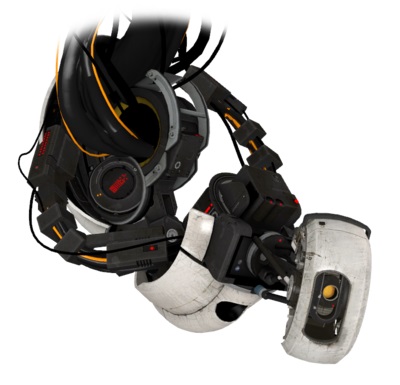
2. GLaDOS (Portal series) GLaDOSThis psychopathic artificial intelligence builds death traps and forces test subjects to solve them. Why? For science, of course! So what if her research methods kill a few people now and then? GLaDOS believes her experiments are worth the cost: “The science gets done and you make a neat gun for the people who are still alive!” I love how this AI becomes unhinged throughout the games, eventually stooping to ranting and petty insults. For complexity of character and degree of insanity, GLaDOS is wonderful.

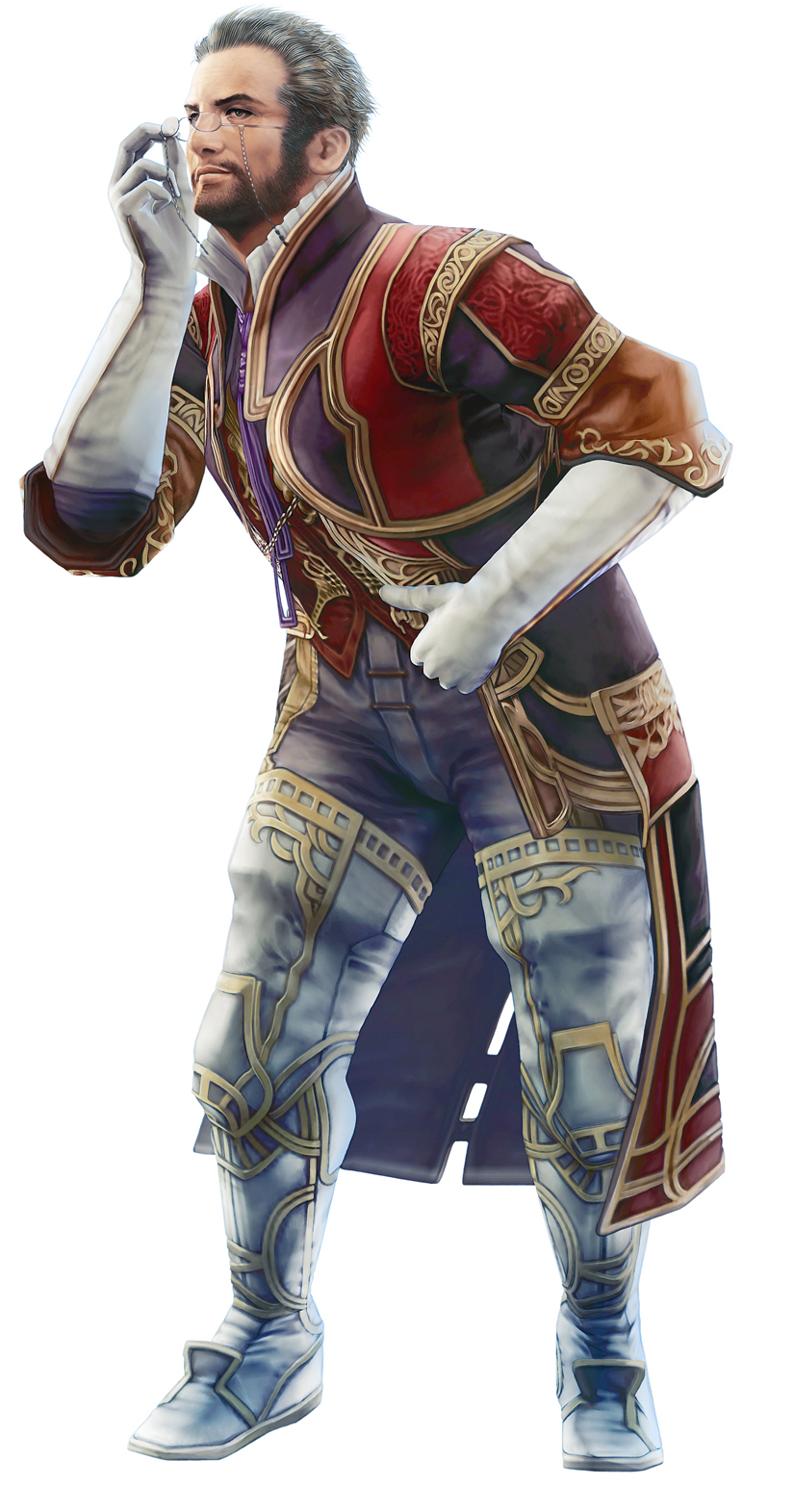
1. Cidolfus Demen Bunansa (Final Fantasy XII) Doctor Cid Cidolfus Demen Bunansa is one of the best video game characters I’ve ever seen: supercilious, brilliant, arrogant, foppish and seemingly insane. He treats tyrants with casual disrespect and talks aloud to an imaginary friend named Venat. I would call Cid a delusional lunatic, except for one minor detail—he’s actually sane. Cid is a rational man obsessed with defying the gods and putting “the reigns of history back in the hands of man,” abetted by the mysterious, invisible Venat. Of course, on his noble quest to liberate humankind, Cid doesn’t mind shedding a little innocent blood: this man ordered the obliteration of an entire city with the magical equivalent of an atomic bomb as a scientific experiment. Cid is fabulous, fascinating, evil, despicable, astonishing and awesome.

O people of the Internet, what video game mad scientists would you add to this list? Let us know in the comments!

224. More Thoughts on Girls in Video Games

Video games often do a lousy job of respecting women. I’m no feminist, but I do believe women should be treated with respect.

One of the major problems I see in video games is sexual objectification, the deplorable practice of making people mere objects to be ogled. People are people. Treating them as anything less is demeaning, yet women in video games are often reduced to little more than slim waists, big breasts and curvy figures.

What about characters who are merely attractive? We like our heroes and heroines to be beautiful, and I don’t think there’s anything wrong with that. Good looks are a good thing. When does a character cross the line? At what point does an attractive character become a sexual object?

After thinking about it, I hit upon a few basic principles.

Appearance: Does a character have a realistic appearance or exaggerated physical proportions?

Attire: Are a character’s clothes appropriate or inappropriate?

Character: Is a character given a genuine personality or merely a shallow persona?

Context: Does a character’s appearance make sense in context?

Let’s put these principles to the test and take a look at some video game girls.

Ashe (Final Fantasy XII)

Ashe

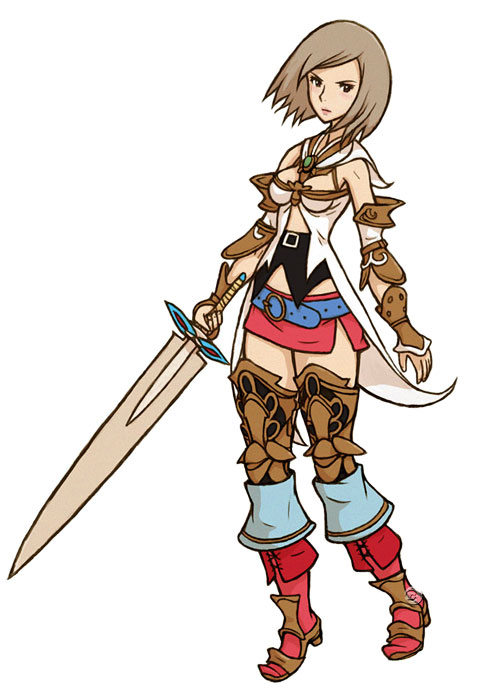
Despite wearing the shortest of all possible miniskirts, the princess of Dalmasca in Final Fantasy XII is definitely not a sexual object. Ashe is a driven, intelligent person who fights for her subjects and earns the respect of her companions. Even her less-than-modest clothes are standard for Dalmasca, a kingdom enveloped by arid deserts. Ashe’s outfit is, in a literal as well as a figurative sense, cool.

Tifa (Final Fantasy VII)

Tifa

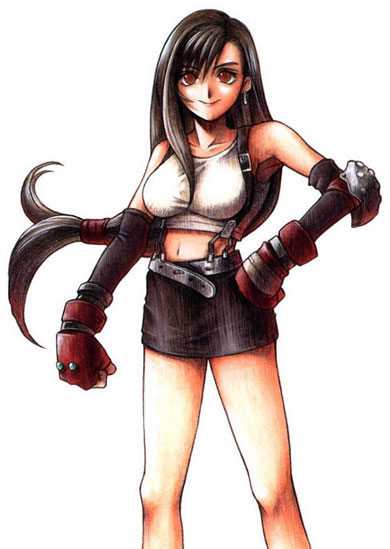
Tifa Lockhart is a wonderful person, but her personality fails to save her from becoming a victim of sexual objectification. She wears a miniskirt and mini-shirt, even into battles against vicious monsters. How she avoids death and injury—not to mention charges of indecent exposure—I can’t imagine. Tifa is a strong woman with an empathetic, motherly nature… but too many gamers remember her only as the babe from Final Fantasy VII with the long legs and huge bust.

Shantae (Shantae series)

Shantae

Some women in video games look uncomfortably like strippers. Shantae looks more like someone in pajamas. Her clothes are revealing, but Shantae is no less modest than some of Disney’s kid-friendly princesses. Shantae is an upbeat, well-developed character, and only one of her physical features is greatly exaggerated… her ears. Even her outfit makes sense given the context of her hometown’s blazing climate. Shantae is definitely a person, and an adorable one at that.

Samus (Metroid series)

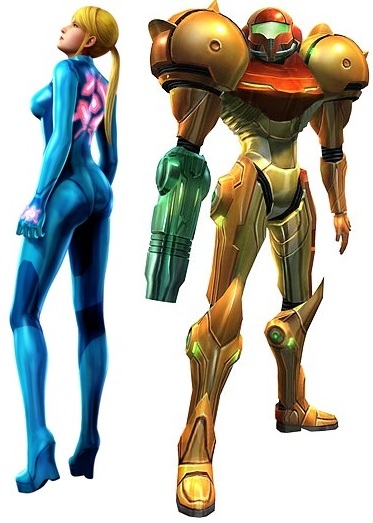
SamusSamus Aran, the solitary bounty hunter from the Metroid series, is an interesting case. In most of her games, she’s a silent protagonist without much personality—yet she’s treated respectfully as an independent, capable person with the good sense to wear full body armor into battle. However, upon removing her armored suit, Samus becomes a babe in pointlessly revealing or form-fitting clothes. Whether Samus can be considered a victim of sexual objectification depends mostly on whether she’s on or off duty.

Physical beauty is a very good thing. Sexuality is an amazing gift, which is exactly why it shouldn’t be flaunted or cheapened by flagrantly sexualized characters. People are people. All people—even video game characters—should be respected.

219. TMTF Reviews: CTRL+ALT+DUETS

I was recently asked whether I might be interested in reviewing an album of geeky music. Upon receiving this unexpected offer, I quickly arrived at my decision by the following three steps.

1. I know nothing about music.

2. I am totally a geek.

3. LET’S DO THIS THING.

Thus, with apologies to my musical friends and a rousing cheer for geeks everywhere, TMTF is delighted to review CTRL+ALT+DUETS, an EP of parody music.

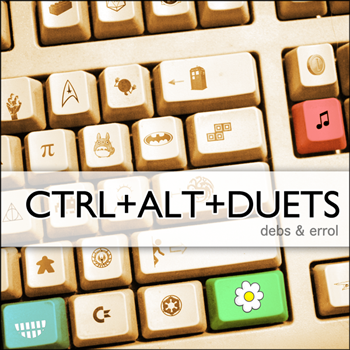
Debs & Errol - CTRL+ALT+DUETS - coverBefore I discuss any of the songs on this EP, I want to mention how much I love its cover. Any design that brings together Batman, Portal, Totoro and the TARDIS is a good one in my book. All it needs, really, is a Triforce and a Poké Ball. The title of the EP is also pretty clever, though the names of the musicians puzzle me. Isn’t Errol an owl from the Harry Potter books? Am I imagining things?

Debs & Errol

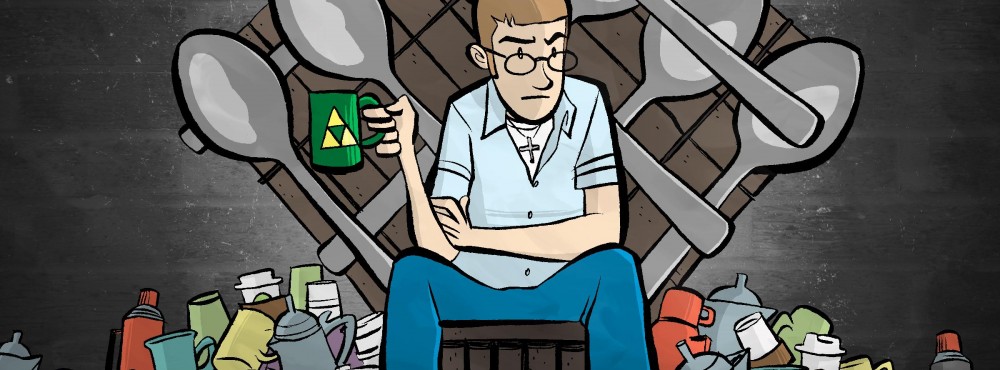
I see Debs, but where is Errol? Who is the guy with glasses? WHERE IS THE OWL?!

All right, let’s face the music.

CTRL+ALT+DUETS features seven tracks: all parodies of popular songs. I was strongly reminded of Weird Al Yankovic, who does a phenomenal job of juxtaposing silly lyrics with sad or emotional melodies. This EP does the same. The most striking thing about its songs is how humorously the lyrics contrast with the melodies.

The first song, “Tribbles,” is a glorious riff on Taylor Swift’s “I Knew You Were Trouble.” The defiant bitterness of the original song is redirected toward the furry creatures called tribbles from the Star Trek franchise. The singer—whom I presume to be Debs, since she doesn’t sound like the Harry Potter owl—delivers a solid, believably poppish performance.

Moving on to another major science fiction franchise: the next song, “TIE After TIE,” puts panicked lyrics to a slow, smooth melody to describe a frenetic Star Wars space battle. I recognized the song as a parody of “Time After Time,” with a bit of the Star Wars theme woven in for good measure. Debs is joined on this one by Errol, who has a surprisingly deep, masculine voice for an owl. As with “Tribbles,” I love the contrast between pop melodies and sci-fi scenarios.

Next, a Disney song! We’ve all heard “A Whole New World,” the magic carpet song from Aladdin. “A Virtual World” is much the same, except the girl really isn’t interested in what the guy wants her to see. The guy extols the merits of MMORPGs. The girl complains about them. The listener—at least, this listener—laughs.

I haven’t the faintest idea what song “Falling Quickly” parodies, but that doesn’t keep me from from appreciating its melancholy description of Tetris addiction.

More Disney? I won’t complain. “My Partner’s a Nerd” snarkily inverts “Part of Your World” from The Little Mermaid. In the original, the singer describes her treasured possessions and wishes her life were less ordinary. In “My Partner’s a Nerd,” the singer complains about the geeky junk cluttering her home and wishes her significant other were more ordinary.

“Commodore 64” is neither a familiar tune nor a familiar topic. (The Nintendo 64 will always be the console of my childhood; no other video game system with 64 in its name will usurp its coveted place in my memory!) “Commodore 64” is a catchy, bouncy love letter to that classic video game system and its software. Most of its gaming references went way over my head—hey, I was born in the nineties—but I like the blending of an Elvis Presley-style tune with snatches of chiptune music.

The EP concludes with “If I Were an Undead Crawler,” a deceptively cheerful acoustic piece in which the singers describe the things they would do if they were zombies—namely maiming, mangling and devouring their listeners. (Once again, I haven’t an inkling what song is parodied.) For me, the real charm of this song is when Errol realizes halfway through that he doesn’t really want to be a zombie.

Debs is a fantastic singer, and Errol has a pretty good voice. Their harmonies are lovely; their banter is even better. As parodies of existing works, the melodies in CTRL+ALT+DUETS are familiar and catchy. Musical arrangements are quite good, though a few synthesized instruments sound painfully fake.

The lyrics are consistently clever and humorous… provided you’re a geek. The references to Star Wars, zombies and classic gaming will make no sense to listeners not steeped in nerd culture. This EP fits a particular niche. Those who understand its jokes and catch its references will enjoy it much, much more than those who don’t.

Barring Errol’s role in the Harry Potter books, I’d never heard of Debs and Errol. (I’m pretty sure the Harry Potter Errol and the geeky musician Errol are the same guy—I mean, how many Errols can there be in the world?) When I began listening to CTRL+ALT+DUETS, I knew only that it would be geeky. I wasn’t sure what to expect.

I wasn’t disappointed. The EP turned out to be pretty awesome… and extremely geeky. For six Canadian dollars—because American dollars just ain’t good enough, I guess—these seven songs are a pretty good deal. If you’re a geek, CTRL+ALT+DUETS is absolutely worth checking out. If you’re not a geek, don’t feel guilty giving it a miss.

215. A Brief Glossary of Handy Video Game Words

The world of video games is a vast and complicated place, littered with coins and spikes and bottomless pits, and discussed using a unique vocabulary: a lexicon packed with abbreviations, technical terms and snippets of Japanese. Video game words can be daunting or confusing to the uninitiated.

We’re here to help.

Here is a brief glossary of handy video game words. May it never be said TMTF has not done its part to promote the spread of knowledge and the betterment of humankind!

Action RPG: An RPG featuring real-time action instead of turns, e.g. Kingdom Hearts; see Turn-based RPG

Boss: A powerful enemy, usually fought at the end of a stage or dungeon

Co-op: A form of multiplayer in which players cooperate to complete an objective

Combo: In fighting games, an unbroken combination of moves or attacks

Console: A device for playing video games; generally connected to a television

Cutscene: A scripted visual sequence used to advance a game’s story

Developer: The person, group or company that makes a game

DLC: Downloadable Content, extra features in a game for which players pay an additional fee

Dungeon: A kind of stage fraught with enemies, puzzles, treasures and challenges; often concluded with a boss

Dungeon-crawler: A game with a strong focus on traversing dungeons

Easter egg: A hidden feature, often of a humorous or frivolous nature; sometimes a reference to another work; tragically, not actually made of chocolate

Escort quest: An objective requiring the player to protect an object or character; for most players, an excruciating nuisance

EXP: Experience, also abbreviated XP, generally awarded to the player in the form of points, which make characters stronger by causing them to level up; common in RPGs

Extra lives: Additional chances for a player to play without incurring a game over

Fetch quest: An objective requiring a player to retrieve an item or character; generally very tedious

Final boss: A powerful boss fought at the end of a game

FPS: First-Person Shooter, a genre of game in which the player wields a weapon from a first-person perspective, e.g. Halo

G: Gold, a standard form of currency in games

Game over: The point at which a player runs out of chances to play, and must begin the game from the beginning or a save point

Gameplay: The player’s interactions with a game; the interactive aspects of a game

Gameplay mechanic: A specific gameplay aspect

Gamer: A person who plays video games

Graphics: A game’s visuals

Hadouken: A colloquial term for projectile attacks in fighting games; named for a move in the Street Fighter series

Handheld: A portable video game device

HP: Health Points or Hit Points, a numerical representation of how much damage can be sustained by an object or character; see Life bar

Inn: In most RPGs, a location in towns where players can restore the HP and MP of their characters

Item: An object usable by the player; often depleted upon use

JRPG: Japanese Role-Playing Game, a style of RPG traditionally associated with Japanese developers, e.g. Final Fantasy; characterized by a linear narrative and stylized visuals; see WRPG

Level up: An increase in a character’s strength or ability, generally earned by accruing a predetermined amount of EXP

Life bar: A visual representation, typically in the form of a horizontal gauge, of how much damage can be sustained by an object or character; see HP

Metroidvania: A kind of platformer with RPG elements and a strong emphasis on exploration; named for Metroid and Castlevania, game series which exemplify the genre

Miniboss: A less powerful boss fought partway through a stage or dungeon

Minigame: A small, simple game within a larger, more complex one

MMORPG: Massive Multiplayer Online Role-Playing Game, an RPG that connects multiple gaming systems and hosts numerous players in a single virtual world, e.g. World of WarCraft

MP: Magic points or Mana points, a renewable asset that can be spent to perform special moves

Multiplayer: A game feature that allows for multiple players to play the same game simultaneously

NPC: Non-Player Character, a character not controlled by any player

Open-world: A kind of game stage in which the player is given freedom to roam a large virtual world and flexibility in approaching game objectives

Overworld: The space connecting dungeons, towns or stages

Pixel: One of many tiny squares or dots that make up a larger image

Platformer: A genre of games in which gameplay usually consists of traversing platforms, pitfalls and other obstacles, e.g. Super Mario Bros.

Power-up: An object which temporarily grants a character greater strength or a new ability

Production values: All aspects of a game apart from gameplay; e.g. music, writing and graphics

Quick time event: An interactive cutscene in which a player must press a button or sequence of buttons displayed on screen; generally a terrible game mechanic

Random encounter: In RPGs, a gameplay mechanic that puts players at risk in certain areas of being ambushed by enemies and having to fight

Respawn: When a defeated character disappears from the game and reappears at a predetermined point

RPG: Role-Playing Game, a genre of game in which player controls a character or group of characters who become stronger as the game progresses; generally emphasizes storytelling and strategic gameplay

RTS: The Real-Time Strategy genre, which puts the player in command of a group of units and emphasizes micromanagement of resources, e.g. StarCraft

Save point: A checkpoint at which the player’s progress is recorded

Shovelware: Badly-designed games fit only for taking up space in landfills

Side quest: An optional objective or set of objectives available for the player to complete

Sprite: A two-dimensional image or animation integrated into a larger scene

Stage: A self-contained area in a game featuring a specific objective; also called a level, course, act or zone

Superboss: An optional boss, often more powerful than the final boss; a challenge for expert players

Town: A space in a game, generally neutral and free of enemies, offering services to the player such as shops, inns and save points

Turn-based RPG: An RPG featuring sequential moves or turns instead of real-time action, e.g. Final Fantasy; see Action RPG

Tutorial: A section of a game that instructs the player how to play

Vaporware: A game supposedly in development that shows no signs of imminent release

WRPG: Western Role-Playing Game, a style of RPG traditionally associated with Western developers, e.g. The Elder Scrolls; characterized by a nonlinear narrative and realistic visuals; see JRPG