405. Adam Sings!

Instead of writing a proper post, I sang a song for today’s blog update. I should probably have written a proper post.

You can hear me sing “Baba Yetu” by clicking here!

“Baba Yetu” is one of my all-time favorite songs. Its background is frankly a bit strange: composed by Christopher Tin for a video game, it went on to win a Grammy Award—the first ever video game composition to score at the Grammys. Its lyrics are the Lord’s Prayer in Swahili.

Baba YetuTo recap: “Baba Yetu” was composed for a video game, won a Grammy, and features as its lyrics an ancient Christian prayer in flipping Swahili. Yes, this song is a bit of a weird one. I love it so much.

I enjoy singing, but I’m not great at it. As my long-suffering younger brother can confirm, I sing while doing household chores. I was in my high school choir back in the day, but that’s the extent of my singing experience.

I have a decent voice and can force a vibrato. (For my non-musical readers: A vibrato is when the pitch of a note wavers slightly… or in my case, when my voice wobbles.) However, tragically, I don’t have a good ear for music. I struggle to sing harmonies, and occasionally fail even to hit the correct notes or stay in the right key.

For this cover of “Baba Yetu,” I sang over one of Christopher Tin’s original tracks karaoke-style, adding bits here and there. I mixed my recordings in a witch’s cauldron an audio editing program called Audacity. I think my cover turned out all right, but I should mention that for every decent part of my performance, there were at least half a dozen takes that totally sucked. In audio mixing, as in writing, editing is magic.

I had really wanted to record a cover of “Baba Yetu” since singing it at an open mic night at my church. My performance kinda sucked. (I was really nervous.) I wanted to sing it again, to get it right, so I wound up recording it at home when I should probably have been blogging or sleeping.

At one point, shortly before I was ready to finalize the audio, Audacity couldn’t find the necessary files. I thought I had lost hours of work, but I was able to find the files again, thank God. Baba yetu, our Father, indeed.

“Baba Yetu” has become a popular song selection for choirs worldwide, including Procantus, the Uruguayan choir for which my dad sings. After I passed my favorite arrangement of the song on to my dad, he passed it on to his choir director, and the choir began practicing the song shortly thereafter.

(Oh my gosh, guys, I looked up the name of the choir to make sure I was spelling it right, and the very first search result on Google for “procantus montevideo” is a YouTube video of my dad singing “Baba Yetu” with the choir. The Internet can be a bizarrely small place. I would describe my aged parent as “the balding gentleman with the glasses,” but that describes nearly half the choir, so I’ll point him out as the gentleman on the left in the back row around the video’s seven-second mark.)

While finishing up “Baba Yetu,” I tried recording one or two Christmas, um, “carols,” but the recordings weren’t worth keeping. I don’t plan to record any more songs in the foreseeable future, but “Baba Yetu” was fun.


Do you know what’s even better than “Baba Yetu”? Saving lives with clean water! Please take a moment to check out Operation Yuletide! We’re raising money to help people this Christmas. There are even rewards and stuff! The fundraiser is lonely, guys. Check it out here!

403. Hmm, I Seem to Have Acquired a Cat

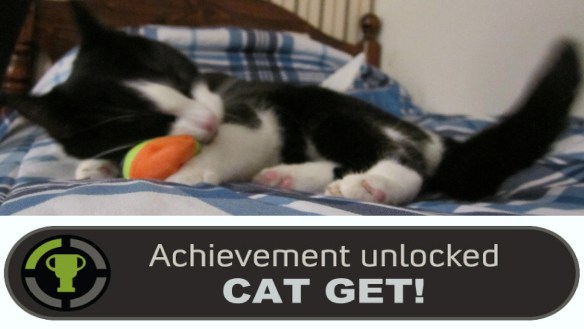
PearlyCongratulations, geeky coffee-drinking blog-man! You are now the proud owner of a small, black-and-white female cat.

Really? Cool!

…Now what?

Please select a name for your cat.

Sure. Here goes:

Name selectPearl? Why Pearl?

Pearl is the name of an adorable character from Steven Universe, and of an even more adorable character from the Ace Attorney games. My Pearl is quite an adorable cat. The name stuck.

If I had acquired a male cat, by the way, I would have named him Godot, or possibly Solid Snake. I wanted to name this cat Sakura, which is Japanese for cherry blossom, but my younger brother disapproved, and we eventually settled on Pearl.

If you equip Pearl, your life will gain +10 Cuteness and +8 Playfulness, but at the cost of -14 Sanity and +6 Kitty Litter Spills. Do you equip Pearl?

Hmm, that’s a tough call. Nah, who am I kidding? Of course I’ll keep Pearly.

With that, I’m well on my way to becoming a crazy cat guy. Sure, I have just one cat, but it’s a slippery slope. Give me time. If I’m not careful, I’ll end up that guy with all those cats.

Book catWithin an hour or two of moving into my apartment, Pearls was lurking behind books on the shelf, batting at Christmas tree ornaments, and high-fiving my beckoning cat figurine’s waving paw. As I compose this blog post, the Pearl of great price is sprawled across my lap, breathing softly, and occasionally waking up enough to stretch.

Pearl also scratched one of my typewriter monkeys, and hisses at them any time they get too close. Yup, I think the Pearl-cat is going to fit right in.

Welcome to the family, Pearly!


Please take a moment to check out Operation Yuletide! We’re raising money to help people this Christmas! There are even rewards and stuff! Check it out here!

Everything I Know about Creativity I Learned from The Legend of Zelda

Today’s post was written by Wes Molebash, blogger and cartoonist extraordinaire. Be sure to check out MOLEBASHED, his latest webcomic!

Like most people my age, I grew up playing the Legend of Zelda video game series. I loved every minute of those games, and Ocarina of Time played a defining role in my young adulthood.

Now I like to consider myself a “creative person.” What I mean by this is that I love to create art and I’m always scheming of my next “big” project. Ideas are cheap; art is work, and I’m absolutely in love with the creative process.

That being said, I realized the other day as I was toiling in my basement office that everything I know about creativity was learned from playing the Legend of Zelda video games.

For instance:

It doesn’t matter how small you are or what tools you are using

In several of the Zelda games, Link starts his journey as a little boy who wields a measly wooden sword and a Deku shield. A DEKU shield! No one is afraid of a Deku shield. But he doesn’t let this stop him. He goes straight into his first dungeon and defeats the baddie with his slingshot David-and-Goliath-style. The journey has begun. He’s received his first taste of victory, and he’s off to the next dungeon.

So what does this tell me about the creative process? Simple: It doesn’t matter how skilled you are or how big your platform is or how expensive your tools are, just create! Don’t be hindered by your limited experience or lack of resources. I know famous cartoonists who draw awesome cartoons on three-thousand-dollar computer tablets. I also know a lot of amateur cartoonists who draw awesome cartoons using Ticonderoga No. 2 pencils and Sharpie markers. Take the resources you have and use them to the best of your ability.

Every obstacle has a weak spot—exploit it!

The Legend of Zelda series has been around since the eighties and it continues to follow a familiar formula: go into dungeons, collect maps and compasses and special weapons, and fight seemingly indestructible beasts who all have a glaring Achilles heel. Does the beastie have one huge, rolling eyeball? It’s a safe bet that you’ll want to shoot some arrows into the beast’s ocular cavity. Does the baddie occasionally stop to roar for a prolonged period of time? I’d grab some bombs and make it rain inside that guy’s maw. No matter how big the monster is, his weak point is right there in front of you begging to be struck.

The same holds true with our creative obstacles. They seem impossible to topple, but—the fact is—they’re quite easy to destroy! If I had to guess, I’d say that 99% of our creative obstacles can be toppled by simply CREATING. Are you having a hard time motivating yourself? Get out your tools and create. Do you have some naysayers telling you that you suck at life? Tune them out and create. Are you swimming in a sea of rejection letters from agents and publishers? Take the critiques and criticism with a grain of salt and create.

It really is that simple. Once you get started it’ll be hard to stop. The weak spot of your obstacle is right there staring you in the face. Exploit it.

You’re going to get better

As I said above, when Link starts his journey he is just a little boy with a crappy sword and shield and three hearts in his life meter. However, as he continues his quest he gets better. He collects more weapons. He becomes more resilient. He ages. By the end of the game he’s got the Hyrule Shield, the Master Sword, some rad magic powers, a pair of flippers that help him swim and hold his breath under water, a bunch of sweet weapons in a bag that would be impossible to carry in the real world, and eighteen hearts in his life meter. He finally ends up at Ganon’s door and he’s ready to—as they say in the UFC—“bang.”

The same is true for your creative endeavors. The more you create, the better you’ll get. You’ll also acquire new tools and awesome advice from other creators. Most importantly, you’ll gain experience. No longer will you feel completely daunted by project proposals, pitches, and rejections. It’s all part of the process and you’ll get better and better at those things.

So wipe your brow, keep creating, and—when you need to take a break—dust off your N64, pop in Ocarina of Time, and wander around Hyrule Field for a spell.

What have you learned from video games? Let us know in the comments!


This post was originally published on November 18, 2011. TMTF shall return with new content on November 30, 2015!

399. Review Roundup: Stupidly Long Edition

In the past few months, I finished some stupidly long books, films, and video games. Some are truly lengthy; others feel overlong due to tedium or slow pacing. A few are well worth their length. The rest overstay their welcome.

In this Review Roundup, I’ll take a quick look at Les MisérablesMetal Gear Solid 4The Once and Future KingSecret of Mana, Rise of the Guardians, and The Godfather Parts I and II.

I’ll try to keep this short. Spoilers: I’ll probably fail.

Les Misérables
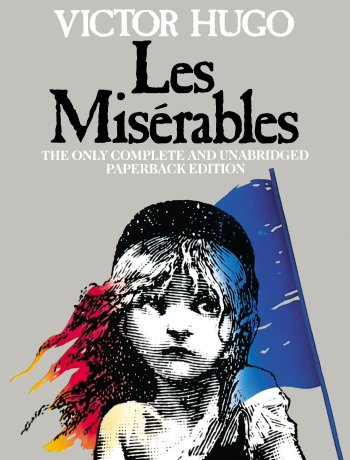
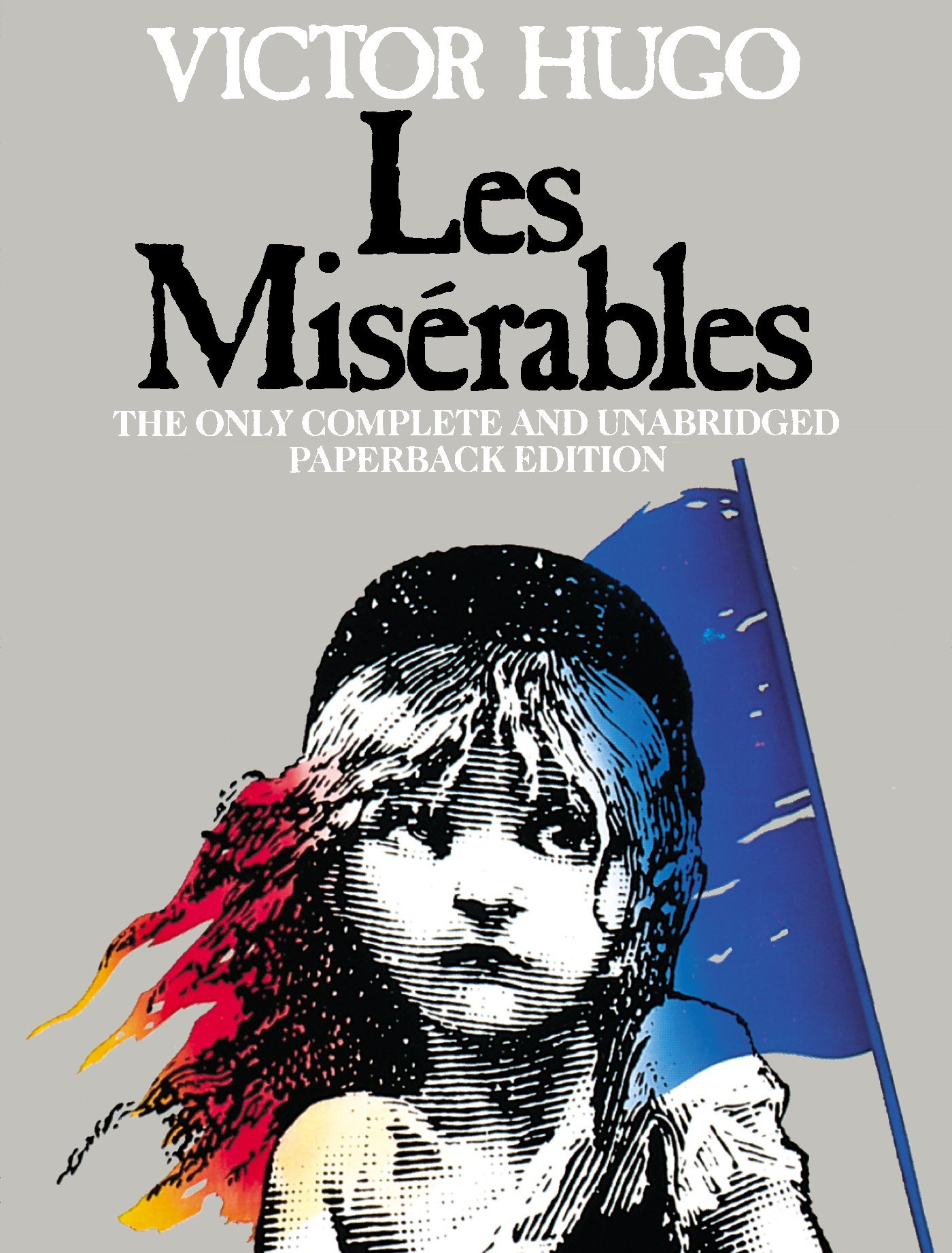
Lez Miz coverI read the abridged Les Misérables a few years ago. It was fantastic. Set in nineteenth-century France, this epic story follows an escaped convict named Jean Valjean. His journey from grief to grace to redemption spans decades, interwoven with tales of war, crime, revolution, and romance. The abridged Les Misérables is one of the finest novels I have ever read.

The complete, unabridged Les Misérables is a badly-paced novel burdened with boring details and jumbled together with a bunch of essays. The story moves with all the grace of a drunken hippo with a blindfold and only three legs.

As a writer, I usually respect an artist’s original vision. Not this time. In this case, I think the artist’s original vision is deeply flawed. The book has too much detail and a number of subplots that go nowhere, but those aren’t its worst faults. At frequent intervals, the novel is interrupted by rambling essays about minor details. How can readers stay invested in the tale of Jean Valjean when it’s constantly derailed by the author’s digressions on street lingo or the Battle of Waterloo?

For example, at the climax of the novel, a band of freedom fighters makes a heroic last stand against the army in Paris as Jean Valjean flees through the sewers. In the next chapter, the author kills the story’s momentum with an essay describing how much money the city of Paris loses by dumping its sewer waste in the river instead of converting it to manure. Never mind Jean Valjean’s sewer escape! Never mind the martyrs of the revolution! All that must wait until the author finishes ranting about sewers several chapters later.

If the author really felt his opinions were so important, he should have published them separately. Les Misérables was written as a serial, but when it was finally published as a complete work, his digressions could have been included as appendices at the back of the book.

Read Les Misérables—the abridged one. For heaven’s sake, don’t waste your time on the unabridged version.

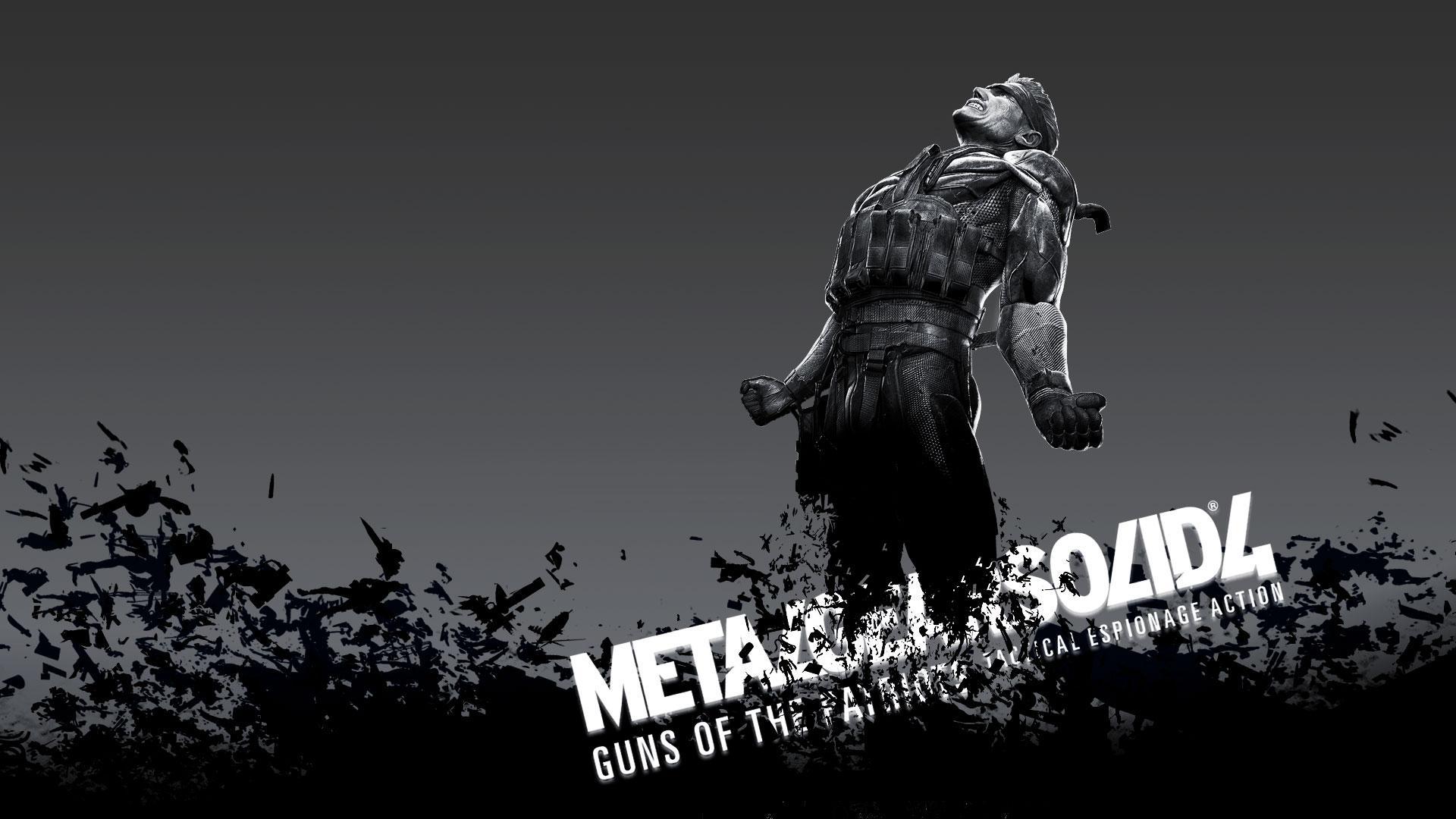
Metal Gear Solid 4: Guns of the Patriots
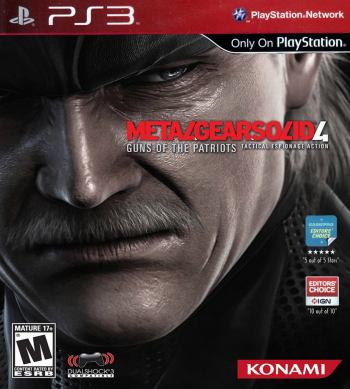
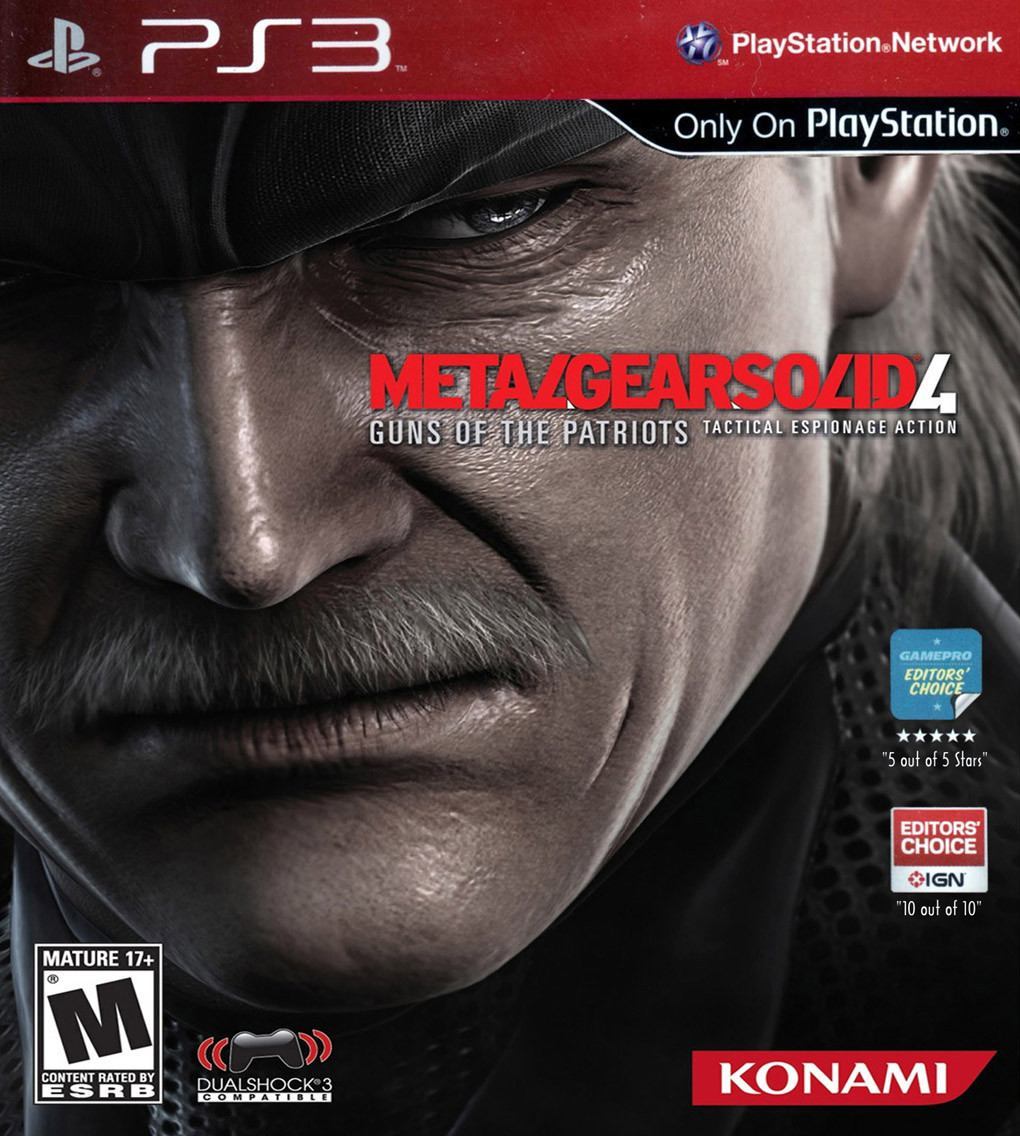
MGS4 coverMetal Gear Solid 4 is a video game that thinks it’s an action movie.

In the, um, distant future of 2014, war has changed. A group called the Patriots has made war a business. Meaningless battles are fought all over the world by privately-owned mercenary companies, fueling a worldwide war economy. Using technology, economics, and the media—and nanomachines, of course—the Patriots control everything.

War has changed, and so has Solid Snake. This legendary soldier has aged prematurely due to a terminal genetic condition. Snake has become, in his thirties or forties, an old man with less than a year to live. When his former commanding officer asks him to undertake one last mission, Snake sets out to bring down the Patriots and end the cycle of war before the whole world burns. After all, what does he have to lose?

In the past couple of years, I’ve come to love the Metal Gear Solid games. I keep comparing them to the films of Quentin Tarantino. Packed with dialogue and populated by larger-than-life characters, they are violent, campy, stylish, contemplative, and frequently ridiculous.

Metal Gear Solid 4 is characteristically Metal Gear Solid-ish, and it does a superb job of pulling everything together. The games that preceded it are radically different in tone and story. Metal Gear Solid is a military thriller with shades of Tom Clancy’s novels and superhero comics. (It would make a great movie.) Metal Gear Solid 2: Sons of Liberty starts as an action game and spirals off into postmodern intrigue. Metal Gear Solid 3: Snake Eater is a James Bond-style adventure set in the sixties. MGS4 somehow ties together plot threads from previous games, uniting them in a triumphant (and surprisingly cohesive) conclusion to Solid Snake’s story.

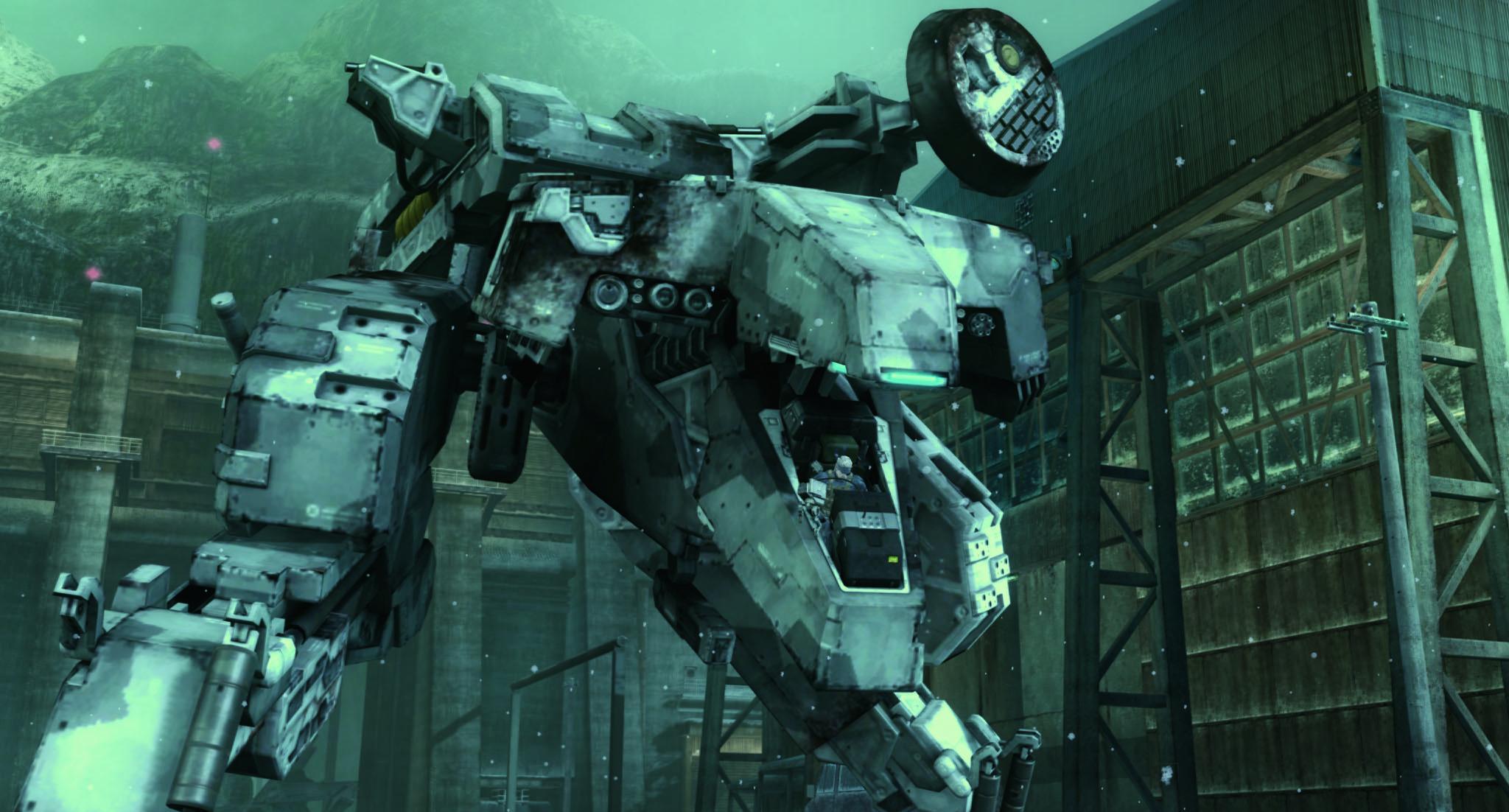
The gameplay and level design of MGS4 are polished for a fairly smooth experience. For the first time in the series, Snake actually pilots one of the eponymous Metal Gears in an exhilarating clash of giant robots. A couple of the other boss fights are brilliantly designed. Tracking and shadowing targets adds a little variety to the usual shooting and sneaking.
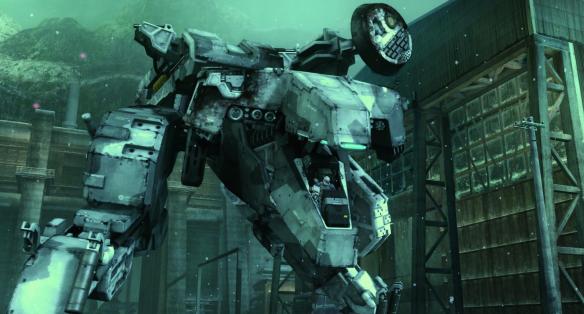
Rex Vs. Ray

After three games of sneaking around in the shadows, a giant robot fight was long overdue.

If the game has a problem, it’s the cutscenes—scripted scenes that take away control from the player. These are superbly produced, but also really long. I mean really, really long. I spent probably a quarter of my time with the game watching instead of playing. MGS4 is a movie superimposed on a video game.

I also have a serious problem with the game’s portrayal of women. The Metal Gear Solid series has its share of good-looking ladies, but the babes of MGS4 aren’t sexy spies or cute scientists—they are freaking PTSD victims. Several of the game’s bosses are traumatized women trapped in armored suits and forced back onto the battlefield. When their powered armors are destroyed, these ladies crawl out in skintight bodysuits as the camera ogles their curves. I think it’s supposed to be sexy in a PG-13 kind of way, but it comes off as creepy and insensitive. There are just a few of these scenes, but yeesh.

It had a few disappointments, yet I really enjoyed Metal Gear Solid 4: Guns of the Patriots. The game is a must for fans of the series. For new players, I recommend Metal Gear Solid 3: Snake Eater as a better introduction.

The Once and Future King
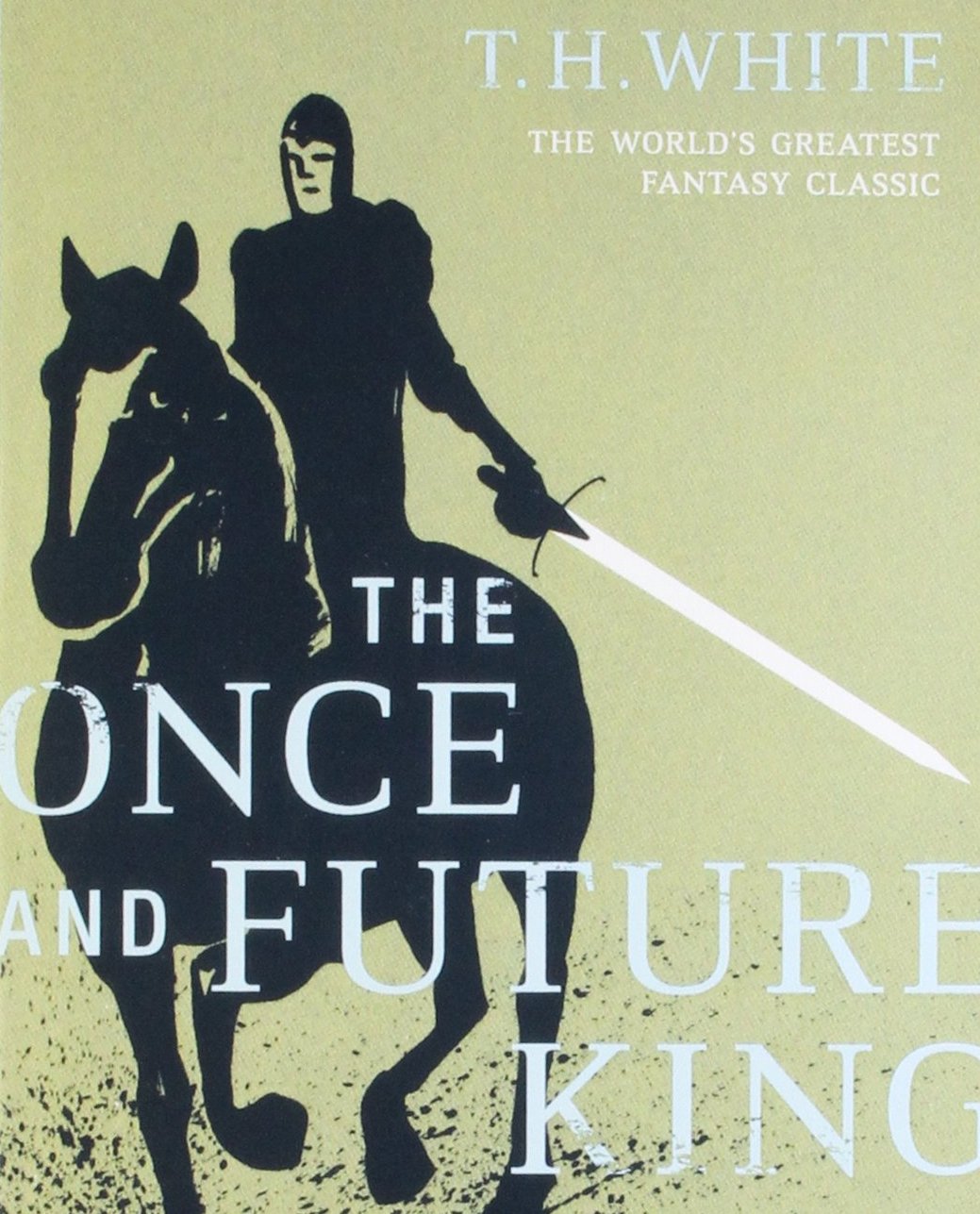
The Once and Future King coverThe Once and Future King is a poignant tale of failure. Based on Arthurian legends, the novel follows King Arthur from his childhood studies under Merlin to his final regrets as an old man. Woven into Arthur’s story is the tale of Lancelot, Arthur’s greatest knight, who follows his own ambitions and makes his own mistakes.

It’s quite a long novel, but unlike Les Misérables, every page is worthwhile. It reinterprets the Arthurian legends, setting them centuries later and giving their characters much greater complexity. Arthur, for example, no longer establishes his Round Table (an order of knights governed by chivalry) for the sake of honor or conquest. The Round Table is reimagined as a redirection of violence from selfish to noble ends. Arthur is more than a king. He is an inventor of civilization.

At first, the novel is lighthearted and often hilarious. In fact, the Disney movie The Sword in the Stone is based on the early chapters of The Once and Future King. The difference is that in the film, Arthur’s coronation is a happy ending, whereas in the book, it’s only the beginning of his struggles. The tone goes from funny to tragic as Arthur grows from a boy to a man.

The Once and Future King is easily the finest book I’ve read so far this year, and the definitive retelling of King Arthur’s story for our age. I highly recommend it.

Secret of Mana
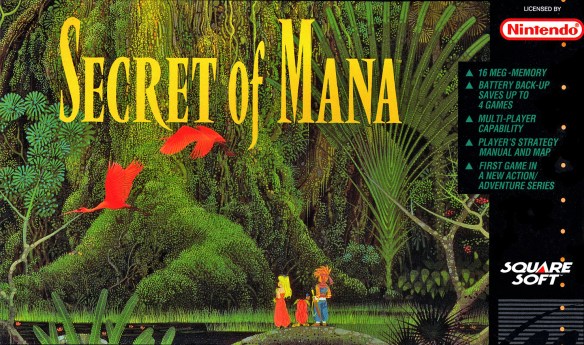
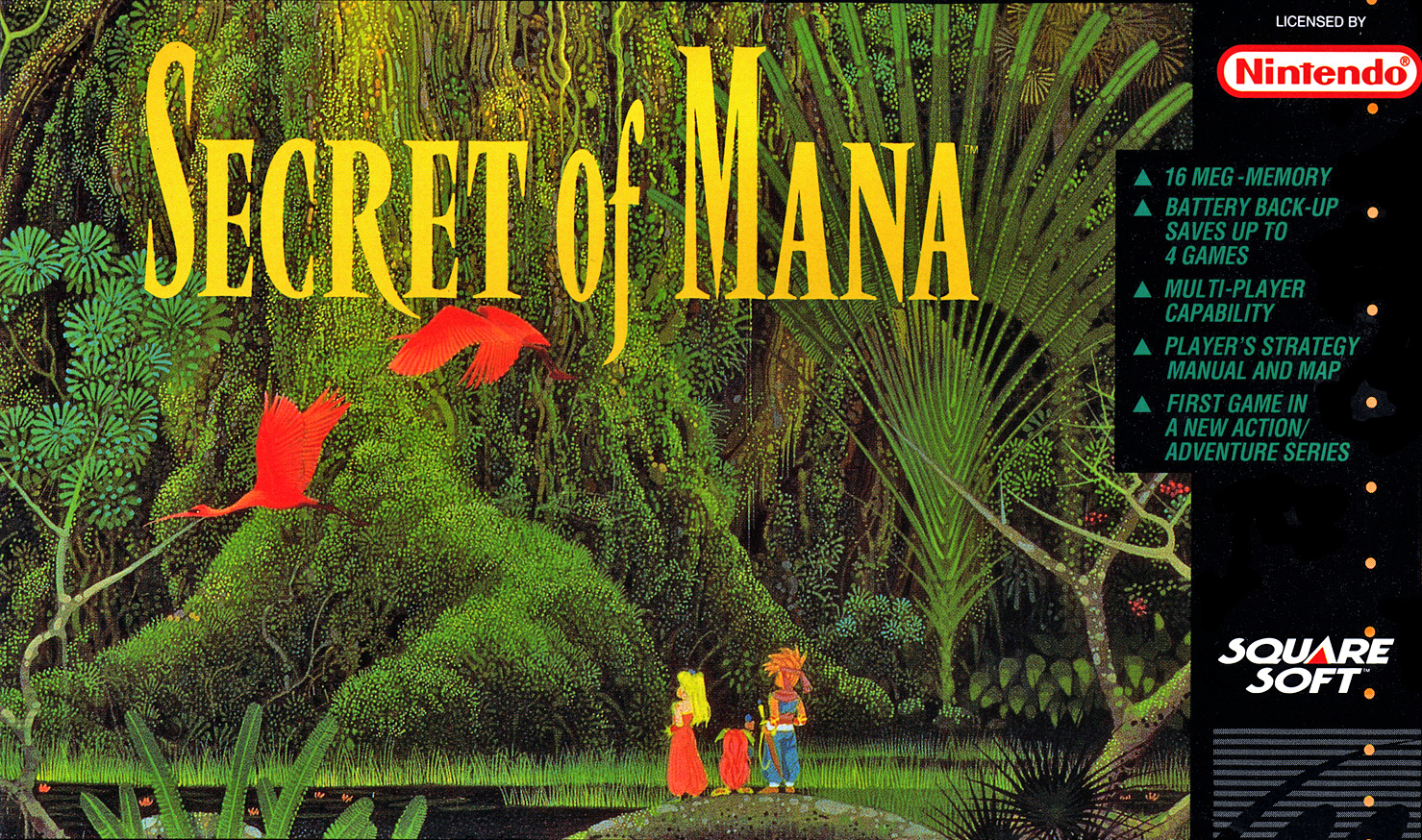
Secret of Mana coverI had wanted to play this game for years. Released around the same time as RPG classics like Chrono Trigger and Final Fantasy VI, for the same system and by the same company, Secret of Mana is widely hailed as a masterpiece of the SNES era.

It’s kind of terrible.

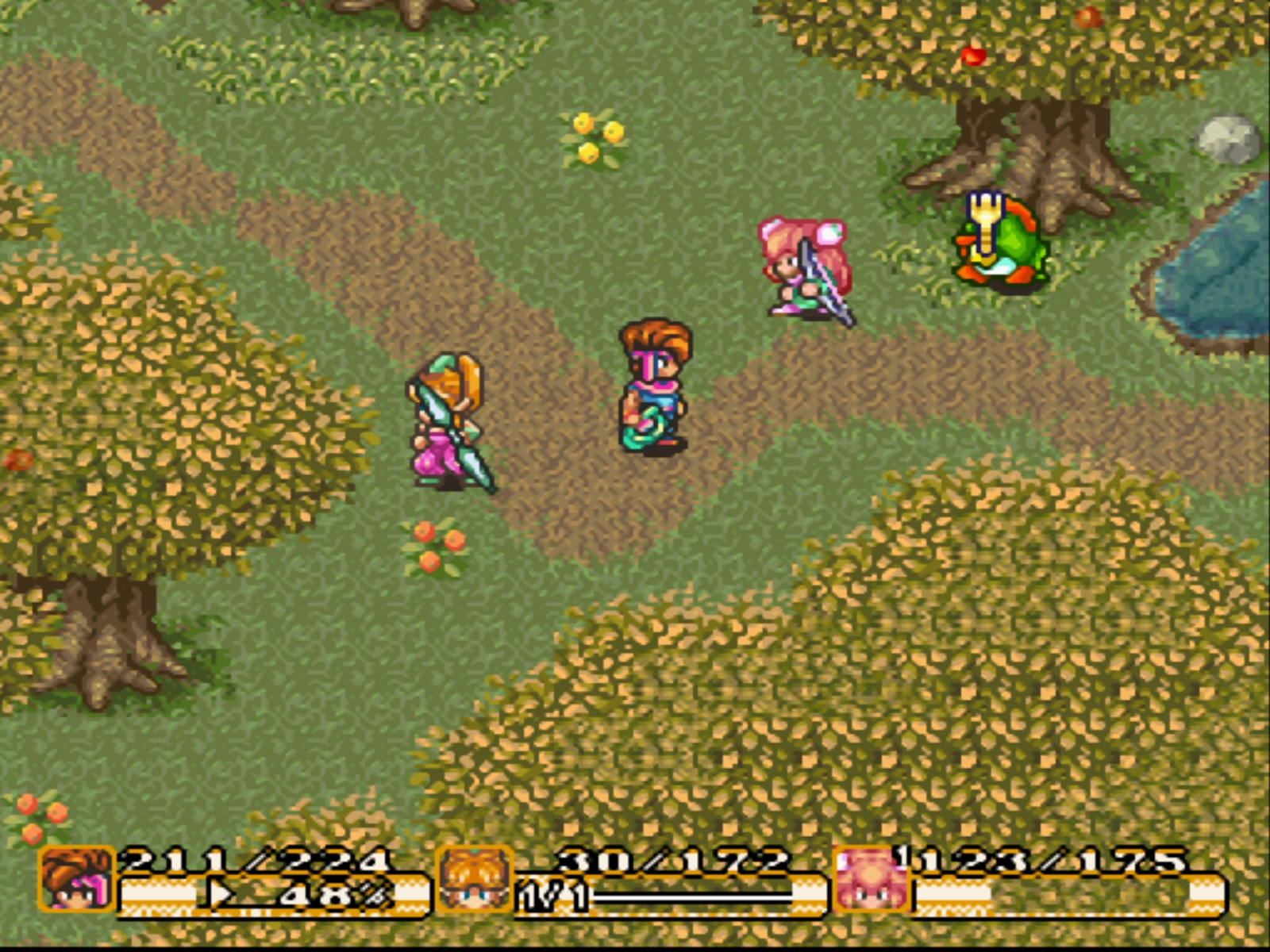
Yeah, it looks nice. Don't be fooled.

Yeah, it looks nice. Don’t be fooled.

There are good things about it. The battle system is robust, engaging, and way ahead of its time. Secret of Mana looks great, with bright colors and attractive old-timey graphics. Its menus are neat. I can understand why the game was so well received in its day. However, its weaknesses greatly outnumber its strengths. The music is forgettable, the story is an undeveloped stream of clichés, the game design is frequently obtuse, and the game settles into a rhythm of dull repetition that lasts way too long.

If you’re looking for an RPG classic, for heaven’s sake play Chrono Trigger and leave Secret of Mana in the nineties where it belongs.

Rise of the Guardians
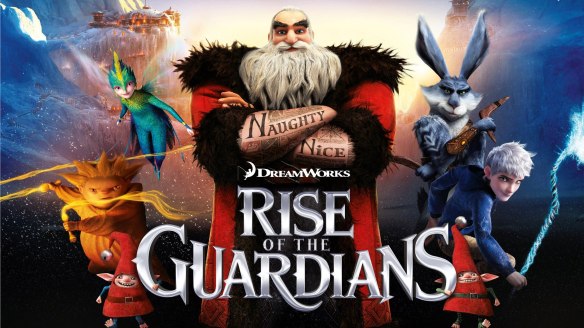
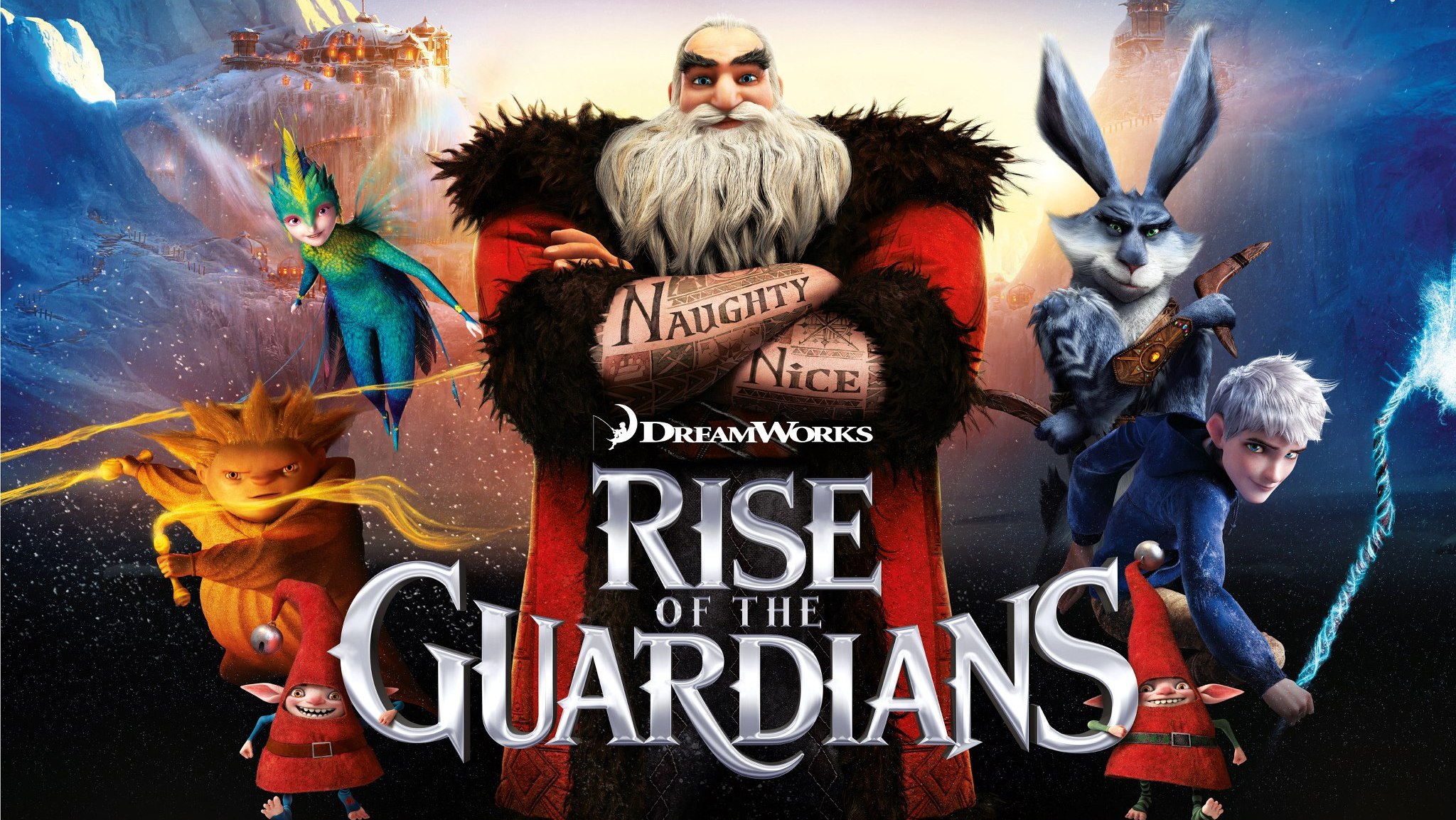
Rise of the Guardians posterI had low expectations for Rise of the Guardians, but it wasn’t bad.

The film recasts Santa Claus, the Easter Bunny, the Tooth Fairy, and other figures of childhood lore as Guardians: members of a league that protects the happiness of children. When the Boogeyman tries to darken the world with nightmares, the Guardians recruit an amnesiac Jack Frost to restore the belief and hope of kids everywhere.

Despite its generic title, Rise of the Guardians is a colorful, well-paced fairy-tale film. (Unlike the other media in this Review Roundup, it doesn’t feel particularly long.) The Guardians are mostly likable; I particularly enjoyed Santa Claus as a gruff Russian and the Sandman as a silent protagonist. The villain is sinister and well-developed. By far the weakest link is Jack Frost, whose angst, amnesia, bland narration, and boy-band looks hit all the wrong notes.

It isn’t a classic, but Rise of the Guardians is all right.

The Godfather Parts I and II
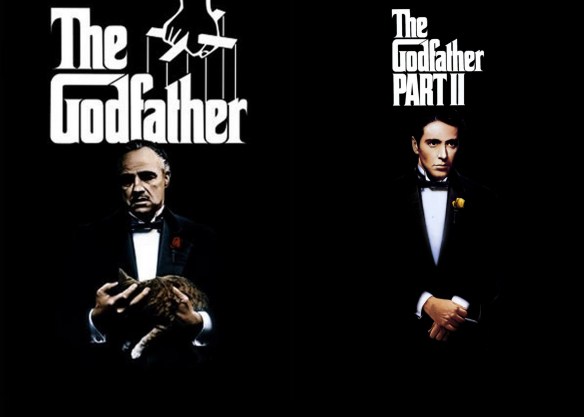
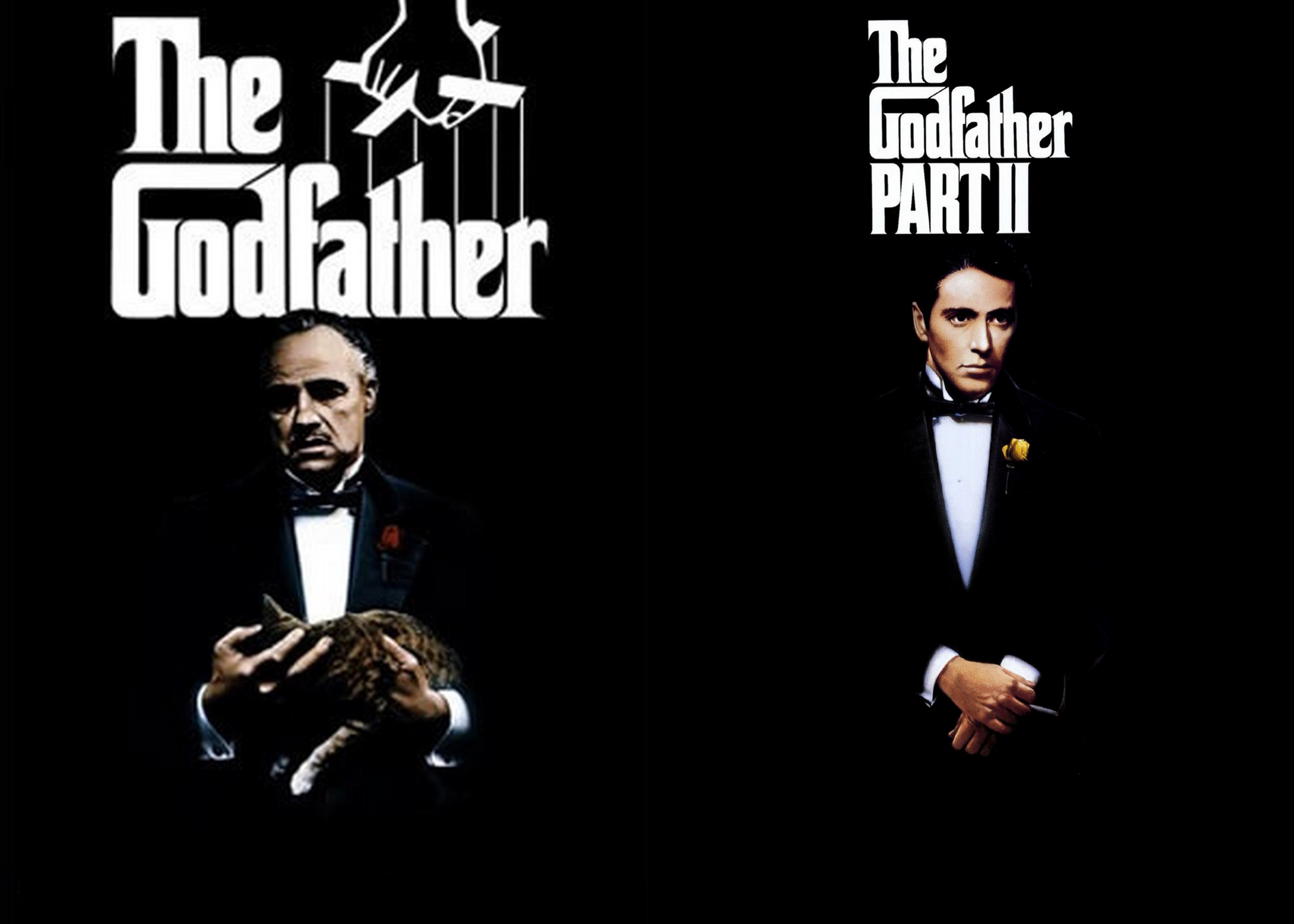
The Godfather covers

The Godfather and The Godfather Part II are allegedly two of the greatest films ever made. I decided I should see them. It was, as the Godfather himself might have put it, a recommendation I could not refuse.

The first Godfather film tells the story of the Corleone family, an Italian-American crime syndicate led by the eponymous godfather, Vito, and later by his son Michael. The second movie follows Michael as he consolidates power, and flashes back to Vito’s arrival in the United States and rise to power as a criminal kingpin.

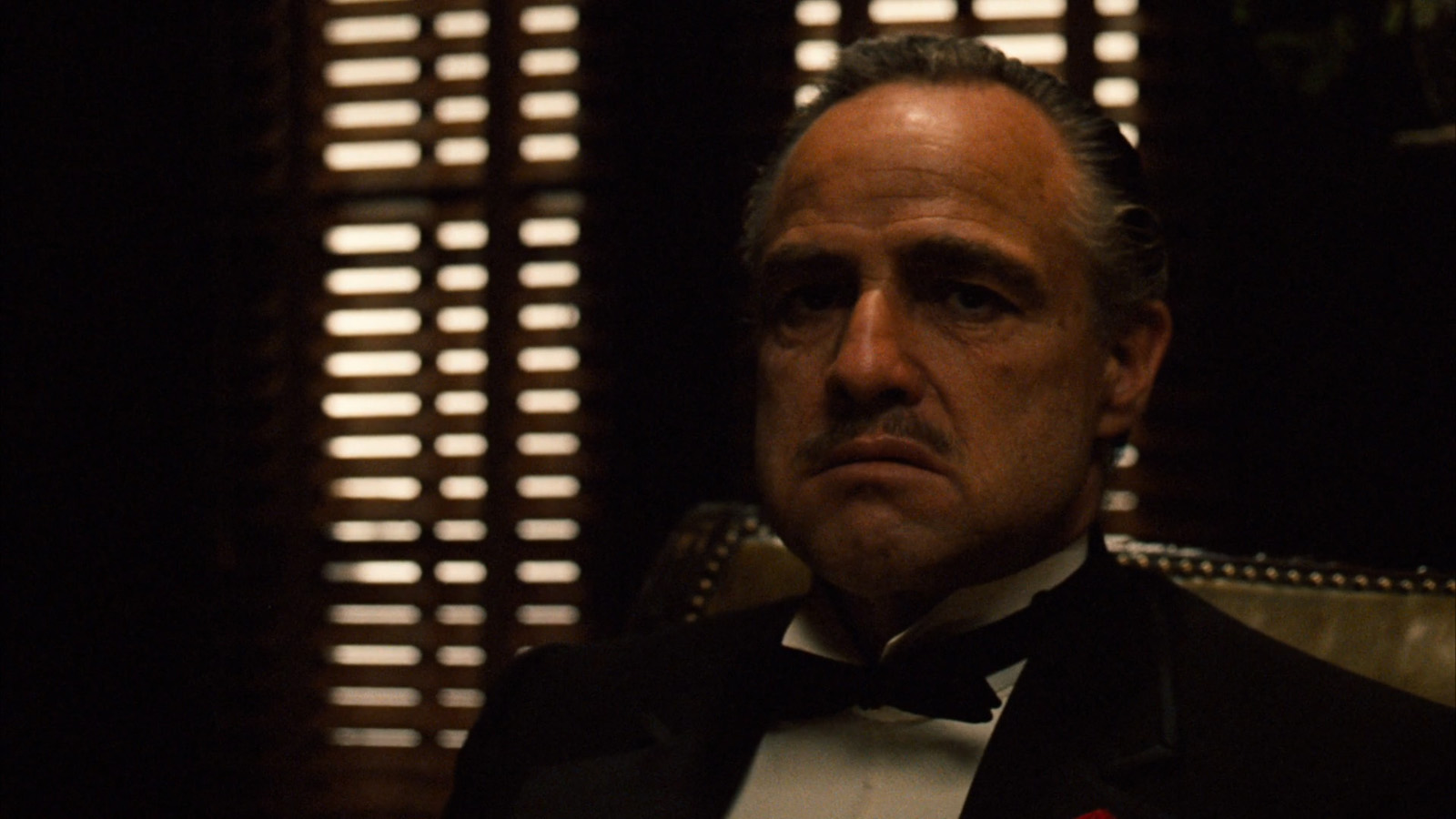
Oh, and the first one consists largely of Marlon Brando making this face:
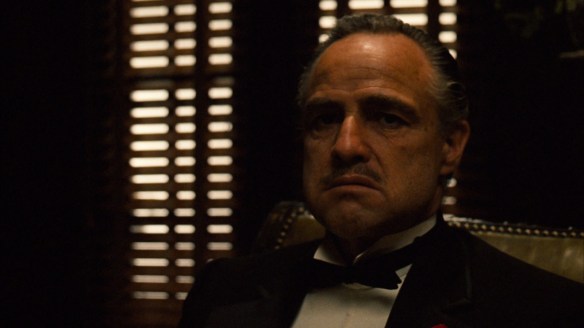
Marlon Brando scowling

Seriously. This is his default expression.

The Godfather movies are fairly old, and a lot longer and slower than contemporary films. They move at the leisurely pace of novels. (If it were made today, The Godfather would probably be a television miniseries, not a series of films.) The meticulous pacing allows for character development and plenty of subplots, but definitely makes watching the films a chore.

The Godfather movies boast great acting and complex characters. Vito is not just a literal godfather to his godson, but a sort of father-figure to his community. His life of crime is governed by strict rules of honor and loyalty. Michael, at first an innocent young man, hardens into a ruthless mob boss who abandons his father’s principles. In telling their stories, the films touch upon themes such as revenge, responsibility, betrayal, tradition, religion, corruption, and family.

The Godfather and The Godfather Part II reward patient viewers with the epic story of a family’s descent into darkness. If you’re looking for something easy to watch, however, you had better look elsewhere.

What books, films, shows, or video games have you enjoyed lately? Let us know in the comments!

393. About Storytelling: Magic, Destiny, and Nanomachines

Here’s a question for you: What do fate, magic, nanomachines, and sonic screwdrivers have in common?

As I mentioned last time, I’ve been playing a video game called Metal Gear Solid 4. Its blend of military intrigue, science fiction, and social commentary is kinda bonkers, but the story’s strangest turns always have an explanation—or, to be more honest, an excuse. That excuse is nanomachines. These microscopic robots are injected into the bloodstream of many characters in the game, giving them superpowers (or super-weaknesses) that defy all other explanations.

How does a character in the game survive being shot in the head and stabbed through the abdomen? Nanomachines. How are entire armies instantly disarmed, disabled, and defeated? Nanomachines. How is a long-dead character revived in a stunning twist? That’s right—flipping nanomachinesEvery impossible twist in the story is explained by these hard-working little bots.

The answer is nanomachines.

The answer is nanomachines. It’s always nanomachines.

In the end, throughout the Metal Gear Solid series, nanomachines are generally the catch-all explanation for things that otherwise make no sense. The audience never learns exactly how they cause immortality, raise the dead, regulate firearms, or do any of the other crazy things they do. Nanomachines are a vague, easy solution to plot holes that can’t otherwise be filled.

Let’s not cast all the blame upon nanomachines, though. Consider how often, especially in fantasy stories, magic is used to explain away things that make no sense. Science fiction often uses technology in exactly the same way. As Arthur C. Clark reminds us, “Any sufficiently advanced technology is indistinguishable from magic.”

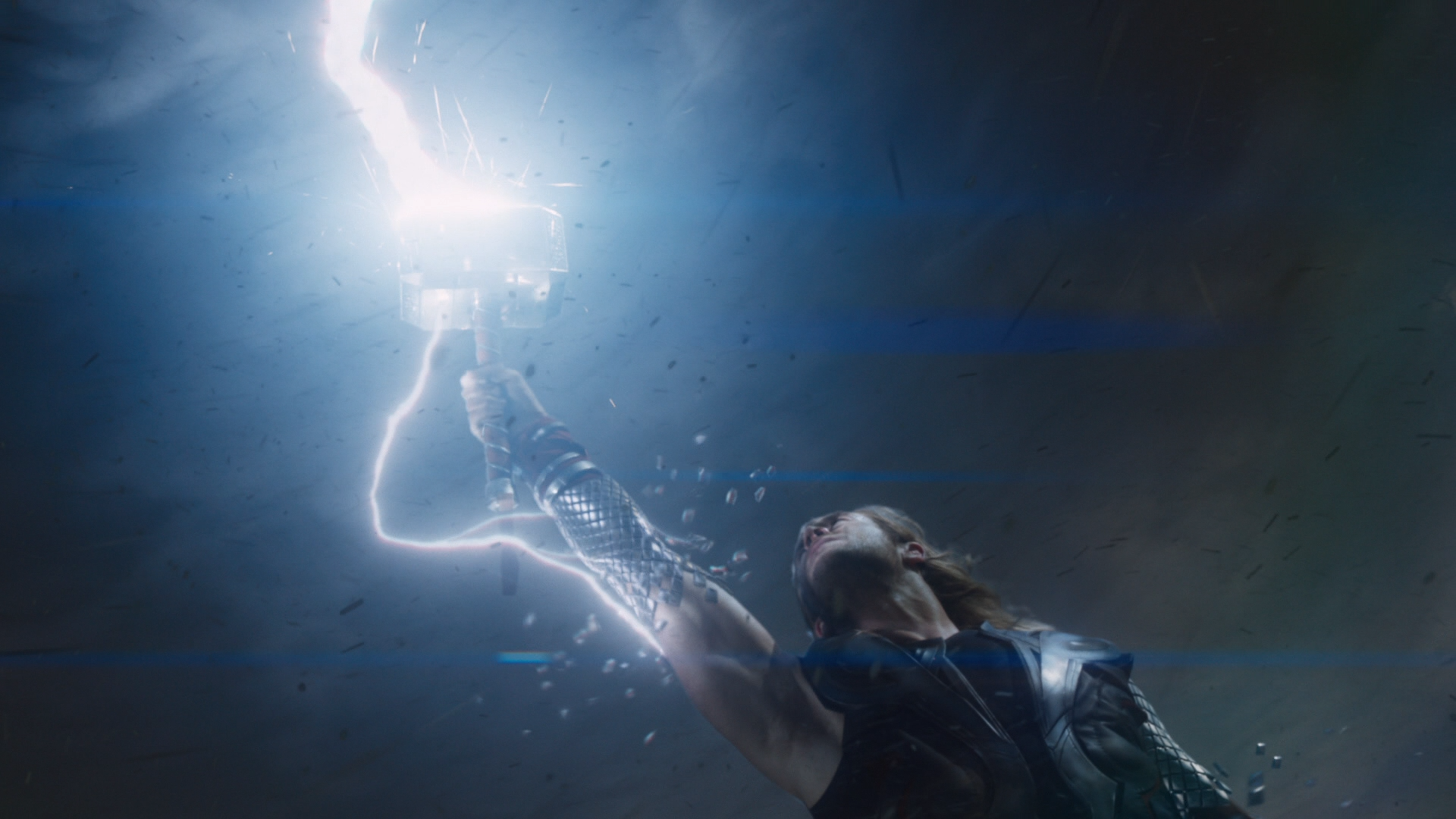
Marvel’s Thor movie openly acknowledges this when its eponymous superhero tells an ordinary human, “Your ancestors called it magic, but you call it science. I come from a land where they are one and the same.” Thor’s hammer makes no sense. Most of the stuff in Marvel’s movies makes no sense. The easiest solution is to claim that it’s incomprehensible technology and call it a day.

Witness the power of... um... technology?

Witness the power of… science?

Fate and destiny can work the same way. In dramas and romances, these vague cosmic forces offer an excuse for crazy coincidences and irrational behavior.

Then there’s Doctor Who. Flipping heck, is there ever Doctor Who. Besides the good Doctor’s sonic screwdriver, which does anything the plot needs it to do, the show’s many plot holes are waved away by the concept of “wibbly-wobbley, timey-wimey… stuff.”

Do you remember the concept of deus ex machina? It’s when a specific problem in a story is resolved by some contrived or impossible solution. This is the same idea, but bigger and more pervasive. It’s when a deus ex machina, instead of resolving a single problem, becomes the storyteller’s go-to resolution for all of the problems.

As cheap or lazy as this sounds, it doesn’t have to be so bad. It all depends on how it’s used. Some stories don’t need to be burdened by a lot of complicated explanations. If media like Doctor Who or Metal Gear Solid 4 obsessed over details, or else cut out everything that lacked a rational explanation, they would be a heck of a lot less fun. If the audience is willing to swallow a vague explanation, and it enables a better, tighter story, then it becomes a good thing.

Used badly, narrative tricks like magic and nanomachines make a story contrived and unbelievable. Used well, they prevent a story from becoming bogged down in details and explanations, and allow storytellers to focus on other areas of storytelling.

I would call my typewriter monkeys my blog’s version of this trick—a vague explanation for the complicated process of how TMTF is kept up and running—except for one thing. My monkeys don’t resolve problems. They cause them!

392. Philosophical Introspection on Growing a Beard

There is an old Greek legend of a king named Sisyphus. This lawless man deceived the gods, murdered travelers, and was generally a bad egg. After his death, the gods punished Sisyphus in the afterlife by forcing him to push a huge boulder up a hill. The boulder was enchanted to roll back down the hill before he could push it all the way to the top. Sisyphus was doomed to an eternity of maddening repetition, rolling the same rock up the same hill over and over again, never reaching the top.

Poor Sisyphus. Endless futility is just how he rolls.

I am growing a beard. Like Sisyphus, I am making yet another pointless attempt to reach an impossible goal. Just as the boulder rolled away from Sisyphus before he could make it to the top of the hill, my beard will certainly end up a failure. What has been will be again, what has been done will be done again; there is nothing new under the sun.

As I ponder my Sisyphean situation, rubbing my stubbled jaw and thinking gloomy thoughts, I recall my last attempt to grow a beard. It was an abomination that caused desolation. What could persuade me to unleash such a loathsome thing once more upon an unsuspecting world?

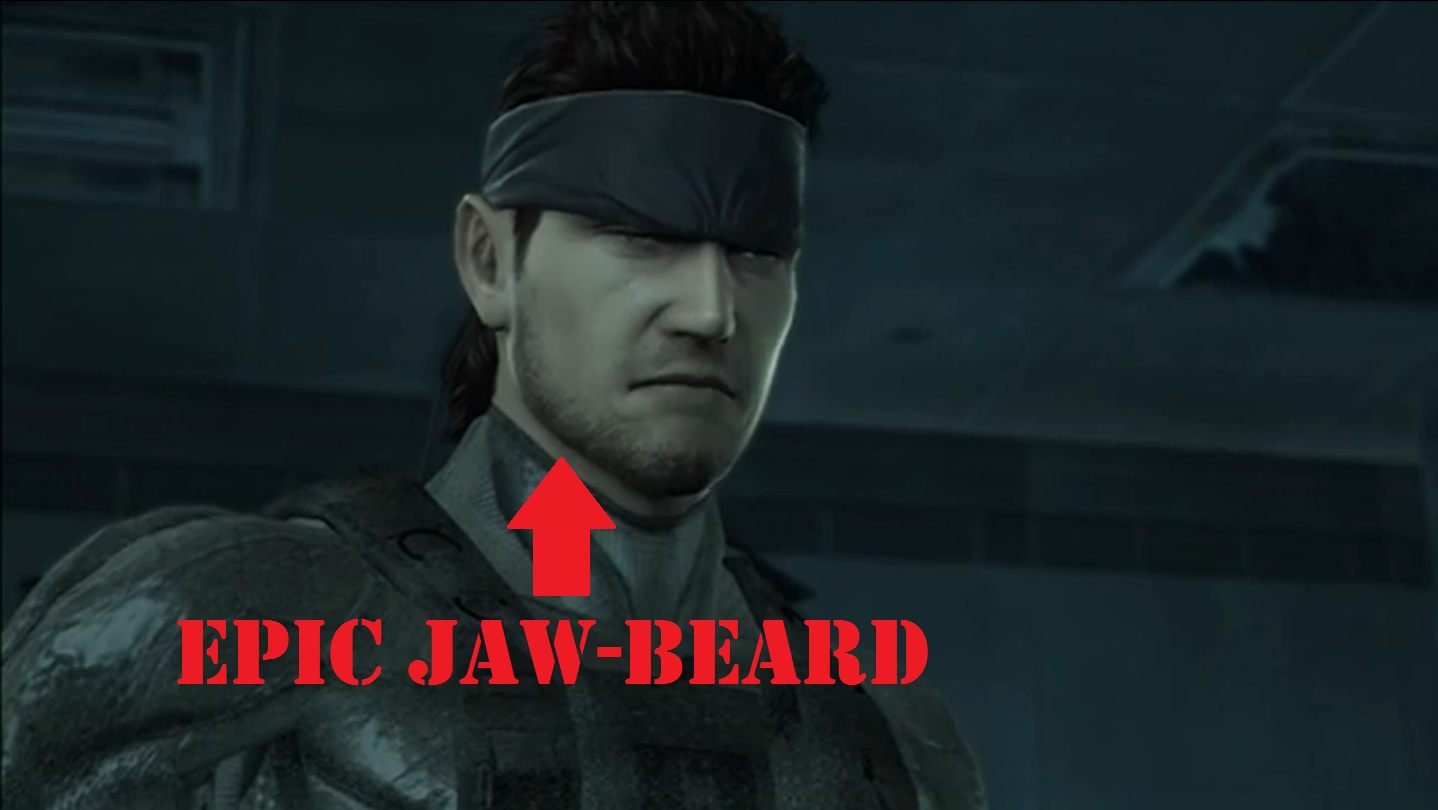
Epic jaw-beardOh, that’s right. I was playing Metal Gear Solid 4, a video game whose tough-as-nails protagonist has a rugged beard. I can only call it a jaw-beard: a line of thick stubble along the jawline. Since my own beard was strongest along the jaw, I wondered whether I might not manage a respectable jaw-beard. My hope is a forlorn one, but in a moment of quixotic stupidity, I resolved to try.

Why? Why have I returned to my folly as the dog to its vomit? What insights can I draw from my Sisyphean attempt to grow a beard? This is an opportunity for philosophical introspection. What can my patchy jaw-beard teach me about myself?

Is my beard a reaction to stagnation? After months of stressful transition, I have finally reached some shaky semblance of consistency—thank God. Does some small part of me rebel against the comfortable predictability that has settled over my life? Is my latest attempt to grow a beard a subconscious effort to escape the numbing influence of familiarity? That’s one possibility.

Is my beard an attempt to feel more grown-up? For all my twenty-something years, I don’t feel particularly competent or mature. I don’t feel very grown-up. Perhaps my beard is an attempt to instill some sort of confidence in myself as an adult—a hideous emblem of putting away childish things and embracing adulthood—a preemptive preparation against whatever grown-up challenges lie ahead. That’s another possibility.

The simplest explanation, of course, is that I think jaw-beards are cool. If that’s the case, my beard is merely a childish attempt to ape the good looks of a computer-generated character in a video game. Vanity of vanities, saith the Preacher, vanity of vanities; all is vanity.

A final possibility is that my beard has no sane explanation. It may be no more rational than the impulse a man feels when standing on a high place to jump to his death.

I suppose it doesn’t really matter. Like Sisyphus, here I go again.

This is probably a good time for me to mention that this blog post is fairly sarcastic, and not meant to be taken seriously.

382. TMTF’s Top Ten Worst Video Game Movies

Today’s post was written by Brittni Williams: writer, gamer, and movie aficionado. It is a truth universally acknowledged that video game movies suck, and Brittni was brave enough to review the worst ones ever made. For more musings from Brittni, find her on Twitter!

In the past decade or so, video games have increasingly cribbed from the world of film to deliver so-called “cinematic experiences” to gamers and non-gamers alike. This has brought us franchises like Half-Life, Call of Duty, Uncharted and The Last of Us, as well as films which called upon a wide range of auteur expertise, from Steven Spielberg to Michael Bay.

It’s a conundrum, then, why video game-based films have been largely unable to draw from the deep well of inspiration that inspired them in the first place. As anyone who harbors a passion for both can attest, it’s been a long and treacherous road of both critical and financial failures.

Following is a list of ten of the most impressively awful video game-movie adaptations: the cream of the crop of the worst of the worst.

[Editor’s note: The films on this list are not ranked numerically, as their sheer awfulness defies all attempts at neat categorization.]

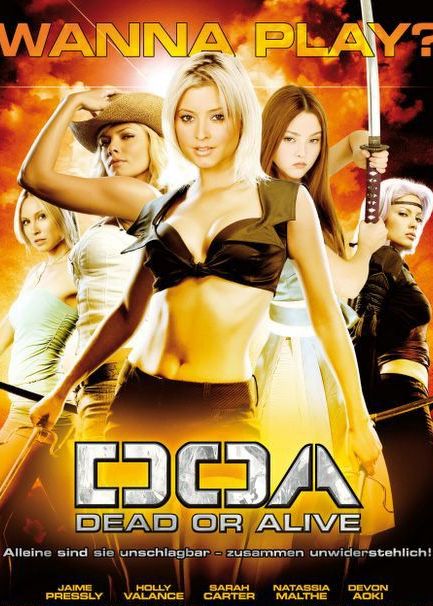
Dead or Alive (2007)

Bad video game movies - Dead or AlivePerhaps it shouldn’t be surprising that a game which derives most of its appeal from seductive female eye candy rather than a meaningful plot doesn’t translate very well to the big screen. Starring a roster of models-turned-actresses (Devon Aoki and Jamie Pressly both appeared on the runways of major designers in the early aughts) this movie is little more than a  middle-school boy’s fantasy brought to life. And it doesn’t help matters that DOA’s action scenes refuse to obey the laws of physics.

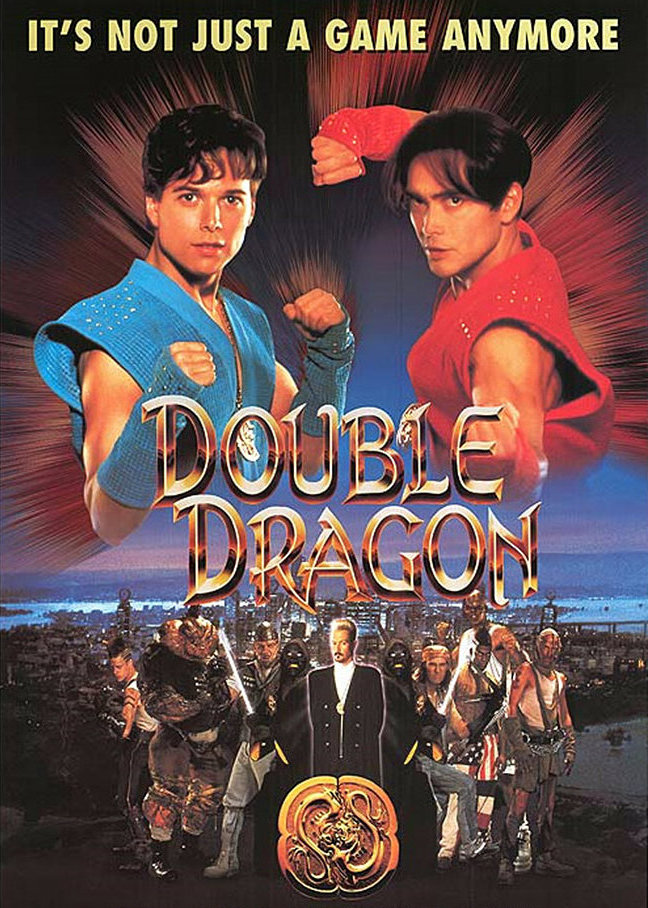
Double Dragon (1994)

Bad video game movies - Double DragonHere’s another video game film which put hardly any thought into its plot, which made a cinematic adaptation pointless. The movie, which is based very loosely on the game’s premise, is predictable and even somewhat racist. Alyssa Milano stars as the love interest of two brothers on the run from a gang of LA thugs hell-bent on recovering a lost talisman.

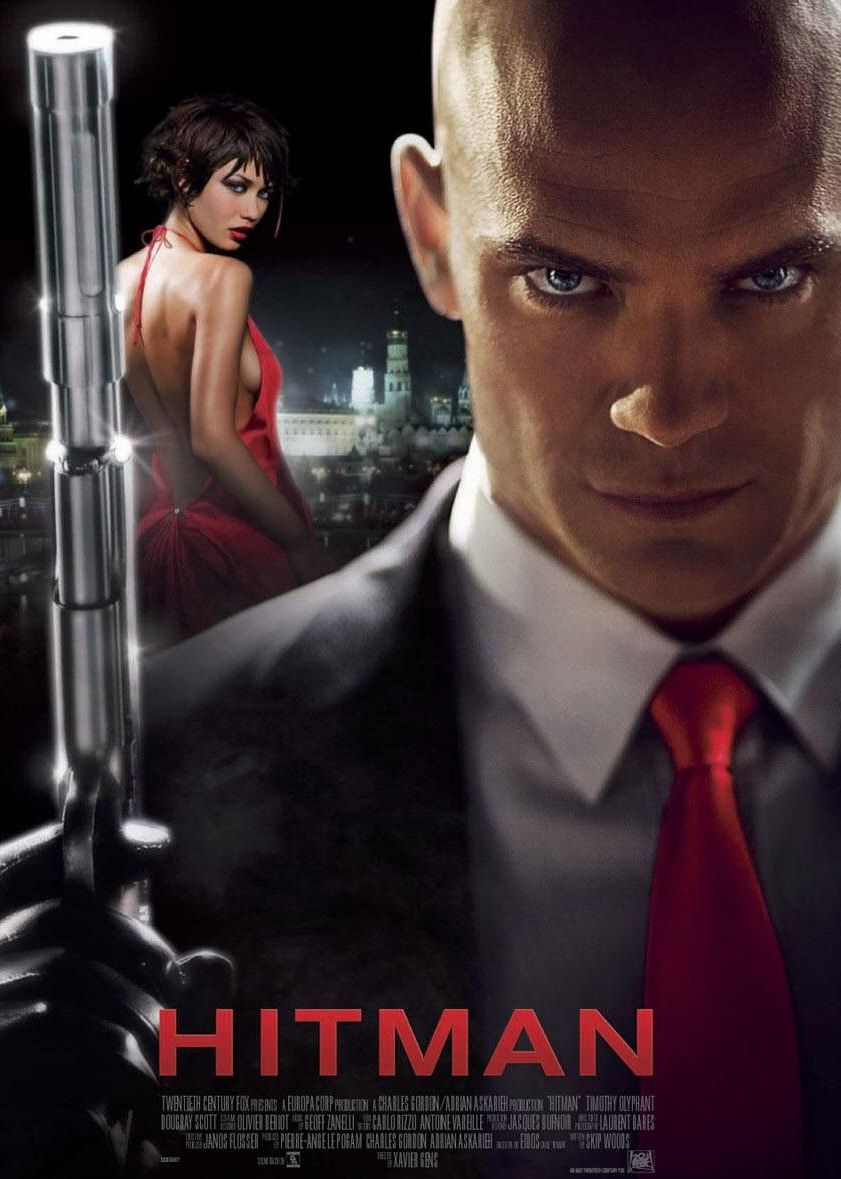
Hitman (2007)

Bad video game movies - HitmanOne would think that an action and adventure game with a fairly interesting story would work well condensed into a couple hours of film, but Hitman unfortunately couldn’t pull off this seemingly easy task—even with a worthwhile leading man, Timothy Olyphant, playing the Hitman. Of course, it didn’t help that the movie’s director, who seemed to have a true appreciation of the game, was pulled midway through production.

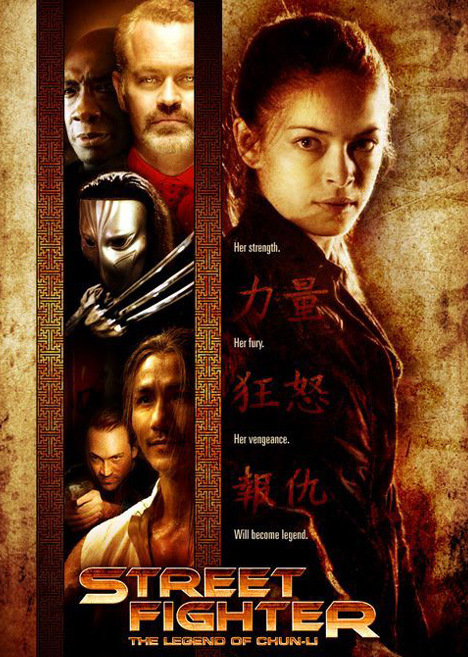
Street Fighter (2009)

Bad video game movies - Street FighterAnother fighting game. Another bizarrely bad plot. And cast. And directing. And just about everything. The worst part—among the many—is how seriously the movie takes itself despite being based on a game which doesn’t take its story seriously at all. Despite a few well-choreographed fight scenes, Street Fighter should have kept off the pavement and stuck around the arcade where it belongs.

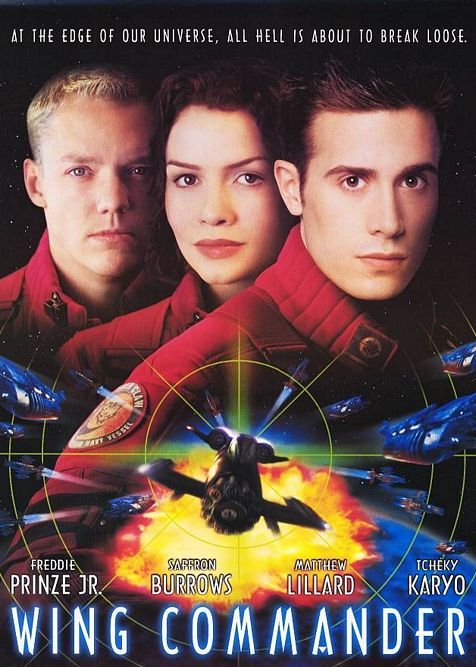
Wing Commander (1999)

Bad video game movies - Wing CommanderMost failed adaptations suffer from the disconnect between the game’s creation and the movie’s—particularly the absence of the creator. Unfortunately for Wing Commander, it had no such excuse as it was the game’s creator himself who directed this financial and critical bomb, and turned futuristic space ships into flying hunks of junk.

Mortal Kombat: Annihilation (1997)

Bad video game movies - Mortal Kombat AnnihilationThe original Mortal Kombat just barely skated along the silliness/self-awareness line to be accepted into guilty pleasure territory. This sorry sequel unfortunately fell over the mark as it threw away what was good in the original and kept all the bad, the shallow acting (from Liu Kang in particular). In the end, you’re probably better off wasting your quarters trying to beat Tekken 2.

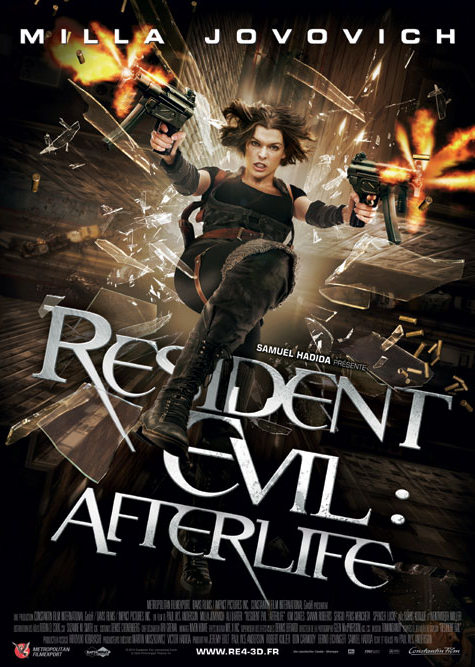
Resident Evil: Afterlife (2010)

Bad video game movies - Resident Evil AfterlifeThe title is appropriate, considering the fact that this was just another sequel that disappointed fans of the previous adaptations. A film series that has surely overstayed its welcome on Earth (the franchise continues to live on via iTunes and various streaming services), this incarnation in particular lacked compelling action scenes, and of course offered little in the way of substantial storytelling. Dull and lifeless, here the afterlife brings no promise of redemption.

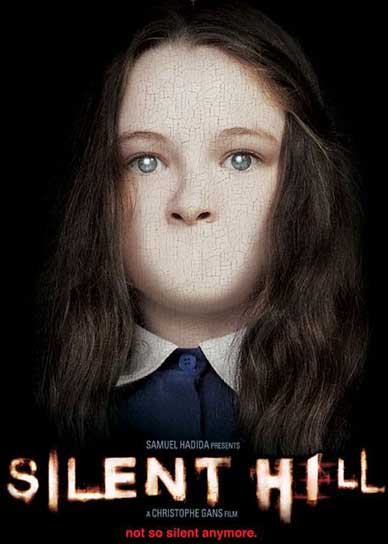
Silent Hill (2006)

Bad video game movies - Silent HillVideo games are often panned for their abysmally poor writing, so it’s rather strange that movie makers are unable to remedy that problem with the various talents at their disposal. Silent Hill is another adaptation that is utterly destroyed by a poor effort from screenwriters, suffering from both a baffling plot and cringe-worthy dialogue. The film might be an aesthetic achievement but it flounders in every other regard.

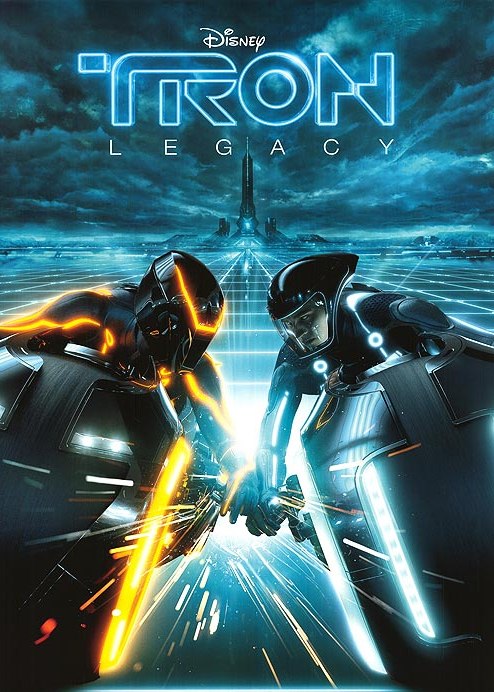
Tron Legacy (2010)

Bad video game movies - Tron LegacyThis adaptation offers stunning visual spectacles, but little else. The studio definitely got its money’s worth from the aesthetically-pleasing action scenes and remarkable depictions of new technology, but the lack of a real story and a compelling human element is probably why they didn’t make much of their money back. From start to finish, the sleek form swallows the shallow attempts at a compelling storyline.

BloodRayne (2005)

Bad video game movies - BloodrayneOf course, the worst of the worst of the worst was directed by Uwe Boll. The video game was actually well-regarded for its inventive story, so it’s a shame that movie magic and a decent cast couldn’t break free from the double curse of video game adaptations and Uwe Boll. Everything about this picture is painful.

Are video game films forever doomed to failure? Considering the fact that modern games are essentially cinematic experiences in and of themselves, the (growing) heap of filmic disasters only serves as further proof that the bridge from console to megaplex is perhaps one best avoided. Life-like is good enough, and there is simply no replacing the experience of role-player fantasy.

376. Metal Gear Solid Absolutely Needs to Be a Movie

I realize that most of the people who read this blog don’t play video games, so this post will be ignored by nearly everyone in the universe. I accept this. You see, there are sometimes truths so obvious and self-evident that they must be stated—nay, shouted from the rooftops!—regardless of whether anyone listens.

I may be only a voice crying in the wilderness, unheard and unheeded, yet this must be known: Someone needs to make a Metal Gear Solid movie.

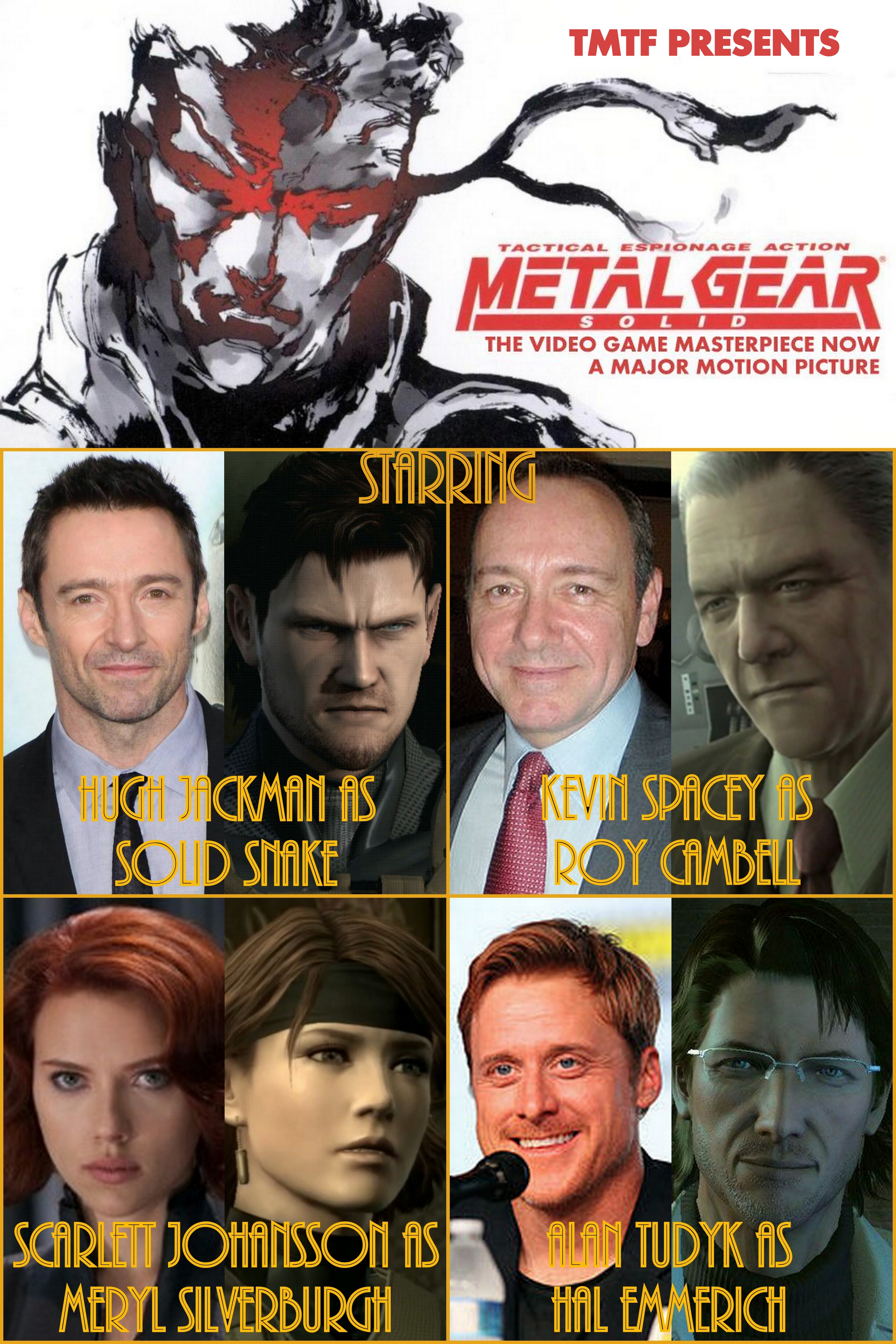
Metal Gear Solid movie (with TMTF logo)How can I describe the Metal Gear Solid series? If someone blended Tom Clancy’s Cold War thrillers, the James Bond movies, some Batman and X-Men comics, and all of Quentin Tarantino’s films, Metal Gear Solid would be the stylish, complex, campy, violent, and weird-as-all-heck result.

Released in the late nineties for the PlayStation, the first Metal Gear Solid follows Solid Snake as he infiltrates a nuclear weapons facility on a remote Alaskan island known as Shadow Moses. The facility has been seized by FOXHOUND: an elite unit of the US military that has gone rogue, taken two high-profile hostages, and acquired a weapon called Metal Gear REX. This superweapon, a bipedal tank armed with nuclear warheads, is now in the bloodstained hands of terrorists. Snake’s orders are to rescue the hostages and neutralize the Metal Gear before FOXHOUND can carry out its threats of nuclear reprisal.

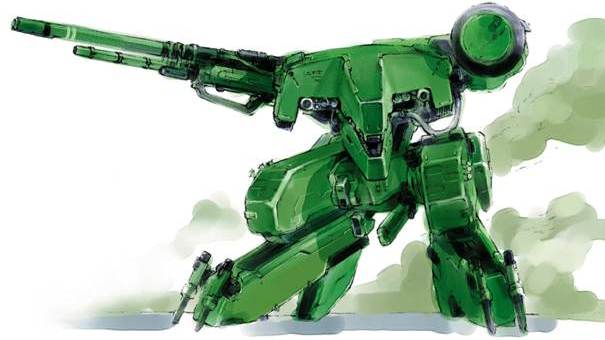
Metal Gear REX artMetal Gear Solid could make a terrific movie. In my last post, I discussed three pitfalls in adapting video games into movies. First, many games lack a strong story; second, too many filmmakers make films that appeal only to people who play games; third, the cyclical structure of most video games can’t be compressed into movies.

Metal Gear Solid can easily dodge all of these problems. The game has a strong story, complete with a highly cinematic presentation. (The game’s director, Hideo Kojima, is a film aficionado whose tagline on Twitter reads: “70% of my body is made of movies.”) The game’s plot requires little backstory or gaming knowledge, and can be easily revised to require none.

Finally, while Metal Gear Solid only slightly follows the ubiquitous looping structure of video games. A few edits to the story would yield a focused narrative that lends itself beautifully to film.

What should be cut? The two hostages taken by FOXHOUND could be reduced to one. Several characters—FOXHOUND member Vulcan Raven and cyborg Gray Fox, among others—could be removed. The plot could be streamlined by leaving out the less interesting parts of Snake’s mission from the original game. One or two action scenes could be omitted, and the others rearranged for the sake of pacing. Finally, the villain’s angsty monologues (which are silly even in the game) could be extremely abridged.

What should be kept? I recommend abbreviating the story’s action-packed climax, keeping Snake’s epic battle against the Metal Gear and subsequent fistfight with the villain, but leaving out the vehicle chase. I also suggest keeping the character of Psycho Mantis, a member of FOXHOUND. This deranged psychic isn’t essential to the plot, yet remains one of the most iconic elements of the story. He is the kind of villain who peers into the flawed hero’s soul and pronounces judgment on him. In the hands of a good writer, Mr. Mantis could contribute a lot to the film’s mood and characterization.

Whatever else is kept for a film adaptation, Snake must, at some point, outsmart his enemies by hiding under a cardboard box.

In a perfect world, the Metal Gear Solid film would be written by David Hayter: the screenplay writer whose credits include X-Men and its sequel X2—and also, by glorious coincidence, the actor who voiced Solid Snake in the Metal Gear Solid games. Mr. Hayter actually wrote a treatment for a Metal Gear Solid movie, but it was rejected. Ours is truly a broken world.

My top picks to direct a Metal Gear Solid film are J.J. Abrams and Jon Favreau, but I would settle cheerfully for any competent action movie director. (The worst potential directors are Michael Bay and Uwe Boll; they should never direct a Metal Gear Solid movie… or any movie, honestly.) The obvious choice for the film’s composer is Harry Gregson-Williams, who wrote much of the score for the Metal Gear Solid games.

MGS artThe casting for Solid Snake is of utmost importance; I consider it no exaggeration to say a Metal Gear Solid movie would be made or broken by Snake. His actor must appear as tough, determined, and dangerous as any action hero. However, that action-movie persona must be accompanied by two things: first, a dry sense of humor; second, an attitude of philosophical resignation—a weary resignation to the fact that he is nothing more than a pawn in the hands of authorities no less corrupt than his enemies.

If Solid Snake is played as merely an action hero, the movie is lost. He is more than that, and also less. Appropriately to the title, he is a gear in the vast, impersonal machines of warfare and politics. He doesn’t make the rules or choose his morality. His mission is to do what he is told. Snake’s tired acceptance of his fate, along with an irrepressible vein of humor, are what make him such an interesting character.

I think Hugh Jackman would make an excellent Solid Snake.

My other casting picks are Kevin Spacy as Roy Cambell, Snake’s commanding officer; Scarlett Johansson as Meryl Silverburgh, Cambell’s niece stationed on Shadow Moses; Alan Tudyk as Hal “Otacon” Emmerich, the nerdy designer of the Metal Gear weapon; Tom Hiddleston as Liquid Snake, the leader of FOXHOUND; Willem Dafoe as Psycho Mantis, a FOXHOUND member and homicidal psychic; Anne Hathaway as Sniper Wolf, another FOXHOUND member and expert sniper; and Jeff Bridges as Revolver Ocelot, Liquid Snake’s enigmatic ally. Besides being a film fanatic, Hideo Kojima has a staggering ego, so he could cameo as an enemy soldier or something.

There have been persistent rumors of a Metal Gear Solid movie for years, but nothing is certain. This is a movie that needs to be made. Please make it happen, Hollywood.

375. Why Video Game Movies Suck

Name three good video game movies.

Yeah, that’s what I thought.

You see, video game movies suck.

Granted, movies about games as a medium are sometimes good, like Disney’s superb Wreck-It Ralph. I love that movie.

Wreck-It Ralph coverMovies adapted from games, however, are another story: a sad, depressing story. I’ve seen a number of video game movies, and most of them are awful.

Why is this? There are many excellent films based on books; why not on video games? There are at least three reasons.

First, many games have either no story or only the barest semblance of one.

The plot of nearly every Super Mario Bros. game, for example, consists of a monster (Bowser) kidnapping a princess (Peach) and a brave man (Mario) setting out to rescue her. That’s it. This story (and minor variations thereupon) appears in game after game after game.

For a video game, such a simplistic story is perfectly fine—after all, the story is just an excuse to play the game. What matters in the Super Mario Bros. games is the what of the adventure; the why is a minor afterthought. It’s such fun to guide Mario through challenging levels that his reason for facing them in in the first place is hardly more than a footnote.

Unlike a game, which can be fun for its own sake, a film needs a story. The what is not enough; it also needs the why. Many video games don’t offer a strong enough why to be adapted into compelling movies.

The second reason video game movies often fail is that too many filmmakers, assuming their film has a guaranteed audience in fans of its source material, make it inaccessible to broader audiences: people who don’t play video games.

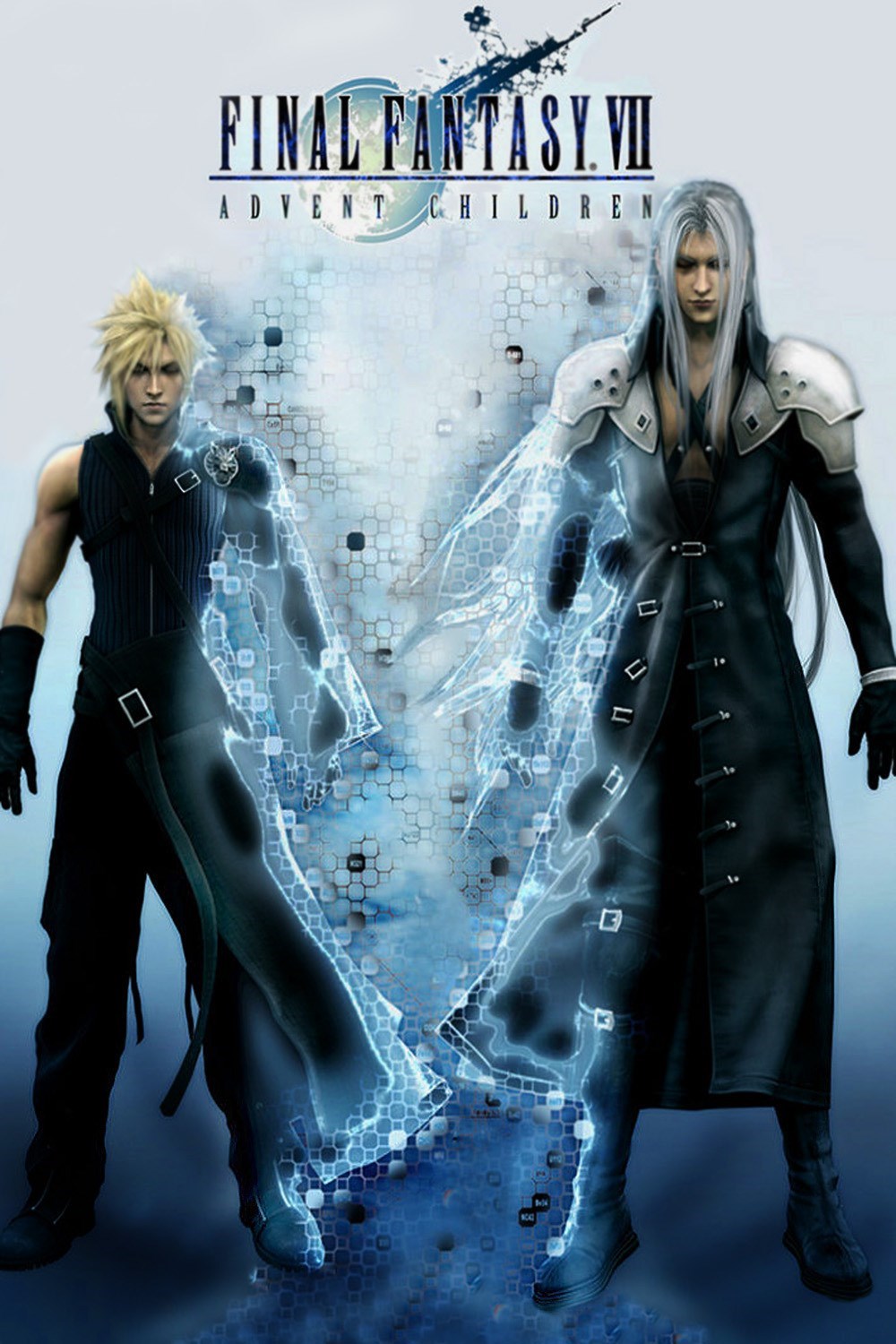
Final Fantasy VII - Advent ChildrenThe clearest example of this is my all-time favorite action movie, Final Fantasy VII: Advent Children. This computer-animated movie’s action scenes are ridiculous—this movie has a sword fight on motorcycles, guys. The animation looks great nearly a decade after the film’s release, the music is excellent, the characterization is compelling, and the ending is genuinely touching.

However, Advent Children has one damning flaw: it’s practically incomprehensible to anyone has hasn’t played an old PlayStation game called Final Fantasy VII. Even for those of us who have played the game, the movie can be a little tough to follow. This is a shame. In every other respect, Advent Children is an excellent film—but that excellence is locked away from most audiences.

The third reason games hardly ever make good movies is in the medium itself. Most video games are a repeating pattern of stages; many are nothing more than a series of levels. That’s hard to adapt to film.

Other games offer a more subtle take on this structure. Role-playing games, for example, generally feature a robust story, yet follow the same pattern: the player progresses from a town, to the open world, to a dungeon, and then back to a town, there to begin the cycle anew.

This approach works well for video games as a medium. It even works for television, in which a set of episodes allows for repeated rising and falling action. A film, however, is too short for this structure. The repeating pattern of a video game doesn’t fit in a movie. A game’s cyclical narrative can’t be compressed into a two-hour film.

Every now and then, however, there comes a game whose narrative isn’t a repeating cycle, but a focused story that could be brilliantly adapted to film. I can think of at least one video game movie that absolutely needs to be made… but I’ll save that for next time.

Are there any good video game movies?

Vide game movies that don't suckOf those I’ve seen, I can think of a few good ones. Professor Layton and the Eternal Diva, an animated film spin-off of the Professor Layton games, is accessible and charming, though it drags a bit. The aforementioned Final Fantasy VII: Advent Children boasts phenomenal action, epic music, and stunning visuals for viewers who don’t mind having no idea what the heck is going on. For those who like foreign films, Takashi Miike’s live-action Ace Attorney is really good, despite its absurd hairstyles.

Um, that’s it. Flipping heck, someone needs to make a good video game movie.

Question: Have you seen any video game movie that you would recommend? Let us know in the comments!

371. Ladies in Fantasy Fiction Need Better Armor

I’m no expert, but I’ve noticed a difference between armor for men and women in fantasy fiction: men wear more of it.

I’m no feminist, but I do believe in treating people with decency and respect. I’m also fairly pragmatic. Most female armor in fantasy fiction isn’t respectful or decent, and pragmatic it most certainly is not.

Here, for example, are male and female warriors from one of the Dragon Quest video games. In the game, they have exactly the same role on the battlefield. Is unreasonable to expect them to wear roughly the same armor?

Amor differencesIn the picture above, the male warrior gets a padded tunic over mail hauberk, along with leather gauntlets, a sturdy helm, a kite shield, and articulated armor plating for his legs. The female warrior, by contrast, gets a tiny mail blouse, half a mail skirt, and random bits of plate armor on her arms and legs.

There are several problems here.

The most glaring issue is sexism, of course. It just ain’t fair for male characters to be fully armored while female characters wear swimsuits. (I’ve touched upon this before.) It exemplifies the concept known as the male gaze: the way visual arts often assume the viewer is male. The male gaze ogles female characters or puts them in revealing clothes, like the chain mail swimsuit above. It’s insulting to women.

(For those ready with the “fantasy fiction is not supposed to be realistic” arguments, I believe at least a small amount of realism makes fiction more believable. If a woman wears dangerously revealing armor, there had better be a good reason for it! For those ready with the “you should stop taking everything so seriously” arguments, I don’t believe fiction is a valid excuse for sexism or double standards.)

This is not, however, a blog post about sexism. Nah, today’s post provides a more pragmatic rationale for giving female characters better armor: the kinds of armor worn by most female characters in fantasy fiction would get them killed.

Let’s take armor styles one at a time.

The chain mail bikini

Chain mail bikiniIt was challenging to find a picture illustrating this style of armor that wasn’t NSFTMTF. (For those who don’t know, NSFTMTF stands for Not Safe For Typewriter Monkey Task Force: a designation covering vulgar language, extreme violence, sexually explicit material, and any media related to Kristen Stewart or Justin Beiber.) Even the picture above pushes the boundaries of good taste.

The chain mail bikini describes any style of armor that (sometimes barely) covers only the naughty bits of a lady’s anatomy. I need hardly describe the practical difficulties of such armor. It exposes vital organs such as the stomach and lungs, providing practically no protection whatsoever. More often than not, what little armor is worn looks like it could fall off at any moment. High heels, which are often worn with chain mail bikinis, don’t allow for quick movement or proper balance.

Are there benefits to chain mail bikinis? I’m really reaching here, but I suppose they could offer good mobility, and might prove distracting to enemies.

Nah. Who am I kidding? Chain mail bikinis are completely useless.

The boob plate

Boob plate armorAs the name suggests, the boob plate is a breastplate with breasts.

Opinions are divided on the usefulness of the boob plate, but the most logical view is that it would probably kill you.

You see, armor doesn’t merely shield the body from sharp or spiky things. It also deflects the force of blows from weapons. A blow from, say, a club will do far less damage if it glances off a breastplate than if it strikes it squarely. In other words, armor is meant to deflect blows, not to absorb them.

The problem with boob plates is that they wouldn’t necessarily deflect blows away from the chest. They could also deflect them inward, funneling them into the cleavage between the breasts—and right into the wearer’s breastbone. Even if a weapon didn’t penetrate the armor, it could fracture the wearer’s sternum. Flipping heck, even falling forward could slam the ridge of metal separating the breasts into the breastbone, breaking it.

As it happens, people who wore armor usually wore padding beneath it, so a woman’s chest would probably be wrapped or padded and wouldn’t require a form-fitting breastplate in the first place.

The battle dress

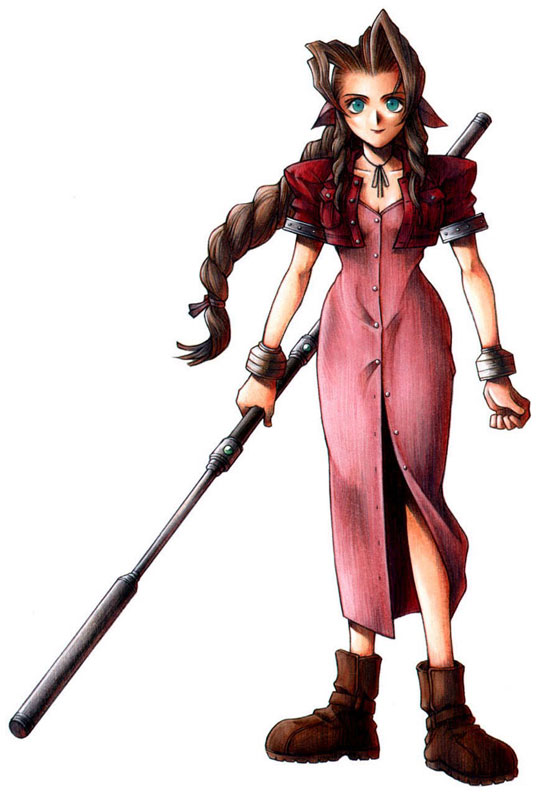
Aerith

A battle dress is a dress worn into battle. Like the boob plate, it’s fairly self-explanatory.

I applaud the battle dress for being less blatantly sexist than other styles of female armor… but it still gets low marks for practicality. Long skirts and dresses have the same problem as capes in The Incredibles: they get caught on stuff. A woman can hardly run, ride a horse, or vault over bushes in a dress. Sooner or later, it will snag on something.

Besides, dresses offer no protection… unless they have chain mail or plate armor sewn into them. Then, unless the armored sections are kept close to the body, such weighted dresses are even more likely to snag on stuff. Besides, any heavy part of the dress left hanging, such as a skirt or long sleeve, impedes movement by swinging awkwardly.

The sensible armor

Sensible lady's amorThe armor in the picture above isn’t perfectly practical—it should lose the flowing skirt, and the breastplate really ought to cover more of the abdomen—but it isn’t bad. (I would cut off the braid and add a helmet, but what do I know?) The shoulders, chest, and legs are protected, leaving the arms free and allowing bend at the waist for wielding so large an axe. The armor also looks awesome as all heck.

Women can wear more or less the same styles of armor as men, with minor adjustments for shoulder width. Even adding a slight outward bulge for breasts is fine, provided it doesn’t include the sternum-shattering cleavage mentioned above; a gentle convex curve can deflect blows as well as anything. Designing sensible female armor doesn’t have to be that difficult.

Is impractical lady armor ever appropriate in fiction? I suppose it has its place, such as in comedic tales and parodies of fantasy fiction. In more serious stories, styles of lady armor which would be useless in battle could be used for ceremonial purposes: parades, coronations, etc.

In the end, however, I think practical armor is definitely the best way to go.