116. Because I Am a Christian

While my command of the English language is redoubtable—well, adequate—my knowledge of Spanish is weak. I’ve read very little Latin American literature, and understood very little of what I’ve read.

There is one story, however, I will never forget.

Juan León Mera, the man who wrote the lyrics to Ecuador’s national anthem, penned a story titled “Porque Soy Cristiano,” which translates to “Because I Am a Christian.” I had to read it for one of my Spanish classes in middle school.

It’s the story of a man whom a military officer treats brutally during one of South America’s many civil wars. The officer eventually cuts off the man’s arm with a machete and abandons him. Many years later, the officer is injured (or becomes sick; I don’t recall exactly) and is rescued by a one-armed peasant.

Of course, the peasant is the man whom the officer had maimed years before. Although he recognizes the officer, the peasant chooses to care for him instead of exacting revenge. When the officer learns the identity of his rescuer, he’s staggered.

“Why have you helped me?” he asks.

The peasant replies, “Because I am a Christian.”

It’s only a few words, but it’s enough. Everyone understands. Christian means forgiveness. Christian means compassion. Christian means love—not romantic nonsense, but a simple resolve to treat other people decently.

Things have changed.

To many people today, Christian means hypocrisy. Christian means superstition. Christian means homophobia, prejudice, legalism, ignorance, arrogance and prudishness. Christian means spending an hour sitting in church every Sunday.

Many followers of Christ have abandoned the word Christian due to its negative connotations. I don’t blame them, and yet I don’t agree. I think the word Christian can be redeemed. How can we redeem it? What can we do?

Do we even have to ask?

Let’s redefine Christian. Better yet, let’s stop redefining it. Its original meaning was awesome.

Why do I read those boring prophecies and genealogies in the Bible? Why do I refrain from lying and swearing and being an Internet troll? Why do I even try to treat other people with kindness and respect?

Because I am a Christian.

115. TMTF’s Top Ten Manly Men in Literature

We here at TMTF are experts on manliness. Some of us have the undeniable advantage of actually being men, giving us considerable insight into the manly virtues of loyalty, courage, honesty, bravery, integrity, humility and resourcefulness.

I personally possess a fascination for bladed weapons, an appreciation for beards and a liking for cartoons about magical rainbow ponies—all manly attributes.

Today’s top ten list features some of the manliest men in literature. A few rules apply to this list. Characters from books I’ve not read are not allowed on the list, and only one character is allowed per author. For the purposes of this list, manliness is defined as characterized by virtues generally associated with men.

By this definition, literary characters such as Odysseus and James Bond are not manly. They are intelligent, strong and brave, but their moral flaws (arrogance, dishonesty, lustfulness and disregard for the value of human life, to name but a few) disqualify them for this list.

Without further introduction, TMTF is excited to present…

The TMTF List of Top Ten Manly Men in Literature!

10. Sydney Carton (A Tale of Two Cities by Charles Dickens)
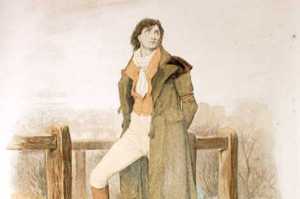
Sydney Carton being wistful.

Sydney Carton is a hopeless mess of a man who wallows endlessly in self-pity. Although an interesting character, he wouldn’t even come close to making this list if it were not for his incredibly manly, stoic, selfless sacrifice in the final chapters of the novel. Heroism often seems pretentious, but true heroes quietly accept the burden of their fate. Sydney atones for a lifetime of unmanly weakness with one powerful act of heroism.

9. Domovoi Butler (Artemis Fowl series by Eoin Colfer)

That’s a lot of neck.

The Artemis Fowl books are not sophisticated literature. In fact, they’re on roughly the same literary plane as the Twilight novels. I must confess to liking the Artemis Fowl books anyway. What they lack in substance and style, they provide in charm, whimsy and delightful absurdity. Domovoi Butler is the, er, butler of Artemis Fowl, an Irish criminal mastermind who also happens to be a twelve-year-old boy. Butler is not only a manservant, but also a bodyguard and a very dangerous man. Apart from his fierce and selfless loyalty to Artemis, he consistently manages to save the life of every person in the room every time there’s a crisis—which, in the Artemis Fowl books, is pretty much every chapter.

8. Remus Lupin (Harry Potter series by J.K. Rowling)

That is one manly ‘stache.

In spite of his strength, girth and massive beard, I don’t consider Rebeus Hagrid the manliest man in the Harry Potter books. (He’s not even a man, technically speaking.) No, that honor goes to Remus Lupin. (He’s also not exactly a man, but I’ll bend the rule this time.) Lupin is an eccentric, disheveled professor who turns out to possess remarkable kindness, humility, courage and common sense. Lupin also possesses a dark secret, a tragic burden which never seems to prevent him from being friendly and cheerful.

7. Radcliffe Emerson (Amelia Peabody series by Elizabeth Peters)
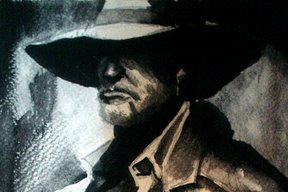
I couldn’t find an image of Emerson, so have a picture of Sean Connery being a gaucho.

Known to Europeans as a noted Egyptologist and to Egyptians as “the Father of Curses,” Radcliffe Emerson is notorious for losing his temper, swearing constantly and making fantastic archeological discoveries. Emerson may be gruff, but he loves his family and treats Egyptians with deep respect—unlike most of his nineteenth-century European colleagues, whose prejudice toward “the locals” frustrates him deeply. Beyond Emerson’s ostentatious masculinity—he’s a handsome, muscular man who dislikes wearing more clothes than absolutely necessary—he demonstrates many virtues of true manliness.

6. Gabriel Syme (The Man Who Was Thursday by G.K. Chesterton)
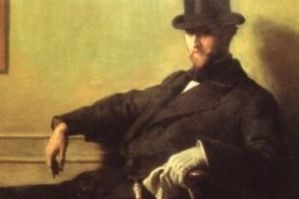
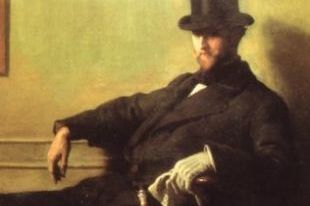
That is a fabulous hat.

The Man Who Was Thursday begins with a poet stumbling upon a secret society of anarchists, and promptly convincing them to elect him into their council of supreme leaders. The poet, who also happens to be a police detective, embarks on a mad journey to protect innocent people from the nihilistic terrorist known only as Sunday. In the face of danger, despair and absurdity, Syme never loses his resolve to do the right thing. His calm bravery in the face of extreme danger is incredible, and his response to tragedy is to maintain his hope and sense of humor. As a bonus, Syme is delightfully witty.

5. Ned Land (20,000 Leagues Under the Sea by Jules Verne)
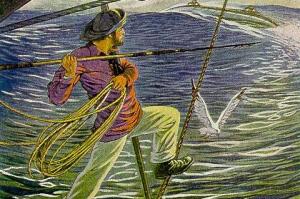
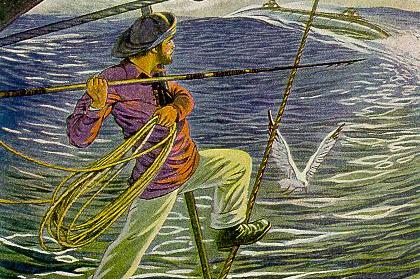
That seagull is toast.

As I’ve mentioned before, 20,000 Leagues Under the Sea has basically four characters, three of whom are obsessed to various degrees with science. The fourth, Ned Land, is a refreshing exception. A sensible, short-tempered harpooner, Land keeps his companions grounded (forgive the pun) every time their resolve falters. Despite disliking his host, Captain Nemo, Land doesn’t hesitate to save his life. Add bravery and a fierce love of life, and Ned Land turns out to be quite a manly fellow.

4. Adam Bede (Adam Bede by George Eliot)

Adam Bede being even more wistful than Sydney Carton.

Stoicism is a manly virtue—not the absurd idea that men should go out of their way to suffer, nor the equally ridiculous notion that men must always hide their feelings, but the decision not to embitter the lives of others by complaining about troubles that can’t be avoided. Adam Bede has it rough. His life seems to be one tragedy after another. He perseveres, never complaining, always working, doing his best to provide for his loved ones and calmly accepting every blow dealt him.

3. Jean Valjean (Les Misérables by Victor Hugo)
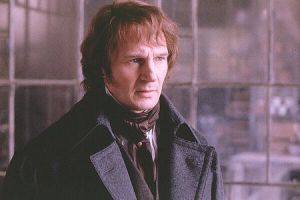
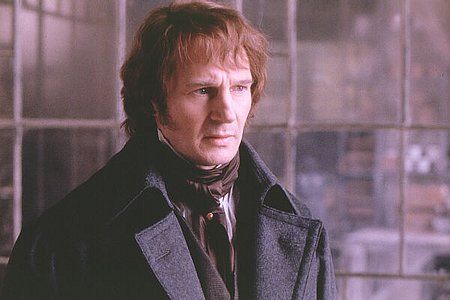
Take notes, Batman.

Jean Valjean is more awesome than Batman, and they’re both awesome for exactly the same reasons: courage, stoicism, resourcefulness, compassion and an undying obsession with atoning for a mistake. What makes both characters so compelling is that they pay for their sins many times over and yet can’t overcome their guilt. They consider themselves monsters when they’ve become saints. Jean Valjean is humble to the point of self-effacement, unable to see what is plain to almost everyone else in the book: he is a great man, not to mention a manly one.

2. Aragorn (The Lord of the Rings by J.R.R. Tolkien)
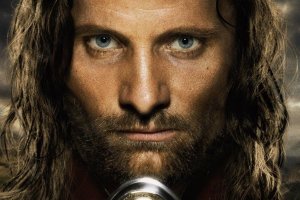
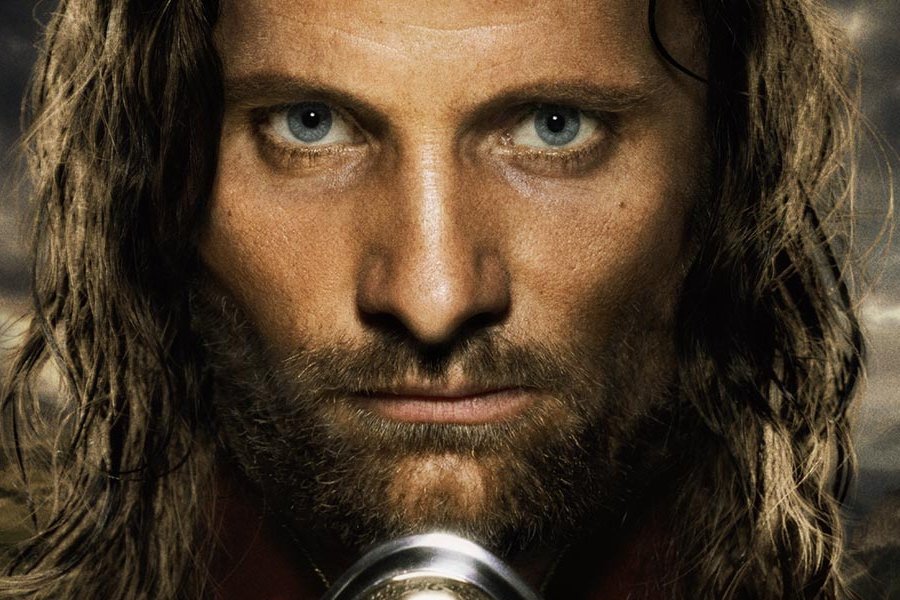
Another manly man with fine facial hair.

Aragorn has a troubled past, but he’s too busy defending Middle Earth from the looming threat of Sauron to waste time brooding over it. (Pay attention, Cloud Strife.) Aragorn is almost messianic in his heroism: a brave warrior, gentle healer and strong leader. He does not succumb to the temptations of the Ring, a powerful but evil relic, but humbly does his best to ensure its destruction. Ironically, the greatest hero of The Lord of the Rings isn’t Aragorn. An ordinary little person named Frodo destroys the Ring. Aragorn is quick to praise Frodo’s heroism over his own, and that is part of what makes Aragorn one of the manliest men on this list.

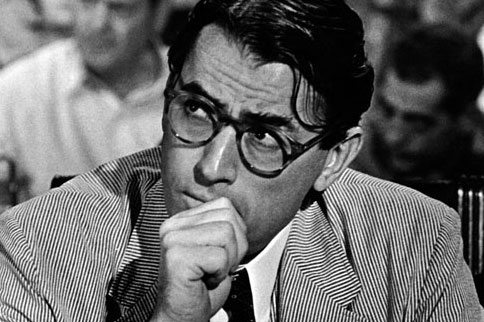
1. Atticus Finch (To Kill a Mockingbird by Harper Lee)

Ladies and gentlemen, men don’t come manlier than this.

I can think of no manlier man in all literature than Atticus Finch, the soft-spoken lawyer from To Kill a Mockingbird. Where do I even begin? Atticus can fire a gun with incredible accuracy, a skill of which his children are unaware because he dislikes violence and refrains from showing off. Atticus does his best to respect and understand every human being, and risks his safety to protect a prisoner from a mob. Most significantly, he willingly throws away his reputation as a lawyer to defend an innocent man. Blinded by racial prejudice, most white people assume the defendant, a black man, to be guilty. Knowing the trial will almost certainly end in a guilty verdict for the defendant, Atticus defends him anyway. Through all this, Atticus doesn’t complain once. He bears every burden patiently, doing the right thing and never losing hope—a true paragon of manliness.

O people of the Internet, what manly literary characters would you add to this list? Let us know in the comments!

109. Science Fiction Vs. Fantasy

The title of this post may be a little misleading. If you were expecting an epic death battle between two literary genres, I’m afraid you will be disappointed. The purpose of this post is to take a quick look at why science fiction and fantasy—two literary genres often associated with each other—are different.

There are similarities, of course. The most striking is that fantasy and science fiction aren’t realistic. Fantasy is unrealistic because of supernatural elements such as magic and monsters. Science fiction, however, doesn’t involve the supernatural. Its unrealism comes from scientific discoveries or developments in technology, society and history that haven’t occurred.

Let’s start with science fiction.

Since the emphasis of science fiction is naturalistic, the genre focuses on the development of human society. Robots, spacecraft and laser weapons reflect the evolution of the human race.

The lack of supernatural elements in science fiction precludes any kind of divinity or absolute morality. Because of this, the genre doesn’t usually depict struggles between good and evil. The ultimate goal of characters in science fiction is usually survival, not moral triumph. What matters is the continued existence of the human race.

Due to this lack of absolute morality, the themes of science fiction are usually psychological, ethical and existential, not moral or religious.

Although it’s often paired with science fiction, fantasy is fundamentally different.

Since the emphasis of fantasy is the supernatural, the genre traditionally places little importance upon the development of human society. Cars, computers and guns are replaced with horses, scrolls and swords.

The supernatural elements in fantasy often indicate some kind of absolute morality, whether a standard good-versus-evil morality (e.g. The Lord of the Rings), a morality based upon maintaining cosmic balance (e.g. A Wizard of Earthsea) or some other moral system. The typical goal of fantasy characters isn’t merely survival, but moral or cosmic victory.

Due to the presence of absolute morality, the themes of fantasy are usually philosophical, moral and religious, not psychological or ethical.

In a previous post presenting a short, untidy and highly idiosyncratic history of fantasy, I made the observation that many of fantasy’s greatest authors have been Christians: George MacDonald, J.R.R. Tolkien, C.S. Lewis and Madeleine L’Engle, among others. I think it’s no coincidence that Christians, who believe in the existence of the supernatural and an absolute moral law, should leave such a profound mark upon a literary genre defined by supernatural phenomena and moral struggles.

Science fiction and fantasy are both unrealistic, but for opposite reasons. Fantasy is characterized by the supernatural, science fiction by a naturalistic worldview. These genres are opposite sides of the same coin.

What about stories like Star Wars or Star Trek that are considered science fiction and yet involve the supernatural? Consider the Force in Star Wars. It isn’t merely a scientific phenomenon, but a spiritual force. The Jedi aren’t scientists, but monks. Even so, Star Wars is usually considered a science fiction franchise. It has aliens and space battles, after all.

I think stories like these are sort of a hybrid genre. Let’s call it science fantasy. Stories in this mixed-up genre tend to demonstrate the outward characteristics of science fiction—advanced technology, space travel and so on—while expressing the moral and philosophical themes typical of fantasy fiction. Final Fantasy is a fine example of science fantasy: magic, lasers, swords, spacecraft and an unmistakable struggle of good against evil.

In the end, I believe science fiction and fantasy belong together. These genres represent radically different approaches to the same concept: a world unlike our own.

Which genre do I prefer?

Fantasy, of course. It has dragons.

106. How to Make Christian Media Awesome

Today’s post was written by Paul McCusker, veteran writer and director for Adventures in Odyssey and Focus on the Family Radio Theatre, and author of numerous books and plays. (For more from Paul, check out his website!) Since his work in Christian media has been phenomenal, I could think of no better person of whom to ask the question: “Why does Christian media so often fail, and how can we make it better?”

In the thirty years I’ve spent as a writer I’ve often heard Christians complain about the sub-standard quality of the Arts in modern Evangelical Christendom. The lament is that films, novels, plays, music and all other forms of Art seem to suffer at the hands of well-meaning Christians. I have launched this complaint myself at one time or another. And some might argue that I’ve contributed to the problem, considering my varied career as a writer in some of those fields.

Before we complain too much or too often, I think it helps to ask a few questions just to clarify what we’re talking about. What do people mean by “sub-standard quality”? Sub-standard compared to what? Are we measuring against the secular realm, which certainly has its share of flops (maybe even more if you consider the percentages)? Or are we measuring against something else? If so, what?

If nothing else, we need a coherent definition of success. For example, how do we measure artistic success? Is it based on a sense of fulfillment and experience—a story or song hits in all the right ways for the audience? Or maybe it’s the fulfillment and experience of the artist, somehow shared with others? I once read how the composer Ralph Vaughan Williams stated that he wasn’t sure if he liked it one of his symphonies, but it was certainly what he meant to say when he wrote it.

Are we measuring according to financial success? Is a great story something less than a great story if a lot of people don’t buy it? Or maybe we’re creating sub-standard art because we don’t have the right level of investment at the start? More money means better effort? Or does it?

Or are we measuring according to spiritual success, tallied by the number of people who are drawn closer to Christ in one way or the other?

These are the kinds of questions we must ask before applauding or dismissing the efforts of Artists. I’ve been moved by stories that I knew were not very well-made. Equally, I’ve been unmoved by stories because the flaws were impossible to look past. I’ve shrugged at big-budget films that should have gotten it right and didn’t. And I’ve watched in wonder at low-budget films that combined plot, character and theme in near-perfection.

All these questions aren’t meant to evade the issue. I’ve wrestled with them repeatedly over the years—from project to project, and audience to audience. There are so many factors an Artist in any discipline has to consider. But those factors aren’t always clear to the unwary. And success may only be an elusive hope, no matter what we do. But let’s allow that we should always do our best. Here are a few suggestions how.

I would suggest that any Artist—Christian or otherwise—must know the disciplines of Art. We must learn the craft. Master it, as much as it can be mastered. Do our very best while recognizing our limitations and the limitations of the Art we hope to master. Understand the objective rules of Art while appreciating the subjective experience people will have of it. Learn, learn and keep learning.

We must never do, nor accept, less than the very best, even if people seem to grow closer to God because of it. Well-intended rubbish is still rubbish. God can redeem our very worst efforts, but we mustn’t keep putting Him in a position where He has to. Yes, we can be forgiving about poorly crafted Art, but we mustn’t let that forgiveness excuse the flaws in a poor effort.

We have to remember that every Artistic effort has its own choices and challenges and opportunities for mistakes. The goal is to learn from those mistakes this time in the hope we won’t repeat them again next time. We learn—and we learn again.

It’s not popular to suggest it, but I believe we must understand for whom we write. Who are they? What are they expecting from us? (And if we don’t like the answer to that question, then we may be writing for the wrong audience.) It’s easy to look down our artistic noses at the very people we want to communicate with—especially when they’ve rejected us. Personally, I’m inclined to want to assume the best about my audience. I suspect that they are a lot smarter than me—and haven’t been proven wrong—and try to write accordingly.

None of this has to do with being “successful” in media, by the way. It’s only part of the equation. Our “success” as Artists is often determined by sales-people, distributors, producers, marketers, and a large number of professionals who will impact what we do and how we do it. In that world, we have to learn their rules—and try to play by them—until someone creates new rules for us to learn and follow. That’s yet another reality.

Even as I guest-write this blog, I’m aware that there’s someone looking over my shoulder, representing his audience, determining whether or not I’ve come close to what he asked me to write. And as I wind up, I have to paraphrase Ralph Vaughan Williams once again: I don’t know if I like what I’ve written, but it’s what I meant to say.

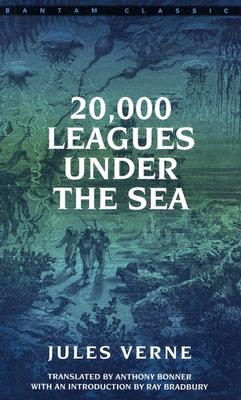
95. TMTF Reviews: 20,000 Leagues Under the Sea

Long ago, when Victor Hugo was writing masterpieces like Les Misérables, another French author was writing novels about submarines, prehistoric creatures and hot-air balloons: Jules Verne, called the Father of Science Fiction.

20,000 Leagues Under the Sea is widely considered to be Verne’s greatest work.

Is it?

20,000 Leagues Under the Sea is a superb novel, blending adventure, fascinating themes and the intriguing characterization of the man who calls himself Nemo—Latin for Nobody.

The novel begins in the year 1866 with the appearance of an enormous seagoing creature. Larger than any whale, it glows with a strange light and eventually tears a hole in the hull of a ship. Professor Aronnax, the narrator of the novel, sets out on a ship with his faithful valet Counseil and a crew devoted to finding and destroying the menace of the sea. When Aronnax, Counseil and a harpooner named Ned Land end up stranded on the back of the creature, they discover it’s actually a submarine. Its captain, the enigmatic Captain Nemo, welcomes them aboard, and so begins an incredible journey under the sea.

20,000 Leagues Under the Sea is a gripping read for at least three reasons.

First, Verne paints a fantastic picture of the underwater world, a world teeming with wondrous creatures and marvelous landscapes—a world as strange as another planet, yet just beneath the surface of the ocean.

Second, the Nautilus, Nemo’s submarine, is fascinating. The reader is privileged along with Aronnax and his companions to discover the secrets of the submarine little by little, with Nemo patiently explaining each of its major components. How could such a machine be built in secret? How did Nemo assemble a crew, and who are his mysterious crewmembers? Why did Nemo build the Nautilus in the first place?

This brings us to the third element of suspense in the novel: Who in blazes is Captain Nemo?

Nemo’s characterization is amazing. The polite, brilliant, sardonic engineer to whom the reader is introduced early in the book is gradually revealed to be—well, I won’t say anymore here. As his motivations become clearer, he himself changes before the reader’s eyes. More than the wonders of the sea and the submarine, Nemo kept me interested in the novel.

Sadly, apart from Captain Nemo, there aren’t many engaging characters in the novel. In fact, there aren’t many characters at all.

Nemo, Aronnax, Counseil and Ned Land are pretty much the only people in the novel. One or two other characters are introduced in the early chapters before Aronnax and his companions board the Nautilus, but they’re forgettable. Nemo’s crew is faceless and voiceless; the only member who makes any lasting impression is Nemo’s second-in-command, a short, incomprehensible man who makes few appearances.

Aronnax is mildly interesting. Ned Land is more engaging, with a down-to-earth personality (as his surname implies) and a quick temper; he’s an excellent foil to the bookish Aronnax and idealistic Nemo. Counseil is disappointing: an impassive, unchanging, self-effacing manservant whose entire personality seems to consist of a compulsive tendency to classify biological specimens.

That brings us to my other objection to the novel: too many lists! Admittedly, part of the science fiction genre is to list facts and technical details; as Stephen Baxter observes in an introduction to my edition of the novel, “This veneer of plausible detail [is] a technique well-known in fantastic fiction.” However, Verne’s novel takes it to an extreme.

The first time I encountered one of Aronnax’s exhaustive lists of marine fauna, I found it interesting and even applauded Verne’s use of real-life detail to enhance his work. Halfway through the novel—about half a dozen lists later—I was becoming jaded. I didn’t want to read about every single species of fish in the Mediterranean—I wanted to read about Captain Nemo and the Nautilus!

Although it would have benefited from a larger cast of characters (and fewer lists), 20,000 Leagues Under the Sea is an excellent book and a must-read for aficionados of science fiction, steampunk stories or adventure novels.

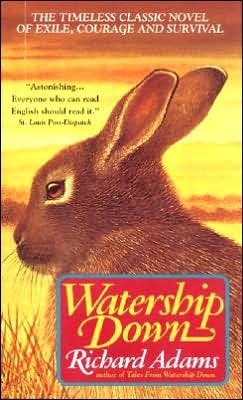
88. TMTF Reviews: Watership Down

Watership Down is an epic adventure. It’s also a story about bunnies.

Admittedly, before reading Watership Down, I didn’t think it could be an epic adventure and a story about bunnies. It could be one or the other, but not both. Bunnies and epic adventures are mutually exclusive.

At least that’s what I thought.

When I actually read the novel, which has been considered a classic for decades, I was amazed at how gripping a novel about bunnies could be.

The story follows a band of rabbits, led by the sensible Hazel, who abandon their warren and strike out into the vast, dangerous wilderness in search of a new home. For these rabbits, the world is a frightening place. Streams are impassable obstacles. Cats are bloodthirsty enemies. Men are an enigmatic menace, setting traps, carrying guns and trapping rabbits for their own sinister purposes. Even other rabbits can’t be trusted. Hazel and his band must depend on their luck, their wits and a few remarkable tricks to survive.

The most remarkable thing about Watership Down is the way it takes a perfectly ordinary scenario—rabbits establishing a warren in a peaceful English countryside—and transforms it into a quest to rival the best myths and fantasies.

G.K. Chesterton, the great British writer, had a knack for taking the ordinary and making it extraordinary. As he explained it, it’s surprising to see the word mooreeffoc in a shop window until one realizes one is looking at the words coffee room from the wrong side of the glass. In his writing, Chesterton tried to show everyday scenarios from perspectives that made them amazing.

Watership Down, though not written by Chesterton, is thoroughly Chestertonian. Much like The Borrowers and its recent film adaptation from Studio Ghibli, The Secret World of Arietty (which is superb, by the way), Watership Down makes commonplace things wondrous by showing them “from the wrong side of the glass.”

To the rabbits, men are inscrutable, godlike beings whose guns flash fire and inflict wounds from far away. Trains are terrifying apparitions, appearing out of the night with a flash and vanishing into the darkness with a roar. Everything human beings take for granted is shown through the eyes of the rabbits, and made marvelous through those eyes.

The characters in Watership Down, while not as developed as they could have been, are a likable bunch. Descriptions of the countryside are beautiful, and the novel is written in a vivid, matter-of-fact style.

Perhaps my favorite thing about Watership Down are the stories told by the rabbits themselves, legends of rabbit heroes, which are fascinating and add a greater depth to the story.

It’s a long novel, but Watership Down is over all too quickly. I recommend it to anyone, and particularly to those who enjoy stories about animals—from The Wind in the Willows to The Call of the Wild—or to readers who like myths and contemporary fantasies.

For a book about bunnies, Watership Down is quite the heroic epic.

72. TMTF Reviews: The Hollow

It’s been a while since TMTF reviewed anything, mostly because I keep forgetting.

“Hold on a second,” I told my typewriter monkeys. “Since when do we do book reviews?” They replied by pointing at the Literature part of the blog’s tagline—Faith, Writing, Video Games, Literature, Life, the Universe and Everything—to which I responded by throwing a copy of Animal Farm at them and telling them to get back to work.

Yes, the time has come for another exciting TMTF book review. Today we take a look at The Hollow, a mystery novel featuring Hercule Poirot.

Hercule Poirot, the brilliant Belgian with the inimitable mustache, is a legend of detective fiction. I love detective fiction: Sherlock Holmes, Father Brown, Edogawa Conan, Adrian Monk, Lord Peter Wimsey and other investigators amaze, amuse and delight me. I had previously read only one Hercule Poirot novel, and I decided to find out whether he deserves his reputation.

I was disappointed. As I read The Hollow, the greatest mystery was how a novel featuring a legendary detective could be so tedious.

The novel begins with the dull, day-to-day lives of several characters: Lucy Angkatell, a wealthy lady; Henrietta Savernake, a consummate artist; John Christow, a frustrated doctor; Gerda Christow, his longsuffering wife; and a number of others. One of them is unexpectedly shot beside a swimming pool. The rest become suspects. As they try to resume their usual lives in the wake of the murder, Hercule Poirot steps in to investigate.

There are good things to be said about the novel. Unlike much mystery fiction, it doesn’t make the mistake of treating the victim as just a plot device. The suspects’ lives are profoundly affected by the murder, and it’s interesting to watch as their true feelings toward the victim are gradually revealed after his death.

While the novel has its strengths, it also has many glaring weaknesses.

Apart from Poirot himself, there are hardly any likable characters in the novel. Most of them are painfully shallow, aloof, arrogant, pathetic, egotistical or self-pitying. I didn’t exactly rejoice when the victim shuffled off this mortal coil, but it was certainly a relief to have him gone.

Besides the annoying characters, the novel has two serious flaws.

First, the mystery and solution are unbelievably dull. There is no clever trick by the criminal; no clever explanation by the detective. The criminal shoots the victim. Late in the novel, the detective quietly stumbles onto the solution. There’s nothing to set apart the mystery from hundreds of similar mysteries. The mystery is eminently forgettable.

Second, the story apart from the mystery is equally forgettable. The mediocre mystery wouldn’t be so much of a problem if the novel were well-written and fun to read—but it’s not. As I’ve already mentioned, the characters are unlikable. The literary style is unimpressive. The plot feels insipid.

The Hollow is a book I could recommend only to the most devoted fans of detective fiction. For the casual reader of mysteries, I’d suggest a good Sherlock Holmes or Father Brown story. There are probably great Hercule Poirot novels out there somewhere, but The Hollow isn’t one of them.

Has anyone discovered a great Hercule Poirot novel out there somewhere? Let us know in the comments!

67. Abandon Hope, All Ye Who Enter Here

I once made a journey through HEL.

HEL had nothing to do with eternal damnation, though it sometimes felt like it. HEL was an (eminently appropriate) acronym for History of the English Language, one of my college courses. For the record, it was a good class. It was also really, really hard.

Although my journey through HEL was a good deal more comfortable than Dante’s stroll through the Inferno, it was not without its difficulties. My fellow students and I learned a little history, a little linguistics, a little philology and a little grammar. We also memorized a number of old literary passages, including the Lord’s Prayer in Anglo-Saxon (which sounded eerily like some kind of evil incantation) and the prologue to Chaucer’s Canterbury Tales in Middle English.

We often joked about giving our professor a bronze plaque on which were inscribed the words Abandon hope, all ye who enter here. He could put the plaque above the doorway to the classroom, we mused, and inspire students to new heights of academic diligence.

On the day of the final exam, one of my fellow students cackled demonically upon entering the room and said, “Welcome to HEL!” After a pause he added in his normal voice, “Whoa, I hope I never have to say that again.”

The class taught us a number of interesting things. Did you know, for example, that awesome and awful, which have completely opposite meanings, originally meant the same thing? Both words designated something that evoked a sense of awe. Awesome eventually came to represent things that inspired awe and amazement: Chuck Norris’s beard is a good example. Awful eventually came to represent things that inspired awe and horror, like natural disasters and teen pop stars.

I’m glad I journeyed through HEL. It gave me a better understanding of the origin, development and mechanics of the English language—and the English language is kinda what I’ve chosen to do for a living.

HEL also gave me a new appreciation for the words we speak and write every day, not to mention greater sympathy for poor old Dante.

65. TMTF’s Top Ten Fictional Clergy

Deep within every blogger’s heart is a strong, almost irresistible compulsion to make a list of the top ten of something.

This means that practically every possible top ten list has already been made. This is a problem, since I, being but a mortal man, am not exempt from the desire to feature a top ten list of some kind on TMTF.

Then it occurred to me a few days ago that there are many notable, unusual or simply awesome priests, ministers, chaplains, monks, nuns and clergymen in fiction, many of whom deserve notice and none of whom (to the best of my knowledge) are commonly featured on top ten lists.

It is, therefore, with pride and satisfaction that TMTF repairs this deficiency by presenting…

The TMTF List of Top Ten Fictional Clergy!

Note that when pictures of the characters themselves are not available, pictures of the author have been featured instead.

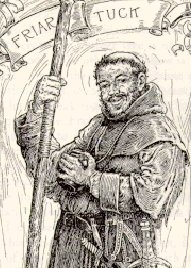
10. Friar Tuck (Ivanhoe)

Friar Tuck

He may be a sham and a scoundrel, but I can’t help but like Friar Tuck: a trusted companion of Robin Hood, a formidable fighter and an unapologetic drinker. His reputation as a man of the cloth is questionable, but his cheerful disregard for his priestly duties is somewhat endearing all the same.

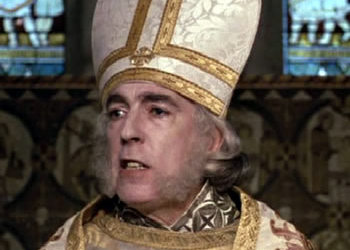
9. The Impressive Clergyman (The Princess Bride)

The Impressive Clergyman

“Marriage is what brings us together today.” That’s all I have to say.

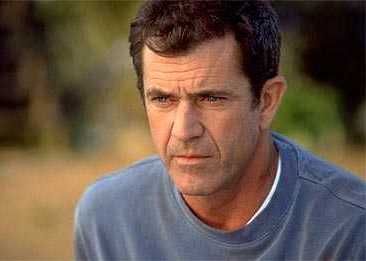
8. Graham Hess (Signs)

Graham Hess

For a movie about aliens, M. Night Shyamalan’s Signs gives quite a touching picture of a man torn between faith and cynicism. After his wife dies in a car accident, Graham resigns from the ministry and becomes an agnostic. He spends much of the film struggling with doubt, and the rest of the film defending his family from alien invaders: a courageous man on both fronts.

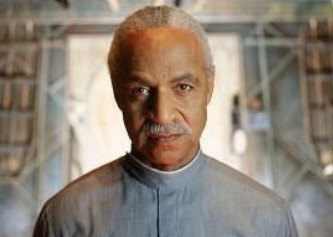
7. Shepherd Book (Firefly)

Shepherd Book

Firefly is a show about criminals, rogues and scoundrels. The cast includes a smuggler, a trigger-happy gunman, a wanted criminal, a lunatic and a classy prostitute. In the midst of these (surprisingly charming and likable) rogues is a kindly, compassionate, grandfatherly gentleman known as Shepherd Book. While one or two of his theological beliefs are slightly suspect, he may be the most genuinely Christ-like character I’ve seen in any television series of the last decade.

6. Dinah Morris (Adam Bede)

George Eliot

For those who have wondered, Adam Bede is not a cheerful book. It’s a novel about vanity and betrayal, and several of its characters end up dead or disillusioned. The gloominess of the novel makes Dinah shine all the brighter. Apart from demonstrating great selflessness and compassion, she is patient with even the characters whom the reader detests: a remarkable feat.

5. Nicholas D. Wolfwood (Trigun)

Nicholas D. Wolfwood

One thing must be made clear from the beginning: Nicholas D. Wolfwood has questionable morals. His morals are so questionable, in fact, that even other characters object to them. Nevertheless, his character is a fantastic depiction of a man trying to do the right thing the wrong way. He believes in absolute justice—he who lives by the sword must die by the sword—and can’t understand his friend Vash, who somehow solves crises without killing anyone. Vash and Wolfwood are easily two of the most complex and compelling characters I’ve seen on television.

4. Sister Carlotta (Ender’s Shadow)

dnews

Compassionate, patient and delightfully sarcastic, Sister Carlotta rescues orphans and street kids in her search for a child genius to defend Earth from a potential extraterrestrial invasion. She demonstrates great patience toward the children in her care and no patience whatsoever toward her haughty superiors—one of whom complains, “I didn’t know nuns were allowed to be sarcastic.” Like Christ himself, Sister Carlotta is kind, gentle and unafraid to speak out against foolishness.

3. Sebastião Rodrigues (Silence)

Shusaku Endo

When Sebastião Rodrigues, a Portuguese priest, travels to medieval Japan to learn the truth behind the alleged apostasy of another priest, he finds himself in a crisis unlike anything he could even have imagined. He was prepared to be martyred for the sake of Christ. He wasn’t prepared to watch as Japanese Christians were martyred instead. Rodrigues is given a choice: renounce his faith or watch as his brethren are slaughtered. Desperate for divine guidance, he is instead tormented by the silence of God. Rodrigues finds himself asking, as another great Priest once asked, “My God, my God, why have you forsaken me?” Sebastião Rodrigues ranks high on this list for the depth of his character and his earnest desire to help others at any cost.

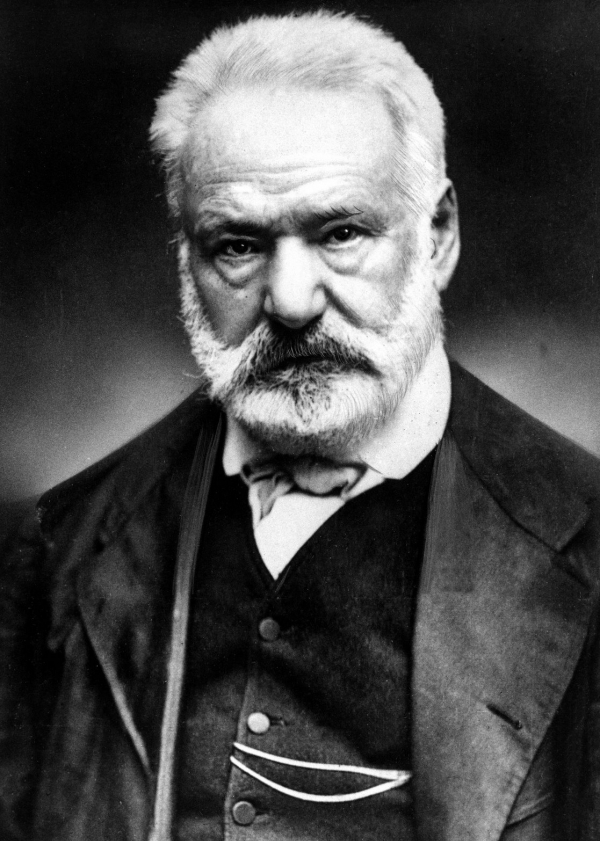
2. Charles François-Bienvenu Myriel (Les Misérables)

Victor Hugo

Monsieur Myriel, the Bishop of Digne, once goes on a journey to visit a remote village because, he explains, its residents “need someone occasionally to tell them of the goodness of God.” He is warned that dangerous bandits roam the area; if he travels toward the village, he may meet them. “True,” says the bishop. “I am thinking of that. You are right. I may meet them. They too must need some one to tell them of the goodness of God.” Unlike the pompous, self-righteous bishops of his day, the Bishop of Digne is humble, selfless, kind, patient and generous. It is a single selfless action of the Bishop of Digne that saves Jean Valjean, a disillusioned convict and the protagonist of Les Misérables, from a bitter life of crime.

1. Father Brown (The Innocence of Father Brown)

Father Brown

Number one on this list is my all-time favorite fictional character. Father Brown is a short, clumsy, disheveled Roman Catholic priest with a blank face, a compassionate heart and a keen understanding of human nature. He’s also a brilliant detective, albeit an apologetic one. Most remarkable is his concern for criminals. Sherlock Holmes throws his archenemy over a precipice to a violent death. Father Brown, by contrast, persuades his archenemy to give up crime and become a private investigator; they later become close friends. As a detective, as a priest and as a fictional character, Father Brown is amazing.

What notable, unusual or simply awesome fictional clergy do you think should be on this list? Let us know in the comments!
60. How to Be Useful

Cause and effect.

These three simple, innocent words sometimes represent an incredible chain of events—not just a chain, but an entire web of events. A single action may have unbelievable consequences.

There’s a story I’d like to share. It involves two of my favorite authors, J.R.R Tolkien and C.S. Lewis. They’re both famous, but for very different reasons.

Tolkien is renowned as a literary critic and author of fantasy fiction. While he’s most famous for writing The Hobbit and The Lord of the Rings, he’s also held in high regard for his contributions to the study of Anglo-Saxon literature and innovative approaches to literary criticism.

Lewis is also a famous author of fantasy fiction, but he is mostly remembered for his books about Christianity. The author of The Chronicles of Narnia dabbled in apologetics, theology, biblical studies and philosophy. From Mere Christianity to The Screwtape Letters, his books have had an incalculable impact on modern Christianity. In the decades since his death, Lewis has become something of a Christian celebrity.

J.R.R. Tolkien and C.S. Lewis are both famous, but only one is remembered as a great Christian. Many people don’t even know that Tolkien was a Christian. Ask anyone which man served God more effectively and the answer will be C.S. Lewis ninety-nine times out of every hundred.

Lewis’s books have led many people to Christ, and given many Christians a clearer understanding of what Christianity is all about. Many of the people whom C.S. Lewis helped through his writing have gone on to help others. For example, Chuck Colson, who committed his life to Christ after reading Mere Christianity, went on to found a ministry called Prison Fellowship, which has served hundreds of prisoners, ex-prisoners and families worldwide.

We see those three words, cause and effect, working through the life of one man to impact many thousands of lives.

Even though C.S. Lewis is a much more famous Christian than J.R.R. Tolkien, I believe Tolkien was every bit as useful to God as Lewis. This belief may seem a bit odd. The Lord of the Rings is an amazing literary work—a literary work, moreover, especially beloved by Christians—but it isn’t exactly famous for pointing people toward Christ. Really, how many conversion stories begin with Bilbo Baggins and Gandalf the Grey?

Through the process of cause and effect, C.S. Lewis and his books have impacted thousands of people. However, there’s something about his life that most people don’t know.

That process of cause and effect didn’t begin with C.S. Lewis.

It began long before Lewis, and it involved an Oxford professor named J.R.R. Tolkien.

After many years as an atheist, Lewis reluctantly accepted a vague belief in God and became a theist in 1929. A couple of years later, he happened to go for a walk in an Oxford park with two fellow professors, Hugo Dyson and John Tolkien. As they walked, they discussed myths and mythmaking.

Lewis was surprised by Tolkien’s belief that myths can originate in God and reflect eternal truth. Christianity is beautiful, maintained Tolkien, because it’s a myth. This doesn’t mean Christianity is untrue like other myths. Tolkien believed Christianity is beautiful because it’s the only myth that perfectly reflects the truth.

Perhaps, suggested Tolkien, someone could serve God by writing myths.

C.S. Lewis converted from theism to Christianity a few days later. “I have just passed on from believing in God to definitely believing in Christ,” he wrote in a letter to a friend. He added, “My long night walk with Dyson and Tolkien had a great deal to do with it.”

Would Lewis have become a Christian without Tolkien? Only God knows. However, there is one thing of which we can be sure: Tolkien helped lead Lewis to Christ. After Lewis became a Christian, he went on to write the books that would instruct, encourage, comfort, correct and strengthen thousands of people around the world.

What those people owe to Lewis, they owe in part to Tolkien.

Why does this matter?

Why have I shared this story about cause and effect?

I’ve shared this story because I’ve heard people suggest that Christians must enter official, fulltime ministries to serve God effectively.

Ridiculous.

God can use anybody anywhere.

He can use a math teacher or a computer programmer as readily as a pastor or missionary.

All that he asks is that we follow him wherever he leads us.

Let’s say a person has the desire and ability to become a carpenter. Is it too farfetched to believe that God wants that person to be a carpenter? For that person to become something else, say a pastor or missionary, would be like trying to screw in a bolt with a hammer or hammer in a nail with a screwdriver. Let someone with a passion for ministry become a pastor or missionary. Let the one who loves carpentry become a carpenter.

The Apostle Paul wrote: “We have different gifts, according to the grace given us. If a man’s gift is prophesying, let him use it in proportion to his faith. If it is serving, let him serve; if it is teaching, let him teach; if it is encouraging, let him encourage; if it is contributing to the needs of others, let him give generously; if it is leadership, let him govern diligently; if it is showing mercy, let him do it cheerfully.”

I would add, “If a man’s gift is painting, let him paint; if it is building, let him build; if it is police work, let him become a police officer; if it is playing soccer, let him become a soccer player,” and so on.

Lewis had a passion for Christianity, and God used him.

Tolkien had a passion for mythology, and God used him.

If you’ve chosen to follow Christ, don’t worry that your plans might “not be Christian enough.” Do your best to serve Christ wherever you are. Be willing to accept whatever opportunities he gives you.

If you do that, wherever you are, Christ will use you.

As Abraham Lincoln said, “Whatever you are, be a good one.”