153. TMTF Reviews: Around the World in Eighty Days & Journey to the Center of the Earth

Having enjoyed 20,000 Leagues Under the Sea, which I reviewed a few months ago, I decided to check out two more novels by Jules Verne: Journey to the Center of the Earth and Around the World in Eighty Days. It was my intention to review one or the other for this blog.

In one of these novels, explorers venture inside the Earth; in the other, travelers go round it. Since they have so much in common, I’ve decided to review them both. Today, ladies and gentlemen, TMTF makes history with its first ever double book review!

The TMTF Review Has Been Doubled!

Journey to the Center of the Earth—or A Journey to the Interior of the Earth, as my translation was titled—is the tale of Otto Lidenbrock, a professor who discovers a mysterious cipher in an old manuscript. This secret message sends Lidenbrock, his hapless nephew Axel and their stoic guide Hans into the crater of an Icelandic volcano, from which they travel into the heart of the Earth.

Around the World in Eighty Days tells the story of Phileas Fogg, a British gentleman whose predictable life is interrupted by the sudden decision to travel round the world on a bet. His servant Passepartout accompanies him, perplexed by Fogg’s wager and determined to help him win it.

In the three books I’ve read by Jules Verne—20,000 Leagues Under the Sea, Journey to the Center of the Earth and Around the World in Eighty Days—he seems to create characters by mixing and matching personality traits. Conseil, Hans and Passepartout serve their masters with single-minded devotion. Ned Land, Lidenbrock and Passepartout are impulsive and short-tempered. Conseil, Hans and Fogg are impassive, calm and logical.

These characters were engaging enough at first, but they eventually began to feel a bit stale. The farther I progressed into each story, the stronger the sense of déjà vu.

I was disappointed by Journey to the Center of the Earth. Like 20,000 Leagues Under the Sea, it has only a few significant characters. However, unlike that novel, its characters aren’t really memorable.

In 20,000 Leagues Under the Sea, Captain Nemo gives fascinating hints of his motives and identity. Ned Land begins to crack under the pressure of his underwater captivity. These characters are compelling. In Journey to the Center of the Earth, Lidenbrock is mildly interesting and the others are forgettable.

Journey to the Center of the Earth isn’t bad, but it’s hardly more than a sightseeing tour. There is hardly any character development. The plot is simplistic. The novel has no depth. (Pardon the pun.) It’s merely the record of a journey, and—compared to the adventures in 20,000 Leagues Under the Sea—not a particularly impressive one.

I liked Around the World in Eighty Days much better.

The novel gives colorful glimpses of exotic locations around the world. From India to Japan to the American West, I had strong impressions of the places Fogg and Passepartout visit in their travels. The variety is delightful, and every locale seems authentic. If Verne is guilty of inaccuracies, I didn’t notice.

Journey to the Center of the Earth is not an especially exciting book. Its protagonists face dangers, but there is never the slightest doubt they will survive. In Around the World in Eighty Days, however, the protagonists race against the clock and the calendar. They must not merely survive their journey—they must complete it within a time limit. As I followed their travels, I rejoiced with every shortcut and cringed with every setback. The reader is kept in suspense until nearly the very end.

If you read only one of these two novels, I recommend Around the World in Eighty Days. I found it much more gripping. However, Journey to the Center of the Earth isn’t bad, particularly as a complement to 20,000 Leagues Under the Sea. These tales of exploration, subterranean and submarine, are worth reading. It’s just a pity the characters in the former aren’t as interesting as those in the latter.
152. Nor Can We Be What We Recall

Today’s post was written by Josh Hamm, also known as The Scholar. (I need a title like that; it’s a pity “The Doctor” is taken.)

“Nor can we be what we recall, / Nor dare we think on what we are.”

I like to quote people in my writing. I like to sprinkle references as if Tinker Bell were a little tipsy and got too free with the magic pixie dust. Maybe it’s a remnant from school, where we have to integrate all sorts of quotations. I distinctly remember a teacher in Grade Twelve telling the class that we should quote authors because anything they’ve said is better than whatever we could up with.

I enjoy it though; it’s an act of sharing secrets that were never meant to be secrets. It’s the same as when you feel the urge to start exchanging YouTube videos, but I prefer to exchange the thoughts of influential authors I’ve read. I tend to drop a few specific names in most of my writing.

People like G.K. Chesterton, Thomas Merton, C.S. Lewis, Frederick Buechner and Marilynne Robinson. I don’t solely quote these guys. I read a lot, so I’ve got a lot of wells to draw from, but these are some of my favorites. Besides, let’s be serious, I’ve never met a Christian who doesn’t profess love for C.S. Lewis.

(I’m pretty sure that when Martin Luther declared Sola Scriptura he included a little caveat for C.S. Lewis.)

But sometimes I disagree with what my teacher said. It seems so defeatist, as if we may as well not try to write anything at all, because it’s all been said, and said better and more profoundly than we could ever hope to write.

Now, I rarely use this word, and I’m sorry to use such strong language, but that is just utter balderdash.

Sure, in most cases these authors have extremely profound phrases and witty turns of speech, but whatever we write has value too. We may never become half the writer that Chesterton or Merton was, but that doesn’t render my voice or your voice useless.

Don’t just outsource your thinking.

Don’t check your brain at the door because you’ve given up and assume that others have already taken your place.

Come up with your own viewpoint, your own writing, and then supplement it with authors you like. Quote those that you love, those authors you’ve read or read about and feel a connection to. Then add your own flavor. Add some meaning, some of yourself into their words and ideas.

But whatever you do, don’t blindly accept what they say or regard everything they’ve written as a work of genius. It’s not.

Remember that other writers do not define what kind of writer you are. I read great novels or great autobiographies, or philosophies, or poetry, and I wonder in jealous despair why I will never write like they do.

Then I’ll remember, it’s not my job to write like them. It’s my job to write like myself.

Don’t feel like your message is diluted just because writers and thinkers before you said similar things in brilliant ways. Share their thoughts if you think it will enhance your message, but remember that’s just what it is at the end of the day—your message.

149. Why I Watch Cartoons

As many of my readers have probably noticed, I like cartoons.

Well, I like some cartoons. Others I would watch only on pain of death, and perhaps not even then. (I’m looking at you, SpongeBob SquarePants.) Besides loving many animated films—for example, classic Disney movies and everything directed by Hayao Miyazaki—I enjoy television shows produced for kids.

I also like literature, especially the classics. Explosions? Car chases? Sultry romances? Bah! Humbug! To blazes with such nonsense! Give me meaningful themes, compelling characterization and well-crafted plots.

Thus I decided to take no fewer than three literature classes in one semester when I was in college. (Where was Admiral Ackbar when I needed him?) For months, I was hammered by grim novels like Silence, a bleak story about the silence of GodOne Hundred Years of Solitude, a fantastical history of a disturbing, sordid society; The Penelopiad, a cynical postmodern perspective on The Odyssey; and several more depressing books.

It was not a happy semester.

Some notable literature is lighthearted—I thank God for cheerful authors like P.G. Wodehouse—but the good stuff is mostly depressing. Even stories by humorists like Mark Twain and James Thurber have tragic undertones. Thurber once wrote, “To call such persons ‘humorists,’ a loose-fitting and ugly word, is to miss the nature of their dilemma and the dilemma of their nature. The little wheels of their invention are set in motion by the damp hand of melancholy.”

I like cartoons because they’re innocent, bright and funny, and they’re unapologetic about it.

Do cartoons give a balanced view of the world? Of course not—but then, neither does much of the best literature. Cartoons remind me that the world can be a pleasant, cheerful place, even as literature reminds me that it can be a dreadful, hopeless one.

For me, cartoons are a kind of escapism.

Is escapism wrong? When balanced with realism, I don’t believe it is. To quote J.R.R. Tolkien, who is awesome, “I do not accept the tone of scorn or pity with which ‘Escape’ is now so often used. Why should a man be scorned if, finding himself in prison, he tries to get out and go home? Or if he cannot do so, he thinks and talks about other topics than jailers and prison-walls?”

A Farewell to Arms tells me there is suffering in the world. My Little Pony: Friendship Is Magic tells me there is good in it. The Great Gatsby tells me happiness can’t be bought with money or popularity. Phineas and Ferb tells me happiness can be found by two kids sitting in the shade of a tree on a summer day. Animal Farm tells me the good guys sometimes lose. Avatar: The Last Airbender tells me the good guys sometimes win.

The other reason I watch cartoons is because, well, they’re fun to watch.

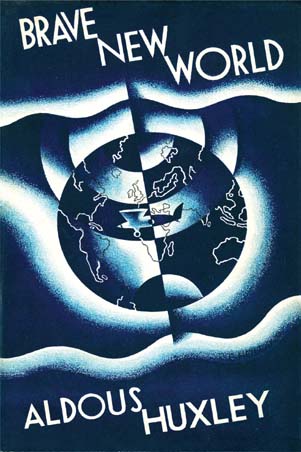
140. TMTF Reviews: Brave New World

I like dystopian fiction. From young-adult novels like The Giver and House of Stairs to literary classics like Nineteen Eighty-Four and Fahrenheit 451, there’s something morbidly fascinating about governments and societies gone wrong.

Aldous Huxley’s Brave New World is considered one of the greatest dystopian novels ever written. Is this grim tale of bad society a good book?

Brave New World

The purpose of most dystopian fiction isn’t merely to tell a story, but to convey an idea. Dystopian stories aren’t just stories, but fables. Brave New World is no exception. It does a fantastic job of depicting a dysfunctional society, and a less fantastic—but still competent—job of creating an engaging plot and well-developed characters.

Nineteen Eighty-Four shows a society controlled by fear. Fahrenheit 451 depicts a society controlled by censorship. Brave New World is different. Its society is controlled by pleasure. People aren’t forced to obey. They’re conditioned to obey. The government doesn’t need to burn books or monitor its citizens. It promotes promiscuous sexuality, hands out recreational drugs and makes sure everyone has such a good time that no one ever bothers to ask questions.

Brave New World introduces its horrifying society in a brilliantly calm, matter-of-fact way. (The novel is full of exposition, which is conveyed pretty smoothly through dialogue.) Children are conceived artificially in factories and preconditioned to their future careers. Infants are taught through painful operant conditioning (involving shrill sirens and electric shocks) to despise books and flowers. The early chapters of the novel describe the brave new world of Aldous Huxley in an incongruously cheerful—and chillingly effective—manner.

Having established its dystopian background, the novel introduces an outsider: the ironically-named Savage, who ultimately takes a stand against the unrestrained hedonism and vapid amorality of his world. Does he succeed? I won’t spoil the ending, but you can probably guess what happens.

As an illustration of a dystopian society, Brave New World devotes many pages to exposition. It’s a novel about ideas. Elements like plot and characterization are secondary. Not much happens in the novel—its plot could be summed up in a paragraph—and most of its characters aren’t terribly well-developed.

In the end, these shortcomings aren’t all that important. As a work of literature, Brave New World may have some faults, but it fulfills its purpose: depicting a dysfunctional society and evoking a reaction (whether disgust, dislike or horrified fascination) from the reader.

It’s not a cheerful read, but I recommend Brave New World—particularly as a complement to Nineteen Eighty-Four by George Orwell. These novels give radically different takes on how society can go wrong: government by fear and government by pleasure.

139. The Wanderer-Hero

I’ve been watching Doctor Who. Besides kindling a strong desire in my heart to own a fez, the show has reminded me of my very favorite character archetype: a rare, strange and wonderful kind of character, comic and tragic, plain and mysterious—the Wanderer-Hero.

(I should wear a fez. Fezzes are cool.)

The Wanderer-Hero is my favorite kind of character in fiction, and a very rare one. I can think of only four characters that fit the description perfectly: the Doctor from Doctor Who, Gandalf from The Lord of the Rings, Vash the Stampede from Trigun and Father Brown from the stories by G.K. Chesterton.

These four—a time-traveling alien, a wizard, a gunslinger and a priest—have hardly anything in common, or so it seems at first glance. They actually share quite a number of traits, all of which characterize the archetype of the Wanderer-Hero.

For fun, let’s take a look at just a few.

The Wanderer-Hero wanders

There is no home for the Wanderer-Hero, whose destiny is to roam.

The Doctor travels in time and space with no home but his TARDIS, a spaceship and time machine. Gandalf wanders across Middle Earth. Vash roams the deserts of Gunsmoke. Even Father Brown, who supposedly lives in Essex and later in London, spends a surprising amount of time rambling throughout England, stumbling onto crime scenes wherever he goes.

The Wanderer-Hero is comic

Outwardly, the Wanderer-Hero is cheerful, witty or clever.

When confronted with deadly peril, the Doctor’s first reaction is to make a joke. Gandalf has a wry sense of humor. Vash makes a fool of himself at every opportunity; for example, while bravely defending a town from bandits, he wears a trash can lid for a hat. Father Brown possesses a gentle wit and a comically unorthodox manner of solving mysteries.

The Wanderer-Hero is tragic

Inwardly, the Wanderer-Hero endures terrible agonies.

The Doctor suffers from deep loneliness, guilt and self-doubt, besides the sorrow of being the only surviving member of his race. Gandalf fights a long, lonely, thankless battle against a nearly invincible enemy. Wherever Vash goes, innocent people die; these tragedies tear him apart. Father Brown admits to solving crimes by possessing a profound, painful understanding of human wickedness.

The Wanderer-Hero is more than human

In some way, the Wanderer-Hero is superhuman.

The Doctor is a Time Lord, the last survivor of an ancient race of extraterrestrials. Gandalf is one of the Maiar: divine beings sent into Middle Earth in the guise of mortals. Vash is a Plant, a humanoid creature possessing incredible power. Father Brown is only a human being, but his gentleness, wisdom and compassion are almost angelic.

The Wanderer-Hero is old

The courage of the Wanderer-Hero is balanced by the wisdom of age.

The Doctor is roughly nine hundred and nine years old. Gandalf spends centuries wandering Middle Earth. Vash is one hundred thirty-one. Father Brown is the only one whose age isn’t numbered in the hundreds, and even he gives the impression of being an ancient saint.

The Wanderer-Hero always happens to be in the right place at the right time

The character is called the Wanderer-Hero, after all.

Quite by accident, the Doctor always finds himself in exactly the right time and place to avert a catastrophe. Gandalf regularly appears just in time to rescue his companions. Vash helps people wherever he goes. By solving every crime he encounters, Father Brown saves the day—and sometimes the criminal.

I suppose the reason I like the Wanderer-Hero so much is that the character is a paradox: funny and sad, silly and wise, plain and mysterious, ordinary and extraordinary. The Wanderer-Hero has a little bit of everything.

Who is your favorite Wanderer-Hero? Should I acquire a fez? Let us know in the comments!

136. Vampires

A few days ago, I received a call from my employer asking me to work the overnight shift for a week. I have become a creature of the night, sleeping away the daylight hours and awaking in the evening to revel in my reign of darkness—not unlike a vampire, albeit one who prefers coffee to blood.

As I was working a couple of nights ago, I stumbled upon a vampire picture book belonging to one of the men with whom I work. Early yesterday morning, a coworker rhapsodized about the new Twilight movie.

Vampires are everywhere, and there are so many kinds. Action movies star leather-clad vampires with silver pistols and cool shades. The Twilight series features Edward “Sparkles” Cullen, a pale, irritating excuse for a creature of the night. The novels of Anne Rice depict vampires whose bloody lives are marked by moral quandaries and existential crises, and classics like Bram Stoker’s Dracula give a more traditional interpretation of America’s favorite monster.

Why are vampires so popular? I think part of it must be that vampires are tragic. They live without hope, doomed to survive by draining away the lives of others, hiding from the day, lurking alone in the cold, dark night, unable to die any death but a violent one, forever separated from love and light and happiness.

We sympathize with vampires, especially the ones who seek redemption. Edward from the Twilight series is engaging—well, tolerable—well, not quite one hundred percent awful—because he clings to his humanity. Vampire Hunter D, a character in Japanese media, travels alone, protecting humans from his own kind, never asking for gratitude or recognition.

Characters like these are compelling. Although they’re cursed with the destiny of villains, they choose instead to be heroes. They persevere, alone and misunderstood.

Of course, vampires can also be great bad guys. There’s something truly horrible about a creature that drinks blood, and this brutal bloodlust is often balanced by a cold, refined politeness. A vampire can be both a monster and a gentleman. That duality makes vampires exceptionally sinister villains.

The problem with vampires is that they’ve been done to death. (No pun intended.) Like zombies, vampires are ubiquitous. They’ve lost their novelty. When I see a novel or film or television show featuring vampires, my first response is to think, “Dash it, not another one.”

As I hinted in a recent creative piece, “A Portrait of the Artist as a Performing Monkey,” I dislike most vampire fiction. The genre has become stale, and I detest the violence, sexual perversity and muddy morality often associated with vampires. I miss old-fashioned stories like Dracula, in which evil evokes disgust and good inspires hope.

I must work a few more overnight shifts, and then I shall no longer have to be a vampire. I look forward to seeing the sun again.

135. Why J.R.R. Tolkien Is Awesome

When I decided to start writing these Why [Insert Author Name] Is Awesome blog posts, I wasn’t sure with whom to begin. At first I considered G.K. Chesterton, and then James Herriot, and then P.G. Wodehouse.

In the end, of course, I realized there was only one author with whom to begin this exciting new series of posts. One author to rule them all.

Ladies and gentleman, I give you the man who created a universe on the backs of letters and exam papers, writing in his study late at night when the world was asleep, reinventing mythology for the modern age—and doing it in his spare time.

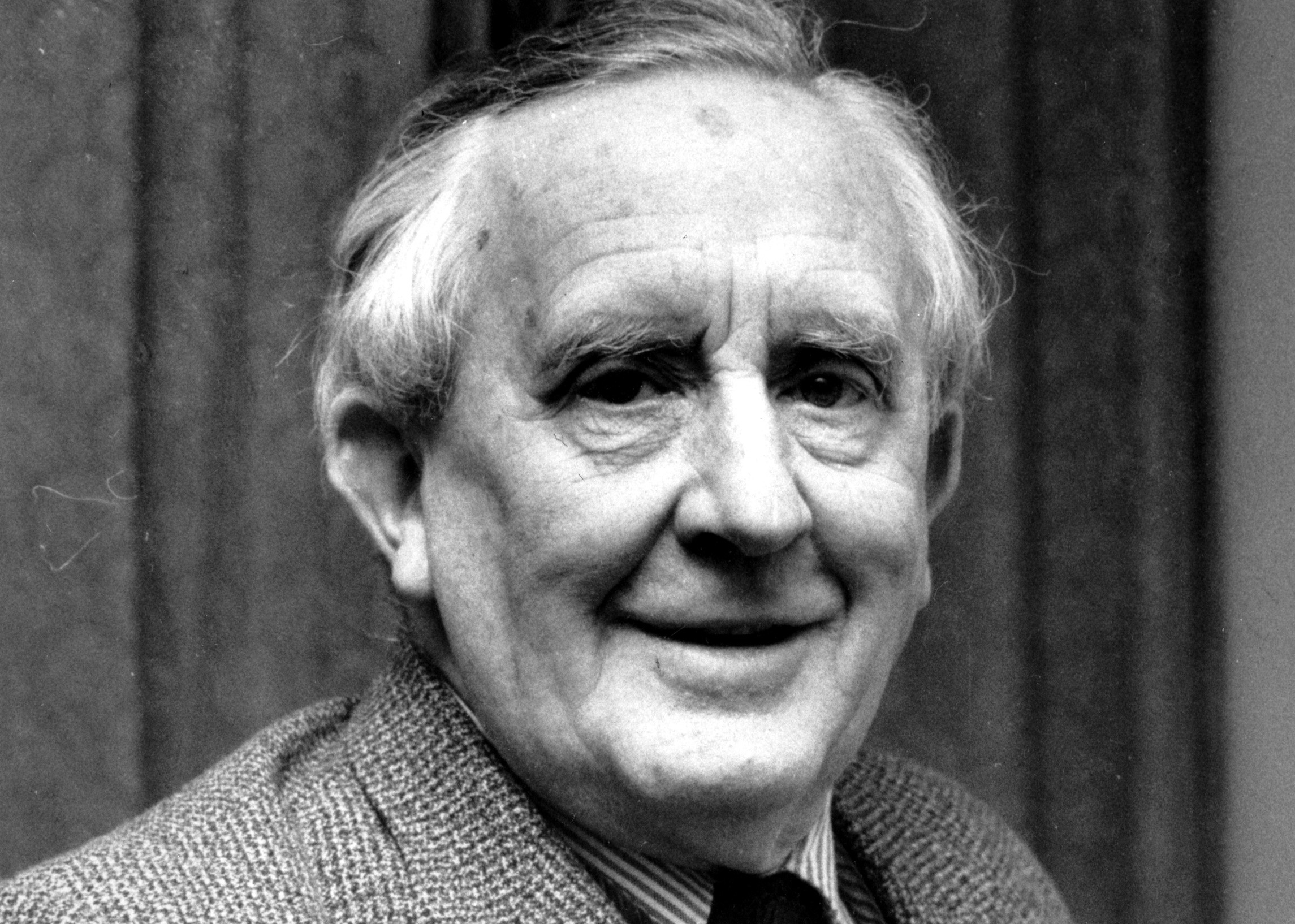
I give you John Ronald Reuel Tolkien, my childhood hero and the father of the fantasy genre.

J.R.R. Tolkien

Of course, Tolkien didn’t invent fantasy. As I noted in my short, untidy and highly idiosyncratic history of the genre, its inventor was probably a Scottish minister named George MacDonald. Don’t be surprised if you haven’t heard of him. Not many people have. He may have invented the fantasy genre, but Tolkien was the man who made it famous.

Enough preamble. Let’s get down to business.

What makes Tolkien awesome?

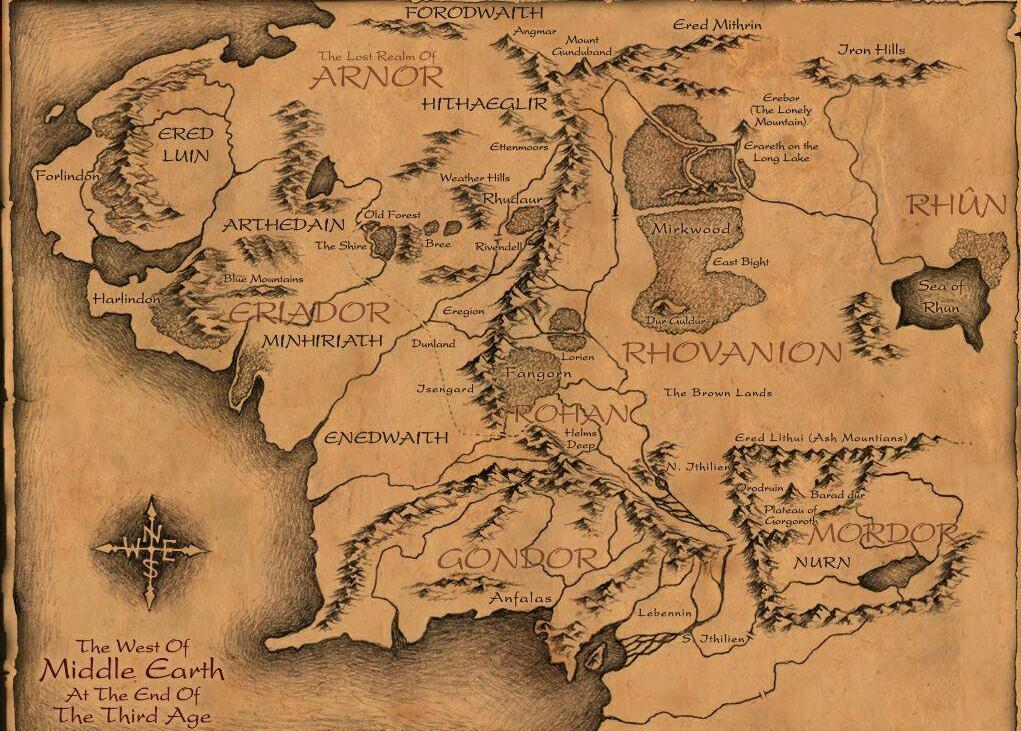
The thing that amazes me most about Tolkien is that the world he created is vast—vaster than vast—vastly vast. Tolkien’s world, Middle-earth, is huge. Worlds like Narnia are tiny by comparison.

Middle-earth

The history of Middle-earth, meticulously chronicled, spans tens of thousands of years. Its geography (which changes over the centuries) is recorded in maps. Tolkien created languages, cultures, genealogies and even legends—myths within his myth. I once read that Tolkien holds the record for creating the largest fictional universe ever devised by a single person.

Tolkien’s literary style is sometimes a bit ponderous, and many readers are discouraged by the slow pace of the early chapters of The Lord of the Rings, his masterpiece. It’s not a fast-paced, action-packed novel. It takes its time creating a world for its characters to inhabit, and patient readers are rewarded with a story made more powerful by its fullness.

Personally, I love Tolkien’s style. It’s not flashy or funny or avant-garde, but does a beautiful job of conveying images and experiences vividly.

Tolkien weaves many familiar images and archetypes into his world. Gandalf reminds us of Merlin. Rohan comes straight out of Beowulf. The elves and dwarves are borrowed from Norse mythology, and the Shire is unmistakably English. While Aragorn wears armor and wields a sword, Bilbo wears a waistcoat and wields an umbrella. These disparate elements somehow never clash.

Although many of Tolkien’s characters are superb, some lack depth and intricate characterization. With three or four exceptions, the fourteen dwarves in The Hobbit (the prequel to The Lord of the Rings) are so undeveloped that they blur together.

The villain, Sauron, isn’t really a character. Although he’s mentioned frequently, he never actually makes an appearance in The Hobbit or The Lord of the Rings. Sauron is more like a threat, an unseen presence haunting these stories like a shadow.

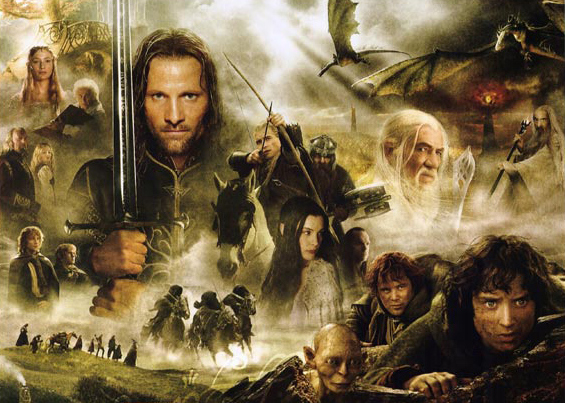
Gollum, by contrast, is developed brilliantly: a minor villain whose slow, faltering steps toward redemption make him a surprisingly compelling character. Gandalf, a wizard, is unforgettable: gruff, powerful, impatient and kind. Bilbo, a timid hobbit, demonstrates a unique sort of courage—not showy heroism, but a quiet, determined bravery built upon resourcefulness and common sense.

Tolkien's Characters

Even Tolkien’s dialogue is memorable. It lacks clever quips and one-liners, but succeeds on a much deeper level: it’s believable. Kings speak with grace and elegance. Samwise Gamgee, a gardener, talks with colloquial simplicity. Tolkien’s books are populated by an enormous range of characters, from ageless sages to degenerate monsters, and their dialogue is no less diverse.

Perhaps the most striking thing about Tolkien’s books is their moral strength. Tolkien never preaches. He doesn’t need to. Loyalty, courage, honesty and self-sacrifice shine throughout his stories. Without ever saying it, Tolkien makes one thing crystal clear: good is better than evil, and good wins.

For someone new to Tolkien, I recommend starting with The Hobbit. It’s a fine introduction to Tolkien’s world and literary style. The Hobbit is a simple story of adventure, like a fairy tale. The Lord of the Rings is more like a myth, featuring a more mature style and a much deeper story.

The Silmarillion, a history of Middle-earth published after Tolkien’s death, isn’t a particularly compelling book. I recommend it only to the most devoted of Tolkien’s readers. The Silmarillion reads like a history textbook: occasionally interesting, but seldom engaging.

For readers who are interested in Tolkien’s other works, Roverandom is a delightful book for children. Farmer Giles of Ham is a funny story about a farmer who tames a dragon, and Leaf by Niggle is a beautiful allegory of a struggling artist.

In conclusion, ladies and gentlemen, J.R.R. Tolkien is awesome.

132. TMTF Reviews: Boy

Although he’s most famous for writing books about chocolate factories, giant peaches and Oompa-Loompas, Roald Dahl also published a couple of memoirs.

While visiting my family in Uruguay a few months ago, I read Going Solo, Dahl’s account of his experiences as a fighter pilot in World War II. I enjoyed the book, and thus it was with excitement that I snatched up its prequel, Boy: Tales of Childhood, at a local yard sale.

Are these tales of childhood worth hearing, or is Dahl a dull read?

Roald Dahl puts off Boy to a hopeful start: “An autobiography is a book a person writes about his own life and it is usually full of all sorts of boring details. This is not an autobiography.” The book is, in fact, a collection of anecdotes from Dahl’s childhood. Important details are included to establish context. The reader is taken from before Dahl’s birth all the way to his graduation from school.

Some of the anecdotes are interesting, but I was mostly disappointed. While Going Solo gives readers Dahl’s vivid recollections of African jungles and vicious battles, Boy consists mostly of plain stories that might have happened to anyone. It’s not a bad memoir, but it’s not a particularly gripping one either.

Nevertheless, the book was not without its surprises. As he tells stories about his childhood, Dahl occasionally pauses to address deeper issues. After writing about his headmaster’s skill for corporal punishment or his own experiences as a businessman, he sidetracks suddenly into simple, powerful accounts of his disillusionment with religion or the difficulties of writing creatively. These unexpected reflections give weight and depth to an otherwise unexceptional book.

I would probably have found the book more interesting had Dahl made more effort to explain how his experiences shaped his writing. He makes only a few connections between his life and his books, and so I was left with hardly anything to tie the eponymous Boy of Dahl’s memoir to the author whose books I enjoyed as a child.

I recommend Boy: Tales of Childhood to anyone who enjoys memoirs or the books of Roald Dahl, but not to the average reader. Going Solo is a more engaging read. Africa and World War II are much more interesting than boarding schools and candy shops. Better yet, read one of Dahl’s books for children. He’s remembered for those books, after all—not for his memoirs!

125. Literary Criticism and Nonsense

When my academic adviser in college signed me up for a literary criticism course, I assumed it would teach me to criticize literature. I’m a literary snob, so I figured passing judgment on written works would be easy. Just give me a textbook and any book in the Twilight series and I’d be ready to roll.

As I soon found out, literary criticism is actually an attempt to find meaning in literature. In my (admittedly biased) opinion, it’s also an attempt in some cases to invent meaning and superimpose it on literary works.

There are many kinds of criticism, each with a distinct focus. Mythic criticism finds symbols and allegories in literature. Biographical criticism studies the writer’s personal experiences, and deconstructionist criticism tries to prove that everything is meaningless.

In my studies of literary criticism, I discovered two varieties that were kind of hilarious.

The first was Marxist criticism, which views literature through the red-tinted lens of Communist theory. To heck with myth, morality and religion. The working class shall prevail! Down with the bourgeois!

The other funny perspective was Freudian criticism, which finds sexual innuendo in everything. Is something longer than it is wide? It’s a phallic symbol. Is a man unhappy? At some level, he’s sexually frustrated.

What’s that? You disagree? Ha! I laugh at you, person of lesser intellect! Do you think you’re smarter than Sigmund Freud?

I was quick to discover that half of literary criticism was analyzing literature carefully, and the other half was making up stuff that sounded plausible.

You don’t believe me? I’ll prove it.

My final paper was a four-part analysis of The Lord of the Rings by J.R.R. Tolkien. I examined it from four perspectives: mythic, biographical, moral and gender studies. Much to my surprise, each approach illuminated some fascinating facet of Tolkien’s masterpiece. My appreciation for The Lord of the Rings, and for literary criticism, was deepened.

Weeks before, I wrote an essay on The Magician’s Nephew by C.S. Lewis. Just for the fun of it, I decided to pit Sigmund Freud against my favorite author and see what happened.

The resulting analysis determined the Wood Between the Worlds to be a place of sexual balance, Queen Jadis to be a faux mother figure and the three elements of the psyche—id, ego and superego—to be represented by Uncle Andrew, Digory and Aslan, respectively.

The essay, which received a B, was ridiculous, but not much more so than some of the Freudian analyses in my textbook.

My studies, silly and serious, impacted me deeply. Literary criticism even became a recurring theme in the novel I was writing at the time, The Trials of Lance Eliot. Its protagonist was a literary critic because it fit his character perfectly, and it gave me an opportunity to poke fun at the nonsensical side of literary criticism.

I’ll finish up this post with a friendly warning.

Watch out for phallic symbols. They’re everywhere.

121. Literature Is a Luxury; Fiction Is a Necessity

I am deeply grateful for the feedback on the previous post! Before making any definite decisions about TMTF’s future, I’ll be taking suggestions, comments and criticisms for one more week. Please check out this post about the blog’s future and comment away!

My tastes aren’t particularly refined. I watch children’s cartoons, listen to video game music and drink cheap, generic blends of coffee.

There is one area, however, in which my tastes are pretty sophisticated: I like literature. Sensational horror tales, thrillers and romances don’t interest me. Give me the classics! Few things delight me as much as a deep, compelling story. I love engaging prose, dynamic characters, intricate plots, thought-provoking themes and clever concepts.

The problem with literature is that it’s not very accessible. The classics aren’t easy to read.

G.K. Chesterton knew all about literature, and he had this to say: “Literature is a luxury; fiction is a necessity.”

We might not all enjoy the classics, but most of us enjoy stories. Whether we see superhero movies, read novels about sparkly vampires or watch professional wrestling, we like fiction. Something about losing ourselves in a story is irresistible.

The ironic thing is how often simple stories succeed where fine literature fails.

When I was in college, I read One Hundred Years of Solitude for a literature class. The greatest work of a Nobel Prize-winning author, the novel features a meandering plot, intriguing symbolism, postmodern perspectives and an unforgettable blend of surrealism with matter-of-fact narration.

I appreciated One Hundred Years of Solitude. With almost every chapter, I found myself thinking, “Ah, I see what you did there, you Nobel Prize-winning author, you. That’s very clever.” Upon finishing the novel, I pronounced it a masterpiece.

The problem with One Hundred Years of Solitude is that it utterly failed to engage my emotions. Reading it was strictly an intellectual experience. It left an impression on my mind, but not on my heart.

More recently, a piece of fan fiction was brought to my attention. It’s impossible for me to be too disapproving of fan fiction because, I confess, I’ve dabbled in it myself from time to time.

All the same, I must point out that most fan fiction is badly written. It’s usually nothing more meaningful than wish-fulfillment. Rather than focus on telling a good tale, too many fans settle for turning their daydreams into stories. Fan fiction may have some trifling literary value, but it can’t begin to compare to original stories.

Some weeks ago, however, I stumbled upon a brief piece of fan fiction that intrigued me. I read it, expecting the usual mix of bad writing and clichéd ideas, and received quite a surprise. The story was actually touching. Reading it was cathartic. It wasn’t especially well written. Like all fan fiction, it shamelessly used situations and characters from an existing story. From a literary perspective, the story was completely unexceptional.

Even so, it made an emotional impact.

That experience set me thinking about the irony of fiction. As Chesterton pointed out, literature is a luxury, but fiction is a necessity. Few of us appreciate the classics, but we all find comfort in stories of one kind or another.

Sometimes a humble piece of fan fiction can touch someone in a way even a literary masterpiece cannot.

It’s a bonus if a story impresses the reader with its depth and complexity. In the end, it’s enough for a story to touch the reader’s heart.

I’m still critical of fan fiction, and I still love the classics deeply. Even so, I must admit that literature is a luxury. In the end, stories are all we need.