The Most Epic Christmas Song

Christmas music has been rearranged for nearly every conceivable genre, including grittier ones like symphonic rock and heavy metal. “Carol of the Bells” and “God Rest Ye Merry Gentlemen” are popular choices for edgy arrangements, but one song manages to be epic without dubstep wubs or electric guitars.

“Fum Fum Fum,” as performed by Mannheim Steamroller, is a fusion of rock and Renaissance styles. It’s pretty tame for the first minute, and then heats up with a woodwind (I’m guessing a tin whistle) carrying the melody over light synths and some solid percussion. This is my all-time favorite instrumental Christmas tune.

Christmas is nearly here, guys. Prepare yourselves.

Vader Did You Know?

So there’s apparently a new Star Wars movie coming out, or something like that. Who knew?

In keeping with the Christmas season, which this year also seems to be the Star Wars season, the video above is one of my favorite Star Wars-themed Christmas songs: “Vader Did You Know,” a parody of “Mary Did You Know.” The Vader version was written by Vic Mignogna, who besides being a popular voice actor seems like a really nice guy.

My other favorite Star Wars-themed Christmas song is “What Can You Get a Wookie for Christmas (When He Already Owns a Comb).”

The original version of this song is excruciatingly terrible, so I’ve shared a (much better) fan arrangement in the video above. The song provides some solid answers to that important question: What can you get a Wookie for Christmas when he already owns a comb? For my part, I suggest simply letting him win.

Jesus Christ and Admiral Ackbar

Then the Pharisees went out and laid plans to trap him in his words.

~ Matthew 22:15

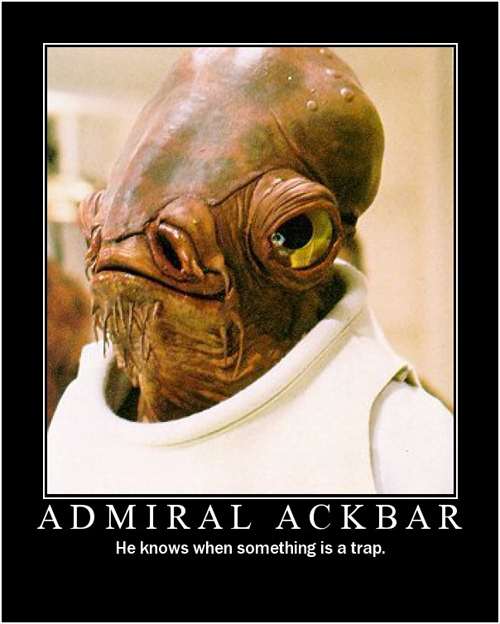
Meet Admiral Ackbar.

Admiral AckbarThe Admiral is a minor character from a Star Wars film. Although he presumably has a life beyond the few scenes in which he appears, he is remembered for one thing and one thing only.

He proclaims, with a glassy-eyed expression of dazed astonishment, “It’s a trap!”

Admiral Ackbar, the ever-useful trap detector, was absent in the days of Jesus Christ. Fortunately, the Lord was shrewd enough to detect a trap without the advice of Star Wars characters.

Quite a number of people disliked Jesus, you see. Two religious groups, the Pharisees and Sadducees, hated the way his teachings upset the balance of things. They wanted him gone—disgraced—dead. These religious groups resorted to all kinds of underhanded traps to bring down the controversial upstart called Jesus Christ.

I find it hilarious, and extremely impressive, how the Lord Jesus dodged every trap with bravado and brilliance.

The Pharisees watched Jesus closely on the Sabbath, the divinely-ordained day of rest, to see whether he would heal a crippled man and thereby dishonor the day by “working.” Jesus didn’t heal anyone secretly. He was way too cool for that. Instead, he had the crippled man stand up in front of everyone and healed him in the most public way possible, pointing out that doing good on the Sabbath is more important than merely following regulations. (See Luke 6:6-10.)

It happened again and again. Even without Admiral Ackbar’s insight, the Lord Jesus never fell for a trap.

The priests demanded to know who gave Jesus his authority. If he claimed it came from God, they could accuse him of blasphemy. If he gave some other answer, or simply refused to reply, they could claim his teachings carried no weight.

Jesus answered this trick question with one of his own: “I will also ask you one question. If you answer me, I will tell you by what authority I am doing these things. John’s baptism—where did it come from? Was it from heaven, or of human origin?”

The priests were baffled: “If we say, ‘From heaven,’ he will ask, ‘Then why didn’t you believe him?’ But if we say, ‘Of human origin’—we are afraid of the people, for they all hold that John was a prophet.”

They couldn’t answer his question, so Jesus declined to answer theirs. (See Matthew 21:23-27.)

“Is it right to pay the imperial tax to Caesar or not?” demanded the Pharisees. If he answered “Yes,” they could accuse him of being a sellout to the Roman authorities. If he answered “No,” they could get him into trouble with those authorities.

He pointed out that Roman coins came from Caesar in the first place and said, “Give back to Caesar what is Caesar’s, and to God what is God’s”—an answer with which neither Romans nor Jews could find fault. (See Matthew 22:15-22.)

The Sadducees added a trap of their own, but Jesus kept his cool.

If a woman is married more than once, they asked, whose wife will she be in the afterlife? By this question, the Sadducees (who didn’t believe in life after death) meant to discredit Jesus and his teachings.

Jesus’ answer? There is no marriage in the afterlife. Take that, Sadducees! (See Matthew 22:23-33.)

One trap stands out among the others. It was a matter of life or death. A woman had been caught in an affair. According to Old Testament laws, she deserved to die. However, in Jesus’ day, Jews couldn’t sentence anyone to death without consent from the Roman authorities. (This is why Jesus was taken to Pilate, a Roman official, to be condemned to be executed after the Jews had already declared him worthy of death.)

If Jesus said the woman should die, he would break Roman law. If he said the woman should live, he would break divine law. There was no way out. It was a trap even Admiral Ackbar could not avoid.

Go ahead, said Jesus. Execute the woman according to Jewish law—but let someone who hasn’t sinned begin the execution.

With infinite calm, Jesus called their bluff. They could threaten to kill the woman—perhaps even watch her die—but not one of them could carry out the execution with a clean conscience. One by one, they slipped away. (See John 8:3-11.)

“Woman, where are they?” asked Jesus at last. “Has no one condemned you?”

“No one, sir,” she replied, perhaps trembling in fear and awe.

“Then neither do I condemn you,” declared Jesus. “Go now and leave your life of sin.”

I find it fascinating that Jesus gave tricky answers only to trick questions. When a Pharisee finally asked him a fair question, Jesus’ answer was honest and straightforward.

What, asked the Pharisee, is the greatest commandment in God’s law?

Love God and love others, answered Jesus.

That, dear readers, is not a trap.


This post was originally published on May 29, 2013. TMTF shall return with new content on November 30, 2015!

The Best History Lesson in the History of History

Never before has video game history been so awesome… or so darn catchy.

Fun Fact: Nintendo existed for nearly a century before it began producing video games. It dabbled in everything from card games to cab services before striking gold with franchises like Donkey Kong, Super Mario Bros. and Legend of Zelda in the eighties.


This post was originally published on September 18, 2013. TMTF shall return with new content on November 30, 2015!

The Ability to Pull Stuff from Nowhere

Art by iangoudelock on deviantART.

Art by iangoudelock on deviantART.

I’m sure you’ve seen it. As you watch a movie or play a video game, a character pulls out something from nowhere. Bugs Bunny and Wakko Warner reach behind their backs and bring out anvils or sledgehammers. Solid Snake and Link produce an endless assortment of gear and weapons from thin air. As Link demonstrates in the clever picture above, actually carrying around all that stuff is a physical impossibility.

The ability to pull stuff from nowhere is sometimes called the back pocket, a wry suggestion that the things characters pull from behind their backs were in their pants pockets the whole time. (This concept is particularly amusing in the case of characters that don’t wear pants.) In anime, the concept is called hammerspace. A comedic trope in Japanese animation is for characters to express anger by hitting something (or someone) with a large hammer produced from nowhere, making hammerspace the hypothetical place where all those hammers are kept.

The back pocket concept is usually played for comic effect in animation. Pinkie Pie, an exuberant character from a surprisingly awesome show about ponies, produces a wide assortment of items (including freaking cannons) from nowhere. Other characters know better than to question Pinkie’s defiance of physics.

In fact, when back pockets are used in any show or film, no one ever seems surprised.

In video games, back pockets are utilitarian rather than comedic in nature. The fact of the matter is that Link from the Legend of Zelda games needs his gear—all of it. Limiting his inventory would be a hindrance to the player, who would have to backtrack every time she needed something Link didn’t happen to be carrying at the moment. Constantly retrieving items, or plodding slowly under their weight, would be horribly annoying.

Thus Link carts around enormous shields and heavy explosives and iron-shod boots without any trouble. (Humorously enough, the iron boots only weigh down Link when he’s actually wearing them.) Solid Snake somehow sneaks through enemy territory burdened with cardboard boxes, sensor equipment and an entire arsenal of weapons (including massive rocket launchers). Every Final Fantasy character carries up to ninety-nine of every kind of weapon, armor and potion.

Where is all that stuff kept? Where does it come from?

Some questions, dear reader, are simply beyond answering.


This post was originally published on April 2, 2014. TMTF shall return with new content on November 30, 2015!

I Was an Action Hero for Halloween

Solid Snake costume

I was a ninja last year for Halloween. This year, I dressed up as someone equally sneaky: Solid Snake, the action hero and stealth operative of Metal Gear Solid fame. What’s that? You can’t see me in the photo above? Of course you can’t. The sneakiest soldiers know there is no better cover on the battlefield than cardboard boxes.

(No, I didn’t really dress up for Halloween this year.)

They’ll Make a Man Out of You

I haven’t heard such a rockin’ arrangement of “I’ll Make a Man Out of You” since… well, the last one. This epic number from Disney’s Mulan has been my favorite since I was just a kid. (I’m not sure it made a man out of me, but then I’m not sure anything ever will.) This arrangement from guitar duo With Ether is flipping fantastic. Bonus points to Al Poon, the gentleman on the right, for wearing what appears to be a lampshade.

I’ve lately listened to a lot of With Ether’s music on YouTube; it’s a great soundtrack for blogging. They’ve arranged a lot of songs from video games and pop culture, in addition to writing some sweet original stuff. Among my favorites are their versions of the Sherlock theme, Metal Gear Solid music, and one of the catchiest songs from Shovel Knight.

These people. These people. Thank you, With Ether, and all the rest of you Internet people who make cool stuff.

Peppocalypse Now

PeppocalypseThe photo above transforms Peppa Pig, the cutesy star of a British preschool cartoon, into a harbinger of destruction, death, and everlasting gloom. Behold Peppa embrace the coming darkness with open arms and a soulless smile. Listen, and you may just hear Peppa whisper: “My motto: apocalypse now.”

The apocalypse—nay, the Peppocalypse—has come. Heaven help us all.

This haunting photo was snapped by M.A. Larson, an author and screenwriter notorious for carrying a sharpie marker and signing anything that holds still long enough. He has joined Katie Cook (comics writer) and Alex Hirsch (creator of Gravity Falls) on my list of Most Entertaining People to Follow on Twitter. Besides writing some stellar episodes of My Little Pony: Friendship Is Magic, Mr. Larson snapped the photo above at a theme park somewhere, unleashing the Peppocalypse upon the world.

Peppa PigI don’t know much about the Peppa Pig cartoon, except that it’s a well-received preschool series, and also twee as all heck. Whether it stars a harbinger of doom, as M.A. Larson’s photo suggests, is a question best left unanswered.