One Punch Man

The face of a hero

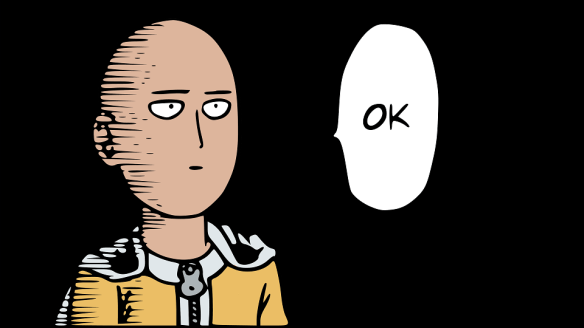
This is truly the face of a mighty hero.

When Joseph Campbell wrote The Hero with a Thousand Faces, I bet he didn’t think the blank face above would be one of them. It doesn’t burn with determination, glow with compassion, or shine with righteous resolve. It just looks bored.

This face belongs to Saitama, the hero of One Punch Man: an anime series that swept across the geekier corners of Internet a few months ago. Its premise is very simple: Saitama is a superhero who can defeat any foe with a single punch—hence the name One Punch Man.
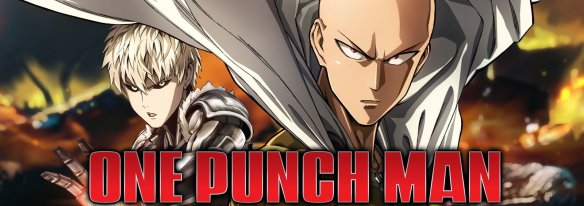
One Punch Man

One would expect a show with such an overpowered hero to be dull, but the storytellers wisely play Saitama’s power for laughs. One Punch Man is delightfully self-aware, at times almost satirical, in how it plays around with anime tropes and superhero clichés. I think the show’s irreverent approach is a secret to its massive popularity.

For example, a common theme in anime is a hero on a journey to become the strongest. Just look at Pokémonthe show’s theme begins with the words, “I wanna be the very best like no one ever was.” I don’t watch a lot of anime, but I get the impression that many of the most popular, from Naruto to One Piece, revolve around a hero’s quest to be stronger.

In One Punch Man, Saitama is already the strongest. (Most of the other characters haven’t realized it yet, but that’s not the point.) As more impressive-looking heroes fail, Saitama destroys his foes with the indifference of a man swatting flies. Saitama doesn’t burn with ambition. He’s bored, good-natured, and a bit clueless. How did he become so powerful? What is the secret that let him surpass hundreds of other superheroes?

In a ridiculous scene, underscored by dramatic music, Saitama finally explains the secret behind his godlike power:

It took me three years to get this strong. One hundred push-ups! One hundred sit-ups! One hundred squats! Then a ten kilometer run. Every single day! And of course, make sure you eat three meals a day. Just a banana in the morning is fine. But the most important thing is to never use the A/C or heat in the summer or winter so that you can strengthen the mind.

There you have it: the secret to absolute physical power.

One Punch Man also has a terrific opening theme. Here’s a fan-made English cover of the original Japanese song:

The intro to the show ends with a picture of Saitama dramatically walking home with a bag full of groceries, which pretty much sums up the tone of One Punch Man.
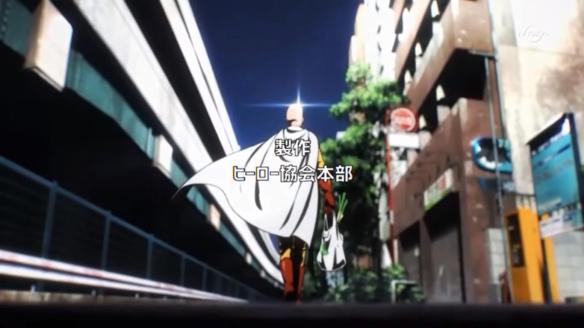
Saitama with shopping bag

With the media saturated with the same old clichés, it’s nice to see a story that flips so many of them on their heads.
In Case of Fire, Send Email

I have to work an extra day this week, so instead of writing a long Geeky Wednesday post, I’ve leave you in the capable hands of Maurice Moss from The IT Crowd, a superb British comedy series.

Here’s a safety tip: If there’s a fire in your building, email is probably not the best way to contact the fire department. (Trust me on this one. When you’ve worked with my typewriter monkeys for as long as I have, you learn a lot about fire safety.)

Stay safe!

A Portrait of the Artist as a Hero Drinking Coffee

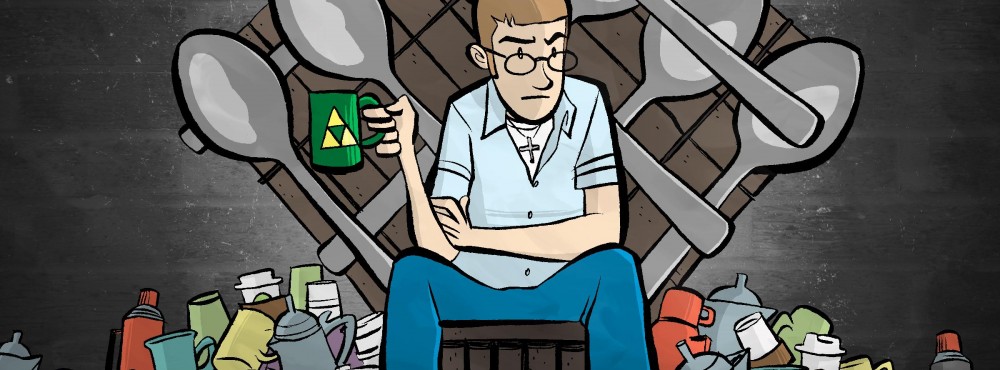
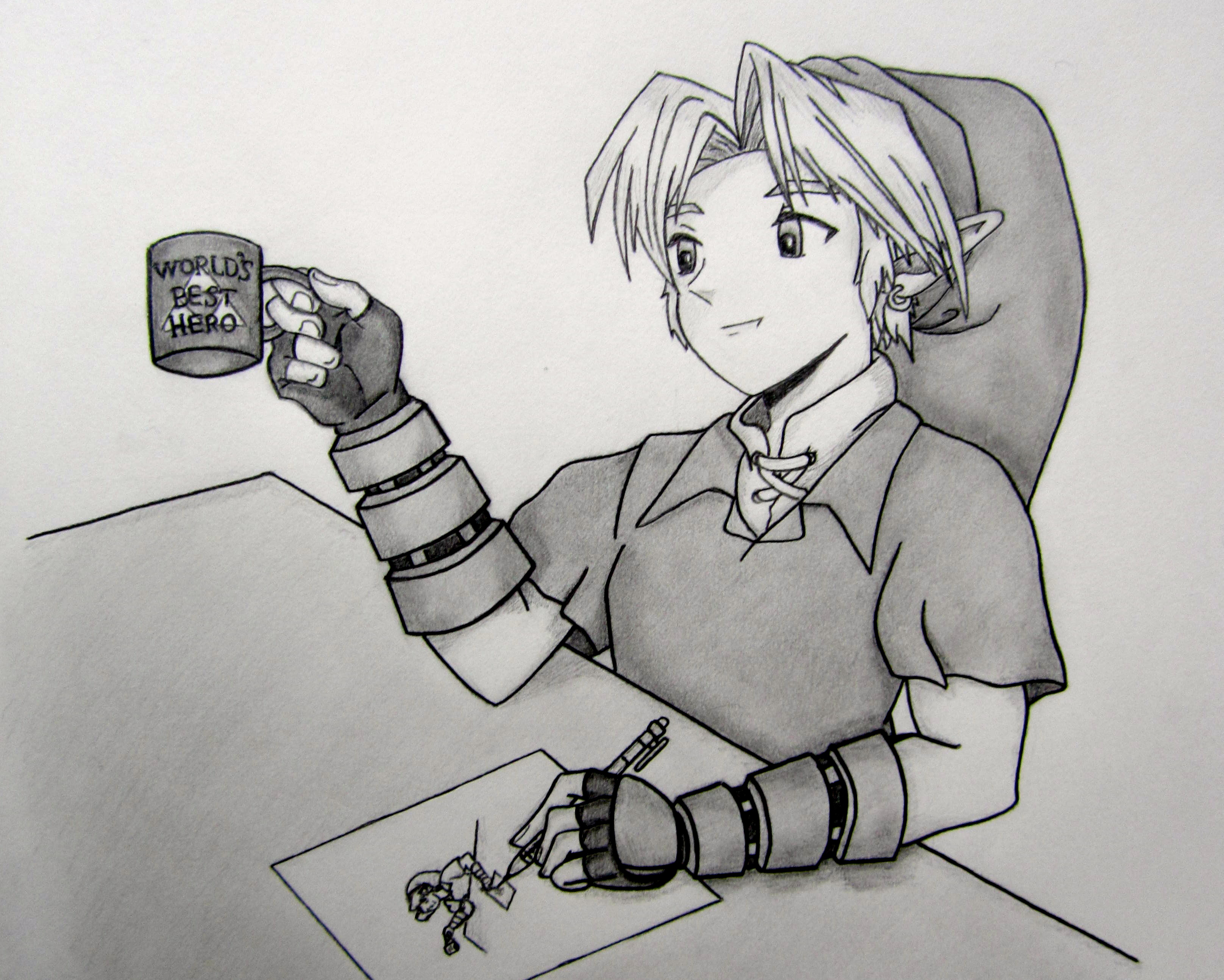
Link Drinking CoffeeLook at that picture. Look at it. I wish I could draw pictures like that.

While I fool around on this blog, my younger brother sketches fantastic pictures in pencil and posts them on his DeviantArt page. Seriously, I don’t know how he produces drawings like these. I’m guessing pencils and paper are involved somehow; the rest is a glorious mystery.

The image above is my brother’s profile picture: Link, the protagonist of the Legend of Zelda games, drinking coffee and drawing… himself. (If his coffee cup is to be believed, Link is also the World’s Best Hero.) As a Zelda fan, I find my bro’s profile picture clever and hilarious.

I strongly recommend taking a look around my brother’s DeviantArt profile. Seriously, it’s cool. Check it out!


This post was originally published on November 27, 2013. TMTF shall return with new content on February 22, 2016!

A Caffeinated Romance

St. Valentine’s Day is coming up. (Yes, I insist on referring to the holiday as St. Valentine’s Day, because I am a grouchy traditionalist.) It’s a time for people in relationships to express their affections, and for single people to feel awkward. St. Valentine’s Day is also a time for coffee, but let’s be honest—it’s always time for coffee.

“Taylor the Latte Boy” is my all-time favorite romantic song. (Well, the video above actually features two songs: “Taylor the Latte Boy” and its response, “Taylor’s Rebuttal.”) What could be more romantic than a guy and a girl falling in love over coffee? The girl’s passionate tale of love, longing, and lattes is only slightly marred by the guy being absolutely not interested.

Coffee, love poetry, and the possibility of a restraining order: “Taylor the Latte Boy” has it all. This two-part song is on the longish side, but if you have time, I absolutely recommend it. The parts of Taylor and his admirer are performed well, and the differences between their points of view are hilarious.

In the end, I think we can all agree that caffeinated romances are the best kind.


This post was originally published on February 11, 2015. TMTF shall return with new content on February 22, 2016!

How to Start a Story

There was a boy called Eustace Clarence Scrubb, and he almost deserved it.

~ C.S. Lewis, The Voyage of the Dawn Treader

Any writer worth her ink and paper knows the importance of starting a story with a really good line. An interesting or clever first line grabs the reader’s attention right away. First impressions are important, you know!

The quote above from C.S. Lewis is one of my favorite opening lines of any story. It’s witty and succinct, and also tells us several important things right away while setting up one or two intriguing questions:

  1. Eustace Clarence Scrubb is a character in this story.
  2. He is also a boy.
  3. His name is terrible.
  4. He almost deserves his name—why?
  5. The lousy name suggests that his parents, who (presumably) named him, are probably unusual in some way or simply have poor taste. (Spoiler: It’s a bit of both.) What is their deal?

In just thirteen words, the author has begun to set the stage for the story, and told a joke into the bargain. That, dear reader, is how it is done.

Here, in no particular order, are some of my favorite opening lines in literature.

When Gregor Samsa woke up one morning from unsettling dreams, he found himself changed in his bed into a monstrous vermin.

~ Franz Kafka, The Metamorphosis

I have yet to read The Metamorphosis by Kafka—it’s on my reading list, which continues to grow at an alarming rate—but this line is fantastic. I mean, after reading this line, I really want to find out what happens next.

It is a truth universally acknowledged, that a single man in possession of a good fortune, must be in want of a wife.

~ Jane Austen, Pride and Prejudice

As many of my friends know only too well, I have read only one book by Jane Austen, and hated it with the burning passion of ten thousand suns. Mark Twain put it well: “I often want to criticise Jane Austen, but her books madden me so that I can’t conceal my frenzy from the reader; and therefore I have to stop every time I begin. Every time I read Pride and Prejudice I want to dig her up and beat her over the skull with her own shin-bone.” However, as much as I disliked Pride and Prejudice, I have to admit that it has one heck of a first line. It wryly pokes fun at the expectations of high society with its “truth universally acknowledged,” and also hints at the plot of the novel.

In a hole in the ground lived a hobbit.

~ J.R.R. Tolkien, The Hobbit

All right, I admit it: I love this one mostly for sentimental reasons. That doesn’t mean it isn’t a great opening line. What is a hobbit? Why does it live in a hole in the ground? The following paragraphs elaborate with surprising information: the hobbit lives not in “a nasty, dirty, wet hole, filled with the ends of worms and an oozy smell, nor yet a dry, bare, sandy hole,” but in a neat, comfortable, luxurious home built inside a hill. This line is an intriguing set-up to a few really engaging paragraphs… assuming the reader doesn’t mind starting the story at a leisurely pace.

What is your favorite opening line in literature? Let us know in the comments!

Mickey Mouse in Mexico

I never did trust piñatas. After so many generations of being beaten by children with sticks, it was only a matter of time before they struck back.

Incidentally, I’m glad Disney is still making Mickey Mouse cartoons. It’s nice to see that this juggernaut of mass media, which now owns everything from Marvel Comics to Star Wars, hasn’t forgotten the little mouse that started it all.

Don’t Interrupt Me While I’m Reading a Book

A friend of a friend of mine writes a blog called The Lingering Lamb, and a recent post reminded me of a song from my college days. “I’m Reading a Book” seemed funny at the time, but now it’s a painful reminder of how irritating it is to be interrupted while reading. (Maybe I should write another Hulk rant.)

I read on break at work, and a coworker has tried to start conversations on inane subjects while, y’know, I’m clearly reading a book. Once or twice, my coworker has entered the room, seen an open book in front of me, and apparently told herself, “Oh, Adam is reading a book! That is obviously an unspoken permission for me to chatter at him for the next ten minutes.”

I don’t want to join a conversation when I’m reading a book. As friend of mine pointed out, when I’m reading a book, I’m already having a conversation. It’s rude to interrupt.

I’m beginning to think I should wear a “DO NOT DISTURB” sign around my neck when I read on break. At the very least, I should look grumpy. (I’m getting pretty good at grouchy expressions; you should see my Power Scowl.) I’ll work on it.

Comic Book Sound Effects

BTYANG!Comic book sound effects are weird.

I didn’t read comics until the past few years. Oh, I read a few graphic novels—mostly critically-acclaimed stuff like Maus and Scott Pilgrim—and a couple of comic series, but nothing particularly comic-booky: no superheroes, noir mysteries, or slice-of-life romances.

Then, quite a number of months ago, a kindly relative began sending me and my younger brother books and comics. These literary care packages contained works of interest he had picked up at comics events and used bookstores. His latest gift was a little stack of free comics he had gleaned from a Halloween comics festival.

It was a fascinating collection. Among others, there was an old-timey Spiderman comic, written by Stan Lee and drawn by Jack Kirby; the first issue of a famous Batman series, which later influenced Christopher Nolan’s Batman film trilogy; a couple of contemporary Marvel superhero comics; and some licensed stuff based on television and video games. With its blend of classics, current issues, and promotional fluff, that stack of comics was like a cross section of the comic book industry.

Anyhowz, one of the things that stood out to me about those comics was the weird sound effects. I knew odd sounds were a thing in comics, but… dang. Rather—if I may spell the word like a sound effect in a comic book—DHAAANG!

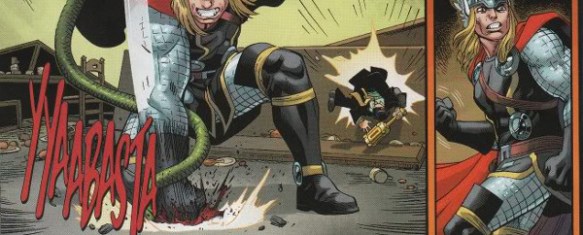
Out of curiosity, I googled “weird comic book sound effects,” and yep, there sure are some weird ones. Consider “YYAABASTA,” which sounds exactly like Spanish for “That’s enough!”

YABASTA!

The weirdest sound effects of all, however, came not from the Internet, but from one of the comics my relative sent me. It was a Donald Duck comic. The sounds were “SPUZZLE,” which is the sound of whipped cream sprayed from a can, and “SPLOMP,” which is the sound of twelve tons of chocolate cremes hitting a street from a height of roughly twenty or thirty feet.

…Yeah, don’t ask.

Doctors Who

Doctor Who, the British television program about an eccentric time-traveling alien, has been around for more than fifty years. That’s a long time for a TV show to exist. The sci-fi shenanigans of Doctor Who have delighted audiences (and occasionally caused them to hide behind the sofa) for five decades. For perspective: Star Wars, another enduring classic of science fiction, hasn’t even hit the forty-year mark.

When a series becomes as old as Doctor Who, it runs into the problem of its actors aging. Actors are only human, after all. They sometimes tire of roles, get sick, move to faraway places, retire from acting, or simply expire.

Most long-running film or television series find ways around this problem. Some, like many James Bond films, cast new actors as the same character, ignoring changes of appearance. Some series retire old characters to make way for new ones. Many series are rebooted, telling updated versions of their stories with new actors in familiar roles.

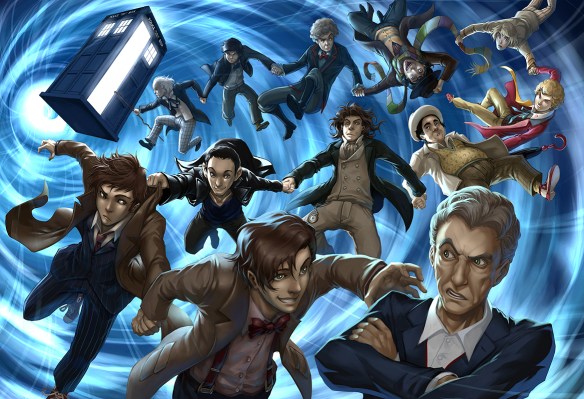
Then there’s Doctor Who. Its hero, the eponymous Doctor, has been portrayed by more than a dozen actors. The show never pretends not to notice the Doctor’s changing face, but instead offers a suitably ridiculous explanation: the Doctor is a space alien, and changing his appearance every so often is part of his life cycle.

This silly explanation become a brilliant and integral part of the show’s story. Every time he changes his face, or “regenerates,” the Doctor’s personality changes, but he retains his values, knowledge, memories, and sense of self. This storytelling trick allows the role to be passed from actor to actor, and keeps the character from becoming stale.

Which Doctor is the best? This is the sort of Kirk-versus-Picard question that fans never tire of arguing. In the end, like so many petty conflicts between fans, it doesn’t really matter. Every version of the Doctor has strengths and weaknesses, and is valuable in his own way.

That said, the Tenth Doctor is the best.

Days Gone By

This song comes from a girly cartoon about rainbow ponies, and it may be the loveliest I’ve heard all year.

This beautiful arrangement of “Auld Lang Syne” has new lyrics and a deft fusion of two styles. The Irish flute and tin whistle give the song a Celtic feel, while the banjo and southern-accented singers add an acoustic country flavor. Celtic and country music come from separate continents, yet have much in common as styles of folk music. (I wish someone would mix Celtic or country with traditional Andean music… I think Irish flutes or banjos could blend well with pan flutes and charangos.)

I generally frown upon rewriting old songs, but this one’s new lyrics are pretty good. Its message—thinking of family who can’t be here and smiling at good memories of days gone by—strikes a chord with me. Many of my loved ones are scattered across the world, and my quiet Indiana life seems far from my adventures growing up. This song is a celebration of good things past, and it hits me right in the feels.

Happy New Year, guys.