Help, I’m a Christian! – Obedience and Service

A white-haired, coffee-drinking teacher of mine once pointed out that a three-legged stool can’t stand with only two legs. He was right. Take away even a single leg and the stool comes crashing down.

This teacher told me the Christian life is like a three-legged stool. Take away prayer, the Bible or church, and the whole thing collapses. These things are essential.

Obedience and service are no less important. They’re roughly the same thing, but for this post I’ll use service to mean doing good things and obedience to mean not doing bad things.

Let’s start with obedience. God calls us to be free from sin—not mostly free, but completely free.

When I was younger, I thought sins were like parking tickets: they’re bad, but a few here and there don’t do much harm. I was wrong. Over time I discovered that sins are more like cancer cells: they’re deadly, and they grow.

Sin has a way of taking root like a weed. It hurts our relationships, destroying trust, shattering peace, undermining confidence and generally making a mess of things. Apart from damaging relationships, sin often brings other nasty consequences too.

God calls us to avoid sin completely because we’re truly more useful, more joyful and more content without it. If he tells us not to do something, it’s not because he’s a spoilsport. It’s because he loves us.

God lets us choose either to follow him or to go our own way. If we follow him, he always accepts us. If we go our own way, he lets us. It’s one or the other. Sin is antithetical to God—it’s everything he is not. We can’t have it both ways.

Service, I’m glad to say, is a much more cheerful subject than sin.

Loving God is his greatest commandment. What is his second greatest commandment?

Jesus said, “And the second is like it: ‘Love your neighbor as yourself.’ All the Law and the Prophets hangs on these two commandments” (Matthew 22:39-40).

Jesus also said, “A new command I give you: Love one another. As I have loved you, so  you must love one another. By this all men will know that you are my disciples, I you love one another” (John 13:34-35).

Service is all about loving others: donating money to feed families in Africa, playing Mario Kart with friends, listening when someone needs to talk or helping out around the house. It’s doing everything we can do to serve, encourage, bless, amuse, help and strengthen others.

It’s simple, but it’s not always easy. People can be awful. As Linus from Peanuts declared, “I love mankind—it’s people I can’t stand!”

In the end, though, loving people is an awesome paradox: those who are loved are blessed, and so are those who love. Everybody wins.

Next: Faith and Works

Help, I’m a Christian! – Church

A church is supposed to be a gathering of Christians who meet together to worship God and serve others. Simple, right?

However, some churches have become cluttered, whether with hymnals and wooden pews or electric guitars and cinema-style padded chairs. The Christian faith is sometimes eclipsed by the traditions and cultures of its churches.

Another kind of clutter is the idea that churches are independent. There isn’t often much communication or cooperation between churches, even though they belong to the same God. We think of different churches as separate entities, not as parts of a single entity.

Worst, I think, is that churches are cluttered with prejudices. We Christians have a tendency to make two deadly mistakes: believing our opinions are infallible, and assuming anyone who disagrees must be a misguided sinner. I’m ashamed to say it, but Christians are often rude in God’s name.

There are so many empty traditions, so many dogmatic views, so many petty squabbles—to wit, so many kinds of clutter—filling churches everywhere that we can’t help but ask a question.

Is church worth it?

Yes, yes it is.

We can start by not giving up. I know people who have stopped going to church. They avoid the clutter, true, but they also miss the glorious blessings churches have to offer.

The Christian faith isn’t something we can live out individually. When we call God our Father, we acknowledge being part of a family—and we don’t get to choose our siblings, biological or spiritual.

Right from the beginning, Christians stuck together. Christ himself had disciples. After Christ’s departure from Earth, his disciples became a community.

Church gives us the opportunity to encourage each other, worship God together, serve our communities and learn from other believers.

We can choose not to lose sight of the big picture. In the midst of the details—the youth ministry events, the Wednesday Bible studies, the rehearsals for Sunday morning worship—we can remember why we do these things.

To repeat an invaluable lesson, we must understand the why of Christian living as we live out the how.

It’s important to recognize church as a community—not a social club, but a family. Some of my favorite congregations have met in houses, banquet halls and indoor soccer stadiums. There were no hymnals, no fog machines and hardly any formal programs. Members gathered simply to worship God and to encourage each other. It was awesome.

Being part of a community takes time, effort and patience. Church isn’t always what we want it to be. Sermons can be boringWorship songs can be unbearably silly. Other Christians can be irritating.

However, church is sometimes even better than what we want it to be. Sermons can be useful. Worship songs can be beautiful. Other Christians can be loving, hospitable and kind.

In the end, church is worth it.

Next: Obedience and Service

Help, I’m a Christian! – The Bible

The Bible. The Bible. These two words evoke a book which weighs nearly as much as a small rhinoceros: a book with hundreds and hundreds of pages packed with tiny lettering. The Bible is fraught with dull footnotes. The Bible is full of weird names like HakkatanAbimelech and Mephibosheth.

The Bible is also the most powerful book ever written.

It’s the bestselling book in history. Along with Greco-Roman mythology, it’s one of the foundations of Western literature. It has influenced thinkers, artists, musicians and writers for two thousand years: Michelangelo, Bach, Dante, Da Vinci, Handel, Newton, Chaucer and Pascal, to name but a few. The Bible has shaped societies around the world. Some of the founding principles of the United States of America were taken from Scripture.

The Bible is an important book, and that’s looking at it from a secular perspective!

For Christians, it’s infinitely more important—it’s the Word of God.

I’ll be the first to admit that reading Scripture is hard. I’ll also be the first to affirm that it’s totally worth it.

When I began reading the Bible, I made three great mistakes.

First Mistake: I thought of the Bible as just a religious obligation. I read it simply because that was what Christians did.

Second Mistake: I failed to understand how the story of the Bible fits together. The Bible is one story. Each part connects to every other part. (Except for the book of Job. It sort of comes out of nowhere.) In Sunday School, I learned the famous stories: Noah and the Ark, David and Goliath and the rest. What I didn’t learn is that they’re all part of a much greater story.

Third Mistake: I didn’t recognize the indirect lessons of Scripture. Sure, there are a lot of direct lessons like You shall not kill, but most of the Bible doesn’t consist of straightforward commandments. There are histories and genealogies and poems, not to mention a lot of ancient laws that don’t apply to us anymore. I thought these things were worthless because they didn’t relate directly to my life.

What I didn’t understand was that they related indirectly.

In a reader skips the slow chapters in a novel, he’ll have an inadequate grasp of the story. It’s the same with Scripture. If we skip the boring parts, we’ll end up with an incomplete understanding of who God is, what he has done and what he wants us to do.

Reading Scripture can be hard, and it would take much more than one blog post to address all of the difficulties that can arise. That’s why Study Bibles and other resources are awesome. They fill in the gaps, interpret the difficult verses and generally make reading the Bible easier.

What’s the best way to read the Bible?

It’s a matter of choice. Some people write down their reflections in a journal. Others make notes in their Bibles. Some people read Scripture every day. Others read it several times a week.

For a beginning reader, I recommend finding a good Study Bible and starting with the New Testament, then reading the Old Testament, then rereading the New Testament. The New Testament probably has more practical lessons for Christians, but the Old Testament influenced the New Testament so much that it’s important for Christians to be familiar with both.

I humbly offer three pieces of advice to anyone reading the Bible.

First, take it slow and steady. A chapter every day is better than seven chapters once a week. Readers risk burning out if they read too much at one sitting, and it’s easiest to absorb Scripture in small doses. Find a reading plan that works for you.

Second, don’t panic. The Bible can be hard to read, and that’s okay. Just take it a little at a time.

Third, don’t be afraid to engage issues that seem confusing or strange. God loves it when we ask questions, and the Bible is a book that has confused people for millennia. Don’t be concerned if something doesn’t seem to make sense. Pray about it, find a good Bible resource or talk it over with someone.

The Bible is my favorite book. When I began reading it, however, I didn’t like it. Scripture seemed boring and distant.

Then little things began to click: a psalm here, a proverb there; a command from Jesus here, a warning from Paul there. I was sometimes convicted. I was sometimes encouraged. Bit by bit, I learned.

Apart from prayer and the good examples of other people, I don’t think anything has helped me grow so much—as a person, as a writer and as a follower of Christ—as the Bible.

Hard to read? Sometimes. Worth it? Totally.

Next: Church

Help, I’m a Christian! – Prayer

Jesus was once asked by his disciples how they should pray. It was pretty smart of them to ask him, since he’s sort of an expert on the subject.

Here’s what he had to say: “When you pray, say: ‘Father, hallowed be your name, your kingdom come. Give us each day our daily bread. Forgive us our sins, for we also forgive everyone who sins against us. And lead us not into temptation’” (Luke 11:2-4).

For me, the most powerful thing about this prayer is one word. The prayer begins with Father. Jesus calls God his Father, but that’s not surprising. (Jesus is the Son of God, after all.) What’s surprising is that he instructs us to call God our Father!

This brings us to the most significant thing I’ve discovered about prayer: If prayer is part of the Christian faith, and the Christian faith is basically a relationship with God, then prayer is part of a relationship.

This seems pretty obvious, but it took me a long time to understand.

When I was younger, my prayers were recitations. It took me a long time to understand that prayers are supposed to involve not one person, but two people: a speaker and a listener. Prayers are meant to be conversations.

My early prayers were full of phrases that sounded impressive but didn’t mean anything. I prayed vaguely, asking God, “keep your hand on this person, and pour out your grace upon that person.”

I wasn’t really asking God to help anyone. I was just easing my conscience by praying churchy prayers.

When we pray for other people, it should be to help them—not to make ourselves feel better. This often requires us to pray for specific needs. If my friend Socrates is recovering from surgery or going through depression, I should pray specifically for his healing or comfort—not petition God to do something unspecified like “showering Socrates with abundant blessings.”

Sometimes we don’t know what other people need. Sometimes we don’t even know what we need. That’s okay. We can still pray, “Father, you know this person’s needs. Please meet those needs, whatever they may be.”

A final lesson I’ve learned about prayer: Every word counts! The Bible warns against praying long, rambling prayers: “God is in heaven and you are on earth, so let your words be few” (Ecclesiastes 5:2).

The Lord Jesus himself said, “And when you pray, do not keep on babbling like pagans, for they think they will be heard because of their many words. Do not be like them, for your Father knows what you need before you ask him” (Matthew 6:7-8).

It’s easy to pray without thinking. When we pray, we must stay focused and say only what we really mean. As Jesus said, “Love the Lord your God with all your heart and with all your soul and with all your mind and with all your strength” (Mark 12:30). We should pray with all our mind, not just part of it.

To sum up, here are the three most important things I’ve learned about prayer:

Prayer should be a conversation, not a recitation.

Prayer should be sincere and meaningful, not empty and meaningless.

Prayer should be focused, not vague.

Next: The Bible

Help, I’m a Christian! – Relationship

Perhaps the most important lesson I ever learned is that the Christian faith is a relationship, not a system.

When I was younger, I was convinced faith was a system made up of logical rules. I thought all I needed to be a good Christian was to spend x number of minutes praying and read y number of chapters in the Bible and do z number of good deeds every day. Being a follower of Christ, I believed, was sort of like being a member of a club. All that was needed was to meet the minimum requirements.

To put it simply, I believed Christian living was just about doing stuff.

I was wrong.

For years I felt vaguely anxious, guilty and perplexed. Praying was awkward. Reading the Bible was tedious. Doing good things, and not doing bad things, seemed pointless.

I prayed, but not to know God or to help anyone. I read the Bible, but not to learn. I did good deeds, but not to be honor God or to serve others. I went to church, but not to strengthen my faith. I did these things simply because they were what Christians did.

I’d gotten the how right, but I’d totally missed the why.

Faith isn’t a system. Treating it like one will only lead to confusion, disillusionment and pain.

What, then, is faith?

It’s a relationship!

Granted, it’s more formal than most relationships. A relationship with God is sort of like a parent-child relationship and sort of like marriage.

We’re dependent on God, just as children are dependent on their parents. He provides for us, protects us and sometimes disciplines us, just as parents do for their children.

As for the marriage example: there are rules that guide our relationship with God, just as there are rules that guide the relationship between husband and wife.

It’s not enough just to “pray the prayer” to become a Christian. That’s the first step. A marriage relationship is more than just a wedding! The wedding is only the first of many, many steps.

In our relationship with God, do we make mistakes?

Absolutely.

That’s when we realize why a relationship is a thousand times better than a system. In a system, mistakes demand remuneration, atonement, compensation. In a relationship, one person simply forgives the other.

However—as in all other relationships—the whole thing falls apart if one person tries to take advantage of the other.

In a marriage, the wife can be the kindest, sweetest woman ever, but the relationship won’t last if the husband is selfish or unfaithful. A father can be the most patient, loving man in the world, but he can’t care for his children if they insist on running away from home.

God forgives us when we make mistakes. However, if we insist on disobeying him, he eventually lets us go our own way. To quote C.S. Lewis, “There are two kinds of people: those who say to God, ‘Thy will be done,’ and those to whom God says, ‘All right, then, have it your way.'” God doesn’t force us to obey him. He gives us the freedom to choose, even if our choice is to turn away from him.

If we turn back to God, he will always accept us. Just look at the story of the Prodigal Son!

If we want to accept God, however, we must accept him on his terms.

One those terms is that God speaks to us indirectly. As nice as it would be to chat with him face to face over coffee every morning, he chooses less direct methods to communicate: the Bible, literature, nature and people, to name a few.

This is admittedly frustrating. I’m not sure why God isn’t more direct, but there is one thing of which I’m sure: this indirectness is temporary. Quoth the Apostle Paul, “Now we see but a poor reflection as in a mirror; then we shall see face to face. Now I know in part; then I shall know fully, even as I am fully known” (1 Corinthians 13:12).

All this is fine theoretical stuff, but what does it mean in practical terms? How does it affect how we live?

It means we must understand the why of Christian living as we live out the how.

We should pray in order to help others and build up our relationship with God. We should read the Bible in order to learn. We should obey and serve in order to be useful. We should attend church in order to grow closer to each other and to God.

Faith isn’t a system, and God doesn’t ask us to do things for no reason. Understanding that faith is a relationship, and Christian living is part of that relationship, is probably the most important lesson I’ve ever learned.

Next: Prayer

Help, I’m a Christian! – Introduction

Becoming a follower of Jesus Christ was absolutely the best decision I ever made, but there was a problem.

I had no idea what I was doing.

Prayer was necessary, I knew, and church was important, and the Bible came into it somehow. I had heard all the Sunday School stories and could sing all the worship songs. However, when it came to the practical day-to-day essentials of Christian living, I had only a vague idea that I should try to “be good.”

I’ve learned a lot since then. It took lots of mistakes, some of them very painful. Much of what I know about Christian living I learned the hard way.

This Holy Week, I’d like to share some of what I’ve learned.

At the heart of Christianity lies a relationship with Christ. Since relationships are unique, nobody can give perfect, specific, infallible instructions about this particular relationship—or any relationship, for that matter.

In the end, all anyone can do is share what they’ve learned from their own experiences. That’s what I’ll do this week.

You may not be a Christian. That’s okay. You’re welcome to read this week’s posts anyway. They might give you a clearer idea of what Christianity is all about.

You may be a much better Christian than I am. That’s awesome! You’re welcome to read this week’s posts anyway. Feel free to share your thoughts (and correct my mistakes) by leaving comments.

Here’s the plan for this week:

Monday: Relationship

Tuesday: Prayer

Wednesday: The Bible

Thursday: Church

Friday: Obedience and Service

Saturday: Faith and Works

Onward!

171. Quirky Bible Translations

During Holy Week, TMTF will feature the Help, I’m a Christian! series, beginning on Palm Sunday, March 24, and concluding on Holy Saturday, March 30. Regular posts will resume on Monday, April 1.

There are many English translations of God’s Word. How many? I’m not sure, but I prefer not to spend years of my life counting.

I often read the Bible, and when I do, I prefer the 1984 New International Version.

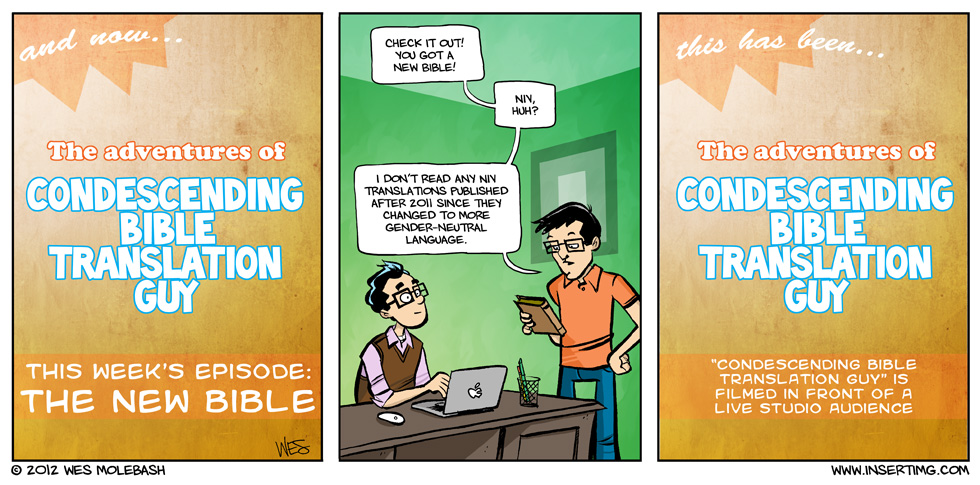
Yes, I'm this guy.

Confession: I am a Condescending Bible Translation Guy.

In my twenty-two years, I’ve stumbled upon some Bible translations that are best described as… quirky.

Here’s part of 1 Corinthians 13 in the plain English of the New International Version.

Love never fails. But where there are prophecies, they will cease; where there are tongues, they will be stilled; where there is knowledge, it will pass away.  For we know in part and we prophesy in part, but when completeness comes, what is in part disappears. When I was a child, I talked like a child, I thought like a child, I reasoned like a child. When I became a man, I put the ways of childhood behind me. For now we see only a reflection as in a mirror; then we shall see face to face. Now I know in part; then I shall know fully, even as I am fully known.

And now these three remain: faith, hope and love. But the greatest of these is love.

Here’s the same passage in the HWP Bible. That’s the Hawaiian Pidgin Bible, in case you were wondering. Read this excerpt aloud. Read slowly. Savor it.

Wen you get love an aloha, dat no goin pau eva. Da guys dat talk fo God, bumbye no need fo da tings dey say. Wen peopo talk diffren kine, bumbye nobody goin talk lidat. Da stuff da smart guys know, no matta, bumbye no need. You know, we ony know litto bit. Wen we talk fo God, we get ony litto bit fo tell. Bumbye, goin come da time wen everyting stay perfeck. Dat time, no need fo da litto bit kine stuff no moa. Small kid time, I wen talk jalike one small kid. I wen tink jalike one small kid. I wen figga everyting jalike one small kid. Now, I big, dass why I no do da tings da same way da small kids do um.

Right now, us guys can see stuff, but ony jalike wit one junk mirror. Hard fo figga wat we see dea. But bumbye, goin be clear. Us guys goin see everyting jalike was right dea in front our face. Right now, I ony know litto bit. But bumbye, I goin undastan everyting, jalike God undastan everyting bout me.

So now, get three tings dat stay: we can trus God, an we can know everyting goin come out okay bumbye, an we get love an aloha. From da three tings, da love an aloha kine, dass da main ting, an da bestes way.

Then there’s my favorite offbeat translation of Scripture… the lolcat version.

Luv no haz endingz. Tellin the futurez, tungz, an alla stuffz u know wil die. We haz knowingz a bit, an we haz profacy a bit. We no haz two much tho. O, wait. Win teh perfict coemz, teh not perfict will dyez, lolol. Wen i wuz a kitten, i meweded leik a kitten, thinkded liek a kittenz, an I chazed strings liek a kittenz. Wen i wuz becomez a cat, i NO WANT kitten waiz ne moar. For nao we see in teh foggy mirorr like when teh human gets out of teh shower, but tehn we see faec tow faec. Nao i haz knowingz just a bit, tehn i will haz all teh knowingz, as i haz been knownz.

Nao faithz an hoepz an luvz r hear, theses threes, but teh bestest iz teh luv. srsly.

Yes, this is a real translation. The entire Bible has been translated into lolspeak, the Internet language of funny cat picture captions. After all, the Apostle Paul did write about becoming “all things to all people.”

 What’s your preferred version of the Bible? Are you a Condescending Bible Translation Person or do you prefer idiomatic versions like The Message? Let us know in the comments!

170. Batman Syndrome

I have Batman Syndrome.

I wish this meant I were as cool, skilled or accomplished as Batman. It does not. It most certainly does not. What it means is that Batman and I have something in common: we obsess over our mistakes.

If you or someone you love suffers from Batman Syndrome... I feel your pain.

If you or someone you love suffers from Batman Syndrome… I feel your pain.

I like fictional characters who overlook their victories and overemphasize their failures. There’s something compelling about characters who are heroic without realizing it. Take the Doctor from Doctor Who, who has saved every planet in the universe roughly twenty-seven times. In all his travels through space and time, he never leaves behind his insecurity, self-loathing or guilt. Consider Jean Valjean from Les Misérables, who atones for a few petty crimes by spending years serving the poor and helpless. They bless him as a saint. He despises himself as a criminal.

Then we have Batman, the eponymous sufferer of Batman Syndrome, who is so blinded by guilt that he fails to recognize one all-important fact: he is freaking Batman. No matter how many thousands of people he rescues, he remains obsessed with the two he failed to save.

I’m not a savior like the Doctor or a saint like Jean Valjean. I’m certainly not a superhero like Batman. Even so, I occasionally do things right. I also do things wrong. In my mind, the wrong things eclipse the right ones. A mistake cancels out all successes.

This isn’t always such a bad thing. I feel driven by my mistakes to try harder, to be better, to get it right. In the short term, it helps.

In the long term, however, Batman Syndrome wears away my confidence. It also makes me anxious. Dash it all, does it ever make me anxious. Doing anything is hard for someone desperately afraid of making mistakes. Perfection is a lousy minimum standard.

Batman Syndrome haunts me with one dreadful question.

You’ll never get it right, so why even try?

I write a lot about grace and stuff. In the end, I suppose it’s because I’m amazed (and sometimes incredulous) that God loves me. I’ve made a lot of mistakes. More to the point, I make a lot of mistakes. It’s easy for me to accept God’s forgiveness for a sin committed ten years ago. What’s hard for me to accept is forgiveness for a sin committed ten minutes ago.

It can also be hard for me to acknowledge my victories. I want to be humble, but there’s a difference between true humility and false modesty. I’m often reminded of my weaknesses. I think I must also allow myself to be reminded of the strengths God has given me. I’ve a long way to go, but I mustn’t overlook how far I’ve come.

I’m not Batman, and I think I’m finally beginning to accept that I don’t have to be.

161. A Conversation with Myself

Hello, Adam.

Go away. Trying to write a blog post here.

Ah, yes. A post for your typewriter monkey blog—the one that’s read by tens of people. Some of them may even be mildly interested in what you have to say.

I happen to like my blog, thank you very much.

Of course. I suppose you must. I mean, who else will?

Seriously, go away.

Why don’t you take a break from your blog and work on your novel? Oh, that’s right. You’re still stuck on that chapter. The one you started six months ago.

Hey! The past six months have been crazy and busy and stressful. Survival comes before creative writing. To quote Louisa May Alcott, “First live, then write.”

Ah, it was only a matter of time before you quoted somebody. You really, really enjoy quoting people, don’t you? You think it makes you seem smart and bookish. I think it makes you sound like a pretentious twit.

Yes, I like quoting people. So what? I haven’t given up on my novel, by the way. This is the year I finish the deuced thing.

We don’t use words like deuced in America, son.

I like dated British idioms.

I know, and I think it’s really cute that you use them. Wait, did I say cute? I meant annoying.

Do you know what? I kind of hate you.

That’s funny, Adam, because you and I happen to be the same person. Therefore, if you dislike me, who is it you really dislike?

I wouldn’t mind so much if you were… you know… cooler. A shadow version of me with glowing red eyes, maybe. The Shadow Adam. The Anti-Adam. My evil doppelganger. But you’re not any of these things. You’re just annoying.

The truth is sometimes annoying, but that doesn’t make it any less true. I’m here to give you healthy doses of realism when you get drunk on excitement and optimism. I’m here, Adam, because I care.

You’re twisting the truth and you know it. You’re exaggerating the nasty facts and hiding the good ones and generally making things seem much worse than they are.

Just listen to you! I know you like big words, so here’s one for you to chew on: pontificating. More to the point, stop pontificating!

Would you kindly go away? I need to finish this blog post.

You’ll never be Jon Acuff, you know.

Go away.

You’ll certainly never be C.S. Lewis.

Go away!

You won’t make a difference.

That’s it. Listen here! I will make a difference. It may not be a big difference. It may be a very small difference, but even a small difference can cause a whole lot of good.

Why do I get the feeling I’m about to hear another one of your fancy quotes?

Well, you are. “Sometimes you can feel like what you have to offer is too little to make a difference, but today I learned that every pony’s contribution is important, no matter how small.”

Wait. Wait. Are you quoting that stupid cartoon about rainbow ponies? That’s pathetic, Adam.

Hey! You can’t blame me for being pretentious, and then fault me for being childish.

I can, because you’ve somehow managed to be both. Congratulations.

Dash it, at least I’m trying to do something worthwhile!

Yes, yes you are. Trying and failing.

“Next to trying and winning, the best thing is trying and failing.”

Ah! Do you never stop quoting people?

Shut up and listen. In the vast scheme of things, I might not have much to offer. Individually, few people can change the world. But what if everybody tries? What then?

What if everybody fails?

God used a little boy’s lunch to feed thousands of people. What might he do with a person who tries to be useful?

Fine. Keep trying. See how little difference you make.

I will. Now tell me something. What are you doing to make a difference?

That’s a stupid question.

You don’t have an answer, do you? That’s what I thought. Now go away. It’s too late for me to finish this blog post, so I guess I’ll have to improvise… or maybe not.

You’re going to post this conversation on your blog, aren’t you?

Yup.

Your readers will think it’s an awkward confession or a plea for attention or something. Besides, this has been a really lame conversation.

Hey! That’s as much your fault as mine! I have to post something today. This conversation is better than nothing. Who knows? Maybe it’ll encourage someone to make a difference—or at least to try. Now go make us some coffee, will you?

158. A Personal Post

I struggle with two temptations as I write this blog.

The first is to be too vulnerable. I sometimes write about my struggles, mistakes, feelings and hopes, but I try not to overdo it. This blog wouldn’t be much fun to read if it were awkwardly personal. It would be even less fun to write.

The second temptation is to make the opposite error and make this blog impersonal. Being vulnerable is hard. It’s easier to ramble about vampires and cartoons and stuff.

Today is a good day for me to be personal.

After two months of working the overnight shift at my job, I revert to my old schedule today. I’ll be working during the day and sleeping at night like an ordinary person.

Starting today, I’ll no longer work peacefully through the night. I’ll no longer enjoy a structured schedule with straightforward responsibilities. I’ll no longer glance out the windows at starry skies and spectacular sunrises.

Starting today, I’ll be cringing as my coworkers lose their tempers and shout at the gentlemen with whom we work. I’ll be coming home exhausted and stressed from complicated, unpredictable workdays. I’ll be trying to stay awake through dull, dreary afternoons.

Working the overnight shift was wonderful, and it’s hard to return to my old schedule.

This time, however, things are different.

During the two months I worked the overnight shift, God put my life in order. My financial situation became much more stable. I picked up some healthy habits, such as eating more vegetables and spending more time reading. I made great progress on my personal projects—repairing and renovating this blog, for example.

I also learned some invaluable lessons. Well, maybe learned isn’t quite the right word. I finally understood some invaluable lessons.

It’s easy to learn the rules of tennis, but becoming a tennis champion takes experience. In the same way, some lessons are easy to learn but difficult to practice. Understanding such lessons can be hard. My time working the overnight shift made it a little easier.

I’m learning to spend my time intentionally, not aimlessly. I’m praying more consistent, meaningful prayers. I’m not overcommitting myself—at least, not as much.

In the past few years, I’ve struggled with an obsessive-compulsive tendency to overthink and overanalyze everything. I’ve also suffered from depression, anxiety and other dreadful things. My attempts to understand, classify, organize and control my feelings have failed. Depression does not listen to reason.

I won’t go into all the details, but my experiences working the overnight shift helped me to understand—not merely to know, but to understand—something fundamentally important: What matters isn’t how I think or what I feel, but what I do.

Instead of overthinking everything, I can focus on doing whatever needs to be done. Instead of getting tangled up in emotions, moods, impulses and all the rest of that wibbly-wobbly, feely-weely stuff, I can accept that it’s mostly beyond my control.

I’m finally beginning to understand these simple lessons, and they’re making all the difference in the world.

Today will be hard. I know that, but I feel oddly hopeful. God has brought me this far, right?

Now then, I’d better drink more coffee. It’s going to be a long day.