465. The Five-Step Writing Conference

I recently attended a professional writing conference. It was… well, it was a lot of things. I’ll outline my experience at the conference in five steps.

1. Early Misgivings

I hit the road a few days ago. My car, Eliezer, is dependable but dilapidated—after all, you can’t spell trusty without rusty. Eliezer lacks such vain frills as air conditioning. I call it a car, but it’s more like an oven on wheels. Thus it was a hot, disheveled Adam who arrived at the conference, sweating like a traveler in the mighty Kalahari, and having second thoughts.

Kalahari

Artist interpretation of writing conference weather.

I should also mention that my jeans kept creeping stealthily toward my ankles. This utterly baffled me. These jeans had previously fit me just fine, and their tag claimed they were my size. They insisted nonetheless on their downward trajectory. I found myself frequently hitching up my jeans until I was able to change into another pair in the privacy of my room.

The conference was held on the campus of a university. It gave me repeated flashbacks to my own college career, which began with severe depression and ended with existential dread. Speaking of which….

2. Crushing Despair

As I attended the conference’s early sessions—which were excellent, by the way—I slid slowly but inexorably into depression, guilt, hopelessness, and acute social anxiety.

This really surprised me. I suffer from chronic depression, as you’ve probably noticed if you’ve followed my blog for more than five minutes, but it usually comes and goes gradually. At the writing conference, it crushed me with the steady force of a steamroller. I was also surprised by the social anxiety. I’m an introvert, but I can usually deal with social events.

The guilt and hopelessness were worst of all.

Depressed Adam

Artist interpretation of depressed Adam. (In case you were wondering, I didn’t actually make faces like this at the writing conference… I don’t think.)

I was surrounded by people with serious aspirations of professional writing, and people who actually write professionally. By comparison, I’m half a writer. I know a few things about writing as a craft, but hardly anything about writing as a profession.

In those early sessions of the conference, with their unfiltered insights into a tough and competitive industry, my bravado and optimism were quick to evaporate. I felt seriously out of my depth. I felt like a fraud.

3. Redeeming Peace

As a pragmatic (and sadly skeptical) follower of Christ, my faith leans more toward intellect than emotion. I don’t often have those moments of raw emotion sometimes called “religious experiences,” and I talk about them still less often, but halfway through the conference, I found one.

Having retreated to my room (which I had formally christened the Introvert Cave), I switched on the air conditioner, sat on the bed, and prayed. I told God that as I held on to faith in him, I had to believe he had brought me to that conference for a reason. I asked him to help me find it, and to see him at work.

I immediately felt a profound peace—a sudden, absolute conviction that everything was going to be okay. This peace carried me through the rest of the day, redeeming it, and giving me a little hope.

4. Shower Misadventures

The showers at the conference deserve a mention. They were lined up along a hallway in a communal bathroom, and guarded from the public eye only by flimsy and ill-fitted curtains. After a long day in the summer sun, I really needed a rinse. I had no choice. Casting off my misgivings, I cast off my clothes. I would not be conquered by a public shower.

I immediately ran into another problem. It was my old enemy, the Tiny Hotel Soap.

My old enemy

We meet again.

Have you ever stayed in a hotel and tried washing yourself with those itty-bitty bars of soap? It’s impossible. The Tiny Hotel Soap provided at the conference was roughly the size and shape of a saltine cracker, with the density of carbon steel. I tried to work up a lather with the Tiny Hotel Soap. It would have been easier to work up a lather with a soap-sized slab of sculpted marble.

I finally concluded my shower, only to realize I had forgotten my towel. (Forgive me, Douglas Adams.) It was a wet and abashed Adam who sneaked back to his room. It was a good thing God had given me peace, or that shower may just have broken me.

5. Caffeinated Resignation

I blundered through the rest of the conference with a kind of resigned determination, fueled by coffee. I learned a lot, actually, and took pages of notes. I also hung out with an old friend, a fellow blogger, and a couple of nice ladies from Argentina, so that was cool.

In the end, the writing conference made me seriously question my vague pretensions of someday being a professional writer. It would be a radical shift, and would take tons of hard work and research for no guaranteed payoff. If I ever make that plunge, I’ll have to go all in.

The conference also reminded me that there are so many other dedicated writers out there, many of whom are admirably ambitious, successful, and gifted. I must keep a healthy sense of perspective. I am, to echo Gandalf, only quite a little fellow in a wide world after all!

Gandalf

When in doubt, quote Tolkien or Doctor Who.

A speaker at the conference made a good point: “A hobbyist writes for himself. A professional writes for his audience.” I’m a hobbyist. I write for fun, and God only knows whether that will ever change. If it does, I now have a slightly clearer idea of what to expect. If it doesn’t, I now have some idea of what I’m missing.

Either way, it’s nice to know.

I never tire of quoting the good Doctor from Doctor Who. (My readers probably tire of it, but I don’t.) As he might have put it, while the conference itself was excellent, my experiences there were a pile of good things and bad things. The good things didn’t always soften the bad things, but vice versa, the bad things didn’t necessarily spoil the good things or make them unimportant.

And the conference definitely added to my pile of good things.
464. Something Bookish This Way Comes

I’m attending a writing conference today. At this very moment, I’m probably scribbling notes, clutching a half-empty bottle of overpriced coffee, and being awkward and self-conscious. Such is the lot of introverts at social events.

Seriously, though, I’m excited to attend this conference. In preparation, I read Networking with Penguins, and also bought a lot of coffee. (I consider it an investment in my future as a writer.) I hope to learn more about marketing, social media strategy, book proposals, and all the other stuff I should have known before publishing a book.

After the conference, my family and I will spend a week on vacation. We plan to travel, visit friends and relatives, and eat many doughnuts. It will be glorious.

I should be able to connect to the Internet on our vacation, so regular blog updates shall continue. (If I take any more long breaks from the blog, I shan’t be able to finish it by the end of this year as I’ve planned.) Today’s post is a short one since I have to finish vacation preparations, but I’ll conclude with a sneak peek at a future post.

The next Adam’s Story post shall introduce the characters in my story project. I’m really excited, guys. Now that the preliminary stuff is out of the way, I can begin to explore some of the project’s other concepts, such as reworked characters.

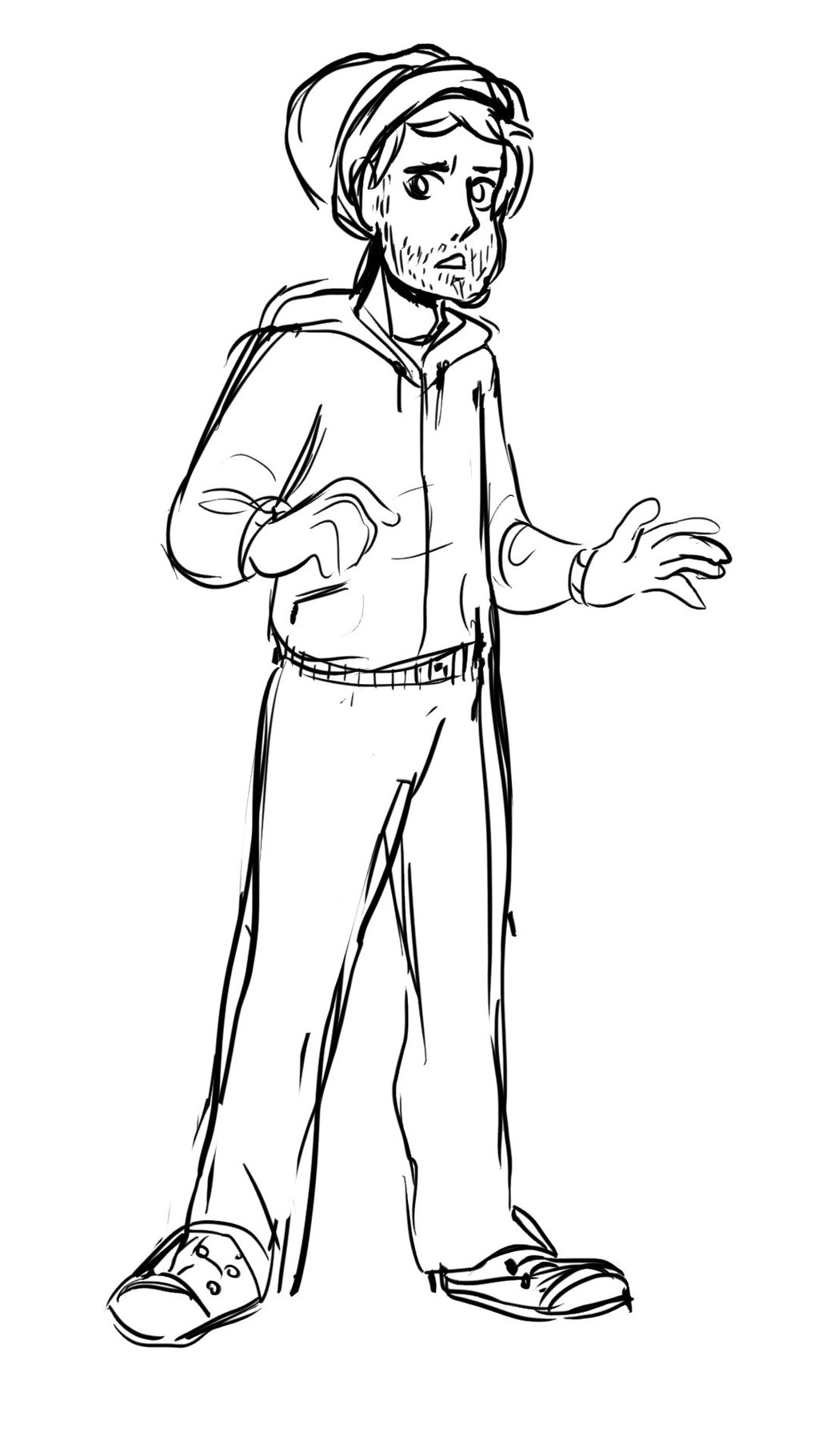
I leave you with an early glance at the worried, whiskered face of Lance Eliot.

Lance Eliot early concept

I’m sure my own expression at today’s conference will be equally uncertain and wary. Fortunately, unlike Lance Eliot, I’ll have the moral support of coffee, so that’s something!

How Games Tell You What to Do

Link partners

Video games create vast worlds for players to inhabit, and offer endless opportunities for interaction. That’s pretty cool. It also poses a problem unique to video games as a medium.

It’s easy to get lost.

With only a few unconventional exceptions, other media guide their audience along one specific path. When I read The Lord of the Rings, for example, I’m given a clear story to follow—the one Tolkien wrote. As he describes Frodo’s journey to Mordor, I can’t choose to see what’s happening back in Hobbiton or Rivendell. Either I read Tolkien’s story, or I don’t. I merely experience it. I don’t create it.

Video games are different. A game allows players to interact with its world, giving them a hand in creating the story. Maybe, as I play a Legend of Zelda game, I’m supposed to rescue Princess Zelda, but choose to smash pots and attack chickens instead. The protagonist, Link, is only a hero if I want him to be.

Games give players an amazing degree of freedom, with many potential paths to take. It’s only natural, then, for games to guide the player toward the path their developers intended.

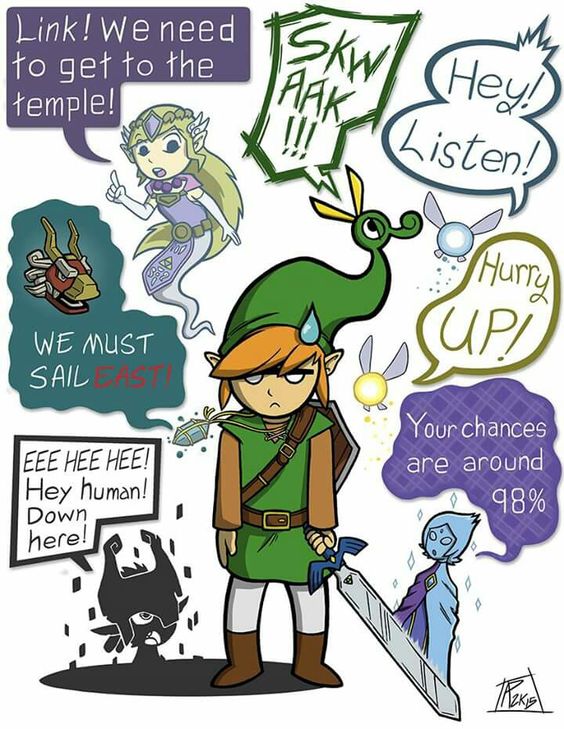
There are many approaches to guiding the player. The Legend of Zelda series often gives Link companions, as seen in the picture above. (I wanted to attribute it, but couldn’t find the artist.) These range from the traditional (a fairy) to the bizarre (a talking hat). These partners give Link advice on where to go and what to do next, guiding the player toward the game’s intended objectives.

This approach works pretty well, but can become irritating as Link’s companions boss him around or spell out every little step of his journey. The latest Legend of Zelda game doesn’t seem to have a partner system, which should allow players to wander more freely.

Other systems for guiding the player include marking objectives on a map, offering text or audio cues, or structuring game environments to direct the player toward the next goal. Some games are straightforward enough not to offer any guidance: Tetris and Pac-Man are good examples.

When I pick up a new game, I’m always interested to see how it tells me what to do.

463. Goodbye, Beatrice

I’ve been reading about hell, and thinking of the girls I liked in my younger days. There’s a connection here, but… probably not the one you think.

In preparation for my story project, I’ve been rereading Dante’s Inferno, a centuries-old poem about a man who journeys through hell. The poem starts with Dante meeting the soul of Virgil, an ancient Roman poet. Virgil rescues Dante from a dark wood, giving him both good and bad news.

Inferno

Oh, hell.

The bad news is that they must pass through the nightmarish depths of hell. The good news is that Dante’s love, the dearly departed Beatrice, has interceded for him from heaven. After braving hell and purgatory, Dante will meet her there.

In the poem, Dante represents Beatrice as a savior: a lady of perfect beauty and saintly goodness. In real life, Dante apparently met Beatrice twice. He barely knew her as a person. Instead, he obsessed over her as an idea—a vision that had poetic power but was disconnected from reality.

Beatrice married another man, and died young. Dante obsessed over her memory for the rest of his life, thinking of her even after marrying another woman and having children. He himself acknowledged Beatrice as “the glorious lady of my mind,” a vision barely grounded in reality. In Dante’s mind, Beatrice was an angelic being of compassion and redemption.

Beatrice

To Dante, Beatrice was all clouds and halos.

It makes me wonder what Beatrice was like in real life. Did she think twice about Dante? Did she even read poetry? What were her favorite foods? Did she have a secret crush of her own?

Beatrice is a fascinating character in Dante’s work—a fictional character. She plays an invaluable role in Dante’s Divine Comedy, of which Inferno is the first part, but the role owes everything to Dante’s imagination and practically nothing to Beatrice herself. Dante’s Beatrice was an idea, not a person.

Like Dante, I’ve had secret crushes on gals I’ve known. Most of them are now happily married to other dudes, and good for them. I wish them the best.

It’s just hard to let go sometimes.

There’s one gal in particular—I’ll call her Socrates—who is rather like my own Beatrice. I could share more details, but won’t in case she ever reads my blog. How awkward would that be? (Answer: Soul-rendingly awkward.) I haven’t seen my old crush in years, but when I think of Dante’s Beatrice, I imagine her looking just like Socrates.

Penguin!

I won’t post a picture of Socrates, so please accept this photo of a penguin instead.

I’m a sentimental person. It’s hard for me not to treasure my memories of Socrates, and even to idealize them. She has become my own “glorious lady of my mind,” disconnected from the real Socrates. The real Socrates, wherever she is now, is a living person. She has her own likes and plans and interests. She has her own life. At this point, it isn’t romantic for me to idealize Socrates—it’s disrespectful, really. It makes for great poetry but lousy living.

I sometimes can’t help but wonder whether my life would be different if I had told Socrates that I liked her all those years ago. This can become just as disrespectful as idealizing her, and for the same reason. It replaces a person with an idea. I stop thinking of Socrates as an actual person, and think of her instead as a missed opportunity. It isn’t respectful, and it frankly isn’t healthy.

I’m still a stubbornly single dude. Even so, I figured that at some point I would grow up and stop having crushes on pretty girls. I haven’t. (Of course, I still watch cartoons and occasionally make faces in the mirror, so maybe I failed the whole growing-up thing.) At the moment, I’m letting go of another crush on another Beatrice. Like Socrates, she is also an actual person with her own life to live, and I need to respect that.

I live in a complicated world. It’s tempting to reduce human beings to trite, comforting ideas, but it isn’t right. People are people. They deserve to be respected as people, not reimagined according to my own romantic notions.

Dante wrote some great stuff, but I have to wonder whether he was happy. He was haunted by the memory of a girl he met twice. Is that any way to live?

My Beatrices have their own lives to live, and I have mine. I had better live it.

I’m now going to eat peppermint fudge and watch Steven Universe. Take that, Dante.