300. Creative Counseling with DRWolf

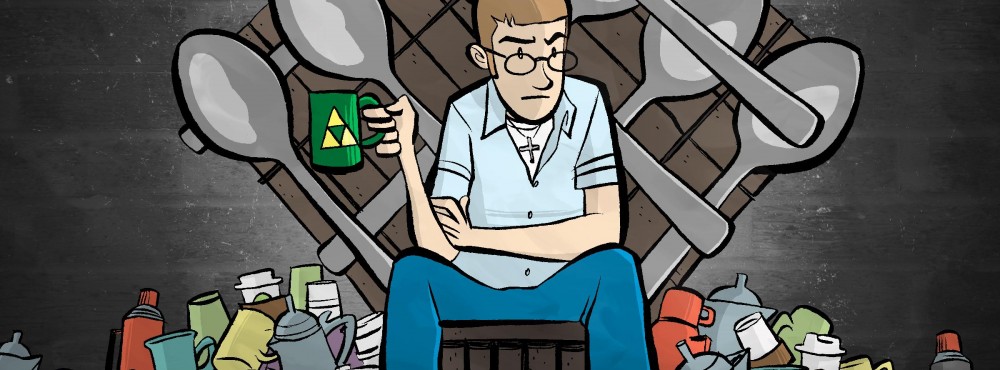
In past months, I’ve felt burned out. Writing has been harder. I realized it was time for this blog to get some help, so I met with DRWolf—a creative thinker known for his work in the brony community—to discuss the problem. He was friendly, polite, and helpful. What I didn’t expect was for the good doctor actually to be… you know… a wolf.

I want to thank DRWolf for his time, consideration, and advice. I was sincerely interested in finding some answers, and he gave some really good ones. Keep up the fine work, Doctor. It was an honor to work with you.

I also want to thank Crowne Prince, animator extraordinaire, for the superb video. It’s absolutely fantastic, Ms. Prince. I appreciate your time and expertise!

As usual whenever I stumble over a blogging milestone, I have a few more words to say.

I owe a great debt of gratitude to my parents for their support and encouragement, and especially to my father for his tips and artwork. Without him, TMTF would probably not have lasted long. Thanks, old man. You’re the stoutest of Stout Fellas.

Next, a word to my typewriter monkeys: If you ever do that again, I will donate you to the zoo. I mean it this time.

Speaking of my monkeys, I guess they deserve some credit. Despite their laziness, pyromania, and extensive criminal record, I don’t know how I would keep TMTF up and running without my dirty dozen: Sophia, Socrates, Plato, Hera, Penelope, Aristotle, Apollo, Euripides, Icarus, Athena, Phoebe, and Aquila. Thanks, guys.

(I’m serious about the zoo, though. Behave yourselves for once!)

My readers have been far kinder to this blog than my monkeys ever have. To every person who has supported TMTF by commenting on it, sharing it, liking posts here or on Facebook, writing guest posts, celebrating Be Nice to Someone on the Internet Day, or simply reading the blog occasionally—thank you. Thank you so much. The greatest joy of a writer is to be read, and I appreciate every single one of you.

Finally—insofar as a blog about video games, Doctor Who, and exploding tomatoes can honor anybody—soli Deo gloria. Whatever my struggles, I hope these three words will always be my guiding principle for creativity.

On a less spiritual note… if I had a penny for every post I’ve written for this blog, I’d have enough money to go out and buy a cup of coffee. That’s pretty neat. All in all, thanks to all of you, it seems I haven’t quite run out of reasons to be creative.

I’d better keep writing.

299. I Am Not Batman

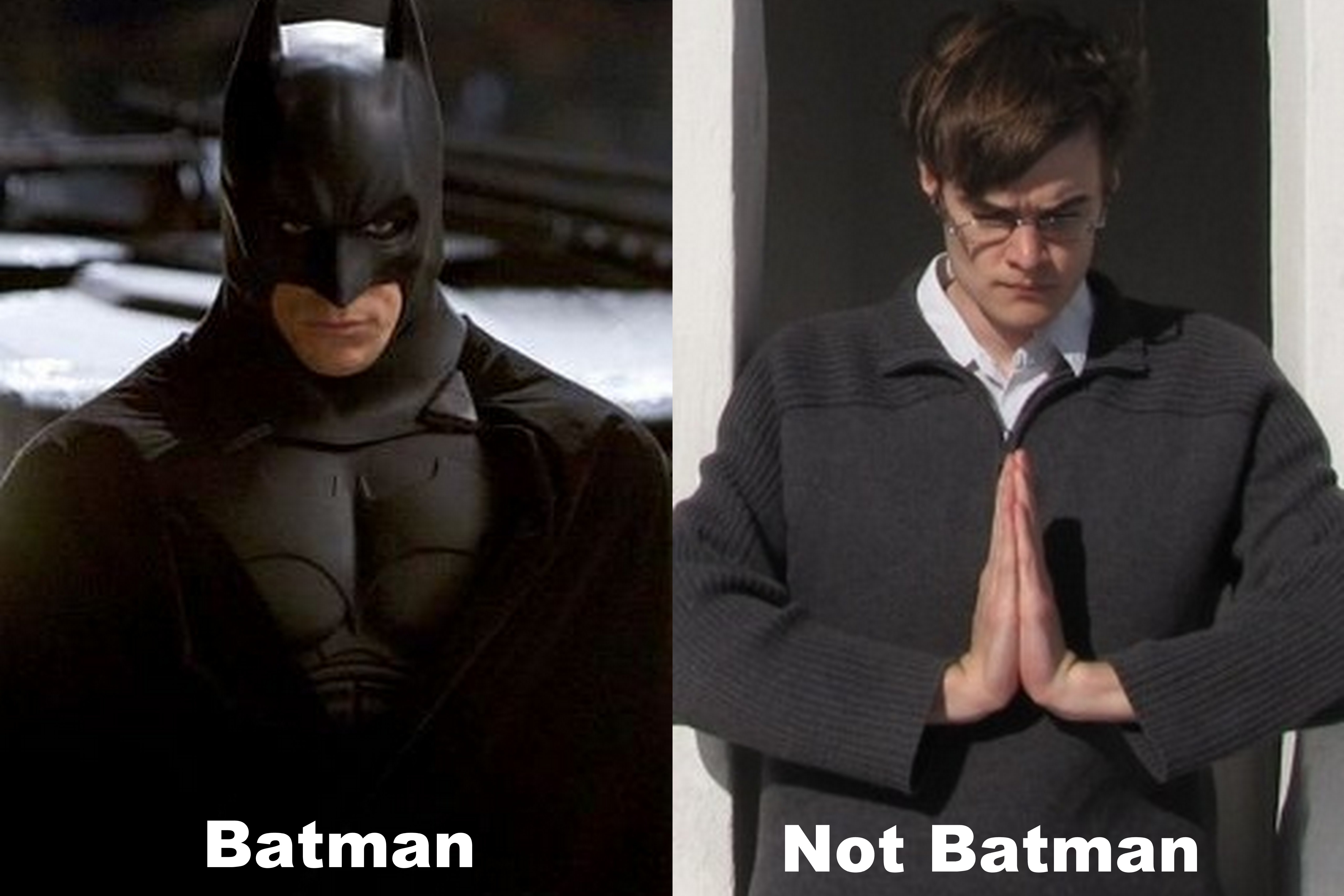
Yes, I know this may come as a shock to some of my readers. Some may have been so sure that I am secretly the Caped Crusader: the legendary vigilante who dresses as a bat for some reason. It is not so.

I am not Batman.

One of These Is Not Batman

All the same, I sometimes hold myself to impossibly high, Batman-esque standards. I also have Batman Syndrome, obsessing over my failures and allowing little mistakes to cancel out great successes. I demand much of myself. I have to be productive. I have to get stuff done.

I forget that I’m not Batman. He may be the pinnacle of human strength, will, and intelligence, but I am not. I’m a guy who needs sleep, gets sick, and needs a day off now and then.

A few days ago, I was reading the latest post from an animator’s blog. Something he said struck a chord with me.

And tomorrow I’m taking the day off from everything and not working on anything . . . It’s been a long time since I took a day completely off, so it’s due. We need downtime. Our society doesn’t like that because we’re not being productive members of society when we don’t do anything, but if we’re always on 24/7, we burn out.

This man has clearly learned a valuable lesson. He understands that he is not Batman. No ordinary person can be on the go all the time, working constantly, never taking a break, expecting nothing less than absolute effort. Normal, non-Batman human beings need days to take naps, read a book, or play Mario Kart. Without those days, we break down. It’s not weakness or self-indulgence to relax occasionally. It’s a necessity.

I’m often busy even when I don’t have to be. More often than I care to admit, I wear myself out working on things that aren’t urgent—things that can wait until I’ve had a cup of tea, a walk to the park, or a good night’s rest. I get so accustomed to being busy that I feel guilty or panicked if I spend too long without doing something “productive.”

There’s something in the Old Testament about taking a day off every week: the Sabbath day. I usually file it away with all those rules about burnt offerings and unclean foods as a religious law that has become obsolete. I’m no longer so sure. Besides being healthy and sensible, taking days off seems like an affirmation of faith—a way of saying, “I trust God enough to give him today.”

Sometimes, determination and coffee aren’t enough: “Man shall not live by caffeine alone,” or something like that. I am not Batman, and I sometimes need a break.

Unless you’re Batman—I’m guessing you’re probably not—you may sometimes need a break, too. Don’t be afraid to take one!

294. The God Who Hides

I’ve been rereading Exodus lately. It’s really boring.

Sure, the book of Exodus has its exciting bits. The book’s first half tells the story of Moses, and how God worked through him to rescue Israel from its slavery in Egypt. It’s an engaging story: the Lord strikes Egypt with all kinds of interesting disasters, and Moses’s standoff with Pharaoh gets pretty heated.

Moses and the Israelites end up in the desert next to a mountain called Sinai, and that’s where things grind to a halt. God, who appears to the Israelites as a cloud, retreats to the mountaintop. After laying out a bunch of societal regulations for Israel, God commands Moses to climb Sinai in order to receive… more rules and instructions.

I won’t go into more details because, honestly, they’re rather tedious. Besides those details, however, something stands out to me from the second half of Exodus.

God keeps his distance.

At Sinai, God gives the Israelites very specific instructions to avoid the mountain. Only Moses is permitted to climb to its summit, and even then he isn’t allowed to see God’s full glory.

Then the Lord said, “There is a place near me where you may stand on a rock. When my glory passes by, I will put you in a cleft in the rock and cover you with my hand until I have passed by. Then I will remove my hand and you will see my back; but my face must not be seen.” (33:21-23)

From all Israel, God’s chosen nation, only one man gets a brief, incomplete glimpse of God. It’s pretty much the closest anyone comes to seeing the Lord in the Old Testament. Sure, God makes a few appearances here and there, but he mostly seems to run things from behind the scenes. Only a few priests are allowed anywhere near God’s presence in his places of worship. Just a handful of leaders and prophets ever glimpse him.

I have often wondered why God seems so distant—especially in our own skeptical, pluralist, postmodern age. The silence of God troubles me greatly, and faith sometimes seems foolish. Is it fair for God to demand obedience and fealty without providing irrefutable evidence of his existence?

I don’t know. Is it okay to admit that? I really don’t know.

Maybe God keeps his distance because we can’t handle the full measure of his power and holiness. That view certainly finds support in the Old Testament. (It’s also supported by the scene in Raiders of the Lost Ark in which God’s glory fries a bunch of Nazis, but Indiana Jones movies might not be the best resource for theological speculation.) It’s possible that God hides because faith, “being sure of what we hope for and certain of what we do not see,” is a virtue he values highly. If God were obvious, faith would not be possible.

It’s worth pointing out that after seeming largely absent in the Old Testament, God showed up in the New Testament in the person of Jesus Christ. The Lord Jesus didn’t keep his distance. Heck, he spent much of his time with the sort of people no one else would go near. Christ touched lepers and chatted with floozies. He was as close and immediate as God had previously seemed distant and unapproachable.

I’m comforted by some of Christ’s final words as he hung dying on a cross. He said, “My God, my God, why have you forsaken me?”

These few words reveal something I find almost unbelievable: even Jesus Christ was troubled by the seeming distance and silence of God. I don’t get it. I don’t understand why God seems so far away. Apparently—at that moment—neither did his Son.

Some of my questions may never be answered, but I’m far from the only person asking, and that gives me hope.

292. Why I Failed as an Author

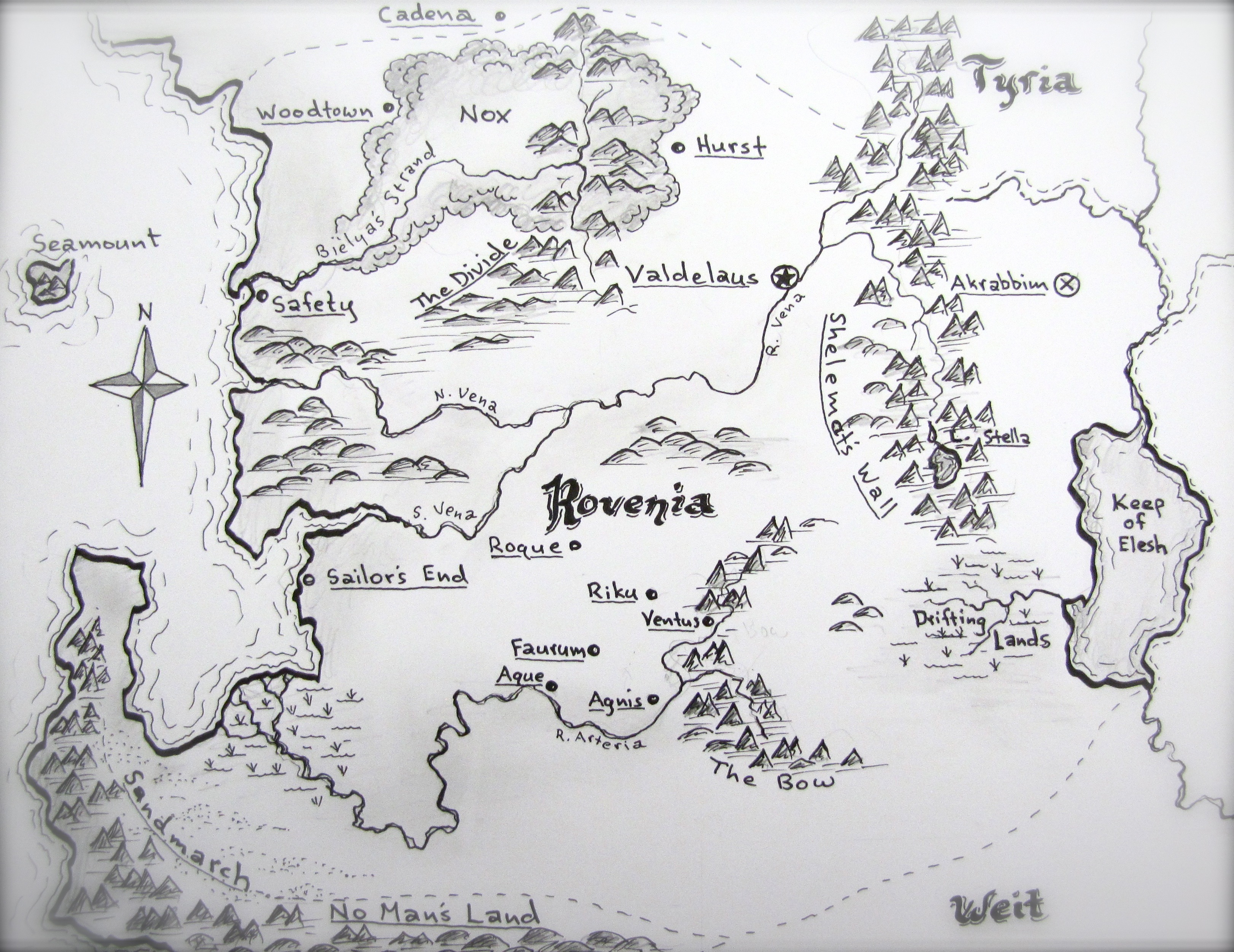
A number of days ago, I noticed a map on my bedroom wall.

Rovenia

I have several maps in my room besides this one: a map of the world, a map of Middle-earth, and a map of Skyrim that was a gift from someone at work. This one, a map of Rovenia, was lurking above my window. I’d nearly forgotten it was there.

What’s that? You’ve never heard of a place called Rovenia? Of course you haven’t, because I made it up.

Rovenia was the setting for a novel titled The Trials of Lance Eliot, the first book of a planned trilogy. I published it about two years ago—a little less than a year after buying typewriter monkeys (what a mistake!) and starting this blog.

Fifteen months later, I pronounced Lance Eliot dead. My short, stressed career as an author was ended.

I may pick up The Eliot Papers sometime. Lance Eliot’s story is certainly one I want to finish. At the moment, however, I don’t think it’s terribly likely. I’m busy enough with work and blogging and all the responsibilities that come from being a grownup.

My map of Rovenia set me thinking about why I failed as an author. I came up with a few reasons, which I toss out today as friendly warnings to all the aspiring authors out there. Don’t make my mistakes. Learn from them, and rise to success!

I didn’t do my research

When I took my first few, tentative steps into the publishing industry, I had absolutely no idea of what I was doing. My ideas of what it meant to publish a book and be an author were hopelessly naïve. A little research would have saved me a lot of time, effort, and discouragement.

I didn’t use my real name

When I began working on The Eliot Papers, I had the romantic notion of using a pen name. It was part of an elaborate frame story for the novels, in which Lance Eliot’s “memoirs” were “discovered” by an “editor,” who published them in the guise of fiction. It wasn’t a terrible idea—Lemony Snicket did pretty much the same thing—but it had one fatal flaw. Without a major publisher to market my book for me, I had to use my real name to promote it. Using both a real identity and an assumed one during the book’s release was a headache, and probably confused people.

I didn’t promote my book effectively

Oh, how I tried to promote The Trials of Lance Eliot. It had its own blog. I had an author page on Facebook and account on Goodreads. Readers submitted reviews, which I shared. It wasn’t enough. Looking back, I realize I should have done more: book blog tours, giveaways, submitting the book to more reviewers, and perhaps even setting up readings in the local library.

I didn’t set realistic goals

As I worked on the manuscripts for The Eliot Papers, I expected way too much of myself. I set impossible deadlines and tried to juggle my book, this blog, a full-time job, and a handful of other projects. There was no way I could do it all.

I didn’t work far enough ahead

When I published The Trials of Lance Eliot, I had written a few chapters of its sequel. Those chapters are pretty much all I have written. After the first book came out, I was far too busy promoting it and writing this blog to work on a sequel. I should have finished, or at least nearly finished, my manuscripts for the entire trilogy before publishing the first part. It would have allowed me to market the book without diverting some of my time and energy to its sequels.

I didn’t plan time for writing

It was a mistake to think I could make steady progress on a book and a blog. This blog has deadlines. My book didn’t. Guess which one was neglected! I also dabbled in a few other personal projects, none of which succeeded. Those could have waited—the book should have taken priority.

I did buy typewriter monkeys

I blame my monkeys for all of my failures. All of them.

Do I regret trying to be an author? No. What I regret is doing it so badly. All the same, the years I put into writing and publishing The Eliot Papers gave me much invaluable experience as a writer and editor. It also taught me lessons about managing my time, setting reasonable goals, and enjoying creativity for its own sake.

If any of my dear readers are writing books or hoping to become authors, keep going! Don’t give up!

Just don’t make my mistakes… and don’t ever buy typewriter monkeys.

290. Some Serious Thoughts on Singleness

I’m sometimes asked whether I have a wife or girlfriend. Since discussions of singleness tend to be awkward, I usually reply, “Well, I’m secretly married to a lady back in Ecuador. Her name is Anna María Rosa, and we have twelve children.”

Singleness is one of those subjects that makes everyone feel self-conscious, which is why I’ve put off discussing it. Why am I writing about it now? That’s a good question, dear reader, and it has a simple answer: Today is one of those days I can’t think of anything else to write. (You wouldn’t believe how many posts have made it onto this blog because I had no other ideas.)

I’ve always been single. Not once have I been married, engaged, or tangled up in any kind of romantic relationship.

An expert on Englishing

Can you believe this charming, sophisticated gentleman is still single?

My attitudes toward my solitary existence have changed over the years. As a kid, I was determined to be a bachelor till the Rapture: an eccentric, cheerful, bookish, tea-drinking, fez-wearing old gent. I held on to this attitude until college. Many of my college friends found romantic partners, and their affections left me feeling conflicted. As happy as I was for my friends… I couldn’t help feeling just a trifle jealous.

Since then, some of my high school and college friends have married. Some have not. A few are in romantic relationships; a few are searching for partners; a few remain staunchly single.

As for me, well, I’d like very much to be married someday. I also like being single very much. I suppose I have “the gift of singleness,” whatever the heck that means. I appreciate the independence, simplicity, and freedom of the single life. As nice as it would be to find my special someone, I’m not going to rush into a romantic relationship for the mere sake of it.

Solitude and simplicity are actually kind of nice.

Solitude and simplicity are actually kind of nice.

Whenever singleness is discussed, I feel sort of bad for not feeling bad. I even feel a little guilty writing this post, despite being entirely qualified (as a very single person) to write it. I know many people who hate being single. They feel lonely, unfulfilled, or insignificant. Some even wonder whether something is wrong with them.

I understand.

So to all the single people out there: You are awesome, and your awesomeness isn’t defined by whether you have a romantic partner. It’s fine to be single, and it’s fine to be in a relationship. It’s okay to like being single, and it’s okay to hate it. I don’t think singleness has to be the thorny issue our culture makes it.

As for my dear readers in romantic relationships, I have a few words for you as well. First, good for you! I hope you’ve found happiness in your special someone.

That said, please don’t assume that everyone needs a special someone to be happy. Don’t single out singles. Don’t tease or patronize us. For those who are sensitive about their singleness, these things hurt. For those who aren’t sensitive, like me, these things merely annoy. Some singles are quite contented, thank you very much, and those who aren’t don’t need to be reminded of it.

Romantic relationships can be amazing. They are not, however, an instant fix for loneliness, insecurity, or any other problem. Far from removing all difficulties, relationships often add them. Loving another person deeply and intimately is hard. Is it worth it? Absolutely. Is it always fun, easy or pleasant? Good heavens, no.

In some ways, singleness ain’t so bad.

Now I’m going to go put on a fez, drink some tea, and read a book, because I am a bachelor and that is how I roll.

286. God is Not a Grump

I may be overanxious, but prayer kind of scares me.

Does any other person of faith feel at least a little nervous speaking to the creator of the universe? Heck, I get flustered interacting with random people on the Internet. Speaking to the Lord God Almighty is a good deal more intimidating. I mean, he made the starry heavens! He designed trees and molecules and wombats! He created coffee! (I believe coffee is the clearest ontological proof of God’s goodness.) I mean, seriously, the greatness of God is immeasurable, and it makes me nervous.

Yes, I know God loves me. Christian culture tends to emphasize the kindness, love and gentleness of Christ, sometimes to the point at which it forgets his harsher words and actions.

"Hey, man. Got Christ?"

Christian culture sometimes gives this impression of Christ, which is equal parts heretical and hilarious.

I generally make the opposite mistake. I remember the Lord Jesus brandishing a whip, killing trees and calling people snakes. I recall all those times in the Old Testament God pronounced curses on people and struck them dead.

When I pray, I sometimes can’t shake the feeling that God hears my prayers with the divine equivalent of a grumpy expression.

I'll listen to your prayers, but only because I have to.

“I’ll listen to your prayers, kid, but only because I’m contractually obligated by the Bible.”

Why do I struggle with this faint, annoying fear that God is a celestial grouch?

I suppose it’s because I’m painfully aware of my own faults, and not always forgiving towards the faults of others. It’s easy for me to assume that God, being absolutely perfect, is even less tolerant of our sins and failures. If I were God—which, fortunately for the universe, I am not—I wouldn’t be very gracious or patient.

Thus I often have what C.S. Lewis called a “vague, though uneasy, feeling that [I haven’t] been doing very well lately.” This uneasiness makes me reluctant to pray or practice other spiritual commitments. It’s easier for me to bury my anxiety in unnecessary busywork, pointless procrastination or random YouTube videos. Quoth Lewis, “All humans at nearly all times have some such reluctance; but when thinking of [God] involves facing and intensifying a whole vague cloud of half-conscious guilt, this reluctance is increased tenfold.”

It was last week I was reminded, and not for the first time, that praying badly is better than not praying at all. “Next to trying and winning,” as I often say, “the best thing is trying and failing.” When I feel far from God, keeping my distance probably won’t help.

As for God being a grump, well, that’s nonsense. There’s a famous verse in the thirty-fourth chapter of Exodus. God appears in this passage and, being a gentleman, introduces himself: “The LORD, the LORD, the compassionate and gracious God, slow to anger, abounding in love and faithfulness.”

These words are echoed throughout the rest of the Bible, and the “slow to anger” part jumped out at me as I read Psalm 145 yesterday: “The Lord is gracious and compassionate, slow to anger and rich in love.” He responds with compassion, not contempt; grace, not disgust; gentleness, not grouchiness.

If God is truly gracious, compassionate and slow to anger, I think it’s safe to say he is not a grump.

283. The Storm and the Internet

As my dear readers have probably guessed, I like the Internet.

Seriously, the Internet is amazing: an invisible, intangible, worldwide web of information, news, pictures, videos and funny cat pictures, all accessible through a few clicks or keystrokes. Need something? Type it into Google or some other search engine, wait a few seconds and voilà! You have it! Even the world’s best libraries can’t compare to the Internet’s incredible speed, marvelous efficiency, up-to-date accuracy and comprehensive variety.

A couple of weeks ago, a strange thought drifted into my caffeine-addled mind. The Internet brings together the best (and worst) of humankind in one place. Anyone anywhere with an Internet connection can contribute to the Internet, building a vast and ever-expanding construct—something entirely artificial. The Internet is unprecedented. Nothing like it exists, or could possibly exist, in nature. It is a unique triumph of humankind, one only humankind could create and sustain. The Internet is something to which people, cultures and societies everywhere have contributed.

It made me think of the Tower of Babel.

Most of us know the story, I think. The book of Genesis in the Bible describes how humankind came together in an early age of Earth to build a tower to heaven. This building, the Tower of Babel, had two purposes. It was a monument to the pride of humanity and an anchor to prevent them from scattering across the world.

God, however, had other plans. He confounded the language of the people building the Tower of Babel. Construction halted when its builders couldn’t communicate, and humanity eventually spread over the earth as God had planned.

I’m not saying the Internet is evil—good heavens, no! I think the Internet is fantastic.

Nevertheless, I can’t help but notice its similarities to the Tower of Babel. The Internet has united humanity in a way Babel could not; thanks to online translators, even differences of language are not a problem! The Internet records the greatest accomplishments of humankind, and could even be called a monument to human achievement. It’s an artificial world ruled by immediate gratification, quick searches, streaming videos and instant communication. The Internet is a world over which humanity holds absolute sway.

Weeks ago, on the same evening I pondered the Internet and the Tower of Babel, there was a terrific storm. It was majestic, exciting, terrifying and awesome. Trees bent and thrashed in the wind. Rain dashed against my windows. Lightning flashed and thunder cracked. As I dozed off, a flash of lightning penetrated my curtains and closed eyelids to wake me up instantly—it was as though lightning had struck right there in my bedroom.

As I lay awake, I kept thinking about the neat, well-behaved world of the Internet and the wild, overwhelming world outside my window. The storm and its peals of thunder seemed almost like God laughing.

In the morning, appropriately enough, the Internet was gone.

It took nearly a week to have it fixed. In that time, I did more reading than usual. My younger brother and I leafed through my copy of Hyrule Historia and waxed nostalgic over our childhood memories. We enjoyed life without Internet. It wasn’t bad at all.

Now the Internet is back. I’m thankful to have it, and glad to be reminded that it’s just a tiny part of a much bigger, better world!

282. Blog Burnout

Blogging has been kind of hard lately.

Mind, I’m not complaining. Blogging is fun, and I have no one to blame for TMTF but myself and my typewriter monkeys. (I mostly blame my monkeys.) I don’t ever want to gripe, and I’m certainly not looking for sympathy. I just want to admit, for the sake of honesty, that it’s been harder lately for me to get excited about TMTF and this whole blogging thing.

This worries me.

I love writing. It’s sort of an addiction, really. Now that I’ve almost-but-not-really given up on writing fiction, blogging is pretty much all I’ve got. I want TMTF to be something I get to do, not something I have to do.

That said, I’m going to hand over the discussion to my dear readers and go drink some coffee.

How do you stay passionate about your hobbies and creative projects? How do you deal with burnout? Send us a message or let us know in the comments!

280. By Faith

My older brother and his family are moving to the Dominican Republic.

I suppose it should have come as no surprise. My family and I and most of our relatives grew up in Ecuador and traveled regularly between the Americas. Relatives on both sides of my family, Stücks and Erdels, are wanderers. We are foreigners and strangers on earth. We bounce from place to place with practiced ease.

Many of my relatives, however, have settled more or less permanently in one place. I had assumed my brother Andrew and his family were among them.

I guess I was wrong.

Andrew and his wife Sarah own a house in Indiana. When they bought the place, it was kind of a wreck. They worked tirelessly to fix it up. They planted an enormous garden, which they diligently pruned and weeded. (Heck, even I spent more than a dozen hours yanking weeds out of their garden.) My brother and sister-in-law built a hen house and raised at least one or two generations of chickens. I haven’t even mentioned their cats, of which there were three at last count.

For all appearances, Andrew and Sarah and their little ones had settled in to stay.

At this moment, Andrew and Sarah are in the process of selling their house, giving away their possessions, obtaining passports for their three children—their youngest, by the way, is just a few weeks old—and preparing to move to some country they’ve never visited in their lives.

They are doing all this by faith.

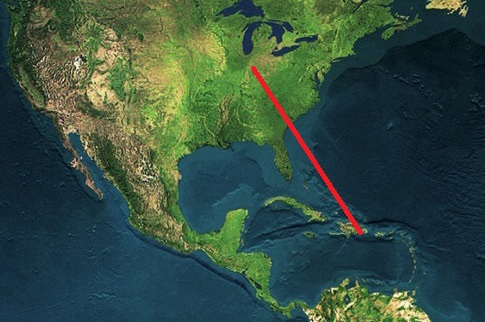
That little red line? Yeah, that's about seventeen hundred miles.

That little red line from Indiana to the Dominican Republic? Yeah, that’s about seventeen hundred miles.

When I talked with Andrew about their decision over the phone, I told him he should follow wherever God led. I could not, however, hold back my opinion that dropping everything abruptly and moving to another country seemed “ill-advised.”

I think Sarah found a better word for it in one of her emails: “crazy.”

Andrew and Sarah believe this crazy, ill-advised decision also happens to be the right one. I agree with them. They have good reasons to believe going to the DR is God’s will… and they have the faith to go.

They amaze me, and I’m proud of them.

I’m also not sure I have that kind of faith.

I was recently asked whether it took faith to grow up on the mission field in Ecuador. I replied, honestly, that it didn’t take much. My family was always there. My future always seemed secure. Ironically, it was when I stepped off the mission field and came to Indiana in the US that I found myself really depending on God.

Surrounded by strangers, disoriented by culture shock, out of place, uncertain of the future and feeling very much alone, it was hard for me to begin college in Indiana after leaving Ecuador six years ago. It was just as hard to leave Uruguay and return to Indiana two years ago.

Moving forward is still hard, and I’m settled comfortably. If God told me to leave everything—my cozy apartment, my fast Internet connection, my peaceful neighborhood, my endless supply of coffee and Cheez-Its from the local Wal-Mart—would I go? If a three-hour drive overwhelms me with anxiety, how would I handle moving, say, to Kenya? If depression makes my life in Indiana a challenge, how would I survive depression in some unfriendly, faraway place?

If God tells me to go, will I go?

One day after Andrew and Sarah confirmed their decision, my Scripture reading took me to Hebrews eleven. Yes, this is the By faith chapter. It lists all these great biblical heroes and the great things they did—things done by faith, of course—and then…

These people all died having faith in God.

How cheerful.

The chapter goes on.

They did not receive what God had promised to them. But they could see far ahead to all the things God promised and they were glad for them. They knew they were strangers here. This earth was not their home. People who say these things show they are looking for a country of their own. They did not think about the country they had come from. If they had, they might have gone back. But they wanted a better country. And so God is not ashamed to be called their God. He has made a city for them.

My brother and his family, like our dear parents and so many of the wonderful people in my life, have chosen to be strangers on earth. They’ve given up safe, permanent homes and faced all kinds of difficulties for rewards they’ll never see in this life. They live by faith. And so God is not ashamed to be called their God.

By faith, my family follows God.

I’m trying to do the same. It scares me, especially on the days I suffer from severe depression or anxiety, to wonder where God may lead me.

Wherever it is, I’ll follow. By faith, I’ll follow. At the very least, by faith, I’ll try.

After all, as I never tire of saying, “Through many trials, toils and snares I have already come. ‘Tis grace hath brought me safe thus far, and grace will lead me home.”

277. Adam Breaks Down

Saturday – June 7, 2014

My friends are awaiting my arrival in Mishawaka, and it has been a pleasant trip so far from the little town of Berne. The sun is shining. A bottle of coffee is within reach. Tribulation, my scrap heap of a car, hasn’t broken down yet. I feel cautiously optimistic. The highway curves gently to the left, flanked by weeds and picturesque trees.

Everything seems fine, but I’m not quite at ease. Things went badly the last time I took Tribulation for a long drive. It broke down, smoking like a cigar and reeking of melted plastic. My younger brother and I were left stranded on the highway in the searing heat, and I missed an important job interview. Trib has been repaired, but I’m reluctant to take it on any long trips.

I have to be honest. I’m not reluctantI’m anxious. I struggle with depression and anxiety. The last time I strayed far from my home, my car troubles only made these problems worse.

I’m touched my friends invited me to visit today, and I want to see them, but… I don’t want to go.

Well, I suppose it’ll be fine. I can’t let anxiety control me. It’ll be good to spend time with my friends. They’re wonderful. I miss them. This’ll be worth the trip, and Tribulation was just fixed—I doubt it will have more problems anytime soon.

Bang!

Something that looks horribly like a deflated tire flies into my peripheral vision and vanishes. Tribulation jolts and bangs its way to a tired stop beside the highway. I hang my head, gripping the steering wheel. My heart sinks until it can sink no more.

Not again.

After putting on the brakes and hazard lights, I get out and survey the damage. Trib’s front-right tire has completely lost its tread—that must have been the fragment of tire I saw whizzing past my window. It tore off a strip of plastic from the door in its violent flight, leaving a scar of discolored paint and white plastic fasteners. The tire is ruined. My anxieties have been affirmed. It was a bad idea to leave home.

I phone my friends and let them know I won’t make it. I pray. I phone my younger brother to apprise him of the situation, and to ask him to pray. I phone my older brother to ask his advice. Things look grim. I’ve never changed a car tire before. My driving directions take me only to Mishawaka and back to Berne—without them, having to turn back, I’m completely lost. Oh, a police car is pulling up behind me. Fantastic.

An hour later, Tribulation limps to the nearest Wal-Mart on a spare tire the approximate size and shape of a doughnut. “Dash it, Tribulation,” I cry, striking the steering wheel. “Can’t I take you anywhere?”

Monday – June 9, 2014

I’ve been at work about an hour, and I’m frankly amazed I’ve lasted so long. I feel bad. No, I feel awful. I can’t remember the last time I felt so depressed. It’s all I can do to keep breathing, let alone deal with eight needy gentlemen.

The last time I worked, I was cursed and threatened and nearly smacked. Those kinds of behaviors are sometimes part of my job—occupational hazards. I’m not usually much fazed by them, but tonight is different.

Wait, what? We’re going to be short-staffed tonight? Of course. Oh, and we’re having an emergency drill? On top of everything else? Of course, of course.

What a fine shift this turning out to be.

Things are quiet for the moment, so I sit and bow my head and begin mumbling. “Father in heaven… I don’t know how I’m going to do this. I can’t do this. You must.” I add a few words, finish my panicked prayer and stand.

I’m going to make it.

Friday – June 13, 2014

Well, I’m home. This is my day off. There’s a pot of coffee on the desk beside me. Birds are chirping outside my window, the weather is beautiful and my younger brother is cooking sausages for breakfast. It may be Friday the thirteenth, a day of ill repute, but I’m feeling pretty good.

I made it.

When Tribulation’s tire was ruined on Saturday, I was quick to remember how my car had previously broken down. I was a little less quick to remember how God worked out everything all those weeks before. My car was towed to an auto shop and repaired, and generous relatives paid a majority of expenses. The interview I missed was rescheduled. My younger brother and I didn’t have long to wait until we were rescued. While we waited, I had coffee, cookies and a book to keep me going. Before any of our problems were resolved, God gave me and my brother courage, humor and a positive attitude.

My car broke down that day, but I didn’t.

Tribulation gave me trouble again on Saturday, but God made things right. I arrived safely home with two new tires at a pretty good price. My brothers were supportive and encouraging over the phone. My friends accepted my absence magnanimously. There was even coffee.

My tire was shredded; my nerves were not. My tire was ruined; my hope remained intact.

Even Monday’s paralyzing depression and daunting difficulties turned out not to be so bad. After two or three really bad hours, things improved. I felt almost recovered by the time I left work.

There are times I don’t feel well. Sometimes, I come uncomfortably close to breaking down. Depression and anxiety are frightful things, and it’s always easy for me to panic. I always remember the problems.

What I forget is the wonderful way my Father has never failed to resolve them.

I’m pretty bad at remembering things, but the faithfulness of God is something I’m trying hard not to forget.