Help, I’m a Christian! – Relationship

Perhaps the most important lesson I ever learned is that the Christian faith is a relationship, not a system.

When I was younger, I was convinced faith was a system made up of logical rules. I thought all I needed to be a good Christian was to spend x number of minutes praying and read y number of chapters in the Bible and do z number of good deeds every day. Being a follower of Christ, I believed, was sort of like being a member of a club. All that was needed was to meet the minimum requirements.

To put it simply, I believed Christian living was just about doing stuff.

I was wrong.

For years I felt vaguely anxious, guilty and perplexed. Praying was awkward. Reading the Bible was tedious. Doing good things, and not doing bad things, seemed pointless.

I prayed, but not to know God or to help anyone. I read the Bible, but not to learn. I did good deeds, but not to be honor God or to serve others. I went to church, but not to strengthen my faith. I did these things simply because they were what Christians did.

I’d gotten the how right, but I’d totally missed the why.

Faith isn’t a system. Treating it like one will only lead to confusion, disillusionment and pain.

What, then, is faith?

It’s a relationship!

Granted, it’s more formal than most relationships. A relationship with God is sort of like a parent-child relationship and sort of like marriage.

We’re dependent on God, just as children are dependent on their parents. He provides for us, protects us and sometimes disciplines us, just as parents do for their children.

As for the marriage example: there are rules that guide our relationship with God, just as there are rules that guide the relationship between husband and wife.

It’s not enough just to “pray the prayer” to become a Christian. That’s the first step. A marriage relationship is more than just a wedding! The wedding is only the first of many, many steps.

In our relationship with God, do we make mistakes?

Absolutely.

That’s when we realize why a relationship is a thousand times better than a system. In a system, mistakes demand remuneration, atonement, compensation. In a relationship, one person simply forgives the other.

However—as in all other relationships—the whole thing falls apart if one person tries to take advantage of the other.

In a marriage, the wife can be the kindest, sweetest woman ever, but the relationship won’t last if the husband is selfish or unfaithful. A father can be the most patient, loving man in the world, but he can’t care for his children if they insist on running away from home.

God forgives us when we make mistakes. However, if we insist on disobeying him, he eventually lets us go our own way. To quote C.S. Lewis, “There are two kinds of people: those who say to God, ‘Thy will be done,’ and those to whom God says, ‘All right, then, have it your way.'” God doesn’t force us to obey him. He gives us the freedom to choose, even if our choice is to turn away from him.

If we turn back to God, he will always accept us. Just look at the story of the Prodigal Son!

If we want to accept God, however, we must accept him on his terms.

One those terms is that God speaks to us indirectly. As nice as it would be to chat with him face to face over coffee every morning, he chooses less direct methods to communicate: the Bible, literature, nature and people, to name a few.

This is admittedly frustrating. I’m not sure why God isn’t more direct, but there is one thing of which I’m sure: this indirectness is temporary. Quoth the Apostle Paul, “Now we see but a poor reflection as in a mirror; then we shall see face to face. Now I know in part; then I shall know fully, even as I am fully known” (1 Corinthians 13:12).

All this is fine theoretical stuff, but what does it mean in practical terms? How does it affect how we live?

It means we must understand the why of Christian living as we live out the how.

We should pray in order to help others and build up our relationship with God. We should read the Bible in order to learn. We should obey and serve in order to be useful. We should attend church in order to grow closer to each other and to God.

Faith isn’t a system, and God doesn’t ask us to do things for no reason. Understanding that faith is a relationship, and Christian living is part of that relationship, is probably the most important lesson I’ve ever learned.

Next: Prayer

Help, I’m a Christian! – Introduction

Becoming a follower of Jesus Christ was absolutely the best decision I ever made, but there was a problem.

I had no idea what I was doing.

Prayer was necessary, I knew, and church was important, and the Bible came into it somehow. I had heard all the Sunday School stories and could sing all the worship songs. However, when it came to the practical day-to-day essentials of Christian living, I had only a vague idea that I should try to “be good.”

I’ve learned a lot since then. It took lots of mistakes, some of them very painful. Much of what I know about Christian living I learned the hard way.

This Holy Week, I’d like to share some of what I’ve learned.

At the heart of Christianity lies a relationship with Christ. Since relationships are unique, nobody can give perfect, specific, infallible instructions about this particular relationship—or any relationship, for that matter.

In the end, all anyone can do is share what they’ve learned from their own experiences. That’s what I’ll do this week.

You may not be a Christian. That’s okay. You’re welcome to read this week’s posts anyway. They might give you a clearer idea of what Christianity is all about.

You may be a much better Christian than I am. That’s awesome! You’re welcome to read this week’s posts anyway. Feel free to share your thoughts (and correct my mistakes) by leaving comments.

Here’s the plan for this week:

Monday: Relationship

Tuesday: Prayer

Wednesday: The Bible

Thursday: Church

Friday: Obedience and Service

Saturday: Faith and Works

Onward!

80. About Writing: Brevity

Shakespeare once wrote, “Brevity is the soul of wit.”

For those of us who don’t speak Shakespearean, what he meant was, “Good writing is brief.” The mark of a good writer is to express something clearly in as few words as possible. Too many words burden a piece of writing.

I didn’t really understand this until I began working on The Infinity Manuscript. Each part of the story, I decided, must not exceed two thousand words. This gave me only two thousand words in each part of the story to set the scene, introduce new characters, develop existing characters and progress the plot, and to do all these things in a way that didn’t feel rushed.

I’ve exceeded the two-thousand-word limit in the first draft of almost every part of the story so far, sometimes by as much as one or two hundred words. It was discouraging at first. However, when I went back and removed whatever dialogue and descriptions weren’t absolutely necessary, I realized the story was actually improved by these omissions. No longer slowed by unnecessary descriptions and wandering dialogue, the story moved along at a quicker pace.

When I began writing long ago, I believed more was better. Long descriptions gave readers a more vivid impression of each scene, and abundant dialogue helped establish characters more clearly, or so I thought.

The problem is that rambling dialogues and longwinded descriptions tend to be vague and pointless.

Anton Chekhov stated that if a gun is hung on the wall of a stage during a play, it should be fired by the end of the final act. In other words, the stage shouldn’t be cluttered with unnecessary props. Every prop should contribute something to the play.

In the same way, every element of a story should have a purpose. Every dialogue and description should develop the characters, explore the setting, move the plot or contribute to the story in some other way. If an element of the story has no purpose, it should probably be cut.

Smaller cuts can often be made as well. Adjectives and adverbs should be used sparingly. Descriptive words lose their impact if they’re used too often.

Take a wordy sentence: “Adam paused suddenly in the middle of a wordy paragraph to sip thoughtfully from a steaming cup of jasmine tea and gaze reflectively out the large window at the green trees swaying ponderously in the strong breeze.”

Awful, right? Let’s cut out those awkward descriptive words: “Adam paused in the middle of a paragraph to sip from a cup of tea and gaze out the window at the trees swaying in the breeze.” The shortened sentence conveys pretty much the same scene without all those cumbersome adverbs and adjectives.

I conclude with a story.

While dining with several other writers, Earnest Hemingway, an author whose brevity is legendary, bet them he could write a compelling story in only six words. They accepted his bet. Hemingway took out a pen and wrote the following words on a napkin.

“For sale. Baby shoes. Never worn.”

He won the bet.

79. Working on the Novel

I had planned the post the next part of The Infinity Manuscript today, but I’ve been too busy to work on it. I apologize for the delay.

One of the reasons I didn’t finish the next part of The Infinity Manuscript is that I’ve been working on my novel, The Trials of Lance Eliot, as it moves slowly toward publication. Since I wasn’t able to update the serial today, I decided to share some concept art my artist and I came up with for the cover of my novel.

'Trials' Polished Concept Art

The artist who sketched this concept art is none other than my old man, whose portrait of my typewriter monkeys graces the homepage of this blog. Materials used for this concept art include printer paper, permanent markers, mechanical pencils and several cups of tea.

The picture depicts a scene from The Trials of Lance Eliot, which is the first novel of a trilogy titled The Eliot Papers. I’ve chosen to publish the novel under the name of M.L. Brown; it will, I hope, be released sometime this year.

Now I’d better get back to work!

78. Machetes and Sabers and Swords, Oh My!

I’ve previously mentioned my passion for swords, knives and other lethally sharp objects. Most male members of the human species have a predilection for bladed weapons, I suspect.

My family has a Mennonite background. Mennonites are known for their pacifistic beliefs (and really good cooking). In spite of our heritage, we’ve amassed a formidable collection of blades over the years.

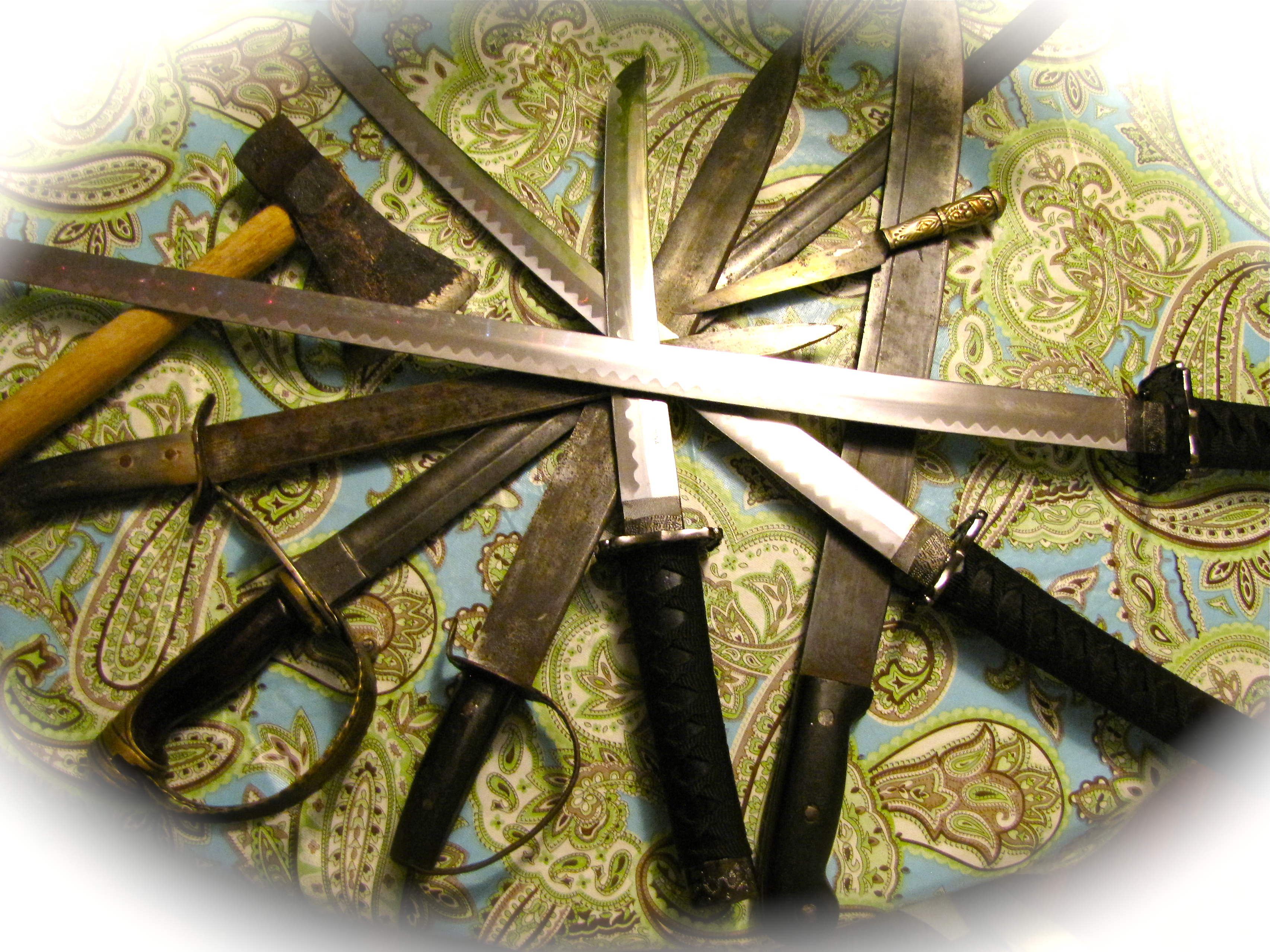
Our current assemblage includes several machetes, an antique cavalry saber, an antique gaucho knife, a set of samurai swords, a throwing knife, a hatchet and a replica of Bilbo’s sword Sting from the Lord of the Rings films. This collection doesn’t include a number of machetes and knives we’ve lost, left behind or given away over the years.

Some of the blades aren’t just for show. My old man uses the gaucho knife to slice apples. The machetes were used regularly in Ecuador, whether for cutting grass (we didn’t have a lawnmower) or chopping wood. The cavalry saber is no longer wielded in battle, but it gives whoever happens to be holding it an air of authority. It’s hard to argue with someone brandishing a cavalry saber.

My old man is particularly skilled with blades, able to snap a stick in half by throwing a machete from a distance of several feet. He says the technique is using for killing snakes in the jungle. I’ve never seen my old man kill a snake—such creatures are pretty rare in the urban areas where my parents have worked for the last decade—but woe to the foolish serpent who crosses my father’s path when he’s got a machete handy.

Our arsenal of blades was surprisingly inexpensive to assemble. The most pricey item was probably the cavalry saber, purchased from a fellow missionary for fifty dollars. Machetes are a dime a dozen—all right, more like twelve dollars for one—in Ecuador. I bought the samurai swords for twenty dollars from a college roommate.

I think we’ve spent our money wisely. The Lord Jesus himself advised his disciples to invest in bladed weapons.

(Disclaimer: I may possibly be taking the verse slightly out of its original context.)

I wanted to make a sword during That Time I Was a Blacksmith, but I never managed it. Making S-hooks and tent pegs was hard enough—a sword would have been practically impossible.

(I laughed bitterly during that episode of Avatar: The Last Airbender in which a character with no experience as a blacksmith forges a beautiful sword in a single night.)

Although I will never make my own sword, I will continue to enjoy and appreciate the blades my family and I acquire.

Swords are awesome. I’m holding a cavalry saber, so don’t even try to argue if you disagree.

77. That Time I Tangled with Barbed Wire

Many missionary kids have learned the folly of strolling carelessly through the jungle, and some even have the scars to prove it.

The jungles in Ecuador are beautiful: dazzling waterfalls, crystal-clear streams, bright flowers and lush vegetation. However, visitors to the jungle must not become too distracted by its beauty. The jungle is a wild place, full of potential threats.

No, I’m not talking about piranhas, jaguars, poisoned darts or ancient temples full of death traps. The true dangers of the jungle are much more insidious and sinister: ticks, amoebas, parasitic worms and mosquitoes. I particularly detest mosquitoes, those messengers of Satan, which buzz and bite and sometimes carry deadly diseases.

The jungle is also full of sharp objects waiting to pierce unwary feet. Unwary visitors to the jungle are confronted by thorns, spines, sharp rocks, rusty nails and even barbed wire. Only a fool walks through the jungle without watching his step.

I was always careful to watch my step. The problem was that sharp objects in the jungle are sometimes found in places other than the ground underfoot.

When I was just a kid, I went camping in the jungle with my old man and big brother. The place to which we went was called Aguas Claras, or Clear Waters. On our way there we stopped at a cacao plantation to visit the parents of a pastor with whom my parents worked. (For those who don’t know, cacao beans are the main ingredient of chocolate.)

My old man, a true missionary, stayed for hours talking. Having long since become accustomed to my parents talking for hours with people I didn’t know, I went off exploring alone. Fortunately, it was an interesting place to explore. There were groves of cacao trees nearby and a river with stones for throwing. I also found a couple of paths through the jungle.

I don’t remember why I decided to run along one of those paths. My brother may have been chasing me, or I may have been letting off steam. Whatever the reason, it was a mistake. Stretched across the path at eye level was a long strand of rusty barbed wire.

Have you ever run into a clothesline? I don’t remember the exact details of my tangle with the barbed wire, but I imagine it must have been something like colliding with a taut clothesline while running at full speed.

We were many miles from any kind of medical facility, so the gash in my left cheek was never stitched up. Some weeks after the incident, my old man tried to console me about the scar by pointing out that I now had something in common with both Indiana Jones and the evil lion from The Lion King. I didn’t need to be consoled. As far as I was concerned, a scar—especially a facial scar—was pretty much the coolest thing that could ever happen to a missionary kid.

My left cheek is still scarred more than a decade later. I’m not sure whether to be relieved or disappointed that the scar isn’t very noticeable. I suppose I should simply be thankful I didn’t lose an eye.

The moral of the story? Be aware of your surroundings if you ever visit a jungle, and consider wearing goggles.

The Infinity Manuscript, Part 6: The Tale of the Enemy

The fifth part of this story can be found here.

The Orofino Empire had been under siege for three years. The enemy was not some powerful nation bent on conquest, but a band of criminals led by one of the most capable strategists in the world.

Although the Empire feared him as Jerem the Plague, his followers called him the Boss.

The Boss was a huge man: heavy, slow and terribly strong. In battle he moved with the slow inexorability of the tide. Nothing could withstand him. According to one account, he had once felled an oak with a single blow from his great poleaxe. Another story claimed he had crushed a man’s skull with one enormous hand. A few doubted the truth of these tales, but nobody had ever dared to question them openly.

Before every raid, the Boss soaked lengths of rope in oil, wove them into his hair and lit them. His hair and beard, already dyed crimson, seemed to burn with hellfire in battle. Those who had seen him from afar called him the Red Demon and the Paragon of Hell. He was, they insisted, a spirit of hatred, rage and malice.

In spite of his diabolical appearance, the Boss was just a man: a calm, brilliant, logical man. He had used every available means to build up a reputation as a fearsome demon. His followers spread rumors of his preternatural powers. In battle, he looked and acted the part of an evil spirit.

“There is no greater weapon than fear,” he once told his warriors. “A brave man’s fists are more to be feared than the swords and arrows of cowards. To make a man afraid is to disarm him.” On another occasion he said, “Men will fight a criminal. No man will fight a demon.”

In only one respect were the dark rumors about the Boss true. He was utterly ruthless. The Boss executed prisoners as tranquilly as he brewed tea. His was a cold cruelty, malice without anger, a detached determination to succeed at any cost.

As far as the Boss was concerned, there were three elements to success. Survival was the first. Monetary gain was the second: every town was looted before it was burned. The third element was personal satisfaction. While the Boss did not particularly enjoy the act of killing, he found satisfaction in avoiding capture and wiping towns off the map.

It was, as he saw it, a game. The Empire constantly lost its playing pieces to the Boss. The Boss seldom lost a piece, and never an important one.

The man whom the Orofino Empire knew as Jerem the Plague seemed to be everywhere at once, yet nowhere. He and his band of fighters descended upon towns, reduced them to ashes and then vanished.

This supernatural feat was, like his supernatural appearance, just another trick.

The Boss had hundreds of men scattered throughout the Empire. Before every attack, his nearest followers gathered secretly and became an army. They dispersed after the battle, slipping back to their homes and resuming the guise of honest tradesmen. Thus the Orofino Empire sought the army of Jerem the Plague in vain, never suspecting his warriors to be local tavern-keepers, blacksmiths and merchants.

He himself traveled with no more than half a dozen men. They posed as traveling merchants, even keeping a wagon stocked with merchandise to sell passersby. No one had ever been alarmed by the weapons the Boss and his men wore. The Empire was a dangerous place, and even merchants were forced to arm themselves against the beasts turned vicious by the Blight.

Only twice had passersby suspected the Boss might be something more sinister. On both occasions the threat to his secrecy had been, as he expressed it, “promptly dealt with,” and the bodies buried.

On a warm, balmy evening, the Boss and his men were interrupted by an unexpected guest as they set up camp.

“Welcome!” exclaimed the Boss, smiling and holding out his hands. “We did not expect to find a customer here, and not at such an hour. It is dangerous to be wandering the woods alone at night, stranger. The Blight makes such places unsafe.”

“Do you have any coffee?” asked the stranger. “Traveling alone is dangerous, yes, but the risk will be worthwhile if only I can have a cup of coffee.”

“You have money?” inquired the Boss. No merchant would part with a cup of coffee without charging for it.

The stranger handed him a gold coin. “Keep the change,” he said. “I haven’t had a cup of coffee in ages. Not since, well, this morning.”

The Boss chuckled. “Well said, stranger. I hope you are willing to wait. Coffee takes time to brew. Evan! Prepare some coffee for our customer.”

The stranger seated himself by the fire. The man called Evan filled a kettle as the others resumed setting up camp. The Boss sat down next to the stranger and whetted his knife.

As long as the stranger did not pry, he was in no danger. There was nothing to be gained by slaughtering passersby. If, however, the stranger began to ask too many questions, the Boss would have no choice but to end him.

“What is your name, stranger?” he asked.

“Innocent Freo,” said the man, tossing a gold coin in the air and catching it.

“Do you always treat your money so carelessly?”

“It’s just a habit,” added Innocent with another toss of the coin. “It’s hard for me to sit still sometimes. I like having something to do with my hands.”

“So where do you come from, Innocent Freo?”

“A little town way out in the desert. You’ve probably never heard of it: Green Isle.”

“I have been to Green Isle. The taverns there serve exquisite fire-nectar.”

Innocent laughed and flipped the coin yet again into the air. “Exquisite isn’t the word I’d choose,” he said. “I’d call it bracing. It’s perfect for getting rust off iron tools, and sometimes even good for drinking. You wouldn’t happen to stock fire-nectar in that wagon of yours?”

“We do.”

“I’d love to have just a taste of home. For another gold coin, could I have a bottle of fire-nectar?”

As Evan rummaged in the wagon, Innocent continued tossing his coin.

“Here you go,” grunted Evan, thrusting a bottle at Innocent.

Innocent flipped the coin a final time, handed it to the Boss and took the bottle.

“Good stuff,” he said, and hurled the bottle into the heart of the fire.

The flames leaped skyward with a roar. For just an instant, the Boss and his men were dumbfounded.

There was a thump and a muffled wheeze. The Boss recovered his senses. “Attack, you fools!” he cried, advancing on Innocent with his knife.

Innocent stood with a sword raised. Evan lay beside him with an empty sheath, clutching his chest and trying to breathe.

Two men charged at Innocent, but they fell to the ground before they could reach him.

“Gotcha!” cried a stout, hairy man, holding down one of the men and grinning impishly. “Stop struggling, you, or you’ll get a knife through your ribs. I know where to stick it, don’t think I don’t.”

The man stopped struggling and whimpered.

The other man lay senseless with an arrow in his arm. “Good shot, Heck,” said the hairy man. “You were right, sure enough. That stuff you slathered on the arrowhead knocked him out right cold.”

The Boss surveyed the scene in an instant. He could not see the rest of his men, but a chorus of groans from behind the wagon told him they could not help him now. It was useless to try to fight. Escape was his best option.

He turned to flee.

“Hold still or I kill you where you stand.”

The Boss felt the cold prickle of a blade held to the back of his neck. He held still.

“You really like that ‘or I kill you where you stand’ line, don’t you, Paladin Fey?” said the hairy man. “You use it a lot. Anyhow, Jerem’s supposed to be immortal. If that’s really Jerem, there’s not much point in telling him you’ll kill him, is there?”

“Quiet, Loxley, or you’re next.”

Two men came into the firelight and began tying up the Boss’s followers.

“Sorry about that,” said Innocent, nudging Evan gently with his foot. “I hit you a little harder than I intended. You’ll be fine, I think. I’ll just keep your sword for now.”

The Boss had put his whole life into playing his game with the Empire. Having lost his pieces, he accepted defeat gracefully.

“Who are you?” he asked.

“I’m Paladin Fey,” said the voice from behind him. “The hairy one is Theobald Loxley.”

“Nick Puck here,” said one of the men tying up the captives. “I’ve spent so many years hearing about you, Jerem, it’s a little surreal to finally meet you. You’re not nearly as demonic as I expected.

“Anyways,” he added, motioning toward the other man, “that’s Hector Fuori, our tracker and bowman. He doesn’t talk much, but he’s the one who managed to find you. We’ve been on your trail since Coppertown. That’s the last place you burned, in case you’d forgotten.”

“We represent the Emperor himself,” said Paladin Fey. “His Excellency Cecil the Immortal tasked us with bringing you and your men to justice.”

“You will never find the rest of my men,” said the Boss.

“That’s fine,” said Innocent. “They’re not one-tenth so dangerous without their leader. We’ve cut off the snake’s head tonight. The rest of the snake will pass away quietly.”

Having finished with the Boss’s men, Puck and Fuori began binding the Boss himself.

“I can’t believe we did it!” squealed Loxley, who was keeping a close watch on the captives. “We brought down Jerem the Plague. We’re heroes! This day will become a holiday or something. The refugees can go home and start over again. The Empire is saved!”

“Please be quiet, Mist,” said Innocent. “I think Jerem wants to say something.”

“You followed us here,” said the Boss. “You are clearly exceptional trackers.”

“Your red beard was a giveaway,” said Fuori quietly. “We also had a tip from a survivor in Coppertown. He directed us to a clearing in the Jade Forest where I picked up your trail.”

“When you found me, you sent Innocent to reconnoiter.”

“Yes,” said Paladin Fey. “Paladin Spike, the man you call Innocent, surveyed the situation and signaled us with that gold coin. It caught the firelight, so Master Fuori could see it from where he was hiding. Paladin Spike gave us the information we needed, and even caused a diversion so we could attack.”

Paladin Fey failed to repress a smile. “When you told us you’d cause a diversion, Paladin Spike, I didn’t expect you to blow up the campfire.”

Innocent shrugged.

“Further questions, prisoner?” asked Paladin Fey. “If not, you’re under arrest for countless charges of murder, arson, theft and treason, among others. Most of all, Jerem the Plague, the Orofino Empire charges you with attempted destruction of the Infinity Manuscript.”

The Boss began to laugh.

“There has been a misunderstanding,” he said. “I plead guilty to all of those charges but two. I have never touched the Infinity Manuscript, and I am not Jerem the Plague.”

Silence.

“Three years ago, I heard rumors of a red-headed man who sought the Infinity Manuscript to destroy it, and the world with it. He was called Jerem. I took his name. If he were credited with my accomplishments, I hoped, the Empire would search for him and leave me alone. It seems I was wrong.

“Tell your Emperor that you conquered the Red Demon, the Paragon of Hell, but the man whose true name is Jerem still walks free. You have saved the Empire, but you have done nothing to save the world.”

The story continues with the seventh part, The Tale of the Paladin.

76. Super Mario Bros.

The Mario games are weird.

There’s simply no way around it. Mario is the most recognizable character in the video game industry. His games are typically superb, whether he happens to be rescuing princesses, driving go-karts, playing sports or moonlighting as a medical doctor. He has moved far, far beyond his platforming roots and conquered almost every other video game genre in existence: puzzle games, racing games, sports games, roleplaying games, sucking-up-ghosts-with-a-vacuum-cleaner games—you name it, he’s probably done it.

The weird thing? Mario, the paragon of the video game industry, is a pudgy Italian plumber in a world populated by anthropomorphic mushrooms and fire-breathing turtles.

While one expects the rampageous strangeness of the Mario games to have some whimsical origin, most of it can be traced back to mundane things like gameplay mechanics and graphical limitations.

Mario’s trademark appearance owes everything to limited graphics. His hat was easier to animate than hair. His mustache was easier to animate than a mouth. Those stylish white gloves kept his hands from blending in with his overalls.

The other bizarre conventions of the Mario universe, from power-up mushrooms to warp pipes, all have logical explanations.

Mind you, that doesn’t make them any less weird.

Despite their oddities, the Mario games are usually excellent. There’s never much of a story—the bad guy kidnaps the princess, the princess is rescued by Mario, Mario gets a kiss from the princess—but the games make up for the lack of plot with ingenious gameplay and catchy music.

Even the oddness of the Mario games gives them a quirky sort of charm. A player can never be too sure of what will happen next. Mario grabs a mushroom and grows huge, or nabs a leaf and sprouts a raccoon tail, or gets a helicopter helmet and takes to the skies.

The world of Mario is a fanciful, lighthearted, Alice’s Adventures in Wonderland sort of place. Anything can happen—and pretty much everything does.

75. Stoic or Stupid?

I don’t think I would make a very good Viking.

I hate cold weather. I lack any kind of vicious bloodlust. Most importantly, I can’t grow a beard. Thus it is proved. Adam would not make a good Viking.

Regardless, I possess one quality that would make any Viking proud: quiet stoicism.

When confronted with trials and tribulations, I don’t usually talk about them. Whether depression or headache, discouragement or insomnia, sadness or soreness, I keep my problems to myself.

In some ways, quiet stoicism isn’t such a bad thing. I know people who could probably use a little stoicism: the sort of people who regularly insist on describing all of their frustrations in painstaking detail. One reason I don’t talk much about my problems is that I don’t want to annoy anyone.

In other ways, however, quiet stoicism is kind of stupid.

To be honest, one of the reasons I keep my struggles to myself is to give the impression that I don’t have any. It’s hard to be vulnerable. It can be embarrassing. The easiest option is sometimes to be stoic and tough out my problems alone.

The trouble is that some problems are too big for anyone to tough out alone.

As much as I’d like to pretend I’m totally self-sufficient, I’m not. There are times I need someone to give me advice, encouragement or criticism. There are times I need someone to listen to me. There are times I need someone simply to be there.

Not long ago, I realized I’d made such a habit of trying to deal with my problems alone that I was forgetting to ask God for help when difficulties arose. It wasn’t a deliberate, “I’ll take care of this little complication, God, and ask you to handle the really big problems” kind of decision. In fact, it wasn’t a decision at all. Asking for help simply didn’t occur to me.

Stoic or not, forgetting to ask the Lord God Almighty for help is stupid. He doesn’t merely allow us to ask for help when we need it. He flat-out commands us to ask for help when we need it!

Paul wrote, “Do not be anxious about anything, but in everything, by prayer and petition, with thanksgiving, present your requests to God” (Philippians 4:6).

Peter added, “Cast all your anxiety on him because he cares for you” (1 Peter 5:7).

Quiet stoicism can be a virtue. I’m a reserved person, and I don’t plan to tell everyone about every problem. I think it’s good sometimes to work through problems patiently.

In the end, though, ain’t it better to ask for help?

The Infinity Manuscript, Part 5: The Tale of the Survivor

The fourth part of this story can be found here.

Night had fallen over Coppertown—rather, over the place where Coppertown had been. Ashes and scorched stones were all that was left, apart from a few buildings that rose like tombstones from the devastation. The moon painted the scene black and silver. It was like a picture, quiet and still, except for the odd flicker of movement as an animal scurried through the remains of the town.

The building that had once been the mayor’s residence was the safest structure left. The survivors had settled in the upper rooms, beyond the reach of the creatures turned vicious by the Blight. There were about forty survivors: mostly young miners and their wives. No children had lived.

The survivors were in the process of exploring the cellars that remained intact after the fire. Once they had gathered enough supplies, they would arm themselves and make the dangerous trek to the nearest town. Then they could book passage with a caravan and travel to the Emperor’s City, there to begin a new life as refugees.

Such was their hope.

Several of the young miners had built a fire in their room, using timbers from the attic as fuel. After removing the ladders to the lower floors, they huddled around the fire and tried to make conversation.

“Cursed be Jerem,” muttered Aloysius, watching the flames. “Ten thousand curses on him and his band of murderers. No mercy, not even for the children. Rope for a few; steel for some; pitch and fire for the rest. Gone. All gone.”

“Will you stop it?” burst out his brother. “It’s over. Jerem’s gone, curse his fat face. Our town is gone, and so are most of our friends. Almost everything is gone, yes, but we’re still here. We’re still alive, Aloysius, don’t you see? We can’t complain. We’re the lucky ones. We survived.”

Aloysius scowled. “Tell me, dear brother,” he said. “How does that make us the lucky ones?”

“Ignore him, Quinton,” said one of the men. “Your brother was a gloomy blighter before Jerem swept through, and now he’s even worse. If we take no notice of him, perhaps he’ll shut his mouth and let us talk about cheerfuller things.”

The conversation turned to other subjects, and Aloysius’s thoughts turned to his parents. They were not among the survivors. In a single day of bloodshed and ruin, most of the family had perished. Aloysius and Quinton were the only members left. They alone survived to carry on their family’s name. For their family’s sake they had to keep living.

It was their only reason to keep living.

Morning dawned: as fresh, bright and beautiful a morning as the world had ever seen. Birdsong was heard for the first time since the fire. Sunlight flooded the ruins of Coppertown.

Aloysius could not help but feel a glimmer of hope. Yes, the world was falling apart. Jerem the Plague and his band cut a swathe of destruction across the Empire. Disasters tore apart the land, and the Blight corrupted whatever creatures were spared.

Yet the sun rose every morning.

Perhaps, mused Aloysius, the end of the world was not such a gloomy thing after all.

“Today’s the last day,” said Paddy, the oldest of the miners. “We can’t afford to stay longer. No stone unturned today, lads. If there’s any food left in this town, we find it. Tonight we pack; tomorrow we leave. Aloysius, you’re on guard duty. The rest of you lot, come along.”

Since the guard towers had been reduced to a few charred timbers, the best vantage point in Coppertown was the roof of the mayor’s residence. After gathering a few essentials—some food, a bottle of water, a parasol and his trumpet—Aloysius crawled out of an upper window and climbed up to the roof.

It was the work of a moment to set up camp for the day. Aloysius opened the parasol and propped it up against a chimney for shade. He placed the other items carefully upon the rooftop and then sat down to keep watch.

Aloysius was the only miner who could play the trumpet. The others had tried, but all they could manage were muffled wheezes. Only Aloysius could produce a long, clear blast from the instrument. If anything approached the ruins of Coppertown, he would blow the trumpet, signaling the miners to make a dash for the safety of the mayor’s residence.

A week before, Aloysius would have been tempted to pass the time by making music. He felt no such temptation now.

Hours passed. Aloysius drank from the bottle and ate a little. The sun blazed. The air shimmered. Except for the murmur of conversation from the miners below, all was silent.

He sounded the trumpet. With shouts of alarm, the miners swarmed across the ashen remains of Coppertown and barricaded themselves in the mayor’s residence.

“What is it?” asked Quinton, joining his brother on the rooftop. “What do you see?”

Aloysius pointed.

Five figures leading horses had entered Coppertown.

“Jerem’s men?” asked Quinton.

“Can’t say,” replied Aloysius. “Sun’s too bright. They could be Imperials. I’ll take a closer look.”

“Aloysius, if you think for one instant I’ll let you—”

“Curse it, Quinton, just be quiet. I’m not the fragile little boy you think I am. Get inside and tell the others to be silent and alert. I’ll meet these people. If all’s well, I’ll give a blast on the trumpet. If you don’t hear anything, assume the worst.”

“Aloysius, I won’t—” began Quinton, but his brother cut him off again.

“I love you, dear brother, but shut up.”

Aloysius clambered down through the window, clutching his trumpet. His decision was made. Life was a painful option; suicide was no option at all. Meeting the strangers seemed like an admirable solution. If he survived the encounter, he would keep living. If he did not survive, his troubles were over.

He left the mayor’s residence and padded silently through the ashes. As he neared the strangers, their voices became clearer.

“Well, gents and lady, here’s the thriving mining outpost called Coppertown. Looks like my information was correct. The place is gutted. We’d best start by looking for survivors: anyone who can tell us where Jerem’s gone.”

“Thank you, Master Puck. Your services are proving to be useful.”

“You’re too kind, Paladin Fey.”

“Your obsequiousness is duly noted. All right, we had better split into two—Loxley! Where do you think you’re going?”

“What, Nicky here gets a formal title and I don’t?”

“Answer the question, Loxley.”

Aloysius heard the ringing sound of a blade unsheathed.

“Whoa, put away the sword! I didn’t mean to offend, lady. I was just slipping away to see if Jerem overlooked anything, don’t you know.”

“Elucidate, Loxley.”

“Do what now?”

“Explain,” said another voice. It was a gentle voice, and Aloysius guessed the man to whom it belonged was smiling.

“Oh, that’s what she means. Thanks for translating, Innocent. Ah! Will you put away the sword, lady? I’ll explain, I’ll explain. I thought there might be some valuables Jerem missed when he plundered this place, see?”

“You disgust me, Loxley. If you try to slip away again, you’ll lose one of your fingers.”

“But I need them all for thieving, lady. Would you endanger our mission by handicapping me?”

“Then you’ll lose some other, less useful portion of your anatomy. I can think of one in particular with which you could certainly afford to part ways.”

The gentle voice spoke again. “With due respect, Paladin Fey, threats are not needed. Mist, don’t forget you owe me quite a debt. You can start repaying it by obeying our leader.”

“All right, Innocent. You got it. I’m listening to you, lady, but only because Innocent here told me to. Don’t think for a second I actually respect you or anything.”

Aloysius had crept near the strangers and hid behind a crumbling section of wall. He had some idea of listening to their conversation until he was sure of who they were and what they wanted.

His designs were ruined. A man stepped around the wall, took hold of his arm and dragged him into the midst of the strangers.

“Well done, Master Fuori,” said the lady, before addressing Aloysius: “Calm down, we’re not here to hurt you.”

Aloysius had begun to shake. As he tried to gather the nerve to speak, he glanced at the strangers and tried to match each one to the voices he had heard.

“We’re from the Emperor’s City,” continued the lady. “I’m Paladin Fey; you may have heard of me. These are my companions, Paladin Spike and Masters Fuori, Puck and Loxley.”

“About time I get the title,” grumbled Loxley.

Paladin Fey was a slender woman in a military uniform. Although he would never have dared admit it, Aloysius thought she was quite pretty. Paladin Spike was middle-aged and had a pleasant smile; Master Fuori was young and athletic; Master Puck was gangly and had ginger hair; Master Loxley was hairy and slightly rotund.

Each of the strangers was armed: the Paladins with swords, Master Fuori with a bow and arrows, Master Puck with a cutlass and Master Loxley with a long knife.

“We’re searching for Jerem the Plague, also called the Red Demon,” continued Paladin Fey. “The Emperor himself has tasked us with bringing him to justice. We received intelligence that he had been seen near Coppertown. Judging by the condition of the town, I surmise this information was accurate.”

“Yes, he was here.”

“What can you tell us?”

Aloysius took a deep breath. “I’ll tell you, but for a price.”

Paladin Fey mechanically raised the point of her sword to his throat. “Tell us or I kill you where you stand.”

With a single, swift motion that made them all start, Paladin Spike drew his sword and knocked the blade away from Aloysius’s throat, forcing the points of both swords into the ground.

Aloysius took a long, shaky breath.

“I apologize, Paladin Fey,” said Paladin Spike quietly. He pulled her sword out of the ground and handed it to her hilt-first. “I know this is the Empire’s way of doing things, but I won’t have more violence than can be helped. Do you understand?”

Paladin Fey’s expression changed rapidly from surprise to anger. “You have no right—” she began.

“I don’t mind dying,” interrupted Aloysius. “The only way I’ll talk is if you pay me. There are other survivors—you’ll never find them, so don’t get any ideas—and we need money for supplies. Your money for my information. It’s a fair trade.”

“Done,” said Paladin Spike.

Paladin Fey scowled, but counted out ten gold coins and handed them to Aloysius.

“Jerem was a fat man,” said Aloysius. “Fat but very muscular, if you know what I mean. He had red hair and a red beard, both long. There were about thirty men with him, all vicious, filthy ruffians. They stormed in, executed everyone they could find, looted the town and burned it to the ground.”

“Which way did they go?” asked Paladin Fey.

“Toward the Jade Forest.” Aloysius pointed. “That way. Listen, I know something that might help you. Not many people know it, but there’s a clearing in the northeast part of the forest; you might see it if you climb a tall tree. If Jerem knows this area, that’s probably where he’s camped.”

The visitors turned and began leading their horses away from the wreck of Coppertown. Paladin Spike lingered a moment to clap Aloysius on the shoulder. “Thanks, and good luck,” he said. “Justice will be done, if it can be.”

Aloysius was not a sentimental man, but he could not repress tears. “No, thank you,” he said, and began walking back through the ashes to the mayor’s residence.

Only halfway there did he remember to blow his trumpet.

The story continues with the sixth part, The Tale of the Enemy.