144. What Makes Christmas Special

Christmas.

What comes to your mind? Snow? Colored lights? Gift cards?

When I think of Christmas, what comes to my mind are palm trees, beaches at twilight and dusty houses built of cinder blocks.

Nothing says Christmas like a beach at twilight.

Nothing says Christmas like a beach at twilight.

As a missionary kid in Ecuador, I spent many Christmas vacations with my family at the beach. We’d pile into our car, crank up Adventures in Odyssey on our CD player and drive for hours: descending from the heights of the Andes, passing banana plantations, stopping at derelict gas stations for fuel and ice cream, winding among low hills and finally arriving at the beach.

Towns and villages are scattered across the Ecuadorian coast. Most of them are small, dirty, unimpressive places. Ecuador is a poor country. In December, however, these little communities are brightened with fake Christmas trees and cheap colored lights.

Not Relevant

Not relevant to this blog post, but adorable.

What really sticks in my memory is the way people celebrated. My old man and I once passed a merry gathering of children in a little town on Christmas Eve. Many were barefooted; most were dirty; nearly everyone was smiling. It was a scene Charles Dickens would have been proud to write.

In Ecuador, Christmas is a time for celebration. It’s a time for fireworks, family get-togethers and three-liter bottles of Coca-Cola. (Yeah, we’ve got those in Ecuador. Be jealous, Americans.) It’s a time for celebration.

Of course, in many ways, Christmas in Ecuador isn’t much different from Christmas in the United States of America. There are the same silly commercials. The same packed shopping malls. The same frenzied media trying to squeeze as much money as they can out of the holiday season.

All the same, when I see the extravagant displays of colored lights around my current home in Indiana, I miss the cinderblock houses on the Ecuadorian coast with tacky tinsel in the windows. The dusty Nativity sets in the corners of living rooms. The cheap ornaments hung from two-foot Christmas trees. The flimsy plastic cups of Coca-Cola.

Most of all, I miss the joy.

Today’s post is about Christmas as a holiday. There is a much deeper meaning to Christmas, and I’ll write about it later this month. For now I want to share what I believe makes the holiday special. It’s not the gifts or the decorations or the music or the food. Even the Grinch understands (eventually) that Christmas means more than stuff.

Joy and celebration and being together with loved ones are what make the holiday special. The other stuff is nice, of course. The holiday stuff is like pretty wrapping paper and shiny ribbons covering the gifts under the Christmas tree.

In the end, though, who wants just the ribbons and wrapping paper without the presents?

143. I Can Has Guest Post?

Update: This blog is finished, and no longer accepts guest posts. Thanks all the same!

A while back, I expressed my intention to feature more guest posts on this blog.

I love guest posts. They strengthen a sense of community among writers. “No blog is an island,” wrote John Donne, or something like that. Guest posts deliver new perspectives and refreshing changes of style.

On a more pragmatic (read: selfish) note, it’s always nice to have someone else write blog posts for me.

“I don’t always write posts for other blogs, but when I do I write them for Typewriter Monkey Task Force.”

“I don’t always write posts for other blogs, but when I do I write them for Typewriter Monkey Task Force.”

TMTF has featured posts from a number of distinguished guests, from Wes Molebash to Paul McCusker. (I’m still psyched that Mr. McCusker authored a post for this blog; he’s a writer whom I admire very much.) Even my typewriter monkeys have written a guest post! (It was a mistake to leave my blog’s password where they could find it.) Yes, guest posts are awesome, and I’d love to share more of them.

Here’s the exciting part: you can write a guest post. Yes, dear reader, you.

The time has come for me to delve into this blog’s dusty archives and bring forth the ancient, sacred principles of Writing a Guest Post for Typewriter Monkey Task Force.

What criteria are needed for a guest post to be featured on TMTF?

It should be about faith, writing, video games or literature

Possible topics for guest posts include creative writing tips, spiritual insights, literary musings or humorous observations about gaming culture. Posts about celebrity hairstyles, trigonometry or rubber bands will be instantly rejected.

It should be well-written

Guest posts should be coherent, succinct and easy to read. Between four hundred to eight hundred words is the ideal length. Grammatical errors and spelling mistakes shall be met with the full fury of my righteous indignation.

It should be funny, insightful or both

I try to make every post on TMTF entertaining or edifying. I don’t always succeed. That makes it even more important for guest posts to succeed where I fail!

It should be pleasant

TMTF is not an edgy or controversial blog, and there are already enough disputes, arguments and insults on the Internet without adding more. The purpose of this blog is “to impart hope or understanding or inspiration—or at the very least a healthy laugh—to someone who needs it.” Guest posts should honor that purpose.

If you’re interested in submitting a guest post, let me know via the Contact page!

I may not accept all submissions. Some guest posts, however well-written, may not be well-suited for this blog. I may suggest changes or edits to guest posts. In all cases, I’ll do my very best to be respectful of the work submitted.

There are many possible topics for guest postage. (Is guest postage a valid phrase? Having already upset grammarians and English professors with the title of this blog post, I can’t be too careful.) These include About Writing posts, Why [Insert Author Name] Is Awesome posts, book reviews, humorous top ten lists and spiritual reflections.

Why write a guest post for this blog? Well, if you have a website, blog, Twitter page or website, it can be featured along with your post.

More importantly, you can become an honorary member of the Typewriter Monkey Task Force! (There are no rules, responsibilities or rewards associated with membership—just bragging rights.) Honorary members of the TMTF include Curious George, Diddy Kong, Fred the Monkey and Matthew McConaughey.

Honorary membership to the TMTF is such an exclusive privilege that most of its lucky recipients aren’t even aware of having been made honorary members. It doesn’t get any classier than that!

Incidentally, my typewriter monkeys and I are always delighted to write posts for other blogs. If you’re in need of some guest postage, let us know!

Zealot: A Christmas Story – Chapter Three: Caleb

Chapter Two can be found here.

Caleb ran down the street, jostling the others, yelling and whooping and laughing. The night was dark, but the dark did not matter. They had found a light, a light to illuminate Bethlehem and Judea and all the world, a light from which all shadows must flee.

“Halt, you rabble,” called a voice. Caleb stopped and looked around. His companions did the same. They saw no one. The streets, lined with dim buildings, were lit only by faint, flickering threads of lamplight leaking through window lattices. The sky above was a black abyss, untouched by gleam of moon or star.

“Who speaks?” asked Caleb, beaming. “Come, there is no need to be shy.”

“Get inside, you fools,” said the voice, and a man emerged from the gloom. “You must be mad or drunk or possessed by devils. I neither know nor care. However, as a fellow Jew, I give you this advice: get indoors and stay there.”

“We cannot,” said Caleb, and his companions murmured their assent. “We have seen him, and we must spread the news!”

“Seen whom?” demanded the stranger. “What news?”

“The Messiah!” cried one of Caleb’s companions.

The stranger reeled.

“Come, friend, and we will tell everything,” said Caleb, advancing upon the stranger and holding out his hand. “Come with us! We will show you.”

The stranger pulled a sword from beneath his cloak.

Caleb withdrew his hand and backed away. Then, unable to contain his mirth, he burst into a laugh. “Come, come, put it away,” he gasped. “No need for weapons. We mean no harm, friend.”

“Keep your distance,” said the stranger. He pointed the blade at Caleb, but his hand shook. “The Messiah? What in God’s name do you mean?”

“The Messiah,” repeated Caleb. “I cannot make it clearer. The Messiah of God has come to Bethlehem.”

The stranger lowered his sword. “Where is he?” he demanded. “This Messiah—where is he? If God, after so many centuries of silence, has finally given us his chosen leader, I will pledge myself to his service.”

“What is your name, friend?” inquired Caleb.

The question seemed to surprise the stranger. “Jehu the zealot,” he replied.

“I am Caleb the shepherd. These are my fellow shepherds: loyal sons of Jacob. Now that we know each other, let us take you to the Messiah.”

Jehu’s hands stopped shaking, and he wrinkled his nose. “Shepherds,” he muttered. “What a fool I am to be shaken by the gossip of shepherds. I ought to have known you by your smell.”

“Are you coming with us?” inquired Caleb.

“Go to your Messiah,” said Jehu. “If you ask politely, he may give you golden scepters and linen robes to replace your crooks and filthy rags.”

“He is sleeping in a manger,” said one of Caleb’s companions, and Jehu froze.

“What?” he whispered.

“Angels appeared to us as we watched our flocks,” explained Caleb, gesturing toward the fields lost in the darkness somewhere far beyond Bethlehem.

Caleb’s companions broke the silence.

“Brighter than the heart of a furnace!”

“White robes—whiter than I have ever seen—whiter than the clouds of heaven.”

“Like bolts of lightning frozen in the sky!”

“There was one angel,” said Caleb. “Then there were many. They told us of the Messiah, the Christ, the child wrapped in cloths and lying a manger somewhere in the town of David. We found him with his parents in a cave outside Bethlehem.”

“You are fools,” said Jehu. “What of your flocks?”

“Ah, I suppose they are out there somewhere,” said Caleb vaguely. “They no longer matter.”

“They are wiser than you,” said Jehu, and sheathed his sword. “They are witless and wandering, but even your sheep have more sense than to invent stories of angels and a Messiah in a manger. Farewell, and God forgive your insanity.”

Jehu vanished into the darkness. Caleb and his companions stood for a moment, watching. Then someone laughed, and they all laughed, and into the night they ran, ready to tell Bethlehem and Judea and all the world that the Messiah had come.

Chapter Four can be found here.


Author’s Note:

Although I wrote “Zealot: A Christmas Story” a year ago, I’ve had to rewrite most of it because, well, the original was awful. (This story isn’t great, but at least it’s better.) My good intentions of working on each chapter ahead of time have failed, so this chapter, like the first two, was written in a hurry. I’d have delayed it until next week, but Christmas waits for no man. I’ve got to get at least some of this story posted before the twenty-fifth!

At the time of the Nativity, being a shepherd was not exactly a glorious career. It was a hard, cold, lonely job with few benefits. Shepherds were pretty much the lowest of the low. That’s why it was frankly weird for Christ’s birth to have been announced to shepherds. Angels gave the good news not to kings or priests or philosophers, but to shepherds. Why shepherds? I’m not sure. Christ spent much of his time ministering to lowly people—beggars, lepers and prostitutes, among others—so perhaps it’s not so strange that shepherds were the first to hear the news of his arrival.

142. Moments of Pure Awesome

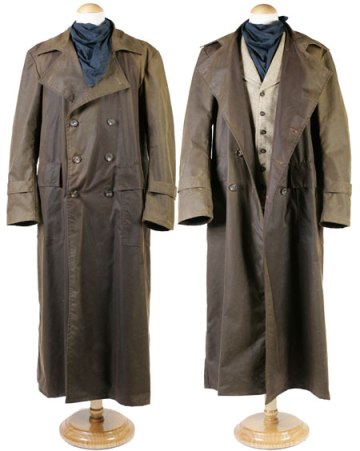
I recently decided I wanted a duster. What is a duster, you ask?

This, dear reader, is a duster:

Dusters

Isn’t it neat? Take just a moment, dear reader, to bask in its majesty.

My longing to own this particular overcoat began a few days ago, when I checked Wikipedia to find out what sets apart dusters from trench coats. (Dusters are distinct for having a slit up the back to the level of the waist, which allows them to be worn comfortably on horseback.)

Like most overcoats, dusters are cool. Neo from The Matrix wears a duster. Vash the Stampede wears a duster. Most gunslingers in Westerns wear dusters. Seriously, dusters are awesome. I even mentioned one in my last post.

Before continuing, I must make one thing clear: I haven’t accumulated much stuff in twenty-two years of moving from place to place. No matter where I’ve gone, however, I’ve kept one thing: a tendency to be neat and organized. When it comes to my possessions, I generally keep an accurate mental inventory of what I have and where I have it.

It was with great surprise, then, that I opened my hall closet a couple of days ago—fewer than twenty-four hours after deciding I wanted a duster—and found one.

I was puzzled. How in blazes did I acquire a duster? From where had it come? How long had it been hanging unnoticed in my closet?

Then I remembered. Some relatives had given me a bundle of used clothes a couple of months before. I’d hung them up in my hall closet without really looking at them, which is how I had overlooked that they had given me a freaking duster.

To say I am excited is a staggering understatement. Without paying a cent, I have acquired a warm duster that fits comfortably and billows satisfactorily when I walk against the breeze. (The coat probably looks silly, like I’m wearing a brown canvas tent, but that’s not the point—it makes me feel cool, which is what matters.)

When I found a duster hanging in my hall closet, it was a Moment of Pure Awesome.

There have been moments throughout my life, Moments of Pure Awesome, when it felt as though God were patting me on the shoulder and saying, “There, there, you’re going to be all right.”

In the worst months of my Thursday Afternoon the Soul, a year and a half of severe depression, I spent a week camping and traveling with my family in California. It was an unexpectedly perfect week, seven days of sunshine, peace and laughter: seven days peppered with Moments of Pure Awesome.

When I was struggling to find a publisher for The Trials of Lance Eliot—and beginning to wonder whether writing books was worth the trouble—I received a package from a creative writer whom I had met only once. It was filled with letters. A class of grade school kids had read a manuscript of mine and wanted to share what they liked about it. It was another Moment of Pure Awesome.

In my penultimate semester of college, two friends presented me with a beautiful sketch of Uncle Iroh: one of my favorite fictional characters. The gift was a random, wonderful act of kindness. On that night many months ago, my friends gave me something more than a picture: a Moment of Pure Awesome.

I could go on for many, many paragraphs, but I’ll conclude with two brief thoughts.

Dusters are really cool, and I’m thankful for a God who gives us Moments of Pure Awesome.

141. Let’s Make Better Christian Video Games

It’s a bitter truth, but we must face it bravely.

Christian video games stink.

Almost without exception, Christian video games are cheap knockoffs of mainstream video games. Christians have made superb contributions to practically every other medium in the world—art, music, literature, film—but not video games.

Why is this?

Well, there are lots of reasons. Video games require money to make, and Christians are a minority demographic in the video game industry. It’s more profitable to make games for larger audiences. More to the point, most Christian video games seem to be made by developers with good intentions, microscopic budgets and practically no experience. The fact that Christian video games tend to be derivative, preachy and poorly designed doesn’t help.

Perhaps the greatest problem is that Christian game developers often focus too much on the message of the games. (This may sound blasphemous, but please hear me out.) Other media can focus primarily on message and succeed, but video games are different.

Video games are built upon gameplay, the way a player interacts with the game. Elements like story, theme and message are secondary. The Mario games, which are amazing, feature the same story over and over again: rescue the princess from the bad guy. Many excellent games have no message—they’re simply entertaining. Even games like Portal and Bioshock with clever plots, deep themes and well-developed characters work only because they are fun to play. For a video game to have a compelling message, it must first have good gameplay.

That’s where Christian video games seem to fail. No matter how good their messages, these games are too flawed for any gamer to care. A video game must succeed as a video game before it can succeed as anything else.

How can we fix Christian video games? Listen up, Christian video game developers. (You all read this blog, right?) I’ve got some suggestions for you.

Focus on gameplay. Don’t preach. Let the game captivate the player with its excellence before introducing profound messages. Put together an adequate budget before starting development. Work with experienced developers. Did I already advise you not to preach? Borrow—but don’t steal—elements from other games. Get lots of feedback. Market your game cleverly and extensively to both Christian and mainstream demographics.

You still need ideas? All right, here are a few concepts for Christian video games that might actually be worth playing. When you make one of these games, just list me in the credits as Creative Consultant.

Underground

Genres: action-adventure, open world, stealth

Influences: Assassin’s Creed series, Metal Gear Solid series

It is the dawn of the fourth century A.D. Diocletian, Emperor of Rome, has intensified the persecution of Christians: burning sacred texts, leveling church buildings and brutally executing Christian leaders. In this time of terror and darkness, a young Christian—let’s call him Socrates—volunteers to be a courier, delivering urgent messages and carrying out secret missions for underground churches.

Underground would borrow much from Assassin’s Creed with its emphasis on historical details, roaming a vast environment and sneaking around without getting caught by the bad guys.

Unlike Assassin’s Creed, the focus of the game wouldn’t be assassination. Socrates would parkour his way around Rome and the surrounding country: clambering over rooftops, creeping through sewers, clinging to the undersides of chariots and generally getting from Point A to Point B without getting caught. (Socrates would also avoid detection by hiding in clay jars, Solid Snake-style.) Since the early church frowned upon murder, killing an enemy would be an instant Game Over. Socrates would have to find creative, nonlethal methods for incapacitating his foes.

Add a story rife with intrigue, betrayal and excitement, and Underground could work.

Pilgrim’s Progress

Genres: RPG, action-adventure

Influences: Legend of Zelda series, Final Fantasy XII, God of War series

The plot of John Bunyan’s classic allegory is perfect for a video game: an unlikely hero sets out on a quest, receives a sword, fights monsters, traverses dangerous environments and finally reaches a happy ending.

Pilgrim’s Progress would give players the choice of playing as either Christian or Christiana. Setting out from the City of Destruction, the player would follow a mostly linear path through exotic locales like the Slough of Despond and the Valley of the Shadow of Death, defeating enemies, solving puzzles and collecting treasures along the way. The ultimate goal? The Celestial City, a place of safety and rest.

The game would include RPG elements like experience points and leveling up, and equipment could be upgraded. Special weapons and tools would be used for combat and puzzle-solving. (Who wouldn’t want to use the Staff of Moses to cross a heretofore impassible river, or the Light of the Word to illuminate a dark cavern?) Progress would be recorded at Save Points. These would also provide a feature called Pilgrim’s Journal, which would allow the player to revisit areas explored previously. (This feature would keep the player from physically backtracking, which is antithetical to the plot of Pilgrim’s Progress.)

The story would have to be tweaked a bit, of course. Although there are one or two “boss battles” in the original allegory, I suggest adding more. For example, there really ought to be a final boss battle right before the player crosses the River of Death to reach the Celestial City. Perhaps Christian (or Christiana) could confront his (or her) greatest fear or worst temptation or something.

Gun for Hire

Genres: third-person shooter, adventure

Influences: Resident Evil 4, Ace Attorney series

Daniel Grey is a private investigator whose tiny office is a mess. A worn duster is draped over the back of his chair. Across his desk are scattered a revolver, a fedora, a Bible and a cup of coffee. When a businessman comes begging him to recover his kidnapped daughter, Grey has only one condition: “Nobody dies.”

As a third-person shooter, Gun for Hire would have plenty of shooting. Grey would venture into some pretty shady places, and bullets would fly. As with Underground, however, killing an enemy would mean an instant Game Over. The game would challenge the player to find creative uses for firearms. When shot, certain pipes would vent clouds of steam to blind foes. A well-aimed bullet would bring a shelf crashing down on an unsuspecting criminal, and shattering a dog’s chain would set it free to chase away potential threats. Of course, a pragmatic player could simply shoot to injure enemies, or knock them out with a blackjack and leave them tied up in a closet.

The game would also focus on investigation, allowing players to examine areas for clues. Important things—facts, documents and miscellaneous items—would be filed away as clues. Aligning the right clues would lead to conclusionsClues and conclusions would be used as keys to unlock answers in conversations with suspects, eventually leading to each mystery’s solution. Gun for Hire would balance exploration and shooting with investigation and perhaps a few puzzles.

The cases in Gun for Hire would be part of an overarching story involving a criminal conspiracy. The game would be set in a big city, probably in the early twentieth century. Daniel Grey would be a Wanderer-Hero with a strong faith, a kind heart, a quick wit and a tragic past. (Why does he drink so much coffee? Is he sublimating a craving for drugs or liquor into a harmless addiction, or simply using the buzz of caffeine to distract himself from some painful memory?) Strong gameplay, clever writing and good acting could make Gun for Hire a great game.

Will some experienced developer please make a good Christian video game? Someone? Anyone?

Zealot: A Christmas Story – Chapter Two: Judith

Chapter One can be found here.

Judith peered through the window and saw nothing. Moon and stars had been obscured by a blanket of clouds. Bethlehem had been plunged into darkness.

“When will Papa get home?” asked Rachel, tugging on Judith’s sleeve.

“Soon,” said Judith, and began to pray silently that her husband came home alive.

The Roman census had made Bethlehem a dangerous place. Bandits multiplied, eager to make a profit from the travelers flooding the roads. Hungry and desperate, many travelers were not above stealing anything they could to survive. It was a time for citizens of Bethlehem to bar their doors, wait and pray for God to guard them.

Judith had spent the day preparing for her husband’s homecoming: baking, cooking, cleaning and not daring to lapse into idleness. Idleness meant worry. Judith kept busy.

Someone hammered on the door, and Rachel flew to open it.

“Wait, child,” said Judith, and called, “Who knocks?”

“It is I, Benjamin, your one and only husband,” called a voice she knew. “Kindly open the door.”

Rachel threw open the door, cried “Papa!” and leapt into Benjamin’s arms. He tottered a few steps backward.

“My dear child,” he said, stroking her hair. “Judith, my love, I am home.”

“You are very late,” said Judith, and grinned. It was hard to be upset with Benjamin.

Benjamin carried Rachel inside. “We have a guest, my love.”

“Any guest is welcome,” said Judith.

Jehu stepped inside.

For an instant, Judith’s face betrayed disgust and fear. Then, speaking in a strained, quiet voice, she said, “Any guest but this one. He must go.”

Benjamin sat down on a cushion with Rachel on his lap. “My love, Jehu has come all the way from Jerusalem. We cannot turn him out into the cold.”

“Yes, we can,” said Judith.

“The night is dark, my love. The clouds covered the lights of heaven as we came into Bethlehem. I cannot leave my cousin to sleep in the streets on a night as gloomy as this.”

“I cannot allow a member of the Sicarii in my house,” said Judith. “He must go.”

Rachel looked up at Benjamin. “Papa, what does Sicarii mean?”

“You need not know,” replied Benjamin, biting his lip. “It is not a matter for children.”

“Tell her, my husband,” said Judith. “Rachel deserves to know what sort of man you have brought into her home tonight.”

Judith may not have been the head of the household, but she always had her way in arguments. Benjamin sighed, as usual, and submitted to his wife’s decision.

“You may sit, Jehu,” he said, making an effort to delay the inevitable. “There is no need for you to stand lifeless in the corner like an idol. For the moment, you are welcome here. Make yourself comfortable.”

Judith glanced fiercely at Benjamin. He held his daughter close and said, “Rachel, do you remember the stories of Joshua and David and the other great warriors of Israel?”

Rachel nodded.

“A Sicarii is a warrior who fights in secret. That is all, my daughter.”

Judith smiled. “I love you, my husband, for making the best of an ugly truth. Rachel, my child, the Sicarii are the dagger-men, murderers with sicae up their sleeves—secret blades to steal the lives of their enemies.”

Rachel stared at Jehu. “He has sicae in his sleeves?” she whispered.

“Well, Jehu?” said Judith. “She asks. Answer my daughter.”

Jehu reached up his right sleeve and withdrew a curved blade. “Just one,” he said. “One is all I need.”

Rachel gazed at Jehu, the grim stranger with a sword at his waist and a knife up his sleeve. “Papa, please let me go,” she whispered.

“My child,” said Benjamin, but stopped as his daughter squirmed in his arms.

“Please let me go,” she whimpered.

Benjamin released his daughter, and Rachel scuttled into a back room.

“Even children fear you, Jehu,” said Judith.

He scowled. “Your daughter fears the dark, dreadful dagger-men of your imagination. You frightened Rachel, not I.”

“Why have you come?” demanded Judith. “What brings you to Bethlehem?”

Jehu smiled, but his smile was darker than his scowl. “The Roman census, of course. Everyone is here for the census.”

“Do not lie to me,” snapped Judith.

“Your husband seemed an easy prey to bandits,” said Jehu. “I could not allow my cousin to travel alone.”

“Closer to the truth, yet no less a lie,” said Judith.

“Is this how you receive guests in Bethlehem, old man?” inquired Jehu. “Your child flees, your wife pries and you sit blinking like a drunkard.”

“Quiet,” said Benjamin, and a shadow of fear came over Judith. She had never heard such anguish in his voice.

“Josiah the priest was murdered yesterday,” continued Benjamin, speaking as though in pain. “A servant of the Most High, stabbed and left to die in the streets. Jerusalem erupted. Riots broke out. By the time the uproar had been quelled, the assassin had vanished. I know now where he has gone.”

“We both know Josiah was the governor’s puppet,” said Jehu, not looking at anyone. “A servant of the Most High? No, old man. A servant of Rome.”

“You killed a priest of God!” cried Benjamin, springing to his feet. He stood a moment, breathing heavily, and then sat down again on his cushion.

“I eliminated a traitor.”

There was a long silence. Judith opened her mouth to speak, but remained silent at a look from her husband. Benjamin, a soft man, seldom asserted his authority. When he did, Judith obeyed. Glaring at Jehu, she said nothing.

When Benjamin spoke, the anger had gone out of his voice. He sounded tired. “Jehu, what have you become? My cousin was not a man with blood on his hands. He was a good lad with bright eyes. Your eyes have become dull, Jehu. They are a drunkard’s eyes. You are intoxicated with blood, and it makes me sad.”

“I fight for our freedom,” protested Jehu. “I fight because I must. Rome grinds Israel into the dust. We must retaliate! What else can we do?”

“We can survive,” said Benjamin. “As we have done for hundreds of years, we can endure. It is not for us to overthrow empires. That is God’s business. We must await the Messiah who will set us free.”

“Will he come?” asked Jehu.

“What are you saying?” demanded Judith. She could not remain silent any longer.

“Will the Messiah come? We have waited hundreds of years. There are no more prophets. There are no more prophecies. The teachers of the law stoop to petty legalism, and God’s own temple is rebuilt as a political maneuver by a pagan king.”

“Do you plan to deliver Israel by murdering her priests?” asked Judith.

Jehu made no reply.

“It is best if you leave,” said Benjamin. “I am sorry, Jehu, but this is no place for you. God’s grace go with you, and may he lead you to a life of peace.”

“Get out,” said Judith.

Jehu opened the door and faded into the night. The lights of heaven had not rekindled, and the darkness was absolute.

Chapter Three can be found here.


Author’s Note:

When my old man told me about the Sicarii, the Jewish dagger-men who murdered their enemies in broad daylight and disappeared into the crowd, I was fascinated. Never mind Assassin’s Creed—this is history!

According to my old man, the Sicarii actually carried concealed blades. They would sidle up to their target in a crowd, slip the blade between the ribs, puncture the heart, withdraw the blade and slip away before anyone noticed them.

My tale of zealots and daggers may seem a bit grim for a Christmas story, but I don’t think it is. The Nativity is depicted as a bright, joyous event, but it came at a dark, dreary time in Jewish history. That’s partly why people were so excited about the Messiah. He would make everything right! He would restore Israel! In the meantime, the Sicarii and the zealots fought back. Everyone else endured, and waited, and hoped.

Nothing defines Christmas more than hope, I think.

140. TMTF Reviews: Brave New World

I like dystopian fiction. From young-adult novels like The Giver and House of Stairs to literary classics like Nineteen Eighty-Four and Fahrenheit 451, there’s something morbidly fascinating about governments and societies gone wrong.

Aldous Huxley’s Brave New World is considered one of the greatest dystopian novels ever written. Is this grim tale of bad society a good book?

Brave New World

The purpose of most dystopian fiction isn’t merely to tell a story, but to convey an idea. Dystopian stories aren’t just stories, but fables. Brave New World is no exception. It does a fantastic job of depicting a dysfunctional society, and a less fantastic—but still competent—job of creating an engaging plot and well-developed characters.

Nineteen Eighty-Four shows a society controlled by fear. Fahrenheit 451 depicts a society controlled by censorship. Brave New World is different. Its society is controlled by pleasure. People aren’t forced to obey. They’re conditioned to obey. The government doesn’t need to burn books or monitor its citizens. It promotes promiscuous sexuality, hands out recreational drugs and makes sure everyone has such a good time that no one ever bothers to ask questions.

Brave New World introduces its horrifying society in a brilliantly calm, matter-of-fact way. (The novel is full of exposition, which is conveyed pretty smoothly through dialogue.) Children are conceived artificially in factories and preconditioned to their future careers. Infants are taught through painful operant conditioning (involving shrill sirens and electric shocks) to despise books and flowers. The early chapters of the novel describe the brave new world of Aldous Huxley in an incongruously cheerful—and chillingly effective—manner.

Having established its dystopian background, the novel introduces an outsider: the ironically-named Savage, who ultimately takes a stand against the unrestrained hedonism and vapid amorality of his world. Does he succeed? I won’t spoil the ending, but you can probably guess what happens.

As an illustration of a dystopian society, Brave New World devotes many pages to exposition. It’s a novel about ideas. Elements like plot and characterization are secondary. Not much happens in the novel—its plot could be summed up in a paragraph—and most of its characters aren’t terribly well-developed.

In the end, these shortcomings aren’t all that important. As a work of literature, Brave New World may have some faults, but it fulfills its purpose: depicting a dysfunctional society and evoking a reaction (whether disgust, dislike or horrified fascination) from the reader.

It’s not a cheerful read, but I recommend Brave New World—particularly as a complement to Nineteen Eighty-Four by George Orwell. These novels give radically different takes on how society can go wrong: government by fear and government by pleasure.

139. The Wanderer-Hero

I’ve been watching Doctor Who. Besides kindling a strong desire in my heart to own a fez, the show has reminded me of my very favorite character archetype: a rare, strange and wonderful kind of character, comic and tragic, plain and mysterious—the Wanderer-Hero.

(I should wear a fez. Fezzes are cool.)

The Wanderer-Hero is my favorite kind of character in fiction, and a very rare one. I can think of only four characters that fit the description perfectly: the Doctor from Doctor Who, Gandalf from The Lord of the Rings, Vash the Stampede from Trigun and Father Brown from the stories by G.K. Chesterton.

These four—a time-traveling alien, a wizard, a gunslinger and a priest—have hardly anything in common, or so it seems at first glance. They actually share quite a number of traits, all of which characterize the archetype of the Wanderer-Hero.

For fun, let’s take a look at just a few.

The Wanderer-Hero wanders

There is no home for the Wanderer-Hero, whose destiny is to roam.

The Doctor travels in time and space with no home but his TARDIS, a spaceship and time machine. Gandalf wanders across Middle Earth. Vash roams the deserts of Gunsmoke. Even Father Brown, who supposedly lives in Essex and later in London, spends a surprising amount of time rambling throughout England, stumbling onto crime scenes wherever he goes.

The Wanderer-Hero is comic

Outwardly, the Wanderer-Hero is cheerful, witty or clever.

When confronted with deadly peril, the Doctor’s first reaction is to make a joke. Gandalf has a wry sense of humor. Vash makes a fool of himself at every opportunity; for example, while bravely defending a town from bandits, he wears a trash can lid for a hat. Father Brown possesses a gentle wit and a comically unorthodox manner of solving mysteries.

The Wanderer-Hero is tragic

Inwardly, the Wanderer-Hero endures terrible agonies.

The Doctor suffers from deep loneliness, guilt and self-doubt, besides the sorrow of being the only surviving member of his race. Gandalf fights a long, lonely, thankless battle against a nearly invincible enemy. Wherever Vash goes, innocent people die; these tragedies tear him apart. Father Brown admits to solving crimes by possessing a profound, painful understanding of human wickedness.

The Wanderer-Hero is more than human

In some way, the Wanderer-Hero is superhuman.

The Doctor is a Time Lord, the last survivor of an ancient race of extraterrestrials. Gandalf is one of the Maiar: divine beings sent into Middle Earth in the guise of mortals. Vash is a Plant, a humanoid creature possessing incredible power. Father Brown is only a human being, but his gentleness, wisdom and compassion are almost angelic.

The Wanderer-Hero is old

The courage of the Wanderer-Hero is balanced by the wisdom of age.

The Doctor is roughly nine hundred and nine years old. Gandalf spends centuries wandering Middle Earth. Vash is one hundred thirty-one. Father Brown is the only one whose age isn’t numbered in the hundreds, and even he gives the impression of being an ancient saint.

The Wanderer-Hero always happens to be in the right place at the right time

The character is called the Wanderer-Hero, after all.

Quite by accident, the Doctor always finds himself in exactly the right time and place to avert a catastrophe. Gandalf regularly appears just in time to rescue his companions. Vash helps people wherever he goes. By solving every crime he encounters, Father Brown saves the day—and sometimes the criminal.

I suppose the reason I like the Wanderer-Hero so much is that the character is a paradox: funny and sad, silly and wise, plain and mysterious, ordinary and extraordinary. The Wanderer-Hero has a little bit of everything.

Who is your favorite Wanderer-Hero? Should I acquire a fez? Let us know in the comments!

Zealot: A Christmas Story – Chapter One: Benjamin

A stout man and a thin man walked the road to Bethlehem in silence. Above them, a full moon shone and stars blazed across the sky. Around them, dusty slopes stretched up into the night, gray in the moonlight, broken by trees and rocks and tufts of grass.

The stout man paused to gaze upward. “Turn your eyes to the stars, Jehu,” he said, puffing and wiping his brow. “Their beauty tonight is beyond compare.”

“To gehenna with the stars,” replied the thin man, looking resolutely downward. “We have no time for them. Keep moving, Benjamin.”

Panting, Benjamin spared enough breath to gasp in indignation. “You must not malign the works of the Most High. The heavens declare the glory of God, as it is written in the psalms. The skies proclaim the work of God’s hands. Day after day they pour forth speech—”

“Not unlike a fat old man of my acquaintance,” said Jehu, scowling at his companion. “I have heard enough of your prattle. We are near Bethlehem, and I beg you to hold your tongue until we get there.”

They walked on. Wind swished the grass and made branches creak. From over the hills came the faint noise of sheep bleating and men chatting, the sounds of a shepherd’s camp. As Jehu and Benjamin plodded along, their shadows stretched out before them, sharply black in the moonlight.

Jehu brought forth a sword from under his cloak and began to twirl it. Benjamin took a few steps back. “Do not fear me,” said Jehu. He smiled, which Benjamin did not find comforting. “Whom you must fear, Benjamin, are the bandits. Like the accursed Romans, they prey upon the weak and helpless.”

“Are we in danger?” whispered Benjamin.

“You are, perhaps,” said Jehu. “Fortunately for you, I am neither weak nor helpless. Stay close to me and you may live to see the lights of Bethlehem.”

Keeping a wary eye on the sword flashing in the moonlight, Benjamin moved a little closer to Jehu.

At last, as they came over the crest of a hill, they saw the lamps and fires of Bethlehem twinkling like golden stars far ahead. Still gasping for breath, Benjamin mumbled, “God be praised.”

Jehu said nothing and did not put away his sword.

“I am not a nervous man,” said Benjamin nervously. “Nevertheless, I admit to feeling perhaps just an echo of fear on this dark, dangerous road. It is good to see lights ahead. They speak to me of food and fire and wine—God preserve us, what is that?”

Jehu held his sword before him and peered into the darkness. “Benjamin, what do you see?”

“I see a cross. Some poor fool has been crucified.”

Jehu sighed and sheathed his sword. “Your eyes deceive you, old man. It is nothing but a pillar and crossbeam of wood. There is a cave in the rock. Someone must use it for a stable or storehouse. The cross you see is a support to keep the mouth of the cave from crumbling.”

“It is an omen,” said Benjamin, clutching Jehu’s sleeve. “The Almighty gives you this sign, Jehu. Your plans are folly. Turn away from them! Abandon your dreams of revolution, or a cross will become your future.”

“That is not a cross,” said Jehu, tearing his sleeve out of Benjamin’s grip. “That is a pillar and crossbeam. Only a fool—or a poet, which is no different—can look upon it and see an instrument of death. Gather your wits and stop babbling.”

Benjamin rubbed his face, wiping away sweat and tears. “I am concerned for you, Jehu. You were once my cousin, before you forsook all ties to family. You may not value your life, but I do.”

“We have wasted time enough,” said Jehu. “Bethlehem awaits.”

As they passed the mouth of the cave, they were startled by a cry from within.

“Is that the sound of a child?” whispered Benjamin.

Jehu’s face was grim. “There,” he said, pointing.

Moonlight poured into the cave, illuminating all but the farthest corners. The pillar and crossbeam supporting the ceiling cast the ruthless black shadow of a cross. A manger stood in the shadow. A woman knelt beside the manger. A man stood nearby, holding out a lamp that flickered uselessly in the moonlight.

“By Joseph’s bones,” murmured Benjamin. “A baby in a manger. In such dangerous times as these, what spirit of madness possessed these fools to take refuge in a filthy cave?”

“The Roman census,” said Jehu. “These fools left their home and dragged themselves across the country for this, a stable reeking of manure, because Rome told them to. Why does this child have no better bed than a cattle trough? The answer is simple. Rome felt it necessary to know exactly how many people are left in this country for her to grind beneath her heel.”

“You should not say such things, Jehu.”

“Why should I be silent? Look at that child. He lies in the shadow of a cross. He will live in the shadow of a cross. Unless we rise against Rome, we too shall live in the shadow of a cross, that bloody emblem of Roman brutality.”

Having regained his breath, Benjamin heaved a long, sad sigh. “You sound more like a zealot every day, Jehu. You have certainly mastered the rhetoric of the revolutionary. No, I do not wish to hear more,” he added as Jehu opened his mouth to reply. “I do not want to be told of Rome’s cruelties or your plans to repay them. I want safety and supper and a warm bed. I want to go home to my wife and daughter. Let us leave.”

They left the cave.

Chapter Two can be found here.


Author’s Note:

I wrote Zealot: A Christmas Story about a year ago because there are not enough Christmas stories about assassins.

When we think of the first Christmas, a stable and shepherds and wise men are usually the first things to come to our minds. In our imaginations, the Nativity exists in its own little bubble. As I wrote this story, I had great fun giving the Nativity its historical context, from the predictions of ancient prophets to the struggles of brave revolutionaries. At the heart of this story lies one man, a zealot, whose life of blood and secrecy begins to change when he meets a child born in the shadow of a cross.

Zealot: A Christmas Story will be posted in short chapters, one each Wednesday, until early January. Regular TMTF posts will continue to be posted on Mondays and Fridays.

Thanks for reading!

138. Advent Conspiracy Again

Colored lights. Holiday music. Television specials. Peppermint-flavored everything. Coca-Cola commercials.

The Christmas season is here, and along with it comes another opportunity to do something awesome.

I wrote last year about the Advent Conspiracy, an initiative inspired by three simple facts.

1. Americans spend $450 billion on Christmas every year.

2. Lack of clean water kills more people every day than almost anything else on Earth.

3. The estimated cost to make clean water available to everyone on Earth is about $20 billion—roughly 4.5% of how much Americans spend on Christmas every single year.

A few years ago, someone asked the question: What if we spent a little less on Christmas stuff and gave the extra money to projects that provide clean water?

Those shoes and DVDs and extra holiday decorations and all the other stuff that spends most of its existence gathering dust in a closet or on a shelf—these things can become life, health and hope for people in poor countries.

I usually dislike churchy videos, but this one is amazing. Watch it. Go on, I’ll wait for you.

There’s nothing wrong with giving and receiving Christmas presents. (I’ve already purchased one or two gifts for family members.) The challenge of the Advent Conspiracy isn’t to stop spending money for Christmas, but to spend less on stuff and more on people in need.

We don’t have to give up our Christmas traditions. Quite the opposite! I think it’s time we add new traditions to our celebration of Christmas: spending less, donating more, giving water, saving lives.

The Advent Conspiracy is dedicated to providing clean water, but its principles can be applied to other good causes. The hungry, the homeless and the brokenhearted need our money as much as the thirsty. Where we give doesn’t matter as much as whether we give.

This Christmas, we can rescue people from poverty, thirst and sickness. This Christmas, we can change the world—or we can buy more stuff for ourselves. It’s our choice.

More information about the Advent Conspiracy can be found here.

Have a truly glorious Christmas season!