173. TMTF Reviews: Don Quixote

An angry airline passenger once wrote a humorous letter complaining about the meal he had been served. (I highly recommend reading the entire letter; it’s absolutely hilarious.) The letter gives what may be the best description I’ve ever read of crushing disappointment.

I’ll try and explain how this felt. Imagine being a twelve year old boy Richard. Now imagine it’s Christmas morning and you’re sat their with your final present to open. It’s a big one, and you know what it is. It’s that Goodmans stereo you picked out the catalogue and wrote to Santa about.

Only you open the present and it’s not in there. It’s your hamster Richard. It’s your hamster in the box and it’s not breathing. That’s how I felt.

I can give no better description of how I felt upon nearing the end of my copy of Don Quixote and realizing it was an abridged version. Who knows how many wonderful, hilarious adventures I missed?
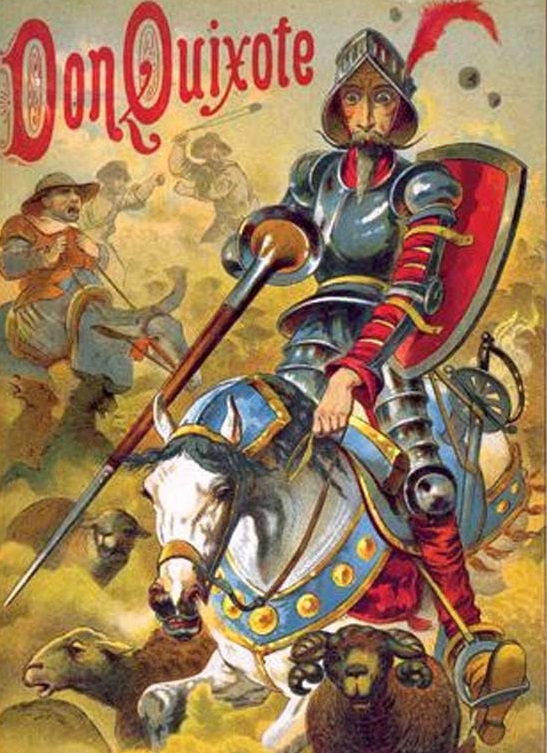
Don Quixote

When beginning a literary classic, I always check the covers and title page for those dreaded words: Abridged Version. If I’m going to read a book, I want to read the whole darn thing. My copy of Don Quixote had no such warning. I only discovered it was an abridged version by comparing it to an online synopsis of the novel.

When I made this discovery, I felt betrayed. Don Quixote is one of the funniest novels I’ve ever read. How dare its editor remove parts of it without warning me!

Don Quixote is a hilarious book. (This surprised me, since most literary classics are either dull or depressing.) The novel’s humor comes from the solemnity with which its author describes the ridiculous misadventures of Don Quixote and Quixote’s even more ridiculous excuses for them. With the seriousness of a historian, the narrator describes absurdity after absurdity.

The novel tells the tragicomic story of a middle-aged Spanish man who, after spending days and nights poring over books of chivalry and adventure, loses his mind and decides to becoming a wandering knight-errant. He chooses the name Don Quixote, puts on some rusty armor and selects a local peasant girl to be the elegant lady in whose name he performs amazing feats. Thus prepared, he sallies forth on his quest for fame and glory. Don Quixote later recruits Sancho Panza, a gullible peasant who often swallows his master’s fantastical explanations for mundane (and often painful) misadventures.

The narrative is episodic. No complicated plots here: just a stupid old man and his stupid companion getting into scrape after scrape. (The most famous of these is Quixote’s famous assault upon unsuspecting windmills, which he insists are giants enchanted by a sorcerer to seem like windmills.) Don Quixote’s misadventures become gradually more complex as the novel progresses, but the story never becomes hard to follow.

As much as I enjoyed Don Quixote’s silly escapades, I found his commentaries upon them funnier still. He never failed to find a fairy-tale explanation for an ordinary event.

Don Quixote is a fascinating meditation on the dichotomy between stories and real life. Stories are often exciting, romantic and neat. By comparison, real life is usually dull, prosaic and messy. Don Quixote is the story of a man who tries to exchange a humdrum existence for a glorious tale of adventure.

In the end, what he gets is a hilarious comedy of mistakes and misadventures, and I think that is the great strength of Don Quixote. Apart from its value as a literary classic, it’s simply a funny book.

The only potential obstacle for readers is the novel’s literary style. It’s an old novel. Centuries old. Some of its language may be hard for modern readers to understand. This difficulty can be solved by finding a translation of the novel in contemporary English. A legendary classic like Don Quixote has almost certainly been adapted for casual readers.

In the meantime, I suppose I will have to find an unabridged version of the novel. I want to find out what I’ve missed!
172. Geeky Wednesdays

Like Pokémon and Darwin’s finches, TMTF has evolved over time. It began as merely a blog about stuff. It has become… well, it’s still a blog about stuff, but I’m better at writing it.

Socrates! I choose you!

Typewriter monkey! I choose you!

Besides its regular posts, TMTF has featured quite a number of extras: a fantasy novella, a series of reflections on Christian living and some creative writing. Even ordinary posts have featured artwork, comics or poetry instead of my usual ramblings about faith, writing, video games, literature, life the universe and everything.

I like things that are different, and I’m thinking of adding something different to this blog.

Posts are published on TMTF every Monday and Friday. What about that midweek gap? Why are there no posts on Wednesdays? Fear not! My typewriter monkeys and I are considering a new feature on this blog we’ve decided to call Geeky Wednesdays.

You see, I’m sort of a geek. (You may have noticed.) I play video games, read biographies of J.R.R. Tolkien and sing songs about psychopathic, science-obsessed computers when I wash the dishes.

Geeky Wednesday posts would consist of something that amuses or interests me (a picture, literary excerpt, Bible verse or YouTube video, for example) and my brief commentary thereupon—anything from a single sentence to several paragraphs.

These Geeky Wednesday commentaries would be shorter and less formal than TMTF’s numbered posts. My observations would range from silly to serious to scholarly. One week I might reflect upon a verse from the Book of Job; the next I might decide which video game character has the best mustache.

At least one previous attempt to add extra features to this blog ended in failure because I was simply too busy. Upon giving the matter some thought, I’ve concluded I can probably handle Geeky Wednesdays without much difficulty. Brief commentaries on geeky things would be much quicker and easier to write than ordinary posts.

What are your thoughts? Would you enjoy impromptu ramblings about geeky things, or should TMTF remain uncluttered by extras?

One more quick question: Is anyone annoyed by links to previous posts? I’ve noticed how often I link to older posts, and I can’t help but wonder how many readers I’m irritating.

Too many Links?

Too many Links?

Should Geeky Wednesdays become a new feature on this blog? Would you prefer fewer links? We need to know! Let us know in the comments!

Help, I’m a Christian! – Faith and Works

Long ago, a clever fellow named Martin Luther changed the way a lot of people look at Christianity.

In his day, you see, the Church was a political organization that gave religious traditions almost as much importance as God’s commands. Luther protested against the Church, claiming Christianity was less complicated.

Luther’s beliefs were based on a few simple doctrines. Two of the most important were sola fides and sola gratiafaith alone and grace alone. His idea was that people didn’t have to do stuff to be saved. All they needed was to have faith in God, and God’s grace would save them.

Luther was bothered by the book of James in the Bible, which emphasizes the importance of good works. It seemed to contradict the rest of the New Testament, which claimed salvation comes through grace.

So which is it, faith or good works?

In the end, Luther’s followers came to this conclusion: “We are saved by faith alone, but if faith is alone it is not faith.” In other words, faith without good works is empty—as James put it, “faith without deeds is dead” (2:26).

I’ve spent a lot of my Christian life swinging like a pendulum from one extreme to the other. I tried living only by faith, and I became complacent. I tried living only by good works, and I became legalistic. Both extremes brought disillusionment and anxiety.

At last it occurred to me that it’s possible to live by faith and good works: to do my best to live for God, and to trust that his grace is sufficient for me when my best isn’t good enough.

C.S. Lewis put it really well: “Christians have often disputed as to whether what leads the Christian home is good actions, or Faith in Christ. I have no right really to speak on such a difficult question, but it does seem to me like asking which blade in a pair of scissors is more necessary.”

Both scissor blades are necessary, of course. In the same way, both faith and good works are necessary. Each is inadequate and incomplete without the other.

It’s a simple lesson, but an important one.

The Apostle Paul wrote:

“For it is by grace you have been saved, through faith—and this is not from yourselves, it is the gift of God—not by works, so that no one can boast. For we are God’s workmanship, created in Christ Jesus to do good works, which God prepared in advance for us to do” (Ephesians 2:8-10).

God saves us by grace. We accept that salvation through faith. Once saved, we’re equipped to do good works.

In other words, we do good works not to be saved, but because we are saved.

~

Before I conclude this series, there are two things I’d like to say.

First, I’d like to affirm that the Christian faith is an awesome, joyful, exciting adventure. It can be hard. It’s a relationship with God, and every close relationship—whether a marriage, a friendship or a parent-child relationship—has difficult stretches.

In the end, however, it’s worth it. Heck yeah, it’s worth it.

Nothing in the world—not coffee, not Legend of Zelda games, not my closest friendships—has even begun to come close to being as awesome as God.

Through everything, God has been there. No matter how great my mistakes, he has never let go of me—not once. His faithfulness has been perfect. His kindness has been incredible. His love has endured.

Faith in Christ can be hard. It takes commitment, patience and persistence.

It’s worth it.

The second thing I’d like to say: Thanks for reading!

Help, I’m a Christian! – Obedience and Service

A white-haired, coffee-drinking teacher of mine once pointed out that a three-legged stool can’t stand with only two legs. He was right. Take away even a single leg and the stool comes crashing down.

This teacher told me the Christian life is like a three-legged stool. Take away prayer, the Bible or church, and the whole thing collapses. These things are essential.

Obedience and service are no less important. They’re roughly the same thing, but for this post I’ll use service to mean doing good things and obedience to mean not doing bad things.

Let’s start with obedience. God calls us to be free from sin—not mostly free, but completely free.

When I was younger, I thought sins were like parking tickets: they’re bad, but a few here and there don’t do much harm. I was wrong. Over time I discovered that sins are more like cancer cells: they’re deadly, and they grow.

Sin has a way of taking root like a weed. It hurts our relationships, destroying trust, shattering peace, undermining confidence and generally making a mess of things. Apart from damaging relationships, sin often brings other nasty consequences too.

God calls us to avoid sin completely because we’re truly more useful, more joyful and more content without it. If he tells us not to do something, it’s not because he’s a spoilsport. It’s because he loves us.

God lets us choose either to follow him or to go our own way. If we follow him, he always accepts us. If we go our own way, he lets us. It’s one or the other. Sin is antithetical to God—it’s everything he is not. We can’t have it both ways.

Service, I’m glad to say, is a much more cheerful subject than sin.

Loving God is his greatest commandment. What is his second greatest commandment?

Jesus said, “And the second is like it: ‘Love your neighbor as yourself.’ All the Law and the Prophets hangs on these two commandments” (Matthew 22:39-40).

Jesus also said, “A new command I give you: Love one another. As I have loved you, so  you must love one another. By this all men will know that you are my disciples, I you love one another” (John 13:34-35).

Service is all about loving others: donating money to feed families in Africa, playing Mario Kart with friends, listening when someone needs to talk or helping out around the house. It’s doing everything we can do to serve, encourage, bless, amuse, help and strengthen others.

It’s simple, but it’s not always easy. People can be awful. As Linus from Peanuts declared, “I love mankind—it’s people I can’t stand!”

In the end, though, loving people is an awesome paradox: those who are loved are blessed, and so are those who love. Everybody wins.

Next: Faith and Works

Help, I’m a Christian! – Church

A church is supposed to be a gathering of Christians who meet together to worship God and serve others. Simple, right?

However, some churches have become cluttered, whether with hymnals and wooden pews or electric guitars and cinema-style padded chairs. The Christian faith is sometimes eclipsed by the traditions and cultures of its churches.

Another kind of clutter is the idea that churches are independent. There isn’t often much communication or cooperation between churches, even though they belong to the same God. We think of different churches as separate entities, not as parts of a single entity.

Worst, I think, is that churches are cluttered with prejudices. We Christians have a tendency to make two deadly mistakes: believing our opinions are infallible, and assuming anyone who disagrees must be a misguided sinner. I’m ashamed to say it, but Christians are often rude in God’s name.

There are so many empty traditions, so many dogmatic views, so many petty squabbles—to wit, so many kinds of clutter—filling churches everywhere that we can’t help but ask a question.

Is church worth it?

Yes, yes it is.

We can start by not giving up. I know people who have stopped going to church. They avoid the clutter, true, but they also miss the glorious blessings churches have to offer.

The Christian faith isn’t something we can live out individually. When we call God our Father, we acknowledge being part of a family—and we don’t get to choose our siblings, biological or spiritual.

Right from the beginning, Christians stuck together. Christ himself had disciples. After Christ’s departure from Earth, his disciples became a community.

Church gives us the opportunity to encourage each other, worship God together, serve our communities and learn from other believers.

We can choose not to lose sight of the big picture. In the midst of the details—the youth ministry events, the Wednesday Bible studies, the rehearsals for Sunday morning worship—we can remember why we do these things.

To repeat an invaluable lesson, we must understand the why of Christian living as we live out the how.

It’s important to recognize church as a community—not a social club, but a family. Some of my favorite congregations have met in houses, banquet halls and indoor soccer stadiums. There were no hymnals, no fog machines and hardly any formal programs. Members gathered simply to worship God and to encourage each other. It was awesome.

Being part of a community takes time, effort and patience. Church isn’t always what we want it to be. Sermons can be boringWorship songs can be unbearably silly. Other Christians can be irritating.

However, church is sometimes even better than what we want it to be. Sermons can be useful. Worship songs can be beautiful. Other Christians can be loving, hospitable and kind.

In the end, church is worth it.

Next: Obedience and Service

Help, I’m a Christian! – The Bible

The Bible. The Bible. These two words evoke a book which weighs nearly as much as a small rhinoceros: a book with hundreds and hundreds of pages packed with tiny lettering. The Bible is fraught with dull footnotes. The Bible is full of weird names like HakkatanAbimelech and Mephibosheth.

The Bible is also the most powerful book ever written.

It’s the bestselling book in history. Along with Greco-Roman mythology, it’s one of the foundations of Western literature. It has influenced thinkers, artists, musicians and writers for two thousand years: Michelangelo, Bach, Dante, Da Vinci, Handel, Newton, Chaucer and Pascal, to name but a few. The Bible has shaped societies around the world. Some of the founding principles of the United States of America were taken from Scripture.

The Bible is an important book, and that’s looking at it from a secular perspective!

For Christians, it’s infinitely more important—it’s the Word of God.

I’ll be the first to admit that reading Scripture is hard. I’ll also be the first to affirm that it’s totally worth it.

When I began reading the Bible, I made three great mistakes.

First Mistake: I thought of the Bible as just a religious obligation. I read it simply because that was what Christians did.

Second Mistake: I failed to understand how the story of the Bible fits together. The Bible is one story. Each part connects to every other part. (Except for the book of Job. It sort of comes out of nowhere.) In Sunday School, I learned the famous stories: Noah and the Ark, David and Goliath and the rest. What I didn’t learn is that they’re all part of a much greater story.

Third Mistake: I didn’t recognize the indirect lessons of Scripture. Sure, there are a lot of direct lessons like You shall not kill, but most of the Bible doesn’t consist of straightforward commandments. There are histories and genealogies and poems, not to mention a lot of ancient laws that don’t apply to us anymore. I thought these things were worthless because they didn’t relate directly to my life.

What I didn’t understand was that they related indirectly.

In a reader skips the slow chapters in a novel, he’ll have an inadequate grasp of the story. It’s the same with Scripture. If we skip the boring parts, we’ll end up with an incomplete understanding of who God is, what he has done and what he wants us to do.

Reading Scripture can be hard, and it would take much more than one blog post to address all of the difficulties that can arise. That’s why Study Bibles and other resources are awesome. They fill in the gaps, interpret the difficult verses and generally make reading the Bible easier.

What’s the best way to read the Bible?

It’s a matter of choice. Some people write down their reflections in a journal. Others make notes in their Bibles. Some people read Scripture every day. Others read it several times a week.

For a beginning reader, I recommend finding a good Study Bible and starting with the New Testament, then reading the Old Testament, then rereading the New Testament. The New Testament probably has more practical lessons for Christians, but the Old Testament influenced the New Testament so much that it’s important for Christians to be familiar with both.

I humbly offer three pieces of advice to anyone reading the Bible.

First, take it slow and steady. A chapter every day is better than seven chapters once a week. Readers risk burning out if they read too much at one sitting, and it’s easiest to absorb Scripture in small doses. Find a reading plan that works for you.

Second, don’t panic. The Bible can be hard to read, and that’s okay. Just take it a little at a time.

Third, don’t be afraid to engage issues that seem confusing or strange. God loves it when we ask questions, and the Bible is a book that has confused people for millennia. Don’t be concerned if something doesn’t seem to make sense. Pray about it, find a good Bible resource or talk it over with someone.

The Bible is my favorite book. When I began reading it, however, I didn’t like it. Scripture seemed boring and distant.

Then little things began to click: a psalm here, a proverb there; a command from Jesus here, a warning from Paul there. I was sometimes convicted. I was sometimes encouraged. Bit by bit, I learned.

Apart from prayer and the good examples of other people, I don’t think anything has helped me grow so much—as a person, as a writer and as a follower of Christ—as the Bible.

Hard to read? Sometimes. Worth it? Totally.

Next: Church

Help, I’m a Christian! – Prayer

Jesus was once asked by his disciples how they should pray. It was pretty smart of them to ask him, since he’s sort of an expert on the subject.

Here’s what he had to say: “When you pray, say: ‘Father, hallowed be your name, your kingdom come. Give us each day our daily bread. Forgive us our sins, for we also forgive everyone who sins against us. And lead us not into temptation’” (Luke 11:2-4).

For me, the most powerful thing about this prayer is one word. The prayer begins with Father. Jesus calls God his Father, but that’s not surprising. (Jesus is the Son of God, after all.) What’s surprising is that he instructs us to call God our Father!

This brings us to the most significant thing I’ve discovered about prayer: If prayer is part of the Christian faith, and the Christian faith is basically a relationship with God, then prayer is part of a relationship.

This seems pretty obvious, but it took me a long time to understand.

When I was younger, my prayers were recitations. It took me a long time to understand that prayers are supposed to involve not one person, but two people: a speaker and a listener. Prayers are meant to be conversations.

My early prayers were full of phrases that sounded impressive but didn’t mean anything. I prayed vaguely, asking God, “keep your hand on this person, and pour out your grace upon that person.”

I wasn’t really asking God to help anyone. I was just easing my conscience by praying churchy prayers.

When we pray for other people, it should be to help them—not to make ourselves feel better. This often requires us to pray for specific needs. If my friend Socrates is recovering from surgery or going through depression, I should pray specifically for his healing or comfort—not petition God to do something unspecified like “showering Socrates with abundant blessings.”

Sometimes we don’t know what other people need. Sometimes we don’t even know what we need. That’s okay. We can still pray, “Father, you know this person’s needs. Please meet those needs, whatever they may be.”

A final lesson I’ve learned about prayer: Every word counts! The Bible warns against praying long, rambling prayers: “God is in heaven and you are on earth, so let your words be few” (Ecclesiastes 5:2).

The Lord Jesus himself said, “And when you pray, do not keep on babbling like pagans, for they think they will be heard because of their many words. Do not be like them, for your Father knows what you need before you ask him” (Matthew 6:7-8).

It’s easy to pray without thinking. When we pray, we must stay focused and say only what we really mean. As Jesus said, “Love the Lord your God with all your heart and with all your soul and with all your mind and with all your strength” (Mark 12:30). We should pray with all our mind, not just part of it.

To sum up, here are the three most important things I’ve learned about prayer:

Prayer should be a conversation, not a recitation.

Prayer should be sincere and meaningful, not empty and meaningless.

Prayer should be focused, not vague.

Next: The Bible

Help, I’m a Christian! – Relationship

Perhaps the most important lesson I ever learned is that the Christian faith is a relationship, not a system.

When I was younger, I was convinced faith was a system made up of logical rules. I thought all I needed to be a good Christian was to spend x number of minutes praying and read y number of chapters in the Bible and do z number of good deeds every day. Being a follower of Christ, I believed, was sort of like being a member of a club. All that was needed was to meet the minimum requirements.

To put it simply, I believed Christian living was just about doing stuff.

I was wrong.

For years I felt vaguely anxious, guilty and perplexed. Praying was awkward. Reading the Bible was tedious. Doing good things, and not doing bad things, seemed pointless.

I prayed, but not to know God or to help anyone. I read the Bible, but not to learn. I did good deeds, but not to be honor God or to serve others. I went to church, but not to strengthen my faith. I did these things simply because they were what Christians did.

I’d gotten the how right, but I’d totally missed the why.

Faith isn’t a system. Treating it like one will only lead to confusion, disillusionment and pain.

What, then, is faith?

It’s a relationship!

Granted, it’s more formal than most relationships. A relationship with God is sort of like a parent-child relationship and sort of like marriage.

We’re dependent on God, just as children are dependent on their parents. He provides for us, protects us and sometimes disciplines us, just as parents do for their children.

As for the marriage example: there are rules that guide our relationship with God, just as there are rules that guide the relationship between husband and wife.

It’s not enough just to “pray the prayer” to become a Christian. That’s the first step. A marriage relationship is more than just a wedding! The wedding is only the first of many, many steps.

In our relationship with God, do we make mistakes?

Absolutely.

That’s when we realize why a relationship is a thousand times better than a system. In a system, mistakes demand remuneration, atonement, compensation. In a relationship, one person simply forgives the other.

However—as in all other relationships—the whole thing falls apart if one person tries to take advantage of the other.

In a marriage, the wife can be the kindest, sweetest woman ever, but the relationship won’t last if the husband is selfish or unfaithful. A father can be the most patient, loving man in the world, but he can’t care for his children if they insist on running away from home.

God forgives us when we make mistakes. However, if we insist on disobeying him, he eventually lets us go our own way. To quote C.S. Lewis, “There are two kinds of people: those who say to God, ‘Thy will be done,’ and those to whom God says, ‘All right, then, have it your way.'” God doesn’t force us to obey him. He gives us the freedom to choose, even if our choice is to turn away from him.

If we turn back to God, he will always accept us. Just look at the story of the Prodigal Son!

If we want to accept God, however, we must accept him on his terms.

One those terms is that God speaks to us indirectly. As nice as it would be to chat with him face to face over coffee every morning, he chooses less direct methods to communicate: the Bible, literature, nature and people, to name a few.

This is admittedly frustrating. I’m not sure why God isn’t more direct, but there is one thing of which I’m sure: this indirectness is temporary. Quoth the Apostle Paul, “Now we see but a poor reflection as in a mirror; then we shall see face to face. Now I know in part; then I shall know fully, even as I am fully known” (1 Corinthians 13:12).

All this is fine theoretical stuff, but what does it mean in practical terms? How does it affect how we live?

It means we must understand the why of Christian living as we live out the how.

We should pray in order to help others and build up our relationship with God. We should read the Bible in order to learn. We should obey and serve in order to be useful. We should attend church in order to grow closer to each other and to God.

Faith isn’t a system, and God doesn’t ask us to do things for no reason. Understanding that faith is a relationship, and Christian living is part of that relationship, is probably the most important lesson I’ve ever learned.

Next: Prayer

Help, I’m a Christian! – Introduction

Becoming a follower of Jesus Christ was absolutely the best decision I ever made, but there was a problem.

I had no idea what I was doing.

Prayer was necessary, I knew, and church was important, and the Bible came into it somehow. I had heard all the Sunday School stories and could sing all the worship songs. However, when it came to the practical day-to-day essentials of Christian living, I had only a vague idea that I should try to “be good.”

I’ve learned a lot since then. It took lots of mistakes, some of them very painful. Much of what I know about Christian living I learned the hard way.

This Holy Week, I’d like to share some of what I’ve learned.

At the heart of Christianity lies a relationship with Christ. Since relationships are unique, nobody can give perfect, specific, infallible instructions about this particular relationship—or any relationship, for that matter.

In the end, all anyone can do is share what they’ve learned from their own experiences. That’s what I’ll do this week.

You may not be a Christian. That’s okay. You’re welcome to read this week’s posts anyway. They might give you a clearer idea of what Christianity is all about.

You may be a much better Christian than I am. That’s awesome! You’re welcome to read this week’s posts anyway. Feel free to share your thoughts (and correct my mistakes) by leaving comments.

Here’s the plan for this week:

Monday: Relationship

Tuesday: Prayer

Wednesday: The Bible

Thursday: Church

Friday: Obedience and Service

Saturday: Faith and Works

Onward!

171. Quirky Bible Translations

During Holy Week, TMTF will feature the Help, I’m a Christian! series, beginning on Palm Sunday, March 24, and concluding on Holy Saturday, March 30. Regular posts will resume on Monday, April 1.

There are many English translations of God’s Word. How many? I’m not sure, but I prefer not to spend years of my life counting.

I often read the Bible, and when I do, I prefer the 1984 New International Version.

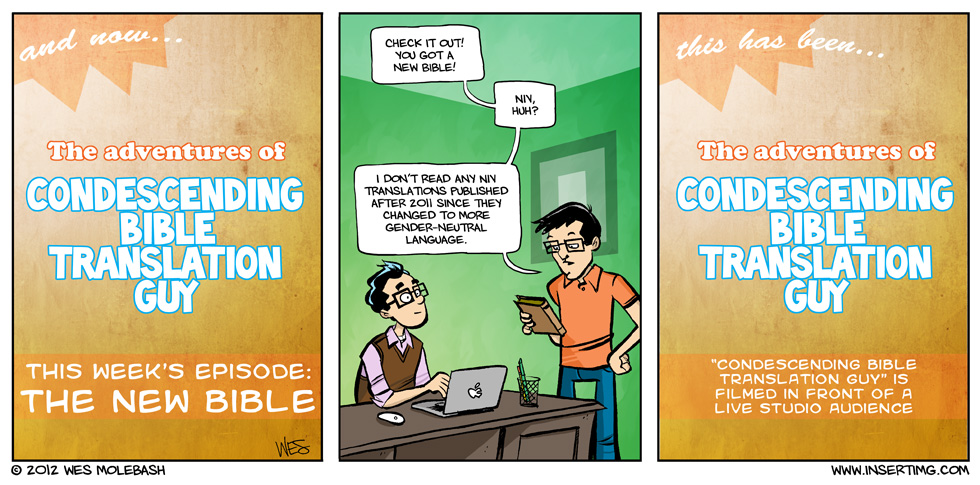
Yes, I'm this guy.

Confession: I am a Condescending Bible Translation Guy.

In my twenty-two years, I’ve stumbled upon some Bible translations that are best described as… quirky.

Here’s part of 1 Corinthians 13 in the plain English of the New International Version.

Love never fails. But where there are prophecies, they will cease; where there are tongues, they will be stilled; where there is knowledge, it will pass away.  For we know in part and we prophesy in part, but when completeness comes, what is in part disappears. When I was a child, I talked like a child, I thought like a child, I reasoned like a child. When I became a man, I put the ways of childhood behind me. For now we see only a reflection as in a mirror; then we shall see face to face. Now I know in part; then I shall know fully, even as I am fully known.

And now these three remain: faith, hope and love. But the greatest of these is love.

Here’s the same passage in the HWP Bible. That’s the Hawaiian Pidgin Bible, in case you were wondering. Read this excerpt aloud. Read slowly. Savor it.

Wen you get love an aloha, dat no goin pau eva. Da guys dat talk fo God, bumbye no need fo da tings dey say. Wen peopo talk diffren kine, bumbye nobody goin talk lidat. Da stuff da smart guys know, no matta, bumbye no need. You know, we ony know litto bit. Wen we talk fo God, we get ony litto bit fo tell. Bumbye, goin come da time wen everyting stay perfeck. Dat time, no need fo da litto bit kine stuff no moa. Small kid time, I wen talk jalike one small kid. I wen tink jalike one small kid. I wen figga everyting jalike one small kid. Now, I big, dass why I no do da tings da same way da small kids do um.

Right now, us guys can see stuff, but ony jalike wit one junk mirror. Hard fo figga wat we see dea. But bumbye, goin be clear. Us guys goin see everyting jalike was right dea in front our face. Right now, I ony know litto bit. But bumbye, I goin undastan everyting, jalike God undastan everyting bout me.

So now, get three tings dat stay: we can trus God, an we can know everyting goin come out okay bumbye, an we get love an aloha. From da three tings, da love an aloha kine, dass da main ting, an da bestes way.

Then there’s my favorite offbeat translation of Scripture… the lolcat version.

Luv no haz endingz. Tellin the futurez, tungz, an alla stuffz u know wil die. We haz knowingz a bit, an we haz profacy a bit. We no haz two much tho. O, wait. Win teh perfict coemz, teh not perfict will dyez, lolol. Wen i wuz a kitten, i meweded leik a kitten, thinkded liek a kittenz, an I chazed strings liek a kittenz. Wen i wuz becomez a cat, i NO WANT kitten waiz ne moar. For nao we see in teh foggy mirorr like when teh human gets out of teh shower, but tehn we see faec tow faec. Nao i haz knowingz just a bit, tehn i will haz all teh knowingz, as i haz been knownz.

Nao faithz an hoepz an luvz r hear, theses threes, but teh bestest iz teh luv. srsly.

Yes, this is a real translation. The entire Bible has been translated into lolspeak, the Internet language of funny cat picture captions. After all, the Apostle Paul did write about becoming “all things to all people.”

 What’s your preferred version of the Bible? Are you a Condescending Bible Translation Person or do you prefer idiomatic versions like The Message? Let us know in the comments!