214. Green Pastures, Quiet Waters and Hot Coffee

About a week ago, I read Psalm 23 in my reluctant journey through the Psalms. (I don’t care much for the emotional poetry of the Psalms; I prefer the dry wit of Proverbs and philosophy of Ecclesiastes.) You’ve probably heard the twenty-third psalm, the famous Shepherd Psalm, at some point: “The Lord is my shepherd, I shall not be in want.”

The past few weeks had been challenging. Work had worn me out. My car had issues. I suffered from depression and couldn’t get enough sleep. Life was busy, stressful and complicated. For weeks, I struggled to keep it together.

On that peaceful Sunday morning a week ago, I found Psalm 23 encouraging… in a mild, abstract sort of way. “He makes me lie down in green pastures, he leads me beside quiet waters, he restores my soul.” It sounded pretty, sure, but it seemed too vague and poetic to be really comforting.

A few hours later, I found myself here:

IMG_1496

Green pastures beside quiet waters, and also hot coffee. I didn’t expect that.

A kindly gentleman from my older brother’s church rented a cabin by a lake for me and my family. We spent an entire week boating, swimming, kayaking, stargazing, watching movies, playing video games, going for walks, drinking coffee, devouring roasted marshmallows and simply hanging out.

My parents live in Uruguay, so we hardly ever have the entire family in one place at the same time. To have my family together for an entire week was awesome, and our cabin by the lake was so darn nice. I felt like a very rich person… and a very blessed one.

Well, I’m back. My vacation is done. I’ve returned to my apartment, my job, my faulty car and all the challenges, trials and responsibilities of my life.

You know what? I’m okay with that.

The Lord is my shepherd, and I shall not be in want.

213. TMTF’s Top Ten Life Lessons in Video Games

Wisdom can be found in unexpected places.

As we search for truth in literature, faith, philosophy and the lives of great people, we mustn’t overlook the lessons to be learned from BatmanDoctor Who, cartoon ponies and webcomics about video games. Speaking of which, video games have invaluable lessons to impart: useful principles that can be applied for success in real life.

What? You don’t believe me?

All right, then! Ladies and gentlemen, consider these practical principles as TMTF presents…

The TMTF List of Top Ten Life Lessons in Video Games!

10. Be Creative in Solving Problems

As tempting as it can be for gamers to try solving everything with violence, some obstacles can’t be shot, hacked or blown away. Puzzles require critical thinking. Some enemies require timing and strategy, not brute force, to conquer. Players have to be creative in solving problems, and creativity is an invaluable gift.

9. Observation Is Important

Anyone who plays a Legend of Zelda game quickly learns to keep his eyes open for cracked walls. Apply explosives to a damaged wall and—boom!—a way is opened. In video games, good things come to those who notice stuff. Video games teach players not merely to hear and see, but to listen and observe.

8. Appreciate Beauty

I love solving puzzles and defeating enemies as much as the next gamer. All the same, one of my favorite things about video games is how darn pretty they can be. (Yes, video games can be beautiful. Like brushstrokes or pencil shading, pixels can make lovely pictures.) Players are treated to sunrises and forests and ocean views, and appreciating beauty in artificial environments is a step toward appreciating it in natural ones.

7. Plan Ahead

Bad things happen to those who are unprepared. The person playing a Final Fantasy game will be annihilated by a tough boss if she hasn’t leveled up her characters or stocked up on healing potions. The person playing a Mario Kart game will lose if he hasn’t bothered figuring out the controls. This brings us to the real world, where the person taking a test or applying for a job will fail if she hasn’t planned ahead and made necessary preparations. Once again, video games reflect how things work in real life.

6. Stay Calm

The player who panics and starts mashing buttons will most often lose, and gamers get plenty of opportunities to panic. It can be hard to stay calm when facing that tricky jump or twisty racetrack or nigh-invincible boss, but rational decision-making is more likely to lead to success than wild overreaction. People who learn to keep cool under pressure while playing video games are better equipped to keep cool under pressure while doing everything else.

5. Practice Makes Perfect

I stink at fighting games: kicks and combos and Hadoukens baffle me. There is, however, one kind of fighting game in which I will destroy you: a Super Smash Bros. game. (My younger brother is a rare exception to this rule; he defeats me effortlessly.) As a kid, I resolved to learn to play Super Smash Bros. to enjoy the game with friends. Mastering the game took time and effort and many failures… and it was totally worth it. Practice makes perfect. At the very least, practice makes better. Video games remind us of the fact.

4. It’s Dangerous to Go Alone

With these cautionary words, the first Legend of Zelda game echoes something in another famous work: a book called the Bible. Quoth the Teacher in Ecclesiastes, “Two are better than one, because they have a good return for their labor: If either of them falls down, one can help the other up. But pity anyone who falls and has no one to help them up.” In other words, It’s dangerous to go alone.

3. You Reap What You Sow

So you’re playing a Final Fantasy game, slaying monsters, saving the world, when your quest is interrupted by some woman who wants you to gather medicines to heal a wounded traveler. A nuisance? Yes. You gather the medicines, the traveler recovers—and your kindness is rewarded. Another example: You take a break from your adventure in a Legend of Zelda game to attack a chicken. You’re enjoying yourself—after all, hacking away at defenseless fowl is fun—until the chicken decides to fight back, and your cruelty is punished with death. Seriously. For better or for worse, we reap what we sow. This biblical principle is common in video games.

2. Success Is an Investment

You can’t traverse that treacherous pitfall in a Mario game? Keep trying. You can’t conquer that unbeatable boss in a Kingdom Hearts game? Keep fighting. You can’t get your client acquitted in an Ace Attorney game? Keep gathering evidence. Sooner or later, you’ll pass that pitfall or flatten that boss or prove your client’s innocence. Now consider the real world. You can’t pass a class? Keep studying. You can’t afford something? Keep saving. You can’t achieve a goal? Keep working at it. No matter where you turn, success is an investment.

1. Good Guys Win

The world is full of terrible, selfish people who seem to succeed. Video games are no different. There are monsters, jerks and villains who triumph by lying, cheating and backstabbing. In the end, an overwhelming majority of those bad guys are brought to justice. The good guys—the guys who strive and fight and sacrifice to help others—win. You know what? In our world, the same thing happens. We need to be reminded that good guys sometimes win.

O people of the Internet, what useful lessons have you learned from video games? Let us know in the comments!

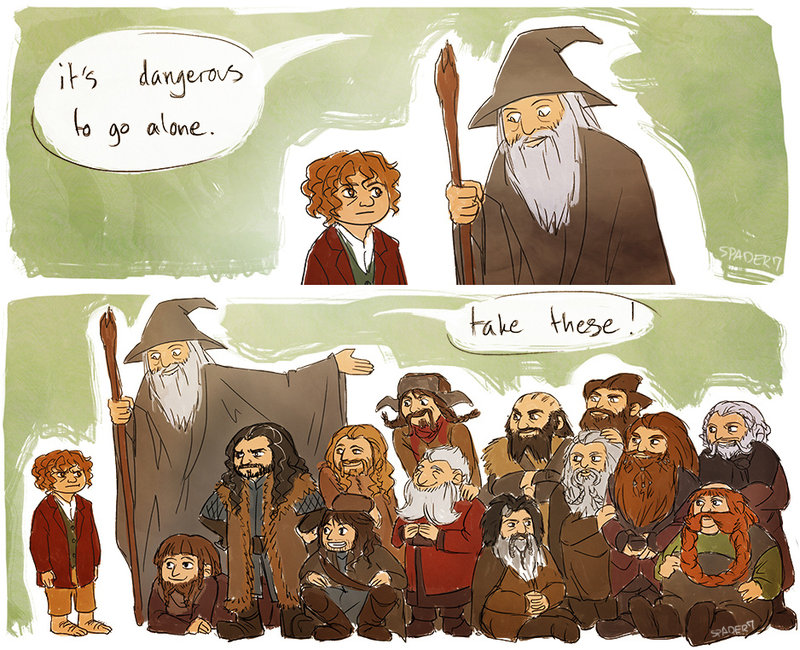
Adventure? Take This with You!

Dangerous to Go Alone

Picture from Spader7 on deviantART.

“It’s dangerous to go alone. Take this.”

These are the famous opening words of The Legend of Zelda, and an age-old motif in mythology, legend, folklore and fantasy. “Going on an adventure? Here, take _____ with you!”

Luke Skywalker got a lightsaber at the start of his journey. Frodo Baggins received a magic ring. The Pevensies (sans Edmund) accepted useful gifts from Father Christmas, and Captain Jack Sparrow was granted a pistol and one shot. Heck, even Perseus got a bunch of neat stuff for his quest from the gods in the old Greek myths.

The hero often seems to get something—a sword, an amulet, a keepsake—at the start of his or her adventure, and whatever it is always turns out to be really useful. A pointless knick-knack is later revealed to be the all-important Map or Key or Talisman of Plot Advancement.

So take my advice. If someone gives you something at the beginning of an adventure, hold on to the darn thing. You’ll be needing it.

212. TMTF Reviews: Scott Pilgrim

I’m on vacation this week, so my typewriter monkeys are handling all blog updates from September 23 to September 27. Blame them for any mishaps. If I get Internet access at any point this week, I’ll be sure to check in!

Relationships are hard. Growing up is hard. Life is hard.

Just ask Scott Pilgrim. He’s a Canadian slacker, twenty-three years old, “between jobs,” mooching off his roommate, dating a high school student and doing his best to maintain his precious little life.

Then a mysterious girl rollerblades into his dreams, and people start attacking him with swords, and things get complicated.

I’d been meaning to read Scott Pilgrim, a graphic novel series, for some time. My search at the local library yielded all six volumes. Was it worth it?

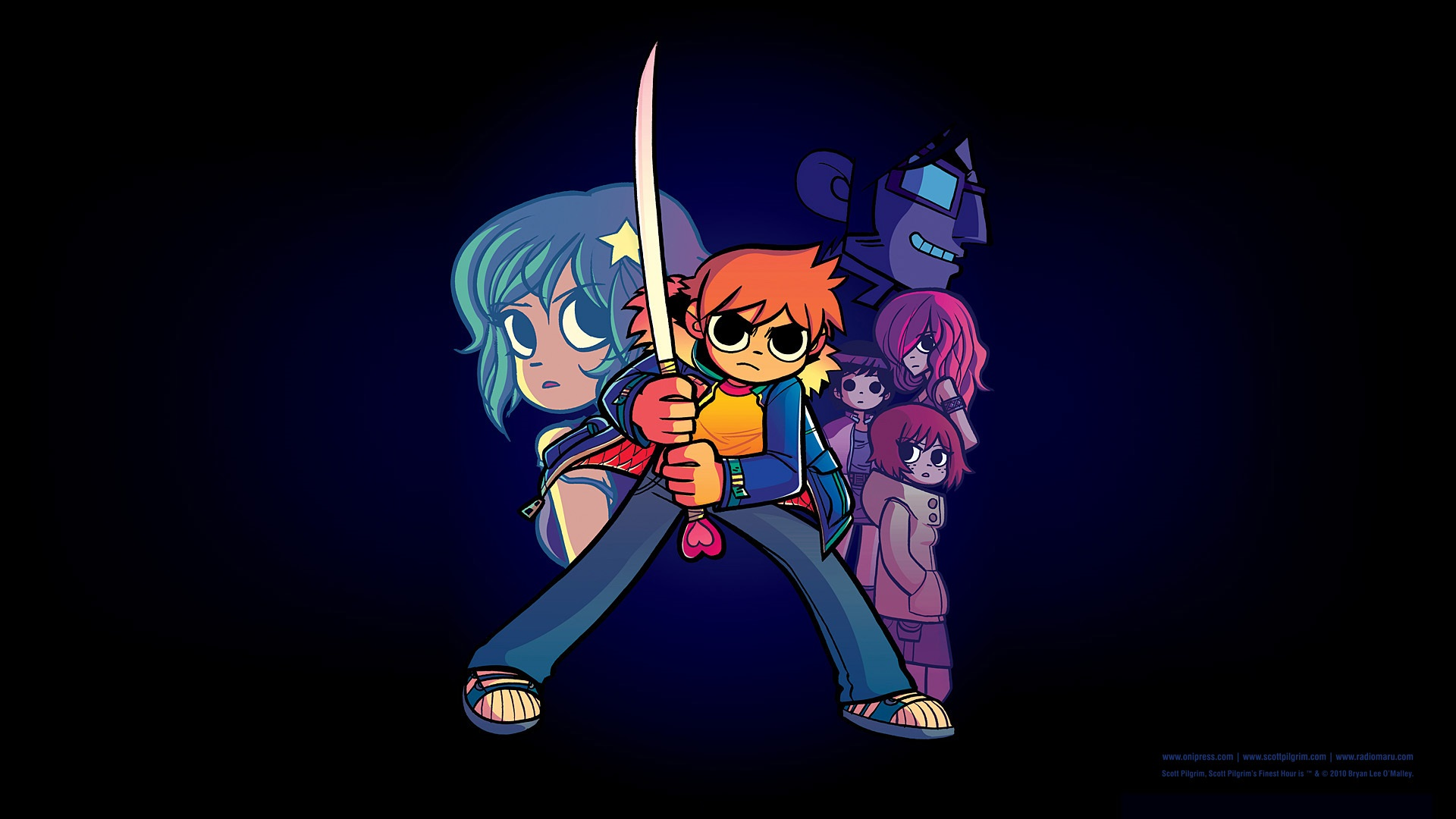
Scott Pilgrim

Heck yeah, it was worth it.

Scott Pilgrim begins in a very ordinary way: Scott lives an average life in an average city with average friends. Then, little by little, almost imperceptibly, things get weird. A girl skates through Scott’s dreams because they’re a handy shortcut on her route delivering packages. A man crashes through the ceiling and challenges him to a duel. Before long, Scott is picking up video game-style extra lives and fighting guys with katanas, all to defeat his new girlfriend’s seven evil exes.

The Scott Pilgrim books are steeped in magic realism, a literary style that combines ordinary stories with surreal details—in this case, video game tropes. Scott and his friends take for granted this bizarre blend of video games and real life. As far as they’re concerned, robots and psychic powers are no more surprising than cars or libraries. This weird, wonderful blend of mundane and fantastic is probably my favorite thing about Scott Pilgrim.

I was also taken aback by how compelling the story turns out to be. The early volumes of Scott Pilgrim aren’t particularly deep, but the last two take a surprisingly compelling turn. The books may not seem serious at first, yet they have meaningful things to say about the importance of growing up and learning to take responsibility. Even some of the story’s most ridiculous elements can be interpreted symbolically… or not, depending on how seriously you choose to view them.

Besides being unexpectedly meaningful, Scott Pilgrim is often hilarious. Characters occasionally allude to previous events in the story by referring to the volume in which they took place. A villain develops psychic powers because of his vegan lifestyle. Scott’s fights are taken for granted by his friends; at one point, they chat calmly about their lives as Scott struggles for his life in the background against a stubborn opponent.

Scott himself, despite being insecure and cowardly, is an inexplicably gifted martial artist. (Someone calls him “the best fighter in the province.”) He’s also a self-centered loser. His faults are played for laughs early on, later becoming a serious part of his character’s development. Scott Pilgrim is, appropriately enough, a pilgrimage: the journey of an irresponsible jerk toward being a decent person.

I should note that Scott Pilgrim has a 13+ rating, the graphic novel equivalent of PG-13, and it earns every bit of it. Characters smoke, drink, curse, treat sexuality with casual abandon and insult each other mercilessly. Hardly anyone—least of all Scott himself—acts respectfully or responsibly. To put it simply, most of the characters in Scott Pilgrim are terrible role models. The books contain no shockingly offensive material, but sensitive readers may want to give them a miss.

In spite of its moral shortcomings, Scott Pilgrim is a marvelously unique, gloriously silly, unexpectedly compelling series. I recommend it.

211. A Witless Witness

Have you seen those Jesus fish decals Christians put on the back bumpers of their cars?

Jesus Fish

My car doesn’t have one. I have no objection to Jesus fishes—in fact, I value the Ichthys symbol as a relic of Christian heritage—but I don’t want people to know my car is driven by a Christian. I’m not ashamed of my faith. No, I’m embarrassed by my lousy driving. Glory to God and all that, but I prefer not to credit him with my mistakes behind the wheel.

My car has no Jesus fish, but I do wear a cross on a chain round my neck. It isn’t an elaborate rosary or a crucifix with a likeness of Christ crucified—just a plain steel cross. It serves as a constant reminder of my commitment to Christ, and it’s a nonthreatening way to express my faith.

I’m not perfect. I’m most certainly not perfect. All the same, I try to live a godly life. My hope is that people will see the cross, notice my lifestyle and put two and two together. Then, perhaps, conversations can happen about Jesus and grace and faith.

My efforts to witness are rather timid, but they were once quite bold. I would go so far as to call them completely obnoxious. There were several weeks during which I handed out tracts and collared random strangers on the street to share the Gospel of Jesus.

Few thing I have ever done felt so wrong.

Shoving the Gospel down the throats of passersby seemed cheap and shallow—and it was. I wanted to share. They did not want to listen. The best solution was not to share anyway, which was what I did, but to find people who wanted to listen.

There are places where random strangers will listen to the Gospel. America is hardly one of them. In America, where people know just enough about Christianity to be inoculated against it, where Christians have a (tragically well-deserved) reputation for being shallow and judgmental, where faith is a cultural curiosity, the Gospel must usually be shared in actions before people will listen to it in words.

Evangelism isn’t quick and easy. It’s a long-term investment. Evangelism isn’t about statistics and numbers. It’s about people. Evangelism doesn’t consist of cheap tracts and three-step plans. It consists of relationships.

As usual, the Apostle Paul put it well. “Because we loved you so much,” he wrote, “we were delighted to share with you not only the gospel of God but our lives as well.”

The Best History Lesson in the History of History

Never before has video game history been so awesome… or so darn catchy.

Fun Fact: Nintendo existed for nearly a century before it began producing video games. It dabbled in everything from card games to cab services before striking gold with franchises like Donkey Kong, Super Mario Bros. and Legend of Zelda in the eighties.

210. TMTF Gets It Together

Confession: For the past two weeks, I’ve been struggling to keep it together.

(Can I confess stuff on my blog? Are bloggers allowed to do that?)

Work has been oddly exhausting. My younger brother recently moved in with me, which has been awesome… and a bit stressful for both of us. My car, Tribulation, lived up to its name and stopped working properly. (Well, Trib never quite worked properly, but it generally came close enough.) I will probably have to pay for expensive repairs or else buy a new car.

Even my typewriter monkeys are still on strike. (I’m typing out this post myself: grueling hard work.) My monkeys keep waving signs at me and threatening to break my coffeepot if I don’t meet their demands, which mostly involve bananas and health insurance.

For two weeks, I’ve felt overwhelmed by changes and difficulties and responsibilities. Mild anxiety has repeatedly given way to discouragement or quiet panic.

Times like these never last, thank God. I’m finally getting it together. As usual, there was no magical moment, abrupt epiphany or blinding revelation that fixed everything instantly. Getting it together has taken work, prayer, sleep, coffee and this post from Amy Green, whose blog is way better than mine.

I was planning to discuss Christian evangelism or Scott Pilgrim today, but those posts can wait. Today is a good day to talk about what’s going on in our lives.

So what’s going on in your life? Let us know in the comments!

209. Super Stück Bros.

My younger bro, who arrived in the US a couple of weeks ago from Uruguay, is now living with me.

So yeah, that’s awesome.

My younger brother may be taller than I, but I'm STOUTER.

My younger brother may be taller than I, but I’m STOUTER.

My parents will also be staying in the area for a few months. They live in Uruguay, so I haven’t seen them in many, many months. (For my readers unversed in geography: Uruguay is quite a long way from my home in Berne, Indiana.) I’m delighted they’ll be around for a while!

Between work, helping my brother get settled and other commitments, I’m going to be pretty busy next week. I’ve decided to take the week off from my blogs. Fear not, dear reader! Regular updates shall resume on TMTF on Monday, September 16, and on the Solidarity blog on Thursday, September 19.

There’s one more reason for my decision to take a week off from this blog. My typewriter monkeys are striking… again. They’re upset about my brother invading (their word) my apartment. (I concede that Mole End, my apartment, is getting a bit crowded.) It will take at least a week to get my monkeys back to work.

In the meantime, I’ve got things to do and places to be and coffee to drink. Onward!

208. Mangling Spanish: A Beginner’s Guide

One of my new year’s resolutions was to improve my Spanish, and I’ve finally resumed my linguistic studies. How have I chosen to study? In the same way all great scholars do, of course.

I’m watching cartoons.

Specifically, I’m watching the Spanish language dub of Avatar: The Last Airbender, my all-time favorite show. It’s a wonderful way to study. Just hearing spoken Spanish again is working wonders for my vocabulary, grammar and syntax.

My studies have reminded me of the linguistic horror stories (or comedies, depending on your point of view) I’ve heard from acquaintances in my homeland of Ecuador.

For example, there was a gentleman who asked for sopa to wash his hands. He meant soap. He received soup.

There was a lady who tried to explain that she had been embarrassed by a pastor, and used the word embarazada because of its similarity to the English word embarrassed. What she announced by mistake was that the pastor had made her pregnant.

Another lady wanted to ride a horse without a rope attached to its bridle, and asked the owner whether she might have permission to mount his horse without the ropa. This greatly alarmed the owner, since ropa is Spanish for clothes.

My favorite story comes from the husband of one of my middle school teachers. One day a group of Jehovah’s Witnesses came to his door. He informed them in faltering Spanish that he did not care to hear about Jehovah’s Witnesses, and was baffled at how angrily they departed.

Only later did he realize that instead of calling them Testigos de Jehová, Jehovah’s Witnesses, he had mistakenly called them Testículos de Jehová—Jehovah’s Testicles.

Not every story is a painful one. A favorite of mine is that of an interpreter asked to translate the following joke into Spanish for an audience: “What did the ocean say to the beach? Nothing. It just waved.”

This awful joke, a play on words, works only in English.

That brilliant interpreter didn’t let that stop him. Without missing a beat, he translated the question into Spanish and answered it with a new punchline: “Hola!”

This Spanish word for hello sounds exactly like ola, the word for wave. That, dear reader, is pretty dashed clever.

I haven’t made any truly memorable mistakes in Spanish, but that’s all right. I’m already quite good enough at making a fool of myself in English.