271. Baking Bad

Due to a frightening case of culinary arson, TMTF will be taking a two-week break.

My typewriter monkeys decided yesterday to bake muffins. Ignoring my dad’s useful muffin-making tips, they cranked up the oven to its hottest setting, threw in the muffins and forgot about them. My brother and I got home from church to find smoke pouring out of the windows and flames dancing merrily on the roof.

Baking Bad

Where there’s smoke, there’s fire… or muffins, in this case.

My monkeys have been known to play with fire now and then, so this latest incident is no surprise. What has astonished me this time is that my monkeys have fled to Canada, either to evade arrest for arson or else to escape my righteous fury. They sent me an email last night promising to return before the end of the month.

Since I can’t maintain this blog without my typewriter monkeys, I must put it on hold for a couple of weeks. TMTF will be back on May 26. I sure hope my monkeys have returned by then.

In the meantime, I had better start cleaning up my apartment. It’s looking a bit… ashen.

We’ll be back on Monday, May 26. Thanks for reading!

270. That Time I Fathered a Watermelon

High school was a strange chapter of my life. I moved repeatedly, attended schools on separate continents, became a writer, discovered my love of coffee and broke down on the Ecuadorian coast in the rain at night in an area infested with bandits. Good times, good times.

Some of my best high school memories come from the Alliance Academy International in Quito, the capital of Ecuador. The school offered an excellent education, and its faculty consisted largely of lunatics. It was at this school that I became the father of a small, rotund, green-skinned child. His mother and I named him Hakkatan Melchizedek Stück.

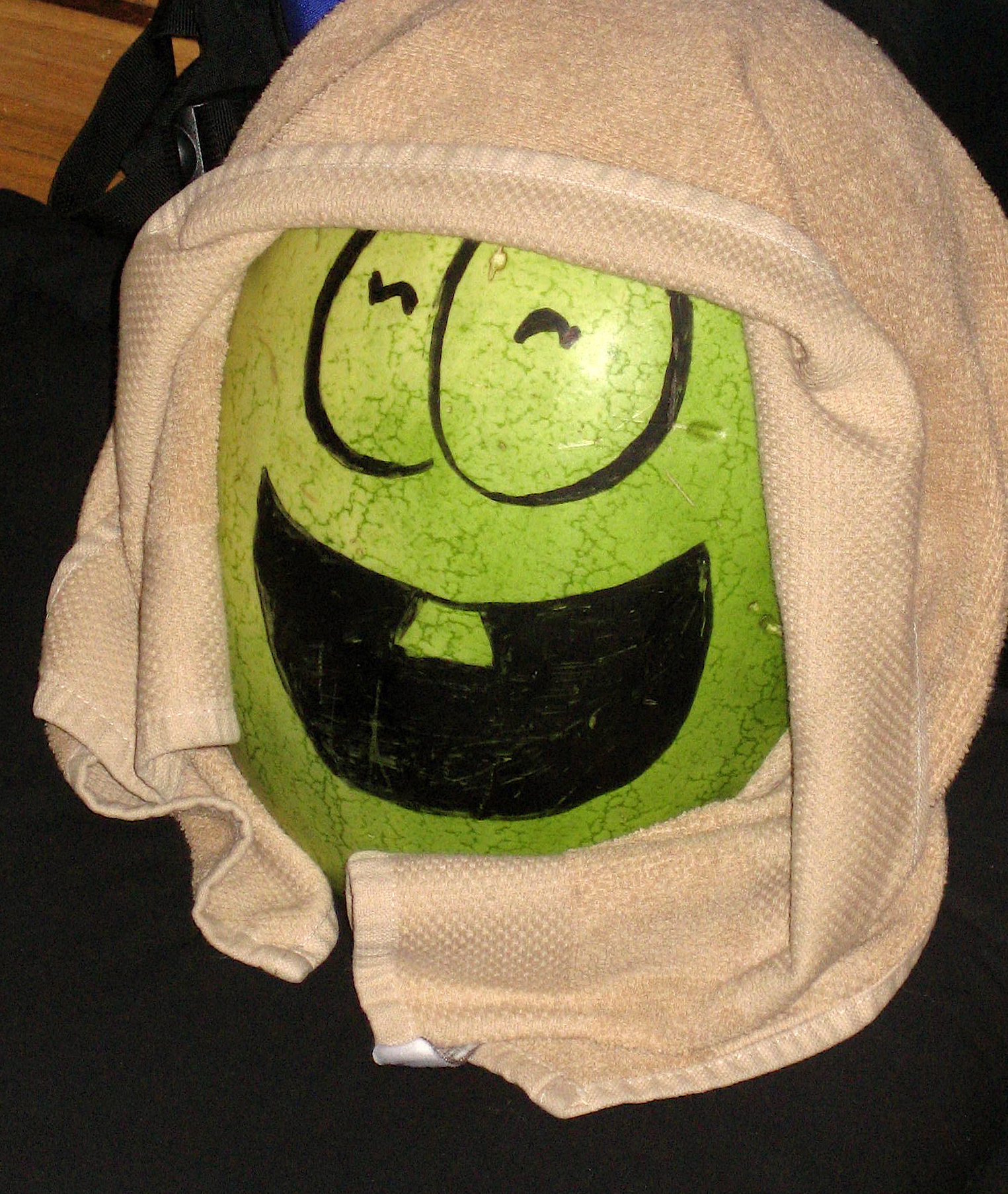
Watermelon Child

He had his father’s, um… dish towel.

My egg-shaped offspring was the result of a project in my senior year in which students were put in pairs, given watermelons and required to spend a week nurturing them as loving parents. This was meant to teach us all about parenting. I’m not sure exactly how that was supposed to work, except that babies and watermelons are both kind of heavy and don’t respond well to being dropped.

My wife for the project, whom I’ll call Socrates, wanted to name our child Hakkatan. I wanted to name him Melchizedek. In the end, in the spirit of matrimonial harmony, we compromised and gave him both names. Our classmates gave their children boring names, except for one young gentleman who called his melon Triton Quincy McFarland.

Hakkatan was a quiet, cheerful child. He never cried, always grinned and gave his parents hardly any trouble.

Of course, the same wasn’t true of all my classmates’ kids. At least one watermelon met a grim end when his parents abandoned him in a dorm room for several hours. According to the story I heard, they returned to find half the melon smashed on the floor, the other half stuck full of knives and a note that read NEVER LEAVE YOUR CHILD ALONE.

Some of my classmates really got into parenting their melons, dressing them up in baby clothes and wheeling them everywhere in strollers. I don’t recall how Socrates and I handled Hakkatan; we may have carried him around in a basket, but I don’t really remember. There is one thing I remember clearly: how Hakkatan met his end.

You see, the parenting project lasted only a week. Hakkatan was my child for seven days. After that, he was merely a watermelon. Some of my classmates celebrated the end of the project by eating their melons. That seemed a bit morbid, so I settled for chopping up Hakkatan with a machete and disposing of his body in a trash bag.

Socrates and I each received a good grade for the project, after which we dissolved our week-long marriage. She and I remained on good terms until our graduation from the Alliance Academy International; I haven’t seen her since. As for Hakkatan, well, his rounded figure and beaming face nearly faded from my memory. It was only as I browsed old photos recently that I stumbled upon the picture above: my child, smiling at me from across the years, neither bitter nor resentful at his violent demise.

Requiescat in pace, my son. Flights of angels sing thee to thy rest!

268. Haircuts Are Evil

Like taxes, haircuts are are a necessary evil.

Every few months, I glance in the mirror and despair, for my hair needs to be cut. It’s pretty easy for me to tell when I should hit the hair salon. When my hair starts to look like Justin Beiber’s iconic (and idiotic) hair helmet, I know it needs to be cut.

I’m sometimes tempted to ignore the Beiber resemblance and let my hair keep growing, but one thought pulls me back to safety from the brink of madness.

I will never, ever have a mullet.

My hair has generally been a mess. Once, in middle school, I tried styling it with gel: a mistake that shattered my fragile self-esteem into tiny, tiny pieces. Since then, I’ve occasionally attacked my hair with a comb and left it at that.

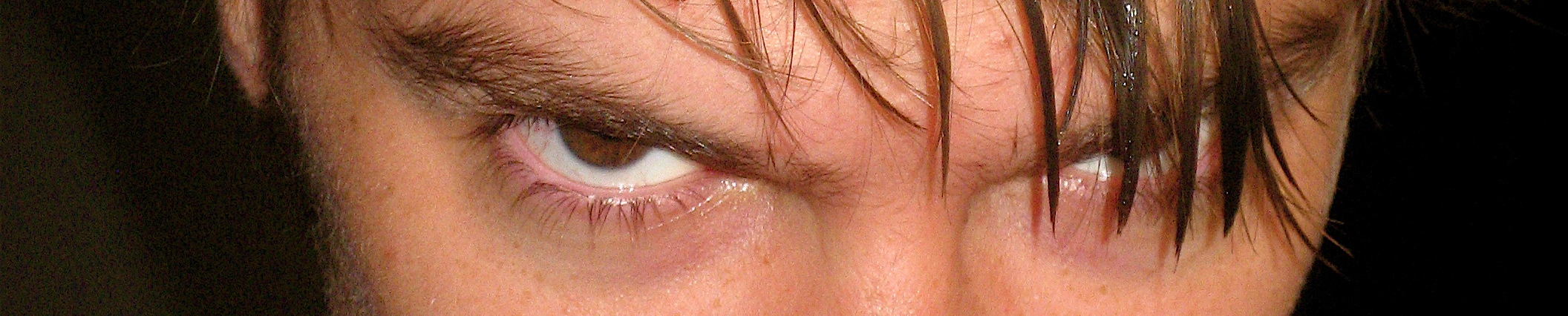
If you tell me I need a haircut, I will glare at you with cold, bitter fury. And then I'll go get a haircut.

If you tell me I need a haircut, I will glare at you with cold, bitter fury. And then I’ll probably go get a haircut.

The problem with haircuts is that they bring scissors, razors and other sharp objects very close to my eyes, ears and other things I’d rather not have cut off or gouged out. My fears are not baseless. At least one hair stylist has drawn blood—repeatedly—giving me good reason to fear anyone who brandishes bladed implements anywhere near my face.

Are haircuts evil? Yes. I will prove it. Let us turn to Scripture, brethren, for our answers.

Most of us know the story of Samson, who let his hair grow as a symbol of devotion to God. When his hair was cut, Samson lost his divinely-given strength. He was surrounded, powerless to resist. His tormentors blinded and enslaved him. In the end, Samson ended his own life. (This is all in Judges 16.) All of this happened because Samson got a haircut. A haircut killed him!

Don’t even get me started on Absalom. He was a really bad dude. He also had his hair cut regularly. An evil man who got haircuts? Coincidence? Coincidence?!

With this vast and comprehensive wealth of Scriptural evidence, I believe I’ve proved that haircuts are evil.

(No, I’m not being serious. Please put down your Bibles and/or heavy stones before someone gets hurt.)

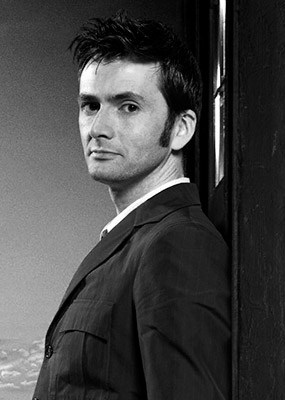
In the past two years, I have found one consolation to make haircuts bearable. The Tenth Doctor from Doctor Who has some sweet, sweet sideburns. Although my paltry sideburns are not worth comparing to the good Doctor’s, they’ve definitely grown on me. (Pun intended. I’m so, so sorry.) Haircuts are awful, yet they keep my sideburns neatly trimmed. Neat sideburns put me ever so slightly closer to achieving the splendor of the Tenth Doctor’s hairstyle.

Saving the universe? Bah! A negligible accomplishment compared to having such awesome hair.

THOSE SIDEBURNS.

Maybe haircuts are worth it after all.

Then again… maybe they’re not.

267. I’m Giving Up

The ironic thing about some of the lessons I’ve learned is that I haven’t really learned them.

Sometimes, I know things without understanding them. I accept a lesson and then forget it. When I’m reminded of some lessons, I understand them a little more fully. Learning becomes an incremental process.

Thus I’m going to quote myself quoting C.S. Lewis and say,

Thus, in one sense, the road back to God is a road of moral effort, of trying harder and harder. But in another sense it is not trying that is ever going to bring us home. All this trying leads up to the vital moment at which you turn to God and say, “You must do this. I can’t.”

Living by grace doesn’t mean merely trying to do good things, says dear old Lewis,

But trying in a new way, a less worried way. Not doing these things in order to be saved, but because He has begun to save you already. Not hoping to get to Heaven as a reward for your actions, but inevitably wanting to act in a certain way because a first faint gleam of Heaven is already inside you.

In other words: Stop trying to be good enough and depend on God’s grace.

My problem is a paradox. I have made depending on God’s grace just another facet of trying to be good enough. As I said last time, I wanted to be consistent. I wanted to depend on God’s grace consistently. Grace became another weapon in my battle to get it right.

Maybe grace is simply permission to stop fighting.

I’m giving up. My dreams of reaching a nice, level plateau of angelic goodness and contentment are gone. My life will be disordered, flawed and messy. I shall sin and struggle and make mistakes. (Please note these are a statements of fact, not of intention.) There will be days of depression and grief and anxiety, and nothing I can do to prevent them.

What does this mean for my day-to-day life? Honestly… not much. I’ll keep living, working, praying, reading, writing, playing video games, drinking too much coffee and failing to act like a solemn, serious adult.

As I do these things, I’ll try not to hold myself to the self-imposed standards of years past. I won’t replay and review things constantly in my mind, and I certainly won’t agonize over mistakes. By accepting I shan’t be perfect, I can stop trying—better yet, I can try in that new, less worried way.

I’m giving up.

266. Crying Out for Consistency

And today I will trust you with the confidence of a man who’s never known defeat, but tomorrow upon hearing what I did, I will stare at you in disbelief. Oh, inconsistent me, crying out for consistency.

~ Relient K

I had a birthday not long ago. On that bright, chilly spring day, I reached the ripe old age of twenty-four and resigned myself to the gloomy of business of being an adult. As I reflected upon my future, I chose a keyword for my twenty-fifth year—a one-word resolution to guide my actions, attitudes, words and thoughts for the next twelve months.

Consistency.

Within one day, I had deceived myself into doing things I should not have done—sinful things. My fine resolutions were effortlessly flattened by familiar temptations. So much for consistency.

Just one day after that, a bleak depression settled upon me. It lasted for days. While I was depressed, I could only scowl at my hopeful new keyword. Consistency? What an idea. In the paralyzing grip of depression, it was all I could do to function. I dragged myself along, hour by hour, grimly surprised every night that I had survived another day. I couldn’t be consistent. I could barely keep going.

Once again, consistency was an empty hope.

For years and years, my life has been largely driven by one all-important conviction. I could express it in a number of ways, but the simplest is this: I needed to get it right. No matter the circumstances, no matter my feelings, no matter what trials and challenges assailed me, I needed to get it right—to love God and to love others and to have faith and to be awesome. God’s grace had redeemed my life, sure, but it was up to me to live.

I wanted for years to reach a plateau or level of goodness and faith. It seemed logical that I would eventually learn every lesson, overcome every temptation, cast off every burden and consistently live a good, contented life. There had to be some secret, some attitude, some perspective or paradigm to make everything click and all the pieces fall into place.

Thus I tried out a long series of resolutions, attitudes, philosophies and personas in my quest to be consistent. I’ve always known I can’t be perfect, but consistency seemed like a reasonable goal.

Now I’m not so sure.

I’ve written many times about my near-obsessive desire to be “good enough,” whatever the heck that means. God’s grace is another subject I’ve discussed repeatedly. My conclusion is always the same. God declares, “My grace is sufficient for you, for my power is made perfect in weakness.”

More clearly than more than ever before, I understand that weakness isn’t merely a sinful nature. It’s helplessness. Weakness is waking up on some days hardly able to stand, let alone work or write or pray. Weakness is never, ever reaching my long-sought plateau of consistency. Weakness is struggling and making mistakes and never quite getting it right.

Weakness is space for God to work.

What next? Well, another blog post, I guess. Check back next time for the conclusion to my thoughts on weakness, grace and where in blazes I should go from here.

265. TMTF’s Top Ten Tips for Fighting Depression

I’ve been reading a book about depression. See, depression is a part of my life. It has been an irregular yet consistent struggle for many years. The book set me thinking me of all the ways I’ve learned to cope with my gloomy condition, and also reminded me that TMTF hasn’t featured a top ten list in ages.

If you suffer from depression… I’m sorry. I’m so, so sorry. This much-more-serious-than-usual list is for you.

Before I begin, there’s one thing I should make clear. This is a list of practical tips for coping with depression when you are already depressed. This is short-term advice. This is not a list of long-term lifestyle changes for treating or preventing depression. That’s another subject for another time.

Take heart, ladies and gentlemen, as TMTF presents…

The TMTF List of Top Ten Tips for Fighting Depression!

10. Drink some tea

I may be the only person in the world for whom tea is a coping strategy, which is why I’ve put it so low on the list, yet I find the process of brewing tea calming and reassuring. Besides, the warm strength of tea never fails to make me feel a tiny bit better.

9. Take a nap

Naps aren’t usually my thing, but it can be a blessed relief to disappear for a half an hour into the cozy darkness of my sleeping bag. For someone suffering from severe depression, a nap is a break from the agony of wakefulness.

8. Listen to good music

Since you probably can’t focus on anything else when you’re depressed, you may as well spend a few minutes sitting in a comfy chair listening to music with headphones. Angry or melancholy music is a great way to vent negative emotions, and cheerful music can be a warm balm to a troubled soul.

Depression Tip #75 - Depression can't withstand the groovy power of dance.

Silly Depression Tip #75 – Play seventies music and dance. No depression, however severe, can withstand the groovy power of disco. If you have them, wear bell-bottoms.

7. Take a hot shower

Hot water is a gift of God. It loosens tense muscles, eases aches and washes away the grit and grime of life. A good shower is refreshing and relaxing. Even when I’m severely depressed, I feel a little better for being warm and clean.

6. Go for a walk

Depression thrives on bleak inactivity. It can be hardso freaking hard—to leave behind the security of your home and step outside when you’re depressed, but a good walk can work wonders. It’s good to have fresh air and sunlight, or at least a change of scenery.

Depression Tip #142 - Look at pictures of funny animals, such as platypuses or blue-footed boobies.

Silly Depression Tip #142 – Look at pictures of funny animals, such as platypuses or blue-footed boobies. If that doesn’t work, remind yourself that birds called boobies are actually things that exist.

5. Look at photos from good experiences

I’m thankful my old man is a photographer. His photos of my beloved family, our vacations together and my dear homeland of Ecuador never fail to encourage me. Depression makes the world seem dark. Photos of pleasant places and faces are undeniable reminders that it isn’t.

4. Get some exercise

I can hardly believe I’m saying this. For all my life, I have disliked exercise. It seemed like a dreary, draining, sweaty, stinky waste of valuable time—time that could be spent doing important stuff like, um, lying on the floor being depressed. All right, maybe exercise is worth a shot. There’s a sciencey explanation of why exercise helps fight depression, but the gist of it is that exercise unleashes chemicals in the brain that make you happy… or something like that. Look, just do some push-ups, okay? I’m learning to enjoy exercise. Life seems simpler when I’m jumping rope.

Depression Tip #386 - Try an herbal remedy. Yierba mate is my favorite; peppermint is also effective. Oregano is strongly discouraged, except on pizza.

Silly Depression Tip #386 – Try an herbal remedy. Yierba mate is my favorite; peppermint is also effective. Oregano is strongly discouraged, except on pizza.

3. Do something productive (that isn’t stressful or complicated)

One of my ultimate strategies for coping with depression is to wash dishes. Seriously. I’ll put on upbeat music (Tip #8!) and run some hot water and get those dashed dishes clean. Washing dishes is therapeutic for me. It isn’t stressful or complicated. It’s something I can do no matter how depressed I feel. Afterward, I can look back and tell myself, “See that? You did something productive. You were useful. Not all the time you were depressed was wasted.” Your thing may not be washing dishes. It may be sweeping or baking or walking your dog. Find whatever it is, and do it.

2. Connect with someone

I don’t usually hug people, with the outstanding exceptions of close family members. (Awkward sibling hugs are the best.) All the same, hugs help. If you have a loved one handy when you’re depressed, ask for a hug. Ask for a prayer or a kind word or a cup of tea. If your loved ones aren’t located conveniently nearby, call them or send them a message. At the very least, tell someone you’re struggling. Solitude isn’t a bad thing; I prefer not to deal with most people when I’m depressed. However, solitude and isolation are different things, and isolation hurts. Connect with someone.

1. Pray to God

Not everyone may appreciate this tip, yet in my experience nothing is better for fighting depression than prayer. Asking God for help and putting my depression in his hands generally helps me most.

O people of the Internet, what’s your advice for coping with depression, anxiety or discouragement? Let us know in the comments!

262. Am I a Man?

Not long ago, I grew a beard. It was horrible, an utter disgrace and an affront to anyone unfortunate enough to gaze upon it. To put it in biblical terms, it was an abomination that caused desolation.

It’s a pity, because I like beards. I wish I could manage a better one. This one made me look like a stoner. In fact, a coworker went so far as to remark, “If I’d never met you before, I’d have assumed you smoked marijuana.”

The Abomination That Causes Desolation

I’m sorry you have to see this. I’m so, so sorry.

In the end, a couple of weeks ago, I euthanized my stoner-beard and got a haircut, restoring my deceptive resemblance to a civilized human male.

I grew a beard for two reasons. First, it was a rebellion against shaving. Shaving is tedious and painful. My beard was the symbol of a revolution, and a remind that rebellion can be an ugly thing. My second reason was a little more serious. A beard—even a hideous stoner-beard—was a reminder that I was a man.

At least, I’m supposed to be a man.

There are certainly times I feel old. The jungles, mountains and beaches of my youth seem very, very far from the quiet town of Berne, Indiana. Much of the time, however, I feel pretty young. I occasionally feel like a kid playing at being a grownup.

I’ve spent nearly a quarter-century knocking about God’s green earth, but I sometimes don’t feel it—and I hardly ever look it. Heck, I was often mistaken for a high school kid during my student teaching. (I was even told by fellow teachers to leave the office or teachers’ lounge because students weren’t allowed!) Many people want to look younger. I want to look older. At the very least, I want a proper beard.

Many of my high school and college chums are getting married, having kids, building careers and watching Breaking Bad. As I play video games, watch cartoons and write silly blog posts about exploding tomatoes, it’s a little scary for me to see how effortlessly responsible and grown-up everyone else seems to be.

I tried watching Breaking Bad once. (It was recommended to me by the same coworker who told me I looked like a weed addict.) The show was brilliant, but also painful to watch. My life was dysfunctional enough without watching Walter White lie to his wife and scream at his boss.

Right about the time [spoiler alert?] Walter and his accomplice tried dissolving a corpse in acid, I realized I wasn’t enjoying the show. It was too grown-up—by which I mean, rife with grown-up problems like lies, unfaithfulness, greed, murder, drug use and nihilistic hedonism. I gave up watching Breaking Bad and went back to the Edenic innocence of My Little Pony: Friendship Is Magic.

Am I some sort of man child, refusing to grow up and take responsibility, chasing fading gleams of childhood simplicity?

Am I… dare I say it… a Peter Pantheist?

I think I am a man.

Admittedly, I am a man who enjoys the wit and silliness of Phineas and Ferb over the gore and drama of The Walking Dead, but still. I would like to think I’m childlike, not childish. There’s a difference. At least, I’m pretty sure there’s a difference.

“When I was a child,” wrote the Apostle Paul, “I talked like a child, I thought like a child, I reasoned like a child. When I became a man, I put childish ways behind me.”

I talk like a man, I think like a man, I reason like a man—most of the time, anyway. I would like to think I’ve followed Paul’s good example and left behind childish ways.

All the same, I want to hope like a child, to trust like a child, to dream like a child. After all, the Lord Jesus himself said, “Let the little children come to me, and do not hinder them, for the kingdom of God belongs to such as these.”

260. That Time I Was Stranded in South Korea

The summer of 2010 was an interesting one. In the first place, I worked as a blacksmith, a job that required intense physical labor and complicated mathematics: my worst archenemies. I also spent a month in South Korea teaching English and choking down fermented cabbage.

My month in South Korea was awesome. My brother and sister-in-law, who lived in the country at the time, gave me a place to stay and showed me the best of South Korea: the mountains, the beaches, the parks and the city streets.

IMG_6481

Korea’s mountains are breathtaking.

Visiting South Korea was an amazing experience, though much more awkward than my sojourns in other countries. I spoke enough Spanish to get around Ecuador and Uruguay. Besides, gringos were a pretty common sight in those countries. South Korea was different. I spoke only a couple of words of Korean, and there were hardly any foreigners. I felt helpless and out of place. Fortunately, I loved Korean food and used chopsticks, which were very small steps toward adapting to Korean society.

IMG_6625

I had a hard time fitting in.

As mention my fondness for Korean food, I must point out one outstanding exception. Kimchi is horrible. For those who are wondering, kimchi is possibly the worst invention of humankind, surpassing even nuclear weapons and paranormal romance novels in its sheer awfulness. I once described kimchi as “a pungent dish consisting of cabbage soaked in some strong liquid (I suspected sulfuric acid) and fermented until its alcohol level equaled that of vodka.”

As my time in South Korea drew to an end, my older brother put me and my luggage on a bus bound for an airport—please don’t ask which, because I don’t remember. What I recall is a growing sense of panic as I realized I didn’t know when I was supposed to get off the bus.

Thus, surrounded by signs in Korean and strangers who spoke Korean and not a single word of dear old English, I disembarked from the bus at what I fervently prayed was the right stop. It looked like an airport. I hoped it was. If it wasn’t, I was stranded without money or a phone somewhere in South Korea.

It was the right stop after all, but my troubles had only begun.

The airport was huge. Huge. I’ve seen quite a number of airports in my time, and this was easily the largest. The lobby was a maze of lights and desks and unreadable signs—and people, of course. South Korea is nearly always crowded. By some miracle, I found the right line to the right desk and showed the right papers to the right person. My larger luggage was whisked away. I received my boarding pass and was pointed toward the terminal, from which home was just two flights and a bus ride away.

One man, however, stood between me and the shining Promised Land of the terminal and my return home: an apologetic little gentlemen in his twenties or thirties, who weighed my carry-on and told me it was too heavy. I could not pass.

I was stranded in South Korea.

My first order of business was to lighten my carry-on by throwing away whatever I didn’t need. My socks, ragged and full of holes, were the first things to go.

The gentleman weighed my carry-on again. Still too heavy.

Kneeling awkwardly on the floor and ignoring the puzzled looks of passersby, I inventoried the contents of my carry-on. They were mostly things I considered too precious to risk transporting in my larger luggage. In other words… there was nothing more I could spare.

Unless… I could leave that behind. Disposing of it would be awkward, but doable. I would simply have to be very, very careful about it.

When I was sure no one was looking, I slipped into a bathroom and threw away a two-kilo bag of yierba mate.

Yes, yierba mate looks kind of like marijuana. Yes, I’m surprised I didn’t get caught and questioned and possibly detained for smuggling drugs. Yes, it hurt to throw away an almost-full bag of tea. Believe me, it hurt.

The little gentleman weighed my carry-on for the third time. It was still a few pounds too heavy, but he decided to let me pass. I did, thanking God and trying not to look any more like a drug runner than I could help.

Thus did I leave South Korea, thankful not to have gotten lost, remained stranded or been arrested.

Indeed, the summer of 2010 was an interesting one!

257. Everything Is Awesome?

I saw The Lego Movie not long ago. Now, I know other bloggers have already discussed this strange, wonderful, colorful film, but I have a few things of my own to say.

On a Saturday evening weeks ago, I stepped out my front door into chilly gloom, clambered into Tribulation (my rickety car) and sped into the dark, forbidding unknown. Depression, anxiety and vague panic had burdened me all afternoon. It was hard to take those first few steps away from home. I wanted to stay, but I had a mission and dash it all, I was going to complete it.

I was going to see The Lego Movie.

The Lego Movie

I’m really glad I did.

The film was excellent, but I’m not really going to talk about it. I’ll just point out that it features an upbeat, poppish song titled “Everything Is Awesome,” which pretty much sums up the movie.

http://www.youtube.com/watch?v=vx5n21zHPm8

The Lego Movie is a bright, cheerful, clever film, and it did me good. Getting out did me good. Defying depression and exploring new places and driving along dark, cold roads in a dilapidated car did me good. These things were different. Some were pleasant. Some were a little scary. For a few hours, I left everything behind.

It helped me see things a little differently.

My life is governed by routines and repetition. Mind, that isn’t a bad thing. Routines are efficient. Doing things differently is challenging, risky and sometimes costly. However, routines have a cost of their own. They lull me into a stupor. Repetition makes me forget there is a wide, wide world beyond my narrow day-to-day experiences.

In a manner of speaking, The Lego Movie is right: everything is awesome. The things repetition make me take for granted are amazing—I just don’t realize it until I leave them behind for a little while.

G.K. Chesterton wrote a story in which a man abandons his children, wife and home and embarks on a long journey. He exclaims, “I won’t stay here any longer. I’ve got another wife and much better children a long way from here. My other wife’s got redder hair than yours, and my other garden’s got a much finer situation; and I’m going off to them.”

The man walks and walks and walks. He walks all the way around the world, and finally comes to his “better” home and “better” family. They are exactly the same ones he left behind… yet they are better. His home and family are better because he has learned to appreciate them. By leaving behind his home and its routines, the man has the exquisite pleasure of coming back to them. He realizes everything is awesome.

Weeks ago, I realized the same.

I guess this means I’ll be going to the cinema sometimes, and varying my route back from work, and ordering more than one kind of sandwich at Subway, and generally finding more excuses to get away. Everything is awesome. Sometimes, I just need to do things a little differently to see it.

256. Zen and the Art of Baking Muffins

Today’s post was written by my dear dad. When he’s not being an awesome missionary or drawing pictures of monkeys, he spends a fair bit of time in the kitchen… on occasion, actually cooking. Following is a list of practical tips á la Steve Smith (of Red Green fame) compiled during my dad’s first attempt at baking zucchini muffins.

1. It’s always good to find a recipe that includes instructions as well as ingredients, unless you’re really good at culinary improvisation.

2. Whatever your temperament, stress can be avoided by removing the battery from the smoke detector before starting.

3. It saves time to search for ingredients where you’d least expect to find them first.

4. If, like myself, you hate washing muffin pans, use small cake pans instead. A muffin is a muffin, irrespective of size or shape.

5. They may look the same and share a first name, but baking powder and baking soda are not interchangeable. Also, if you end up (through no fault of your own) dumping in a whole teaspoon instead of the requisite half, you can skim most of the baking soda (or powder, as the case may be) off the top of the mix with a teaspoon. This maneuver grows steadily more complicated in direct proportion to the amount of time it takes for you to notice your mistake.

6. Throw in some raisins. That way, if your muffins turn out really gooey, you can always pass them off as bread pudding.

7. Mixing the batter by hand (i.e. with your fingers) guarantees a smooth blend, saves wear-and-tear on kitchen utensils, and makes for less washing up later. Another small economy: After dealing with the zucchini, keep the vegetable grater handy. You can use it to scrape the finished product out of the pans at the end and save yourself the trouble of messing with a spatula.

8. If your kitchen, like mine, doesn’t boast hot running water and you happen to be boiling broccoli while you bake, drain the vegetable water into the mixing bowl with a little detergent (after removing the batter, of course) for effective pre-wash, grease-removing action.

9. Some gas ovens refuse to light unless you hold the control knob down for a bit. (Contentious old buzzards, what?) Apparently, this information can be found in the “manual,” whatever that is.

10. If your oven isn’t spacious, your pans may tilt. This transforms the contents into something akin to the windswept dunes of the Sahara Desert. Caught in time, however, a judicious readjustment will return your muffin batter to the smooth, flat Death Valley it was meant to be—a strictly topographical reference, naturally.

11. Dish towels double very nicely as hot-pads as long as (a) your wife is well out of range, (b) you can take second-degree burns like a man and (c) you’ve remembered to remove the smoke-alarm battery as per Step 2.

12. Muffins in the oven can bubble like the Ugbischú Tar Pits. How cool is that?

13. If the recipe neglects to elucidate upon the precise temperature of your oven or the exact baking time, dial the knob around to about eight o’clock and then shut the blighted thing down when the finish goes from glossy to matte—I refer to the muffins, of course, not the paint on the stove.

14. If you’re out of toothpicks, a sliver from the wicker basket in the laundry room works just as well… especially if you haven’t the foggiest idea what the point of sticking it in the muffins is anyway.

15. There are very few baking errors that can’t be effectively masked by the generous application of melted butter, brown sugar and cinnamon before giving away your baked goods—or in the less fortunate cases, baked bads—to neighbors.

And remember that you’ll always have recourse to the admirable advice enshrined in the official motto of the Possum Lodge:

Quando omni flunkus moritati

When all else fails play dead