320. Hope

Last month, my parents took a break from being awesome in Uruguay to spend a few weeks being awesome in Indiana. I have possibly the best parents in the universe, and I don’t get to spend much time with them—we live about fifty-five hundred miles apart—so I cherished every moment of their visit.

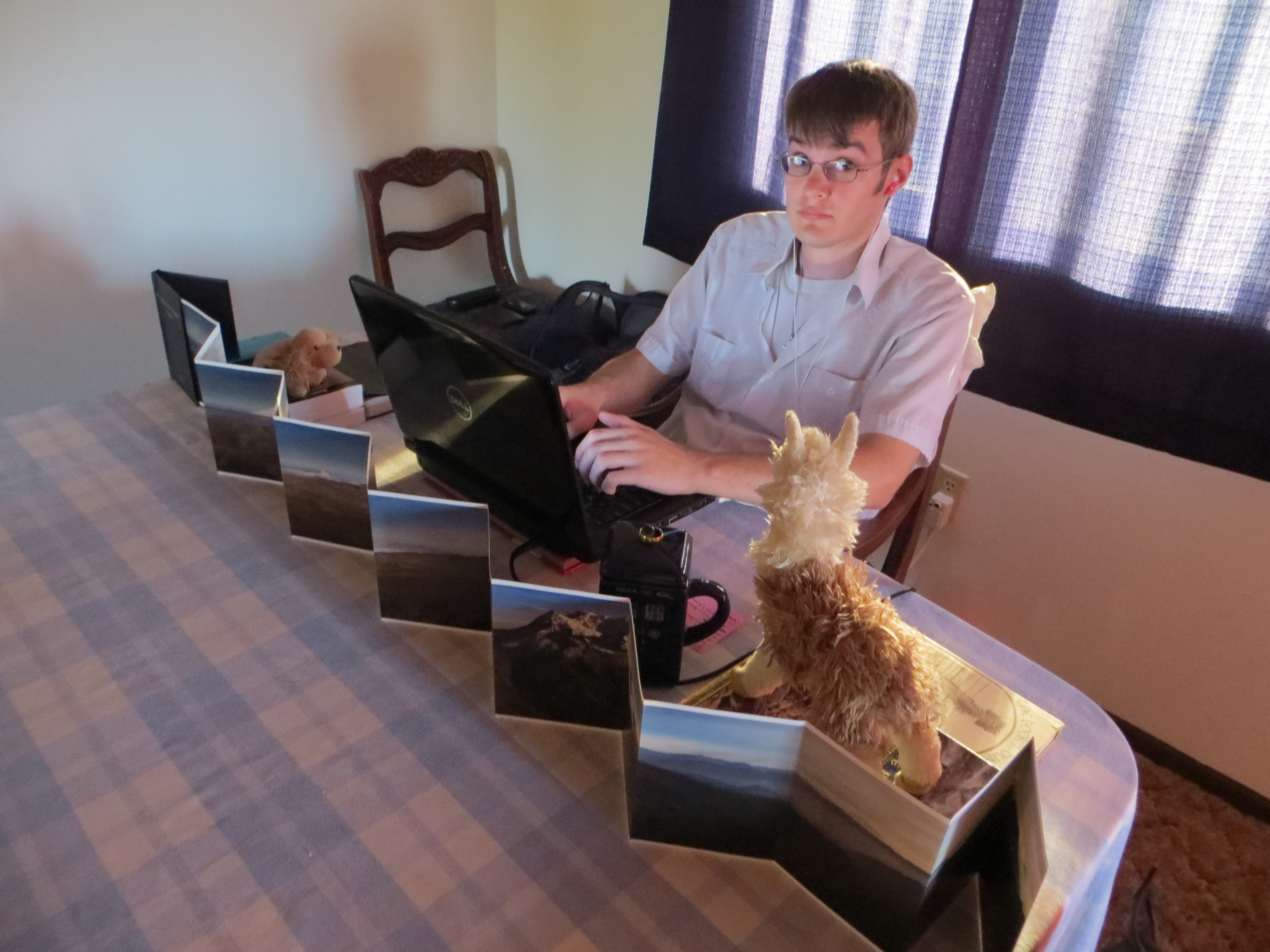
Of course, it was challenging to pack four people into a one-bedroom apartment. I relinquished my bedroom to my parents and set up camp around the dining room table with my sleeping bag, laptop, laundry basket, and assorted plush animals.
IMG_8456

When he must, a blogger can rough it with the best of them.

In this and other ways, my parents’ visit made my life messy. My routines and habits were disrupted. I had to improvise. We also spent a few days on the road, leaving behind my home in the little town of Berne. My life was extremely different for a few weeks, and it was really refreshing.

When my parents departed, leaving little gifts and pleasant memories, I faced the daunting task of putting everything back in its proper place. I had routines to reestablish and an apartment to reorganize. Then a funny thing happened: I kept finding opportunities for improvement. Having abandoned my ordinary lifestyle for a while, I could now look at it more critically.

I began changing things.

For a month and more, I tidied up my life. I swept through my apartment like a whirlwind, reorganizing drawers, cabinets, cupboards, and closets; I altered my diet, adding more vegetables and cutting out certain unhealthy snacks; I replenished my wardrobe, ditching holey socks and buying geeky T-shirts; I did some redecorating, adding five machetes and a plush llama to my bedroom decor; I reordered my priorities, putting first things first.

A few days ago, I reflected upon the changes I’ve made. My life has definitely improved. There is still room for improvement, however, which prompted me to ask myself: What else needs to change? What else do I need?

It was then I realized I could use a more hopeful attitude.

For several reasons, I often live with an attitude of defeat. My recurring depression makes it hard to have a positive outlook. Winter has arrived with its dark days, barren scenery, and bitter cold. Not least of all, my life situation is humbling.

From my early teens onward, I wanted to be an English teacher. I was convinced it was my calling. I went to college, attended classes, completed my student teaching, and earned both an English degree and a teacher’s license. This was all well and good, but there was one concern.

During my last semester, after three full years of study, I had second thoughts. My student teaching utterly demoralized me. I was no longer sure I wanted to spend my life teaching. Thus I eventually found myself in Indiana, using neither my degree nor my teacher’s license, working a low-wage job.

That was two years ago.

I’m still working the same job, and it looks like I won’t be moving on any time soon. (I have reasons for staying.) Heck, I don’t even know where I would go. I may end up teaching; I may not. Many of my peers are using their education to pursue great careers. It’s humbling for me to be so far behind. I’m not sure whether I’ll ever use my college degree or teacher’s license for anything.

I just don’t know.

My ambitions of becoming an English teacher have faltered. I don’t know whether I’ll ever put my college studies to use. My attempts to become an author failed; that particular childhood dream is extinguished. As I work a job that seems to be going nowhere, worrying about the future, struggling with depression, freezing in the icy darkness of winter, I realize what I’ve been missing despite all my earnest attempts at self-improvement.

I sure could use a more hopeful attitude.

Hope is a simple solution, but not an easy one. Hope is hard. As I blunder onward, I’m trying to look back. My life—even the past two years—hasn’t been wasted. I’m trying to look forward. The future is uncertain, yet full of unforeseen opportunities. Above all, I’m trying to look around at my life as it is now.

Setting aside my insecurities and uncertainties, I remain sincerely convinced that I am where I need to be—for the time being, at any rate. My life is full of blessings. I’m surrounded by awesome people. My coffeemaker still works. God’s grace never fails, and I’m comforted by these words from C.S. Lewis: “If you continue to love Jesus, nothing much can go wrong with you.”

These are things I mustn’t ever forget.
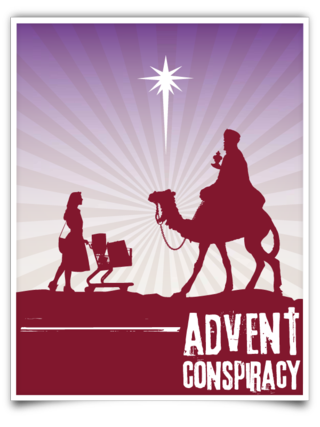
316. Christmas… Fundraiser?!

Around the start of December every year, TMTF promotes the Advent Conspiracy: an annual project that provides safe, clean, drinkable water for people in poorer countries.

Advent Conspiracy

This year, we want to do a little more.

This December, TMTF might support the Advent Conspiracy (and one other charity project) by holding… what? What? But—what?! WHAT?!

That’s right, TMTF might hold a fundraiser for charity! Well, TMTF might set up a fundraising webpage for charity. I suppose there’s a difference. I’ve wanted to hold a fundraiser on TMTF for a year or two, but the prospect daunted me. At last, I’ve decided to give this fundraising thing a try.

(To clarify: Neither I nor my blog would receive any money from this fundraiser. One hundred percent of money given by donors would go to the charity of their choice.)

An amazing organization called Living Water International drills wells and provides safe water solutions all over the world. I would like to create a Living Water donation page in December representing this blog and its readers.

Working together, we could help save lives this Christmas!

Living Water is a Christian organization. As not all of my dear readers are Christians, I would like to include an alternative charity: Child’s Play. This awesome/geeky organization donates video games, toys, and other goodies to kids in hospitals. Child’s Play doesn’t seem to have individualized pages that track donations, but TMTF could easily link to the organization’s general donations page.

If TMTF puts even one Legend of Zelda game in the hands of a sick child, I will consider this blog’s entire existence justified.

Although fundraisers can accomplish great things, they’re often really boring. Worry not! TMTF is here to put the fun in fundraiser. I’d like to create a Kickstarter-style tier of rewards for donors. While I haven’t worked out all the details, the idea is to acknowledge donations with small benefits.

For example, donors who give a dollar receive a digital thank-you message. Donors who give five dollars also get a shout out on this blog. Donors who give ten dollars receive an actual thank-you card in the mail. Larger donations might receive benefits like guest posts for donors’ blogs or websites, personalized poems or very short stories, or inclusion in a raffle to win a copy of my book. I’m open to further suggestions for rewards.

What’s that? You’re wondering why—if I’m really so excited by the possibility of holding a charity fundraiser—I haven’t already decided to hold one?

Here’s the thing. A fundraiser can’t work with just one person… unless that person is Batman. I’m not Batman. I can plan a fundraiser, but I can’t fund the whole thing myself! It has to be a group effort, and I can’t hold a fundraiser without hoping readers will support it.

That said, I’ve created a poll to test the waters and figure out whether a TMTF charity fundraiser is feasible. The poll will last a week; I’ll post reminders on this blog and on Twitter over the next few days. If you ever glance at this blog, please take ten seconds to cast your vote. And please be honest. And vote only once. And spread the word!

315. Fans, Geeks, and Shipping: A Momentary Study

Today we delve once again into anthropological study as we take a look at shipping. No, I don’t mean the transportation of goods. The word shipping also denotes a strange, fascinating, and occasionally outrageous trend observable in communities of geeks across the Internet.

As an eminently geeky blog, TMTF must investigate this sociological phenomenon. For science! Grab your pens, clipboards, and safety goggles, ladies and gentlemen. Let’s get geeky!

(Wait, give me ten minutes to research shipping on Wikipedia, that splendid fount of Internet knowledge. All right, let’s begin!)

We begin with a preliminary note about fandom. A portmanteau of fan and kingdom, a fandom is a community of people united by a common attachment to something. To put it more simply: a fandom is a group of fans. The word also refers to the subcultures created by these groups, and to each fan’s individual predilection for the object of attachment.

As the word shipping used in the context of fandom, it denotes a wish for two people, usually fictional characters, to have a certain kind of relationship—usually a romantic one. (I suppose shipping can involve more than two people, but I prefer not to pursue that thread of inquiry any further.) The term is the gerund form of the verb ship, which is derived from the word relationship. Fans ship their favorite characters by pairing them up. The word ship also functions as a noun, referring to a specific pairing.

In other words, shipping is fans wanting people (real or imagined) to find happiness together, which is sort of sweet, extremely silly, and just a bit creepy.

I didn’t know much about shipping before looking into it; I thought it might make an interesting blog post. I was astonished to realize how fully developed and widely accepted a practice shipping has become. Many fans pen fan fiction, create artwork, or write music promoting their preferred ships. Some fans argue about them—after all, this is the Internet.

Shipping has become so widely practiced that it apparently has its own terminology. A sailed ship, for example, is a pairing that actually happens. A joke ship is a ship too ridiculous to be taken seriously, and a sunken ship is one that has no chance of happening. (Wikipedia has a list of nearly twenty shipping terms. It’s insane.) Portmanteau combinations of names often represent ships, such as Romuliet for Romeo and Juliet. (Yes, Romuliet is an awful word; I hate to think of what terrible violence ships have inflicted upon the English language.) Some fans become so invested in certain ships that they declare them OTPthe One True Pairing for those characters.

I thought shipping was mostly a joke, but I was surprised to discover its complexity and ubiquity across the Internet.

What’s that? You want to know my preferred ship? That would be milk and coffee, thanks for asking. What finer OTP could there be?

314. The Parable of the Monkey’s Whiskers

When I shared on Monday about my struggles to cope with depression, I promised today’s post would be less gloomy. Not only shall my reflections today be more cheerful, but they’ll also feature pictures of cute monkeys!

(Don’t be surprised. This blog is called Typewriter Monkey Task Force, after all. The pictures belong to my dad, who graciously dug them out of his archive at my request.)

Here’s an old African parable. There were once two monkeys; I’ll name them Apollo and Socrates after two of my typewriter monkeys.

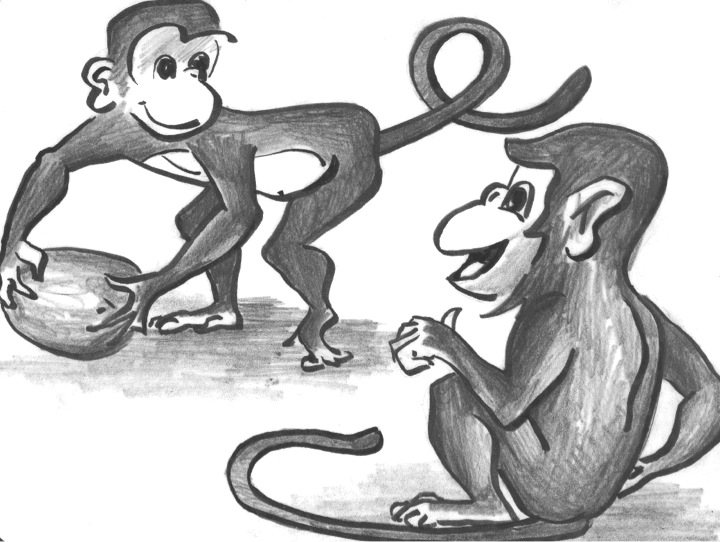
Monkey Parable - Playful monkeyApollo and Socrates frolicked across the savanna one day, tossing around a coconut and being adorable. Neither monkey realized they were playing near a foul swamp. (As I know from long experience, monkeys aren’t very bright.) Apollo and Socrates tossed their coconut back and forth until Socrates missed a catch. The coconut landed in sticky mud far from the bank.

As the monkeys sat on the bank, staring forlornly at the coconut, Apollo nudged Socrates as if to say, “You go first.”

Monkey Parable - Sinking monkey

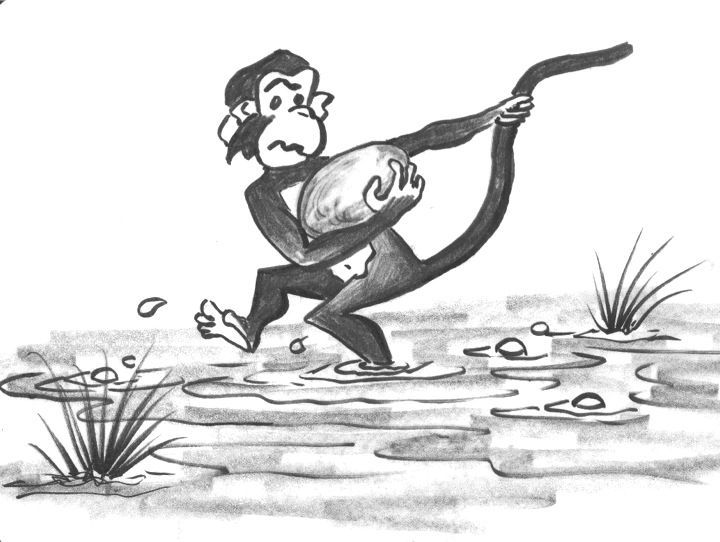
Socrates stepped into the swamp and trudged toward the coconut, holding up his tail to keep it from trailing through the stinking mud. At last he picked it up, tried plodding back to the safety of the bank, and realized he was stuck. The clinging muck held him fast by the ankles… and slowly pulled him downward.

Socrates let go of his tail, dropped the coconut, and tried pulling a foot out of the mud. It didn’t even budge. He tried the other foot. It was hopeless. The little monkey was trapped, and the mire sucked him steadily down, down, down into the gloom.

Monkey Parable - Desperate monkey

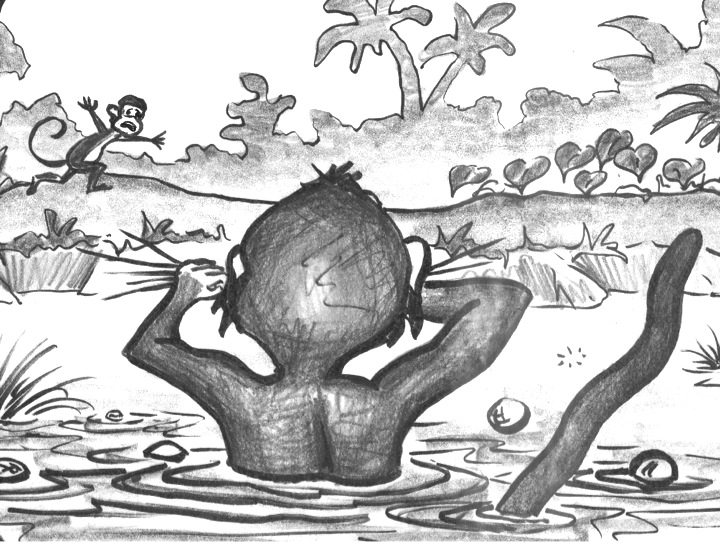
Apollo began running back and forth on the bank, waving his little arms helplessly. There were no branches, no vines, nothing that could be used as a bridge or lifeline. If only there were something to which Socrates could hold—something to keep him from sinking.

Then Apollo had an idea. He chattered at Socrates (now waist-deep) to get his attention, and then tugged on his own whiskers. Of course! Socrates didn’t need a lifeline. He could pull himself out of the swamp by his whiskers! The solution to his problem was literally right under his nose.

Socrates understood and began pulling his whiskers. He pulled and pulled and pulled, trying to raise himself out of the slimy mess drawing him into its reeking depths.

Monkey Parable - Drowned monkey

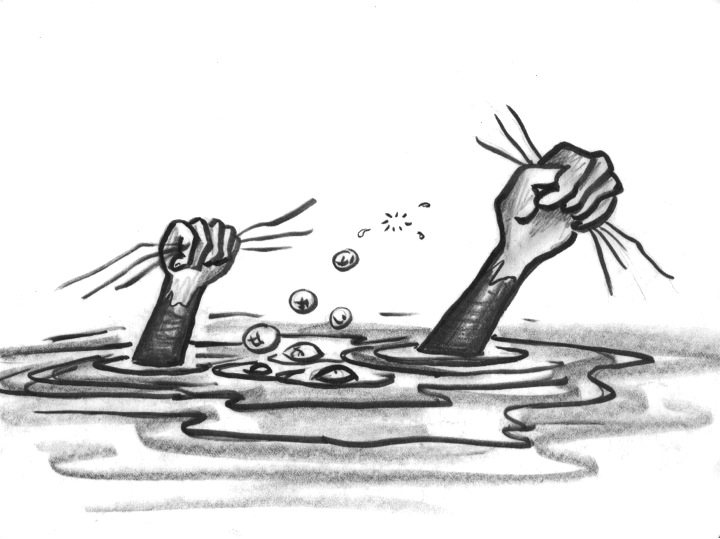
The last Apollo ever saw of Socrates was a pair of paws, twitching faintly and grasping handfuls of monkey whiskers.

Wait. That wasn’t a happy story, was it? Dash it, this is embarrassing. I promised my readers today’s post would be more hopeful. Well, it’s not too late to make a few changes to this parable. Let’s give it a happier ending!

Monkey Parable - Noticed monkey

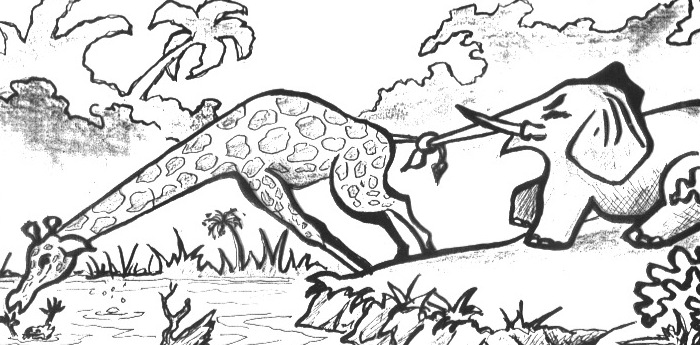
As Socrates yanked vainly on his whiskers, a nearby giraffe glanced over and saw the little monkey struggling in the swamp. Art Garfunkel Giraffe was this noble creature’s name. (Art’s parents were huge fans of folk rock.) He galloped away to find his friend Ringo Starr Elephant. (Ringo’s parents were more into classic rock and roll.) Art and Ringo reached the swamp just as Socrates’ head was about to slip beneath the mud.

Monkey Parable - Rescued monkeySocrates was saved! The animals, who never went near a swamp again, all went out for coffee and lived happily ever after.

There. Was that better?

On Monday, I mentioned that I hate my inability to cope with depression. I also pointed out that many of us struggle to win our private battles. Why have I shared a parable about monkey whiskers?

Some problems have no easy fixes.

As much as I want to find the perfect strategy for coping with depression and anxiety, it may not exist. There may be no easy fix for these problems. My best intentions may be no more useful than a monkey trying to lift himself up by his own whiskers.

Oddly enough, this comforts me. I tend to blame myself for every failure to cope with my depression. The parable of the monkey’s whiskers suggests the possibility that I may not always be able to rescue myself. Some battles may be beyond my power to win… and that means I can stop blaming myself for losing. I can feel depressed without feeling guilty.

If depression is a problem my best intentions can’t fix, should I just give up?

Well… no.

We can’t rescue ourselves—but others can help.

Depression is a private battle. All the things I mentioned on Monday—addiction, self-loathing, broken relationships, self-destructive impulses, and so on—are things we hide. They’re private. They’re shameful. They’re embarrassing. They’re also things we don’t have to face alone.

In fact, facing them alone may be as stupid as a monkey trying to haul himself out of a swamp by his whiskers.

We all need help from others. Some of us could benefit from professional counseling, antidepressants, or therapy. We all need hugs. Some of us need hugs. We feel better for talking or going for walks or playing Mario Kart with loved ones. It’s amazing to share a private battle with someone and hear them say “I love you” or “I’m praying for you” or even “That really sucks; I hope things get better.”

In my struggles, few things have brought me greater hope or healing than people listening to me, praying for me, encouraging me, or simply acknowledging that they know I’m struggling. Maybe that’s what the Apostle Paul, bless him, meant when he wrote, “Carry each other’s burdens, and in this way you will fulfill the law of Christ.”

We can look to others for help, and we can always look to God. As it is written, “Cast all your anxiety on him because he cares for you.” He listens when no one else will.

We all have our battles to fight. What we must always know is that we never have to face them alone.

313. Coping with Depression

About a week ago, an acquaintance was asked how she planned to spend her evening. She replied, “Oh, I’ll go home,” and added in an undertone, “I’ll probably curl up and cry my eyes out.”

I assumed my acquaintance—I’ll call her Socrates—was being sarcastic, yet her tone was very matter-of-fact. “Will you really?” I inquired.

This was not a polite question. All the same, it led to a frank conversation about depression and the ways we try to deal with it. Socrates apparently cries a lot. I would never have guessed. She’s considerate, friendly, and helpful; she never seems depressed. As she talked about her struggles, I felt a sobering sadness.

I can’t pretend to understand her perfectly after one brief conversation, but I’m certain of at least one thing: Socrates is a very brave person. She fights her private battle with a courage that fooled me into thinking she was quite happy. She smiles, storing up her tears.

Socrates reminded me that depression is a common struggle. Most of us have hidden problems of some kind, whether depression, self-loathing, addiction, self-destructive impulses, broken relationships, or other issues. We all try to cope in different ways. Socrates cries. I write, drink too much coffee, and spend hours or days being antisocial and unproductive.

Trying to cope

Look, I’m really depressed. I can’t deal with people right now. Go away! Begone! Go read some other blog!

I don’t like depression, but what I really hate is not knowing how to deal with it.

My depression comes and goes. When I’m not depressed, it seems like a mere nuisance. In fact, in these brighter times, I feel slightly guilty talking or writing about it. I feel like I’m exaggerating a small problem.

Then depression creeps over me, darkening my life slowly and imperceptibly. (The process is so gradual that I sometimes feel depressed for days before realizing it.) Depression robs me of the ability to enjoy and appreciate good things. It sucks the hope and meaning out of life, leaving the universe a dismal, empty place.

Fortunately, my bouts with depression are neither frequent nor injurious, and seldom last more than a week or two—thank God! In the end, no matter how dark my depression, God carries me through it.

All the same, I wish I were better at coping. I want to be more self-aware in recognizing the symptoms of depression. I remind myself that what I do matters more than what I feel. I try not to blame myself, but to recognize depression as a sickness. Like Socrates, I smile and keep my struggles to myself.

As I look back on the battles I never won, I can’t shake a sense of regret. I feel guilty for being unproductive and unsociable. I rue time wasted, opportunities lost, and blessings unappreciated.

Depression really sucks.

Why am I writing all this? I have two reasons.

First, I know I’m not the only one who doesn’t win these battles. There are many people like me and Socrates. I want the readers fighting their own private battles to know they’re not alone.

Second, I have more to say. This is the darker half of a two-part discussion. I’ll end these reflections on a brighter note next time. Come back on Friday for the conclusion!

311. Strange American Pumpkin Rituals

I’ve spent a few years in Indiana, one of the United States of America. Indiana is extremely different from my homeland of Ecuador. The season of autumn brings all sorts of strange cultural customs. In fact, as we approach the holiday known as “Halloween,” I’ve seen disconcerting rituals take place in my very neighborhood.

Today TMTF delves into anthropology and investigates strange American pumpkin rituals. For science.

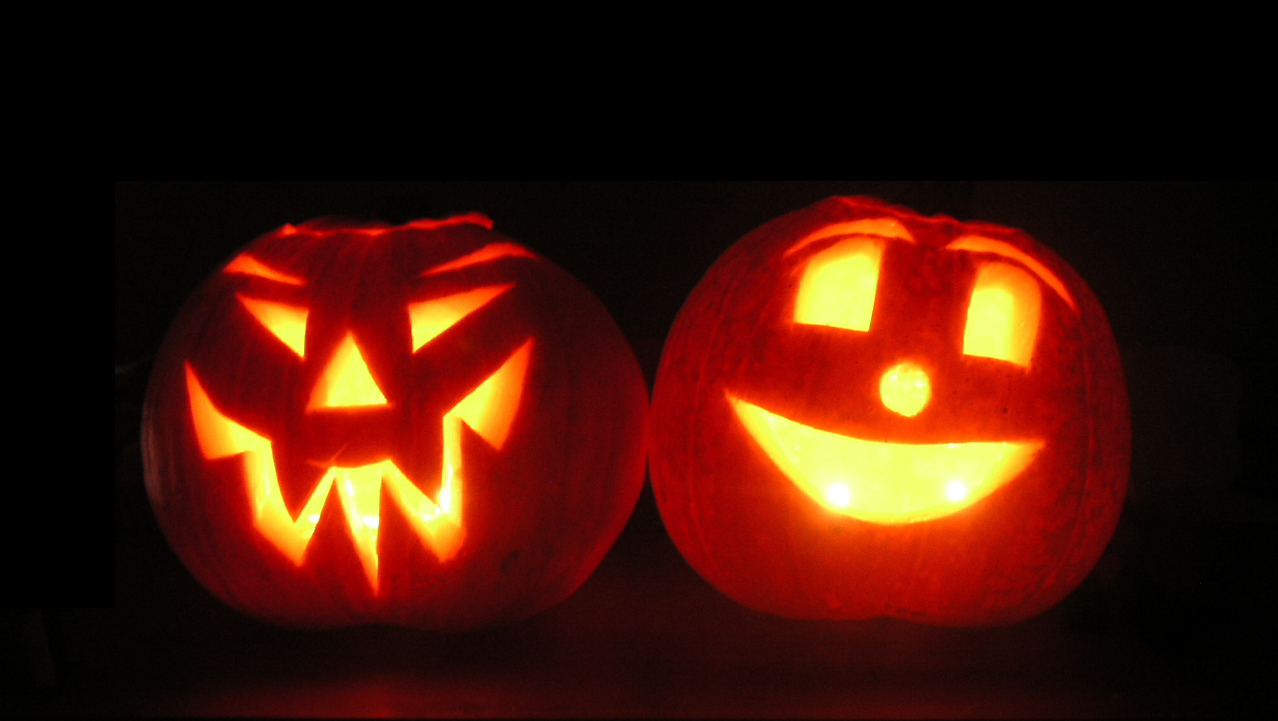
I’m baffled by the bizarre, violent, and highly dubious custom of carving pumpkins into facsimiles of severed heads. These gruesome gourds are known as “jackal lanterns,” or some such.

Nothing brightens up a porch like grotesque facsimiles of severed heads!

Nothing brightens up a home like grotesque facsimiles of severed heads!

I recently witnessed the creation of jackal lanterns firsthand. First, the pumpkins were eviscerated and their innards piled in slimy heaps. Seeds were extracted from these heaps, seasoned, and cooked in an oven. I gathered that roasted pumpkin seeds are a seasonal delicacy, and tried a small handful—for science. The seeds tasted like buttered wood chips and were more or less completely indigestible. Americans must lack taste buds and have ironclad stomachs—but that’s research for another time.

After they were emptied of seeds and pulp, the hapless pumpkins had faces carved in them. These were grotesque. Further researches on my part yielded some interesting information: although jackal lanterns are generally patterned after severed heads, they can feature words, portraits, logos, cartoon ponies, interstellar weapons of mass destruction, and other forms of visual art.

Once completed, jackal lanterns are usually placed upon porches or in front yards. Lights or candles are placed inside them, shining through apertures and places where the sides of the pumpkins have been pared to a translucent thinness. This explains the lantern part of jackal lantern, but my researches have yet to explain the jackal part. Is the purpose of displaying these lanterns to frighten away jackals?

My other hypothesis is that jackal lanterns are deployed outside homes as protective charms to ward off gnomes, trolls, or evil spirits.

Halloween brings many more peculiar rituals, such as the custom of donning disguises, accosting strangers on their doorsteps, and demanding sweets. This ritual is apparently call “triquertreting.” (I haven’t actually seen the word written, so I’ve transcribed it phonetically here.) I can only presume the word is derived from the French triquer (cudgel) and the German treten (trample). Thus triquertreting can be loosely translated to cudgeling and trampling, which confirms my worst fears about Halloween and its customs.

All this makes me long for Ecuador’s peaceful and sensible customs for the Día de los Difuntos (Day of the Dead) on November 2, a couple of days after Halloween. Ecuadorians eat guaguas de pan, children made of bread; slurp colada morada, a soupy hot drink made with spiced fruit; and dine atop the graves of dead ancestors. What’s weird about that?

308. On the Shoulders of Giants

I recently spent a few days traveling with my parents and younger brother. It was quite a trip: exciting, exhausting, sentimental, and rife with unexpected ups and downs. Tolkien was right: It’s a dangerous business, going out your door. There’s no telling what will happen.

At one point, we had dinner with relatives and a family friend. Our conversations during and after the meal were of a kind common in my family: full of nostalgia, peppered with Spanish, ringing with laughter, and rich in stories of distant times and faraway places.

I heard anecdotes of adventures (and misadventures) in Ecuador, Portugal, Morocco, Fiji, and Antarctica, among other countries. I lounged on a sofa, looking round a cozy room lit by soft lamps, and listened contentedly to wild tales of grass skirts, bus breakdowns, shifty carpet merchants, and thieving penguins.

Penguin!

He may look innocent, but this bird is a stone-cold criminal. (Pun intended. I’m so, so sorry.)

For that one evening, I forgot the quiet, comfortable, soundly American life I’ve lived for the past two years. I remembered places long forgotten: gray beaches strewn with shells and driftwood; low hills studded with weathered trees; water cascading down cliffs covered in moss and ferns; mountains towering green and silent against the sky. As places were mentioned that I hadn’t visited, my imagination filled in the gaps.

Some of the stories that night told took me back decades to a time when the coast of Ecuador, my homeland, was a wilderness. There were hardly any cars or paved roads in those days. People traveled on foot, in canoes, and on rickety buses. My grandfather, a missionary to Ecuador’s coast many decades ago, was a pioneer in his time.

Those conversations opened windows in my imagination and memory, giving glimpses of things dimly seen or half-forgotten.

All of this reminded me of three things.

I am such a softy.

As I enjoy a life of incredible luxury, I often take for granted blessings like clean water, hot showers, fast Internet, video games, a comfortable home, a steady income, a safe neighborhood, and a steady supply of coffee. While I gripe about chilly weather and minor car troubles, a staggering number of people survive in harsh conditions with very few luxuries.

It’s my responsibility to be grateful and generous… and also to toughen up a bit!

I panic over little things.

I feel extremely stressed by small things, from the everyday pressures of my job to minor problems like my Internet connection failing. It helps to recall those tales of risks, perils, and painful misadventures. Things could always be much worse.

I need to keep a proper sense of perspective.

I mustn’t get too comfortable.

I get so comfortable in my quiet Indiana life that I often forgot my all-important purpose of loving people. Love is hard. It leaves behind cozy armchairs, warm lamps, and cups of tea. It braves darkness, cold, and awkward pauses to reach out. Love makes me uncomfortable, but that shouldn’t ever stop me from trying to love people. It didn’t stop my grandfather. It doesn’t stop my parents. I mustn’t let it stop me.

All said, it was quite a trip.

All said, it was quite a trip.

I stand, as the saying goes, upon the shoulders of giants. I’m related to some remarkable people, and they’ve done some remarkable things. As I live out this unremarkable chapter of my life, I mustn’t ever lose sight of the things that matter most—the things I can’t see.

306. Ghost Stories

I don’t like Halloween.

Well, to be fair, it isn’t just Halloween. I’m a cynical grump when it comes to most holidays. I hate how they’re commercialized, I dislike the cutesy decorations, and I abhor how celebrations I cherish are overshadowed by twee nonsense.

Thanksgiving, the day we celebrate our blessings, is followed immediately by Black Friday, the day we celebrate our greed. The Christmas season has become two months of corporations clamoring for our attention, capitalizing on our nostalgia, and taking our money.

Halloween used to be the prelude to All Saints’ Day: a celebration of some of the most courageous men and women of the past two millennia. It’s now the time of year for bloody horror films, cheap candy, and decorations of the same blinding shade of orange as marine rescue equipment. No one remembers All Saints’ Day.

It makes me sad.

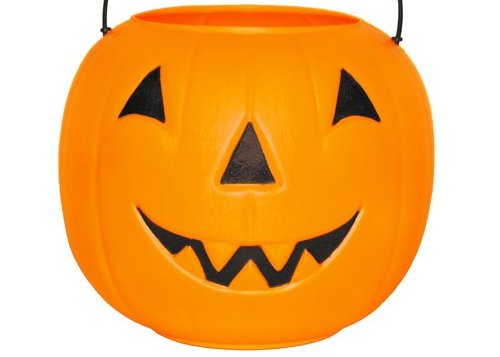
A horrible, horrible pumpkin

Stop grinning at me, you maniac! You’re horrible, cheap, and orange. Why on God’s green earth are you so happy about it?!

All the same, there are good things to be said for Halloween. I’m fascinated by scary stuff, and I like pumpkin spice-flavored everything. (This is odd, considering pumpkin spice exists only to make pumpkin taste less awful.) I’m also interested by ghost stories, notwithstanding my firm belief they’re pretty much all false.

(Yes, I believe in God and angels and the supernatural, but faith is not superstition. There is evidence for these things, but hardly any to back up tales of haunted houses or the Slenderman.)

A couple of coworkers and I shared ghost stories the other day. As we talked, I mentioned the most frightening moment of my life.

I once walked into my parents’ living room at night and saw what appeared to be a man hanged from the ceiling—I clearly saw the silhouette of legs against the pale light of the streetlamps outside. The hanged man turned out to be a pair of pants hung to dry, but it was still quite a shock.

I told one other story. It’s a tale of pale apparitions floating in the darkness, and it’s absolutely true.

There was once a student studying in a seminary on the coast of Ecuador. I don’t remember his name, so I’ll call him Socrates. This man arose from sleep one night to get a drink or use the bathroom in his dormitory. As he stumbled down the hall, fumbling in the dark, he was stunned by the sight of a ghostly thing floating toward him.

The apparition was the size of a small dinner plate and shaped vaguely like a half moon. It seemed to float about three feet above the ground. No sooner had Socrates registered this phenomenon than another came out of the darkness.

It was a smile.

Gleaming in the dark, a broad white smile appeared like the grin of the Cheshire Cat. It hung a couple of feet above the half moon. The two ghostly phenomena moved together along the hall. As they neared Socrates, he realized what they were.

The pale apparitions belonged to a very black man in a pair of very white underpants, smiling in greeting as he passed Socrates and returned to his bedroom in the dormitory.

I don’t expect to see any ghostly phenomena this October, but I shall certainly see hideous holiday decorations, and that will be quite bad enough.

305. That Time My Vacation Held Me Prisoner

I begin a long vacation tomorrow, and I’m thankful. For weeks, work has been an exhausting, stressful, thankless grind. Dash it all, I am so, so thankful for a long break.

While musing upon vacations I had as a kid in Ecuador, I recently recalled That Time My Vacation Held Me Prisoner: an adventure equally restful and stressful, when my family and I were prevented from going home by barricades of burning tires. Ah, Ecuador, why did I ever leave you?

OLYMPUS DIGITAL CAMERA

Ecuador: land of dazzling natural beauty, diverse cultures, superb cuisine… and horrible, horrible cockroaches. I knew I had a reason for leaving.

In the jungles of Ecuador, east of the Andes, there is a little town called Shell Mera. (This tiny settlement made national news in the fifties due to the Auca incident, in which five missionaries were killed.) Near Shell Mera is a camp called Mangayacu. This motley collection of cabins, pastures, and the world’s best swimming pool was one of my family’s favorite vacation spots until we left Ecuador in 2008.

Mangayacu pool

Seriously, this pool is awesome: no chlorine, no life guards, and the exciting possibility of cutting open your feet on sharp rocks!

My family and I were once stranded in Mangayacu. This was a long time ago; I was somewhere between first and fourth grade, which would put this adventure in the late nineties. I’d nearly forgotten it; I’m very gifted at forgetting things.

My parents and brothers and I had finished our visit to Mangayacu and reluctantly packed up our things. After saying goodbye to our cabin, we took off in our dusty car and bumped along dirt roads in the direction of the town of Baños. (Yes, this happens to be Spanish for bathrooms. The word also means baths; the town is named after its hot springs.)

We were stopped by piles of burning tires. It was a paro (workers’ strike) shutting down the road. My dad got out of the car and pleaded our case to the strikers. They didn’t let us pass.

Back we went to the cabin we’d just left, delighted to enjoy a longer vacation, and apprehensive at how our vacation suddenly held us prisoner.

Mangayacu cabin view

I suppose there are worse prisons than the cabins at Mangayacu. At least the view is nice!

I don’t remember how many extra days we stayed at Mangayacu, but it was at least two or three. We scoured one or two tiny local shops for necessities like bread, and had a few meals at a local restaurant. I recall their stock running low because of the paro. As fun as it was at first to be stranded in a cozy jungle cabin, we felt more stressed with each new day. We wanted to go home!

At last, after my brother and I had missed at least a couple of school days, we made it safely back to our home in Santo Domingo de los Colorados. My older brother returned to Quito for school, and I resumed my studies at home.

Later visits to Mangayacu were undisturbed by paros and flaming tires. It was kind of fun to be held prisoner by our vacation, but I’m thankful it never happened again.

Every time I’m afraid I’ve run out of stories for these That Time I _____ posts, a memory of some odd adventure drifts back to me from the brightly-colored blur of the past twenty-something years. It’s surreal, and sweetly nostalgic. It makes me wonder what else I’ve forgotten.

Ah, well. It doesn’t matter. My latest vacation begins tomorrow, and I can’t wait. Here’s hoping this one doesn’t take me prisoner!