The Appalling Scandal of a Cross-Eyed Pony

Derpy Hooves

Offensive?

I work in a group home for gentlemen with mental and physical disabilities. I am also a fan of a pleasant, cheerful cartoon called My Little Pony: Friendship Is Magic.

Mental disabilities and rainbow ponies are hardly subjects I expected to overlap, and I was right. They didn’t overlap.

They collided.

These subjects crashed together in a train wreck of censure and indignation, a firestorm ignited by a few innocent words from a cross-eyed pony. This strange controversy set me thinking generally about scandal, censorship and the absolute impossibility of pleasing everybody.

In an early episode of My Little Pony: Friendship Is Magic, a character in the background—an unassuming gray mare nearly lost in a crowd of brighter ponies—had unfocused eyes. Her derpy expression was a mistake, which the supervising director thought was funny and kept in the episode.

Well, the show’s fan base, which is equal parts ridiculous and awesome, immediately fell in love with this mysterious, cross-eyed stranger, whom they christened Derpy Hooves.

Derpy and the Monkeys

Derpy even made an appearance on this blog! Her visit was… memorable.

The show’s creators, amused by the incredible popularity of this incidental character, began drawing her with crossed eyes as a tip of the hat to fans.

Over time, those fans developed persona for Derpy. This mute background pony became a bumbling, cheerful, well-intentioned mail carrier with a passion for muffins. Derpy became a mascot for fans of the show. Without them, Derpy Hooves would not have existed. The cross-eyed gray mare would have been just another silent, cardboard-cutout character in the background.

Then—wonder of wonders!—Derpy Hooves spoke.

Derpy was given a minute or two of screen time and some dialogue alongside a major character, who very clearly addressed her as “Derpy.” In this brief scene, everyone’s favorite background pony was established to be friendly and klutzy and eager to help. “I just don’t know what went wrong,” she admitted sheepishly, having nearly demolished town hall in her attempts to be useful.

Fans were wild with excitement. This was their character. Derpy had a voice!

Then, shortly after the episode’s release, the scene was changed—censored, according to some fans. Derpy’s voice was less… well… derpy. Her eyes were not so acutely crossed, and her name was no longer mentioned.

The scene was altered due to complaints that the character and her name were offensive to persons with disabilities.

A few fans commended the show’s creators for their sensitivity. Many responded with indignation, and several went out of their way to insult the people who submitted complaints. Some claimed the “censorship” of Derpy Hooves was a slap in the face to fans: a misguided attempt to “fix” the quirks of a character beloved for her quirkiness.

In the end, the show’s creators kept the alterations to the scene. The controversy faded away. Derpy has stayed out of the spotlight, resuming her modest appearances in the background and retaining her immense popularity among fans.

Looking back at that strange, messy incident, I can only echo Ms. Hooves and admit sadly, “I just don’t know what went wrong.”

Personally, I wish the scene had not been altered. Even if Derpy were interpreted as a pony with disabilities, she was cheerful and kind. She wanted to help, and other characters obviously respected her enough to let her try.

At the same time, I think the show’s creators did the right thing by altering the scene. It was edited, not censored, to show respect for a group of people who are often disrespected.

The whole business reminds me that some controversies have no easy answer, and many concern things infinitely more important than rainbow ponies. How do we settle political differences? What about conflicts within churches? If so much strife can be provoked by a silly cartoon, how do we resolve really significant controversies?
Redeeming the Worst Song in the World

All right, the title of this post is a little misleading. “Friday” is the worst song in the world, and it is far beyond redemption. The song above, “Communicate,” is the worst redeemable song in the world.

Adventures in Odyssey is amazing, but this long-running Christian radio drama once made an unspeakable mistake. In 1987, a year of darkness and infamy, an episode titled “Lights Out at Whit’s End” unleashed an atrocity upon the world. This was “Communicate,” a rap song sung by two middle-aged men and a bunch of kids, whose message was… the importance of communication.

I couldn’t find the original version of the song online, presumably because “Communicate” would leave the Internet a smoldering ruin. The song was so bad that “Lights Out at Whit’s End” has not been aired since its first broadcast.

Then the brave folks over at The Ceiling Fan Podcast, a really clever Adventures in Odyssey fan series, decided to find out whether “Communicate” could be made into… well… something that didn’t stink.

I think the video above is a smashing success. Given the source material, the new “Communicate” is actually kind of awesome.

For some reason, my typewriter monkeys (who are fond of rap music) really like this video. I mean, they really, really like it. It worries me.

Jesus Christ and Admiral Ackbar

Then the Pharisees went out and laid plans to trap him in his words.

~ Matthew 22:15

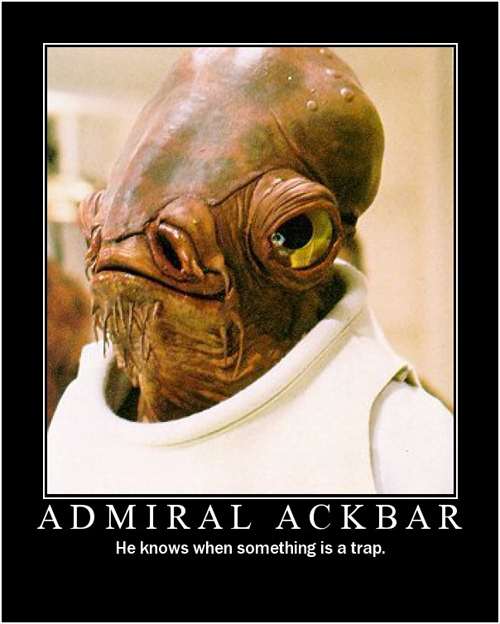
Meet Admiral Ackbar.

Admiral AckbarThe Admiral is a minor character from a Star Wars film. Although he presumably has a life beyond the few scenes in which he appears, he is remembered for one thing and one thing only.

He proclaims, with a glassy-eyed expression of dazed astonishment, “It’s a trap!”

Admiral Ackbar, the ever-useful trap detector, was absent in the days of Jesus Christ. Fortunately, the Lord was shrewd enough to detect a trap without the advice of Star Wars characters.

Quite a number of people disliked Jesus, you see. Two religious groups, the Pharisees and Sadducees, hated the way his teachings upset the balance of things. They wanted him gone—disgraced—dead. These religious groups resorted to all kinds of underhanded traps to bring down the controversial upstart called Jesus Christ.

I find it hilarious, and extremely impressive, how the Lord Jesus dodged every trap with bravado and brilliance.

The Pharisees watched Jesus closely on the Sabbath, the divinely-ordained day of rest, to see whether he would heal a crippled man and thereby dishonor the day by “working.” Jesus didn’t heal anyone secretly. He was way too cool for that. Instead, he had the crippled man stand up in front of everyone and healed him in the most public way possible, pointing out that doing good on the Sabbath is more important than merely following regulations. (See Luke 6:6-10.)

It happened again and again. Even without Admiral Ackbar’s insight, the Lord Jesus never fell for a trap.

The priests demanded to know who gave Jesus his authority. If he claimed it came from God, they could accuse him of blasphemy. If he gave some other answer, or simply refused to reply, they could claim his teachings carried no weight.

Jesus answered this trick question with one of his own: “I will also ask you one question. If you answer me, I will tell you by what authority I am doing these things. John’s baptism—where did it come from? Was it from heaven, or of human origin?”

The priests were baffled: “If we say, ‘From heaven,’ he will ask, ‘Then why didn’t you believe him?’ But if we say, ‘Of human origin’—we are afraid of the people, for they all hold that John was a prophet.”

They couldn’t answer his question, so Jesus declined to answer theirs. (See Matthew 21:23-27.)

“Is it right to pay the imperial tax to Caesar or not?” demanded the Pharisees. If he answered “Yes,” they could accuse him of being a sellout to the Roman authorities. If he answered “No,” they could get him into trouble with those authorities.

He pointed out that Roman coins came from Caesar in the first place and said, “Give back to Caesar what is Caesar’s, and to God what is God’s”—an answer with which neither Romans nor Jews could find fault. (See Matthew 22:15-22.)

The Sadducees added a trap of their own, but Jesus kept his cool.

If a woman is married more than once, they asked, whose wife will she be in the afterlife? By this question, the Sadducees (who didn’t believe in life after death) meant to discredit Jesus and his teachings.

Jesus’ answer? There is no marriage in the afterlife. Take that, Sadducees! (See Matthew 22:23-33.)

One trap stands out among the others. It was a matter of life or death. A woman had been caught in an affair. According to Old Testament laws, she deserved to die. However, in Jesus’ day, Jews couldn’t sentence anyone to death without consent from the Roman authorities. (This is why Jesus was taken to Pilate, a Roman official, to be condemned to be executed after the Jews had already declared him worthy of death.)

If Jesus said the woman should die, he would break Roman law. If he said the woman should live, he would break divine law. There was no way out. It was a trap even Admiral Ackbar could not avoid.

Go ahead, said Jesus. Execute the woman according to Jewish law—but let someone who hasn’t sinned begin the execution.

With infinite calm, Jesus called their bluff. They could threaten to kill the woman—perhaps even watch her die—but not one of them could carry out the execution with a clean conscience. One by one, they slipped away. (See John 8:3-11.)

“Woman, where are they?” asked Jesus at last. “Has no one condemned you?”

“No one, sir,” she replied, perhaps trembling in fear and awe.

“Then neither do I condemn you,” declared Jesus. “Go now and leave your life of sin.”

I find it fascinating that Jesus gave tricky answers only to trick questions. When a Pharisee finally asked him a fair question, Jesus’ answer was honest and straightforward.

What, asked the Pharisee, is the greatest commandment in God’s law?

Love God and love others, answered Jesus.

That, dear readers, is not a trap.

When Batman Has a Bad Day

A wise person once said, “Always be yourself, unless you can be Batman. Then be Batman.”

Batman is my favorite superhero. Christopher Nolan’s excellent films introduced me to the brilliant, skilled martial arts prodigy who decided the best way to cleanse his city of corruption was to dress up like a bat, throw pointy objects at evildoers and drive around in a really neat car.

Batman is interesting because he has no superpowers. His abilities are the fruit of determination, intelligence and self-discipline, augmented with some sweet technology.

More significantly, Batman is a conflicted character. I like conflicted characters. Granted, most superheroes have insecurities. Batman is different. As Charlie Brown would say, his anxieties have anxieties; Batman is the eponymous sufferer of Batman Syndrome. Nevertheless, he keeps going. He sees no joy and little hope in doing the right thing, yet he does it anyway. I admire that.

On a less intellectual level, Batman is really cool.

However, like every other person on Earth, Batman has bad days. The charming animation above depicts a day when the Caped Crusader just can’t seem to catch a break. Keep an eye out for an appearance from comics legend Stan Lee!

The Best Cellist in the World

I wish I could do anything one-half as well as this gentleman plays the cello. To tell the truth, I’m a bit cellist of his remarkable talent.

Now I’m going to spend an hour or two doing penance for making such a terrible pun. I’m sorry. I’m so, so sorry.

(I’m not sorry.)

Just watch this gentleman’s facial expressions as he plays. His passion for music is unmistakable. I may never become as skilled at anything as he is at playing cello, but I want to nurture that same kind of joyful, passionate enthusiasm for my own gifts.

A Collection of Fabulous Video Game Mustaches

Stache Stash

Clockwise, beginning at the top right: Yang (Final Fantasy), Mario (Super Mario Bros.), Dr. Eggman (Sonic the Hedgehog), Dr. Wily (Mega Man), Wario (Super Mario Bros.), Naked Snake (Metal Gear Solid), Don Paolo (Professor Layton) and Marvin Grossberg (Ace Attorney).

This is a collection of magnificent video game mustaches: a stache stash, if you will. Which is best? My money is on Mario’s mustache. It lacks the extravagant flair and staggering size of the competition, yet it boasts an understated charm.

Airships

The Tiger Moth from Castle in the Sky

The Tiger Moth from Castle in the Sky

An airship is a lighter-than-air aircraft; examples include dirigibles and hot-air balloons. Airships use buoyant gases such as hydrogen and helium to remain aloft, unlike heaver-than-air aircraft such as airplanes and helicopters that rely upon wings or rotors.

In fiction, however, airship is a catch-all term for unusual aircraft. Fictional airships are much cooler than real-life ones, probably because their designs aren’t restricted by nuisances like production cost and the law of gravity.

Airships are common in certain kinds of fiction (notably steampunk fantasy) and even make appearances in the Super Mario Bros. games. My favorite airships, however, are those from the Final Fantasy series and the films of Hayao Miyazaki.

Airships in fiction often evoke a sense of nautical adventure. The sky is an ocean waiting to be explored! In stories with airships, pirates roam the skies as readily as the seas. Balthier from Final Fantasy XII (who is basically Captain Jack Sparrow, but cooler) and the Dola Gang from Castle in the Sky (whose airship, the Tiger Moth, can be seen in the picture above) are among the most memorable sky pirates I’ve seen.

In its earliest stages, The Trials of Lance Eliot involved airships. I eventually cut them out of the novel because they served no significant purpose (other than being awesome) and complicated the story. It’s kind of a pity, really.

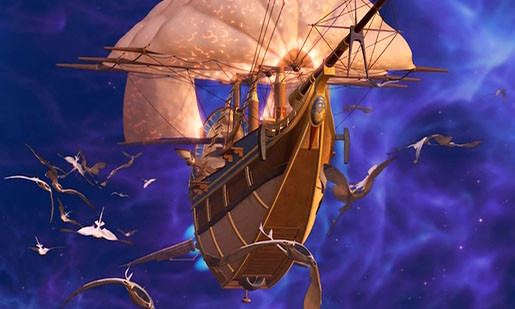
Here are some of my favorite airships.

The Gigante from Future Boy Conan

The Gigante from Future Boy Conan

The Highwind from Final Fantasy VII

The Highwind from Final Fantasy VII

The Fahrenheit from Final Fantasy X

The Fahrenheit from Final Fantasy X

The Strahl from Final Fantasy XII

The Strahl from Final Fantasy XII

The RLS Legacy from Treasure Planet

The RLS Legacy from Treasure Planet

Have you seen any interesting airships in fiction? Let us know in the comments!

When Blacksmiths Get Geeky


The first time I saw a Kingdom Hearts game, I was surprised to see the hero use an enormous key as a weapon. I mean, where were the swords and axes? What the heck was going on?

The keyblade is actually a pretty cool weapon. In combat, it’s something between a pole-axe and a two-handed sword. The keyblade also plays an important role in the (admittedly incomprehensible) plot of Kingdom Hearts. Its significance to the story and unique design make the keyblade one of the most interesting video game weapons I’ve ever seen.

Then this blacksmith decided to make a real-life keyblade. Which is amazing.

This video takes me back to That Time I Was a Blacksmith: the summer I wore noise-reducing earmuffs and dirty shirts, used machines like band saws and belt grinders, beat the daylights out of red-hot metal and wished I could grow an epic beard.

What video game weapon would I most like to see forged by a blacksmith? Cloud Strife’s buster sword, without question. The fact that it would be impossible to use is unimportant. What matters is that it would be awesome.

Jesus Broke the Fourth Wall

Truly I tell you, wherever this gospel is preached throughout the world, what she has done will also be told, in memory of her.

~ Matthew 26:13

One of my favorite storytelling tricks is called breaking the fourth wall. There was once a playwright, you see, who insisted on making his stage productions as realistic as possible. In a play performed on a stage with three walls, the audience must be the fourth wall.

Thus the fourth wall became a phrase describing the imaginary boundary between the audience and the performers, or (more broadly) between reality and fiction. When a performer acknowledges the audience, that fourth wall is broken. This trick is often used for comedic effect or even as a clever, self-aware way for fiction to communicate its meaning.

It occurred to me not long ago that Jesus seems to break the fourth wall, so to speak, in the Gospels of Matthew and Mark. The story is a familiar one. Days before his crucifixion, Jesus is anointed with perfume by a woman. His disciples are indignant: “Why this waste? This perfume could have been sold at a high price and the money given to the poor.”

Jesus gives this touching reply: “Why are you bothering this woman? She has done a beautiful thing to me. The poor you will always have with you, but you will not always have me. When she poured this perfume on my body, she did it to prepare me for burial.”

Then things get awesome as Jesus breaks the fourth wall.

“Truly I tell you, wherever this gospel is preached throughout the world, what she has done will also be told, in memory of her.”

In simply speaking those words, recorded in the Gospels of Matthew and Mark and later preached to countless people over many centuries, Jesus made them come true.

As much as I’d like to assume Jesus specifically meant the Gospel of Matthew or the Gospel of Mark when he said “this gospel,” history tells us otherwise. The word translated gospel in this passage—and later applied to the books of Matthew and Mark—means good news. By “this gospel,” Jesus was speaking broadly of the good news of his life, death and resurrection—not of a specific Gospel in the Bible.

All the same, I chuckle every time I read that passage. Jesus was a man of miracles. He walked on water, healed the sick, raised the dead and did what no one (as far as I know) has ever done outside of fiction.

Jesus broke the fourth wall.

An Evil Scientist Explains Band Names

Starting this week, Geeky Wednesdays are officially a thing.

From Kicking Crickets to Closet Vikings, I’ve come up with a staggering number of awful band names. Dave Barry, a humorist and master of rock band nomenclature, is the one from whom I picked up the bad habit of turning odd phrases from everyday life into absurd names for rock bands.

Seriously, though, what’s with band names? A few make sense. Peter, Paul and Mary is refreshingly simple, and The Beatles is a clever pun on beat and beetle. But what about Pink Floyd and ZZ Top and other strange band names? Are such bizarre names the result of nonconformist intellect, warped humor or reckless drug use? And why do Doofenshmirtz’s explanations seem so reasonable?