A Caffeinated Romance

St. Valentine’s Day is coming up. (Yes, I insist on referring to the holiday as St. Valentine’s Day, because I am a grouchy traditionalist.) It’s a time for people in relationships to express their affections, and for single people to feel awkward. St. Valentine’s Day is also a time for coffee, but let’s be honest—it’s always time for coffee.

“Taylor the Latte Boy” is my all-time favorite romantic song. (Well, the video above actually features two songs: “Taylor the Latte Boy” and its response, “Taylor’s Rebuttal.”) What could be more romantic than a guy and a girl falling in love over coffee? The girl’s passionate tale of love, longing, and lattes is only slightly marred by the guy being absolutely not interested.

Coffee, love poetry, and the possibility of a restraining order: “Taylor the Latte Boy” has it all. This two-part song is on the longish side, but if you have time, I absolutely recommend it. The parts of Taylor and his admirer are performed well, and the differences between their points of view are hilarious.

In the end, I think we can all agree that caffeinated romances are the best kind.

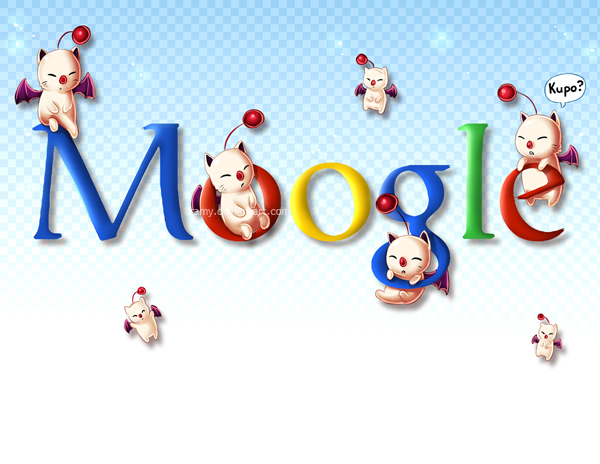
Moogle

Make it happen, Google.

For the uninitiated: Moogles are small, furry creatures from the Final Fantasy series of video games. They’re known for selling stuff, being adorable, and saying “kupo” a lot. (Don’t ask me what kupo means, or why moogles have antennae with fluffy pom-poms; I neither know nor care.)

Moogles are an important reminder that life isn’t all dragons, monsters, swords, and sorcery. At the end of the day, no matter how many friends you’ve lost or villains you’ve slain, it’s important to appreciate the things that are cute.

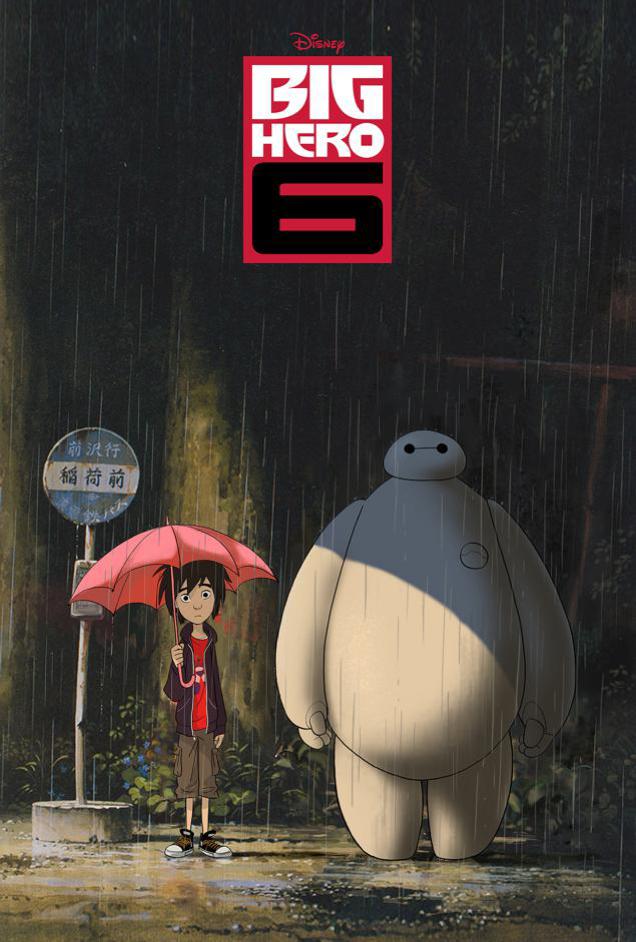
My Neighbor Baymax

My Neighbor BaymaxBravo, Disney. Bravo.

This lovely art was drawn by Jin Kim, a character designer for Walt Disney Animation Studios. It uses the Japan-inspired setting of Disney’s Big Hero Six to pay homage to Japan’s greatest animation studio, the amazing Studio Ghibli.

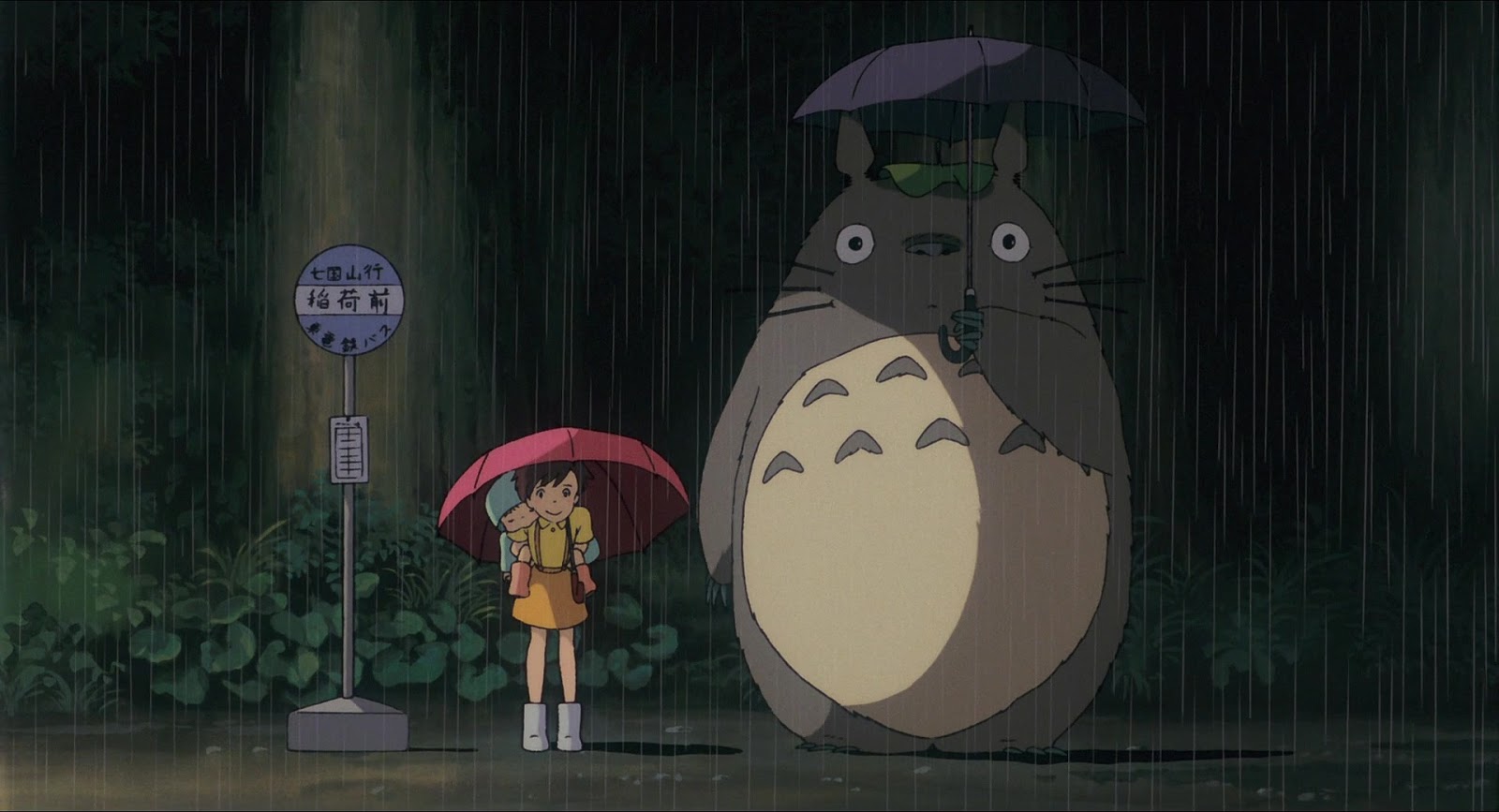
For comparison, here’s the image from My Neighbor Totoro on which Kim’s picture is based.

Totoro in the rainI really enjoyed Big Hero Six, the first animated Disney movie based on Marvel comic book characters. In fact, it’s one of my favorite films of the past five years. Its story hit all the right notes for me, and its visuals are jaw-dropping. Despite being much more Disney than it is Marvel, Big Hero Six avoids most of Disney’s clichés. There are no princesses; there is no romance; the villain is not pointlessly evil. Big Hero Six is a film about brotherly love, coping with loss, and the futility of revenge. It’s pretty deep stuff… for Disney, anyway.

Anyway, if you haven’t seen Big Hero Six, you should go watch it. And then, regardless of whether you’ve already seen it, you should watch My Neighbor Totoro. You’ll thank me later.

Cartoon Anatomy Is Weird

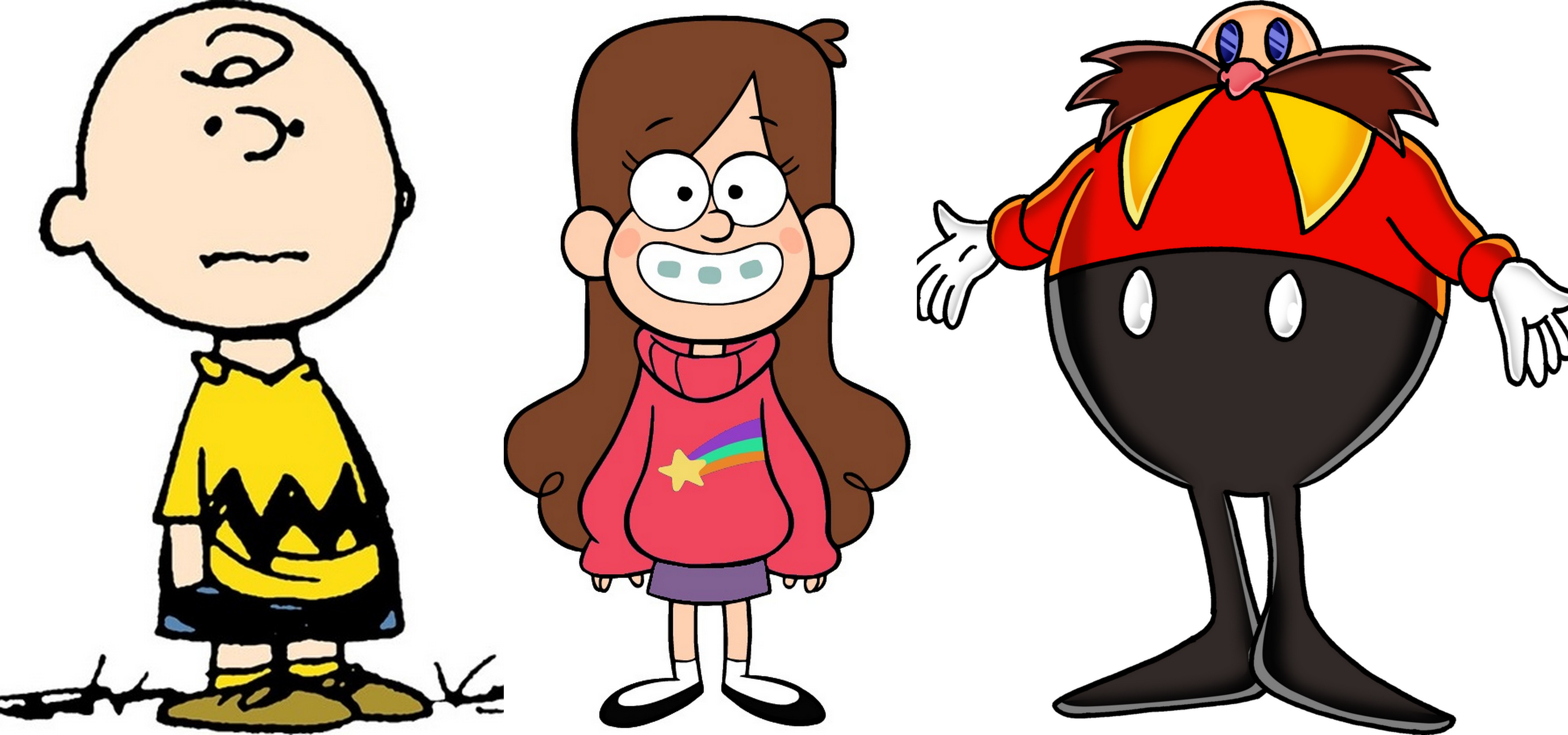
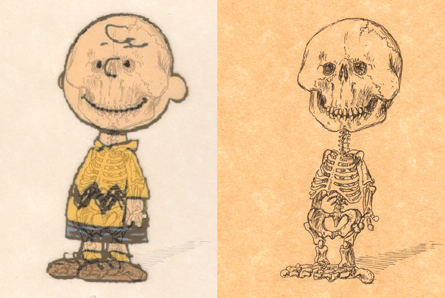
Cartoon anatomyI’m no expert on human anatomy, but I’m pretty sure Charlie Brown’s neck wouldn’t support his head. He’s always seemed a bit… top-heavy.

The same is true for Mabel Pines, and her neck isn’t the only problem—I’m pretty sure those legs wouldn’t carry her weight. Speaking of which, I consider it a miracle that Doctor Eggman can stand at all. His slender needle-legs wouldn’t hold up his mustache, let alone his, um, bulbous physique.

Yes, I’m overthinking things. Cartoons aren’t supposed to be realistic. Character designs are highly stylized. I get that, and I like cartoony proportions. (Would Snoopy from Peanuts be one-half as adorable with a proportionately-sized head? I didn’t think so.) All the same, I find myself occasionally scrutinizing cartoon characters and wondering which bones would be the first to break.

Consider the following image of Charlie Brown, courtesy of Michael Paulus.

Charlie Brown's skeletonFor someone frequently addressed as “blockhead,” Charlie Brown’s gargantuan dome is quite spherical. No way on God’s green earth would a few spindly vertebra hold up a skull like that.

I suppose cartoon anatomy joins the ability to pull stuff from nowhere as one of animation’s greatest mysteries.


This post was originally published on October 8, 2014. TMTF shall return with new content on January 19, 2015!

The Man Who Fixed the Internet

The Internet is a wonderful, nay, miraculous, invention. This intangible web of information, media and funny cat pictures transforms my laptop, a humble slab of plastic and silicon, into a window unto worlds real and imagined.

There are times—dark times—when the Internet fails. Some dark, vile sorcery makes the Internet disappear by severing its connection to my laptop. It is at times such as these, dear reader, that we who use the Internet have three options. We can live without Internet: a lamentable fate. We can attempt to restore it ourselves: a venture fraught with frustration and difficulty. Our best and final option is to seek a hero to fix our Internet for us.

The video above is the epic tale of such a man, a story worthy of a place among the myths and legends of old, to be handed down to future generations and never forgotten.

Behold, dear reader, the Ballad of a WiFi Hero.


This post was originally published on April 9, 2014. TMTF shall return with new content on January 19, 2015!

Annum Novum Faustum Felicem!

Annum Novum Faustum Felicem! Thus I wish you cheer.

Annum Novum Faustum Felicem in the coming year!

Annum Novum Faustum Felicem, as I said before;

Annum Novum Faustum Felicem now and evermore!

I presume I’ve now made plain this Yuletide wish to you.

Explication would make it mundane: a fate I fain eschew.

Ergo, Annum Novum Faustum Felicem! How so well expressed!

Annum Novum Faustum Felicem simply says it best.

Id est: Happy New Year!

~ Eugene Meltsner, Adventures in Odyssey

I would like to share these warm wishes from Eugene Meltsner, even though his words are so, well, wordy. A number of them are in Latin, and even some of the ones in English are a little hard to follow.

When I was a child, I delivered unto my listeners the following pronouncement: “People don’t always understand me when I use big words, but say let ’em learn ’em!” (At any rate, my relatives tell me I made such a statement; I don’t remember it, but that’s hardly a surprise.) Even as an adult, I sympathize with Anne from Anne of Green Gables, who declares, “People laugh at me because I use big words. But if you have big ideas you have to use big words to express them, haven’t you?”

I like wordy words, but I’ll be the first to admit they have two faults. First, the purpose of language is communication, and fancy-sounding words don’t always fulfill that purpose. What’s the point of using those words if nobody understands them?

The second problem with a large vocabulary is that is gives an impression of self-conceit. People who use big words seem like they’re showing off. In college, a classmate once accused me of shaming others by flaunting my vocabulary. His criticisms really stung. After all, I don’t consider it a personal insult if other people are more skilled than I at dancing or baseball or repairing cars. Why should anyone be outraged if I use big words? My classmate and I argued about it until a professor shut us up.

In the end, as much as I appreciate fancy-sounding words for their power to convey precise shades of meaning, I acknowledge they aren’t suitable for many contexts. The value of language is in being understood, not in seeming smart.

That said, instead of repeating Mr. Meltsner’s unintelligible benedictions, I’ll just say, “Happy New Year,” and leave it at that.

The Foolish Wise Men

I’ve always liked the Wise Men.

I think the Magi are one of the most fascinating things about the Christmas story. These Wise Men arrived from the east to worship Jesus, and then vanished as mysteriously as they appeared. Christian tradition tells us there were three Magi and even gives their names, but history offers few clues as to the number or identity of these enigmatic pilgrims. The Magi are popularly called kings and widely believed to have been scholars. Who were the Wise Men?

I don’t think it matters.

I like the Magi because I relate to them. They were men searching for truth, following a star in a quixotic search for light and meaning in a bleak, meaningless world. Their pilgrimage, beginning God-knows-where and ending at the dirty feet of a little child, resonates with me. Amid my doubts and struggles, I sometimes feel like a man stumbling in the dark, following a star and trusting I’ll find peace at the end of the journey.

Am I a fool for chasing so faint and distant a star as faith in a Savior? I may be. If I am a fool, then so are the Wise Men, ironically enough.

The Wise Men found what they sought, and another wise man wrote at the end of his life, “I have fought the good fight, I have finished the race, I have kept the faith.” For my part, I can only echo Robert Frost: “I have promises to keep, and miles to go before I sleep.” I have my own journey ahead, and I hope I shall finish it well.

Happy Christmas, everyone.

A Most Unusual Nativity Scene

Today’s Geeky Wednesday post features Mr. Bean and a delightfully odd Nativity scene. Yes, I know today is Friday.

This blog just had a Geeky Wednesday post a couple of days ago—you know, on Wednesday—but some unexpected complications this week have prevented me from writing a proper blog post for today.

Please accept my apologies, along with the weirdest/best Nativity scene I’ve ever witnessed. It comes from Mr. Bean, a comical British television program about a bumbling man child. (Despite his many faults, Mr. Bean still acts with more thoughtfulness, tact, and common sense than most celebrities.) In the video above, Mr. Bean takes a humble Nativity scene and elevates it to dizzying heights of weirdness.

Since I was a little kid, this was my favorite scene from any Mr. Bean episode. Now that I recognize its marauding robot as a Dalek from Doctor Who, my amusement has only increased.

To conclude on a more serious note, I’ve always loved well-crafted Nativity scenes. (Those garish inflatable ones are dreadful.) Depictions of the Nativity are a quiet reminder of the hope and meaning underlying Christmas.

I Really Don’t Hate Christmas

I can be a bit of a grump when it comes to Christmas, but I can’t find it in the darkest corners of my cynical heart to resist the joys of the season for long. The hope and beauty of Christmas outweigh the frivolous nonsense of the holiday it has become. Not even Ebenezer Scrooge or the misanthropic Dr. Doofenshmirtz can really hate Christmas.

Yes, the good Doctor—well, the bad Doctor—from Disney’s Phineas and Ferb is back, this time lamenting the fact he can’t seem to work up a nice, healthy hatred for America’s favorite holiday. Doofenshmirtz is one my favorite television characters, and I applaud him for flinging about words like ambivalenceinvective, and animosity in a kid’s cartoon. A large vocabulary is most admirable… even if it’s mostly spent griping about the holidays.