487. That Time I Saw a President Kicked Out of Office

Tomorrow is Election Day for the United States of America. The American people will gather to choose their next president. Some of us will worry for The Future of Our Nation. At least one of us will wish Batman were running for president instead of Trump or Clinton.

The presidential election takes me back to Ecuador, a nation of notorious political instability, and That Time I Saw a President Kicked Out of Office.

Lucio Gutiérrez was Ecuador’s president for only a couple of years, but long enough for his name to become a punchline in my family. Gutiérrez put up a lot of billboards during his presidency that read “Lucio Construye,” meaning “Lucio Builds.”

These signs, which often stood near roads under construction, were intended, I presume, to promote some initiative to improve Ecuador’s public infrastructure. What they really signified was unfinished roads and bumpy driving conditions. When my family and I were out driving, a “Lucio Construye” billboard warned us to brace ourselves for jolts. We reached a point at which any bumpy roads provoked me and my brothers to shout “Lucio construye!” from the back seat.
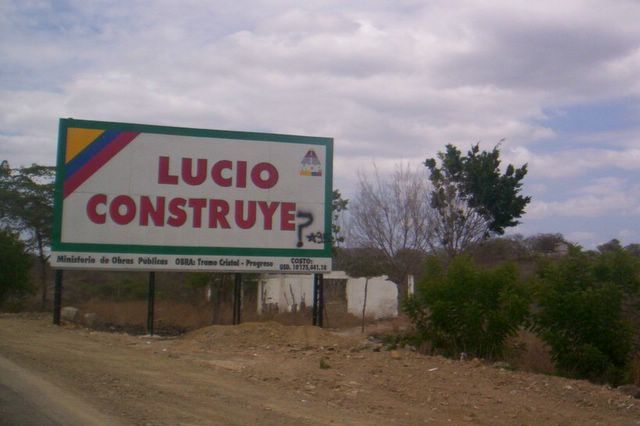
I don’t know who spray painted that question mark, but was a valid question: Lucio construye? Lucio builds? I guess Lucio did build the sign.

Following some political unrest, the Congress of Ecuador voted on April 20, 2005 to remove Gutiérrez from power, and the military publicly withdrew their support for him. Gutiérrez was overthrown by his own government. He fled the Presidential Palace in a helicopter, escaping mobs of protesters.

I heard his helicopter fly overhead. At the time, I was sitting quietly in my World History classroom at school, listening to updates on the political situation. My teacher had abandoned the day’s history lesson—after all, history was being made that day. As Gutiérrez fled, we heard the drone of a helicopter far overhead. “That’s his helicopter!” someone exclaimed, and it may have been. Alternatively, it may well have been a news or military helicopter, but I like to think it was the ex-president on the run.

Some of the protests were pretty rowdy. At one point, I got a face full of tear gas while walking to school. The wind blew the gas from a nearby protest to my school campus. It hit me like a bucket of vinegar, and stung quite a bit. On a scale of one to ten, one being a mild insult and ten being a jellyfish sting, the tear gas was maybe a three.

Since I didn’t actually see Lucio Gutiérrez removed from power, I suppose the title of this post is a bit inaccurate. It should be “That Time I Heard a President Kicked Out of Office” since I heard the helicopter, or even “That Time I Smelled a President Kicked Out of Office” because of the tear gas, but those titles just are just weird.

Alas, poor Lucio, who pretended to build things. We miss you. (We don’t really.)

In the end, the vice president, Alfredo Palacio, assumed the presidency, later to be succeeded by Ecuador’s current prez, Rafael Correa. The political unrest surrounding Gutiérrez subsided, only to be replaced by conflicts surrounding Correa. In fact, when I double-checked my facts for this post, I learned that Correa blamed Gutiérrez for allegedly provoking unrest in an attempt to instigate a coup. Another president, another crisis. “What has been will be again, what has been done will be done again; there is nothing new under the sun.”

I love Ecuador, my homeland, mi patria, but its politics aren’t the greatest.

Tomorrow is Election Day for the United States of America. I know a lot of people are worried, but hey—nobody is attempting to overthrow our president at the moment, and there probably won’t be tear gas. It could be worse. The road ahead may be rough, with plenty of bumps and jolts, but we can always shout “Lucio construye!” and keep moving forward.

486. Adam’s Story: The Themes

For anyone new to Adam’s story, here’s an introduction.

Every story means something. Patterns of meaning are called themes, and give stories greater depth and significance. The meaning of a story can be obvious, ambiguous, or deviously difficult to pin down. Heck, some people devote their entire lives to figuring out what stories mean; their profession is known as literary criticism, and it’s often a strange one.

Themes have a way of creeping into stories, insidious and ninja-like, sometimes without the author noticing. As I worked on previous versions of the Lance Eliot saga, I began to see motifs and patterns that I hadn’t planned. I was able to develop only a couple of them. It was too late to explore the rest.

I’m planning to rewrite the Lance Eliot saga from the beginning, which will allow me to explore its ideas more deliberately.

Here are four themes I plan to develop as I rewrite The Trials of Lance Eliot, the first part of my story.

Purpose

Lance Eliot’s journey to the fantastical kingdom of Guardia is apparently a pointless mix-up. He was summoned instead of Lancelot, the legendary knight of Camelot, due to a careless mistake. Now he’s stranded in Guardia, torn between amazement and annoyance, and convinced his journey is meaningless.

Is it?

I preceded an earlier version of the Lance Eliot story with these words from Geoffrey Chaucer: “Alas, why is it common to complain of God or Fortune, who so often deign, hiding their foresight under many a guise, to give us better than we could devise?”

Is there a greater purpose behind Lance’s adventure, or is he struggling against the aimless workings of a blind universe?

Anything out there?

I believe every story means something, but Lance isn’t so sure.

Before his journey to Guardia, Lance studies literary criticism for one of his college courses. He doesn’t take it seriously. Literary criticism appears to invent meaning where there is none. Like the dishonest tailors in “The Emperor’s New Clothes,” it points out things that aren’t really there.

Is anything there? Is there any meaning or purpose in the universe? Lance doesn’t know, and his unexpected adventure sure isn’t helping.

Overcoming self-destructive tendencies

At first, Lance Eliot is not brave, selfless, or virtuous. As a matter of fact, he is cowardly, selfish, and pessimistic. He also has a drinking problem. Lance is a far cry from Lancelot, the pure-hearted hero.

Lance Eliot, our… hero?

Tsurugi is broken. Once a legendary soldier, he is now a war criminal, working for a rogue general as an alternative to execution. Tsurugi seems to have given up on everything: his nation, his future, and his soul.

Paz gave up a quiet life to wander the kingdom as a professional gambler. Her miraculous luck has brought her a lot of money, but luxuries as friends and family are more than she can afford. Paz travels alone, homeless, always on the defensive… and her luck is bound to run out someday.

In their own ways, these unlikely traveling companions have given up on their lives, and given in to self-destructive tendencies. Guardia faces annihilation. If our heroes want to prevent the kingdom’s destruction, they’ll have to start by preventing their own.

Peace

Guardia is a kingdom of glass. It exists in a delicate balance, suspended between two warlike empires, keeping a fragile peace. Its strong navy and military, along with its defensible borders, are all that prevent Guardia from becoming a battleground for its powerful neighbors: a kingdom reduced to blood and ashes.

Paz was named for this peace. She has spent years traveling across Guardia, and doesn’t want to see it trampled by armies. Peace can’t last forever. What will happen when it fails?

Yeah, probably.

Three of the story’s main characters, mentioned above, are searching for a different kind of peace. Lance wants to find meaning or purpose in life. Tsurugi lives in a haze of grief. Paz is restless and unfulfilled. Other characters, whom I won’t mention yet, look for peace in darker places.

If I finish the Lance Eliot saga, perhaps I’ll find a little peace of my own. Here’s hoping.

The Divine Comedy

Around the time I began working on the Lance Eliot saga in earnest, I read Dante’s Divine Comedy for the first time. I couldn’t help but notice some similarities, and decided to make them deliberate.

The first part of my story, The Trials of Lance Eliot, shall roughly parallel Inferno, which chronicles Dante’s journey through hell.

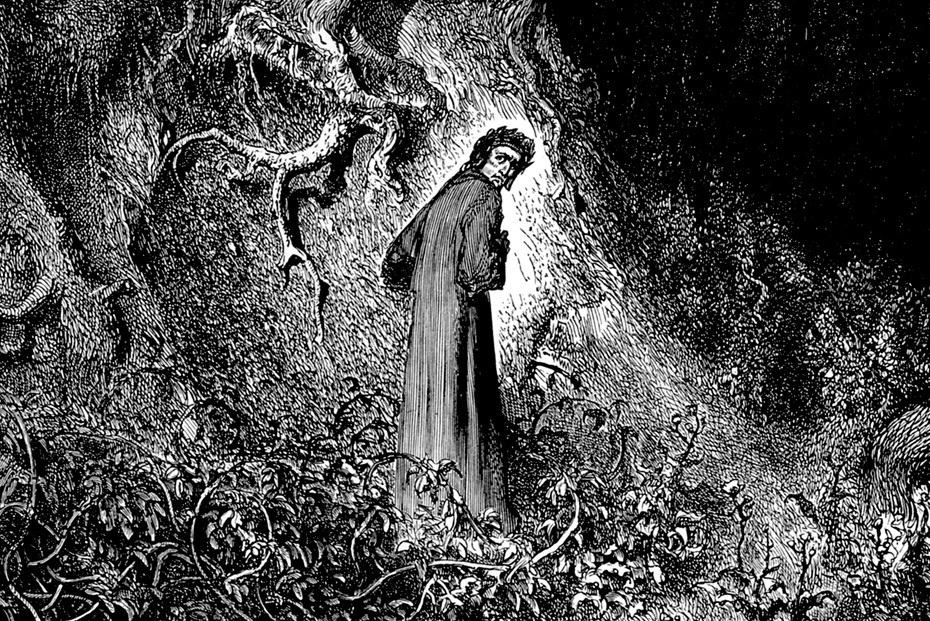
Y’know, Dante doesn’t look very heroic, either.

I hope to hit a lot of the same beats: the dark wood, Beatrice’s early influence, Virgil’s guidance, the final encounter with the Devil, and the escape to safety beneath starry skies. As its title suggests, The Trials of Lance Eliot will put its hapless protagonist through hell.

National Novel Writing Month just started, and while I’m not participating this year, it reminds me of a painful truth: The Lance Eliot saga is going to take a lot of work. Lance won’t be the only one struggling! As long as I’m on the subjects of hell and writing, I’ll conclude with a quote I’ve seen floating around the Internet:

writing-is-like-riding-a-bike

Pretty much.

The Batman of Shanghai

We live in a time of conflict and turmoil. In this age of uncertainty, the video above dares to ask the one question that really matters: What if the Batman stories were set in 1930s Shanghai?

The Bat Man of Shanghai is a four-minute animated miniseries; each of its three episodes is about a minute and twenty seconds long. The animation is gorgeous. Its style seems to take its cues from such diverse inspirations as ink wash painting, Japanese anime, Hong Kong action movies, and Western comics.

If you have any interest in martial arts, superheroes, animation, or stuff that’s cool, I highly recommend The Bat Man of Shanghai. The entire miniseries is only four minutes long. I wish it were much, much longer.

Here’s the second part:

And here’s the third part:

Is it too late to nominate Batman for President of the United States? Imagine it: The United States of America, one Nation under Batman. We could put his scowling face on US currency. (The Founding Fathers were great men, but none of them were Batman.) Heck, with the Dark Knight in charge, the US wouldn’t even need nukes. Who needs nuclear deterrence when you have the Caped Crusader?

Batman for President 2016.