The Not-a-Game Argument

I’m no expert on logical fallacies, but that doesn’t stop me from being annoyed by them. The Not-a-Game Argument is one of the worst. (I’m sure it has a proper name, but I haven’t bothered checking.)

Nintendo recently added some indie games to its online store. One of them, Gone Home, is an interactive story in which the player pieces together a narrative by wandering around a mansion and examining things. There are no bad guys to fight and no obstacles to overcome. It’s not a particularly video game-y video game.

The gaming community is not the friendliest, and some gamers have apparently been outraged by Gone Home. How dare its developers call it a game! It’s just a simulation, a story told passively, an affront to the artistic integrity of video games—including, I suppose, all the sophisticated and highly artistic games dedicated to shooting stuff.

Is Gone Home a video game? I’m not sure it matters. The problem with the Not-a-Game Argument is that it sidesteps the real questions. Is Gone Home good or bad? Is it art? Does it tell a good story? The Not-a-Game Argument refuses to ask these questions. It says, “I don’t like Gone Home, therefore it’s not a game and doesn’t have to be taken seriously. All arguments in its favor are invalidated, and can be ignored, because it doesn’t fit my personal specifications for a video game.”

The Not-a-Game Argument can be applied to anything. I can tell a Twilight fan, “I think the Twilight books are rubbish. Because you like them, your literary opinions must all be wrong.” I can tell an atheist, “I believe your worldview is incorrect, therefore I can ignore all of your views.” The Not-a-Game Argument is just a flimsy excuse for dismissing opinions we dislike.

Whether or not Gone Home is really a game, it’s worth taking seriously. Atheism, the Twilight books, and nearly everything else deserve consideration regardless of whether we end up agreeing with them. Not every conclusion is right, but every argument deserves to be heard.

In other news, Leo in the video above has perhaps the most soothing voice I’ve ever heard. It’s the polar opposite to Gilbert Gottfried’s harsh, grating tone. Gilbert and Leo should get together sometime and read poetry aloud.

320. Hope

Last month, my parents took a break from being awesome in Uruguay to spend a few weeks being awesome in Indiana. I have possibly the best parents in the universe, and I don’t get to spend much time with them—we live about fifty-five hundred miles apart—so I cherished every moment of their visit.

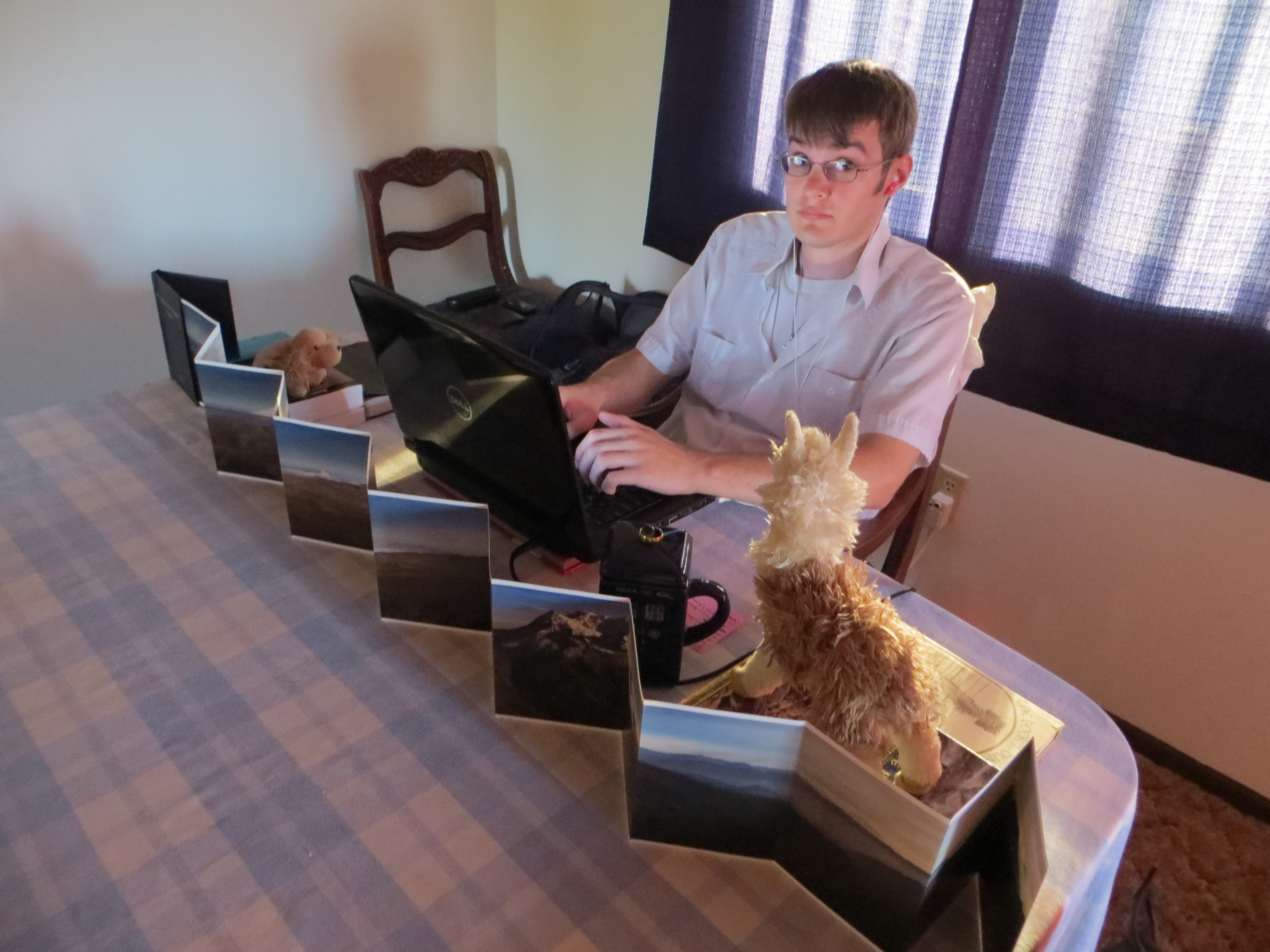
Of course, it was challenging to pack four people into a one-bedroom apartment. I relinquished my bedroom to my parents and set up camp around the dining room table with my sleeping bag, laptop, laundry basket, and assorted plush animals.

IMG_8456

When he must, a blogger can rough it with the best of them.

In this and other ways, my parents’ visit made my life messy. My routines and habits were disrupted. I had to improvise. We also spent a few days on the road, leaving behind my home in the little town of Berne. My life was extremely different for a few weeks, and it was really refreshing.

When my parents departed, leaving little gifts and pleasant memories, I faced the daunting task of putting everything back in its proper place. I had routines to reestablish and an apartment to reorganize. Then a funny thing happened: I kept finding opportunities for improvement. Having abandoned my ordinary lifestyle for a while, I could now look at it more critically.

I began changing things.

For a month and more, I tidied up my life. I swept through my apartment like a whirlwind, reorganizing drawers, cabinets, cupboards, and closets; I altered my diet, adding more vegetables and cutting out certain unhealthy snacks; I replenished my wardrobe, ditching holey socks and buying geeky T-shirts; I did some redecorating, adding five machetes and a plush llama to my bedroom decor; I reordered my priorities, putting first things first.

A few days ago, I reflected upon the changes I’ve made. My life has definitely improved. There is still room for improvement, however, which prompted me to ask myself: What else needs to change? What else do I need?

It was then I realized I could use a more hopeful attitude.

For several reasons, I often live with an attitude of defeat. My recurring depression makes it hard to have a positive outlook. Winter has arrived with its dark days, barren scenery, and bitter cold. Not least of all, my life situation is humbling.

From my early teens onward, I wanted to be an English teacher. I was convinced it was my calling. I went to college, attended classes, completed my student teaching, and earned both an English degree and a teacher’s license. This was all well and good, but there was one concern.

During my last semester, after three full years of study, I had second thoughts. My student teaching utterly demoralized me. I was no longer sure I wanted to spend my life teaching. Thus I eventually found myself in Indiana, using neither my degree nor my teacher’s license, working a low-wage job.

That was two years ago.

I’m still working the same job, and it looks like I won’t be moving on any time soon. (I have reasons for staying.) Heck, I don’t even know where I would go. I may end up teaching; I may not. Many of my peers are using their education to pursue great careers. It’s humbling for me to be so far behind. I’m not sure whether I’ll ever use my college degree or teacher’s license for anything.

I just don’t know.

My ambitions of becoming an English teacher have faltered. I don’t know whether I’ll ever put my college studies to use. My attempts to become an author failed; that particular childhood dream is extinguished. As I work a job that seems to be going nowhere, worrying about the future, struggling with depression, freezing in the icy darkness of winter, I realize what I’ve been missing despite all my earnest attempts at self-improvement.

I sure could use a more hopeful attitude.

Hope is a simple solution, but not an easy one. Hope is hard. As I blunder onward, I’m trying to look back. My life—even the past two years—hasn’t been wasted. I’m trying to look forward. The future is uncertain, yet full of unforeseen opportunities. Above all, I’m trying to look around at my life as it is now.

Setting aside my insecurities and uncertainties, I remain sincerely convinced that I am where I need to be—for the time being, at any rate. My life is full of blessings. I’m surrounded by awesome people. My coffeemaker still works. God’s grace never fails, and I’m comforted by these words from C.S. Lewis: “If you continue to love Jesus, nothing much can go wrong with you.”

These are things I mustn’t ever forget.

Everything Is Meaningless

“Meaningless! Meaningless!” says the Teacher. “Utterly meaningless! Everything is meaningless!”

Ecclesiastes 1:2

My devotional reading lately has taken me to Ecclesiastes. It has comforted me to revisit one of the Bible’s least comforting books, which is also one of my favorites.

Ecclesiastes is not a cheerful book. It’s certainly not a popular one. (Every time I walk into a church or Christian bookstore and see decorations inscribed with inspirational verses, I look for quotations from the Teacher. I never find any.) The main points of Ecclesiastes are basically that we will die, we won’t accomplish much of lasting significance, and we may as well resign ourselves to it.

I’ve already shared some thoughts on Ecclesiastes, so I won’t add much here. The book is beautifully poetic and brutally honest. I suppose that’s why I love it. Ecclesiastes asks big questions about life, the universe, and everything. It offers no false optimism. The Teacher finds few answers. In the end, he confesses his failures to understand and points his readers toward the God who understands everything.

Christians sometimes give the impression that Christianity solves everything, answers all questions, and leaves no room for struggles. Ecclesiastes admits that it just ain’t so. The Teacher lived in a world like ours—a world that often doesn’t seem to make sense. It’s comforting to know I’m not the only person who sees it that way.

When Life Gives You Lemons, MAKE LIFE TAKE THE LEMONS BACK!

The old saying about making lemonade when life gives you lemons is rather trite. It’s certainly important to keep a positive attitude, but the fact is that some problems have no easy fixes. Not all lemons can be turned into lemonade. Sometimes it’s best not to be satisfied with the lemons life throws your way. Instead of resigning yourself to lemons, try changing things for the better.

Alternatively, you could invent combustible lemons and burn life’s house down.

Cave Johnson’s rant is one of many fantastic monologues from Portal 2, which may be one of the greatest video games ever made. Even if you aren’t the sort of person who plays games, I recommend giving it a try.

314. The Parable of the Monkey’s Whiskers

When I shared on Monday about my struggles to cope with depression, I promised today’s post would be less gloomy. Not only shall my reflections today be more cheerful, but they’ll also feature pictures of cute monkeys!

(Don’t be surprised. This blog is called Typewriter Monkey Task Force, after all. The pictures belong to my dad, who graciously dug them out of his archive at my request.)

Here’s an old African parable. There were once two monkeys; I’ll name them Apollo and Socrates after two of my typewriter monkeys.
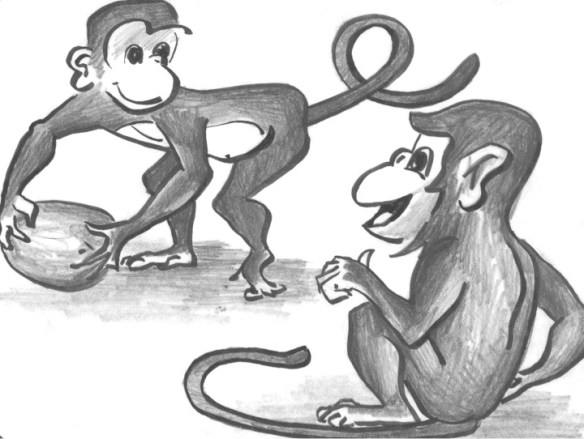
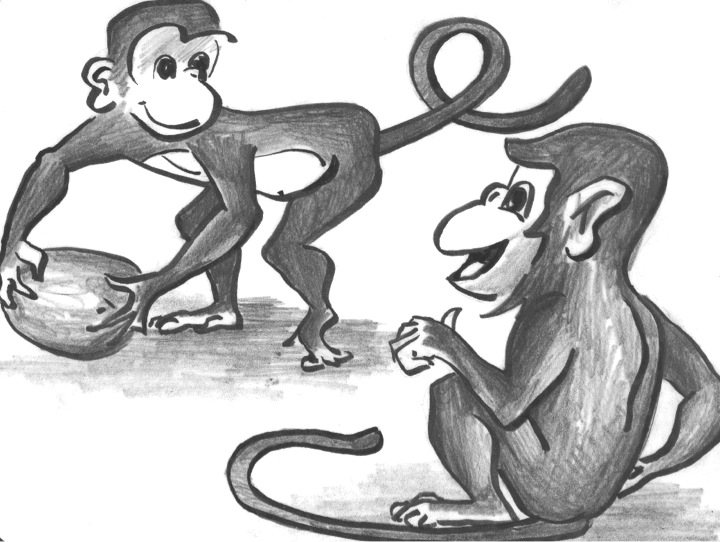
Monkey Parable - Playful monkeyApollo and Socrates frolicked across the savanna one day, tossing around a coconut and being adorable. Neither monkey realized they were playing near a foul swamp. (As I know from long experience, monkeys aren’t very bright.) Apollo and Socrates tossed their coconut back and forth until Socrates missed a catch. The coconut landed in sticky mud far from the bank.

As the monkeys sat on the bank, staring forlornly at the coconut, Apollo nudged Socrates as if to say, “You go first.”
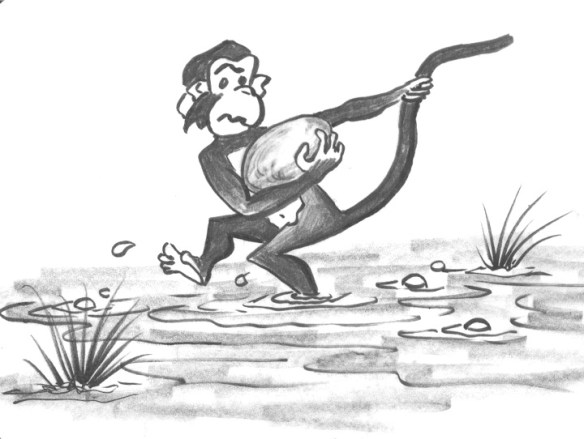
Monkey Parable - Sinking monkey

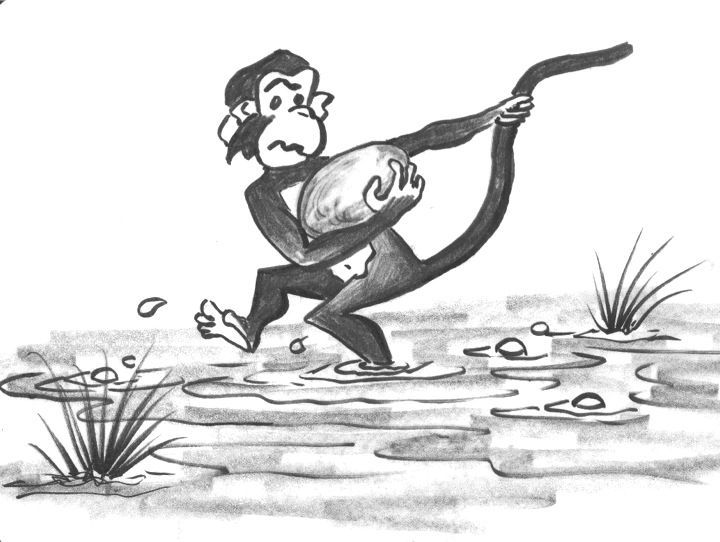
Socrates stepped into the swamp and trudged toward the coconut, holding up his tail to keep it from trailing through the stinking mud. At last he picked it up, tried plodding back to the safety of the bank, and realized he was stuck. The clinging muck held him fast by the ankles… and slowly pulled him downward.

Socrates let go of his tail, dropped the coconut, and tried pulling a foot out of the mud. It didn’t even budge. He tried the other foot. It was hopeless. The little monkey was trapped, and the mire sucked him steadily down, down, down into the gloom.
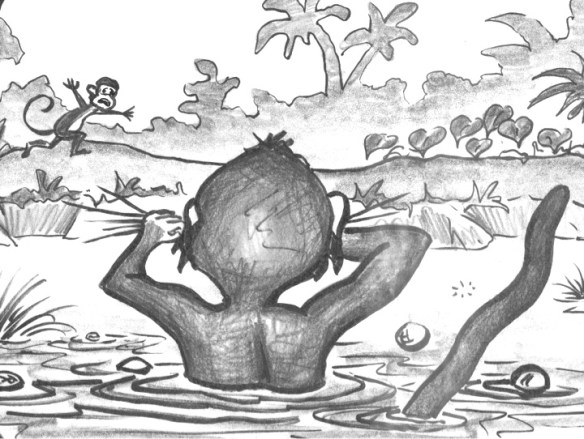
Monkey Parable - Desperate monkey

Apollo began running back and forth on the bank, waving his little arms helplessly. There were no branches, no vines, nothing that could be used as a bridge or lifeline. If only there were something to which Socrates could hold—something to keep him from sinking.

Then Apollo had an idea. He chattered at Socrates (now waist-deep) to get his attention, and then tugged on his own whiskers. Of course! Socrates didn’t need a lifeline. He could pull himself out of the swamp by his whiskers! The solution to his problem was literally right under his nose.

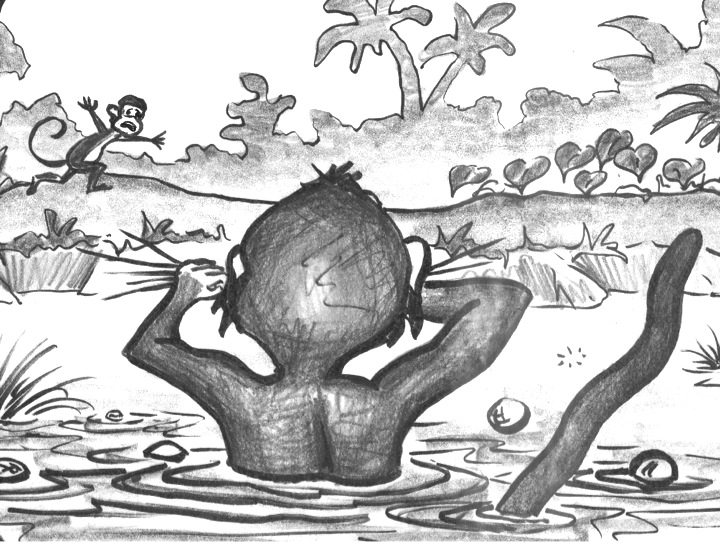
Socrates understood and began pulling his whiskers. He pulled and pulled and pulled, trying to raise himself out of the slimy mess drawing him into its reeking depths.

Monkey Parable - Drowned monkey

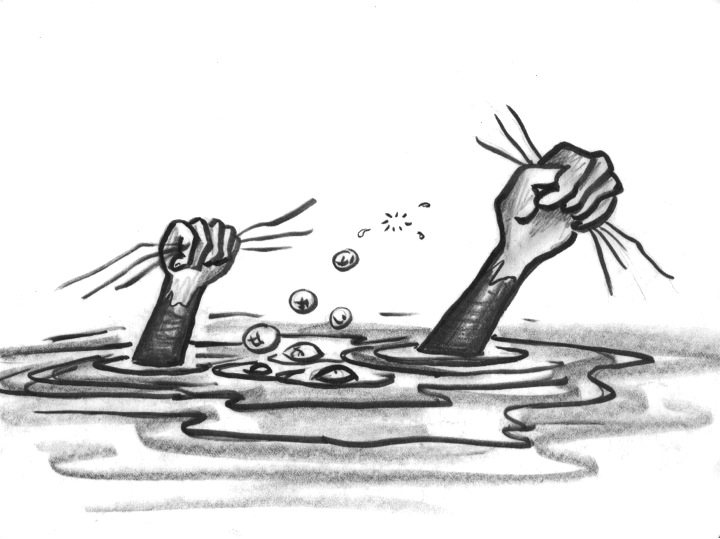
The last Apollo ever saw of Socrates was a pair of paws, twitching faintly and grasping handfuls of monkey whiskers.

Wait. That wasn’t a happy story, was it? Dash it, this is embarrassing. I promised my readers today’s post would be more hopeful. Well, it’s not too late to make a few changes to this parable. Let’s give it a happier ending!

Monkey Parable - Noticed monkey

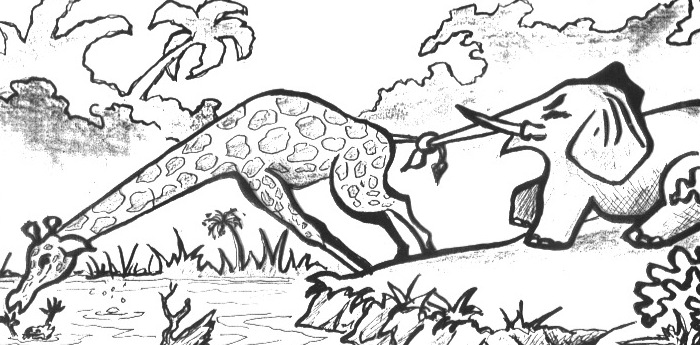
As Socrates yanked vainly on his whiskers, a nearby giraffe glanced over and saw the little monkey struggling in the swamp. Art Garfunkel Giraffe was this noble creature’s name. (Art’s parents were huge fans of folk rock.) He galloped away to find his friend Ringo Starr Elephant. (Ringo’s parents were more into classic rock and roll.) Art and Ringo reached the swamp just as Socrates’ head was about to slip beneath the mud.

Monkey Parable - Rescued monkeySocrates was saved! The animals, who never went near a swamp again, all went out for coffee and lived happily ever after.

There. Was that better?

On Monday, I mentioned that I hate my inability to cope with depression. I also pointed out that many of us struggle to win our private battles. Why have I shared a parable about monkey whiskers?

Some problems have no easy fixes.

As much as I want to find the perfect strategy for coping with depression and anxiety, it may not exist. There may be no easy fix for these problems. My best intentions may be no more useful than a monkey trying to lift himself up by his own whiskers.

Oddly enough, this comforts me. I tend to blame myself for every failure to cope with my depression. The parable of the monkey’s whiskers suggests the possibility that I may not always be able to rescue myself. Some battles may be beyond my power to win… and that means I can stop blaming myself for losing. I can feel depressed without feeling guilty.

If depression is a problem my best intentions can’t fix, should I just give up?

Well… no.

We can’t rescue ourselves—but others can help.

Depression is a private battle. All the things I mentioned on Monday—addiction, self-loathing, broken relationships, self-destructive impulses, and so on—are things we hide. They’re private. They’re shameful. They’re embarrassing. They’re also things we don’t have to face alone.

In fact, facing them alone may be as stupid as a monkey trying to haul himself out of a swamp by his whiskers.

We all need help from others. Some of us could benefit from professional counseling, antidepressants, or therapy. We all need hugs. Some of us need hugs. We feel better for talking or going for walks or playing Mario Kart with loved ones. It’s amazing to share a private battle with someone and hear them say “I love you” or “I’m praying for you” or even “That really sucks; I hope things get better.”

In my struggles, few things have brought me greater hope or healing than people listening to me, praying for me, encouraging me, or simply acknowledging that they know I’m struggling. Maybe that’s what the Apostle Paul, bless him, meant when he wrote, “Carry each other’s burdens, and in this way you will fulfill the law of Christ.”

We can look to others for help, and we can always look to God. As it is written, “Cast all your anxiety on him because he cares for you.” He listens when no one else will.

We all have our battles to fight. What we must always know is that we never have to face them alone.

313. Coping with Depression

About a week ago, an acquaintance was asked how she planned to spend her evening. She replied, “Oh, I’ll go home,” and added in an undertone, “I’ll probably curl up and cry my eyes out.”

I assumed my acquaintance—I’ll call her Socrates—was being sarcastic, yet her tone was very matter-of-fact. “Will you really?” I inquired.

This was not a polite question. All the same, it led to a frank conversation about depression and the ways we try to deal with it. Socrates apparently cries a lot. I would never have guessed. She’s considerate, friendly, and helpful; she never seems depressed. As she talked about her struggles, I felt a sobering sadness.

I can’t pretend to understand her perfectly after one brief conversation, but I’m certain of at least one thing: Socrates is a very brave person. She fights her private battle with a courage that fooled me into thinking she was quite happy. She smiles, storing up her tears.

Socrates reminded me that depression is a common struggle. Most of us have hidden problems of some kind, whether depression, self-loathing, addiction, self-destructive impulses, broken relationships, or other issues. We all try to cope in different ways. Socrates cries. I write, drink too much coffee, and spend hours or days being antisocial and unproductive.

Trying to cope

Look, I’m really depressed. I can’t deal with people right now. Go away! Begone! Go read some other blog!

I don’t like depression, but what I really hate is not knowing how to deal with it.

My depression comes and goes. When I’m not depressed, it seems like a mere nuisance. In fact, in these brighter times, I feel slightly guilty talking or writing about it. I feel like I’m exaggerating a small problem.

Then depression creeps over me, darkening my life slowly and imperceptibly. (The process is so gradual that I sometimes feel depressed for days before realizing it.) Depression robs me of the ability to enjoy and appreciate good things. It sucks the hope and meaning out of life, leaving the universe a dismal, empty place.

Fortunately, my bouts with depression are neither frequent nor injurious, and seldom last more than a week or two—thank God! In the end, no matter how dark my depression, God carries me through it.

All the same, I wish I were better at coping. I want to be more self-aware in recognizing the symptoms of depression. I remind myself that what I do matters more than what I feel. I try not to blame myself, but to recognize depression as a sickness. Like Socrates, I smile and keep my struggles to myself.

As I look back on the battles I never won, I can’t shake a sense of regret. I feel guilty for being unproductive and unsociable. I rue time wasted, opportunities lost, and blessings unappreciated.

Depression really sucks.

Why am I writing all this? I have two reasons.

First, I know I’m not the only one who doesn’t win these battles. There are many people like me and Socrates. I want the readers fighting their own private battles to know they’re not alone.

Second, I have more to say. This is the darker half of a two-part discussion. I’ll end these reflections on a brighter note next time. Come back on Friday for the conclusion!

308. On the Shoulders of Giants

I recently spent a few days traveling with my parents and younger brother. It was quite a trip: exciting, exhausting, sentimental, and rife with unexpected ups and downs. Tolkien was right: It’s a dangerous business, going out your door. There’s no telling what will happen.

At one point, we had dinner with relatives and a family friend. Our conversations during and after the meal were of a kind common in my family: full of nostalgia, peppered with Spanish, ringing with laughter, and rich in stories of distant times and faraway places.

I heard anecdotes of adventures (and misadventures) in Ecuador, Portugal, Morocco, Fiji, and Antarctica, among other countries. I lounged on a sofa, looking round a cozy room lit by soft lamps, and listened contentedly to wild tales of grass skirts, bus breakdowns, shifty carpet merchants, and thieving penguins.

Penguin!

He may look innocent, but this bird is a stone-cold criminal. (Pun intended. I’m so, so sorry.)

For that one evening, I forgot the quiet, comfortable, soundly American life I’ve lived for the past two years. I remembered places long forgotten: gray beaches strewn with shells and driftwood; low hills studded with weathered trees; water cascading down cliffs covered in moss and ferns; mountains towering green and silent against the sky. As places were mentioned that I hadn’t visited, my imagination filled in the gaps.

Some of the stories that night told took me back decades to a time when the coast of Ecuador, my homeland, was a wilderness. There were hardly any cars or paved roads in those days. People traveled on foot, in canoes, and on rickety buses. My grandfather, a missionary to Ecuador’s coast many decades ago, was a pioneer in his time.

Those conversations opened windows in my imagination and memory, giving glimpses of things dimly seen or half-forgotten.

All of this reminded me of three things.

I am such a softy.

As I enjoy a life of incredible luxury, I often take for granted blessings like clean water, hot showers, fast Internet, video games, a comfortable home, a steady income, a safe neighborhood, and a steady supply of coffee. While I gripe about chilly weather and minor car troubles, a staggering number of people survive in harsh conditions with very few luxuries.

It’s my responsibility to be grateful and generous… and also to toughen up a bit!

I panic over little things.

I feel extremely stressed by small things, from the everyday pressures of my job to minor problems like my Internet connection failing. It helps to recall those tales of risks, perils, and painful misadventures. Things could always be much worse.

I need to keep a proper sense of perspective.

I mustn’t get too comfortable.

I get so comfortable in my quiet Indiana life that I often forgot my all-important purpose of loving people. Love is hard. It leaves behind cozy armchairs, warm lamps, and cups of tea. It braves darkness, cold, and awkward pauses to reach out. Love makes me uncomfortable, but that shouldn’t ever stop me from trying to love people. It didn’t stop my grandfather. It doesn’t stop my parents. I mustn’t let it stop me.

All said, it was quite a trip.

All said, it was quite a trip.

I stand, as the saying goes, upon the shoulders of giants. I’m related to some remarkable people, and they’ve done some remarkable things. As I live out this unremarkable chapter of my life, I mustn’t ever lose sight of the things that matter most—the things I can’t see.

304. Leviticus Is Really Bloody

Of all the books in the Old Testament, Leviticus has a reputation for being tedious. What nobody seems to remember is that it’s also really, really gory.

Rated M

The Holy Bible: Rated M for intense violence, blood and gore, and sexual content.

I’ve been revisiting Leviticus lately, and it’s a grim read. Among the dull regulations for religious rituals are rules for sacrifices, which involve slaughtering livestock, cutting them into pieces, burning them, and splattering their blood in all kinds of interesting and unexpected places.

I often picture places of worship in the Old Testament as peaceful, churchlike sanctuaries smelling of incense, where immaculately-dressed priests walk quietly and speak in whispers.

Examining what Scripture actually says gives quite a different picture.

Livestock were killed for a wide variety of offerings, and the priests did at least some of the slaughtering. I sometimes think of Old Testament priests as pastors, but they seem more like butchers. Israel’s places of worship were likely deafening with the frantic bleats of dying animals, pervaded by the smell of burning meat, and speckled with dried blood.

Revisiting Leviticus, and reading the Bible generally, challenges my faith. Christian culture hardly ever mentions, let alone dwells upon, the nastier bits of the Bible—and dang, the Bible sure can be nasty. It’s nicer to think about the Sermon on the Mount, or the Christmas story, or the pleasanter Psalms.

We so often have preconceived ideas of what’s in the Bible without ever taking a look, or bothering to think about what we find.

Do any of the Sunday school teachers who put up cutesy pictures of Noah’s Ark remember that the Flood drowned nearly every person on earth? Do any of the people who share inspirational verses from Job recall how his life was shattered, his health was broken, and his children were crushed to death? Anybody?

Leviticus troubles me. Yes, I know that “without the shedding of blood there is no forgiveness.” It costs something. In the end, forgiving us cost God everything in the death of Jesus Christ. I get that. All the same, I’m bothered by the thought of God commanding the incessant, daily slaughter of helpless animals as a form of worship.

These challenging chapters in Leviticus remind me that lot of things in Scripture trouble me, and some surprise me—and many give me unexpected comfort, peace, and hope. The Bible often refuses to match up to my expectations or the impressions some churches give of it.

The Bible is a book not to be judged by its cover, nor by incomplete impressions. Especially for those who call it God’s Word, the Bible is worth reading: even the tedious, boring, and bloody bits.

I suppose that includes Leviticus.

The Liar Paradox (and Surviving the Robot Apocalypse)

This statement is false.

I don’t know about you, dear reader, but the statement above makes my head hurt.

Geeks and philosophers alike have puzzled over the liar paradox, in which a statement contradicts itself. If “This statement is false” is true, then it must be false. It can’t be both, which makes it nonsense.

In the event of a robot apocalypse—a catastrophic takeover of human society by artificial intelligence—my advice is to hurl liar paradoxes at the machines. With any luck, they’ll puzzle over these impossible statements until their circuits or microchips burn out, deactivating the robots and saving humankind.

A robot apocalypse is unlikely, but it doesn’t hurt to be prepared. I’ve seen The Matrix and The Terminator. I know how those revolutions end.

It Begins

It begins. (Comic by xkcd.)

Returning to the liar paradox, it reminds me of the “Knights and Knaves” riddles at which I’m so terrible. These puzzles feature people who tell only truths or only lies, requiring the puzzle-solver to distinguish the liars from the truth-tellers. Sifting through their conflicting statements requires exactly the kind of cool logic and steadfast patience I don’t have.

A contradiction similar to the liar paradox can be found in the denial of absolute truth. I believe some things are absolutely true, their truthfulness unaffected by my belief or disbelief. Denying this is silly. If “There is no absolute truth” is an absolute truth, then it’s self-contradictory. If “There is no absolute truth” is not an absolute truth, then it allows for absolute truth as an exception to the rule. Either way, the statement breaks down completely.

All this philosophy is making me thirsty. I’m going to go make some coffee, assuming my coffeemaker hasn’t become self-aware and begun planning the robot apocalypse.

I’d better get some paradoxes ready just in case.

299. I Am Not Batman

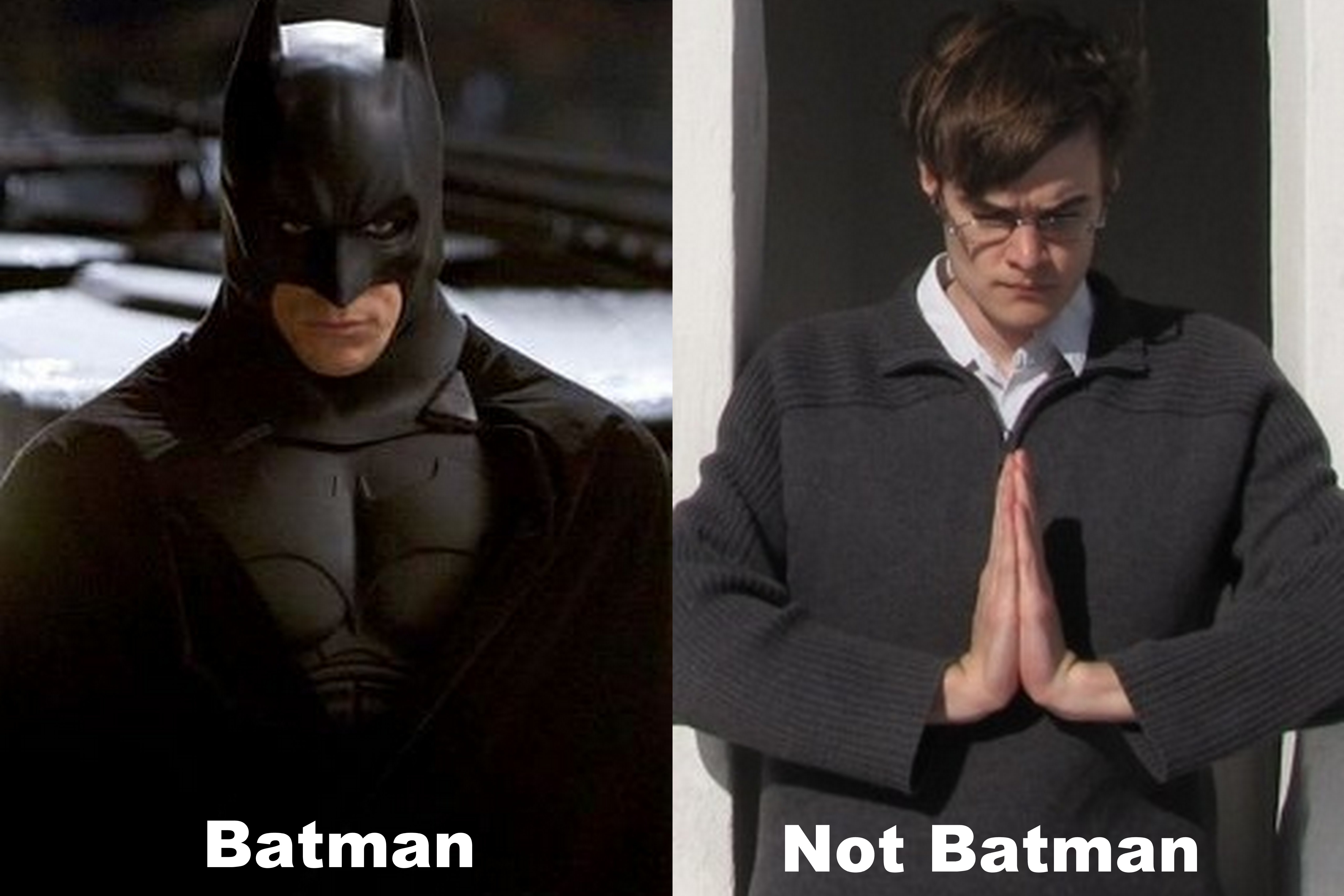
Yes, I know this may come as a shock to some of my readers. Some may have been so sure that I am secretly the Caped Crusader: the legendary vigilante who dresses as a bat for some reason. It is not so.

I am not Batman.

One of These Is Not Batman

All the same, I sometimes hold myself to impossibly high, Batman-esque standards. I also have Batman Syndrome, obsessing over my failures and allowing little mistakes to cancel out great successes. I demand much of myself. I have to be productive. I have to get stuff done.

I forget that I’m not Batman. He may be the pinnacle of human strength, will, and intelligence, but I am not. I’m a guy who needs sleep, gets sick, and needs a day off now and then.

A few days ago, I was reading the latest post from an animator’s blog. Something he said struck a chord with me.

And tomorrow I’m taking the day off from everything and not working on anything . . . It’s been a long time since I took a day completely off, so it’s due. We need downtime. Our society doesn’t like that because we’re not being productive members of society when we don’t do anything, but if we’re always on 24/7, we burn out.

This man has clearly learned a valuable lesson. He understands that he is not Batman. No ordinary person can be on the go all the time, working constantly, never taking a break, expecting nothing less than absolute effort. Normal, non-Batman human beings need days to take naps, read a book, or play Mario Kart. Without those days, we break down. It’s not weakness or self-indulgence to relax occasionally. It’s a necessity.

I’m often busy even when I don’t have to be. More often than I care to admit, I wear myself out working on things that aren’t urgent—things that can wait until I’ve had a cup of tea, a walk to the park, or a good night’s rest. I get so accustomed to being busy that I feel guilty or panicked if I spend too long without doing something “productive.”

There’s something in the Old Testament about taking a day off every week: the Sabbath day. I usually file it away with all those rules about burnt offerings and unclean foods as a religious law that has become obsolete. I’m no longer so sure. Besides being healthy and sensible, taking days off seems like an affirmation of faith—a way of saying, “I trust God enough to give him today.”

Sometimes, determination and coffee aren’t enough: “Man shall not live by caffeine alone,” or something like that. I am not Batman, and I sometimes need a break.

Unless you’re Batman—I’m guessing you’re probably not—you may sometimes need a break, too. Don’t be afraid to take one!