41. International Travel

I type these words from the sunny city of Montevideo in Uruguay, relieved to have escaped the icy grip of another Indiana winter. I had intended to compose a long, thoughtful post today, but three things prevent me from doing so.

First: My access to the Internet is limited by a modem, which is in high demand among the other members of my family.

Second: My computer, Polyphemus, refuses to connect to the Internet at all. Stubborn machine.

Third: My typewriter monkeys, which I had shipped to Montevideo in a largish cardboard box, were the victims of a luggage mix-up. The airport administrators informed me earlier today that my monkeys are currently located in an airport somewhere in southern Vietnam. The airline workers are doing their best to return my monkeys as quickly as possible, but for now I have no choice but to update the blog myself. It’s actually kind of a tedious process. I hope my monkeys get back soon.

Anyway, I spent the last few days packing up my remaining possessions and transporting them (and myself) from Mishawaka to Montevideo, a trifling journey of about five and a half thousand miles.

I think I must be getting old and cynical. I used to love traveling, whether road trips or international flights. Gas stations and airports used to fill me with excitement. Now they fill me with a vague sense of dread. I’ve spent too many hours trying to sleep on airplanes to regard them with anything but dislike. It may be possible to get a good night’s sleep in an airline seat, but I have yet to do it.

I suppose I shouldn’t grumble. I have much for which to be thankful. Not only did I reach the right destination at the right time, but I arrived with all my luggage (sans typewriter monkeys). At no point did I miss a flight, leave behind a piece of luggage or repeat any of the other mistakes I’ve made on previous travels.

Well, I guess I should wait for my monkeys to arrive. I hope they’re having a good time in Vietnam.
38. Packing

Missionaries live by a number of ancient and sacred proverbs. Where God leads me I will follow; what God feeds me I will swallow is one such proverb, inspiring missionaries everywhere to eat fried leaf-cutter ants, roasted guinea pig and other exotic fare. A pocketknife may save a life is another such proverb, prompting many missionaries never to be caught without one.

One of my favorite missionary proverbs, the Packing Proverb, has been very useful to me: I will make it fit! Although I believe in the inerrancy of Scripture, I think Paul must have forgotten to include the art of packing in his lists of spiritual gifts. Being able to pack efficiently and effectively is a gift of God.

Missionaries in particular seem to have been gifted with a spectacular ability to make any item, no matter how large or unwieldy, fit in any piece of luggage. It’s almost like magic—no, more like the bag in Mary Poppins that can hold anything.

Over the past few weeks, I’ve been packing things into suitcases and storage boxes as I prepare for my imminent trip to Uruguay. There’s something fun about fitting things together like pieces in a jigsaw puzzle: the delicate items cocooned in socks and T-shirts to prevent them from breaking, the lighter objects placed on top of the heavier ones to prevent them from being crushed, the things that may be needed during the trip positioned where they’re easily accessible.

It’s almost a pity to unpack baggage after it’s been packed with such care.

However, care is necessary when traveling—especially when traveling internationally. Luggage handlers have little respect for luggage. Bags are dropped, shoved and thrown on top of each other. Fragile items in suitcases are reduced to smaller, more conveniently-sized pieces and distributed lavishly among hardier items. The contents of baggage are creatively rearranged by gravity.

I’m probably making it seem much worse than it is.

All the same, I’m taking no chances. I’d better go buy more socks.

27. Breast Cancer Awareness Month

I’ve become acquainted with a nice old custodian who works at the school at which I’m student teaching. It was quite a surprise to run into him a week or two ago and discover that his beard had turned a shocking shade of neon pink.

He told me he colored his beard because October is Breast Cancer Awareness Month and he wanted to show support. He hasn’t been the only person at the school to sport pink hair this month. A number of students have added pink highlights or extensions to their hair, and one of my MEC students colored his Mohawk pink.

It’s been touching to see the support for the fight against breast cancer. It’s also been a little jading. Dyeing hair pink or wearing I Boobies bracelets doesn’t do much to help cancer victims—at least not directly. Rocking the bracelets and pink hair does raise awareness of the problem, and awareness of the problem brings us a little closer to solving it.

Since I’m only a few days away from finishing student teaching—and consequently busy and exhausted—I’m going to wrap up this post with a short cartoon from JKR over at Fredthemonkey.com.

(For the record, Fred is no relation to any of my monkeys.)

The cartoon, aptly titled The Important Things, presents its protagonist with several dilemmas. How can he scrounge up the money for a new Nintendo DS game? (The game he mentions is awesome, by the way.) Can he get his true love to go on a date with him? And could there possibly be more important things than buying a new video game?

Enjoy the cartoon here!

25. Beards

I recently attended a production of “The Hobbit” by the Bethel College Theatre Department. It was a fine performance, despite the fact that most of the dwarves were played by women. Not enough actors tried out, so all but three of the dwarves were actresses in beards. Gandalf also had a beard. Almost everyone in the production had a beard. As much as I enjoyed “The Hobbit,” it was a painful reminder of a grave personal shortcoming: my lamentable inability to grow facial hair.

Oh, you may laugh. You may scoff at my woes and call them absurd. (You’d be absolutely right, but that’s not the point.) I wish I could grow a beard. Granted, facial hair hasn’t always been a good thing. Beards and mustaches have been the distinguishing marks of men whose ideas we hold in contempt or suspicion. Take Hitler and that silly excuse for a ’stache. Take Marx or Nietzsche or any of the other Dead European Thinkers With Strange Ideas And Facial Hair. Beards and mustaches clearly do not a virtuous man make.

All the same, I wish I could grow a beard.

Virtuous men sometimes have beards. Jesus had a beard. What, you don’t believe me? I have it on good authority. In a passage most commentators interpret as a prophecy about the Lord Jesus Christ, Isaiah clearly indicated that God’s Servant would have facial hair: “I offered my back to those who beat me, my cheeks to those who pulled out my beard; I did not hide my face from mocking and spitting” (Is. 50:6). Brethren, if we cannot trust Isaiah on the matter of the Servant’s beard, how can we trust him on any other matter?

(For the record, Jesus is the Son of God whether he had a beard or not.)

I suppose I should reserve my theological speculations for more important matters, such as the degree to which our salvation is predestined or whether people with spiky hair are holier than people without spiky hair.

No-Shave November is coming soon. I’m tempted to stop shaving my lack of facial hair and see what happens, but I’ll probably decide not to participate. I’ll leave No-Shave November to the pros. Perhaps some day I’ll be able to join them. We’ll see.

22. Autumn

People talk about how much they love the autumn season, with its pumpkins and colored leaves and frosty mornings. I stare at them with horrified incredulity. Everything dies in autumn. The trees lose their beautiful leaves and become skeletons. The temperature plunges from pleasantly warm to icy cold. There are many things I’ll never understand in this life—the precise theological nature of the Trinity, the popularity of the Twilight novels, trigonometry—and why people like autumn is one of them.

When I first came to Indiana, I knew autumn was coming. I expected the leaves to turn bright colors and fall from the trees. What I didn’t expect was for all green to vanish, leaving behind murky browns and grays.

“I love autumn,” said someone during my first semester of college.

It seemed like a good time to share my observations about the season. “Everything is dying,” I pointed out.

“That’s normal.”

“You clearly don’t understand,” I replied, speaking very slowly. “Everything is dying. The grass and the trees. Dying. There’s frost every morning. It’s really, really cold. And people put up hideous Halloween decorations.”

“It’s autumn, Adam. It happens every year.”

“And you like autumn?”

He nodded, and I was left to shake my head and wonder.

Autumn isn’t all bad. It’s fun to see carved pumpkins on front porches. The sudden ubiquity of pumpkin pie is wonderful. Autumn is the season of Thanksgiving, and the Christmas season draws steadily nearer. I’m willing to concede that autumn has its blessings. I just don’t like the cold, or the tawdry Halloween decorations, or the tendency of beautiful green things to die.

Are you an autumn person? If so, maybe you can bring me a little closer to unraveling the inexplicable mystery of why people actually like the autumn season.

10. Squirrels

It was fun to grow up in Ecuador for many reasons, but one of them was the way visitors to the country reacted in awe and amazement to everyday things. A missions team would come to Quito from the US and gape in wonder at llamas or street performers or the Andes Mountains, and I would feel a smug sense of pride at considering these miraculous wonders a normal part of my missionary kid life.

Then I came to Indiana and began doing the same thing as those visitors, except my awe and amazement were reserved for squirrels.

In my fourteen or so years in Ecuador, I only ever saw two squirrels. One was kept in a cage as an exotic animal at a beach resort. The other crossed my path while I was visiting a cloud forest with my high school biology class. Cloud forests are basically high-altitude rainforests, and the location we were visiting was renowned worldwide for its vast variety of bird species. My class was given the option of taking an early-morning bird-watching tour. Most of us agreed to try it.

So at about six o’clock in the morning we found ourselves stumbling along a jungle path, bereft of breakfast or coffee, clutching our binoculars and trying to stay awake as our guide pointed out toucans and parrots that were so far away they all looked alike. I was almost asleep on my feet when someone gave a sharp, sudden cry.

“Squirrel!”

We immediately abandoned whatever tropical bird our guide was pointing out and looked around eagerly for the squirrel. There it was! A squirrel! Running across our path just thirty feet away! We were fascinated. In the end, the most remarkable and memorable thing about that whole bird-watching tour was the squirrel.

Then I came to Indiana to attend college and realized there are squirrels everywhere. I immediately pointed this out to people.

“Squirrels!” I exclaimed. “Right there! Cute fuzzy furry squirrels!

People began giving me odd looks.

Squirrels are adorable. I don’t understand why people aren’t more excited about them.

7. The Death Cupboard

Nobody takes my tea without my permission and lives.

That’s not to say I won’t share. I love sharing tea with friends, but woe to the fool who takes my tea without my consent!

All right, I’m exaggerating a little. I may not summon the full force of my mighty wrath if you take my tea, but I’ll certainly be a little irritated.

It’s not that I mind people drinking my tea. To be honest, I’m secretly pleased when people ask for tea; it’s always a pleasure to serve a fellow tea-drinker. It’s that I feel vaguely insecure when my possessions vanish without warning.

At the beginning of my sophomore year of college, I moved into a house with seven other young men and immediately realized my tea was in danger of falling into the wrong hands—by which I mean any hands that weren’t mine. I also had baking supplies and coffee and an emergency stash of ramen noodles, all of which would become public property unless I did something to defend them.

I promptly annexed a kitchen cupboard and filled it with my eatables and drinkables. But what was to keep bandits from raiding my cupboard and carrying off my cherished tea? I gave the problem considerable thought and devised an ingenious solution.

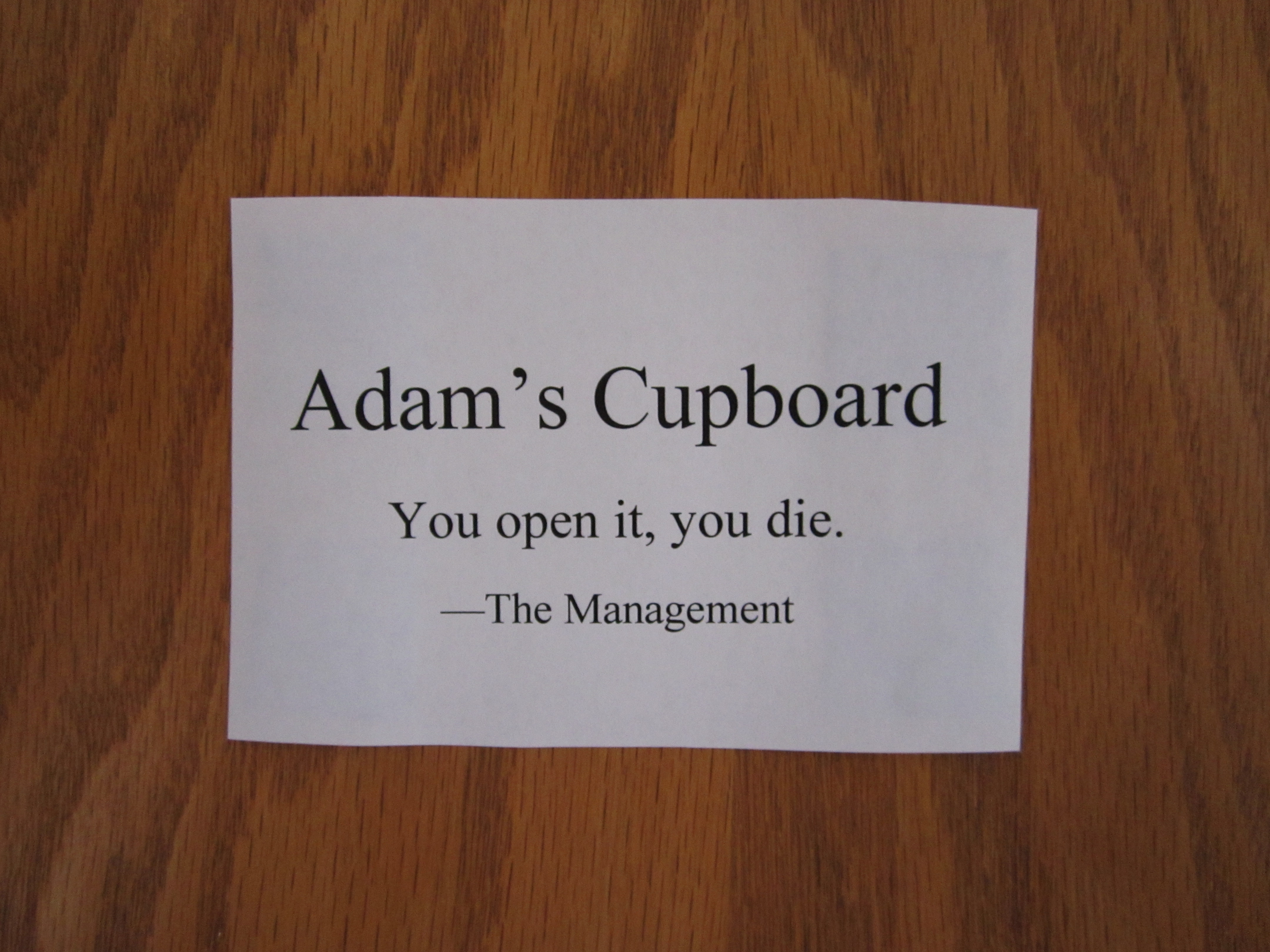
I put up a sign.

Well, that was a mistake.

Several of my housemates and a number of visitors made a point of opening my cupboard just to annoy me. It became known as the Death Cupboard. However, even though the cupboard was opened regularly, my plan was sort of a success. No one took my tea without asking permission.

Since death apparently wasn’t a convincing enough penalty to keep people from opening my cupboard, I later revised the sign to read, Adam’s Cupboard. You open it, Adam unfriends you on Facebook. –The Management.

Well, that didn’t work either. People continued to open the Death Cupboard and I never had the heart to unfriend them. No one took my tea, though, so I guess I can’t complain.

The people who opened the Death Cupboard were quick to point out they didn’t die. Little do they know the day of their doom is coming. They opened Adam’s Cupboard, and they will die.

Eventually. You know, in sixty or seventy years.

When that day comes, I’ll shake my old gray head and mutter, “Ah, if they hadn’t opened the Death Cupboard back in the fall of ’09 they might still be alive today.”

2. Confessions of a Literary Snob

I have a confession to make: I’m a literary snob. This wouldn’t be so bad if my literary judgments were confined to the Twilight books, but my snobbishness goes where even angels fear to tread.

Yes, I’m talking about modern worship music.

It’s Sunday morning. Having quaffed my morning coffee and dressed less shabbily than usual, I’ve come to church to worship God and learn from Scripture. But I look at the bulletin and feel a pang of annoyance.

The first song on the list: “How He Loves Us.”

I stifle a groan. Not “How He Loves Us.” Not again.

The song begins.

“He is jealous for me, love’s like a hurricane, I am a tree bending beneath the weight of his wind and mercy.”

Bending beneath the weight of his wind? What is that even supposed to mean?

“When all of a sudden, I am unaware of these afflictions eclipsed by glory and I realize just how beautiful you are and how great your affections are for me.”

Dash it all, that’s got to be the worst poetry I’ve ever heard.

“So we are his portion and he is our prize, drawn to redemption by the grace in his eyes.”

That’s bad writing, but at least it’s coherent.

“If grace is an ocean we’re all sinking.”

That is not coherent. Drowning in an ocean doesn’t even come close to being an appropriate metaphor for divine grace.

“So heaven meets earth like a sloppy wet kiss and my heart turns violently inside of my chest.”

Something is turning violently inside me, but it’s not my heart. How exactly is heaven like a sloppy wet kiss? I haven’t seen such bad writing since Eoin Colfer likened sparks of magic to “mystical beavers repairing storm damage.”

Then, in a blinding instant, I realize I’m being a literary snob when I ought to be worshiping the Lord God Almighty.

Am I the only Pharisee guilty of literary snobbishness? Does anyone else have something to confess? Let us know in the comments!