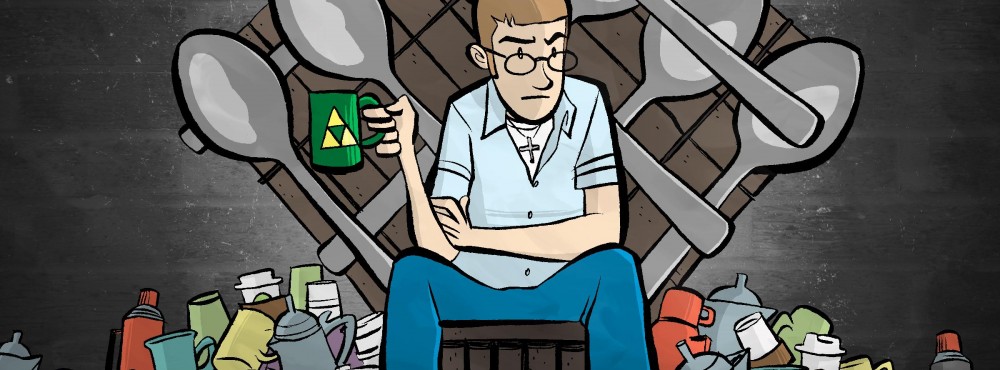
119. God’s Fool

A couple of weeks ago, a coworker informed me quite seriously that our workplace is haunted.

I laughed and told her I think I’d have noticed by now if the bogeyman, the Slenderman or any other kind of spook were lurking in our workplace.

Later in the evening, the garbage compactor went off by itself.

“See?” said my coworker, smiling nervously. “Nobody’s in that room. How do you explain that?”

“If I were a vengeful spirit,” I replied, “I think I’ve have better things to do than activate garbage compactors.”

The incident made me laugh at the time, but it later made me think seriously about the things we believe. My coworker believes our workplace is haunted. It would be easy for me to scoff at her beliefs, but I happen to believe in an invisible, all-powerful, everlasting God.

What sets apart my beliefs from hers? What’s the difference between faith and superstition?

The answer, of course, is evidence. There’s much more evidence to support the existence of God than there is to suggest dark spirits have taken possession of the garbage compactor in my workplace.

Many people don’t agree. I recently read an article claiming science will someday eliminate the need for God. The theory of intelligent design is frowned upon by many scientists. Naturalistic evolution is the de facto explanation for the origin of human life.

Honestly, both sides offer compelling arguments. No matter what atheists may say, there’s certainly evidence for God. Regardless of what Christians will tell you, there’s certainly evidence for atheism. To quote C.S. Lewis, an atheist who converted reluctantly to Christianity, “Now that I am a Christian I do have moods in which the whole thing looks very improbable; but when I was an atheist I had moods in which Christianity looked terribly probable.”

In the end, casting one’s lot with one side or the other isn’t just a matter of reason, logic and evidence. It’s a matter of faith, even for atheists.

There are things I don’t understand about the Christian faith, even though I’ve tried. Regardless, I’ve chosen Christianity. Based on the evidence, it makes sense. I speak not only of scientific, archeological and historical evidence, but also of the evidence of changed lives.

Some months ago, I wrote about gangster pastors: men who have been miraculously transformed from violent, drug-addicted criminals into loving husbands, fathers and church leaders. I know these men personally. I’ve heard numerous accounts of miraculous events. Most powerfully, I know many people whose lives are marked by something, a loving graciousness that goes far beyond mere altruism or friendly disposition.

For me, the best evidence is my own life. Ten years ago, I was a selfish, dishonest, insecure jerk. Eight years ago, I turned my life over to Jesus Christ. Today, while I’m not perfect, I’m a much, much better person than I was.

In the eight years I’ve been a Christian, I’ve seen too many answers to prayer, too many transformed lives and too many unbelievable circumstances for me to pretend it’s all just a series of coincidences—just as it’s possible for ten rolls of a die to yield only sixes, but my first guess is that the gambler who rolls ten sixes in a row is probably using a loaded die.

I’m sure some of my readers are nodding their heads and exclaiming, “Yes, yes.” Some of my readers are probably shaking their heads and saying, “This guy’s deluded,” and a few may have stopped reading once I switched topics from the Slenderman to the Christian faith.

Christians are sometimes considered foolish, and that’s fine. Christ’s own family thought he was out of his mind. (To those who believed he was just a Jewish carpenter, some of the things Jesus said and did must have seemed pretty strange.) The Apostle Paul, who wrote nearly half the New Testament, was accused of insanity.

If I’m crazy for being a man of faith, at least I’m in good company. If I’m a fool, at least I have the consolation of being God’s fool.

I’m not quite sure why I decided to compose this blog post. The subjects of faith, atheism and superstition (and the Slenderman) have been on my mind recently, and I suppose I just wanted to share my thoughts.


108. Life until Further Notice

I’ve decided to take a post simply to mention some of the things going on in my life at the moment. My life isn’t just severed arms and giant mutant killer jungle ants, you know. Normal things happen to me occasionally.

I’ve settled in Indiana and found a job working with mentally handicapped men. Eight men live in the house in which I work. The other staff and I assist them with their day-to-day activities, from eating meals to taking medicine. There’s also paperwork. Tons of paperwork. Thousands of pounds of paperwork. (I exaggerate for effect, but you get the idea.) Other responsibilities include cooking, cleaning and making sure the residents stay out of trouble.

The job is proving to be satisfying and interesting. It’s definitely never boring!

In the long term, I hope to find work as an editor or a professional writer. Teaching English is another possibility, though I’d prefer to write. Words, unlike students, usually do what I tell them to do. In addition to professional writing or editing, I’d love to write short stories and novels.

I hope to move into an apartment of my own within a few weeks. After so many months in transition, it will be a relief to be settled in one place until further notice.

When I checked out apartments, I forgot to ask whether typewriter monkeys are allowed. Are they technically considered residents or pets? I’ll have to ask.

107. Things I Don’t Talk About

There are things I don’t talk about.

Some of these things are trivial. I enjoy watching a television show about magical rainbow ponies, for example. I sometimes make faces at myself in the bathroom mirror. I also think Miley Cyrus’s “Party in the USA” is pretty darn catchy.

I’m not ashamed of these things, but they’re a little embarrassing, and so I keep them to myself.

Then there are the other things I don’t talk about—things that are anything but trivial.

I’ve suffered for years from serious depression. It comes and goes more or less at random, and robs me of the ability to do much of anything except breathe. When I’m depressed, all I can do is pray, retreat to my bedroom with a cup of tea and wait until my depression goes away.

I struggle with insecurity. Although I try not to let it show, I often wrestle with doubts and worries about my future, my faith, my writing and pretty much everything else.

I worry too much about my reputation, and show too little care or concern for the needs of other people.

I don’t feel particularly at home anywhere in the world. Even though I grew up in Ecuador, my Spanish is pretty weak. The culture of the United States is still strange to me. Every country feels like a foreign one.

Why don’t I ever talk about these things?

Well, it’s embarrassing and awkward. These things tear apart the bookish, cheerful, slightly eccentric impression I wish to make on people. Being vulnerable is hard. Sharing my insecurities feels too much like complaining or making excuses. It’s easier to reminisce about crazy high school teachers or grumble about how modern worship music is badly written.

I think other people would be more patient with me if they understood my struggles.

Do you know what else?

I would be a dashed lot more patient with other people if I understood their struggles.

My closest relationships are those in which the things we don’t talk about have been talked about. Some of the best discussions I’ve ever had were the ones in which the masks came off. These discussions were uncomfortable, but they built up stronger friendships.

There are times when revelations of a personal nature aren’t appropriate. There is a very, very fine line between being vulnerable and complaining about personal problems. It takes discernment to know when to speak and when to remain silent.

The problem is when I simply remain silent, hiding my struggles, refusing to acknowledge I’m not perfectly self-sufficient.

Uncle Iroh and the Apostle Paul—a fictional tea-drinker and a famous missionary, respectively—seem to agree on certain issues, and this is one of them.

Uncle Iroh once said, “There is nothing wrong with letting people who love you help you.”

The Apostle Paul wrote, “Carry each other’s burdens, and in this way you will fulfill the law of Christ.”

Maybe we should talk about the things we don’t talk about.

104. Jesus Was an Introvert

During his life on Earth, Jesus was an introvert.

I don’t have any concrete proof to back up my claim. However, I’ve read enough courtroom mysteries (and played enough Ace Attorney games) to know that evidence is everything in a court of law (or a blog of typewriter monkeys).

Unlike extroverts, who enjoy being with people and dislike being alone, an introvert is a person who prefers solitary activities over social ones. Introversion shouldn’t be confused with shyness: an introvert prefers being alone, whereas a shy person avoids social events out of fear.

Now for the evidence!

The Lord Jesus often withdrew to solitary places. Mark informs us, “Very early in the morning, while it was still dark, Jesus got up, left the house and went off to a solitary place, where he prayed” (1:35). Matthew points out that the Lord’s response to the death of his cousin John was to get away from people: “When Jesus heard what had happened, he withdrew by boat privately to a solitary place” (14:13). Luke confirms that Jesus went off alone early in the morning (4:42).

Introverts are sometimes viewed with suspicion, as though their love of solitude were a deficiency that requires a cure. That’s nonsense. Personally, I think introverts are awesome.

Granted, I’m sort of biased.

As an introvert, I find the passages describing the Lord’s preference for solitude encouraging. If Jesus Christ could get away with being introverted, then so can I!

I think both introverts and extroverts can learn something from Jesus.

Extroverts must try to be sensitive toward introverts. For example, introverts sometimes turn down invitations or leave social events early: not to offend anyone, but simply because they feel overwhelmed.

Introverts mustn’t use their liking of solitude as an excuse for being lazy or avoiding people. The Lord Jesus may have been an introvert, but he spent countless hours teaching, preaching, healing the sick and comforting the discouraged. For every hour he spent alone, he spent many more helping people. Introversion mustn’t become a license for selfishness.

Now I’ll withdraw to a solitary place to enjoy a solitary activity.

To wit, I’m off to my bedroom to drink some coffee.

98. Just Try to Relax

The past month has been pretty hectic.

Four weeks ago, I began packing my worldly goods and possessions for the five thousand-mile journey from Montevideo to Fort Wayne.

Three weeks ago, I arrived at my brother and sister-in-law’s home in Indiana, burdened with several suitcases and a dozen typewriter monkeys.

Since then, I’ve learned to drive, purchased a car, failed a driver’s test, done some author stuff, worked on my blogs, applied for jobs and busied myself with dozens of miscellaneous tasks, responsibilities, errands, duties, obligations, commitments and chores.

Until a few days ago, I kept myself almost constantly busy. I refused to give myself much time to relax. I told myself I didn’t need to rest, but to get everything done. When I had fulfilled my obligations—all of them—I could consider taking some time off.

Then, earlier this week, I stopped functioning.

I was paralyzed mentally, exhausted emotionally and tired physically. I couldn’t stay focused.

I had broken down.

At last, unable to work, I retreated to my bedroom with a cup of tea and a video game. For several hours, I set aside my self-imposed obligations and relaxed—and it was awesome.

That long rest was calming, refreshing and fun. Hour by hour, I could feel myself regaining my composure and focus.

I’ve attempted to cope with the stress and difficulty of the past few weeks by acting busy, trying to persuade myself that everything was under my control.

Everything is not under my control. That’s the bad news.

The good news is that everything is under God’s control.

He commands us to rest. It’s even one of the Ten Commandments: “Remember the Sabbath day by keeping it holy. Six days you shall labor and do all your work, but the seventh day is a Sabbath to the LORD your God. On it you shall not do any work.”

We honor the Sabbath day by resting—trusting God to work things out instead of exhausting ourselves trying to keep everything under control.

The Lord Jesus himself said, “Come to me, all you who are weary and burdened, and I will give you rest.”

It is now my intention to drink some tea and play a video game.

94. For When the World Seems Dark

In the centuries since the invention of the printing press, Christians everywhere have perfected the fine art of writing in their Bibles.

Some readers of Scripture create complex systems involving symbols or different colors of highlighter markers. Others cram notes, observations and questions into the margins.

I write in my Bible, though my notations are pretty simple. A couple of years ago, for example, I labeled the psalms in order to keep track of them. I came upon the seventy-seventh psalm a few days ago. Its label intrigued me.

For when the world seems dark

The psalm begins: I cried out to God for help; I cried out to God to hear me. When I was in distress, I sought the Lord; at night I stretched out untiring hands and my soul refused to be comforted.

Well, that’s cheerful.

Moving forward a few verses: Will the Lord reject forever? Will he never show his favor again? Has his unfailing love vanished forever? Has his promise failed for all time? Has God forgotten to be merciful? Has he in anger withheld his compassion?

What a bright, happy psalm this is turning out to be.

As I read the first few verses, I was wondered why I’d given Psalm 77 a title like For when the world seems dark. When the world seems dark, I want it to seem lighter—not more depressing!

Then the theme of the psalm takes an abrupt turn: I will remember the deeds of the Lord; yes, I will remember your miracles of long ago. I will meditate on all your works and consider all your mighty deeds.

The psalmist goes on to describe one of God’s great miracles, and ends with these words: You led your people like a flock by the hand of Moses and Aaron.

Some great Christian thinker (I don’t remember which) once wrote, “Do not forget in the darkness what you have learned in the light.”

The psalmist didn’t forget. When God seemed far away, he paused to remember two things: the great deeds God had done, and the great love God had shown.

Psalm 77 came at a good time. At the moment, I’m under some emotional strain. Leaving loved ones, adjusting to a new place, facing an uncertain future—these things are hard. It’s easy to lose perspective and become lost in depression, anxiety or fear.

It’s at times like these that I must stop and remind myself of two things: the great deeds God has done for me, and the great love he’s shown toward me.

I remember those scholarships that allowed me to graduate from Bethel College. I remember how, when I was depressed during my third semester, I enjoyed the much-needed blessing of a long, solitary Thanksgiving break spent writing, watching Disney movies and playing Final Fantasy VII. I remember the glorious evenings spent watching Avatar: The Last Airbender and drinking tea with my friends from college. I remember all those mornings my old man brought me coffee in bed, and all those times my mum told me, “You’re a treasure.”

I remember how often God has made things right.

When the world seems dark, remember what you’ve learned in the light.

92. Impressions from a Cynical Traveler

My typewriter monkeys and I made it safely to Indiana, much to my own surprise. Things go wrong when I travel, you see. Missed flights, misplaced luggage, sleepless nights, broken boarding ramps, typewriter monkeys misdirected to Vietnam—as far as I’m concerned, the magic has gone out of international travel.

This time there was only one problem. The computers weren’t working in the Montevideo airport, which meant luggage was checked and boarding passes written without the help of machines. (I’ve typed out blog posts without help from my monkeys or their typewriters, so I know how hard it can be to do by hand what’s supposed to be done automatically.) My mum, a marvelously patient lady, stood in line with me as I waited to check my bags and receive a pass.

I checked my suitcases, commending them to God, and pocketed my boarding pass. The time had come to me to say goodbye to my mum, old man and younger brother. I did, wishing goodbyes weren’t so hard.

I spent part of the flight from Montevideo to Miami conversing with a nice old gentleman who works in the education department of a university in Philadelphia. We discussed the works of C.S. Lewis and J.R.R. Tolkien, the premise of my novel, his impressions of Uruguay and a few other things. I never did get his name, though.

After I arrived at the Miami airport, a customs official informed me that I look like Harry Potter. It wasn’t the first time I’d heard that comparison. I’ve taught three groups of students on three different continents, and each time at least one kid told me I looked like Harry. (In South Korea, a number of students addressed me as “Harry Potter Teacher.”) It’s a mystery to me how anyone can draw any connection between a skinny, black-haired, green-eyed Briton like Harry and a stocky, brown-haired, brown-eyed American like me. I suppose I should count my blessings. At least people aren’t comparing me to, say, Charlie Sheen.

From Miami I flew to Dallas, where I spent an eight-hour layover drinking coffee, wandering around the terminal and working on The Wanderings of Lance Eliot, the sequel to my novel. Although I was severely tempted to try out my Matthew McConaughey impression, I refrained. I’m pretty sure they shoot you for McConaughey impressions in Texas.

From Dallas I flew to Fort Wayne, where my older brother picked me up. My typewriter monkeys and I have taken up residence in his spare bedroom until I find an apartment of my own. Needless to say, my room smells strongly of bananas.

I’m glad to see my brother, sister-in-law and nephew again, and less glad to be used as a sidewalk by their cats. (Why the cats choose to walk all over me, when they have the whole house to roam, is a mystery.)

As usual, leaving loved ones and moving to a new place has been hard. It’s emotionally exhausting, with depression, excitement, homesickness, anxiety, hope and despair all taking turns. For now, I can only remember dear old Paul’s word’s in the twelfth chapter of Romans: “Be joyful in hope, patient in affliction, faithful in prayer.”

I also need to keep an eye on my typewriter monkeys. I’m afraid they’ll pick a fight with the cats if I’m not careful.

91. Life in Uruguay

For months, my old man has been suggesting I write a post about life in Uruguay. “People love travel blogs,” he said. I’ve put it off because writing about other things—heroic bunnies and bladed weapons, for example—has been more fun.

Today is my last full day in Uruguay, however. My packing is done. Tomorrow I must endure the horrors of international travel. This is my last opportunity to write about my sojourn in Montevideo before it comes to an end.

I’ll start with the parrots.

Montevideo, the capital of Uruguay, is full of trees, and those trees are full of parrots. They aren’t as common as, say, pigeons, but it’s not unusual while strolling along the sidewalk to hear parrots squawking overhead. My parents love them, but most Uruguayans consider them to be pests.

My parents’ neighborhood in Montevideo

Apart from the ubiquitous trees, Montevideo features many old buildings. Some of these have stood for centuries, dating from the colonial period. Others are fashionably old. Many are merely decrepit. These crumbling, rusting, peeling structures seem to have accepted their fate, and are now patiently awaiting the inevitable.

Montevideo stands beside a large body of water. I assumed it was the Atlantic ocean, but my old man informed me it’s actually an estuary: a cross between a river mouth and an ocean bay. An avenue called la Rambla runs along the water. It’s the backbone of the city. Turning off la Rambla plunges an unwary traveler into a maze of one-way streets.

The fanciest neighborhoods feature European-style buildings, bright flowers and beautiful views of the water. The seedier neighborhoods are decorated by graffiti and weeds. Most buildings are at least two or three stories tall.

The system for numbering floors in Uruguay is different than in America. A four-story building in America would be called a three-story building in Uruguay; the floor at ground level is simply called “ground level,” and “first floor” refers to the first floor above ground level.

Two other striking differences between America and Uruguay are electrical outlets and keys. The prongs on electrical plugs in Uruguay are round, not flat. The voltage in Montevideo is high, so low-power appliances get fried if they’re plugged in without an adapter. Uruguayan keys are charming because they’re designed in the old-fashioned way, complete with long barrels and teeth. Car keys are an exception, being identical to their American counterparts

Since Uruguay is located south of the equator, its seasons run in an opposite cycle to seasons in the northern hemisphere. January, February and March are summer months in Uruguay, while July, August and September are winter months. While it doesn’t snow in Montevideo, my parents tell me it can turn bitterly cold.

Most Uruguayans drink yierba mate, a kind of herbal tea. My old man and I like it. My mum insists it tastes “like pasture where cows have been recently.”

Uruguayans drink yierba mate from cups (usually fashioned from gourds or cow horns) called mates. The yierba is sipped through metal filters called bombillas that look a bit like straws. A single mate full of yierba leaves can last an entire day, provided the drinker refills the mate regularly with hot water. Many Uruguayans carry leather satchels called materas around with them, containing mates, bombillas, yierba mate and thermoses of hot water. As an avid drinker of tea, I wholeheartedly applaud Uruguay’s devotion to its favored brew.

A thermos, a mate and a bombilla

Everyone in Uruguay eats meat. (Sorry, vegan friends.) My mum once told me even the salad bar at a local restaurant featured meat. My favorite local cuisine is the chivito, a dish served al pan (as a sandwich) or al plato (on a plate) consisting of beef, bacon, eggs, lettuce, tomatoes and other trimmings. The literal meaning of chivito is small male goat, which seems appropriate.

The atmosphere in Uruguay is oddly European. Cities like Montevideo are populated by cultured, classy people. By contrast, the countryside is full of farms, ranches and small towns. Some of Uruguay’s major exports are beef, leather, yierba mate and amethysts. Tourism is also a major industry.

Spanish is the primary language spoken in Uruguay. The local dialect is different from the language I learned as a child in Ecuador. For example, impecable (impeccable) and divino (divine) are the Uruguayan equivalent of cool or awesome. Strangely, bárbaro (barbarous) is an informal synonym for good. It gave me quite a shock when a dentist in Montevideo inspected my teeth and proclaimed, “I’ve checked your teeth, and they’re barbarous.”

Uruguay is extremely secular. Christianity is considered foolish or quaint by most Uruguayans. Easter Week is known as Tourism Week by government decree. Despite its secular outlook, the country is full of superstitions and pagan practices. My old man sometimes finds coins, candles, decapitated chickens or other sacrifices set out to appease gods, idols or possibly Cthulhu.

In spite of sea, sunshine and beautiful scenery, the general mood of Uruguay is one of pessimism. My mum described the country as “a nation of Puddleglums,” alluding to the gloomy character from the Narnia books.

My favorite thing about Uruguay is that my parents and younger brother live there.

I thank God for my time in Montevideo. While I’m not quite sure what lies ahead of me, I’m hoping for the best.

My typewriter monkeys are excited for the trip back to the United States. I hope they find their suitcase comfortable.

84. Another Bend in the Road

“My future seemed to stretch out before me like a straight road. I thought I could see along it for many a milestone. Now there is a bend in it. I don’t know what lies around the bend, but I’m going to believe that the best does.”

These bold words (spoken by Anne Shirley in Anne of Green Gables) were a comfort to me some months ago. I was about to graduate from college, you see, and I didn’t know where to go next.

I’ve spent much of my life moving from place to place. When it came time to figure out where to invest the next few years of my life, I didn’t know even where to begin looking. The United States? Ecuador? Uruguay? Japan?

In the end, I was given an opportunity to visit my family in Montevideo for a few months.

My time in Uruguay has been ridiculously blessed. I’ve made progress with my writing, recovered the sleep I lost during my college years and shared many pleasant weeks with some of my favorite people in the world.

In a month, however, I must move onward.

My plan is to return to Indiana at the end of May and settle down for at least a year or two. I hope eventually to find a teaching position overseas or to make a living as a writer, but I’m going to take things one at a time.

Once again, my future stretches out before me like a road. There’s a bend in it. I have only a vague idea of what lies beyond the bend, but I’m going to believe that the best does. As I’ve said before, ’tis grace that brought me safe thus far and grace will lead me home.

I believe it will, wherever home may be, and I continue to hope there will be coffee shops along the way.

75. Stoic or Stupid?

I don’t think I would make a very good Viking.

I hate cold weather. I lack any kind of vicious bloodlust. Most importantly, I can’t grow a beard. Thus it is proved. Adam would not make a good Viking.

Regardless, I possess one quality that would make any Viking proud: quiet stoicism.

When confronted with trials and tribulations, I don’t usually talk about them. Whether depression or headache, discouragement or insomnia, sadness or soreness, I keep my problems to myself.

In some ways, quiet stoicism isn’t such a bad thing. I know people who could probably use a little stoicism: the sort of people who regularly insist on describing all of their frustrations in painstaking detail. One reason I don’t talk much about my problems is that I don’t want to annoy anyone.

In other ways, however, quiet stoicism is kind of stupid.

To be honest, one of the reasons I keep my struggles to myself is to give the impression that I don’t have any. It’s hard to be vulnerable. It can be embarrassing. The easiest option is sometimes to be stoic and tough out my problems alone.

The trouble is that some problems are too big for anyone to tough out alone.

As much as I’d like to pretend I’m totally self-sufficient, I’m not. There are times I need someone to give me advice, encouragement or criticism. There are times I need someone to listen to me. There are times I need someone simply to be there.

Not long ago, I realized I’d made such a habit of trying to deal with my problems alone that I was forgetting to ask God for help when difficulties arose. It wasn’t a deliberate, “I’ll take care of this little complication, God, and ask you to handle the really big problems” kind of decision. In fact, it wasn’t a decision at all. Asking for help simply didn’t occur to me.

Stoic or not, forgetting to ask the Lord God Almighty for help is stupid. He doesn’t merely allow us to ask for help when we need it. He flat-out commands us to ask for help when we need it!

Paul wrote, “Do not be anxious about anything, but in everything, by prayer and petition, with thanksgiving, present your requests to God” (Philippians 4:6).

Peter added, “Cast all your anxiety on him because he cares for you” (1 Peter 5:7).

Quiet stoicism can be a virtue. I’m a reserved person, and I don’t plan to tell everyone about every problem. I think it’s good sometimes to work through problems patiently.

In the end, though, ain’t it better to ask for help?