272. Making Lessons Stick

I struggle to remember things. There’s probably a reason for this, but I’ve forgotten it.

In seriousness, I don’t have any good excuse for forgetting stuff. It’s not like I’m an old man or the guy from Memento. All the same, things seem to be constantly slipping out of my mind: names, faces, phone numbers and memories of all kinds. It’s especially hard for me to recall details from my own life. The past twenty-something years are a brightly-colored blur.

I visited my old college campus a number of weeks ago. It was a bit surreal. That campus was my home for seven semesters, yet it seemed to vanish from my memory the moment I graduated. Every time I visit the campus, it seems unfamiliar. I can hardly believe I spent months, let alone years, living there.

Why does this place seem so familiar? Have I seen photos or visited? Oh, that’s right, I spent a few years there. I suppose that would explain it.

In some ways, my poor memory is actually kind of a blessing. I’ve lived in so many places that it’s nice not to be burdened with homesickness for all of them. It’s hard to pine for the past when I can’t remember it. My day-to-day life is mostly uncluttered by memories, and they’re all the sweeter on the rare occasions I recall them.

Of course, a bad memory is also a nuisance… mostly for the people around me. I sometimes offer my younger brother an observation, opinion or bit of news only for him to reply, “Adam, this is the fourth time you’ve told me that.”

My memory isn’t even consistent in its faultiness. For example, I memorized the “quality of mercy” speech from “The Merchant of Venice” for an English class nearly a decade ago. I’ve made no effort to remember the speech, yet can recite it word for word to this day. On the other hand, entire epochs of my life (like my college years, mentioned above) seem distant and empty. It takes an effort for me to remember anything that happened before, say, last Tuesday.

The worst part of having a lousy memory is that it makes learning lessons hard.

If you’ve followed this blog for more than a few months, you should probably find some better way to spend your life. (I’m joking! Don’t go! Please come back!) If you’re one of the brave readers who has stuck with this blog for half a year or more, you’ve probably noticed how I’ve revisited certain things. I’ve written a lot about grace, and depression, and doubt, and the fear of not being good enough.

Part of the reason I revisit things is that learning is an incremental process. Learning a lesson takes one day; living a lesson takes years. If I’m honest with myself, however, part of the reason I write about some things so often is that I forget them. Writing about lessons and struggles helps me remember them.

What does this mean? Well, TMTF has had plenty of posts about grace and doubt and stuff, and it will probably have plenty more. I’ll keep going in circles, hitting some of the same notes again and again, occasionally hitting new ones (I hope) and gradually making the most important lessons stick.

Now then… what was I talking about?
267. I’m Giving Up

The ironic thing about some of the lessons I’ve learned is that I haven’t really learned them.

Sometimes, I know things without understanding them. I accept a lesson and then forget it. When I’m reminded of some lessons, I understand them a little more fully. Learning becomes an incremental process.

Thus I’m going to quote myself quoting C.S. Lewis and say,

Thus, in one sense, the road back to God is a road of moral effort, of trying harder and harder. But in another sense it is not trying that is ever going to bring us home. All this trying leads up to the vital moment at which you turn to God and say, “You must do this. I can’t.”

Living by grace doesn’t mean merely trying to do good things, says dear old Lewis,

But trying in a new way, a less worried way. Not doing these things in order to be saved, but because He has begun to save you already. Not hoping to get to Heaven as a reward for your actions, but inevitably wanting to act in a certain way because a first faint gleam of Heaven is already inside you.

In other words: Stop trying to be good enough and depend on God’s grace.

My problem is a paradox. I have made depending on God’s grace just another facet of trying to be good enough. As I said last time, I wanted to be consistent. I wanted to depend on God’s grace consistently. Grace became another weapon in my battle to get it right.

Maybe grace is simply permission to stop fighting.

I’m giving up. My dreams of reaching a nice, level plateau of angelic goodness and contentment are gone. My life will be disordered, flawed and messy. I shall sin and struggle and make mistakes. (Please note these are a statements of fact, not of intention.) There will be days of depression and grief and anxiety, and nothing I can do to prevent them.

What does this mean for my day-to-day life? Honestly… not much. I’ll keep living, working, praying, reading, writing, playing video games, drinking too much coffee and failing to act like a solemn, serious adult.

As I do these things, I’ll try not to hold myself to the self-imposed standards of years past. I won’t replay and review things constantly in my mind, and I certainly won’t agonize over mistakes. By accepting I shan’t be perfect, I can stop trying—better yet, I can try in that new, less worried way.

I’m giving up.

266. Crying Out for Consistency

And today I will trust you with the confidence of a man who’s never known defeat, but tomorrow upon hearing what I did, I will stare at you in disbelief. Oh, inconsistent me, crying out for consistency.

~ Relient K

I had a birthday not long ago. On that bright, chilly spring day, I reached the ripe old age of twenty-four and resigned myself to the gloomy of business of being an adult. As I reflected upon my future, I chose a keyword for my twenty-fifth year—a one-word resolution to guide my actions, attitudes, words and thoughts for the next twelve months.

Consistency.

Within one day, I had deceived myself into doing things I should not have done—sinful things. My fine resolutions were effortlessly flattened by familiar temptations. So much for consistency.

Just one day after that, a bleak depression settled upon me. It lasted for days. While I was depressed, I could only scowl at my hopeful new keyword. Consistency? What an idea. In the paralyzing grip of depression, it was all I could do to function. I dragged myself along, hour by hour, grimly surprised every night that I had survived another day. I couldn’t be consistent. I could barely keep going.

Once again, consistency was an empty hope.

For years and years, my life has been largely driven by one all-important conviction. I could express it in a number of ways, but the simplest is this: I needed to get it right. No matter the circumstances, no matter my feelings, no matter what trials and challenges assailed me, I needed to get it right—to love God and to love others and to have faith and to be awesome. God’s grace had redeemed my life, sure, but it was up to me to live.

I wanted for years to reach a plateau or level of goodness and faith. It seemed logical that I would eventually learn every lesson, overcome every temptation, cast off every burden and consistently live a good, contented life. There had to be some secret, some attitude, some perspective or paradigm to make everything click and all the pieces fall into place.

Thus I tried out a long series of resolutions, attitudes, philosophies and personas in my quest to be consistent. I’ve always known I can’t be perfect, but consistency seemed like a reasonable goal.

Now I’m not so sure.

I’ve written many times about my near-obsessive desire to be “good enough,” whatever the heck that means. God’s grace is another subject I’ve discussed repeatedly. My conclusion is always the same. God declares, “My grace is sufficient for you, for my power is made perfect in weakness.”

More clearly than more than ever before, I understand that weakness isn’t merely a sinful nature. It’s helplessness. Weakness is waking up on some days hardly able to stand, let alone work or write or pray. Weakness is never, ever reaching my long-sought plateau of consistency. Weakness is struggling and making mistakes and never quite getting it right.

Weakness is space for God to work.

What next? Well, another blog post, I guess. Check back next time for the conclusion to my thoughts on weakness, grace and where in blazes I should go from here.

265. TMTF’s Top Ten Tips for Fighting Depression

I’ve been reading a book about depression. See, depression is a part of my life. It has been an irregular yet consistent struggle for many years. The book set me thinking me of all the ways I’ve learned to cope with my gloomy condition, and also reminded me that TMTF hasn’t featured a top ten list in ages.

If you suffer from depression… I’m sorry. I’m so, so sorry. This much-more-serious-than-usual list is for you.

Before I begin, there’s one thing I should make clear. This is a list of practical tips for coping with depression when you are already depressed. This is short-term advice. This is not a list of long-term lifestyle changes for treating or preventing depression. That’s another subject for another time.

Take heart, ladies and gentlemen, as TMTF presents…

The TMTF List of Top Ten Tips for Fighting Depression!

10. Drink some tea

I may be the only person in the world for whom tea is a coping strategy, which is why I’ve put it so low on the list, yet I find the process of brewing tea calming and reassuring. Besides, the warm strength of tea never fails to make me feel a tiny bit better.

9. Take a nap

Naps aren’t usually my thing, but it can be a blessed relief to disappear for a half an hour into the cozy darkness of my sleeping bag. For someone suffering from severe depression, a nap is a break from the agony of wakefulness.

8. Listen to good music

Since you probably can’t focus on anything else when you’re depressed, you may as well spend a few minutes sitting in a comfy chair listening to music with headphones. Angry or melancholy music is a great way to vent negative emotions, and cheerful music can be a warm balm to a troubled soul.

Depression Tip #75 - Depression can't withstand the groovy power of dance.

Silly Depression Tip #75 – Play seventies music and dance. No depression, however severe, can withstand the groovy power of disco. If you have them, wear bell-bottoms.

7. Take a hot shower

Hot water is a gift of God. It loosens tense muscles, eases aches and washes away the grit and grime of life. A good shower is refreshing and relaxing. Even when I’m severely depressed, I feel a little better for being warm and clean.

6. Go for a walk

Depression thrives on bleak inactivity. It can be hardso freaking hard—to leave behind the security of your home and step outside when you’re depressed, but a good walk can work wonders. It’s good to have fresh air and sunlight, or at least a change of scenery.

Depression Tip #142 - Look at pictures of funny animals, such as platypuses or blue-footed boobies.

Silly Depression Tip #142 – Look at pictures of funny animals, such as platypuses or blue-footed boobies. If that doesn’t work, remind yourself that birds called boobies are actually things that exist.

5. Look at photos from good experiences

I’m thankful my old man is a photographer. His photos of my beloved family, our vacations together and my dear homeland of Ecuador never fail to encourage me. Depression makes the world seem dark. Photos of pleasant places and faces are undeniable reminders that it isn’t.

4. Get some exercise

I can hardly believe I’m saying this. For all my life, I have disliked exercise. It seemed like a dreary, draining, sweaty, stinky waste of valuable time—time that could be spent doing important stuff like, um, lying on the floor being depressed. All right, maybe exercise is worth a shot. There’s a sciencey explanation of why exercise helps fight depression, but the gist of it is that exercise unleashes chemicals in the brain that make you happy… or something like that. Look, just do some push-ups, okay? I’m learning to enjoy exercise. Life seems simpler when I’m jumping rope.

Depression Tip #386 - Try an herbal remedy. Yierba mate is my favorite; peppermint is also effective. Oregano is strongly discouraged, except on pizza.

Silly Depression Tip #386 – Try an herbal remedy. Yierba mate is my favorite; peppermint is also effective. Oregano is strongly discouraged, except on pizza.

3. Do something productive (that isn’t stressful or complicated)

One of my ultimate strategies for coping with depression is to wash dishes. Seriously. I’ll put on upbeat music (Tip #8!) and run some hot water and get those dashed dishes clean. Washing dishes is therapeutic for me. It isn’t stressful or complicated. It’s something I can do no matter how depressed I feel. Afterward, I can look back and tell myself, “See that? You did something productive. You were useful. Not all the time you were depressed was wasted.” Your thing may not be washing dishes. It may be sweeping or baking or walking your dog. Find whatever it is, and do it.

2. Connect with someone

I don’t usually hug people, with the outstanding exceptions of close family members. (Awkward sibling hugs are the best.) All the same, hugs help. If you have a loved one handy when you’re depressed, ask for a hug. Ask for a prayer or a kind word or a cup of tea. If your loved ones aren’t located conveniently nearby, call them or send them a message. At the very least, tell someone you’re struggling. Solitude isn’t a bad thing; I prefer not to deal with most people when I’m depressed. However, solitude and isolation are different things, and isolation hurts. Connect with someone.

1. Pray to God

Not everyone may appreciate this tip, yet in my experience nothing is better for fighting depression than prayer. Asking God for help and putting my depression in his hands generally helps me most.

O people of the Internet, what’s your advice for coping with depression, anxiety or discouragement? Let us know in the comments!

262. Am I a Man?

Not long ago, I grew a beard. It was horrible, an utter disgrace and an affront to anyone unfortunate enough to gaze upon it. To put it in biblical terms, it was an abomination that caused desolation.

It’s a pity, because I like beards. I wish I could manage a better one. This one made me look like a stoner. In fact, a coworker went so far as to remark, “If I’d never met you before, I’d have assumed you smoked marijuana.”

The Abomination That Causes Desolation

I’m sorry you have to see this. I’m so, so sorry.

In the end, a couple of weeks ago, I euthanized my stoner-beard and got a haircut, restoring my deceptive resemblance to a civilized human male.

I grew a beard for two reasons. First, it was a rebellion against shaving. Shaving is tedious and painful. My beard was the symbol of a revolution, and a remind that rebellion can be an ugly thing. My second reason was a little more serious. A beard—even a hideous stoner-beard—was a reminder that I was a man.

At least, I’m supposed to be a man.

There are certainly times I feel old. The jungles, mountains and beaches of my youth seem very, very far from the quiet town of Berne, Indiana. Much of the time, however, I feel pretty young. I occasionally feel like a kid playing at being a grownup.

I’ve spent nearly a quarter-century knocking about God’s green earth, but I sometimes don’t feel it—and I hardly ever look it. Heck, I was often mistaken for a high school kid during my student teaching. (I was even told by fellow teachers to leave the office or teachers’ lounge because students weren’t allowed!) Many people want to look younger. I want to look older. At the very least, I want a proper beard.

Many of my high school and college chums are getting married, having kids, building careers and watching Breaking Bad. As I play video games, watch cartoons and write silly blog posts about exploding tomatoes, it’s a little scary for me to see how effortlessly responsible and grown-up everyone else seems to be.

I tried watching Breaking Bad once. (It was recommended to me by the same coworker who told me I looked like a weed addict.) The show was brilliant, but also painful to watch. My life was dysfunctional enough without watching Walter White lie to his wife and scream at his boss.

Right about the time [spoiler alert?] Walter and his accomplice tried dissolving a corpse in acid, I realized I wasn’t enjoying the show. It was too grown-up—by which I mean, rife with grown-up problems like lies, unfaithfulness, greed, murder, drug use and nihilistic hedonism. I gave up watching Breaking Bad and went back to the Edenic innocence of My Little Pony: Friendship Is Magic.

Am I some sort of man child, refusing to grow up and take responsibility, chasing fading gleams of childhood simplicity?

Am I… dare I say it… a Peter Pantheist?

I think I am a man.

Admittedly, I am a man who enjoys the wit and silliness of Phineas and Ferb over the gore and drama of The Walking Dead, but still. I would like to think I’m childlike, not childish. There’s a difference. At least, I’m pretty sure there’s a difference.

“When I was a child,” wrote the Apostle Paul, “I talked like a child, I thought like a child, I reasoned like a child. When I became a man, I put childish ways behind me.”

I talk like a man, I think like a man, I reason like a man—most of the time, anyway. I would like to think I’ve followed Paul’s good example and left behind childish ways.

All the same, I want to hope like a child, to trust like a child, to dream like a child. After all, the Lord Jesus himself said, “Let the little children come to me, and do not hinder them, for the kingdom of God belongs to such as these.”

257. Everything Is Awesome?

I saw The Lego Movie not long ago. Now, I know other bloggers have already discussed this strange, wonderful, colorful film, but I have a few things of my own to say.

On a Saturday evening weeks ago, I stepped out my front door into chilly gloom, clambered into Tribulation (my rickety car) and sped into the dark, forbidding unknown. Depression, anxiety and vague panic had burdened me all afternoon. It was hard to take those first few steps away from home. I wanted to stay, but I had a mission and dash it all, I was going to complete it.

I was going to see The Lego Movie.

The Lego Movie

I’m really glad I did.

The film was excellent, but I’m not really going to talk about it. I’ll just point out that it features an upbeat, poppish song titled “Everything Is Awesome,” which pretty much sums up the movie.

The Lego Movie is a bright, cheerful, clever film, and it did me good. Getting out did me good. Defying depression and exploring new places and driving along dark, cold roads in a dilapidated car did me good. These things were different. Some were pleasant. Some were a little scary. For a few hours, I left everything behind.

It helped me see things a little differently.

My life is governed by routines and repetition. Mind, that isn’t a bad thing. Routines are efficient. Doing things differently is challenging, risky and sometimes costly. However, routines have a cost of their own. They lull me into a stupor. Repetition makes me forget there is a wide, wide world beyond my narrow day-to-day experiences.

In a manner of speaking, The Lego Movie is right: everything is awesome. The things repetition make me take for granted are amazing—I just don’t realize it until I leave them behind for a little while.

G.K. Chesterton wrote a story in which a man abandons his children, wife and home and embarks on a long journey. He exclaims, “I won’t stay here any longer. I’ve got another wife and much better children a long way from here. My other wife’s got redder hair than yours, and my other garden’s got a much finer situation; and I’m going off to them.”

The man walks and walks and walks. He walks all the way around the world, and finally comes to his “better” home and “better” family. They are exactly the same ones he left behind… yet they are better. His home and family are better because he has learned to appreciate them. By leaving behind his home and its routines, the man has the exquisite pleasure of coming back to them. He realizes everything is awesome.

Weeks ago, I realized the same.

I guess this means I’ll be going to the cinema sometimes, and varying my route back from work, and ordering more than one kind of sandwich at Subway, and generally finding more excuses to get away. Everything is awesome. Sometimes, I just need to do things a little differently to see it.

250. Life Lessons from a Thirsty Blogger

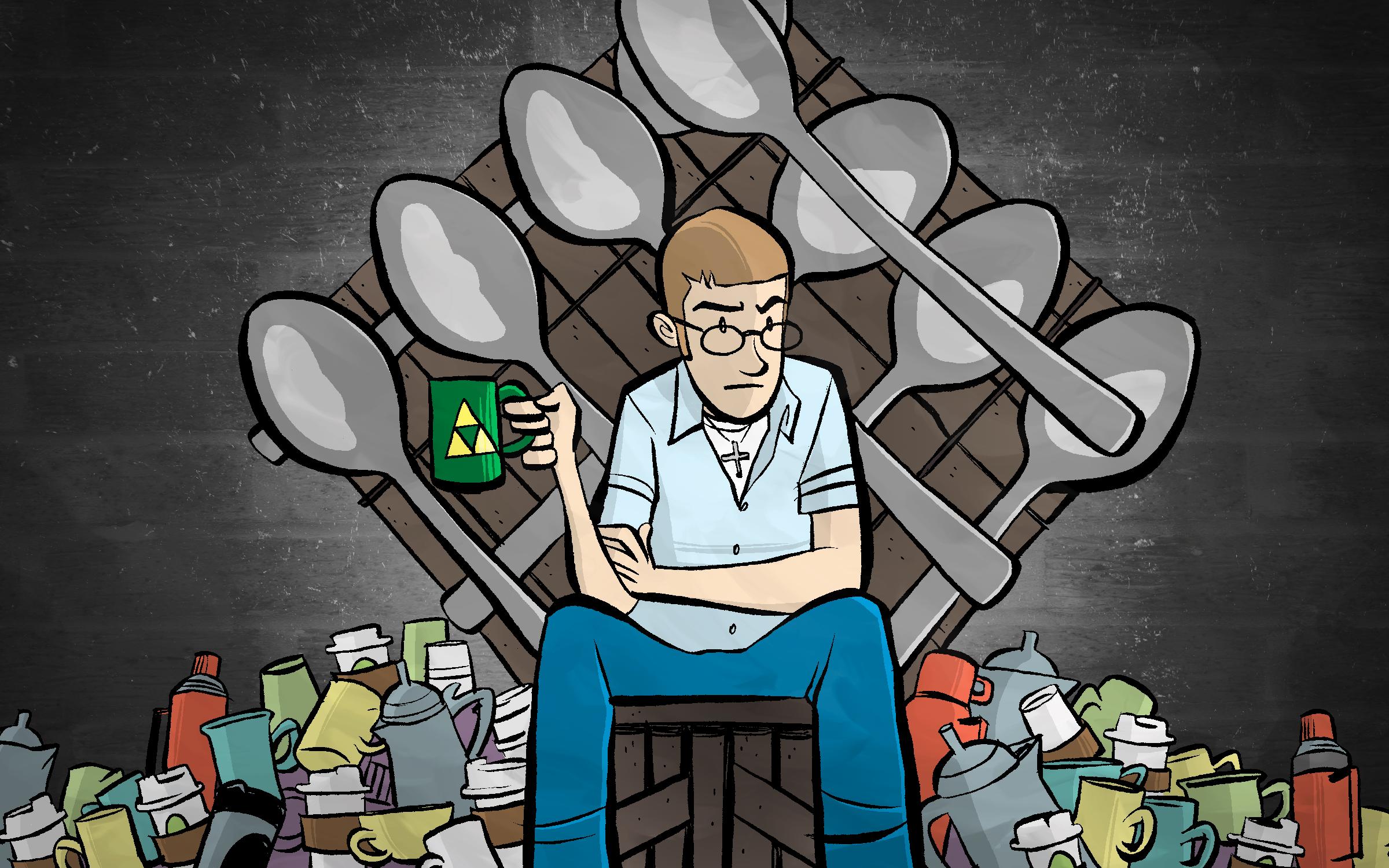
So I drink a lot of coffee. Don't judge me.

Yes, I drink a lot of coffee. Don’t judge me.

If anyone has ever wondered how I come up with ideas for this blog, the picture above tells the whole story: I sit and drink coffee and wait for something to happen. What can I say? Blogging is thirsty work.

(Due credit to the inimitable Wes Molebash for the splendid caricature, which has become my official Internet profile picture and a new banner for this blog.)

Today marks another milestone in the sunny existence of Typewriter Monkey Task Force: a blog fueled by coffee, sustained by geeky enthusiasm and buoyed by the support of loved ones. This blog has allowed me to share my passion for everything from God to tea to Tolkien. In good times and in bad, working on TMTF has brought me no end of satisfaction, comfort, encouragement, joy and pleasure. It has also given me the privilege of connecting with many fascinating, creative, generous people—writers, bloggers, artists and others—whom I would otherwise never have known.

In the two and a half years since starting this silly blog, I have gained a number of personal insights about life, the universe and everything. Today—as my typewriter monkeys and I celebrate this milestone with banana shakes and coffee, respectively—I’d like to share ten of the best lessons I’ve learned since TMTF began.

I must focus on today

I’m really good at brooding about the past, worrying about the future and generally thinking about all times but the present. God has given me today. Yesterday and tomorrow are in his hands, and I need to leave them there. My business isn’t to be burdened by worries or regrets, but to make the most of the time I have been given.

What matters is not what I feel, but what I do

For a long time, I made a simple assumption: If I felt bad, I was doing badly; if I felt good, I was doing well. I was wrong. Feelings are mostly beyond my control and largely unconnected to how well or badly I’m living my life. Depression isn’t proof of failure, nor does success does guarantee happiness. I should do my best under all circumstances, no matter what I feel.

I need sleep

I hate to say it, but I can’t shrug off sleep deprivation. Those late nights playing Ace Attorney or reading random Wikipedia articles seriously affect my concentration, mood and overall health. A long sleep can totally brighten my day; a short sleep can tip me over the brink into sickness or severe depression. In fact, I would go so far as to say sleep is almost as important as coffee.

Prayer and Scripture really, really make a difference

The past two years have taught me that prayer and Scripture are anchors. These commitments to God keep me rooted in my faith and focused on things that matter. When I quit praying and reading Scripture, I drift away from God. When I drift away from God, I become kind of a jerk. When I become kind of a jerk, everybody loses. Prayer and Scripture make an incredible difference in my life for good—even more than coffee, which is saying something.

I am not a great writer

I’m a pretty good writer, I think. Writing is one of my greatest talents, along with drinking coffee and having magnificent sideburns. I’m a good writer—but not a great one. When I was younger, I assumed my writing was brilliant. Working on this blog, failing to make The Eliot Papers a success and (above all) reading fantastic works by truly great writers have given me healthy doses of perspective and humility.

Things don’t fall apart

Heck, I wrote an entire post about this. No matter how I try to keep things together, I shall sometimes fail. It is well, then, that God is there to hold things together when my best efforts can’t keep them from falling apart.

I can’t fix people, but I can love them

If Doctor Who has taught me one thing, it is the importance of having epic sideburns. If the series has taught me a second thing, however, it is the value in simply showing kindness. “The way I see it, every life is a pile of good things and bad things,” the good Doctor reminds us. “The good things don’t always soften the bad things, but vice versa, the bad things don’t necessarily spoil the good things or make them unimportant.” The world is full of hurting people. I may not be able to take away their bad things, but nothing will ever prevent me from adding to their good ones.

I must be focused and intentional

It is so hard—so darn hard—to stay focused. I seem to live in a disorienting fog of distractions, diversions and complications. Depression and obsessive-compulsive impulses are only slightly greater obstacles to productivity than the Internet and its endless wealth of interesting articles and funny cat pictures. A useful, meaningful life doesn’t just happen. It takes intention, self-control and (in my case) a good deal of caffeine.

People are awesome

Human beings are amazing, awful, odd, ordinary, selfish, selfless creatures. In general, they’re pretty awesome. I’ve realized it’s worth getting to know people, and important to respect even those I don’t know.

I have good reasons for believing in God

When I began this blog, I felt conflicted about God and life and the universe in general. Many of my questions about God were unanswered. Some of them still are. It was while working on this blog that I reached a fundamentally important conclusion: I have my doubts about God and Christianity, but my evidence in their favor definitely outweighs my evidence against them. No worldview makes perfect sense to me, but Christianity makes the most sense.

Well, dear reader, thanks for reading this blog, putting up with our shenanigans and generally being awesome. My sincere thanks to everyone who has supported this blog, and to God for grace and coffee and stuff. Here’s to many more cheerful ramblings about faith, writing, video games, literature, life, the universe and everything!

248. The Problems of an Extrovert

Today’s post was written by Amy Green as a response to my introverted ramblings. For more great stuff from Amy, check out her previous guest post for TMTF and her blog The Monday Heretic, which covers such all-important subjects as God and bacon.

Hi, my name is Amy and I’m delighted to meet you and we probably have a lot in common that we should talk about for hours and hours.

Also, I’m an extrovert.

Like many extroverts, I need to be around people… but I don’t really know them.

Does that last part sound familiar? Maybe… exactly like what Adam said last week about introverts? That’s because it is. (I’m beginning to wonder if selfishness is the universal personality type.)

Of course, how this problem manifests itself is very different. Extroverts often struggle with having lots of somewhat shallow relationships. They wave to everyone they pass on campus, work the room at a company party, and seem to know everyone’s name at church.

That’s not a bad thing. There are many great things about being an extrovert. Extroverts often process verbally, meaning they think as they talk, so they seem to come to conclusions more quickly. They’re also often good leaders. And please, please do not tell me that extroverts aren’t capable of deep thought just because don’t give off the pensive philosopher air.

To be honest, society tends to gush over extroverts. Labels like “enthusiastic,” “assertive,” “generous,” and “sociable”—often applied to extroverts—seem much more positive than “thoughtful,” “introspective,” and “rational.”

However, sometimes that adjective-laden personality I haul into social situations is just a (slightly overwhelming) smokescreen. Sometimes when I’m in the middle of a monologue, I cringe because I know I’m talking over people, running them down like a conversational steamroller.

But I can’t stop because anything, anything would be better than silence.

In the silence, I have to face my doubts and inadequacies and fears about the future. The only person I have to talk to is myself, and sometimes I don’t really like myself.

But invite all of my friends over, and it’s okay. Because they all like me—see how much fun they’re having? So I must be likeable. I must be worth something.

But under every excited conversation, every party, every picture I post on Facebook of me with a dozen friends is the gnawing fear, “Please don’t abandon me to silence. Please don’t find out who I really am. Please don’t leave me.”

How can I love my neighbor as myself if I don’t love myself? And how can I love my neighbor when I’m constantly thinking about myself and how I’m being perceived?

This past year, I’ve learned to appreciate silence and have come to the conclusion that it’s not an enemy to attack with a barrage of words and jokes and laughter. It’s a way of choosing to believe I am worthy, even when I don’t feel like it, even without a constant stream of outside affirmation and approval.

I’m not saying that all extroverts struggle with putting up a façade for the rest of the world. But I have heard from many who admit it’s a significant problem.

Extroverts don’t have much trouble talking to people or meeting people or spending time with people—it gives us energy. But I think we have just as much trouble as introverts with loving people. That’s why God had to tell us over and over again to love each other. Because it’s hard and takes effort and none of us are good at it… but it’s important.

247. The Problems of an Introvert

I am an introvert. That said, go away. I wish to be left alone.

No, I didn’t mean it! Please come back!

Dash it, I didn’t mean to drive away my readers. Well, for those of you who haven’t left, I’ll admit being introverted isn’t a bad thing. Jesus Christ was an introvert. I scoff at the idea that introverts are broken extroverts. Some people simply enjoy being alone, and I’m one of them.

However, as an introvert, I often struggle to connect with people in a meaningful way. Sure, I’m amiable and polite. I get along just fine with coworkers and churchgoers and people at Wal-Mart. That’s not the problem at all.

The problem is that I don’t really know them.

It takes effort to get to know someone. Introverts don’t always enjoy getting to know people, so why make an effort? It’s much easier to be respectful and friendly, and then to go home to a cup of tea and a good book. This is a fine plan in the short term. In the long term, it leads to a life full of tea, packed with books and bereft of friends.

Making friends is hard, especially after high school and college. When something is hard, people generally feel disinclined to attempt it. For introverts, getting to know people is particularly exhausting.

This is why Facebook and other social media are so attractive to introverts. They require only brief visits and very little commitment. Facebook is convenient. It’s also shallow. Social media can enable deep discussions, but it’s mostly inundated with jokes and memes and rants and snippets of personal news. When I use social media, I feel like I’m standing in a crowd. I hear a little bit of everything from everyone, but meaningful conversations are difficult.

Facebook makes me feel connected because it gives me glimpses into the lives of people I love. I like a post here, leave a comment there and feel I’ve done my duty as a loyal friend. No need for emotional exhaustion: Facebook and Twitter bring relationships to the comfort of my armchair.

That’s the problem.

Facebook and Twitter are often blessings. Social media are wonderful way to keep in touch with people, hear their personal news and chuckle at their jokes. For introverts, however, social media can become a substitute for relationships or an excuse for not interacting with others. Social media may not be deep or meaningful, but they’re easy—certainly easier than meeting strangers, making commitments and spending time with people.

I never seem to have enough time, and I’m sometimes reluctant to spend it with others. People are exhausting. What I forget is that people are also awesome. More to the point, God has called me to love them. How can I love my neighbor when I don’t really know him?

As much as introverts struggle to relate to people, I’m sure extroverts have problems of their own. (Selfishly, I kind of hope they do; weakness loves company.) Check back next time for a guest’s thoughts on the problems of being an extrovert!

243. Solidarity Ends

Long ago, I had a teacher named Mr. Quiring: a dignified, solemn gentleman, like one of the Old Testament patriarchs without a beard, who taught upper-level high school English classes. His bookish manner belied a wicked sense of humor, which manifested itself in unexpected and unusual ways.

Mr. Quiring once pelted his students with Snickers bars—a rare treat in Ecuador—while bellowing “FEAST!” On another occasion, while explaining the infinitive form of verbs, he climbed onto a chair, leaped into the air and shouted, “To infinitives and beyond!” I will never forget the day he interrupted a discussion of ritual sacrifices in ancient Judaism to brandish a meat cleaver at me.

Besides his memorable jokes, I owe much to Mr. Quiring. He opened my eyes to the world of contemporary literature. Mr. Quiring also encouraged me to write a book for a contest, which won a college scholarship and motivated me to keep writing. Finally, it was Mr. Quiring who invited me to Solidarity and began to break my heart.

Solidarity was a weekly prayer meeting that met on Thursdays to focus on religious persecution. I was staggered to realize persecution isn’t a relic of bygone eras, but an ongoing tragedy. It is, in fact, a greater problem now than it has ever been.

In the years that followed, I started a prayer letter that highlighted persecution cases and offered suggestions on how to pray for the victims. I called the prayer letter Solidarity and sent it nearly every Thursday. Solidarity eventually transitioned from a prayer letter to a blog. A couple of years ago, I realized hardly anyone visited the blog, and so began updating it every two weeks instead of weekly.

For half a decade, Solidarity has existed in some form: a prayer letter, a blog, a fading hope that someone would care.

This week, after all these years, Solidarity ends.

I hate to let it go. The problem of persecution breaks my heart. I wanted to spread awareness and help people through the Solidarity blog, but I can’t keep spending hours every two weeks researching, writing and maintaining a blog no one reads. In past weeks, the blog published two posts, each representing hours of work—and received only one view.

I desperately want to help victims of religious persecution, to stand in solidarity with them, but I can’t invest so much time and effort in a project that makes no difference. Good intentions help no one. If nobody glances at the Solidarity blog, I can hardly justify keeping it.

My efforts seem to have failed, but I’m not bitter or angry. Solidarity was never a personal project, like The Eliot Papers or this blog. It was meant to be a ministry. It was meant to help people. I’m sad to see it end, and sorry it wasn’t very useful.

What next?

Solidarity may no longer exist as a blog, but I’ll use Twitter and Facebook every Thursday to share a single persecution case and request for prayer for its victims. I’ll keep up with news about religious persecution, and I’ll keep praying.

God bless you all!