This song gives me chills nearly every time I listen to it. From the slow buildup underscored by static, to the epic crescendo and thrashing drums shortly after the two-minute mark, to the soaring conclusion backed by choir and strings—this song is odd and exciting and beautiful, and I love it.
This music comes from Metal Gear Solid 2 of all places. (It’s a strange game.) The creator of the Metal Gear Solid series, Hideo Kojima, is basically the video game industry’s Quentin Tarantino. Like Tarantino’s movies, Kojima’s games are violent and campy as all heck, yet stylish, complex, and compelling. This song, with its unusual blend of orchestra, drums, and electronic music, suits Metal Gear Solid perfectly.
I hear Kojima recently left the Metal Gear Solid series, which is a shame. I also realize I have yet to play Metal Gear Solid 4. One of these days.
This goofy song would be the perfect opening theme for an eighties-style cartoon. Imagine Hyper Camelot, a show based very loosely on the Arthurian legends, in which King Arthur, Lancelot, and the other Knights of the Round Table fight with courage, chivalry, and the power of friendship™ to protect Avalon from the forces of evil. Pandering to misplaced nostalgia for the cartoons of our childhood, such a show would be packed with terrible one-liners, cheesy life lessons, and spectacular explosions.
Geeky Wednesday posts on this blog generally feature a song, picture, video or literary excerpt. Today’s post is a little different.
This particular Geeky Wednesday features a video game. Most games are far too long for this blog, but this one can be completed in a couple of minutes. If you don’t want to play it, that’s fine; I’ll explain in just a moment why this weird, wonderful little game is significant.
If you’ve ever played a video game, spare a few minutes of your life and give You Have to Burn the Rope a try. The game’s controls are up arrow key to jump, down arrow key to throw axes and left and right arrow keys to move left and right, respectively. (As with YouTube videos, a brief ad may play before the game begins.)
You Have to Burn the Rope is a joke, a critique of the video game industry or an exercise in postmodernism. I’m honestly not sure which it is.
Right from the start, the game gives the player the following facts:
There’s a boss at the end of this tunnel
You can’t hurt him with your weapons
To kill him you have to burn the rope above
Thus the player proceeds along the tunnel and finds the game’s one and only boss, the Grinning Colossus. This towering enemy can’t be hurt by the player’s axes, leaving the player to snatch a torch from the wall and burn the rope above the boss. Burning the rope sends a chandelier crashing down upon the boss’s head… and that’s the game. You have burned the rope. The end.
As the credits roll, the player is rewarded extravagantly by this wonderful song.
“Congratulations!” exclaims the song. “You’re the hero we all wish we could be! You made it through the tunnel and grabbed that fire from the wall! You burned the rope and saved us all! Now you’re a hero! You managed to beat the whole damn game!”
The irony here is obvious. This short, easy game gives the player step-by-step instructions on how to overcome its only obstacle—heck, the game’s title gives away the only strategy needed to beat it—and then congratulates the player as though completing the game were an extreme challenge.
Since a friend of mine recommended You Have to Burn the Rope a long time ago, I’ve wondered what its developer is trying to say. Is the game an elaborate joke? Is it a protest of how modern video games are becoming too easy and rewarding players for negligible achievements? Is it a postmodern deconstruction of traditional video game design?
I don’t get it. All I know is that you have to burn the rope.
This post was originally published on March 12, 2014. TMTF shall return with new content on April 20, 2015!
At work, country music is frequently played on the radio. I suffer in bitter silence, trying to block out the endlessly repeating songs about trucks, tractors, back roads, beer, intoxication, and promiscuous women. The music mostly sounds the same to me, and the lyrics are deplorable.
Pop music is nearly as bad. It’s no less shallow than country music, but at least it’s not as muddy. Pop’s obsessions with dysfunctional relationships, cheap sex, and glamorous appearances are depressing.
To be fair, I’ve heard pop and country songs that are pretty good. I can’t think of any, but I’m sure they’re out there.
Much to my astonishment, the Gregory Brothers have fused pop and country into something that sounds… actually pretty awesome. Miley Cyrus’s “Wrecking Ball” makes a great country ballad.
I particularly like how the camera, near the end of the music video, pans slowly across an action figure of Ryu from Street Fighter, which later falls over inexplicably. It’s obviously a metaphor for something incomprehensibly profound, and I respect the Gregory Brothers’ artistic vision.
St. Valentine’s Day is coming up. (Yes, I insist on referring to the holiday as St. Valentine’s Day, because I am a grouchy traditionalist.) It’s a time for people in relationships to express their affections, and for single people to feel awkward. St. Valentine’s Day is also a time for coffee, but let’s be honest—it’s always time for coffee.
“Taylor the Latte Boy” is my all-time favorite romantic song. (Well, the video above actually features two songs: “Taylor the Latte Boy” and its response, “Taylor’s Rebuttal.”) What could be more romantic than a guy and a girl falling in love over coffee? The girl’s passionate tale of love, longing, and lattes is only slightly marred by the guy being absolutely not interested.
Coffee, love poetry, and the possibility of a restraining order: “Taylor the Latte Boy” has it all. This two-part song is on the longish side, but if you have time, I absolutely recommend it. The parts of Taylor and his admirer are performed well, and the differences between their points of view are hilarious.
In the end, I think we can all agree that caffeinated romances are the best kind.
Shovels and video games are not a promising combination. In fact, one of the worst catastrophes in the history of electronic games was the Atari game burial, when thousands of unsold games were buried in a landfill. This set a precedent for the term shovelware, which TMTF once definedas “Badly-designed games fit only for taking up space in landfills.” No, shovels and video games don’t mix well.
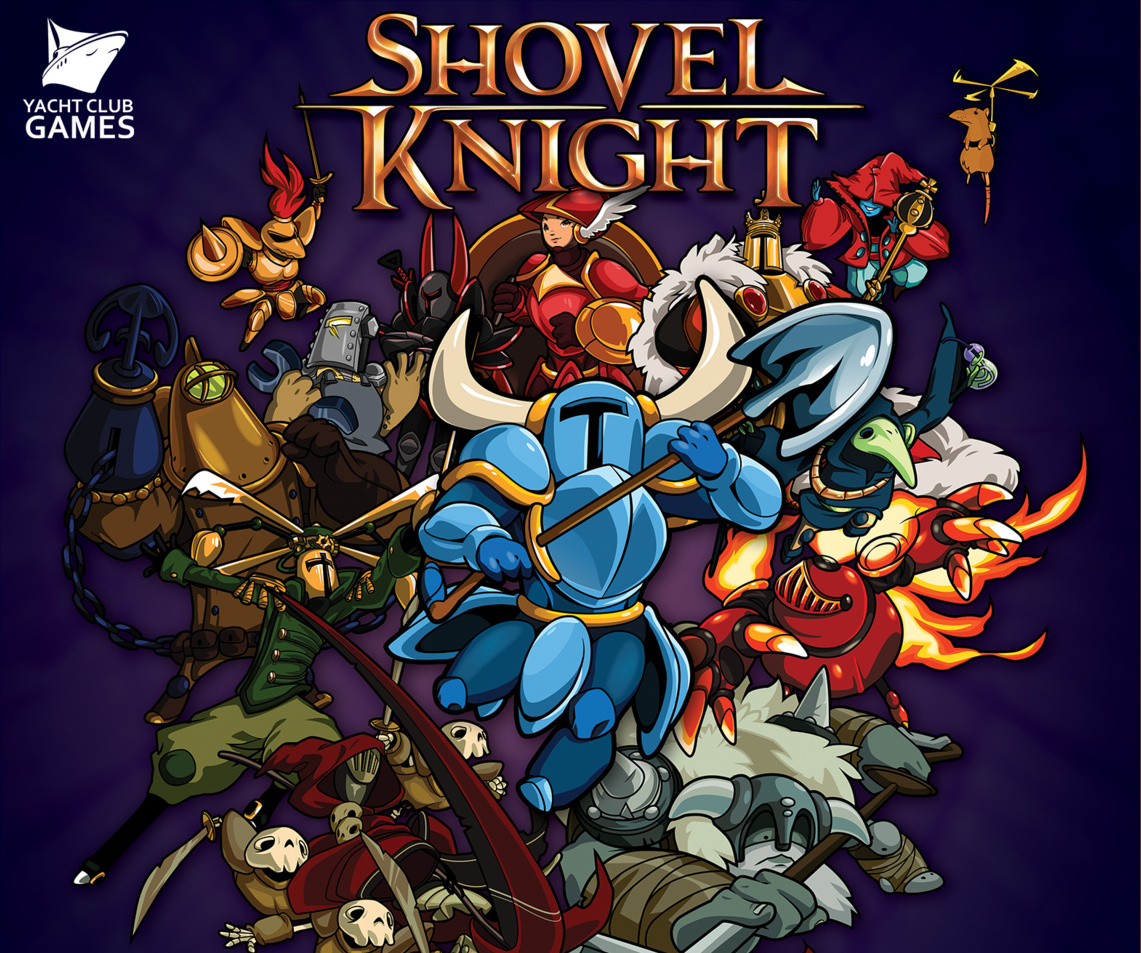
Thanks to one brave little knight, however, that may be changing. Shovel Knight is a game I really wanted to play. Last month, I finally picked it up and played it.
Did I unearth a treasure in Shovel Knight, or should I have left it buried?
Shovel Knight (PC, Nintendo 3DS/Wii U eShop; 2014)
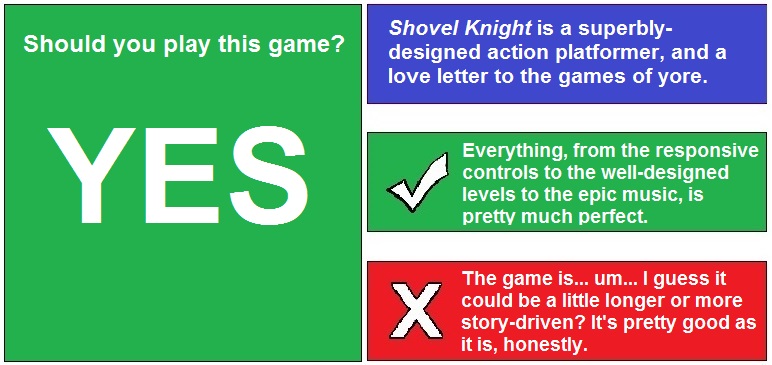
Shovel Knight is a near-perfect blend of responsive controls, challenging level design, retro-styled visuals, and whimsical humor—to wit, I really dig this game.
Of Shovels and Chivalry
Once upon a time, Shovel Knight and Shield Knight roamed the world in search of treasure and adventure. Tragedy struck, however, when a cursed amulet stole Shield Knight, driving Shovel Knight to a life of grief and solitude. Time has passed. An evil Enchantress has arisen. Her ruthless Order of No Quarter, a band of eight wicked knights, terrorize the land. In his quest to find Shield Knight and rescue the realm, Shovel Knight must take up his tool and fight.
Shovel Knight, like the Shantae games, is heavily inspired by the games of yore. (Shovel Knight and Shantae have much in common; the same composer and some of the same developers worked on both.) Shovel Knight borrows its level designs and basic gameplay from the Mega Man games, its map from Super Mario Bros. 3, its towns from Zelda II: The Adventure of Link, and one of its moves from that improbably awesome DuckTales game.
(Fun fact: The original DuckTales has a remake scored by the same composer as both Shovel Knight and Shantae—the guy really gets around!)
My point is that Shovel Knight is built on the solid foundation of older games, and that’s a good thing. In fact, it makes me rethink my criticism of Shantae and the Pirate’s Curse for being “awfully familiar.” It’s important to innovate in game development, as in any other creative medium, but there’s also something to be said for perfecting what has been done before. Shovel Knight is built of old parts, but they come together to make something really special. What it lacks in innovation, it makes up in technical excellence.
The controls in Shovel Knight are tight and responsive, allowing the eponymous hero to slash, hack, jump, thrust, and bounce with perfect precision. That’s fortunate, for the levels are extremely challenging. The platforming can be tricky; traps, enemies, and obstacles only make things more difficult. I was relieved, however, by how fair the game is. It doesn’t sabotage the player with poor controls, obtuse level design, or deliberate tricks. Shovel Knight can be a hard game, and most players will die a lot, but they’ll have no one but themselves to blame for it.
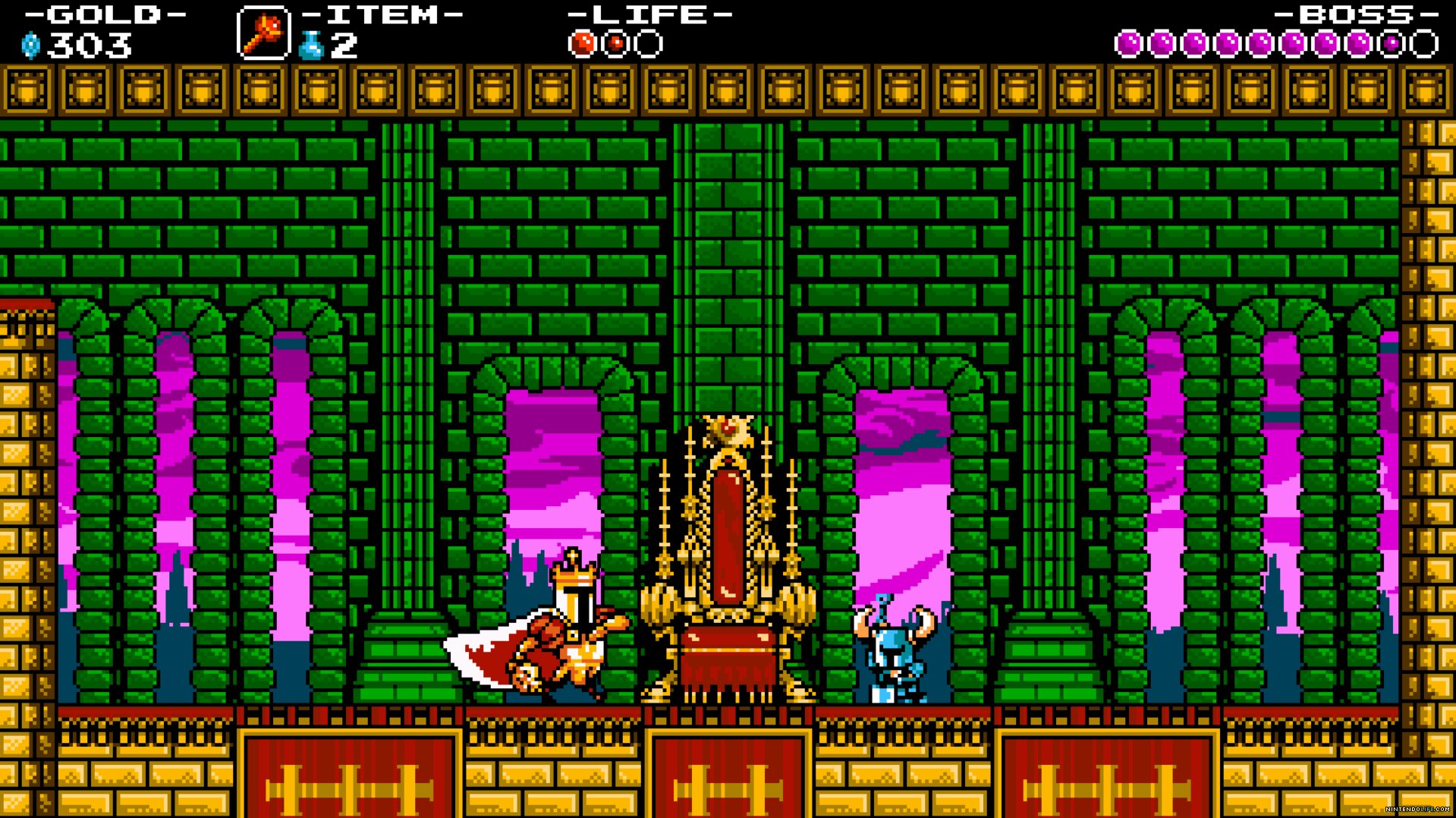
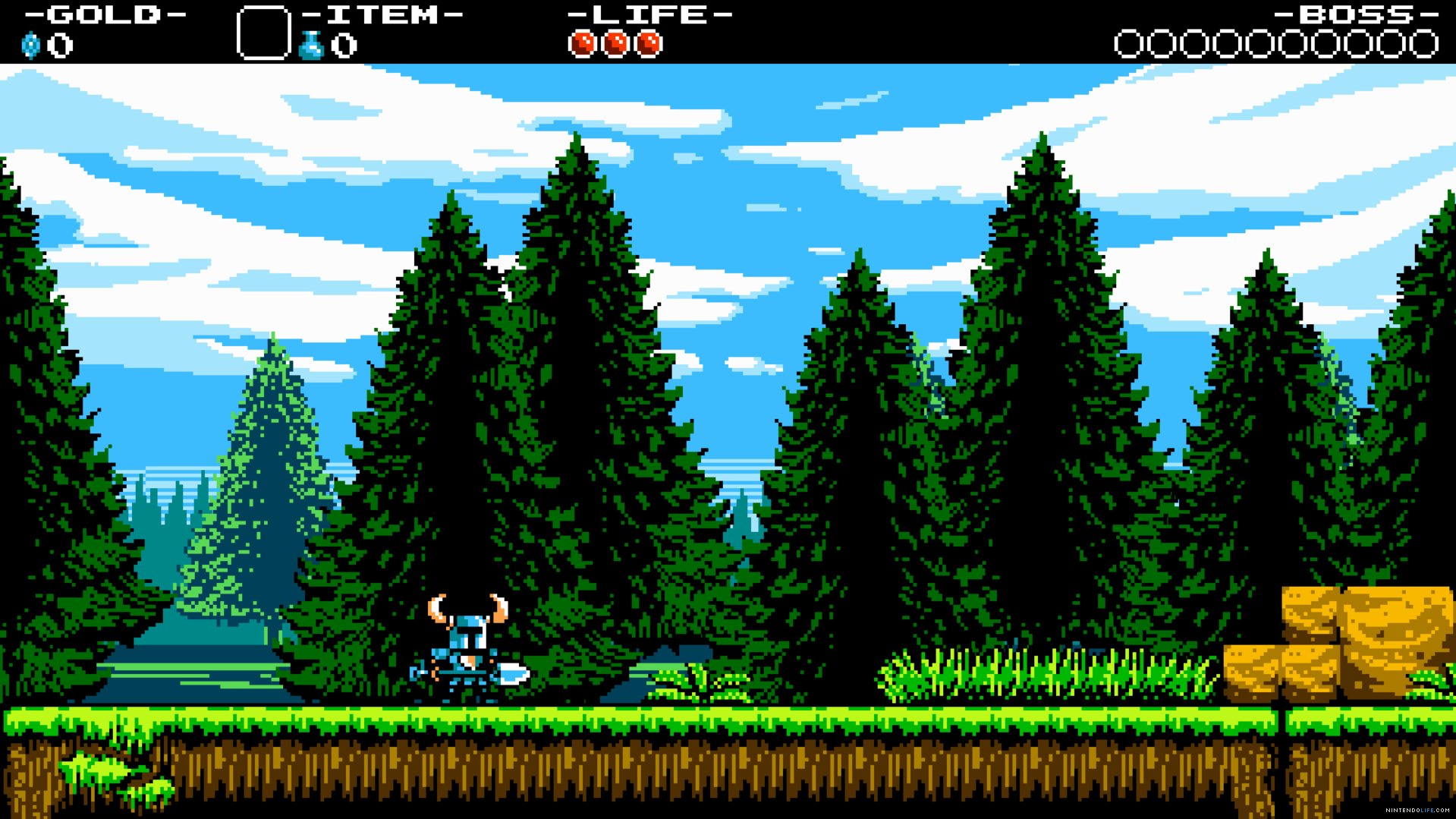
The levels are terrific. They scroll horizontally and vertically, and not a screen is wasted: every room and area has some new challenge, and there are plenty of secrets to find. Visually, the gameboasts pixelated, old-timey visuals on the same color palette as the old Nintendo Entertainment System. Shovel Knight looks (and plays) like a long-lost NES game, plus a few modern tweaks and minus the bad writing ubiquitous in the old days.
Besides his namesake weapon, Shovel Knight wields relics, a wide assortment of weapons and equipment bought from Chester, a wandering merchant who hangs out inside treasure chests (get it?) hidden in most levels. Money can also be used to buy shovel upgrades, new suits of armor, health boosts, and other bonuses.
Among other collectibles, Shovel Knight allows players to gather sheets of music that can be exchanged for songs and in-game cash. Speaking of music, the game’s soundtrack is phenomenal in a shrill, electronic sort of way. Seriously, listen to its main theme.
If that doesn’t give you feels, you may have no soul.
Adventure in Spades?
This is normally the part where I criticize a game for its flaws. With Shovel Knight, Ihave to look really hard. Prepare yourself, dear reader, for Adam at his most hypercritical.
NITPICKING POWERS ACTIVATED!
There’s not much story in Shovel Knight. It doesn’t need a complex story—the game is tons of fun to play—but more plot and characterization would have been nice. It’s sort of a Super Mario Bros. story: girl is taken, hero must rescue her, etc. There are one or two twists, and the Order of No Quarter are likable enough as characters, but the simplistic story feels like a missed opportunity.
Shovel Knight is a pretty short game. I actually appreciated that—I don’t have as much time for video games as I wish I had—but players expecting a long quest may be disappointed by its brevity.
Besides its difficulty, which is matter of preference, that’s pretty much everything I can find to criticize in Shovel Knight.
…And They Lived Happily Ever After, You Dig?
Shovel Knight is a game as pleasant and stalwart as its horned hero. It’s old-fashioned, challenging, and not for everyone; I know a couple of people who don’t much care for it. All the same, I love it, and I recommend it wholeheartedly.
The game is a well-written, beautifully-designed, gorgeously-scored love letter to the video games of the eighties. Like those games, Shovel Knight proves you don’t need fancy graphics, elaborate storytelling, or extravagant pageantry to make a game.
No, all you need is a shovel and a little courage.
I think the Magi are one of the most fascinating things about the Christmas story. These Wise Men arrived from the east to worship Jesus, and then vanished as mysteriously as they appeared. Christian tradition tells us there were three Magi and even gives their names, but history offers few clues as to the number or identity of these enigmatic pilgrims. The Magi are popularly called kings and widely believed to have been scholars. Who were the Wise Men?
I don’t think it matters.
I like the Magi because I relate to them. They were men searching for truth, following a star in a quixotic search for light and meaning in a bleak, meaningless world. Their pilgrimage, beginning God-knows-where and ending at the dirty feet of a little child, resonates with me. Amid my doubts and struggles, I sometimes feel like a man stumbling in the dark, following a star and trusting I’ll find peace at the end of the journey.
Am I a fool for chasing so faint and distant a star as faith in a Savior? I may be. If I am a fool, then so are the Wise Men, ironically enough.
The Wise Men found what they sought, and another wise man wrote at the end of his life, “I have fought the good fight, I have finished the race, I have kept the faith.” For my part, I can only echo Robert Frost: “I have promises to keep, and miles to go before I sleep.” I have my own journey ahead, and I hope I shall finish it well.
I can be a bit of a grump when it comes to Christmas, but I can’t find it in the darkest corners of my cynical heart to resist the joys of the season for long. The hope and beauty of Christmas outweigh the frivolous nonsense of the holiday it has become. Not even Ebenezer Scrooge or the misanthropic Dr. Doofenshmirtz can really hate Christmas.
Yes, the good Doctor—well, the bad Doctor—from Disney’s Phineas and Ferb is back, this time lamenting the fact he can’t seem to work up a nice, healthy hatred for America’s favorite holiday. Doofenshmirtz is one my favorite television characters, and I applaud him for flinging about words like ambivalence, invective, and animosity in a kid’s cartoon. A large vocabulary is most admirable… even if it’s mostly spent griping about the holidays.
The phrase moon music suggests compositions like Claude Debussy’s “Clair de Lune” or Beethoven’s “Moonlight Sonata.” For the geeks out there, however, it may call to mind a miserly cartoon duck and his adventures on the Nintendo Entertainment System.
The DuckTales video game should have been a disaster. More often than not, licensed games (i.e. games based on an existing intellectual property) are poorly-designed attempts to squeeze more money out of a media franchise. Seeing as DuckTales was never more than a decent cartoon in the first place, its game should have been an abject failure.
DuckTales turned out to be a masterpiece of the 8-bit era, and a resounding commercial success. I suppose Scrooge McDuck of all people (or poultry) really knows how to rake in the cash.
One of the game’s most enduring legacies is its moon music. “The Moon Theme” is among the most widely recognized game melodies of its time. Although the original version is a bit shrill, it’s quite complex for a song using the NES’s primitive sound chip. It makes me think of Schroeder from the Peanuts comics plinking out Beethoven’s masterpieces on a toy piano. The song also reminds me of the soundtracks to the old Mega Man games, which were made by the same developer.
When DuckTales was remade recently as DuckTales: Remastered, “The Moon Theme” was all over the game, not just in the Moon stage; I counted two or three arrangements of the song in the game’s end credits alone. One might even say… it eclipses the other songs in the soundtrack. (Pun intended. I’m so, so sorry.)
Musical instruments may be designed to produce a specific sound, but that doesn’t stop some musicians from using a single instrument to make all kinds of noises. For example, guitarist Phil Keaggy and cellist Steven Sharp Nelson use their instruments in incredibly creative ways. In my all-time favorite arrangement of Pachelbel’s Canon, Mr. Nelson strums his instrument like a banjo and beats it like a drum besides playing it as, you know, a cello.
Some clever musician on YouTube composed and performed some lovely music: smooth electronica backed by acoustic percussion. The only instruments used were three video game consoles: a Wii, an Xbox 360, and a PS3. The song is titled “Console Wars.” Of course.
I’m amazed at how a coherent melody, let alone such a charming one, could be arranged from the beeps of systems powering on, the jingles of menu screens, the clicks of analogue sticks, and the soft thumps of hands hitting plastic.

 Typewriter Monkey Task Force