171. Quirky Bible Translations

During Holy Week, TMTF will feature the Help, I’m a Christian! series, beginning on Palm Sunday, March 24, and concluding on Holy Saturday, March 30. Regular posts will resume on Monday, April 1.

There are many English translations of God’s Word. How many? I’m not sure, but I prefer not to spend years of my life counting.

I often read the Bible, and when I do, I prefer the 1984 New International Version.
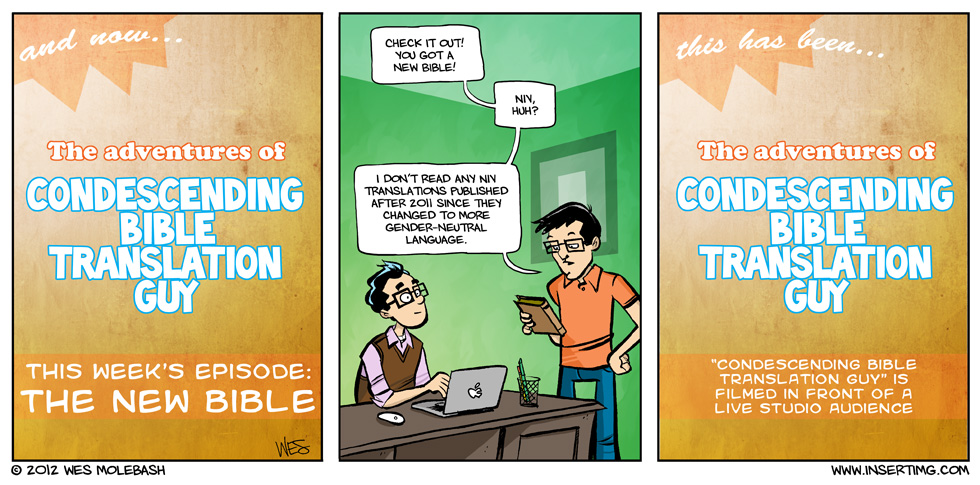
Yes, I'm this guy.

Confession: I am a Condescending Bible Translation Guy.

In my twenty-two years, I’ve stumbled upon some Bible translations that are best described as… quirky.

Here’s part of 1 Corinthians 13 in the plain English of the New International Version.

Love never fails. But where there are prophecies, they will cease; where there are tongues, they will be stilled; where there is knowledge, it will pass away.  For we know in part and we prophesy in part, but when completeness comes, what is in part disappears. When I was a child, I talked like a child, I thought like a child, I reasoned like a child. When I became a man, I put the ways of childhood behind me. For now we see only a reflection as in a mirror; then we shall see face to face. Now I know in part; then I shall know fully, even as I am fully known.

And now these three remain: faith, hope and love. But the greatest of these is love.

Here’s the same passage in the HWP Bible. That’s the Hawaiian Pidgin Bible, in case you were wondering. Read this excerpt aloud. Read slowly. Savor it.

Wen you get love an aloha, dat no goin pau eva. Da guys dat talk fo God, bumbye no need fo da tings dey say. Wen peopo talk diffren kine, bumbye nobody goin talk lidat. Da stuff da smart guys know, no matta, bumbye no need. You know, we ony know litto bit. Wen we talk fo God, we get ony litto bit fo tell. Bumbye, goin come da time wen everyting stay perfeck. Dat time, no need fo da litto bit kine stuff no moa. Small kid time, I wen talk jalike one small kid. I wen tink jalike one small kid. I wen figga everyting jalike one small kid. Now, I big, dass why I no do da tings da same way da small kids do um.

Right now, us guys can see stuff, but ony jalike wit one junk mirror. Hard fo figga wat we see dea. But bumbye, goin be clear. Us guys goin see everyting jalike was right dea in front our face. Right now, I ony know litto bit. But bumbye, I goin undastan everyting, jalike God undastan everyting bout me.

So now, get three tings dat stay: we can trus God, an we can know everyting goin come out okay bumbye, an we get love an aloha. From da three tings, da love an aloha kine, dass da main ting, an da bestes way.

Then there’s my favorite offbeat translation of Scripture… the lolcat version.

Luv no haz endingz. Tellin the futurez, tungz, an alla stuffz u know wil die. We haz knowingz a bit, an we haz profacy a bit. We no haz two much tho. O, wait. Win teh perfict coemz, teh not perfict will dyez, lolol. Wen i wuz a kitten, i meweded leik a kitten, thinkded liek a kittenz, an I chazed strings liek a kittenz. Wen i wuz becomez a cat, i NO WANT kitten waiz ne moar. For nao we see in teh foggy mirorr like when teh human gets out of teh shower, but tehn we see faec tow faec. Nao i haz knowingz just a bit, tehn i will haz all teh knowingz, as i haz been knownz.

Nao faithz an hoepz an luvz r hear, theses threes, but teh bestest iz teh luv. srsly.

Yes, this is a real translation. The entire Bible has been translated into lolspeak, the Internet language of funny cat picture captions. After all, the Apostle Paul did write about becoming “all things to all people.”

 What’s your preferred version of the Bible? Are you a Condescending Bible Translation Person or do you prefer idiomatic versions like The Message? Let us know in the comments!

119. God’s Fool

A couple of weeks ago, a coworker informed me quite seriously that our workplace is haunted.

I laughed and told her I think I’d have noticed by now if the bogeyman, the Slenderman or any other kind of spook were lurking in our workplace.

Later in the evening, the garbage compactor went off by itself.

“See?” said my coworker, smiling nervously. “Nobody’s in that room. How do you explain that?”

“If I were a vengeful spirit,” I replied, “I think I’ve have better things to do than activate garbage compactors.”

The incident made me laugh at the time, but it later made me think seriously about the things we believe. My coworker believes our workplace is haunted. It would be easy for me to scoff at her beliefs, but I happen to believe in an invisible, all-powerful, everlasting God.

What sets apart my beliefs from hers? What’s the difference between faith and superstition?

The answer, of course, is evidence. There’s much more evidence to support the existence of God than there is to suggest dark spirits have taken possession of the garbage compactor in my workplace.

Many people don’t agree. I recently read an article claiming science will someday eliminate the need for God. The theory of intelligent design is frowned upon by many scientists. Naturalistic evolution is the de facto explanation for the origin of human life.

Honestly, both sides offer compelling arguments. No matter what atheists may say, there’s certainly evidence for God. Regardless of what Christians will tell you, there’s certainly evidence for atheism. To quote C.S. Lewis, an atheist who converted reluctantly to Christianity, “Now that I am a Christian I do have moods in which the whole thing looks very improbable; but when I was an atheist I had moods in which Christianity looked terribly probable.”

In the end, casting one’s lot with one side or the other isn’t just a matter of reason, logic and evidence. It’s a matter of faith, even for atheists.

There are things I don’t understand about the Christian faith, even though I’ve tried. Regardless, I’ve chosen Christianity. Based on the evidence, it makes sense. I speak not only of scientific, archeological and historical evidence, but also of the evidence of changed lives.

Some months ago, I wrote about gangster pastors: men who have been miraculously transformed from violent, drug-addicted criminals into loving husbands, fathers and church leaders. I know these men personally. I’ve heard numerous accounts of miraculous events. Most powerfully, I know many people whose lives are marked by something, a loving graciousness that goes far beyond mere altruism or friendly disposition.

For me, the best evidence is my own life. Ten years ago, I was a selfish, dishonest, insecure jerk. Eight years ago, I turned my life over to Jesus Christ. Today, while I’m not perfect, I’m a much, much better person than I was.

In the eight years I’ve been a Christian, I’ve seen too many answers to prayer, too many transformed lives and too many unbelievable circumstances for me to pretend it’s all just a series of coincidences—just as it’s possible for ten rolls of a die to yield only sixes, but my first guess is that the gambler who rolls ten sixes in a row is probably using a loaded die.

I’m sure some of my readers are nodding their heads and exclaiming, “Yes, yes.” Some of my readers are probably shaking their heads and saying, “This guy’s deluded,” and a few may have stopped reading once I switched topics from the Slenderman to the Christian faith.

Christians are sometimes considered foolish, and that’s fine. Christ’s own family thought he was out of his mind. (To those who believed he was just a Jewish carpenter, some of the things Jesus said and did must have seemed pretty strange.) The Apostle Paul, who wrote nearly half the New Testament, was accused of insanity.

If I’m crazy for being a man of faith, at least I’m in good company. If I’m a fool, at least I have the consolation of being God’s fool.

I’m not quite sure why I decided to compose this blog post. The subjects of faith, atheism and superstition (and the Slenderman) have been on my mind recently, and I suppose I just wanted to share my thoughts.

104. Jesus Was an Introvert

During his life on Earth, Jesus was an introvert.

I don’t have any concrete proof to back up my claim. However, I’ve read enough courtroom mysteries (and played enough Ace Attorney games) to know that evidence is everything in a court of law (or a blog of typewriter monkeys).

Unlike extroverts, who enjoy being with people and dislike being alone, an introvert is a person who prefers solitary activities over social ones. Introversion shouldn’t be confused with shyness: an introvert prefers being alone, whereas a shy person avoids social events out of fear.

Now for the evidence!

The Lord Jesus often withdrew to solitary places. Mark informs us, “Very early in the morning, while it was still dark, Jesus got up, left the house and went off to a solitary place, where he prayed” (1:35). Matthew points out that the Lord’s response to the death of his cousin John was to get away from people: “When Jesus heard what had happened, he withdrew by boat privately to a solitary place” (14:13). Luke confirms that Jesus went off alone early in the morning (4:42).

Introverts are sometimes viewed with suspicion, as though their love of solitude were a deficiency that requires a cure. That’s nonsense. Personally, I think introverts are awesome.

Granted, I’m sort of biased.

As an introvert, I find the passages describing the Lord’s preference for solitude encouraging. If Jesus Christ could get away with being introverted, then so can I!

I think both introverts and extroverts can learn something from Jesus.

Extroverts must try to be sensitive toward introverts. For example, introverts sometimes turn down invitations or leave social events early: not to offend anyone, but simply because they feel overwhelmed.

Introverts mustn’t use their liking of solitude as an excuse for being lazy or avoiding people. The Lord Jesus may have been an introvert, but he spent countless hours teaching, preaching, healing the sick and comforting the discouraged. For every hour he spent alone, he spent many more helping people. Introversion mustn’t become a license for selfishness.

Now I’ll withdraw to a solitary place to enjoy a solitary activity.

To wit, I’m off to my bedroom to drink some coffee.

94. For When the World Seems Dark

In the centuries since the invention of the printing press, Christians everywhere have perfected the fine art of writing in their Bibles.

Some readers of Scripture create complex systems involving symbols or different colors of highlighter markers. Others cram notes, observations and questions into the margins.

I write in my Bible, though my notations are pretty simple. A couple of years ago, for example, I labeled the psalms in order to keep track of them. I came upon the seventy-seventh psalm a few days ago. Its label intrigued me.

For when the world seems dark

The psalm begins: I cried out to God for help; I cried out to God to hear me. When I was in distress, I sought the Lord; at night I stretched out untiring hands and my soul refused to be comforted.

Well, that’s cheerful.

Moving forward a few verses: Will the Lord reject forever? Will he never show his favor again? Has his unfailing love vanished forever? Has his promise failed for all time? Has God forgotten to be merciful? Has he in anger withheld his compassion?

What a bright, happy psalm this is turning out to be.

As I read the first few verses, I was wondered why I’d given Psalm 77 a title like For when the world seems dark. When the world seems dark, I want it to seem lighter—not more depressing!

Then the theme of the psalm takes an abrupt turn: I will remember the deeds of the Lord; yes, I will remember your miracles of long ago. I will meditate on all your works and consider all your mighty deeds.

The psalmist goes on to describe one of God’s great miracles, and ends with these words: You led your people like a flock by the hand of Moses and Aaron.

Some great Christian thinker (I don’t remember which) once wrote, “Do not forget in the darkness what you have learned in the light.”

The psalmist didn’t forget. When God seemed far away, he paused to remember two things: the great deeds God had done, and the great love God had shown.

Psalm 77 came at a good time. At the moment, I’m under some emotional strain. Leaving loved ones, adjusting to a new place, facing an uncertain future—these things are hard. It’s easy to lose perspective and become lost in depression, anxiety or fear.

It’s at times like these that I must stop and remind myself of two things: the great deeds God has done for me, and the great love he’s shown toward me.

I remember those scholarships that allowed me to graduate from Bethel College. I remember how, when I was depressed during my third semester, I enjoyed the much-needed blessing of a long, solitary Thanksgiving break spent writing, watching Disney movies and playing Final Fantasy VII. I remember the glorious evenings spent watching Avatar: The Last Airbender and drinking tea with my friends from college. I remember all those mornings my old man brought me coffee in bed, and all those times my mum told me, “You’re a treasure.”

I remember how often God has made things right.

When the world seems dark, remember what you’ve learned in the light.

Help, I’m a Christian! – The Bible

The Bible. The Bible. These two words evoke a book which weighs nearly as much as a small rhinoceros: a book with hundreds and hundreds of pages packed with tiny lettering. The Bible is fraught with dull footnotes. The Bible is full of weird names like Hakkatan, Abimelech and Mephibosheth.

The Bible is also the most powerful book ever written.

It’s the bestselling book in history. Along with Greco-Roman mythology, it’s one of the foundations of Western literature. It has influenced thinkers, artists, musicians and writers for two thousand years: Michelangelo, Bach, Dante, Da Vinci, Handel, Newton, Chaucer and Pascal, to name but a few. The Bible has shaped societies around the world. Some of the founding principles of the United States of America were taken from Scripture.

The Bible is an important book, and that’s looking at it from a secular perspective!

For Christians, it’s infinitely more important—it’s the Word of God.

I’ll be the first to admit that reading Scripture is hard. I’ll also be the first to affirm that it’s totally worth it.

When I began reading the Bible, I made three great mistakes.

First Mistake: I thought of the Bible as just a religious obligation. I read it simply because that was what Christians did.

Second Mistake: I failed to understand how the story of the Bible fits together. The Bible is one story. Each part connects to every other part. (Except for the book of Job. It sort of comes out of nowhere.) In Sunday School, I learned the famous stories: Noah and the Ark, David and Goliath and the rest. What I didn’t learn is that they’re all part of a much greater story.

Third Mistake: I didn’t recognize the indirect lessons of Scripture. Sure, there are a lot of direct lessons like You shall not kill, but most of the Bible doesn’t consist of straightforward commandments. There are histories and genealogies and poems, not to mention a lot of ancient laws that don’t apply to us anymore. I thought these things were worthless because they didn’t relate directly to my life.

What I didn’t understand was that they related indirectly.

In a reader skips the slow chapters in a novel, he’ll have an inadequate grasp of the story. It’s the same with Scripture. If we skip the boring parts, we’ll end up with an incomplete understanding of who God is, what he has done and what he wants us to do.

Reading Scripture can be hard, and it would take much more than one blog post to address all of the difficulties that can arise. That’s why Study Bibles and other resources are awesome. They fill in the gaps, interpret the difficult verses and generally make reading the Bible easier.

What’s the best way to read the Bible?

It’s a matter of choice. Some people write down their reflections in a journal. Others make notes in their Bibles. Some people read Scripture every day. Others read it several times a week.

For a beginning reader, I recommend finding a good Study Bible and starting with the New Testament, then reading the Old Testament, then rereading the New Testament. The New Testament probably has more practical lessons for Christians, but the Old Testament influenced the New Testament so much that it’s important for Christians to be familiar with both.

I humbly offer three pieces of advice to anyone reading the Bible.

First, take it slow and steady. A chapter every day is better than seven chapters once a week. Readers risk burning out if they read too much at one sitting, and it’s easiest to absorb Scripture in small doses. Find a reading plan that works for you.

Second, don’t panic. The Bible can be hard to read, and that’s okay. Just take it a little at a time.

Third, don’t be afraid to engage issues that seem confusing or strange. God loves it when we ask questions, and the Bible is a book that has confused people for millennia. Don’t be concerned if something doesn’t seem to make sense. Pray about it, find a good Bible resource or talk it over with someone.

The Bible is my favorite book. When I began reading it, however, I didn’t like it. Scripture seemed boring and distant.

Then little things began to click: a psalm here, a proverb there; a command from Jesus here, a warning from Paul there. I was sometimes convicted. I was sometimes encouraged. Bit by bit, I learned.

Apart from prayer and the good examples of other people, I don’t think anything has helped me grow so much—as a person, as a writer and as a follower of Christ—as the Bible.

Hard to read? Sometimes. Worth it? Totally.

Next: Church

75. Stoic or Stupid?

I don’t think I would make a very good Viking.

I hate cold weather. I lack any kind of vicious bloodlust. Most importantly, I can’t grow a beard. Thus it is proved. Adam would not make a good Viking.

Regardless, I possess one quality that would make any Viking proud: quiet stoicism.

When confronted with trials and tribulations, I don’t usually talk about them. Whether depression or headache, discouragement or insomnia, sadness or soreness, I keep my problems to myself.

In some ways, quiet stoicism isn’t such a bad thing. I know people who could probably use a little stoicism: the sort of people who regularly insist on describing all of their frustrations in painstaking detail. One reason I don’t talk much about my problems is that I don’t want to annoy anyone.

In other ways, however, quiet stoicism is kind of stupid.

To be honest, one of the reasons I keep my struggles to myself is to give the impression that I don’t have any. It’s hard to be vulnerable. It can be embarrassing. The easiest option is sometimes to be stoic and tough out my problems alone.

The trouble is that some problems are too big for anyone to tough out alone.

As much as I’d like to pretend I’m totally self-sufficient, I’m not. There are times I need someone to give me advice, encouragement or criticism. There are times I need someone to listen to me. There are times I need someone simply to be there.

Not long ago, I realized I’d made such a habit of trying to deal with my problems alone that I was forgetting to ask God for help when difficulties arose. It wasn’t a deliberate, “I’ll take care of this little complication, God, and ask you to handle the really big problems” kind of decision. In fact, it wasn’t a decision at all. Asking for help simply didn’t occur to me.

Stoic or not, forgetting to ask the Lord God Almighty for help is stupid. He doesn’t merely allow us to ask for help when we need it. He flat-out commands us to ask for help when we need it!

Paul wrote, “Do not be anxious about anything, but in everything, by prayer and petition, with thanksgiving, present your requests to God” (Philippians 4:6).

Peter added, “Cast all your anxiety on him because he cares for you” (1 Peter 5:7).

Quiet stoicism can be a virtue. I’m a reserved person, and I don’t plan to tell everyone about every problem. I think it’s good sometimes to work through problems patiently.

In the end, though, ain’t it better to ask for help?

70. Talking Too Much

I talk too much.

This wouldn’t be a problem, except for one small detail: when I talk, most people feel obligated to listen. Some of my acquaintances have probably perfected the art of Tuning Out Adam, but the rest have no choice but to suffer politely through my ramblings, rants and dramatic monologues.

Even after I realized I talk too much, I didn’t think it was a serious fault. Pastors don’t preach sermons about the sin of talkativeness. The Lord Jesus didn’t warn against being too chatty. The Bible doesn’t have anything to say about rampant loquacity.

At least that’s what I thought.

Once, years ago, I contradicted a high school teacher about a passage of Scripture. A grim expression came over his face. He busted out a Bible. One of my classmates whispered, “Oh, Adam’s about to get Scripture-owned.” As it turned out, my teacher was absolutely correct. I was chastened, humbled and embarrassed.

Pretty much the same thing happened in regard to my tendency to talk too much.

Much to my discomfort, I kept finding verses in Scripture that suggest talking too much is a foolish thing to do.

Solomon had all kinds of things to say in the book of Proverbs.

“When words are many, sin is not absent, but he who holds his tongue is wise.”

“A man of knowledge uses words with restraint, and a man of understanding is even-tempered.”

“Even a fool is thought wise if he keeps silent, and discerning if he holds his tongue.”

New Testament writers were equally eloquent upon the subject.

“Do not let any unwholesome talk come out of your mouths, but only what is helpful for building others up according to their needs, that it may benefit those who listen,” wrote the Apostle Paul.

“Everyone should be quick to listen, slow to speak and slow to become angry,” wrote James the brother of Jesus.

Most discomforting were words spoken by the Lord Jesus himself: “But I tell you that men will have to give account on the day of judgment for every careless word they have spoken.”

Wait, I’ll have to give account for every careless word I’ve spoken? Every careless word I’ve ever spoken?

Dash it.

Once again, I got Scripture-owned.

One of my resolutions for this year is not to talk quite so much. Have I broken this resolution? Yes, yes I have. I’m still working on it.

66. Taxes

As we all know, February is a month for love, romance and taxes.

Taxes wouldn’t be so bad if they were simpler to pay. I don’t mind giving money to the government. No, what bothers me is that giving money to the government requires so many hours of tedious paperwork.

Despite the complications, I continue to pay taxes every year. After all, Jesus paid his taxes. There’s a great story in Matthew 17 in which Jesus sends Peter fishing, promising that the first fish he catches will have a coin in its mouth with which to pay the temple tax.

My first reaction to this story is, “Of course Jesus paid his taxes, and so should I.”

My second reaction is, “Man, Jesus had it easy. I wish I could just hand over my tax money and be done with it. I wonder what miracle Jesus would use to pay his taxes today.”

Another reason I pay taxes is to prevent the US government from arresting me for tax evasion. There are many places in the world I’d like to visit, but prison isn’t one of them. Besides, if I were arrested and put on trial, the legal paperwork would be even worse than tax paperwork. It’s sort of like Scylla and Charybdis from The Odyssey. A person must decide which misery is less miserable.

When I pay taxes, the process typically involves a large amount of tedious fact-checking, a moderate amount of careful estimating and a small amount of wild guessing.

In addition to my usual federal and state taxes, I also pay the Federal Secretarial Animal Assistant Tax (also called the FSAAT) for my typewriter monkeys.

I never ask my monkeys to help me with my taxes. In addition to their other faults, they are extremely bad at mathematics. I’m much better at math than any of my typewriter monkeys, despite having an English degree. (For those who don’t know, an English degree is not so much a sign of being good at English as a sign of being bad at mathematics.)

Besides being poor mathematicians, my typewriter monkeys are also unmotivated to do tax paperwork. They have the stubbornness of mules and slothfulness of… well… sloths.

At least I don’t have the misfortune of employing typewriter sloths. Indeed, I must count my blessings.

I’d also better think about doing taxes soon.

48. Falling Asleep in Church

God loves the people who fall asleep in church.

This comes as a relief to me, since my thoughts sometimes wander to the ends of Earth during sermons. To borrow a phrase inadvertently coined by an acquaintance of mine, I tend to daze off during services—to slip into a blank state of mind somewhere between a daze and a doze in which I’m only vaguely aware of the message being preached.

I suspect the reason some churches serve coffee is to keep churchgoers awake during the sermon. Other churches, not quite so shrewd, make the mistake of serving real wine during communion services—there’s nothing like alcohol to make churchgoers drowsy.

One of my favorite stories in the Bible concerns a young man who fell asleep during church. Paul, the missionary who wrote about half of the books in the New Testament, was preaching in an upstairs room late at night. As Paul droned on and on, a young man named Eutychus fell asleep, plummeted from a third-story window and died.

It would have been awful if the story had ended there. The moral of the story would have been You fall asleep in church, you die. The story continues, however, and we learn two great things about God. First, he loves the people who fall asleep in church. Second, he has a sense of humor.

After Eutychus fell out the window, Paul rushed down to the street and put his arms around his dead body. “Don’t be alarmed,” he said. “He’s alive!” Eutychus revived, much to the delight of the people. Paul went upstairs, had something to eat—and kept preaching.

If I had been God, I might have considered not restoring Eutychus to life. “Let his death stand as a warning to all future sleepers in churches,” I might have said. Fortunately for churchgoers everywhere, the Lord is very merciful. Eutychus was revived and God’s love for all people—even people who fall asleep during church—was demonstrated.

(The story of Eutychus can be found in Acts 20:7-12.)

There are quite a number of funny things like that in the Bible.

There’s the poetic passage in which God described the stupidity of ostriches (Job 39:13-17).

There’s the tragicomic story of how King David’s murderous son Absalom was killed by soldiers after he rode beneath an oak tree, got his head caught in a branch and dangled helplessly in midair as his mule went on without him (2 Samuel 18:9-15).

There’s the account of how, during a contest between God and the false god Baal, the prophet Elijah taunted rival prophets with snarky remarks (1 Kings 18:22-29).

For all its seriousness—and it can certainly be serious—the Bible is sometimes pretty funny.

45. Give Us This Day Our Daily Schedule

An acquaintance of mine once uttered this profound insight: “Procrastination is just an extreme form of patience, and patience is a good thing.”

By this standard, I’ve been extraordinarily patient for the last two weeks.

In fairness, I’ve had a number of distractions: graduating from college, packing, traveling to Uruguay, unpacking and playing Skyward Sword. Before arriving in Uruguay, I had ambitious plans to write at least half a dozen posts for TMTF to spare myself the stress of desperately composing a post at the last minute. Within five or ten minutes of actually arriving in Uruguay, my plans to work ahead on my blog had been forgotten.

Now at last I’m resuming my sensible plan of working out a tentative schedule for TMTF a week or so in advance. Since I’m trying to figure out a schedule for the blog, this seems like the perfect time to mention the most unexpected strategy I’ve discovered for keeping in touch with God: scheduling.

I believe Christians are supposed to keep in touch with the Lord through prayer and reading Scripture—not as a requirement for salvation but as a response to it. Jesus said something clever about branches not being able to bear fruit unless they remain in the vine, meaning his followers won’t be productive unless they remain in a consistent relationship with him.

Fact of Importance: Prayer and reading the Bible aren’t part of a system to earn God’s favor. Christians don’t have to earn anything. Studying Scripture and praying are simply the best way to keep in touch with God: to honor him, learn from him, be encouraged, be corrected and be ready for action.

The other day I was reminded of a simple and decidedly unspectacular method for being consistent in praying and reading the Bible. I speak, of course, of the fine art of scheduling.

The more I procrastinate, the less motivated I become to pray or read the Bible. If I choose not to procrastinate—in other words, if I choose to pray and study Scripture early in the day while I’m refreshed from a night’s sleep and fueled by coffee—I’m able to face the rest of the day with greater motivation, enthusiasm and confidence.

(This also proves the potential spiritual benefits of coffee.)

Scheduling isn’t an impressive strategy, but it’s done more to help my relationship with God than almost anything else.

Are you a “patient” person? What strategies help you get things done? Let us know in the comments!