59. Emoticons

Emoticons—those short combinations of letters, numbers and punctuation marks that sort of resemble little faces if you look at them sideways—have crept over the Internet like an army of tiny pictographic soldiers.

When I was a student teacher, some of my students even used emoticons in their homework. This annoyed and perplexed me greatly. Apart from being childish and unprofessional, putting emoticons in hand-written assignments seemed pointless. I can’t imagine why my students made the effort to write out emoticons when they could have just drawn little faces.

Though I seldom use emoticons, I have nothing against them. They’re an interesting development of written English, and they can give informal writing a certain charm.

For the sake of Internet People everywhere, I’ve compiled (with a little help from Dave Barry) a list of useful emoticons.

Typewriter Monkey Task Force is proud to present…

The Official TMTF List of Eminently Practical Emoticons for Convenient, Everyday Usage!

: )         Happy person

: (         Sad person

: – )       Happy person with a nose

: – (       Sad person with a nose

: — (     Person who is sad because he has such a big nose

: /          Frustrated person

: D        Overjoyed person

. (         Person who ran with scissors

X D        Amused person

<l : )      Gandalf the Grey

:’ (         Weeping person

: P        Cheerful person

:V: (      Person with an alligator on her head

:-3         Cat

; )          Wry person

: o )       Clown

XO        Person who is afraid of clowns

: o          Slightly surprised person

8 O        Very surprised person

: ) ?        Captain Hook

: I           Person who has eaten too much

: ) ~D     Person about to drink a calming cup of Jasmine tea

: ^ (        Cyrano de Bergerac

O Internet People, it is now up to you to use these emoticons with creativity, discernment and wisdom.

Just don’t use any of them on homework assignments, all right?

What emoticons did I miss? What are your favorites? Let us know in the comments!

58. Gangster Pastors

One of my most prized possessions is a weather-stained, gray cloth cap. If my residence ever burns down, this cap is one of the first things I will try to rescue from the flames. I call it my gangster cap, not because it fits the so-called gangster style, but because a gangster—or rather, an ex-gangster—gave it to me.

I was touched when my ex-gangster friend, whom I’ll call Miguel, gave me his cap, because it has great sentimental value for him. He had once lost it while plunging into a gully to escape from a rival gang. It lay at the bottom of the ravine for four months until he sneaked back to retrieve it.

Miguel was a car thief and a gang leader in Quito, the capital of Ecuador and the city of my birth. Besides his other crimes, Miguel occasionally worked for Mama Lucha, a notorious criminal kingpin. (I guess she should actually be called a queenpin since she was a woman.)

On one occasion, Miguel and his comrades tried to steal a long sheet metal sign welded to a pedestrian bridge. Unfortunately for them, they weren’t able to divide the sign into pieces as they’d planned. In the end they had to carry it whole through the streets of Quito, weaving furtively through city streets like some sort of monstrous metal centipede.

Miguel is currently happily married, working at a government job in Quito and ministering as a lay leader in his church.

It is a source of amazement, amusement and wonder to me how many of the church leaders I knew in Ecuador are former gangsters, thieves or occultists.

I’m not using real names in this post in order to protect the privacy of the leaders whose stories I’m sharing. I assure you, however, that to the best of my knowledge all of these stories are accurate, factual and true.

Paco is a kind, gentle and fiercely amiable pastor from the coast of Ecuador. Like King Saul in the Old Testament, Paco is about a head taller than everyone around him. His skin is black, his frame is muscular and his cheek is scarred by a gash from a knife. He used to be a thief on the streets.

Armed with a knife, Paco once accosted a girl at night with the intention of taking her money. The girl, who was a Christian, began talking with him about God. Although it was a long time before Paco would know Christ, he eventually put away the knife and escorted the girl to her home because—as he explained—it was a dangerous neighborhood and he didn’t want her to get robbed.

Paco eventually wound up in prison. Some of his fellow prisoners were personal enemies who wanted to kill him. However, before they had the opportunity, Paco was released. He didn’t know how or why—the only hint he received was a vague explanation that “some lawyer” had made all the necessary arrangements. What those arrangements were, and who the lawyer was, he doesn’t know to this day. It has been suggested to him that the lawyer might have been an angel. He doesn’t deny the possibility.

Then there’s Luís, another ex-criminal from the Ecuadorian coast. His skin is black, which makes his dazzling white smile all the more striking. Luís is a fantastic storyteller, and my dad has been privileged to hear accounts of several of his escapades.

Luís, while stoned on drugs, once tried to murder another man, also stoned. Having crept up on him from behind, Luís put a pistol to the man’s head and pulled the trigger. The gun misfired. Luís examined the pistol, peering blearily into its barrel, while his victim sat peacefully unaware of the attempt being made on his life. Luís tried again to murder his victim. The gun didn’t go off, but this time the man realized what was happening and fled shrieking while Luís resumed his bewildered examination of the gun.

On another occasion, Luís entered a church and sat down—only for a huge army knife to fall out of his shirt and hit the concrete floor with a thunk. Nearly every head turned to look at him, and a little old lady sitting nearby picked up the knife and sweetly gave it back to him.

A turning point came when a taxi crashed into a light pole as Luís leaned against it. The pole absorbed most of the impact, but Luís flew a considerable distance and landed hard. Just a few minutes later he met a Christian lady from his neighborhood. “Did something just happen to you?” she asked. “God told me to pray for you five minutes ago, so I did.”

After Luís became a Christian, two attempts were made on his life, once with a pistol and once with a sawed-off shotgun. The guns misfired both times—two more miraculous interventions.

All three of these church leaders have told my dad that they’re grateful to God for never letting them kill anybody. They all came frighteningly close to it. Looking back, they can see the hand of God at work in their lives, even when they didn’t care for him.

I believe, if we look hard enough, most of us can see the hand of God at work in our own lives.

I know I can.
57. Final Fantasy

I have a fascination for the fantasy genre. Fantasy provides a unique medium through which to explore themes like redemption and destiny and objective morality. Fantasy also teems with dragons and wizards and heroes. In other words, it’s got pretty much everything.

As I’ve mentioned in a previous post, fantasy has branched out into roughly several million subgenres: high fantasy, low fantasy, dark fantasy, steampunk fantasy, urban fantasy, magic realism, paranormal romance—the list goes on and on and on.

One of my favorite subgenres of fantasy also happens to be a series of video games. I speak, of course, of Final Fantasy.

Fantasy might have a ridiculous number of subgenres, but Final Fantasy doesn’t seem to fit any of them. It basically creates its own.

A good word to describe the Final Fantasy games would be eclectic. The games take many wildly different elements—elements that simply should not make sense in the same story—and somehow weave them together into compelling narratives. Soldiers wielding swords ride motorcycles. Scientists in research facilities study magic and genetic engineering in neighboring laboratories. Heroes are confronted by robots one moment and dragons the next. A hodgepodge of elements from fantasy and science fiction are combined to create worlds that seem quite believable.

I saw worlds, plural, because each Final Fantasy game takes place in an entirely different world. This means each game features a new plot, setting and cast of characters more or less unrelated to any other game in the series. Each game is its own adventure.

There are a few common threads throughout the Final Fantasy series. Reoccurring elements include creatures, names, terminology, plot devices and themes.

The themes of Final Fantasy are noteworthy as being surprisingly deep. The series deals with diverse moral, philosophical and ethical themes: everything from nihilism to environmentalism.

Apart from the fact that the games are fun to play, arguably the best thing about Final Fantasy is the characters. Whether seeking revenge, striving for redemption or grappling with existential angst, the characters of Final Fantasy are usually complex, dynamic and memorable.

The characters are also pretty cool. Consider Cloud Strife, equally renowned for his complex characterization and massive sword. Note also his spiky hair.

Massive swords tend to be another recurring feature of Final Fantasy games, by the way.

In regard to gameplay, the Final Fantasy games are quite good, though not as inspired as, say, the Legend of Zelda series. Final Fantasy offers massive worlds to explore and endless quests to accomplish, but the RPG-style battles can get a little tedious. It should be noted that the Final Fantasy games have amazing music.

I can hardly resist including one more image, this time a striking portrait that goes a long way to illustrate the essence of Final Fantasy.

This character represents pretty much everything there is to know about Final Fantasy. His design represents the strangely coherent blend of old and new prevalent through the series, combining stylish sunglasses with clothes that wouldn’t look out of place in feudal Japan. His face hints at deep internal struggles—in his case, unfulfilled promises—typical of Final Fantasy characters. His sword is, of course, improbably large.

Although some critics argue that Final Fantasy has declined in recent years, I argue that it’s still one of the best video game series in existence. It also brings a number of excellent narratives to the fantasy genre: a contribution not to be overlooked.

56. About Writing: Self-discipline

According to one of his biographies, Douglas Adams, the author of The Hitchhiker’s Guide to the Galaxy, was notoriously bad at meeting the deadlines set by his publishers. “I love deadlines,” he once said. “I like the whooshing sound they make as they fly by.”

When he absolutely couldn’t put off submitting a manuscript any longer, he locked himself in a hotel room, played the same music over and over, drank gallons of coffee and worked feverishly on the manuscript until it was done. This unusual writing process probably explains why his novels are so bizarre. In addition to being somewhat unorthodox, his writing process must have been highly uncomfortable.

I can sympathize with Douglas Adams. I realized this morning that today is the deadline for a new post for TMTF and I had forgotten to compose one.

Many writers fall prey to procrastination. It’s easy to put off writing until past the deadline. If there’s no deadline, well, it’s easy to put off writing indefinitely. Writing requires a considerable investment of time and effort. It can be exhausting. Without definite goals or serious deadlines, many writers are quick to become distracted from their writing.

Writers sometimes make the opposite mistake, setting so many goals and expectations that writing becomes discouraging, fatiguing and stressful.

It can be difficult for writers to be self-disciplined without straying into one of two extremes: legalism or laziness.

What’s the solution? If you’re a writer, how can you be both productive and relaxed without becoming anxious or lazy?

That’s entirely up to you.

Writers are different. My idea of self-discipline is very different from Douglas Adams’s idea of self-discipline. His methods wouldn’t work for me, and mine probably wouldn’t have worked for him.

In the end, it’s up to each writer to find ways to maintain self-discipline.

Some writers set themselves a daily goal of writing a certain number of words or writing for a certain number of hours. Some writers work only when they’re in a creative mood. Some writers simply start writing and stop when they can’t write anymore.

It also helps writers to find ways to minimize distractions.

Some writers focus best while listening to music; others are distracted by music and prefer silence. Some writers enjoy working in crowded areas; for example, J.K. Rowling wrote much of the Harry Potter series in crowded cafés during the day. Other writers dislike company and opt to work in solitude; for example, J.R.R. Tolkien wrote The Lord of the Rings alone in his study at night.

All writers are unique, and must find their own unique ways of remaining focused, relaxed, productive and self-disciplined.

I’ll keep striving for self-discipline, and maybe I’ll have the next post for TMTF ready by the deadline.

Maybe.

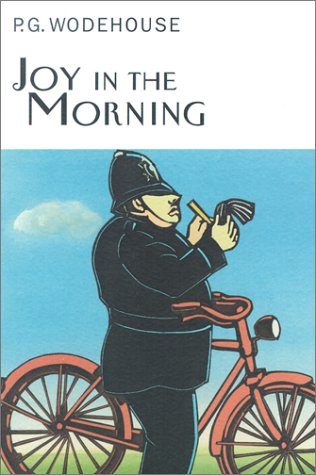
55. TMTF Reviews: Joy in the Morning

A friend once told me the following story. Several of the most respected writers in the world were asked to compile a list of the one hundred best books ever written. One of these writers supposedly replied, “Well, P.G. Wodehouse wrote ninety-seven books in his lifetime, so it only remains to us to come up with three more books for the list.”

I’m not sure whether this story is true, but it definitely could be. P.G. Wodehouse is one of the funniest writers in the history of writers who are funny. Every time I read one of his books I feel deep admiration, almost reverence, for his effortless command of the English language. I also feel profound envy. I wish I had Wodehouse’s gift for writing.

Admiration and envy, however, are always my secondary responses to books by Wodehouse—my first reaction is invariably amusement, often manifested in raucous laughter.

I recently happened upon a copy of Joy in the Morning, a novel by P.G. Wodehouse. I decided to read it for two reasons. First, it had been a long time since TMTF reviewed a new book. Second, it was a novel by P.G. Wodehouse—’nuff said.

Joy in the Morning is vintage Wodehouse: a character gets into a sticky social situation that gets progressively stickier and stickier, only to be rescued at the last moment by a clever friend or a lucky turn of events.

The novel is the memoir of Bertram “Bertie” Wooster, a London resident who becomes engaged (entirely by mistake) to an domineering lady named Florence. Her previous fiancée views Bertie as a traitorous sneak and expresses a strong desire to pull out his insides and trample on them. A few other dreadful characters—Bertie’s short-tempered Uncle Percy and horrible cousin Edwin, for example—blunder onto the scene to complicate matters further. The whole crisis is overshadowed by the looming threat of Bertie’s Aunt Agatha, described by Bertie as “my tough aunt, the one who eats broken bottles and conducts human sacrifices by the light of the full moon.”

Bertie is trapped in a dreadful mess, and only one person has any hope of rescuing him: his valet, a dignified, philosophical gentleman known only as Jeeves.

Joy in the Morning is predictably Wodehousian. Bertie’s hopeless troubles are solved at the last instant by a clever plan from Jeeves, and happy endings are “distributed in heaping handfuls.” It’s the same old Jeeves-and-Wooster formula with few unexpected surprises—but that’s not a bad thing. If it ain’t broke, don’t fix it, as the saying goes, and Wodehouse’s traditional pattern certainly ain’t broke.

The novel has only one weakness. It would be misleading to call it a fault or defect; it’s more of a quirk or idiosyncrasy. Joy in the Morning is very, very British. Consider this quote from Bertie on the very first page: “I saw no ray of hope. It looked to me as if the blue bird had thrown in the towel and formally ceased to function. And yet here we are, all boomps-a-daisy. Makes one think a bit, that.” For some readers, British slang is delightfully quaint. For other readers, however, it may simply be confusing.

Though some American readers may be puzzled by its Britishness, Joy in the Morning is a superb comic novel, a classic work from one of the greatest humorists ever to have picked up a pen. Together with Sherlock Holmes, Ebenezer Scrooge and other legends of British literature, Jeeves and Wooster are among the best literary characters Britain has ever produced. I strongly recommend Joy in the Morning.

54. Random Notes of Appreciation

Long, long ago, when I was just a freshman in high school, I was surprised to find a note tucked behind the latch on my school locker. It was written neatly on an index card folded in half vertically.

I didn’t know what it was, but I had a suspicion—a delirious, delightful suspicion. At age fourteen, having never experienced the charms of epistolary romance, I believed I had received a love letter.

The note stayed in my pocket all morning. I resolved not to read it until my lunch break, when I could examine it without being interrupted. My excitement grew hour by hour until it was almost too much to bear. When at last the bell rang for lunch, I ran home, bolted my food and dashed upstairs to my bedroom to read the note.

It wasn’t a love letter, but it turned out to be something even better.

A student in my Spanish class—I’ll call her Socrates—had written the message on the index card. It was a note of encouragement, an expression of appreciation ending with God bless you or some other kindly wish.

I kept that note for years.

I haven’t seen Socrates since she graduated from high school six or seven years ago, but I’m still grateful for her note. It was an encouragement at a time when I felt uncertain and out of place.

Why have I dredged up this story from the distant past?

It occurred to me that there are a lot of people whom I admire and appreciate. If I were somehow killed—run over by a car or shot in a robbery or murdered by Colonel Mustard in the library with the lead pipe—some of those people might never know how much they were admired and appreciated.

Inspired by the memory of Socrates’ note, I set about writing RNA.

RNA stands for Random Notes of Appreciation, by the way. Please don’t confuse it with ribonucleic acid.

(While we’re on the subject, please don’t mix up TMTF and TMNT.)

Writing RNA gave me a deeper thankfulness for some of the people in my life. If I’m someday slain by a car or a robber or the Mustard of my doom, some of those people will know that I admired and appreciated them. Most importantly, there is always the chance that some of those people were encouraged by the notes they received, just as I was encouraged by the note from Socrates long ago.

(I award +75 bonus points to anyone who caught the Fawful reference in the last paragraph.)

This is just a guess, but you can probably think of people whom you admire and appreciate—people who may not know how much you admire and appreciate them—people who may treasure a note from you for years.

I encourage you to try writing a few RNA as we begin the new year. It’s quick, easy and simple, and it’s amazing how much it can encourage, comfort and uplift.

53. Wait, More TMTF Announcements?

I know we just had a bunch of announcements on TMTF a couple of weeks ago, but I recently made an important decision about the blog.

TMTF has been updated every Monday, Wednesday and Friday. From this point onward, it will be updated on Tuesdays and Fridays—twice a week.

There are at least three reasons for this decision.

I want to maintain the quality of the posts on TMTF

There are two kinds of writers in the world: Wodehouse writers and Tolkien writers. P.G. Wodehouse wrote books faster than some people read them. J.R.R. Tolkien wrote slowly and niggled over every detail. I’m a Tolkien writer. I’d prefer to take my time writing two good posts each week than to rush writing three passable ones.

I want to pursue other writing projects

This is the year I get my novel published—I hope. The manuscript for its sequel has been untouched for many months, and I’m eager to get back to work on it. There are two or three other novels and some short stories I’d like to write too. Writing fewer posts for TMTF each week will give me a little more time to work on my other writing projects.

My typewriter monkeys are threatening to strike

I hadn’t even heard of the Society for the Protection and Advancement of Typewriter Monkeys, but my monkeys applied for membership. Now they’re threatening to go on strike if I don’t cut their working hours. Apart from terminating their employment, there isn’t much I can do except mutter under my breath and agree to their demands.

According to the new schedule, the next post will be featured on TMTF on Tuesday.

Wait a moment, that’s tomorrow.

Dash it. All right, typewriter monkeys, back to work.

52. That Time I Was Trapped in a Stage Kiss

As the old year draws to a close and the new year begins, it is a season for remembering. Silly sentimentalists (such as myself) reminisce about days long past. I was recently caught up in pleasant recollections when the memory of a certain incident shattered my calm. Even now, years later, the memory of that incident chills my heart.

It was the memory of That Time I Was Trapped in a Stage Kiss.

I dabbled in drama when I was in high school. My favorite role was that of the eponymous character in a one-act play by Anton Chekhov titled “The Brute.” I was privileged to play the role of an unkempt, uncouth and short-tempered Russian named Smirnov. It was great fun.

The play had two other characters, a sharp-tongued widow called Madam Popov and her servant Luka. “The Brute” consisted of a long argument between Smirnov and Madam Popov that ended with them falling in love and kissing. This kiss was supposed to be interrupted by Luka, who believed Smirnov was about to shoot Madam Popov and rushed in with a pitchfork to save the day.

I have many shortcomings. One of them is that I’m somewhat uncomfortable with physical displays of affection. I generally dislike hugs. Kisses—even stage kisses—are simply out of the question. However, altering Chekhov’s script was impossible. I had no choice but to pretend to kiss someone passionately on a stage in front of an audience.

According to the script, Smirnov and Madam Popov were supposed to remain locked in a loving embrace until Luka came onstage with the pitchfork. Well, to make a long story short, Luka lost the pitchfork during one of the performances and remained backstage looking for it, leaving Smirnov and Madam Popov to set a record for the longest stage kiss in the history of theater.

All right, it probably wasn’t the longest stage kiss ever. But it was pretty dashed long.

Apart from the awkwardness of kissing someone in front of an audience, the stage kiss was pretty hard on my back since I had to hold up Madam Popov. (If this doesn’t seem so bad, try supporting someone’s weight while pretending to kiss on a stage with an audience watching and see how you like it.)

At last Luka rushed onto stage sans pitchfork, allowing us to end the kiss and bring “The Brute” to its conclusion.

Fortunately, the actress playing the role of Madam Popov had a sense of humor. Even I laughed about the incident afterward, though I rather wished for a steadying shot or two of strong coffee.

The actor playing Luka was jokingly accused of hiding the pitchfork deliberately to prolong the kiss onstage. Much to my consternation, the same accusation was directed at me—as though I would deliberately inflict such an experience upon myself and another performer. I never did find out what happened to the pitchfork.

The incident could probably be made into a mystery story, perhaps titled The Interminable Kiss or Who Hid the Pitchfork? Someone else will have to write it, though. It goes against all my authorial instincts to write stories about kissing.

On that cheerful note, my typewriter monkeys and I wish you a joyful end to the old year and a hopeful start to the new!

51. Crying over Spilt Tea

Uncle Iroh, a fictional character whom I hold in high regard, once remarked tearfully, “I know you’re not supposed to cry over spilt tea, but it’s just so sad.”

There’s an idiom about crying over spilt milk, but I agree with Iroh—spilt tea is much, much sadder. If I spill a cup of tea, tears flow like a river and anguished sobs sound forth like peals of thunder.

All right, I exaggerate. But the waste of a cup of tea certainly causes me some regret. It’s awful to lose something good irrevocably because of a mistake.

I lost a lot of good things this year—things much better than tea, and that’s saying something. Hours that could have been spent reading or writing or praying were wasted pointlessly lounging around the house or aimlessly surfing the Internet. Words that should not have been spoken were, and words that should have been spoken were not. Dreams were choked by anxiety or laziness before they could grow.

Looking back, I realize I’ve spilt a good deal of tea.

I don’t know whether anyone else is ever burdened with regrets, but I am sometimes. It’s so dashed easy to look back and say to myself, “You certainly made a mess of that, you blasted fool,” or “You had an opportunity to do something amazing, and you missed it.” Trying to let go of regrets seems irresponsible. “You made those mistakes,” I tell myself. “You’re just going to have to live with them.”

Fortunately, the Apostle Paul took quite a different view. Paul, whom I hold in even higher regard than Uncle Iroh, was quite a wise fellow. He once wrote, “But one thing I do: Forgetting what is behind and straining toward what is ahead, I press on toward the goal to win the prize for which God has called me heavenward in Christ Jesus.”

Wait, what?

Forgetting what is behind? Straining toward what is ahead?

Seriously?

Awesome.

So we can live without clinging to regrets. Now what?

According to some people, the ancient Mayans predicted the world will end in 2012. Even if the Mayans did predict such a thing (which is pretty doubtful) I don’t put any confidence in their ability to foretell the future. The Mayans held human sacrifices, after all, so their views about the world were probably a little skewed.

Assuming the Mayans were wrong about the world ending in 2012, I’m going to head into the new year without any regrets about the past. There’s a saying about starting off each day with a clean slate. While it’s a little trite, I’m beginning to think that saying is also quite sensible.

It’s no good crying over spilt tea. It’s far better just to clean up the mess and brew another cup.

Speaking of which, all these metaphors are making me thirsty.

50. TMTF Announcements

Today is a day of renown and celebration, for TMTF has reached its fiftieth post. My typewriter monkeys wanted to celebrate with fireworks, but I sternly forbade them from doing any such thing. My monkeys are enough of a nuisance without pyrotechnics.

Today seems like a good day for a few announcements, disclaimers and miscellaneous statements.

TMTF is taking a short break

I recently read a post urging all bloggers of Earth to consider pausing their blogs for Christmas. It sounds like a great idea, especially since I should probably give my typewriter monkeys a break for the holiday. Regular updates will resume here at TMTF on Wednesday, December 28.

No animals were harmed in the production of this blog

Although I’ve often been tempted to give my typewriter monkeys a good smack, no animals have been harmed (so far) in the development of TMTF.

The Advent Conspiracy is still going strong

Some awesome people are saving lives this Christmas by supplying clean water to locales around the world. Check out my post about the Advent Conspiracy and consider donating or getting involved. Nothing brightens the holidays like saving lives, right?

Consider checking out the TMTF Archive

I’m going to be guilty of shameless self-promotion and suggest checking out past posts in the TMTF Archive. From writing tips to spiritual reflections to ramblings about squirrels, you’ll find all sorts of insightful, humorous or simply odd views about faith, writing, video games, literature, life, the universe and everything.

We really, really appreciate your support!

I can’t express enough gratitude and appreciation for the people who’ve supported TMTF by subscribing to the blog, giving it a shout out on Facebook or their own blogs, liking posts, leaving comments or writing guest posts. As Neil Gaiman observed, “writing is, like death, a lonely business,” and he forgot to mention how fatiguing it can be. (Writing, I mean, though death is probably pretty fatiguing too.) The support and encouragement of readers and other writers means a lot, and I thank you all from the bottom of my coffee-loving heart. My typewriter monkeys also appreciate the banana donations.

God loves you

I don’t mean to be preachy or Jesus-y, but I want you to know that God loves you. That’s what Christmas is about.

TMTF will return in a week and a half—assuming my typewriter monkeys aren’t arrested for misuse of pyrotechnics this Christmas. We’ll see.

Happy Christmas!