67. Abandon Hope, All Ye Who Enter Here

I once made a journey through HEL.

HEL had nothing to do with eternal damnation, though it sometimes felt like it. HEL was an (eminently appropriate) acronym for History of the English Language, one of my college courses. For the record, it was a good class. It was also really, really hard.

Although my journey through HEL was a good deal more comfortable than Dante’s stroll through the Inferno, it was not without its difficulties. My fellow students and I learned a little history, a little linguistics, a little philology and a little grammar. We also memorized a number of old literary passages, including the Lord’s Prayer in Anglo-Saxon (which sounded eerily like some kind of evil incantation) and the prologue to Chaucer’s Canterbury Tales in Middle English.

We often joked about giving our professor a bronze plaque on which were inscribed the words Abandon hope, all ye who enter here. He could put the plaque above the doorway to the classroom, we mused, and inspire students to new heights of academic diligence.

On the day of the final exam, one of my fellow students cackled demonically upon entering the room and said, “Welcome to HEL!” After a pause he added in his normal voice, “Whoa, I hope I never have to say that again.”

The class taught us a number of interesting things. Did you know, for example, that awesome and awful, which have completely opposite meanings, originally meant the same thing? Both words designated something that evoked a sense of awe. Awesome eventually came to represent things that inspired awe and amazement: Chuck Norris’s beard is a good example. Awful eventually came to represent things that inspired awe and horror, like natural disasters and teen pop stars.

I’m glad I journeyed through HEL. It gave me a better understanding of the origin, development and mechanics of the English language—and the English language is kinda what I’ve chosen to do for a living.

HEL also gave me a new appreciation for the words we speak and write every day, not to mention greater sympathy for poor old Dante.

The Infinity Manuscript, Part 1: The Tale of the Thief

A foreword to this project can be found here.

There was an art to thieving, and Gil was an artist.

It was held that thieves led easy, carefree lives: no deadlines, no obligations, no commitments. The truth was that thievery was a dangerous business. Tricks that looked easy, like picking pockets or snatching purses, were devilishly difficult. Even if a thief managed to steal something, he still faced the problem of getting away unnoticed.

Getting away unnoticed was where most thieves failed. Those caught by the police were turned over to the Empire, and the Empire was not kind to thieves.

Gil had eluded capture for all of his eleven years. He had mastered the art of thievery to a degree remarkable for one so young. On the rare occasions his robberies were noticed, they were noted for their ingenious simplicity—but then Gil’s philosophy was that the mark of an artist is to make complicated actions seem simple.

Like most artists in the world, Gil struggled to make a living. It was a pity, he mused, that so few people appreciated art.

Gil had spent most of his life prowling the streets of Green Isle, a town in a remote corner of the Orofino Empire. It was named for the oasis in which it was built, an island of grass and palm trees in a vast golden ocean of sand.

Stranded in Green Isle, Gil realized there were only a few careers open to him. If he were extremely fortunate, he could become a merchant or a municipal official; if he were moderately fortunate, he could become an artisan; if he were unfortunate, as most of Green Isle’s inhabitants were, he could work in the mines. None of these options appealed to him. He opted for thievery.

Despite his trade, Gil’s conscience was usually as clear as the blue desert sky. When it troubled him, he reminded himself that he did not have the advantage of living parents. Surely the gods would not be too severe toward an orphan. If any of them were one-half as merciful as the priests claimed, he would be all right.

Gil could not cross the desert by himself, but he hoped someday to earn enough money to book passage with a merchant caravan. Every coin he did not need to survive he carefully hid away. Someday he would escape Green Isle, that prison without walls or bars, and make his fortune nearer the heart of the Empire.

In the meantime Gil had to eat, and so continued to practice the delicate art of thievery.

A painter cannot paint until she had chosen a canvas, a brush and a palette of colors. In the same way, a discerning thief cannot thieve until he has chosen a location, a victim and a strategy for obtaining the desired object.

It was market day. The streets teemed with maids and housewives on their way to the shops, their pockets and purses loaded with silver. It was a scene to entice any thief, but Gil was cautious. Experience had taught him to be aware of the furtive watchfulness of shop owners and the vigilance of guards patrolling the streets.

First, Gil had to find a location for the theft. He chose a secluded avenue that led to the marketplace: not many guards, but enough of a crowd to cover his escape; there were also a few promising alleyways in case he had to flee. Huge sheets of fabric had been hung across the avenue from the buildings on either side to shade pedestrians from the sun.

Second, Gil had to pick a victim. He decided upon a corpulent woman with a purse dangling from her arm. Even if she noticed the theft, she was in no form to chase the thief.

Third, Gil had to determine what strategy would best enable him to separate the victim from her money. After some contemplation, he concluded that a diversion would distract the woman long enough for him to snatch her purse.

The location, victim and strategy were decided. It was time for action.

Gil strolled toward his victim, fingering a large pebble in his pocket. A little boy tottered alongside the woman. When Gil was just a few steps away, he flicked the pebble at the child and hit him squarely in the forehead.

The boy began to cry. The woman stooped to comfort him—Gil seized the purse—and off he went at a run.

He had planned to duck into an alley across the street, climb to the rooftop of the adjoining house and slip into the crowd on the street beyond. His plans were ruined. Out of nowhere, it seemed, loomed a tall man with a tattered hat.

“There was no need to hurt that poor child,” said the man, frowning. “Apologize to the boy and return the lady’s purse, Gil.”

Gil ran.

The man with the tattered hat pursued. For a man of his age—he could not have been younger than forty—he was awfully quick.

Gil emerged from the shady avenue and faltered for a moment as his eyes adjusted to the blinding sunlight. A crate had been left in front of a nearby shop. Gil clambered onto the crate, made a flying leap toward the shop and caught the bars of an upstairs window. Pulling himself up with an effort, he found a foothold on the windowsill and climbed onto the red-tiled roof of the shop.

The man with the tattered hat had stopped in front of the shop below and stood looking up at Gil. “I’m impressed,” he said. “That was quite a leap, Gil.”

Gil paused long enough to make a face at his pursuer and shout, “Catch me if you can, old man!” Without waiting to see the man’s reaction, he clambered over the roof tiles and dropped into the market plaza behind the shop.

The man, he expected, would run to the plaza’s nearest entrance and begin looking for Gil in the marketplace. Gil did not intend to remain in the plaza. He would hide near the entrance, wait for the man to enter and then slip away while his pursuer searched for him among the market stalls.

What he did not expect was for the man to enter the marketplace in the same manner he had done. Gil had begun to edge toward the entrance to the plaza when a scraping noise from behind him made him look back. The man had dropped into the marketplace from the roof of the shop, ruining Gil’s plans once again.

There was one course of action left to Gil: hide immediately and hope the man would not find him.

“You made two mistakes,” said the man a moment later, holding Gil firmly by the arm.

“You’re hurting me!” squealed Gil. “Help! This man’s trying to kill me!”

“I wish he would,” grumbled a merchant. “Hiding beneath my stall like that and upsetting my wares, you dirty, unkempt, trouble-making brat.”

“There’s no need for insults,” said the man with the tattered hat. “Gil is admittedly rather dirty and unkempt, but you don’t have to be rude about it. I’m unkempt and dirty too. It’s hard not to be when you live in a desert.”

The merchant chuckled. “Well, Innocent, I reckon you’re right. Just keep the whelp away from my stall, you hear?”

“I hate being called a whelp,” muttered Gil. The man called Innocent, still holding Gil by the arm, led him along the street in the direction of the police station.

“You shouldn’t bother the merchants,” said Innocent. “Now then, as I mentioned, you made two mistakes this time. Mistake One: you took the first hiding place that caught your eye. Didn’t it occur to you that it might also be the first to catch my eye? Mistake Two: you chose a hiding place with only one exit. You should’ve picked a place from which you could’ve escaped if I found you.”

“Are you going to turn me in to the Imperial Consul?” asked Gil.

Innocent hummed for a moment. “No, I don’t think I will. Do you want to go to the mines as a prisoner, Gil?”

Gil shook his head.

“I didn’t think so. You’d do better to work as a paid laborer in the mines until you save up enough to leave Green Isle.”

“What are you going to do with me?”

“A week in prison should be enough, I think. Cheer up. That’s a week of rest, Gil, and three meals a day.”

“I hate prison.”

Innocent took hold of Gil’s other arm, kneeled on the sandy street and looked the boy in the eye. “Then stop thieving, you knucklehead! I’m going to keep catching you, you know, and I can’t keep you away from the Consul forever. And what do you think will happen if you get caught by another constable? You’ll be turned over to the Imperials.”

Gil shuddered.

“I’ve been asking around town about apprenticeships,” continued Innocent. “There aren’t any available at the moment, but something will come up sooner or later. I’ll get you work if you’ll just be patient and keep your hands to yourself.”

They kept walking.

“You’re worse than Theobald Loxley,” remarked Innocent.

“Who’s that?”

“He’s a thief who calls himself Mist.”

“Mist the Plunderer? You’ve heard of him?”

“I’ve met him,” said Innocent, and began to laugh. “Gil, your expression is beyond description. You look like you just met a god.”

“You actually met Mist the Plunderer?”

“He’s not very impressive in person. I can’t fathom why his parents chose to inflict a name like Theobald on him. No wonder he turned to a life of crime. Ah, here we are at the station.”

As they entered the lobby, the secretary bowed to Innocent and gave Gil the sort of look usually reserved for things dredged out of sewer drains. Gil stuck out his tongue at her.

“Welcome back, Constable Freo,” said the secretary. “You have brought along our favorite guest, I see. I think it high time we entrust him to the Consul of Orofino.”

“Let’s give him one more chance and see what happens,” replied Innocent, hanging his dilapidated hat on a nail in the wall. “Anything happen while I was away?”

“A messenger came from the Consul,” said the secretary. “You will not believe it, Constable. A High Arbiter of the Empire is visiting Green Isle, and he wants to meet with you!”

Apparently unimpressed by the secretary’s revelation, Innocent sat Gil in a chair and told him to stay put while the secretary filled out the paperwork for his imprisonment.

“I’ll visit your cell this evening, Gil,” said Innocent. “For now I think I’ll have a nap. Chasing you all over town has worn me out.”

“Constable!” exclaimed the secretary. “The High Arbiter! Will you meet with him?”

Innocent yawned and asked, “What does he want?”

“The messenger said something about the High Arbiter wishing to have the honor of meeting a Paladin of the Empire. I am not sure what he meant. Constable, are you well?”

Innocent had paled.

Gil leaned forward and tugged gently on Innocent’s sleeve. “You all right? You’ve come over all pallid. You sick?”

“Fine,” said Innocent faintly. “Did the messenger say when and where I was supposed to meet the High Arbiter?”

“The first hour of evening at the Hourglass Tavern. That gives you about forty minutes. You should dress nicely.”

“No, no,” murmured Innocent, retrieving his hat. “I think the time would be better spent bracing my nerves with coffee, or possibly something stronger. I’m off to the Hourglass. Keep an eye on Gil, will you?”

As Gil watched Innocent walk out, he felt a vague fear for the future of his—friend? Now that Gil thought about it, the closest thing he had to a friend was this police constable.

It was a lonely life, being an artist.

The story continues with the second part, The Tale of the Three Old Men.

66. Taxes

As we all know, February is a month for love, romance and taxes.

Taxes wouldn’t be so bad if they were simpler to pay. I don’t mind giving money to the government. No, what bothers me is that giving money to the government requires so many hours of tedious paperwork.

Despite the complications, I continue to pay taxes every year. After all, Jesus paid his taxes. There’s a great story in Matthew 17 in which Jesus sends Peter fishing, promising that the first fish he catches will have a coin in its mouth with which to pay the temple tax.

My first reaction to this story is, “Of course Jesus paid his taxes, and so should I.”

My second reaction is, “Man, Jesus had it easy. I wish I could just hand over my tax money and be done with it. I wonder what miracle Jesus would use to pay his taxes today.”

Another reason I pay taxes is to prevent the US government from arresting me for tax evasion. There are many places in the world I’d like to visit, but prison isn’t one of them. Besides, if I were arrested and put on trial, the legal paperwork would be even worse than tax paperwork. It’s sort of like Scylla and Charybdis from The Odyssey. A person must decide which misery is less miserable.

When I pay taxes, the process typically involves a large amount of tedious fact-checking, a moderate amount of careful estimating and a small amount of wild guessing.

In addition to my usual federal and state taxes, I also pay the Federal Secretarial Animal Assistant Tax (also called the FSAAT) for my typewriter monkeys.

I never ask my monkeys to help me with my taxes. In addition to their other faults, they are extremely bad at mathematics. I’m much better at math than any of my typewriter monkeys, despite having an English degree. (For those who don’t know, an English degree is not so much a sign of being good at English as a sign of being bad at mathematics.)

Besides being poor mathematicians, my typewriter monkeys are also unmotivated to do tax paperwork. They have the stubbornness of mules and slothfulness of… well… sloths.

At least I don’t have the misfortune of employing typewriter sloths. Indeed, I must count my blessings.

I’d also better think about doing taxes soon.

65. TMTF’s Top Ten Fictional Clergy

Deep within every blogger’s heart is a strong, almost irresistible compulsion to make a list of the top ten of something.

This means that practically every possible top ten list has already been made. This is a problem, since I, being but a mortal man, am not exempt from the desire to feature a top ten list of some kind on TMTF.

Then it occurred to me a few days ago that there are many notable, unusual or simply awesome priests, ministers, chaplains, monks, nuns and clergymen in fiction, many of whom deserve notice and none of whom (to the best of my knowledge) are commonly featured on top ten lists.

It is, therefore, with pride and satisfaction that TMTF repairs this deficiency by presenting…

The TMTF List of Top Ten Fictional Clergy!

Note that when pictures of the characters themselves are not available, pictures of the author have been featured instead.

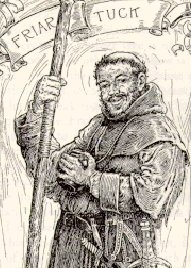
10. Friar Tuck (Ivanhoe)

Friar Tuck

He may be a sham and a scoundrel, but I can’t help but like Friar Tuck: a trusted companion of Robin Hood, a formidable fighter and an unapologetic drinker. His reputation as a man of the cloth is questionable, but his cheerful disregard for his priestly duties is somewhat endearing all the same.

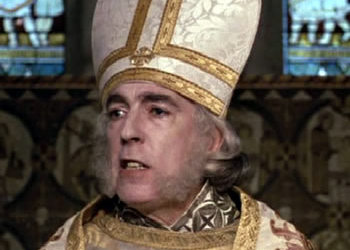
9. The Impressive Clergyman (The Princess Bride)

The Impressive Clergyman

“Marriage is what brings us together today.” That’s all I have to say.

8. Graham Hess (Signs)

Graham Hess

For a movie about aliens, M. Night Shyamalan’s Signs gives quite a touching picture of a man torn between faith and cynicism. After his wife dies in a car accident, Graham resigns from the ministry and becomes an agnostic. He spends much of the film struggling with doubt, and the rest of the film defending his family from alien invaders: a courageous man on both fronts.

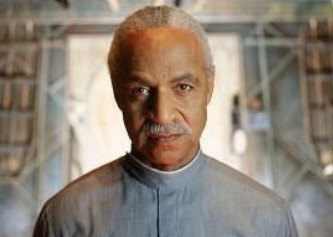
7. Shepherd Book (Firefly)

Shepherd Book

Firefly is a show about criminals, rogues and scoundrels. The cast includes a smuggler, a trigger-happy gunman, a wanted criminal, a lunatic and a classy prostitute. In the midst of these (surprisingly charming and likable) rogues is a kindly, compassionate, grandfatherly gentleman known as Shepherd Book. While one or two of his theological beliefs are slightly suspect, he may be the most genuinely Christ-like character I’ve seen in any television series of the last decade.

6. Dinah Morris (Adam Bede)

George Eliot

For those who have wondered, Adam Bede is not a cheerful book. It’s a novel about vanity and betrayal, and several of its characters end up dead or disillusioned. The gloominess of the novel makes Dinah shine all the brighter. Apart from demonstrating great selflessness and compassion, she is patient with even the characters whom the reader detests: a remarkable feat.

5. Nicholas D. Wolfwood (Trigun)

Nicholas D. Wolfwood

One thing must be made clear from the beginning: Nicholas D. Wolfwood has questionable morals. His morals are so questionable, in fact, that even other characters object to them. Nevertheless, his character is a fantastic depiction of a man trying to do the right thing the wrong way. He believes in absolute justice—he who lives by the sword must die by the sword—and can’t understand his friend Vash, who somehow solves crises without killing anyone. Vash and Wolfwood are easily two of the most complex and compelling characters I’ve seen on television.

4. Sister Carlotta (Ender’s Shadow)

dnews

Compassionate, patient and delightfully sarcastic, Sister Carlotta rescues orphans and street kids in her search for a child genius to defend Earth from a potential extraterrestrial invasion. She demonstrates great patience toward the children in her care and no patience whatsoever toward her haughty superiors—one of whom complains, “I didn’t know nuns were allowed to be sarcastic.” Like Christ himself, Sister Carlotta is kind, gentle and unafraid to speak out against foolishness.

3. Sebastião Rodrigues (Silence)

Shusaku Endo

When Sebastião Rodrigues, a Portuguese priest, travels to medieval Japan to learn the truth behind the alleged apostasy of another priest, he finds himself in a crisis unlike anything he could even have imagined. He was prepared to be martyred for the sake of Christ. He wasn’t prepared to watch as Japanese Christians were martyred instead. Rodrigues is given a choice: renounce his faith or watch as his brethren are slaughtered. Desperate for divine guidance, he is instead tormented by the silence of God. Rodrigues finds himself asking, as another great Priest once asked, “My God, my God, why have you forsaken me?” Sebastião Rodrigues ranks high on this list for the depth of his character and his earnest desire to help others at any cost.

2. Charles François-Bienvenu Myriel (Les Misérables)

Victor Hugo

Monsieur Myriel, the Bishop of Digne, once goes on a journey to visit a remote village because, he explains, its residents “need someone occasionally to tell them of the goodness of God.” He is warned that dangerous bandits roam the area; if he travels toward the village, he may meet them. “True,” says the bishop. “I am thinking of that. You are right. I may meet them. They too must need some one to tell them of the goodness of God.” Unlike the pompous, self-righteous bishops of his day, the Bishop of Digne is humble, selfless, kind, patient and generous. It is a single selfless action of the Bishop of Digne that saves Jean Valjean, a disillusioned convict and the protagonist of Les Misérables, from a bitter life of crime.

1. Father Brown (The Innocence of Father Brown)

Father Brown

Number one on this list is my all-time favorite fictional character. Father Brown is a short, clumsy, disheveled Roman Catholic priest with a blank face, a compassionate heart and a keen understanding of human nature. He’s also a brilliant detective, albeit an apologetic one. Most remarkable is his concern for criminals. Sherlock Holmes throws his archenemy over a precipice to a violent death. Father Brown, by contrast, persuades his archenemy to give up crime and become a private investigator; they later become close friends. As a detective, as a priest and as a fictional character, Father Brown is amazing.

What notable, unusual or simply awesome fictional clergy do you think should be on this list? Let us know in the comments!

The Infinity Manuscript: Foreword

I am excited to make an announcement today about the future of TMTF. For at least a couple of months, TMTF will feature—in addition to the two usual weekly blog posts—a longish story, serialized in conveniently short parts every week.

This story, The Infinity Manuscript, is something I’ve wanted to write for some time. The problem has been that I haven’t been able to find the right narrative form for the story: it isn’t long enough for a full-fledged novel, but it’s a good deal too long for a short story. While I considered writing the story as a screenplay, I decided against it due to my inexperience in the complicated field of moviemaking.

Then it occurred to me that The Infinity Manuscript is exactly the sort of story that would work well in parts. To wit, it would work well as a serial—which led me to ask myself, “Why not serialize it?”

A fantasy, The Infinity Manuscript will recount the story of Innocent Freo, a good-natured police constable in remote desert outpost, who is recruited by the Orofino Empire to track down and capture an infamous criminal called Jerem the Plague. In addition to terrorizing towns throughout the Orofino Empire, Jerem is rumored to be searching out and destroying pages of the Infinity Manuscript, a book without which the world cannot exist.

Some readers of TMTF will have no interest in reading a story like The Infinity Manuscript, and that’s okay. TMTF will continue to feature two blog posts every week about faith, writing, video games, literature, life, the universe and everything. The story will be an addition to the blog, not a replacement for it.

Installments of The Infinity Manuscript will be posted each Wednesday. Since TMTF will be back on a schedule of three posts a week, the first post of each week will be moved from Tuesday back to Monday. To put it simply, TMTF will be updated on Mondays and Fridays; the story will be updated on Wednesdays; the Solidarity blog (which is linked to TMTF) will continue to be updated on Thursdays.

In regard to writing fiction, my primary focus is still The Eliot Papers, a trilogy of novels on which I’ve been working for a long time. The first novel in the trilogy, The Trials of Lance Eliot, is edging slowly but surely toward publication; it will be released (I hope) sometime this year. The Infinity Manuscript is just a side project. Even so, I’m excited to begin the story of Innocent Freo, and I invite you to share in his journey.

The journey has begun!

64. The Fear of Not Being Perfect

Do you ever suffer from the fear of not being perfect?

I do.

In fact, the fear of not being perfect has been one of my greatest struggles.

My Thursday Afternoon of the Soul, a year and a half of intense depression, occurred partly because I was constantly afraid that I wasn’t good enough.

One of the greatest lessons I’ve learned impacted me so deeply because I was focused on trying to be perfect instead of trying to help others.

I’ve still got my fair share of qualms, struggles and insecurities, but I’m no longer afraid that God will abandon me if I make too many mistakes.

(That’s a really good thing, ’cause I make lots of mistakes.)

I’m still trying to reconcile myself to the fact that certain areas of my life are less than perfect. Some things are beyond my control: my tragic inability to grow a beard, for example. Other things, things over which I have a little more control, frustrate me because I want them to be perfect and they aren’t.

I wonder how many people have given up on something because they weren’t perfect.

I wonder how many violin players have stopped practicing because their performances never sounded exactly right. I wonder how many painters have thrown away their brushes because they were tired of finding flaws in their paintings. I wonder how many poets have quit writing poetry because their poems were met with criticism or disinterest.

Sometimes it’s best to give up on something. If a hobby is costing extravagant amounts of time, money or effort, and clearly going nowhere, perhaps it’s wise to let it go. But I think we sometimes kill our dreams before they have a chance to grow.

For example, when I write, my greatest hindrance is the nagging conviction that writing is just a colossal waste of time. An insidious little voice whispers, You’re investing so much time and effort in your writing, and for what purpose? Your writing is full of faults. Nobody will read it. Your novel is clichéd. Nobody will buy it. Your blog is pointless. Nobody will like it. There are tens of thousands of better writers out there. You should spend your time doing something worthwhile.

I think pretty much every person has heard that voice. Some people listen to it. Some people refuse to listen.

Blogger Jon Acuff is one of the people who has refused to listen. “The road to awesome always leads through the land of horrible,” he wrote. “Go be horrible at something. It’s the only way to be awesome at everything.”

Web cartoonist Wes Molebash is another such person. “There will be many obstacles on your road to success,” he wrote, “so don’t build your own.”

Amateur animator JKR is yet another such person. “Don’t worry about failing,” he wrote. “You’re going to, and it’s okay. Just learn from whatever you don’t get quite right.”

Perseverance, I keep telling myself, is a much better quality that perfectionism.

I recently saw Steven Spielberg’s film adaptation of The Adventures of Tintin, and one of its characters offered a wise piece of advice.

“There are plenty of others willing to call you a failure,” he said. “Don’t you ever say it of yourself.”

63. That Time I Worked in a Haunted House

I really wanted to title this post That Time I Was a Zombie or That Time I Was a Killer Clown, but those titles would have been misleading. I was neither zombie nor killer clown. I was merely a tour guide in a haunted house full of them.

Years ago, when I was a senior in high school, it fell to me and some of my classmates to put together a haunted house as a fundraiser for our class. The idea was simple: lead groups of jittery customers (we preferred to think of them as victims) through the basement of our school, scaring them as much as possible along the way. Each customer would pay for a ticket, and the proceeds would go our class fund.

It was an important fundraiser, so my classmates and I formed a Haunted House Committee weeks in advance and began planning. We met during our lunch break, discussing gory details over sandwiches and slices of pizza.

It was decided early on that our haunted house would feature killer clowns. Clowns, even of the non-killer variety, are freakishly scary. Zombies were the next suggestion, and they were quickly added to our list of Freakishly Scary Things Needed For Our Haunted House.

Several members of the Haunted House Committee were horror movie aficionados. They insisted on adding authentic little touches, such as puddles of blood and a heap of intestines. The blood was fake; the intestines were genuine, having previously belonged to a pig butchered at a local market.

While I appreciated the enthusiasm that went into planning these ghoulish details, I didn’t like them. They were rather too macabre for my Puritan sensibilities. Besides, I wound up slipping in one of the blood puddles during the fundraiser and acquiring several colorful bruises.

On the night of the fundraiser, our victims—our customers, I mean—lined up with their tickets ready. I had been chosen to play the role of a tour guide. In retrospect, I’m thankful not to have been a zombie or a killer clown, since those unfortunate ghouls had to wear thick makeup.

I had two responsibilities as a tour guide.

First, I had to lead our customers safely through the haunted house.

Second, I had to give the impression of a person who was verging on insanity after having been locked for hours in a haunted house full of killer clowns and zombies.

The second responsibility was a good deal more fun than the first.

The haunted house through which I led our customers was a masterpiece of creepy interior design. Apart from the aforementioned intestines and blood puddles, there were overturned desks and torn scraps of paper littering the floor. A hangman’s noose dangled from the ceiling. The mirrors were scrawled with grotesque lipstick drawings.

My favorite part of the haunted house was a corridor with a cloud of dense smoke from a fog machine. The tour guide’s flashlight became useless in the smoke; its beam stabbed through the obscurity without illuminating anything. A strobe light flashed at the end of the corridor, revealing scenes of carnage: desks, textbooks, papers and bodies strewn over the floor.

After leading a group of customers through the haunted house, I had to retrace my steps from the exit back to the entrance to meet the next group. This was, without question, my favorite part of working in a haunted house. The zombies and killer clowns, so terrifying in the presence of customers, smiled and laughed and gave each other high-fives when the customers were gone. There was an atmosphere of cheerfulness, companionship and solidarity among my classmates that contrasted quite sharply with their ghastly costumes and gloomy surroundings.

Despite a few mishaps—a customer running into a glass door and shattering it, for example—our haunted house was a success. The only downside was having to clean up afterward. We remained until the early hours of the morning, cleaning up bloodstains and picking up paper scraps, like murderers trying to get rid of the evidence.

After removing all traces of our haunted house and restoring the basement of our school to its original, less creepy condition, we went back to our homes and slept like the dead.

I felt about as lively as a zombie upon waking up the next day. My side ached from where I had bruised it after slipping in a blood puddle, and my throat was sore from all the screaming I had done in the character of an insane tour guide. It took time, tea and cough drops, but I eventually recovered.

Working in a haunted house was a memorable experience. I enjoyed it, and I hope never to do it again. I will leave it to the younger generation to carry on the tradition of putting together haunted houses.

Just a word of caution: Be wary of makeup and blood puddles.

62. About Writing: Dialogue

Today’s post was written by Amy Green, blogger and author of young adult fiction. For more thoughts on writing, faith and fiction, check out her blog!

If you want the safe version of this post, here are three simple tips to writing better dialogue: listen to others, know your characters well, and ask others for help with editing. You can stop right there. Go ahead. I won’t be offended. Really.

If you’re still reading, let me tell you something: there’s a problem with those three simple tips.

They’re not simple. And they probably won’t work.

How do I know? Because I am a selfish person, and I recently realized that the biggest obstacle to writing good dialogue is selfishness. Before you stone me with copies of Christian Writer’s Market Guide, here are the reasons why I came to this conclusion.

Selfishness keeps us from listening

I have a cartoon taped to my desk where a boy is going on a rant about how most people just “wait to talk” instead of actually listening. “You know you’ve met someone special if they can respond to what you’ve said without launching into something unrelated about themselves,” he says.

Ouch. Do you know how humiliating it is to be called out on selfishness by a one-inch tall line drawing?

Most of the time, I don’t really listen to what people are saying. I just hijack the conversation to get it to what I want to talk about. That makes me selfish, obviously, but it also makes me a bad writer, because unless I learn to listen to what others say—really listen—I won’t be able to write what others say.

Selfishness makes people into props

I have this really bad habit of using people as objects in my life. Like in the section above, they can be springboards to topics of conversations I’m interested in, or I can use them to make me feel good about myself (sometimes by showing off my excellent sense of humor at their expense).

This carries over to my writing, too. I occasionally dump characters haphazardly into a scene simply because my protagonist needs them for something. Or I start a story with an antagonist who I know as much about as a person I looked up on Facebook.

Then I wonder why my dialogue sounds unnatural or repetitive.

To sound convincing, characters have to be made from fragments of reality—quirks, passions, irrational fears, and annoying habits that make other people want to punch them sometimes. Writing them as people instead of props is what makes the dialogue come alive, and it’s hard for me to do that if, in real life, my relationships with others are two-dimensional or all about me.

Selfishness refuses to ask for help

I don’t like asking for feedback on my dialogue, partly because I think I can do it on my own, and partly because I’m secretly afraid the other person will laugh at me.

If I have a male narrator, I should probably ask a guy if I’m getting it right. If I’m writing about a five-year-old boy, I should go to a mom with small kids to get help with his lines. But I’m too afraid, because what if I got it wrong and they laugh at me and quote the worst part on their Facebook status and everyone comments about how awful it is and they happen to be friends with an editor who blacklists me from every publisher in the country….

So, I clearly have an overactive imagination. The point is, if I don’t know what’s wrong, I can’t fix it. I have to be willing to put away my rugged individualism and fear of failure and get a different perspective on what I write.

I still struggle with all three of these. But I’m working on it. And, hey, even the process of writing this post was humbling. Which means I’m getting better at dialogue while writing a post on getting better at dialogue. Top that!

Oh. That was a little arrogant and selfish, wasn’t it?

Oops.

61. The Turnspike Emails: Offensive Language

It is the solemn duty of TMTF to present another diabolical email intercepted from the demon Turnspike to his colleague Goreflak. TMTF has previously succeeded in obtaining two of Turnspike’s emails, the latest of which can be found here.

My dear Goreflak,

I must congratulate you! I was beginning to think you had no potential whatsoever as a demon, but the latest development in the life of your Patient suggests otherwise.

Your Patient has slipped into the habit of using swearwords. I am afraid swearwords are not a mortal sin, my dear devil, but that does not mean we cannot use them to our own ends. If you intend to exploit this promising development in your Patient’s habits, it is imperative that you understand the nature of offensive language.

There are three basic categories of offensive language: obscenities, slurs and blasphemies. To put it as simply as possible—so simply that even you, my dear devil, cannot fail to understand—obscenities are insults against propriety, slurs are insults against human beings and blasphemies are insults against God.

Consider for a moment the severity of these insults. From the point of view of the human vermin, it is worst to insult God. After that it is worst to insult other humans. It is least offensive to insult propriety. Therefore we may arrange these categories of foul language from most to least offensive: blasphemies, slurs, obscenities.

Is this clear so far?

Our Father Below has made great progress with foul language in the last few centuries. He has twisted the standards of society so that the mildest obscenities have become more offensive than the worst blasphemies.

Take the most offensive swearwords in use today, those related to sexuality and bodily functions. Anyone who uses these kinds of obscenities is instantly branded an offender of the worst degree.

The human vermin overlook the fact that sexuality, unless it is abused or perverted, is not offensive. Sexuality is an invention of our Enemy. It is, from his point of view, a good thing. Bodily functions are also an invention of our Enemy. They are embarrassing to the humans, but there is nothing wrong with them.

We have so skewed the mindset of society that most humans perceive sexual and scatological swearwords as the worst kind of foul language. We have succeeded in making mere obscenities taboo.

Now let us consider the swearwords considered by the humans to be the mildest: words such as damn and hell. Few people mind if these words are used. Even many Christians think nothing of using such “mild language.”

Can you see the joke?

Hell and eternal damnation are the worst things that can happen to any of the human vermin. There is nothing more torturous, more wretched or more painful for humans than to suffer separation from their Creator. Even so, we have trained humans to consider words like damn and hell much less offensive than bodily functions and human sexuality.

I regret to inform you that we have made little progress with slurs. Despite our best efforts to persuade them that slurs are only slightly offensive, the humans have recognized religious, racial and sexual slurs as the filthy insults they are.

However, we have made excellent progress with blasphemies against the name of our Enemy.

When the Enemy gave his people the regulations known as the Ten Commandments, only one of them pertained in any way to offensive language. Among solemn pronouncements such as “You shall not murder” and “You shall not commit adultery” came these oft-ignored words: “You shall not misuse the name of the Lord your God.”

Misusing the name of our Enemy is, in his judgment, the very worst kind of offensive language.

Admittedly, merely saying “My God!” in a moment of surprise is hardly blasphemy. It is, however, extremely irreverent. I am delighted when Christians, who owe everything to the God who saved them at the cost of his own Son, throw God’s name about as though it were a common swearword.

In summation, Our Father has done a careful job of making sure the human vermin misjudge the severity of foul language. They overlook the strongest blasphemies and consider mere obscenities taboo.

Regarding your own Patient, it is possible to produce in him a kind of contempt for his God through blasphemous language. It affords us much amusement to witness his hypocrisy as he prays, “My God, I love you,” in church, and swears, “My God, that was awful,” in his home.

However, the most effective use of foul language among Christians is not to destroy their own faith. It is to destroy the respect of others. If your patient uses foul language, he is giving a very poor impression of Christ. Since Christians are called to reflect Christ, it is to our advantage when they use the same obscenities, slurs and blasphemies as the rest of the world.

Your Patient is coming along nicely, my dear devil. Keep up your good work.

Your affectionate colleague,

Turnspike

60. How to Be Useful

Cause and effect.

These three simple, innocent words sometimes represent an incredible chain of events—not just a chain, but an entire web of events. A single action may have unbelievable consequences.

There’s a story I’d like to share. It involves two of my favorite authors, J.R.R Tolkien and C.S. Lewis. They’re both famous, but for very different reasons.

Tolkien is renowned as a literary critic and author of fantasy fiction. While he’s most famous for writing The Hobbit and The Lord of the Rings, he’s also held in high regard for his contributions to the study of Anglo-Saxon literature and innovative approaches to literary criticism.

Lewis is also a famous author of fantasy fiction, but he is mostly remembered for his books about Christianity. The author of The Chronicles of Narnia dabbled in apologetics, theology, biblical studies and philosophy. From Mere Christianity to The Screwtape Letters, his books have had an incalculable impact on modern Christianity. In the decades since his death, Lewis has become something of a Christian celebrity.

J.R.R. Tolkien and C.S. Lewis are both famous, but only one is remembered as a great Christian. Many people don’t even know that Tolkien was a Christian. Ask anyone which man served God more effectively and the answer will be C.S. Lewis ninety-nine times out of every hundred.

Lewis’s books have led many people to Christ, and given many Christians a clearer understanding of what Christianity is all about. Many of the people whom C.S. Lewis helped through his writing have gone on to help others. For example, Chuck Colson, who committed his life to Christ after reading Mere Christianity, went on to found a ministry called Prison Fellowship, which has served hundreds of prisoners, ex-prisoners and families worldwide.

We see those three words, cause and effect, working through the life of one man to impact many thousands of lives.

Even though C.S. Lewis is a much more famous Christian than J.R.R. Tolkien, I believe Tolkien was every bit as useful to God as Lewis. This belief may seem a bit odd. The Lord of the Rings is an amazing literary work—a literary work, moreover, especially beloved by Christians—but it isn’t exactly famous for pointing people toward Christ. Really, how many conversion stories begin with Bilbo Baggins and Gandalf the Grey?

Through the process of cause and effect, C.S. Lewis and his books have impacted thousands of people. However, there’s something about his life that most people don’t know.

That process of cause and effect didn’t begin with C.S. Lewis.

It began long before Lewis, and it involved an Oxford professor named J.R.R. Tolkien.

After many years as an atheist, Lewis reluctantly accepted a vague belief in God and became a theist in 1929. A couple of years later, he happened to go for a walk in an Oxford park with two fellow professors, Hugo Dyson and John Tolkien. As they walked, they discussed myths and mythmaking.

Lewis was surprised by Tolkien’s belief that myths can originate in God and reflect eternal truth. Christianity is beautiful, maintained Tolkien, because it’s a myth. This doesn’t mean Christianity is untrue like other myths. Tolkien believed Christianity is beautiful because it’s the only myth that perfectly reflects the truth.

Perhaps, suggested Tolkien, someone could serve God by writing myths.

C.S. Lewis converted from theism to Christianity a few days later. “I have just passed on from believing in God to definitely believing in Christ,” he wrote in a letter to a friend. He added, “My long night walk with Dyson and Tolkien had a great deal to do with it.”

Would Lewis have become a Christian without Tolkien? Only God knows. However, there is one thing of which we can be sure: Tolkien helped lead Lewis to Christ. After Lewis became a Christian, he went on to write the books that would instruct, encourage, comfort, correct and strengthen thousands of people around the world.

What those people owe to Lewis, they owe in part to Tolkien.

Why does this matter?

Why have I shared this story about cause and effect?

I’ve shared this story because I’ve heard people suggest that Christians must enter official, fulltime ministries to serve God effectively.

Ridiculous.

God can use anybody anywhere.

He can use a math teacher or a computer programmer as readily as a pastor or missionary.

All that he asks is that we follow him wherever he leads us.

Let’s say a person has the desire and ability to become a carpenter. Is it too farfetched to believe that God wants that person to be a carpenter? For that person to become something else, say a pastor or missionary, would be like trying to screw in a bolt with a hammer or hammer in a nail with a screwdriver. Let someone with a passion for ministry become a pastor or missionary. Let the one who loves carpentry become a carpenter.

The Apostle Paul wrote: “We have different gifts, according to the grace given us. If a man’s gift is prophesying, let him use it in proportion to his faith. If it is serving, let him serve; if it is teaching, let him teach; if it is encouraging, let him encourage; if it is contributing to the needs of others, let him give generously; if it is leadership, let him govern diligently; if it is showing mercy, let him do it cheerfully.”

I would add, “If a man’s gift is painting, let him paint; if it is building, let him build; if it is police work, let him become a police officer; if it is playing soccer, let him become a soccer player,” and so on.

Lewis had a passion for Christianity, and God used him.

Tolkien had a passion for mythology, and God used him.

If you’ve chosen to follow Christ, don’t worry that your plans might “not be Christian enough.” Do your best to serve Christ wherever you are. Be willing to accept whatever opportunities he gives you.

If you do that, wherever you are, Christ will use you.

As Abraham Lincoln said, “Whatever you are, be a good one.”