193. About Writing: Tropes

There is a website called TV Tropes, and it has gobbled up more of my time than I care to admit.

TV Tropes is a fascinating and highly informal collection of articles on tropes in storytelling. What are tropes, you ask? A trope is a recurring convention, element or device in a particular genre or type of fiction.

Take horror movies. I’ve never seen one all the way through, but even know that when the power goes out in a horror film, bad things happen to the person who goes into the basement to check the circuit breakers. Cabins in the woods are dangerous places to be in horror movies, and clowns are evil. We all know these things. They are tropes of the horror genre.

Although tropes are not necessarily good or bad, they can easily degenerate into clichés—conventions that are overused and become trite.

Take the damsel in distress trope: the convention of a female character (often a princess) being rescued by a male character. This trope is everywhere. Consider the Star Wars films, or games in the Mario and Zelda series, or pretty much any animated film produced by Disney. Princesses Leia, Peach, Zelda, Jasmine and Rapunzel are all bona fide damsels in distress.

(I laughed when, in a recent Legend of Zelda game, Princess Zelda—a character descended from a long line of damsels in distress—told the hero, “I will wait for you here. That’s what princesses have always done. From what I understand, it’s kind of a family tradition.”)

While tropes can easily become clichés, they can also be subverted or inverted in clever ways. What happens when the damsel in distress escapes on her own? What if the damsel rescues the hero?

Defying tropes is a wonderful way to surprise readers. We all expect specific things from certain kinds of stories, and it’s a delightful shock to have our expectations shattered.

We’re all familiar with bad guys. Whatever else they may be, they are… well… bad. The trope is simple. Villains are evil. Bad guys are bad. It’s common sense.

Right?

Quite a number of recent films disagree. Despicable Me and Megamind turn villains into good guys. Dr. Horrible’s Sing-Along Blog goes a step farther, making a bad guy out of a “good” superhero. Disney’s Wreck-It Ralph stars a video game villain who decides he wants to be the good guy for a change.

These films toy with our preconceived ideas about heroes and villains, blurring the lines between our notions of “good” and “bad” characters. These films are also tons of fun to watch.

If you’re writing a story, ask yourself: “Has this been done before?”

Working tropes into your story isn’t a crime; some tropes are so general there’s practically no escaping them. In many cases, however, a story can be much improved by avoiding—or defying—the expectations set by all the stories that came before.

The Appalling Scandal of a Cross-Eyed Pony

Derpy Hooves

Offensive?

I work in a group home for gentlemen with mental and physical disabilities. I am also a fan of a pleasant, cheerful cartoon called My Little Pony: Friendship Is Magic.

Mental disabilities and rainbow ponies are hardly subjects I expected to overlap, and I was right. They didn’t overlap.

They collided.

These subjects crashed together in a train wreck of censure and indignation, a firestorm ignited by a few innocent words from a cross-eyed pony. This strange controversy set me thinking generally about scandal, censorship and the absolute impossibility of pleasing everybody.

In an early episode of My Little Pony: Friendship Is Magic, a character in the background—an unassuming gray mare nearly lost in a crowd of brighter ponies—had unfocused eyes. Her derpy expression was a mistake, which the supervising director thought was funny and kept in the episode.

Well, the show’s fan base, which is equal parts ridiculous and awesome, immediately fell in love with this mysterious, cross-eyed stranger, whom they christened Derpy Hooves.

Derpy and the Monkeys

Derpy even made an appearance on this blog! Her visit was… memorable.

The show’s creators, amused by the incredible popularity of this incidental character, began drawing her with crossed eyes as a tip of the hat to fans.

Over time, those fans developed persona for Derpy. This mute background pony became a bumbling, cheerful, well-intentioned mail carrier with a passion for muffins. Derpy became a mascot for fans of the show. Without them, Derpy Hooves would not have existed. The cross-eyed gray mare would have been just another silent, cardboard-cutout character in the background.

Then—wonder of wonders!—Derpy Hooves spoke.

Derpy was given a minute or two of screen time and some dialogue alongside a major character, who very clearly addressed her as “Derpy.” In this brief scene, everyone’s favorite background pony was established to be friendly and klutzy and eager to help. “I just don’t know what went wrong,” she admitted sheepishly, having nearly demolished town hall in her attempts to be useful.

Fans were wild with excitement. This was their character. Derpy had a voice!

Then, shortly after the episode’s release, the scene was changed—censored, according to some fans. Derpy’s voice was less… well… derpy. Her eyes were not so acutely crossed, and her name was no longer mentioned.

The scene was altered due to complaints that the character and her name were offensive to persons with disabilities.

A few fans commended the show’s creators for their sensitivity. Many responded with indignation, and several went out of their way to insult the people who submitted complaints. Some claimed the “censorship” of Derpy Hooves was a slap in the face to fans: a misguided attempt to “fix” the quirks of a character beloved for her quirkiness.

In the end, the show’s creators kept the alterations to the scene. The controversy faded away. Derpy has stayed out of the spotlight, resuming her modest appearances in the background and retaining her immense popularity among fans.

Looking back at that strange, messy incident, I can only echo Ms. Hooves and admit sadly, “I just don’t know what went wrong.”

Personally, I wish the scene had not been altered. Even if Derpy were interpreted as a pony with disabilities, she was cheerful and kind. She wanted to help, and other characters obviously respected her enough to let her try.

At the same time, I think the show’s creators did the right thing by altering the scene. It was edited, not censored, to show respect for a group of people who are often disrespected.

The whole business reminds me that some controversies have no easy answer, and many concern things infinitely more important than rainbow ponies. How do we settle political differences? What about conflicts within churches? If so much strife can be provoked by a silly cartoon, how do we resolve really significant controversies?

192. Running Like Frodo

Today’s post was written by Zak Schmoll, a graduate from the University of Vermont with a double major in Accounting and Statistics. (For me, an English major, mathematical arcana like Accounting and Statistics inspire perplexity, fear and wonder.) On July 23, 2012 Zak undertook an epic quest: writing about one chapter of the Bible every day from start to finish. Check out his progress here!

Wherefore seeing we also are compassed about with so great a cloud of witnesses, let us lay aside every weight, and the sin which doth so easily beset us, and let us run with patience the race that is set before us, looking unto Jesus the author and finisher of our faith; who for the joy that was set before him endured the cross, despising the shame, and is set down at the right hand of the throne of God.

~ Hebrews 12:1-2

When I think about adventures, one of my favorite literary examples is Frodo Baggins, a reasonably comfortable hobbit who was thrown into the epic saga of The Lord of the Rings.

He carried the one Ring, the only thing separating the land of Middle-Earth from the evil domination of Sauron. Frodo wasn’t looking for an adventure, but one dropped in his lap out of nowhere.

I think we can see something similar in our Christian journey.

We are told that our life is a race. According to Strong’s numbers entry for this word race, there’s definitely an indication that this is not just going out for a jog. Some of the alternative words that are suggested are contest or contention. In other words, there is a definite opponent in this competition with real stakes.

We certainly have an adversary in the world, just like Frodo did. We are on a mission to overcome that opposition. For Frodo, that mission involved throwing the Ring into the fires of Mount Doom to destroy it forever. For us, our mission involves running this race successfully. Implicit in both of these statements is that we both have a target. Ours is not necessarily a geographic location, but it is certainly a place where we are in a good relationship with God.

How do we go about running successfully and making it to that destination?

Jesus himself pointed out a few pretty basic guidelines in Mark 12:30-31 that should govern all of our actions. First, we need to love God, and second, we need to love other people. The more we follow these two guidelines, the closer we will be walking to God.

Of course, I should mention that having a relationship with God in the first place is the most important thing. Without that relationship, all of the works in the world and love that we try to display don’t mean a whole lot.

Running successfully also means that we overcome stumbling blocks that are put in our way. Frodo had to fight through fatigue, betrayal, stress and anxiety in order to finally make it to his destination. Similarly, our lives will never be perfect either. There will always be problems that pop up. However, we are promised that through God, we can do all things (Philippians 4:13).

Our race does not stop because of roadblocks, but they do us to rely on God.

Our lives might not quite compare to the epic quest of Frodo Baggins, but we are in the middle of a race, a race run by being in a relationship with God and living with love. We need to love God and to love other people.

That is an adventure in itself.

191. TMTF’s Top Ten Weapons in Video Games

I love video games. I enjoy making top ten lists. Finally—despite my loathing for real-life violence—I like weapons.

This blog post was inevitable.

This top ten list, which includes weapons only from games I’ve played, defines a weapon as an object used to inflict damage on someone or something in a video game. Power-ups, vehicles and powered armor suits don’t count. (Sorry, Samus.) Weapons that originated in media apart from video games, such as lightsabers from Star Wars or the golden gun from James Bond films, will not be included.

Duck for cover, ladies and gentlemen, as TMTF presents…

The TMTF List of Top Ten Weapons in Video Games!

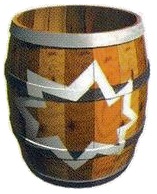
10. Barrel Cannon (Donkey Kong series)

Barrel Cannon

What’s more devastating than heavy artillery? Why, heavy artillery that fires gorillas, of course! The barrel cannon can be used not only as a form of transportation for Donkey Kong, but also as a way to turn the ape into a high-speed projectile. If only it fired sharks…

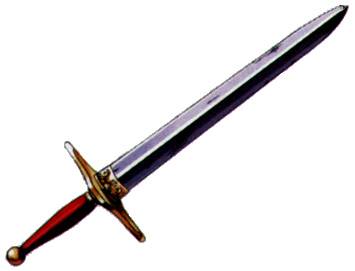
9. Masamune (Chrono Trigger)

Masamune

This legendary sword, the blade of a brave knight who, er, also happens to be a frog, is a powerful and storied weapon despite its plain appearance. It carries tremendous sentimental value for its amphibious owner. Finding and repairing the Masamune is a major feat, requiring the game’s heroes to travel through time from prehistory to the modern age. Later in the game, a sidequest unlocks the sword’s full potential and transforms it into an extremely powerful weapon.

8. Satellite Gun (Shadow the Hedgehog)

Satellite Gun

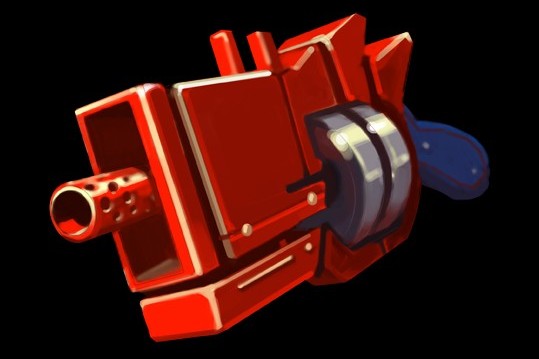
Shadow the Hedgehog is a terrible game. Apart from its bad level design, lousy writing and atrocious acting, the game is a poor attempt to make the bright, whimsical Sonic series seem dark and gritty. There is at least one good thing about this game, however: the Satellite Gun. This weapon, which looks a bit like a television remote, uses a targeting system to lock onto enemies and signals an orbiting satellite to annihilate them with a freaking laser beam from outer space. That’s cool.

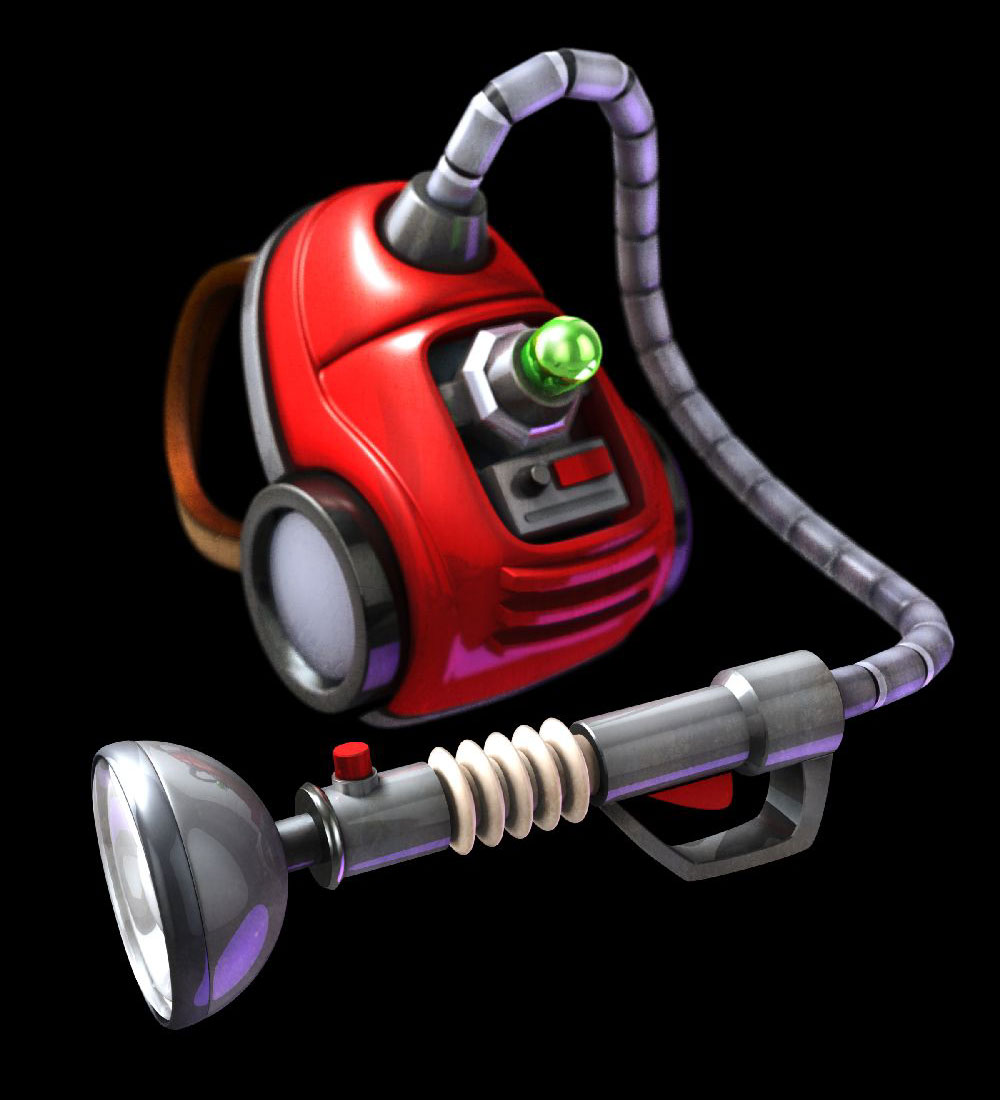
7. Poltergust 3000 (Luigi’s Mansion)

Poltergust 3000

This is a vacuum cleaner that sucks up ghosts, used by Luigi to rescue his brother Mario from a mansion teeming with spooks. (The image above is actually an advanced Poltergust from another game, but I’ve used it for this list because it’s much cooler than the original model.) Besides trapping phantoms, the Poltergust 3000 is capable of collecting cash from hard-to-reach nooks and blasting foes with fire, water or ice. All this begs the question: Who you gonna call?

6. Enchanted Arrows (Legend of Zelda series)

Enchanted Arrow

Bows and arrows are pretty neat, but the Legend of Zelda series offers several variations thereupon that are nothing short of awesome. Players can use the three standard varieties of magical projectiles—fire, ice and light arrows—not only to damage enemies, but also to solve puzzles and navigate environments. Fire arrows burn away obstacles. Ice arrows freeze water, creating solid platforms for a player to cross. Light arrows activate switches to flip one particular dungeon entirely upside down, turning ceilings into floors and sky into an endless abyss. Bomb arrows (which are, yes, arrows with bombs attached) are cool, but enchanted arrows are nothing short of amazing.

5. Portal Gun (Portal series)

Portal Gun

The Aperture Science Handheld Portal Device, also called the portal gun, is capable of creating interdimensional portals on flat surfaces. Enter into one portal and you instantly exit the other. (Here’s a thirty-second video to demonstrate how it works.) Used correctly, the portal gun can harness physical laws like momentum and gravity to destroy enemy targets. Used incorrectly, the portal gun can use those physical laws to destroy the player. Look before you leap!

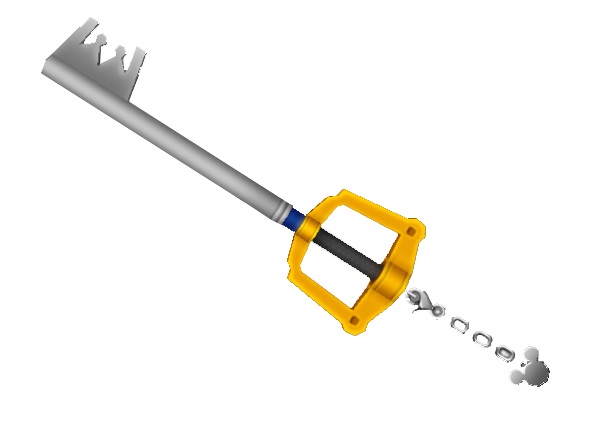
4. Keyblade (Kingdom Hearts series)

Keyblade

I’ve already shared my thoughts on this one, so I haven’t much to add. This creative, unorthodox weapon plays a huge role in the story of the Kingdom Hearts games. The Keyblade is transfigured into a new weapon by each token (keychain?) attached to its handle, and it can channel all kinds of magical abilities. Most importantly, the Keyblade is useful for smashing things.

3. Machine Gun (Cave Story)

Machine Gun

Indie classic Cave Story transforms a generic firearm, one that is practically a video game cliché, into one of the most empowering weapons I’ve ever used in a game. The machine gun’s rapid rate of fire is handy for mowing down enemies, but the weapon’s greatest value lies in its navigational uses. Fully upgraded, the machine gun functions as a jet pack when fired toward the ground, giving the player the power of flight. Awesome.

2. Buster Sword (Final Fantasy VII)

Buster Sword

Look at this sword. Look at it. Tetsuya Nomura, the artist who designed this weapon, referred to it as “the giant kitchen knife.” Its blade is freaking huge. The Buster Sword has no special attributes besides two circular slots for Materia (crystallized magic) that enable its wielder to cast spells. No, the weapon’s true worth is in its sentimental value. For Cloud Strife, to whom it belongs, it symbolizes the self-sacrifice of its former owner. For players everywhere, it represents a glorious, bygone era of role-playing games.

1. Master Sword (Legend of Zelda series)

Master Sword

This is it. The Master Sword. The Blade of Evil’s Bane. This is the iconic weapon that has become synonymous with the Legend of Zelda series, itself a legendary success of the video game industry. I can think of no other video game weapon with such a wealth of lore or backstory. Depending on which game you play, the Master Sword harbors a beneficent spirit, alters the flow of time or seals away the corrupting influence of evil. No matter which game you play, the Master Sword is one heck of a weapon.

O people of the Internet, what great video game weapons would you add to this list? Let us know in the comments!

Redeeming the Worst Song in the World

All right, the title of this post is a little misleading. “Friday” is the worst song in the world, and it is far beyond redemption. The song above, “Communicate,” is the worst redeemable song in the world.

Adventures in Odyssey is amazing, but this long-running Christian radio drama once made an unspeakable mistake. In 1987, a year of darkness and infamy, an episode titled “Lights Out at Whit’s End” unleashed an atrocity upon the world. This was “Communicate,” a rap song sung by two middle-aged men and a bunch of kids, whose message was… the importance of communication.

I couldn’t find the original version of the song online, presumably because “Communicate” would leave the Internet a smoldering ruin. The song was so bad that “Lights Out at Whit’s End” has not been aired since its first broadcast.

Then the brave folks over at The Ceiling Fan Podcast, a really clever Adventures in Odyssey fan series, decided to find out whether “Communicate” could be made into… well… something that didn’t stink.

I think the video above is a smashing success. Given the source material, the new “Communicate” is actually kind of awesome.

For some reason, my typewriter monkeys (who are fond of rap music) really like this video. I mean, they really, really like it. It worries me.

190. A Conversation with Lance Eliot

This is a conversation with a character from my book, The Trials of Lance Eliot. Although it may appear strange for someone to speak with a fictional person, it is entirely normal for writers to converse with their characters. At least, I really hope it is.

Nice to see you, Adam.

Gah! Where did you come from?

Los Angeles, originally—or are you wondering how I got into your flat?

Yes, that’s it. Who are you? What the heck are you doing in my apartment?

Really, Adam. I’m Lance Eliot. I thought you of all people would recognize me.

Ah, sorry about that. I’ve actually don’t have a clear mental picture of you.

You haven’t? Hang it, Adam, you’re the chap writing my blasted story. You’ve really no idea of what I look like?

Excessive physical description is a sign of poor characterization. That’s my excuse and I’m sticking to it.

Whatever you say.

Why are you here? My characters don’t usually drop in on me. Well, there was that one time Innocent came over for coffee and—Lance Eliot, put that down!

Don’t fret. You were the one who gave me a fighting staff, remember? I know how to use it.

That’s exactly what worries me. Will you please stop showing off? I’m not comfortable watching you wave that thing around. This apartment is full of breakable objects, including me. Please put down the weapon before someone gets hurt. And by someone, I mean Adam.

All right, I’ll put it away.

How the heck did you get here, anyway? I left you in Rovenia. That’s a long way from here. A really long way.

Maia sent me. You should have thought twice before giving one of your characters the ability to bounce people between dimensions by magic.

Well, I had to get you out of the real world and into my world somehow. Magic seemed like a good explanation at the time. I didn’t think you’d use it to get back into the real world. Why did Maia send you?

We’re all very bored, Adam.

What?

You’ve stranded us. For nearly an entire year, we’ve been stuck in that quaint little town—

What was it called?

You don’t even remember? God help me, the person writing my story is an idiot.

That’s a bit harsh.

The town is called Hurst, Adam. We’re all ready to go. We’ve been ready for months. Don’t tell me you’ve interrupted my life with another deuced adventure only to put it on hold indefinitely!

Not indefinitely. I’m working on it. Slowly.

See here, Adam, I’m concerned. We all are. As long as you put off writing the story, we’re never going to find—

Quiet! You’re giving away plot details.

And this time, I’m not the only person you’ve involved. You’ve dragged someone else into this dreadful adventure, and she—

Stop! I won’t have you blurting out your own story.

Then answer me, Adam. If I don’t tell the story, who will?

Lance, the past year has been… busy. My life is crowded with responsibilities. It’s hard for me to sit and write for hours on end, especially when I consider how few copies I’ve sold of your book. Writing is uphill work. And I may not deal with dragons or sorcerers, but I do suffer from depression sometimes. I know that’s a problem to which you can relate.

Yes. I can.

I have a blog now, too! It takes a lot of work, and my typewriter monkeys drive me crazy, but it’s totally worth it. The problem is that the blog has deadlines, and… your story doesn’t. I’ll get it written. Just give me time.

I haven’t much, you know.

You have enough. Now then, I have a blog post to finish. Say hello to everyone for me, will you?

By the way, Cog asked me to ask you to make him taller.

I refuse to pander to my characters. Tell him he’s tall enough.

All right, then. I guess it’s time for me to slip away. Keep writing, won’t you?

And he’s gone. How did he do that? How do they ever do that? Ah, well. Lance Eliot is a good fellow—though I regret giving him a weapon. No writer should ever be threatened by one of his own characters. Any future heroes will have to be pacifists, I guess. Now then, back to work!

189. Death

I work in a group home for gentlemen with mental and physical disabilities. Of these gentlemen, by far the most interesting was the middle-aged man called James Joyce.

(In this blog post, all names have been changed for reasons of privacy.)

James Joyce, who very pragmatically addressed me as “Man With Glasses,” suffered from extreme obsessive-compulsive disorder and one or two other psychological conditions. He also had a few physical problems, and—I can only guess—heart trouble.

He drove us all crazy with his manic behavior and cranky attitude, but James Joyce also made us laugh. A hot pink Disney princess poster brightened up his bedroom. He often warned me, “The Boogerman’s gonna getcha!” James Joyce constantly demanded all kinds of snacks, and occasionally pounded the floor with his shoe to kill nonexistent spiders.

More poignantly, he sometimes asked me, “Are we very good friends?” On one occasion, when I was particularly out of temper with him, he broke a long silence by saying in a still, small voice, “You’re nice.”

On a Monday afternoon a few weeks ago, James Joyce helped me mix up batter for corn muffins as I prepared supper at work. He later tried snatching a water balloon out of someone’s hand. It exploded and left him wet and squawking in indignation. When I left work, he was being as much of a nuisance as ever.

Early the next morning, James Joyce passed away of heart failure.

Death is a sobering subject. We’re reluctant to discuss it, and when we do we generally change subjects as quickly as possible. Perhaps the reason it makes us uncomfortable is that we know there is no getting away from it. Death is a guest whom no locked door can keep out.

I’m truly thankful never to have suffered the loss of a loved one. My family and friends are alive and well. My experience with death is mostly limited to killing off fictional characters, which is nothing. To claim I know something about death because I’m a writer is like pretending I’m an expert on literary scholarship because I’ve read a picture book.

There’s a common saying: I’m too young to die!

That’s idiotic. No one is too young to die.

Responding to that old cliche, I can only echo the words of an incidental character from Avatar: The Last Airbender and say: I’m not, but I still don’t want to!

In the end, however, I’m ready—not eager, but ready. If I today shuffled off this mortal coil, I’d leave some books unwritten and a dozen typewriter monkeys unemployed and many thousands of liters of coffee undrunk. It would be a bit of a disappointment for me, and a tragedy for the people who don’t mind having me around.

Where, O death, is your victory? Where, O death, is your sting?

I guess the sting of death falls mostly upon those left behind.

God rest your soul, James Joyce. I’ll always be wary of the Boogerman.

Jesus Christ and Admiral Ackbar

Then the Pharisees went out and laid plans to trap him in his words.

~ Matthew 22:15

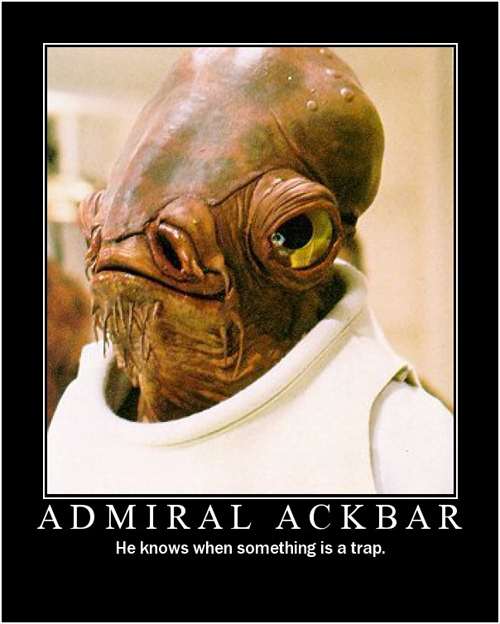
Meet Admiral Ackbar.

Admiral AckbarThe Admiral is a minor character from a Star Wars film. Although he presumably has a life beyond the few scenes in which he appears, he is remembered for one thing and one thing only.

He proclaims, with a glassy-eyed expression of dazed astonishment, “It’s a trap!”

Admiral Ackbar, the ever-useful trap detector, was absent in the days of Jesus Christ. Fortunately, the Lord was shrewd enough to detect a trap without the advice of Star Wars characters.

Quite a number of people disliked Jesus, you see. Two religious groups, the Pharisees and Sadducees, hated the way his teachings upset the balance of things. They wanted him gone—disgraced—dead. These religious groups resorted to all kinds of underhanded traps to bring down the controversial upstart called Jesus Christ.

I find it hilarious, and extremely impressive, how the Lord Jesus dodged every trap with bravado and brilliance.

The Pharisees watched Jesus closely on the Sabbath, the divinely-ordained day of rest, to see whether he would heal a crippled man and thereby dishonor the day by “working.” Jesus didn’t heal anyone secretly. He was way too cool for that. Instead, he had the crippled man stand up in front of everyone and healed him in the most public way possible, pointing out that doing good on the Sabbath is more important than merely following regulations. (See Luke 6:6-10.)

It happened again and again. Even without Admiral Ackbar’s insight, the Lord Jesus never fell for a trap.

The priests demanded to know who gave Jesus his authority. If he claimed it came from God, they could accuse him of blasphemy. If he gave some other answer, or simply refused to reply, they could claim his teachings carried no weight.

Jesus answered this trick question with one of his own: “I will also ask you one question. If you answer me, I will tell you by what authority I am doing these things. John’s baptism—where did it come from? Was it from heaven, or of human origin?”

The priests were baffled: “If we say, ‘From heaven,’ he will ask, ‘Then why didn’t you believe him?’ But if we say, ‘Of human origin’—we are afraid of the people, for they all hold that John was a prophet.”

They couldn’t answer his question, so Jesus declined to answer theirs. (See Matthew 21:23-27.)

“Is it right to pay the imperial tax to Caesar or not?” demanded the Pharisees. If he answered “Yes,” they could accuse him of being a sellout to the Roman authorities. If he answered “No,” they could get him into trouble with those authorities.

He pointed out that Roman coins came from Caesar in the first place and said, “Give back to Caesar what is Caesar’s, and to God what is God’s”—an answer with which neither Romans nor Jews could find fault. (See Matthew 22:15-22.)

The Sadducees added a trap of their own, but Jesus kept his cool.

If a woman is married more than once, they asked, whose wife will she be in the afterlife? By this question, the Sadducees (who didn’t believe in life after death) meant to discredit Jesus and his teachings.

Jesus’ answer? There is no marriage in the afterlife. Take that, Sadducees! (See Matthew 22:23-33.)

One trap stands out among the others. It was a matter of life or death. A woman had been caught in an affair. According to Old Testament laws, she deserved to die. However, in Jesus’ day, Jews couldn’t sentence anyone to death without consent from the Roman authorities. (This is why Jesus was taken to Pilate, a Roman official, to be condemned to be executed after the Jews had already declared him worthy of death.)

If Jesus said the woman should die, he would break Roman law. If he said the woman should live, he would break divine law. There was no way out. It was a trap even Admiral Ackbar could not avoid.

Go ahead, said Jesus. Execute the woman according to Jewish law—but let someone who hasn’t sinned begin the execution.

With infinite calm, Jesus called their bluff. They could threaten to kill the woman—perhaps even watch her die—but not one of them could carry out the execution with a clean conscience. One by one, they slipped away. (See John 8:3-11.)

“Woman, where are they?” asked Jesus at last. “Has no one condemned you?”

“No one, sir,” she replied, perhaps trembling in fear and awe.

“Then neither do I condemn you,” declared Jesus. “Go now and leave your life of sin.”

I find it fascinating that Jesus gave tricky answers only to trick questions. When a Pharisee finally asked him a fair question, Jesus’ answer was honest and straightforward.

What, asked the Pharisee, is the greatest commandment in God’s law?

Love God and love others, answered Jesus.

That, dear readers, is not a trap.

188. TMTF Reviews: The Inspired Wisdom of Abraham Lincoln

When I read a book, it’s generally for one of three reasons.

1. The book has literary significance or has impacted society in some way.

2. The book was written by an author whose other books I enjoy or appreciate.

3. The book was shoved in my face by a friend or relative who commanded me to read it.

For the most part, the books in the third category prove to be good reads. I discovered classics like Beau Geste and Peace Like a River only because my relatives quite literally pushed them into my hands.

My grandfather, a kindly gentleman of tremendous intelligence, gave me a book last month titled The Inspired Wisdom of Abraham Lincoln. As far as I understand, the book impressed him so much that he purchased a brand-new copy for every one of his grandchildren—that’s roughly a dozen books.

If a book is good enough to buy nearly a dozen copies, I decided, it’s probably worth a look.

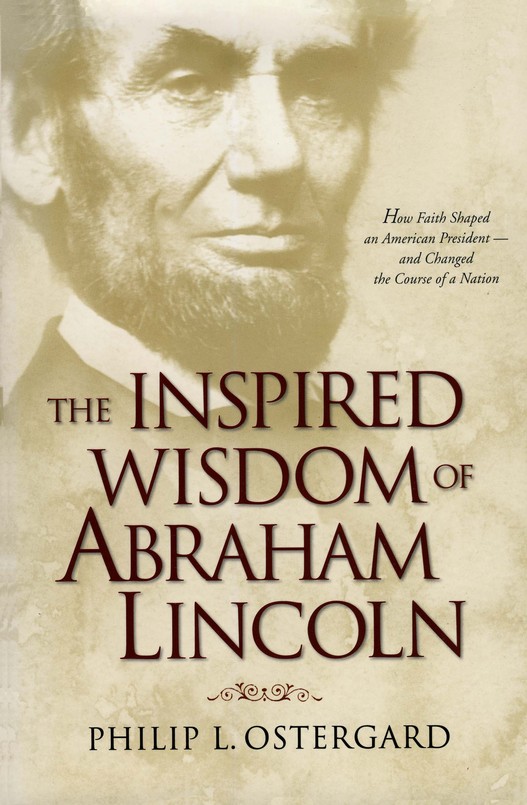
The Inspired Wisdom of Abraham LincolnThe Inspired Wisdom of Abraham Lincoln is a biography of the man who held the United States of America together when its dissolution seemed inevitable. More specifically, the book traces the development of Lincoln’s religious thought throughout his life by examining his speeches, letters and memorandums.

Was Abraham Lincoln, perhaps the greatest leader in American history, a believer or a skeptic? Did the fiery trial (as he put it) of devastating battles and political infighting destroy or strengthen a faith in a living God?

I won’t spoil the book’s answers to those questions—you’ve probably guessed them already—but I will say this: The Inspired Wisdom of Abraham Lincoln is an excellent read. The book mostly refrains from using second sources; the author writes, “I make my case stronger if the reader can be certain that he or she is reading the words of Lincoln.” Every major inference about Lincoln’s religious thought is drawn directly from his recorded statements.

These statements—contained in excerpts from memorandums, letters and speeches by Lincoln—are woven into a basic outline of his life. The author provides commentaries upon Lincoln’s statements, clarifying allusions to Scripture and giving historical and biographical context.

I knew about Abraham Lincoln. Don’t we all? He led the United States through the American Civil War! He saved the Union! He freed the slaves! Some of us are familiar with the images of the young man splitting rails in the Illinois frontier or the top-hatted politician pacing the halls of the White House. Beyond these vague ideas, however, I knew very little.

In the end, Abraham Lincoln turns out to be someone to whom I strongly relate. For much of his life, he suffered from intense depression. He loved literature. He wrestled with doubts about Christianity and religion in general. In many ways, he reminds me of myself. Lincoln and I even share a thing for hats.

The thing that impressed me most when I read The Inspired Wisdom of Abraham Lincoln is the way he kept calm and carried on. The country was falling apart—no, it was being actively pulled apart—and he held it together. His depression never left him. Lincoln and his wife lost a son during the Civil War; somehow, he pushed through his grief and kept making the shrewd decisions that saved his country. Lincoln’s sufferings would have broken an ordinary man. They would certainly have broken me.

In the end, Lincoln expressed a principle that may have carried him, and the Union, through the Civil War: “Without the assistance of the Divine Being . . . I cannot succeed. With that assistance I cannot fail.”

The Inspired Wisdom of Abraham Lincoln is a fine work of scholarship. It’s hardly a gripping read, but its conclusions are well-written and meticulously backed up with clear, unambiguous statements from Lincoln himself. Amid these statements and the biographical details surrounding them, the book includes occasional anecdotes that give a vivid picture of a fascinating man.

Inspired? Yes, I rather think so.

187. TMTF’s Top Ten Adjectives in the English Language

I like words. (You may have noticed I tend to use quite a lot of them.) There are several kinds of words, and adjectives are one of my favorites. An adjective is a word that describes something. Hot and dark and caffeinated are adjectives.

Some adjectives are particularly evocative, fun or colorful. Today I’ve decided to share ten adjectives that are, for one reason or another, delightful.

TMTF is excited, proud, satisfied, exhilarated, happy and honored to present…

The TMTF List of Top Ten Adjectives in the English Language!

10. Soporific

Tending to induce sleep or sleepiness

Looking at this word makes me yawn.

9. Awesome

Evoking awe or amazement

Compared to the other words on this list, awesome seems rather bland. I include it because of its endless usefulness. In a literal sense, it denotes something that inspires awe, such as the starry heavens or the Tenth Doctor’s sideburns. In a figurative sense, awesome is an emphatic way to express extreme admiration for something. Incidentally, did you know awesome and awful once meant exactly the same thing?

8. Sepulchral

Suggestive of graves or tombs

I’m not sure why I find this word so evocative, but it makes me think of crows, gray skies and weathered mausoleums. It’s also a splendid word for describing certain professors, classrooms or schools in general. Writers, take note.

7. Abominable

Hateful, loathsome or extremely bad

Bad is a plain, common word. No one cares about bad. If something is abominable, however, take warning! Despite its invariable association with snowmen, abominable is a wonderful way to disparage something.

6. Ghastly

Shocking or horrifying

This adjective, suggestive of grim words like ghost, is a stronger way of describing something than unimpressive words like scary. This particular adjective is best when emphasized or spoken loudly. “That Twilight book was simply ghastly.”

5. Quixotic

Noble or romantic in an unrealistic, deluded manner

I like Don Quixote. More importantly, quixotic is fun to say: quik-SOT-ik. Ain’t it great?

4. Brobdingnagian

Big

The word big is actually quite small. The word Brobdingnagian is enormous. That is all.

3. Mephistophelean

Showing the cunning or wickedness of a devil

This word makes me think of pitchforks, pointed goatees and red tights. On a more sophisticated note, it’s a great word to throw around when discussing politics: “I think that politician has a streak of Mephistophelean hubris. What do you think?”

2. Lush

Vibrant, teeming with life

A word doesn’t have to be Brobdingnagian in size to be a good adjective. In a single syllable, lush evokes (at least in my imagination) vibrant scenes of green jungles or reefs swarming with colorful fish.

1. Pulchritudinous

Possessing great physical beauty

This one makes me smile because it’s so dashed ugly. I mean, look at it. Pulchritudinous. It’s ghastly. The adjective sounds like a description of some revolting, misshapen medical anomaly. “His untreated wounds, which had begun to ooze, were sickeningly pulchritudinous.” This is, without question, the most delightful adjective in the English language. Just… don’t ever use it to describe your spouse or romantic interest, all right?

O people of the Internet, what are your favorite adjectives? Let us know in the comments!