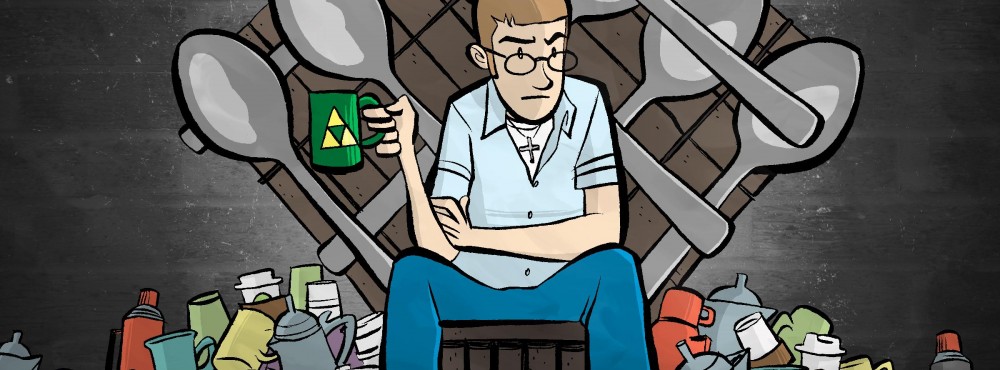
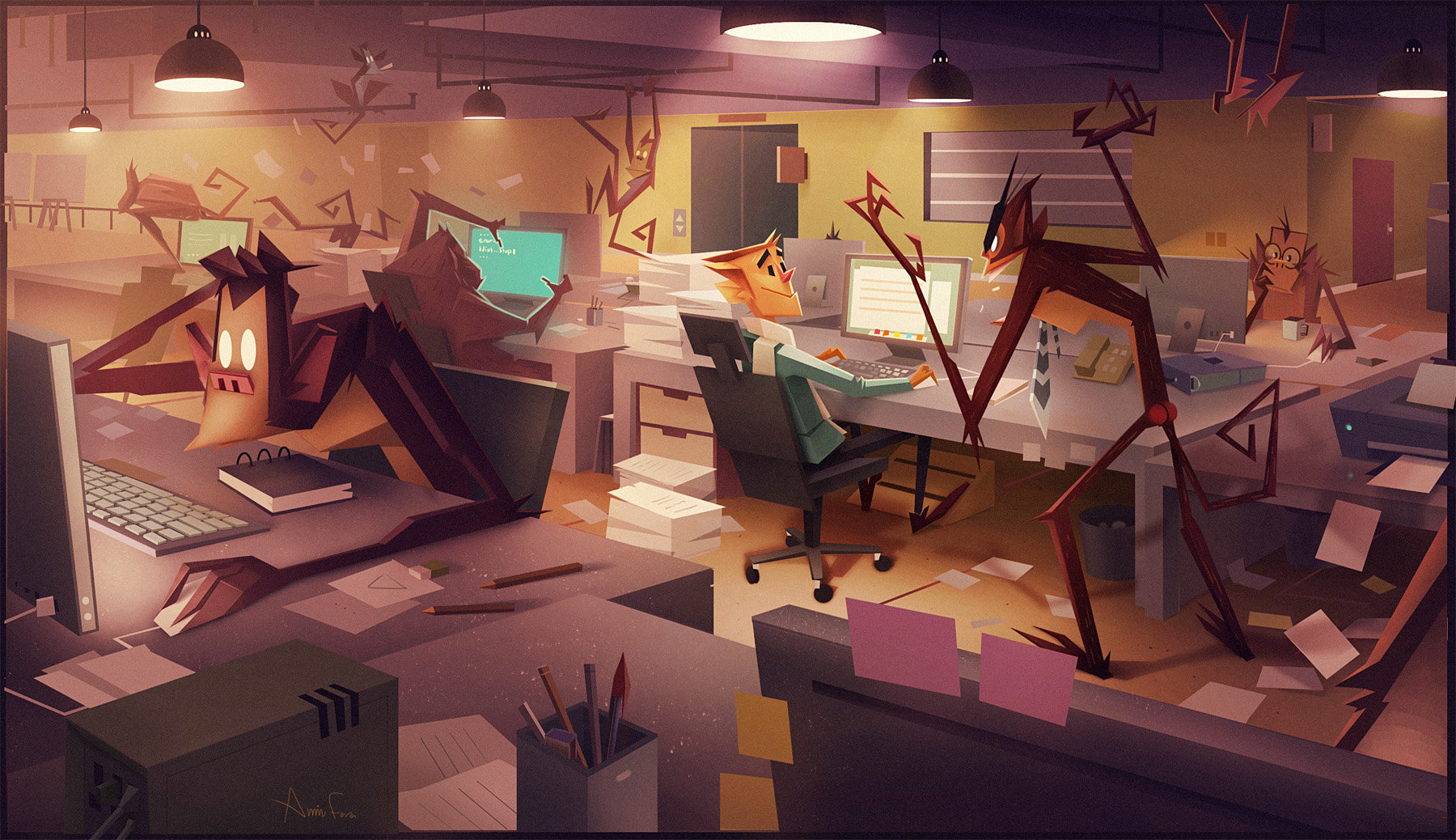
Due to technical difficulties (i.e. Adam is really busy) there will be no proper blog post today. Please accept our apologies, along with this apropos picture from Amin Faramarzian. (It seems too perfect for me not to share it.) TMTF will return on Monday!
Three Minutes of Charm
The animation above, produced by Mechanical Apple and presented by Disney, is basically three minutes of heartwarming charm. Like many of my favorite short animations, Motorbike doesn’t need words to tell its story, just soft music and softer colors.
The first time I watched the video, I was struck by its similarities to the Professor Layton games: the music, pastel colors, and comic-strip character designs seem familiar. My impression of the video the second time around was that reminds me strongly of Kiki’s Delivery Service and Studio Ghibli’s other films.
Either way, Motorbike is ridiculously charming.
I encourage you, dear reader, to set aside the woes, worries, trials, troubles, and problems of your life for three minutes, and spend those minutes on a motorbike in the sunshine.
323. TMTF Charity Fundraisers!
It’s official: Typewriter Monkey Task Force is raising money to provide clean water for people in impoverished areas and video games for kids in hospitals!
You probably have some questions. Let’s take them one at a time.
Why is TMTF holding fundraisers?
We’re raising support for two charity projects.
TMTF is supporting Living Water International in its efforts to provide clean water for people everywhere. We have two reasons for choosing a clean water project. First, clean water saves lives. Second, clean water is necessary for preparing coffee. As we enter the Christmas season, we want to make the world a better (and wetter) place by providing clean water (and hot coffee) for people in need!
We’re also raising money for Child’s Play to give video games, toys, and other goodies to kids in hospitals. Staying in a hospital isn’t much fun. We want to help change that.
Wait. Why is TMTF supporting two separate projects?
Living Water International is a Christian organization, and not all of this blog’s readers are Christians. We want to respect our readers by providing more than one opportunity to bless others this Christmas.
If I donate to one of these fundraisers, do I receive any benefits?
You sure do! We’ve created a Kickstarter-style set of rewards for donors. Check it out below!
Give $1 or more: Droplet Tier! / Pixel Tier!
Receive a public thank-you on this blog, and bask in the satisfaction of making the world a better place!
Give $5 or more: Trickle Tier! / 8-bit Tier!
Receive a personalized thank-you message, sent to the email address of your choice! All previous rewards are included.
Give $10 or more: Splash Tier! / Sprite Tier!
Receive a personalized thank-you card, sent to the mailing address of your choice! All previous rewards are included.
Give $20 or more: Wave Tier! / 16-bit Tier!
Receive a brief video in which I thank you personally! The video will be sent as an email attachment to the email address of your choice. All previous rewards are included.
Give $30 or more: Cascade Tier! / Polygon Tier!
Receive an original blog post, or an original poem, on any subject you choose! (Full disclosure: I am a mediocre poet.) You may feature this blog post or poem anywhere (or nowhere) on the Internet. (I retain the right to reject any subjects I deem inappropriate or unsuitable.) All previous rewards are included.
Give $50 or more: Tsunami Tier! / HD Tier!
Receive an original short story written to your personal specifications! You choose anything and everything: characters, setting, theme, plot, etc. You may feature this story anywhere (or nowhere) on the Internet. (I retain the right to reject any subjects I deem inappropriate or unsuitable.) All previous rewards are included.
I can’t guarantee the donation pages will track donor information, so send me a message via this blog’s Contact page after donating to make sure you get your rewards!
I guess that’s not such a bad deal. If I donate, when can I expect to receive my rewards?
You’ll get them as soon as I can get them to you. I’m afraid I can’t give any estimated dates.
Will TMTF somehow get money out of these fundraisers?
Nope, we shan’t receive a penny.
Do your fundraisers have a definitive goal?
Yes. The Living Water International fundraiser has a $300 goal, and the Child’s Play fundraiser has a $100 goal. These goals can absolutely be surpassed, and I hope we can work together to raise far more for these charities!
How long will these fundraisers last?
The Child’s Play fundraiser will be active for one month: December 2014. I had much less flexibility in planning the duration of the Living Water International fundraiser; it will stretch about three months, until the end of February 2015.
Why are you holding a fundraiser in the first place?
It started with the Advent Conspiracy. TMTF has highlighted this awesome initiative every December since the blog began.
We wanted to do more this year, so we polled readers a few weeks ago about the possibility of a fundraiser. Only a dozen people voted, but the response was positive enough that we decided to give this fundraising thing a try.
How can I support one or both of these fundraisers?
TMTF now has buttons (or widgets if you want to be technical) on the right-hand side of the homepage that will take you to specialized donation pages for these fundraisers. The Living Water International donation page can also be found here, and the Child’s Play page here.
Please consider giving clean water or video games this month, and spread the word! Happy Christmas!
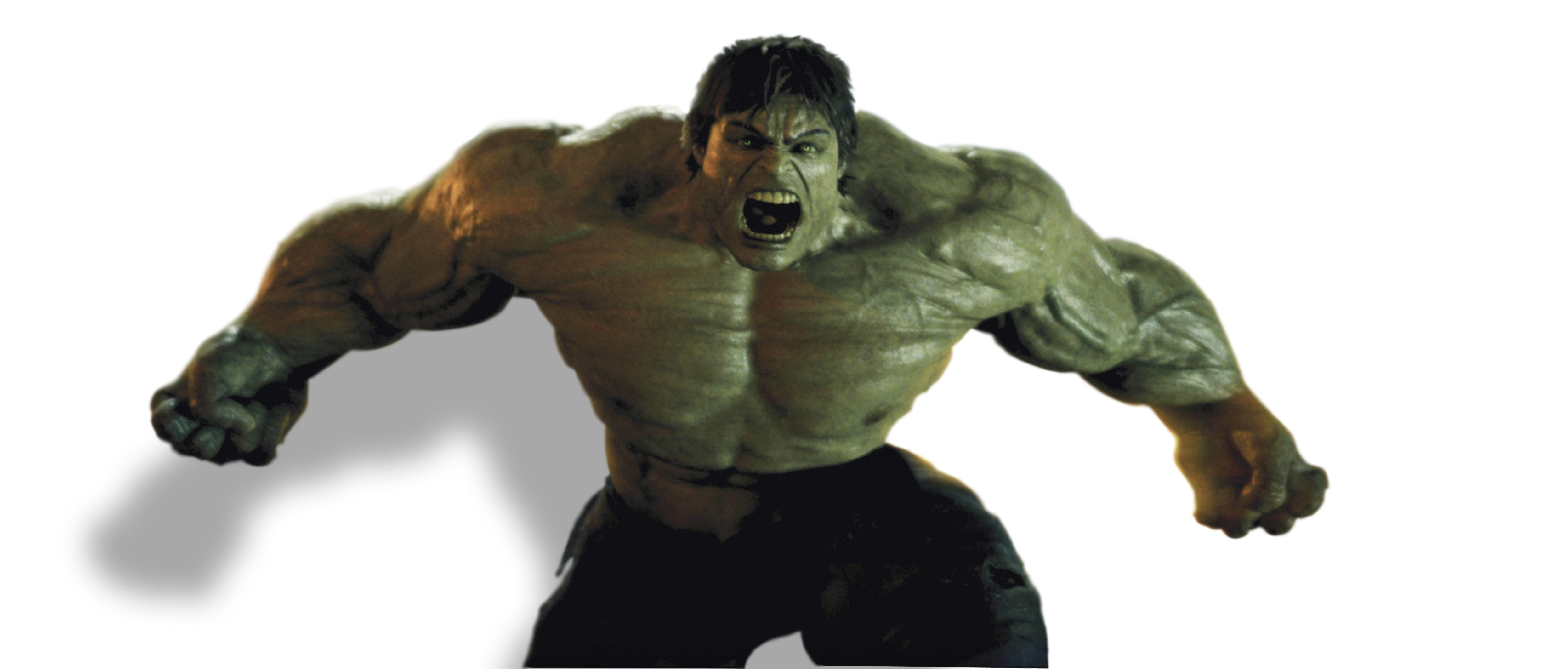
322. Adam Turns into the Hulk and Rants about Black Friday
Caution: This blog post contains furious ranting. Sensitive readers, and readers averse to things being smashed, are advised not to continue.
It’s that time of year again. Today is the day I stay inside, bolt the door, drink tea, and reflect upon the injustices of the world. Of all these, one of the greatest is that Black Friday, America’s annual celebration of consumerism, takes place on the day after Thanksgiving.
Look, Black Friday has every right to exist. I may not like the event, but I don’t think it’s inherently bad. Black Friday is a great opportunity for businesses to make money, and an equally great opportunity for consumers to buy things cheaply. Everybody wins. There are few problems, except for the fact that Black Friday now eclipses the one day we set apart for being thankful.
Black Friday’s timing is the worst kind of irony. It’s infuriating. The whole thing… I mean… it’s so frustrating… it makes my stomach hurt…
BLACK FRIDAY HAS WORST TIMING OF ANY EVENT IN UNIVERSE. HULK WOULD SMASH BLACK FRIDAY, BUT CRAZED SHOPPERS ALREADY CAUSE ENOUGH DAMAGE.
HULK ADMIT BLACK FRIDAY ITSELF IS NOT BAD. EVEN ITS TIMING AFTER THANKSGIVING MAKE SENSE—PEOPLE HAVE DAYS OFF FOR HOLIDAY AND CAN SHOP FREELY. DAY AFTER THANKSGIVING IS ALSO START OF CHRISTMAS SHOPPING SEASON AND CONVENIENT DAY FOR BUYING THINGS.
DAY AFTER THANKSGIVING IS ALSO STUPID DAY FOR BUYING THINGS.
THANKSGIVING IS ONE DAY OF YEAR WE SET ASIDE TO BE THANKFUL. THANKSGIVING IS NOW OVERSHADOWED BY CRAZY CONSUMERISM. BEAUTIFUL HOLIDAY IS NOW CLUTTERED WITH AGGRESSIVE ADS FROM BUSINESSES TO BUY MORE AND SPEND MONEY AND GET STUFF. MESSAGE OF NOVEMBER MONTH IS NO LONGER “Relax, rejoice, and be thankful” BUT “You can buy a TV for 70% off at Wal-Mart—OMG, guys! Go buy it! Buy it now!”
THANKSGIVING IS NO LONGER QUIET DAY TO EAT AND BE THANKFUL AND SPEND TIME WITH FAMILY. THANKSGIVING IS NOW DAY OF PREPARATION FOR BLACK FRIDAY.
SOME STORES NOW EVEN OPEN ON THANKSGIVING DAY! HULK ASK AMERICA: IS NO THING SACRED?! YOU NOT SATISFIED TO ECLIPSE THANKSGIVING? YOU MUST STIR UP GREED AND FRENZY ON THANKSGIVING DAY ITSELF?!”
BLACK FRIDAY IS DAY OF CHAOS AND VIOLENCE. PEOPLE GET ANGRY. PEOPLE GET HURT. PEOPLE HAVE DIED. HULK USUALLY MAKE POINT BY SMASHING THINGS, BUT SHOPPERS TODAY BEAT HULK AT HULK’S OWN GAME.
THIS DAY OF GREED, SELFISHNESS, VIOLENCE, STRESS, AND NOISE CASTS SHADOW OVER THANKSGIVING: DAY OF PEACE, REST, JOY, FEASTING, AND FUN. BLACK FRIDAY COULD BE ANY DAY BEFORE CHRISTMAS HOLIDAY.
HULK ASK AMERICA: WHY CHOOSE DAY AFTER THANKSGIVING FOR SHOPPING DAY? WHY DISTRACT FROM PEACE AND THANKFULNESS WITH WORRY AND GREED? WHY? WHY?!
HULK NOT UNDERSTAND. HULK NEVER UNDERSTAND.
HULK BEG PEOPLE EVERYWHERE. PLEASE. HONOR THANKSGIVING. REST. EAT. BE THANKFUL. AND IF YOU SHOP ON BLACK FRIDAY: BE KIND AND RESPONSIBLE.
HULK OUT!
Whoa, that was disorienting. Did I turn into the Hulk again? I blame the mutagenic effects of my wireless Internet connection—it may not be as dangerous as gamma radiation, but it sure does the trick. I suppose violent, unpredictable mutations are a cross we bloggers must bear. Well, I had better go put on a shirt.
The Not-a-Game Argument
I’m no expert on logical fallacies, but that doesn’t stop me from being annoyed by them. The Not-a-Game Argument is one of the worst. (I’m sure it has a proper name, but I haven’t bothered checking.)
Nintendo recently added some indie games to its online store. One of them, Gone Home, is an interactive story in which the player pieces together a narrative by wandering around a mansion and examining things. There are no bad guys to fight and no obstacles to overcome. It’s not a particularly video game-y video game.
The gaming community is not the friendliest, and some gamers have apparently been outraged by Gone Home. How dare its developers call it a game! It’s just a simulation, a story told passively, an affront to the artistic integrity of video games—including, I suppose, all the sophisticated and highly artistic games dedicated to shooting stuff.
Is Gone Home a video game? I’m not sure it matters. The problem with the Not-a-Game Argument is that it sidesteps the real questions. Is Gone Home good or bad? Is it art? Does it tell a good story? The Not-a-Game Argument refuses to ask these questions. It says, “I don’t like Gone Home, therefore it’s not a game and doesn’t have to be taken seriously. All arguments in its favor are invalidated, and can be ignored, because it doesn’t fit my personal specifications for a video game.”
The Not-a-Game Argument can be applied to anything. I can tell a Twilight fan, “I think the Twilight books are rubbish. Because you like them, your literary opinions must all be wrong.” I can tell an atheist, “I believe your worldview is incorrect, therefore I can ignore all of your views.” The Not-a-Game Argument is just a flimsy excuse for dismissing opinions we dislike.
Whether or not Gone Home is really a game, it’s worth taking seriously. Atheism, the Twilight books, and nearly everything else deserve consideration regardless of whether we end up agreeing with them. Not every conclusion is right, but every argument deserves to be heard.
In other news, Leo in the video above has perhaps the most soothing voice I’ve ever heard. It’s the polar opposite to Gilbert Gottfried’s harsh, grating tone. Gilbert and Leo should get together sometime and read poetry aloud.
321. Strange American Turkey Rituals
As much as I like the United States of America, I’m confused and disturbed by some of its customs. (The traditions in my homeland of Ecuador seemed so much simpler.) For example, Americans will celebrate a festival of ritualistic gluttony known as Thanksgiving in just a few days.
We at Typewriter Monkey Task Force pride ourselves on our anthropological researches. Although we generally reserve our investigations for important matters such as geek culture and cartoons for little girls, we’re expanding our vision to cover American holidays. Our research is completely authentic, and presented in a factual manner utterly devoid of humor, sarcasm, or silliness.*
As I recovered from last month’s sinister pumpkin rituals, I heard disquieting rumors of a November celebration for which Americans gather to disembowel turkeys and observe brutal bouts of gladiatorial violence. Halloween was odd, but Thanksgiving truly takes the cake… or the pie in this case.
Let’s start with the turkeys.
According to tradition, many American families prepare a turkey for the Thanksgiving festival. The bird is slaughtered and disemboweled. Then, in a macabre twist, its innards are replaced with a mixture of dried bread and spices. Thus desecrated, the turkey’s carcass is placed in an oven, cooked, and then served as part of the traditional Thanksgiving meal.
I can only speculate that the Thanksgiving turkey is a sacrifice offered as an act of thanksgiving for a good year, hence the name of the holiday. Note that the bird is not immolated as a burnt offering. It is eaten instead by participants in the Thanksgiving festival. I can only infer that the turkey’s ceremonial function is similar to the wave offering prescribed for ancient Israel in the earlier books Old Testament: an offering dedicated, but eaten instead of burned.
The sacrificial turkey is generally served with foods such as mashed potatoes, gravy, ham, corn, bread rolls, pies, and sauerkraut. (I presume sauerkraut is eaten because it has ceremonial significance; I can hardly imagine anyone actually liking the stuff.) Collectively, these foods are called Thanksgiving dinner.
Thanksgiving dinner is often devoured with reckless enthusiasm. This annual display of gluttony occurs so widely that it may be ritualistic. Worship has taken many forms in different epochs and cultures: singing, dancing, praying, meditating, offering sacrifices, making pilgrimages, giving alms, and even inflicting self-harm. Could overeating be a form of worship unique to the Thanksgiving festival? Of course, these are just speculations.
The final custom we will examine is that of football.
This athletic event is not to be confused with the sport of the same name, known as soccer to Americans. Having done a little research, I have concluded that American football is a gladiatorial competition in which armored men ram into each other on a field. Their goal is to take, by means of extreme force, an elliptical object that seems to be the eponymous football. This football is carried by hand, not propelled by foot, rendering the origin of its name an incomprehensible mystery.
We conclude that Thanksgiving is an appalling display of gluttony, violence, and unexplained rituals. However, in the interests of anthropological study, we intend to sample Thanksgiving dinner this year. For science.
*Nah, we’re just kidding.
320. Hope
Last month, my parents took a break from being awesome in Uruguay to spend a few weeks being awesome in Indiana. I have possibly the best parents in the universe, and I don’t get to spend much time with them—we live about fifty-five hundred miles apart—so I cherished every moment of their visit.
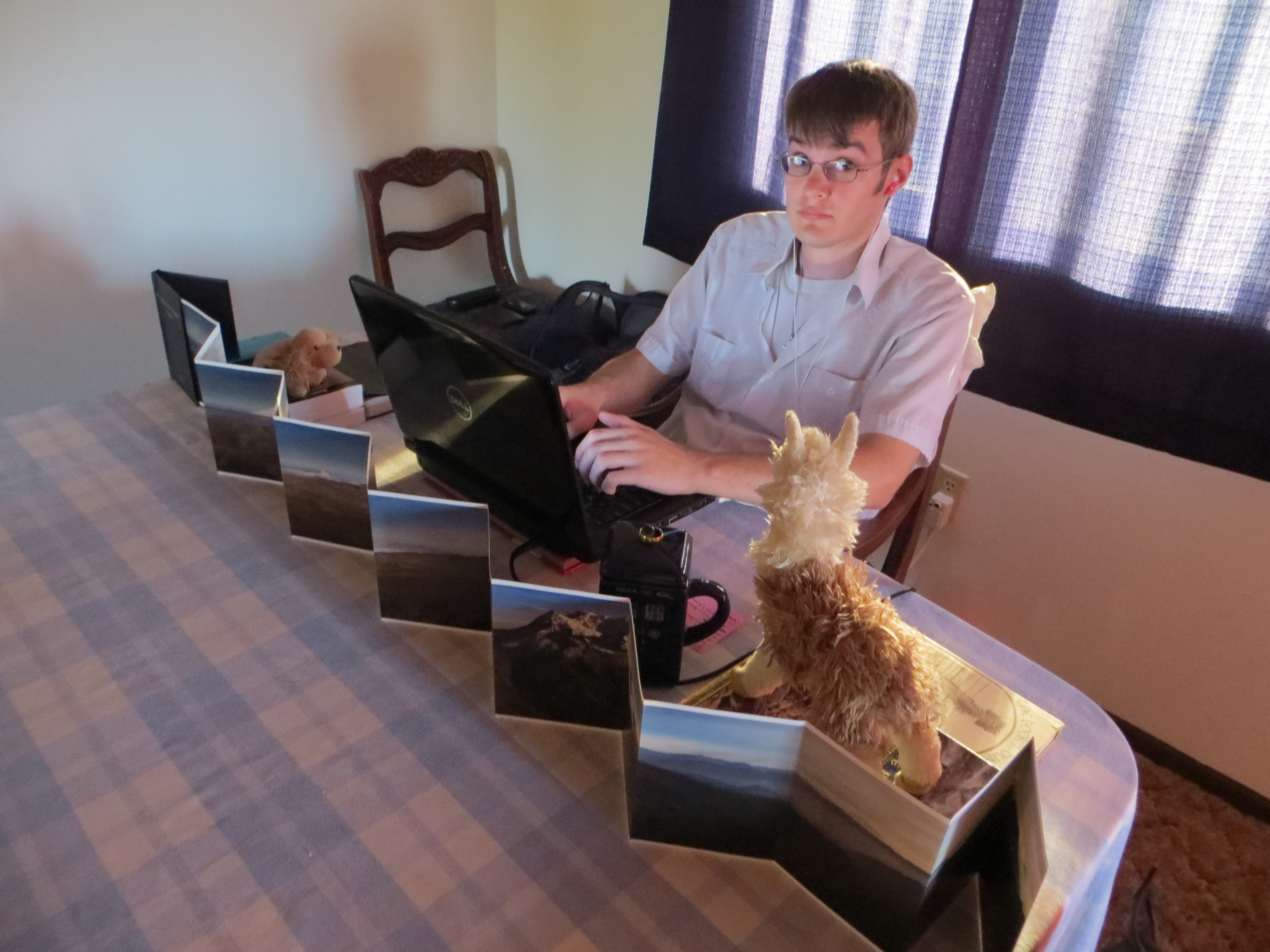
Of course, it was challenging to pack four people into a one-bedroom apartment. I relinquished my bedroom to my parents and set up camp around the dining room table with my sleeping bag, laptop, laundry basket, and assorted plush animals.
In this and other ways, my parents’ visit made my life messy. My routines and habits were disrupted. I had to improvise. We also spent a few days on the road, leaving behind my home in the little town of Berne. My life was extremely different for a few weeks, and it was really refreshing.
When my parents departed, leaving little gifts and pleasant memories, I faced the daunting task of putting everything back in its proper place. I had routines to reestablish and an apartment to reorganize. Then a funny thing happened: I kept finding opportunities for improvement. Having abandoned my ordinary lifestyle for a while, I could now look at it more critically.
I began changing things.
For a month and more, I tidied up my life. I swept through my apartment like a whirlwind, reorganizing drawers, cabinets, cupboards, and closets; I altered my diet, adding more vegetables and cutting out certain unhealthy snacks; I replenished my wardrobe, ditching holey socks and buying geeky T-shirts; I did some redecorating, adding five machetes and a plush llama to my bedroom decor; I reordered my priorities, putting first things first.
A few days ago, I reflected upon the changes I’ve made. My life has definitely improved. There is still room for improvement, however, which prompted me to ask myself: What else needs to change? What else do I need?
It was then I realized I could use a more hopeful attitude.
For several reasons, I often live with an attitude of defeat. My recurring depression makes it hard to have a positive outlook. Winter has arrived with its dark days, barren scenery, and bitter cold. Not least of all, my life situation is humbling.
From my early teens onward, I wanted to be an English teacher. I was convinced it was my calling. I went to college, attended classes, completed my student teaching, and earned both an English degree and a teacher’s license. This was all well and good, but there was one concern.
During my last semester, after three full years of study, I had second thoughts. My student teaching utterly demoralized me. I was no longer sure I wanted to spend my life teaching. Thus I eventually found myself in Indiana, using neither my degree nor my teacher’s license, working a low-wage job.
That was two years ago.
I’m still working the same job, and it looks like I won’t be moving on any time soon. (I have reasons for staying.) Heck, I don’t even know where I would go. I may end up teaching; I may not. Many of my peers are using their education to pursue great careers. It’s humbling for me to be so far behind. I’m not sure whether I’ll ever use my college degree or teacher’s license for anything.
I just don’t know.
My ambitions of becoming an English teacher have faltered. I don’t know whether I’ll ever put my college studies to use. My attempts to become an author failed; that particular childhood dream is extinguished. As I work a job that seems to be going nowhere, worrying about the future, struggling with depression, freezing in the icy darkness of winter, I realize what I’ve been missing despite all my earnest attempts at self-improvement.
I sure could use a more hopeful attitude.
Hope is a simple solution, but not an easy one. Hope is hard. As I blunder onward, I’m trying to look back. My life—even the past two years—hasn’t been wasted. I’m trying to look forward. The future is uncertain, yet full of unforeseen opportunities. Above all, I’m trying to look around at my life as it is now.
Setting aside my insecurities and uncertainties, I remain sincerely convinced that I am where I need to be—for the time being, at any rate. My life is full of blessings. I’m surrounded by awesome people. My coffeemaker still works. God’s grace never fails, and I’m comforted by these words from C.S. Lewis: “If you continue to love Jesus, nothing much can go wrong with you.”
These are things I mustn’t ever forget.
Everything Is Meaningless
“Meaningless! Meaningless!” says the Teacher. “Utterly meaningless! Everything is meaningless!”
Ecclesiastes 1:2
My devotional reading lately has taken me to Ecclesiastes. It has comforted me to revisit one of the Bible’s least comforting books, which is also one of my favorites.
Ecclesiastes is not a cheerful book. It’s certainly not a popular one. (Every time I walk into a church or Christian bookstore and see decorations inscribed with inspirational verses, I look for quotations from the Teacher. I never find any.) The main points of Ecclesiastes are basically that we will die, we won’t accomplish much of lasting significance, and we may as well resign ourselves to it.
I’ve already shared some thoughts on Ecclesiastes, so I won’t add much here. The book is beautifully poetic and brutally honest. I suppose that’s why I love it. Ecclesiastes asks big questions about life, the universe, and everything. It offers no false optimism. The Teacher finds few answers. In the end, he confesses his failures to understand and points his readers toward the God who understands everything.
Christians sometimes give the impression that Christianity solves everything, answers all questions, and leaves no room for struggles. Ecclesiastes admits that it just ain’t so. The Teacher lived in a world like ours—a world that often doesn’t seem to make sense. It’s comforting to know I’m not the only person who sees it that way.
319. Why James Herriot Is Awesome
In my early teens, I went through what I can only describe as a Tolkien phase. I obsessed over the reclusive author of The Lord of the Rings, devouring biographies, essays, poems, short stories, and even the good Professor’s noted treatise on Beowulf—my first foray into the confusing world of literary criticism. When I ran out of books about J.R.R. Tolkien, I began reading books about his colleague C.S. Lewis.
Yes, I was a strange child. This should come as absolutely no surprise to anyone who now knows me as a strange adult.
(Fun fact: My obsession with tea, which was diminished slightly by my later obsession with coffee, began with my fascination with British authors. I also wanted to imitate Tolkien by drinking beer and smoking tobacco, but my parents disapproved.)
It wasn’t until my high school and college years that my literary horizons broadened far beyond Lewis and Tolkien. In those early years, however, there was one more author whose books I loved dearly—a storyteller whose world delighted me as much as any Narnia or Middle-earth. Although this author was British, like Lewis and Tolkien, he was no professor.
No, he was a veterinarian.
Ladies and gentlemen, I give you a man whose stories of men, women, and animals have charmed me for more than a decade.
I give you James Herriot, who penned enchanting tales of creatures great and small.
James Alfred Wight, who wrote under the name James Herriot, was a veterinary surgeon who served farmers and residents in England’s Yorkshire Dales. He spent many years treating cattle, sheep, horses, pigs, cats, and dogs. Herriot was a vet in more ways than one: he served in England’s RAF (Royal Air Force) during World War II. His books are slightly fictionalized memoirs, full of real-life experiences tailored for dramatic effect.
The life of a vet may not seem interesting, but Herriot’s stories reveal a career of excitement and unpredictability. Have you ever seen a medical drama on television? Have you felt the tension of a tough case, the thrill of a clever cure, or the grief of a death the doctors couldn’t prevent? Imagine all that, but with animals instead of people, farms instead of hospitals, and wry optimism instead of cynical angst. I will always prefer James Herriot to Gregory House.
The animals in Herriot’s stories are often as interesting as the people, and the people are plenty interesting. Herriot’s boss (and eventual partner) Siegfried is eccentric, charismatic, short-tempered, and absent-minded. Siegfried’s younger brother Tristan is an unstoppable force of cheerful irresponsibility. Their clients, from tough-as-nails gaffers to delusional old ladies, are a fascinating bunch.
The stories themselves range from hilarious to heartbreaking. One day, Herriot holds back laughter as Siegfried cowers beneath the tyrannical bossiness of his secretary. Another day, Herriot holds back tears as a poverty-stricken man loses his dog to cancer. Add a burgeoning romance to the mix, one with enough humor to appease even a cynical reader like me, and Herriot’s stories become something truly special.
For someone with no background as an author—Herriot didn’t start writing until the age of fifty—his style is remarkably good. His books have a warmth and sincerity that practically shine through the pages.
In conclusion, ladies and gentlemen, James Herriot is awesome.
318: TMTF Reviews: Shantae and the Pirate’s Curse
Do you know what more video games need? That’s exactly right: friendly zombies. (How did you know?) Video games need more friendly zombies, disillusioned squid monsters, and other such zany nonsense. At a time when games are full of guns and gritty violence, the video game industry sure could use more silliness.
I may have found just the thing.
Shantae and the Pirate’s Curse is the latest chapter in the tale of Shantae, a chipper young genie—well, half-genie—sworn to protect the fishing village of Scuttle Town. The previous two Shantae games offered Metroidvania-style adventure and tons of charm, but both suffered from significant flaws.
Has Shantae finally hit her stride? Does this game’s quality match its endearing goofiness?
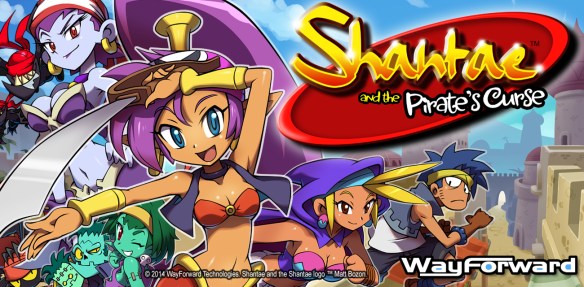
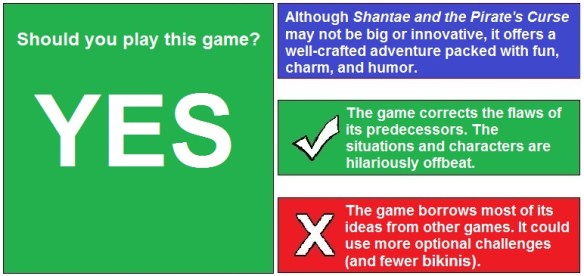
Shantae and the Pirate’s Curse may not be a big game, but like its pint-sized heroine it never lacks for humor, charm, and fun.
A Pirate’s Life for She
Shantae may have lost her genie magic in a previous chapter, but she’s no less determined to protect her village. She’s astonished when her nemesis, the dread pirate Roberts Risky Boots, sneaks into Scuttle Town and suggests a temporary truce. Shantae and Risky must work together to prevent the return of the Pirate Master, Risky’s old mentor, saving the land and perhaps even recovering Shantae’s scattered genie magic.
Shantae becomes probably the most friendly and kindhearted pirate ever to set sail. She travels from island to island, gathering Risky’s old pirate weapons, meeting bizarre people, and being totally freaking adorable.
Mechanically, Pirate’s Curse is a fine video game; more on that in a bit. Its true value, however, is in its outlandish humor and vibrant charm. The never takes itself seriously for a second, yet manages to deliver quite a touching conclusion. Getting there takes the player through all kinds of ridiculous (read: hilarious) situations.
At one point, Shantae searches for an ancient spell. She begins by sealing the smell of roasted ham in a magical lamp and releasing it near a dragon. The monster salivates hungrily and creates a pool of drool. When a pair of oblivious tourists stumble upon this convenient “swimming hole,” they strip to their swimsuits. The sunlight reflecting off their pallid skin illuminates hidden runes on a nearby wall, revealing the spell Shantae needs.
Pirate’s Curse is full of such outrageous scenes as these, and some of its humor is delightfully self-aware. One character, the monstrous Squid Baron, is a boss (extra-tough enemy) from a previous Shantae game. He spends much of Pirate’s Curse wrestling with the disillusionment and existential angst of being a low-level video-game bad guy. Shantae doesn’t seem to understand his problem, but is just as quick to comfort him as she is to fight him.
On the whole, Pirate’s Curse is as goofy and good-natured a game as any I’ve played.
Boldly Going Where Many, Many Games Have Gone Before
Shantae and the Pirate’s Curse may stand out for its style and humor, but its design and mechanics are awfully familiar.
The game’s blend of exploration, platforming, combat, and puzzle-solving is nothing new. I recognized literally every mechanic in Pirate’s Curse from some other game; even Shantae’s iconic ability from previous games to transform into different animals is replaced with a more traditional setup of gathering items and equipment to reach new areas. The puzzle-packed dungeons felt like The Legend of Zelda; the sidescrolling overworld felt like Metroid; the tricky final challenges felt like Mega Man.

Although it hardly innovates, Pirate’s Curse never feels stale. It may do nothing wildly original, but what it does it does well.
I was pleased to note Pirate’s Curse corrects the flaws of its predecessors. The first Shantae game had a sprawling overworld that was frustrating to navigate; Pirate’s Curse divides the overworld into six islands, making it much easier to get around. The second Shantae game was tragically short; Pirate’s Curse, though neither so deep as a well nor so wide as a church-door, is a big enough game to satisfy.
I wish Pirate’s Curse contained more sidequests and optional challenges. I often revisited an island equipped with an ability for reaching new areas, eager to explore and find treasure, only to realize the unexplored areas I discovered were a necessary part of the game. On the other hand, I applaud the way the game keeps track of how many collectible bonuses are on each island. This keeps frustration to a minimum by showing players where to search, preventing them from looking for treasures that aren’t there.
The music in Pirate’s Curse is catchy; the graphics are crisp and colorful; the character designs are cute. I was, however, surprised at the… um… shapeliness of the female cast. Shantae games have always been a bit flirty. Pirate’s Curse is downright saucy. The cartoony designs are never inappropriate, but the game could definitely have shown a little less skin.
(I absolutely refuse to make a pun about pirates and booty. There are depths to which even I will not sink!)
A Pirate’s Curse Is a Player’s Blessing
It has minor flaws, and it never sails past familiar territory into uncharted waters, but Shantae and the Pirate’s Curse is fun, hilarious, and absolutely a blast to play. If you’re wishing for an upbeat adventure, something sillier than the gloomy games filling store shelves, your wish is one this particular genie—well, half-genie—may be able to grant.