How Games Tell You What to Do

Link partners

Video games create vast worlds for players to inhabit, and offer endless opportunities for interaction. That’s pretty cool. It also poses a problem unique to video games as a medium.

It’s easy to get lost.

With only a few unconventional exceptions, other media guide their audience along one specific path. When I read The Lord of the Rings, for example, I’m given a clear story to follow—the one Tolkien wrote. As he describes Frodo’s journey to Mordor, I can’t choose to see what’s happening back in Hobbiton or Rivendell. Either I read Tolkien’s story, or I don’t. I merely experience it. I don’t create it.

Video games are different. A game allows players to interact with its world, giving them a hand in creating the story. Maybe, as I play a Legend of Zelda game, I’m supposed to rescue Princess Zelda, but choose to smash pots and attack chickens instead. The protagonist, Link, is only a hero if I want him to be.

Games give players an amazing degree of freedom, with many potential paths to take. It’s only natural, then, for games to guide the player toward the path their developers intended.

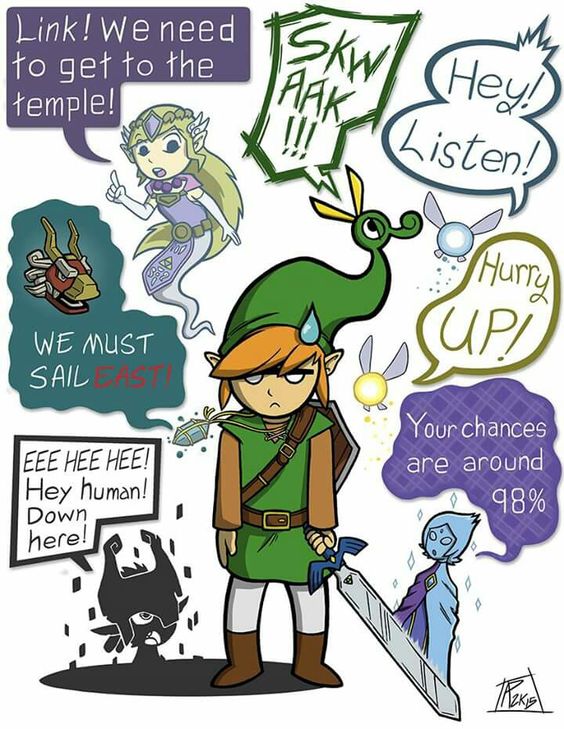
There are many approaches to guiding the player. The Legend of Zelda series often gives Link companions, as seen in the picture above. (I wanted to attribute it, but couldn’t find the artist.) These range from the traditional (a fairy) to the bizarre (a talking hat). These partners give Link advice on where to go and what to do next, guiding the player toward the game’s intended objectives.

This approach works pretty well, but can become irritating as Link’s companions boss him around or spell out every little step of his journey. The latest Legend of Zelda game doesn’t seem to have a partner system, which should allow players to wander more freely.

Other systems for guiding the player include marking objectives on a map, offering text or audio cues, or structuring game environments to direct the player toward the next goal. Some games are straightforward enough not to offer any guidance: Tetris and Pac-Man are good examples.

When I pick up a new game, I’m always interested to see how it tells me what to do.

Mad Max: Fury Road Is Still Awesome

If you haven’t seen Mad Max: Fury Road yet, you should. It’s good. I mean, seriously, it’s really good. At any rate, it’s better than a film about spiky death cars has any right to be.

Why is the latest Mad Max considered a masterpiece? I’ve already written about it in a couple of blog posts, but I can boil it down to just a few points: narrative minimalism, sparse dialogue, practical effects, striking color saturation, flawless cinematography, and flame-spewing electric guitars. (Maybe not that last one.)

Seriously, though, the cinematography is superb. The film’s editing guides the audience’s eyes, tracing a clear path through the maelstrom of explosions, gunshots, dust clouds, and Tom Hardy’s scowls.

Incidentally, I still wonder whether the film’s villain, Immortan Joe, is secretly Donald Trump.

Immortan Trump

I’m thinking… probably.

It was a red-letter day when my brother and I trekked to our local movie theater to see this movie on a whim. Oh, what a day. What a lovely day!

The Force Is Strong with This One

The Force is strong with this one

Good gosh, do I ever miss Sam and his Obi-Wan impressions. He occasionally did other movie impressions, too.

Sam reclining

“Draw me like one of your French poodles.”

After spending many happy years with my family in Ecuador and Uruguay, Sam stayed in Uruguay with some dear friends. I have a cat now, and she’s all right, but I still miss the Sam-pup. Man’s best friend, indeed.

Sam curled up

Two Perfect Girls

For the record, I support monogamy. (I also support Pokémon.)

Did you know there was an official Pokémon musical? I haven’t seen it, but I’ve heard most of the songs from its soundtrack, and a few are actually pretty rad. (That said, a few are terrible.) Seriously, though, how cool/weird is it that Pokémon got its own musical?

Heck, they’ll be giving Ace Attorney its own musical at this rate… wait, what? Japan got three separate musicals based on the Ace Attorney series? Of course it did. Of course it did. We’re still waiting on an official Ace Attorney musical in the West, but there’s a fan-made one in the works, and its soundtrack is pretty good. (I was involved with the fan-made musical in a very minor way a long time ago. Good times!)

Returning to the Pokémon musical, the song above, “Two Perfect Girls,” is a bouncy ballad of divided affections. Catching random Pokémon must be a lot easier than wooing the perfect catch.

In other news, Pokémon Go, an augmented reality game, was released a number of days ago. It has flooded my social media with digitally-enhanced pictures of Pokémon in real-life parks, streets, restaurants, churches, and… bathrooms. The world just got a little weirder, guys.

457. The Sirens Are Calling for Me

No man is an island, entire of itself; every man is a piece of the continent, a part of the main. If a clod be washed away by the sea, Europe is the less, as well as if a promontory were, as well as if a manor of thy friend’s or of thine own were: any man’s death diminishes me, because I am involved in mankind, and therefore never send to know for whom the bell tolls; it tolls for thee.

~ John Donne

Nearly every time I think of John Donne, I remember the concluding lyrics of “Can You Feel the Love Tonight” from The Lion King. This is admittedly an odd reaction to a centuries-old English poet, but there’s a reasonable explanation, I swear!

When I was in high school, I did an assignment on a meditation Donne wrote about friendship. (I think Donne wrote it; someone else may have.) He argued that friendship and romance take away from each other: as a man grows closer to his romantic partner, he grows farther from his friends. His affections become divided.

I explained this concept in my assignment. When I received it back from my teacher, I found the following words scribbled in the margin: “And if he falls in love tonight….” These apt lyrics from “Can You Feel the Love Tonight” are easily the best thing anyone has ever written on any of my homework.

In short, their pal is dooooooomed.

I’ve read hardly anything by Donne, but one of his statements is very famous. It provided the title for one of Earnest Hemingway’s novels. Heck, even I’ve quoted it. It’s his statement on our shared humanity: “Never send to know for whom the bell tolls; it tolls for thee.”

In other words: If someone dies, and the funeral bell rings, don’t ask who died. It was a fellow human, and as a member of the human race, you just lost a piece of yourself. The bell rings for you.

On a related note, I’ve been hearing a lot of sirens lately.


I listen to the sirens as they sing me back to sleep.

I pray that no one’s seriously hurt.

It feels like everything is dying at the pivot point of me.

I listen to the sirens tell me things could still be worse.

~ Relient K


I live in a quiet corner of Indiana. There aren’t many violent crimes around my home. Throughout the United States, however, there has recently been a number of shootings. It’s old news at this point, and I won’t rehash the sordid details. It’s enough to know that a lot of people have lost loved ones. A lot of people are angry. A lot of people are scared.

None of this affects me directly. I’m a white dude in a small town in Indiana. I never hear gunshots; the loudest things around here are geese and firecrackers. The tragedies across the US are just headlines on the Internet and blurred articles in the newspaper. My immediate reaction is to say “That’s really sad,” and then to get back to whatever I was doing.

Police siren

I hate the sound of sirens.

It’s exactly the same when I hear sirens. I don’t know whether they’re announcing a medical emergency, a police arrest, or a house on fire—all I know is that sirens are bad news. I often take a moment to pray for those trapped in whatever tragedy summoned the sirens. Beyond that, I’m not affected. Those sirens call for someone else… don’t they?

The truth is that sirens are a lot like Donne’s bells. They’re calling for me. Every siren, online article, and smudged newspaper headline tells me that humankind is broken, and that I’ve lost something.

I’m not sure what to do with that.

The Brutal Art of Speedrunning

This is a special week. America celebrated its Independence Day, sure, but that’s not all: Games Done Quick is currently running its summer marathon for charity.

Games Done Quick, whose current marathon supports Doctors Without Borders, is an event celebrating the art of speedrunning. A speedrun is an attempt to complete a video game as quickly as possible. There are endless variations upon this concept, but they all have one thing in common—they are ridiculously fast.

The video above is a brief feature on a young man nicknamed Darbian, who held (and still holds, I think) the world record for speedrunning the original Super Mario Bros. He beat the game in under five minutes. The entire game. That’s bonkers.

I don’t really follow Games Done Quick or other speedrunning projects, but I’m fascinated by the metagame they create around existing games. They add rules, objectives, and strategies never intended by the games’ developers, building new games upon the old ones. It’s neat.

It’s also pretty brutal—a tiny mistake can derail an entire speedrun. A successful speedrun requires near-perfect timing, comprehensive knowledge of the game, tons of practice, endless patience, and perhaps just a touch of insanity.

I only ever tried speedrunning one game; coincidentally, it was Super Mario Bros. When I was in college, I spent a week or two playing and replaying the game, whittling away the seconds, until I managed to finish it in under ten minutes. I felt quite accomplished. Now, knowing that speedrunners like Darbian can beat the game in less than half that time, I feel… less accomplished.

Ah, well. I suppose what matters is having fun!

Abandon Hope, but Save a Little

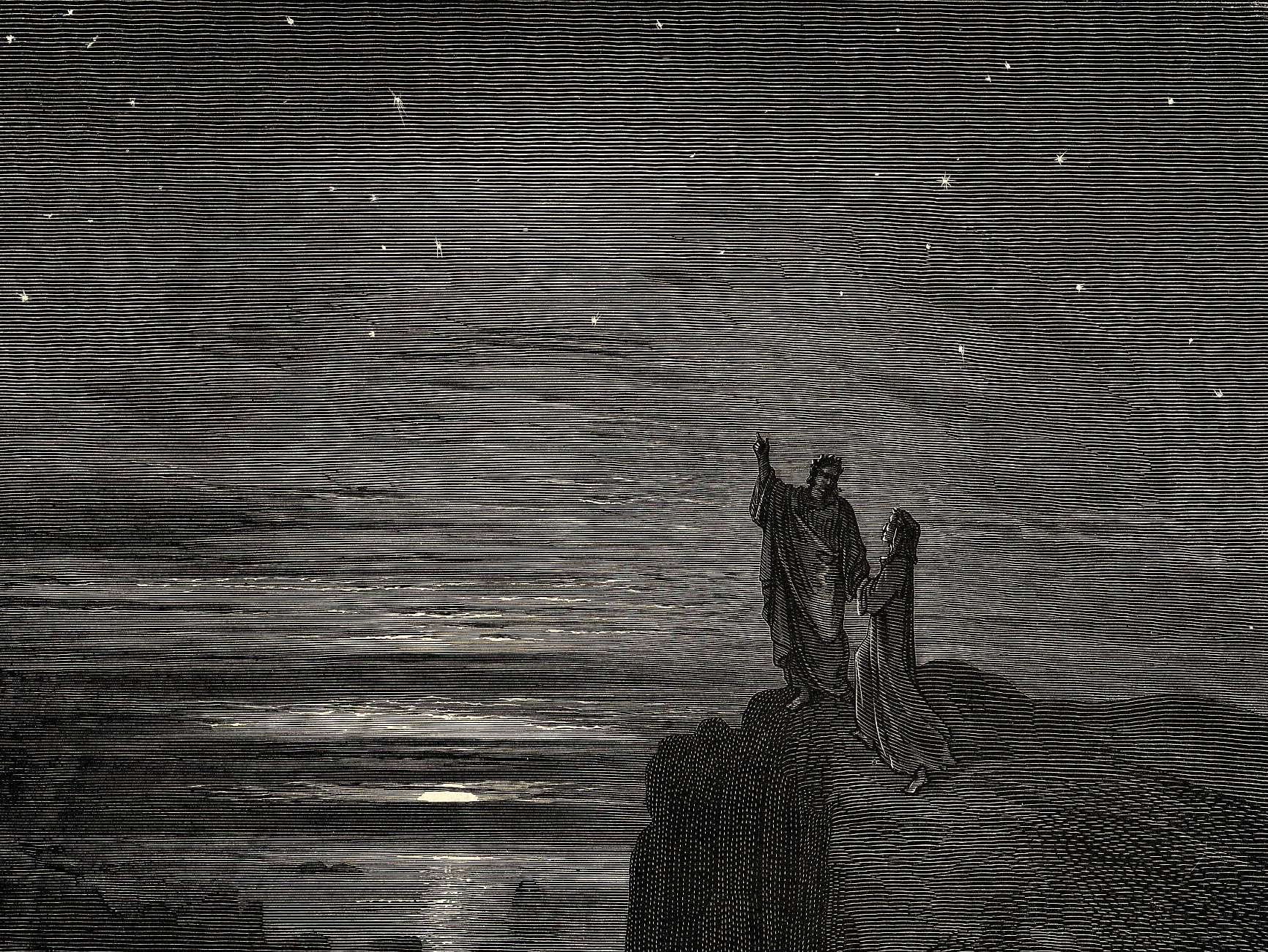
Thence we came forth to see again the stars.

~ Dante Alighieri

Dante’s Inferno is not a cheerful poem. It follows the poet Dante and his guide Virgil through hell, upon whose gate are inscribed these words: Abandon all hope, ye who enter hereThis slogan could just as easily be printed on the poem’s front cover. Inferno isn’t a fun read, unless you happen to enjoy long conversations (all written in archaic language and poetic meter) with the tormented souls of damned sinners.

I once wrote about my favorite opening lines in literature, and more recently considered some of my favorite last lines. For example, A Tale of Two Cities ends on a poignant note: “It is a far, far better thing that I do, than I have ever done; it is a far, far better rest that I go to than I have ever known.” My all-time favorite last line concludes The Lord of the Rings: “‘Well, I’m back,’ he said.”

The final line of the Inferno is right up there with my favorites. For a poem whose most enduring words are “Abandon hope,” it ends hopefully. Dante and Virgil leave hell.

I can imagine it so clearly: disheveled travelers, exhausted from climbing in the endless dark, chilled by the ice of hell’s last circle, disturbed by the horrors of the underworld, glancing upward and seeing a sky alight with stars. I can see them stumbling out of the cave into the fresh air, blinking in the soft light from heaven. I can hear cicadas buzzing and feel a breeze stirring the grass. Hell is behind them. The nightmare is ended. After all the circles of hell, they know they’ve reached safety, for they see again the stars.

Thence we came forth to see again the stars

I’m a bit sentimental, but that’s one of my favorite images in all of literature. After literally going through hell, our heroes are safe. They are no longer trapped beneath stone ceilings. Above them, the heavens declare the glory of God. It’s a touching picture, and an uplifting end to a really bleak poem.

In one of the Chronicles of Narnia by C.S. Lewis, there’s a similar scene in which the protagonists escape an underworld to find themselves beneath a starry sky. J.R.R. Tolkien’s books also feature characters ending underground journeys by stumbling out into the open, such as Bilbo getting out of the Misty Mountains in The Hobbit and the Fellowship fleeing Moria in The Fellowship of the Ring. Escaping the underworld to find oneself beneath the sky has become a literary motif, and I dig it.

To conclude, here’s a bit of trivia: All three parts of the Divine Comedy end with the word stars. Neat, huh?

Waiting for E3

E3 happens next week. This annual trade show for the video game industry is like Christmas to gamers like yours truly. New games are shown, game systems unveiled, trailers released online, and announcements made. These exciting videos and headlines are tossed rapid-fire at eager gamers like me, like a stream of crumbs sprinkled among so many hungry goldfish.

This year’s E3 promises news of the new Legend of Zelda game, which was supposed to come out this year but has been delayed to next. In honor of this year’s E3, and because I can’t think of anything else for this week’s Geeky Wednesday post, have eight minutes of beautifully orchestrated Zelda music. The Legend of Zelda games have some rockin’ melodies, and this medley showcases some of the most iconic. Enjoy.

In the meantime, I’ll go back to staring at the calendar. Just six days to go.