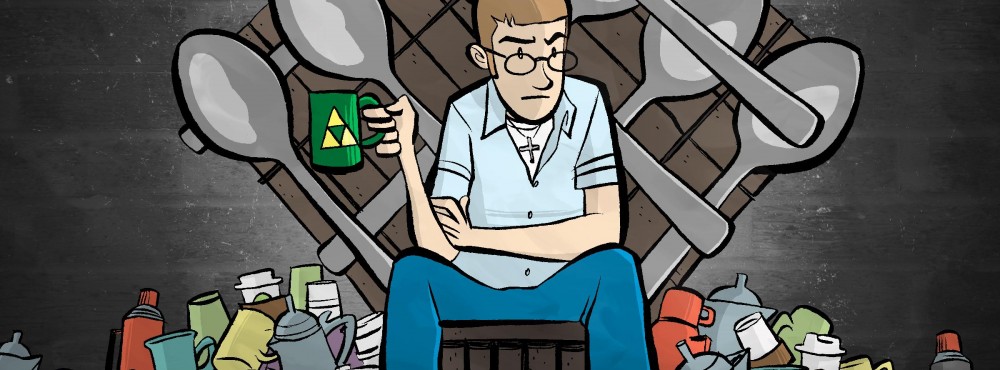
Everything Wrong with The Avengers (in Three Minutes)

Hollywood can be pretty dumb. There, I said it.

I love movies as much as anyone, but I’ll be the first to admit they’re often packed with clichés, mistakes, bad performances, lousy dialogue, cheesy action scenes and sparkly teenage vampires. If only someone on the Internet had the courage to stand up and condemn these films for their faults!

Fear not, dear reader! We have such a hero: a true champion of snarking, nitpicking and being a jerk to movies. We have Cinema Sins.

Cinema Sins is a YouTube series that acts as judge, jury and executioner to condemn the problems in both recent and classic films. With extreme prejudice, Cinema Sins explains exactly what’s wrong with movies.

Take The Avengers. It wasn’t bad as superhero films go; director Joss Whedon wove a pretty decent tale from the tangled histories of five or six different heroes. Cinema Sins still manages to expose sixty-four sins in three minutes flat. Well played, Cinema Sins, well played.

As long as there are movies, they will have problems. And as long as they have problems, I hope Cinema Sins will be there to condemn them.

Word Crimes

I had something completely different planned for today’s Geeky Wednesday post, but then stumbled upon this video last night and realized I must share it. As a blogger, I accept this as my inexorable destiny.

Weird Al has released another album of parodies, including this glorious riff on “Blurred Lines.” It’s all about English grammar and spelling. What nobler subjects can there be for song lyrics? There are also a couple of off-color jokes, but I’ll let them slide this time because, in case I hadn’t mentioned it, this is a song about English grammar and spelling.

Weird Al Yankovic, bless him, has been writing music for decades. I grew up listening to his silly songs, and I’m glad he still doing his thing.

When Philosophers Play Football

As the World Cup draws to a close, we at TMTF wonder what would happen if philosophers played football, the glorious sport known as fútbol in my country and soccer in the US.

Fortunately, this is a question answered many years ago by Monty Python, a British comedy group made up of insane, brilliant gentlemen. Their decision to put Greek and German philosophers on a football field together was nothing short of genius.

Speaking of the World Cup, I have a confession to make. I haven’t watched it. Having grown up in Ecuador, I know I should like fútbol. I admire the game, I love the passion of its fans and I enjoyed playing it as a kid, but… I don’t like watching sports. Not even fútbol can cure my aversion to athletics.

I kind of like philosophy, though.

Video Games Need More Gilbert Gottfried

Video games are great and all, but do you know what they need? Gilbert Gottfried, the comedian who voiced the parrot from Disney’s Aladdin. Gilbert Gottfried is what video games need.

That said, here is two minutes and forty-five seconds of Gilbert Gottfried voicing iconic lines from video games, followed by a few very brief observations of my own.

1. Navi, the fairy from The Legend of Zelda: Ocarina of Time, would be less annoying if she were voiced by Mr. Gottfried.

2. Mr. Gottfried’s quiet “Fus ro dah,” a casual performance of a fierce dragon shout, is still enough to send a man plummeting to his death in The Elder Scrolls V: Skyrim. The man’s got skills.

3. The famous opera scene from Final Fantasy VI definitely loses some of its charm and beauty when Mr. Gottfried reads its lyrics. I suppose he can’t win them all.

4. A Mario game in which Mr. Gottfried provided Mario’s voice would be sublime.

5. Mr. Gottfried’s performance is possibly the only thing in the universe that could make Liquid Snake’s monologue about genetics from Metal Gear Solid any cheesier.

Now all we need is a video in which iconic game lines are read by Morgan Freeman. Get on it, Internet!

Fireflies

In case there is anyone left in the world who hasn’t seen it, here is the music video for “Fireflies” by Owl City.

I don’t even like music videos, but I’ll be the first to admit this one is magical. I suppose it’s because it doesn’t star sultry babes or angry guys with guitars, but a dusty bedroom full of toys from the eighties.

The cuts get pretty fast and furious toward the end, giving the song a sense of kaleidoscopic color and motion. I like the effect, though some viewers might echo the good folks at RiffTrax and say, “Geez, with the quick edits here, Michael Bay thinks this thing is overcut!”

Our culture is saturated with songs about partying, sex, romance, heartbreak, bitterness, rebellion and other exhausted subjects. I’m tired of modern music; even its new songs seem old. I appreciate artists like Weird Al Yankovic and Schmoyoho whose songs are wildly weird, and I’m even more thankful for artists like Owl City whose songs are serious without seeming tired or clichéd.

On a different note, I haven’t seen fireflies in ages. Where have they gone? They were everywhere at twilight when I visited Indiana as a kid. Have the fireflies, like Douglas Adams’s dolphins, abandoned Earth for a better place?

The Man Who Annoyed God

Napoleon had been impeached before the Infinite, and his fall was decreed. He annoyed God.

~ Victor Hugo

I’ve been reading Les Misérables, which is why I haven’t posted any book reviews recently and probably won’t post any for at least another three or four years. To say Lez Miz is a long novel is a staggering understatement. The book weighs about as much as all of my other books combined, with a couple of elephants thrown in for good measure.

Having previously read an abridged edition, I’m enjoying the full version of Less Misery very much. I’m also beginning to understand why so many editions are abridged. At the moment, the gripping tale of Jean Valjean has been interrupted by about nineteen chapters describing the battle of Waterloo, which has (if I remember correctly) only the slightest bearing upon one of many supporting characters in the novel. These Waterloo chapters are mostly an excuse for Hugo to ramble about Napoleon, whom he seems to admire.

I could hardly care less about Napoleon. I want to read about Jean Valjean, dash it!

There’s even a whole chapter praising a French officer for swearing when asked to surrender. (I swear I’m not making this up.) Victor Hugo apparently decided a filthy swearword with no relevance to the main story was important enough to merit an entire freaking chapter of the novel.

However, to be fair, even these pointless Waterloo chapters have a few literary gems sparkling here and there. My favorite of these can be found above: Napoleon, that brilliant tactician and self-assured leader of men, stumbled and fell because, Hugo informs us, “He annoyed God.”

This line reduces a colossus of world history—Napoleon, whose ambition, pride and courage knew no limits—to an annoyance. It’s a matter of perspective. God in his infinite greatness looked upon mighty Napoleon and saw a fly. Waterloo, which Hugo calls not merely a battle but “the changing face of the universe,” became God’s flyswatter.

“He annoyed God.” I love this line. It thrills my geeky soul.

“Let It Go” Is a Great Song, but a Terrible Philosophy

Disney released Frozen a number of months ago. It was, honestly, quite a good movie, but the film was largely eclipsed by one of its songs, “Let It Go.” There’s some truth in the joke about Frozen being the song’s feature-length music video.

I like “Let It Go.” It may be ridiculously overhyped, but the song is really quite a catchy one. The remix above is by far my favorite. “Let It Go,” a slow, melodic ballad, translates unexpectedly well to dubstep.

Despite its beautiful music, I find “Let It Go” bittersweet. The song is defiant, exalting rebellion and egoism, lifted up from a broken heart, reflecting a bitter moment. “I don’t care what they’re going to say,” sings Elsa. “Let the storm rage on! The cold never bothered me anyway.” She adds, “No right, no wrong, no rules for me. I’m free!”

I know people who live with that kind of selfish abandon. They’re some of the most miserable people I know. I think of them sometimes when I hear “Let It Go,” and my heart aches for them.

In the film, Elsa eventually finds a happy ending. (This is a Disney film, after all.) “Let It Go” reflects just one moment in her journey—a particularly selfish, defiant moment. The song’s pathos is touching, but it represents a horrible attitude toward life. It makes me sad that in a film celebrating loyalty and love—real love, “putting someone else’s needs before yours,” not Disney’s usual follow-your-heart nonsense—the thing most people latched onto was the song about selfishness.

“Let It Go” may represent a terrible philosophy, but it’s a great song. I particularly enjoy the remix above. Nothing brightens up a sad song like stuffing it with dubstep beats!

Please, Have a Llama

OLYMPUS DIGITAL CAMERAThere are times, dear reader, when I run out of ideas for blog posts. As a cloud is consumed and vanisheth away, so my creativity evaporates. I am left destitute, desperate for some spark of inspiration, groping blindly through an impenetrable fog of fatigue and mental paralysis.

Today is such a day. I can think of nothing more to say, so please accept this photo of a llama.


Puff the Magic Dragon Does Not Smoke Weed

It’s time to set the record straight. “Puff the Magic Dragon,” unlike any given Beatles song, is not a veiled allusion to drugs.

The first song I remember ever hearing was “Lemon Tree” by Peter, Paul and Mary. Songs by this sixties folk trio have played in the background of my life from my earliest childhood on the coast of Ecuador to my high school years in the Andes mountains. I love their songs to this day. As much as I’ve come to enjoy other styles of music, from rock and ska to chiptunes and the odd spot of dubstep, I will always find Peter, Paul and Mary’s harmonies beautiful.

Peter, Paul and Mary are remembered for performing hits like “Blowin’ in the Wind,” “Leaving on a Jet Plane” and, perhaps most infamously, “Puff the Magic Dragon.” The lyrics of this last song tell of a boy and a dragon who enjoy merry adventures together. When the boy grows up, he abandons the dragon to grief and loneliness.

I suppose the boy’s odd adventures could be considered a metaphor for drug trips, and yes, the dragon’s name could be an obvious nod to smoking marijuana.

In the end, however, “Puff the Magic Dragon” was simply a poem by a college student about the passing of childhood. After the poet had gotten it out of his head, he forgot about it until Peter Yarrow (the Peter of Peter, Paul and Mary) turned it into a song and credited him with the lyrics.

So let it be known to all people that “Puff the Magic Dragon” has no meaning except the obvious one. Peter, Paul and Mary are acquitted. Case dismissed!