264. TMTF Reviews: Struggle Central

This seems to be a good week for reviewing things, so I think it’s time for a look at Struggle Central: Quarter-Life Confessions of a Messed Up Christian. An alternate subtitle for the book could be The Book Adam Has Been Meaning to Read and Review Since, Like, Last September. What can I say? I forget things.

Thomas Mark Zuniga is a blogger, introvert, Christian, coffee drinker and wordsmith. When he released an e-book some time ago, I snagged a free copy for review purposes. It spent the next few months gathering digital dust in a folder on my laptop. Around the time TMZ agreed to write an excellent guest post for this blog, I remembered his book and resolved to finish it. I bought the paperback version—I will always prefer ink-and-paper books to virtual ones—and walked with TMZ through twenty-five years of struggles.

Appropriately enough, one of the first significant autobiographies in history was titled Confessions. For its author, Augustine, the story of a life is a series of confessions. Whatever our accomplishments, we make mistakes. We all struggle. Struggle Central, a memoir in the tradition of Augustine, testifies to the fact.

Is Struggle Central a good memoir? A good story? A good book?

Struggle Central

Despite minor stylistic flaws, Struggle Central: Quarter-Life Confessions of a Messed Up Christian is an honest, vulnerable memoir that never loses sight of its purpose.

Right from the beginning, TMZ makes one thing clear: Although Struggle Central is his story, it isn’t really about him. The book is meant neither to shock nor impress its readers with his mistakes and triumphs. Its purpose is to encourage. It tells its readers, “You’re not alone!”

In Struggle Central, TMZ is remarkably honest, seeming to hold back nothing, making some heavy confessions. This is a book about loneliness, insecurity, fear and isolation. It deals with pornography, homosexuality, shame and doubt. If I wrote a memoir, I doubt I could be so vulnerable.

In all its confessions, Struggle Central tempers honesty with its strong sense of purpose. The book could easily have been a pleading, self-conscious cry for attention. It could have been a halfhearted attempt at openness, gilding its mistakes with excuses and rationalizations. Struggle Central is neither of those things. Its confessions are made as evidence of the book’s fundamental message: “You are not alone; there is hope.”

A number of the confessions in the book resonated with me. As an introvert, I relate to TMZ’s failed attempts to connect with people in churches. As a sinner, I understand the rationalization, shame and self-loathing in TMZ’s struggles to overcome pornography. As an insecure person, I know TMZ’s discouragement at how everyone else seems to be talented, successful or perfect. Struggle Central may not touch all of its readers, but it sure touched me.

On a literary level, Struggle Central has a surprisingly strong narrative. It recounts not a random string of events, but a structured story. TMZ doesn’t merely spit out facts. He highlights certain experiences, adding digressions and flashbacks wherever necessary to keep his story flowing smoothly. In the book’s story and structure, nothing is wasted.

The style of Struggle Central is a different matter: the book is packed with modifiers. If I had a penny for every qualifier, adjective and adverb, I would probably have enough cash to buy coffee at Starbucks.

Despite its many modifiers, the writing in Struggle Central isn’t bad. It’s engaging, readable, informal and crammed with sentence fragments and one-sentence paragraphs for emphasis. All the same, my nitpicky sensibilities were rubbed the wrong way by the constant use of modifiers and dramatic sentence fragments. The more they were used, the less impact they made. There were also a few puns and pop culture references that made me roll my eyes.

In the end, though, the writing takes secondary consideration to the book’s message and purpose—and these are excellent. Struggle Central has a clear and positive purpose, and it does a fine job of sticking to it. It could use a little polish, yet Struggle Central is a touching read for anyone who struggles—that is, for any human being on Earth.
254. On Homosexuality: Let Us Only Handle Love

Today’s post was written by the talented TMZ—Thomas Mark Zuniga, I mean, not the celebrity tabloid—as a response to my thoughts on homosexuality. For more wise words and wanderings from Tom, check out his blog and his book, Struggle Central.

When my blogging friend, Adam (or as I’ve long regarded him, “That Monkey Guy”), asked me to contribute a post on homosexuality to his blog, I knew I wanted to write something. I just didn’t know where to start. Homosexuality is, after all, a Pandora’s Box of an issue lined with nettles and littered with landmines.

I really latched onto something Adam wrote recently. He talked about how his convictions and sympathies often seem to oppose each other. Oddly enough, I often find myself in a similar stance regarding homosexuality—though from a more unique, complicating perspective.

You see, it’s been almost a year that I’ve been publicly “out” as a “gay Christian”—or whatever you’d label me. First, I wrote a book, and then I wrote a blog post.

When I initially “came out” on my blog, I wrote that despite my male attractions, I cannot mentally reconcile a homosexual relationship and my walk with Jesus. Given the choice of one or the other, I’ve staked everything on Christ; without Him, I am nothing.

What about other gay people though? What about other gay Christians who don’t do what I do and believe what I believe?

Honestly, I used to feel angry toward other gay people. But I used to feel really angry toward other gay Christians who claimed to pursue Jesus and same-sex partnerships.

Not sad. Not disappointed. Angry. I hated that these particular gay Christians had somehow found this theological “loophole” and were able to reconcile the two while I remained “holy” in my struggles through singleness.

In recent years, however, I’ve been learning the process of not letting my beliefs necessarily dictate my reactions. I know, I’m a horrible Christian, right?

Whether we like it or not, there exist gay people and gay Christians in homosexual relationships. While homosexuals certainly experience discrimination, homosexuality and gay marriage are gradually becoming more normalized, both inside Christianity and out.

Our evolving culture has often left me wondering in this question mark-sized boat:

How do you believe one thing yet still show love and grace toward others—human and spiritual siblings alike—who live quite the opposite?

I suppose my answer hearkens back to something else That Monkey Guy mentioned. Where is the outrage over poverty, homelessness, sex trafficking, child abuse, the failed foster system, and the disheartening list trails on?

Are we naive to think that homosexuality and gay marriage is the biggest “threat” facing America? The world? Is our time really best invested in endless vociferous debates?

As a non-confrontational person, I’ve long been “over” the debate. I’ve already stated what I believe on my blog, and I’m going to leave it at that. Moving forward, I just want to tell my story—my messy, miraculous story.

Contrary to what many naysayers have “advised” me, God has indeed used my conviction on homosexuality for good. He’s introduced me to some of the most solid brothers I could ever know, both online and off. He’s moved me across an entire continent for a fresh new life. He’s given me a voice to speak for the voiceless among whom I lived for over two decades.

I’d have never gained so many of my current blessings were I not attracted to the same sex.

I’m not saying my entire road has been paved with peace, but God has certainly used the apparent “bad” of this conviction for His good. I’m convinced He’s in the business of writing similar redemptive stories for homosexuals and heterosexuals alike.

Since my book’s release, I’ve exchanged numerous conversations with people of all ages on all sides of this contentious issue: young and old and gay and straight and religious and nonreligious. It’s becoming more of a “normal” thing for total strangers to confide in me their sacred sexual secrets. I am touched that people would entrust me with their problems and pain.

I love them all.

And so while my convictions may reside on one side of the homosexuality hotbed, I’m learning to plant my sympathies across both sides. I figure if God wants to convict somebody about his or her sexual proclivities, heterosexual or homosexual, His Spirit is capable. God doesn’t need my blog or my Twitter account to draw people into His arms.

My advice to others struggling at the crossroads of their convictions and sympathies is actually quite simple. Regardless the complicating “issue” at hand, just love people. Open up your phone; open up your home. Treat someone to breakfast, or let them cry into your chest.

Hear their stories. Uncover your similarities and differences alike. Connect. We were wired for love, I’m convinced.

God can handle the homosexuality issue. He is big enough; He can do it.

Let us only handle love.

253. A Post About Homosexuality

A number of weeks ago, I walked in on an acquaintance of mine and noticed an engagement ring on his finger. “Congratulations!” I exclaimed, beaming. “Who’s the lucky lady?”

My acquaintance, whom I’ll call Socrates, looked away and replied quietly, “Well, he’s actually a guy.”

Well.

Socrates and I chatted for a bit about his plans. He and his boyfriend hope to marry in Mexico before settling down together in Indiana.

“Mazel tov,” I said as we concluded our chat, and I meant it.

My unexpected talk with Socrates reminded me that I’ve wanted to write this post for a long time. The reason I’ve put it off is that… well… I’m not really sure what to say, and I’m afraid of what will happen when I say it.

Deep breath, guys. Let’s talk about homosexuality.

I’m deeply conflicted about homosexuality and the controversies surrounding it. My convictions are squarely on one side of the debate; my sympathies are squarely on the other. The prejudice and bitter hatred of some so-called Christians toward LGBT (Lesbian, Gay, Bisexual, Transgender) persons appalls and angers me. On a personal note, I have several gay acquaintances, and I appreciate them. They’re all good fellows.

All the same, I can’t support homosexuality on moral or spiritual grounds. Scripture seems inescapably clear upon the point: the first chapters of Romans and 1 Timothy condemn acts of physical homosexuality.

(Interestingly, Scripture never mentions sexual orientation; the concept apparently wasn’t current at the time. The Bible addresses same-sex acts, not same-sex attraction.)

I’m angered by Christians who use Scripture as a license for intolerance or cruelty. At the same time, I’m troubled at the way accusations of ignorance or bigotry are sometimes hurled at people who believe, sincerely and respectfully, that homosexuality is wrong. Tolerance is a fine philosophy, but only when it goes both ways.

I suppose the thing that troubles me most is how homosexuality is becoming the issue of American Christianity, eclipsing discussions of urgent problems like poverty and religious persecution. The recent Duck Dynasty controversy dominated the media for weeks. Where is the outrage for abuse and starvation and human rights violations?

It’s a mess.

I don’t have much more to say, which is why I’m going to yield the floor to a blogger who is much better qualified than I to discuss the issue. Check in next time for his thoughts!

250. Life Lessons from a Thirsty Blogger

So I drink a lot of coffee. Don't judge me.

Yes, I drink a lot of coffee. Don’t judge me.

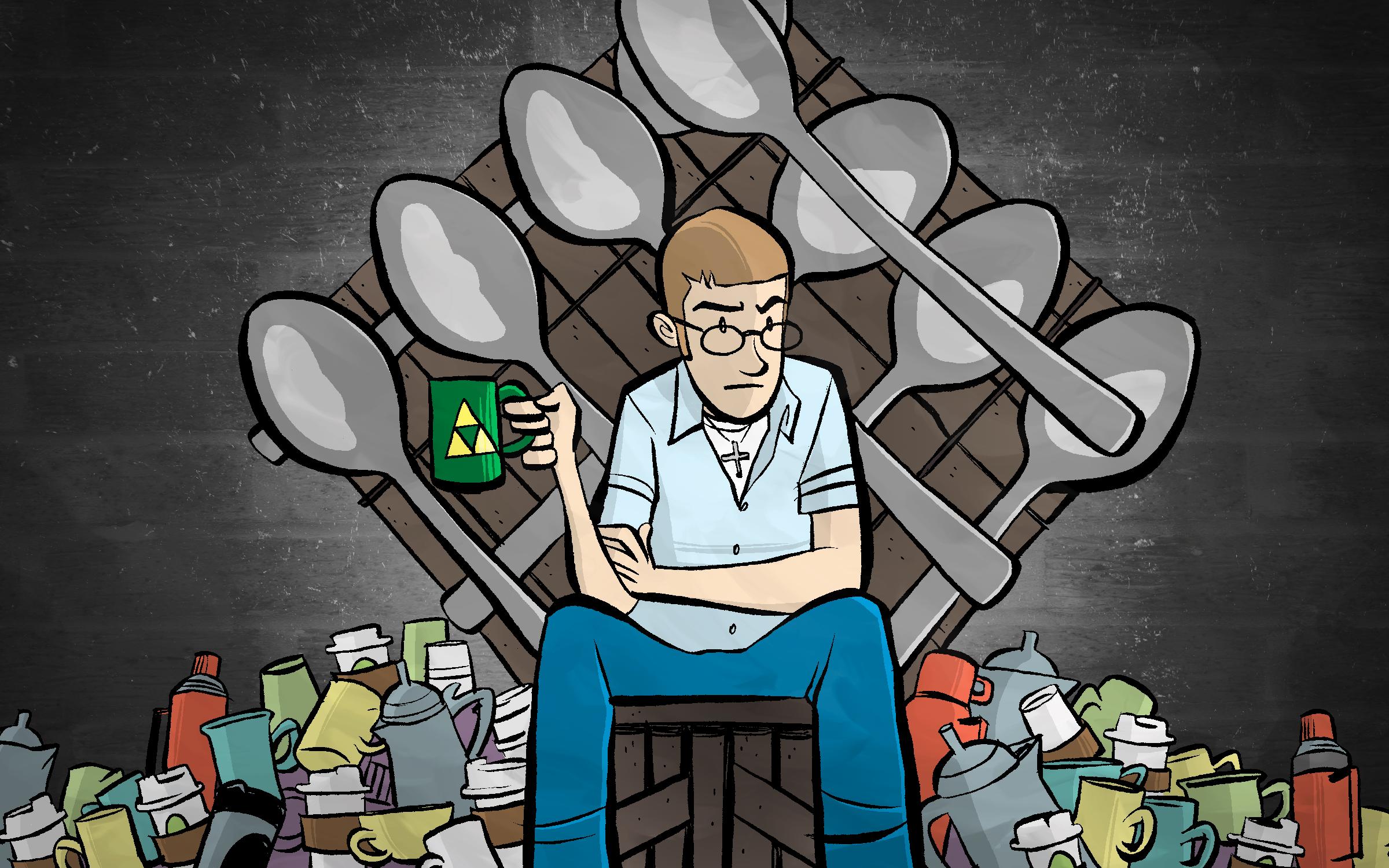
If anyone has ever wondered how I come up with ideas for this blog, the picture above tells the whole story: I sit and drink coffee and wait for something to happen. What can I say? Blogging is thirsty work.

(Due credit to the inimitable Wes Molebash for the splendid caricature, which has become my official Internet profile picture and a new banner for this blog.)

Today marks another milestone in the sunny existence of Typewriter Monkey Task Force: a blog fueled by coffee, sustained by geeky enthusiasm and buoyed by the support of loved ones. This blog has allowed me to share my passion for everything from God to tea to Tolkien. In good times and in bad, working on TMTF has brought me no end of satisfaction, comfort, encouragement, joy and pleasure. It has also given me the privilege of connecting with many fascinating, creative, generous people—writers, bloggers, artists and others—whom I would otherwise never have known.

In the two and a half years since starting this silly blog, I have gained a number of personal insights about life, the universe and everything. Today—as my typewriter monkeys and I celebrate this milestone with banana shakes and coffee, respectively—I’d like to share ten of the best lessons I’ve learned since TMTF began.

I must focus on today

I’m really good at brooding about the past, worrying about the future and generally thinking about all times but the present. God has given me today. Yesterday and tomorrow are in his hands, and I need to leave them there. My business isn’t to be burdened by worries or regrets, but to make the most of the time I have been given.

What matters is not what I feel, but what I do

For a long time, I made a simple assumption: If I felt bad, I was doing badly; if I felt good, I was doing well. I was wrong. Feelings are mostly beyond my control and largely unconnected to how well or badly I’m living my life. Depression isn’t proof of failure, nor does success does guarantee happiness. I should do my best under all circumstances, no matter what I feel.

I need sleep

I hate to say it, but I can’t shrug off sleep deprivation. Those late nights playing Ace Attorney or reading random Wikipedia articles seriously affect my concentration, mood and overall health. A long sleep can totally brighten my day; a short sleep can tip me over the brink into sickness or severe depression. In fact, I would go so far as to say sleep is almost as important as coffee.

Prayer and Scripture really, really make a difference

The past two years have taught me that prayer and Scripture are anchors. These commitments to God keep me rooted in my faith and focused on things that matter. When I quit praying and reading Scripture, I drift away from God. When I drift away from God, I become kind of a jerk. When I become kind of a jerk, everybody loses. Prayer and Scripture make an incredible difference in my life for good—even more than coffee, which is saying something.

I am not a great writer

I’m a pretty good writer, I think. Writing is one of my greatest talents, along with drinking coffee and having magnificent sideburns. I’m a good writer—but not a great one. When I was younger, I assumed my writing was brilliant. Working on this blog, failing to make The Eliot Papers a success and (above all) reading fantastic works by truly great writers have given me healthy doses of perspective and humility.

Things don’t fall apart

Heck, I wrote an entire post about this. No matter how I try to keep things together, I shall sometimes fail. It is well, then, that God is there to hold things together when my best efforts can’t keep them from falling apart.

I can’t fix people, but I can love them

If Doctor Who has taught me one thing, it is the importance of having epic sideburns. If the series has taught me a second thing, however, it is the value in simply showing kindness. “The way I see it, every life is a pile of good things and bad things,” the good Doctor reminds us. “The good things don’t always soften the bad things, but vice versa, the bad things don’t necessarily spoil the good things or make them unimportant.” The world is full of hurting people. I may not be able to take away their bad things, but nothing will ever prevent me from adding to their good ones.

I must be focused and intentional

It is so hard—so darn hard—to stay focused. I seem to live in a disorienting fog of distractions, diversions and complications. Depression and obsessive-compulsive impulses are only slightly greater obstacles to productivity than the Internet and its endless wealth of interesting articles and funny cat pictures. A useful, meaningful life doesn’t just happen. It takes intention, self-control and (in my case) a good deal of caffeine.

People are awesome

Human beings are amazing, awful, odd, ordinary, selfish, selfless creatures. In general, they’re pretty awesome. I’ve realized it’s worth getting to know people, and important to respect even those I don’t know.

I have good reasons for believing in God

When I began this blog, I felt conflicted about God and life and the universe in general. Many of my questions about God were unanswered. Some of them still are. It was while working on this blog that I reached a fundamentally important conclusion: I have my doubts about God and Christianity, but my evidence in their favor definitely outweighs my evidence against them. No worldview makes perfect sense to me, but Christianity makes the most sense.

Well, dear reader, thanks for reading this blog, putting up with our shenanigans and generally being awesome. My sincere thanks to everyone who has supported this blog, and to God for grace and coffee and stuff. Here’s to many more cheerful ramblings about faith, writing, video games, literature, life, the universe and everything!

248. The Problems of an Extrovert

Today’s post was written by Amy Green as a response to my introverted ramblings. For more great stuff from Amy, check out her previous guest post for TMTF and her blog The Monday Heretic, which covers such all-important subjects as God and bacon.

Hi, my name is Amy and I’m delighted to meet you and we probably have a lot in common that we should talk about for hours and hours.

Also, I’m an extrovert.

Like many extroverts, I need to be around people… but I don’t really know them.

Does that last part sound familiar? Maybe… exactly like what Adam said last week about introverts? That’s because it is. (I’m beginning to wonder if selfishness is the universal personality type.)

Of course, how this problem manifests itself is very different. Extroverts often struggle with having lots of somewhat shallow relationships. They wave to everyone they pass on campus, work the room at a company party, and seem to know everyone’s name at church.

That’s not a bad thing. There are many great things about being an extrovert. Extroverts often process verbally, meaning they think as they talk, so they seem to come to conclusions more quickly. They’re also often good leaders. And please, please do not tell me that extroverts aren’t capable of deep thought just because don’t give off the pensive philosopher air.

To be honest, society tends to gush over extroverts. Labels like “enthusiastic,” “assertive,” “generous,” and “sociable”—often applied to extroverts—seem much more positive than “thoughtful,” “introspective,” and “rational.”

However, sometimes that adjective-laden personality I haul into social situations is just a (slightly overwhelming) smokescreen. Sometimes when I’m in the middle of a monologue, I cringe because I know I’m talking over people, running them down like a conversational steamroller.

But I can’t stop because anything, anything would be better than silence.

In the silence, I have to face my doubts and inadequacies and fears about the future. The only person I have to talk to is myself, and sometimes I don’t really like myself.

But invite all of my friends over, and it’s okay. Because they all like me—see how much fun they’re having? So I must be likeable. I must be worth something.

But under every excited conversation, every party, every picture I post on Facebook of me with a dozen friends is the gnawing fear, “Please don’t abandon me to silence. Please don’t find out who I really am. Please don’t leave me.”

How can I love my neighbor as myself if I don’t love myself? And how can I love my neighbor when I’m constantly thinking about myself and how I’m being perceived?

This past year, I’ve learned to appreciate silence and have come to the conclusion that it’s not an enemy to attack with a barrage of words and jokes and laughter. It’s a way of choosing to believe I am worthy, even when I don’t feel like it, even without a constant stream of outside affirmation and approval.

I’m not saying that all extroverts struggle with putting up a façade for the rest of the world. But I have heard from many who admit it’s a significant problem.

Extroverts don’t have much trouble talking to people or meeting people or spending time with people—it gives us energy. But I think we have just as much trouble as introverts with loving people. That’s why God had to tell us over and over again to love each other. Because it’s hard and takes effort and none of us are good at it… but it’s important.

247. The Problems of an Introvert

I am an introvert. That said, go away. I wish to be left alone.

No, I didn’t mean it! Please come back!

Dash it, I didn’t mean to drive away my readers. Well, for those of you who haven’t left, I’ll admit being introverted isn’t a bad thing. Jesus Christ was an introvert. I scoff at the idea that introverts are broken extroverts. Some people simply enjoy being alone, and I’m one of them.

However, as an introvert, I often struggle to connect with people in a meaningful way. Sure, I’m amiable and polite. I get along just fine with coworkers and churchgoers and people at Wal-Mart. That’s not the problem at all.

The problem is that I don’t really know them.

It takes effort to get to know someone. Introverts don’t always enjoy getting to know people, so why make an effort? It’s much easier to be respectful and friendly, and then to go home to a cup of tea and a good book. This is a fine plan in the short term. In the long term, it leads to a life full of tea, packed with books and bereft of friends.

Making friends is hard, especially after high school and college. When something is hard, people generally feel disinclined to attempt it. For introverts, getting to know people is particularly exhausting.

This is why Facebook and other social media are so attractive to introverts. They require only brief visits and very little commitment. Facebook is convenient. It’s also shallow. Social media can enable deep discussions, but it’s mostly inundated with jokes and memes and rants and snippets of personal news. When I use social media, I feel like I’m standing in a crowd. I hear a little bit of everything from everyone, but meaningful conversations are difficult.

Facebook makes me feel connected because it gives me glimpses into the lives of people I love. I like a post here, leave a comment there and feel I’ve done my duty as a loyal friend. No need for emotional exhaustion: Facebook and Twitter bring relationships to the comfort of my armchair.

That’s the problem.

Facebook and Twitter are often blessings. Social media are wonderful way to keep in touch with people, hear their personal news and chuckle at their jokes. For introverts, however, social media can become a substitute for relationships or an excuse for not interacting with others. Social media may not be deep or meaningful, but they’re easy—certainly easier than meeting strangers, making commitments and spending time with people.

I never seem to have enough time, and I’m sometimes reluctant to spend it with others. People are exhausting. What I forget is that people are also awesome. More to the point, God has called me to love them. How can I love my neighbor when I don’t really know him?

As much as introverts struggle to relate to people, I’m sure extroverts have problems of their own. (Selfishly, I kind of hope they do; weakness loves company.) Check back next time for a guest’s thoughts on the problems of being an extrovert!

243. Solidarity Ends

Long ago, I had a teacher named Mr. Quiring: a dignified, solemn gentleman, like one of the Old Testament patriarchs without a beard, who taught upper-level high school English classes. His bookish manner belied a wicked sense of humor, which manifested itself in unexpected and unusual ways.

Mr. Quiring once pelted his students with Snickers bars—a rare treat in Ecuador—while bellowing “FEAST!” On another occasion, while explaining the infinitive form of verbs, he climbed onto a chair, leaped into the air and shouted, “To infinitives and beyond!” I will never forget the day he interrupted a discussion of ritual sacrifices in ancient Judaism to brandish a meat cleaver at me.

Besides his memorable jokes, I owe much to Mr. Quiring. He opened my eyes to the world of contemporary literature. Mr. Quiring also encouraged me to write a book for a contest, which won a college scholarship and motivated me to keep writing. Finally, it was Mr. Quiring who invited me to Solidarity and began to break my heart.

Solidarity was a weekly prayer meeting that met on Thursdays to focus on religious persecution. I was staggered to realize persecution isn’t a relic of bygone eras, but an ongoing tragedy. It is, in fact, a greater problem now than it has ever been.

In the years that followed, I started a prayer letter that highlighted persecution cases and offered suggestions on how to pray for the victims. I called the prayer letter Solidarity and sent it nearly every Thursday. Solidarity eventually transitioned from a prayer letter to a blog. A couple of years ago, I realized hardly anyone visited the blog, and so began updating it every two weeks instead of weekly.

For half a decade, Solidarity has existed in some form: a prayer letter, a blog, a fading hope that someone would care.

This week, after all these years, Solidarity ends.

I hate to let it go. The problem of persecution breaks my heart. I wanted to spread awareness and help people through the Solidarity blog, but I can’t keep spending hours every two weeks researching, writing and maintaining a blog no one reads. In past weeks, the blog published two posts, each representing hours of work—and received only one view.

I desperately want to help victims of religious persecution, to stand in solidarity with them, but I can’t invest so much time and effort in a project that makes no difference. Good intentions help no one. If nobody glances at the Solidarity blog, I can hardly justify keeping it.

My efforts seem to have failed, but I’m not bitter or angry. Solidarity was never a personal project, like The Eliot Papers or this blog. It was meant to be a ministry. It was meant to help people. I’m sad to see it end, and sorry it wasn’t very useful.

What next?

Solidarity may no longer exist as a blog, but I’ll use Twitter and Facebook every Thursday to share a single persecution case and request for prayer for its victims. I’ll keep up with news about religious persecution, and I’ll keep praying.

God bless you all!

241. Things Don’t Fall Apart

Things fall apart; the centre cannot hold;
Mere anarchy is loosed upon the world.

~ William Butler Yeats

In these few well-chosen words, Mr. Yeats neatly sums up one of my greatest fears: things falling apart.

A few weeks ago, I was sick. I think it was a cold. It felt like ebola virus disease. I spent days shuffling around my apartment in a fevered delirium, coughing painfully and waiting for the sweet relief I assumed only death could bring. My younger brother generously made me hot chocolate and compassionately refrained from smacking me every time I whined about how awful I felt.

At the same time as my sickness, and probably for the same reasons, I had a bout with really severe depression. For my readers who’ve suffered depression—I’m sorry. I’m so, so sorry. For my readers who haven’t suffered depression, you probably have no idea how blessed you are. Depression sucks. I’m not sure I can overstate this. Depression sucks.

The worst part of all this wasn’t the fever, the fatigue or even the bleak hopelessness.

The worst part was the helplessness.

The prospect of going back to work was terrifying. Hang it, the mere thought of leaving my apartment scared me. I couldn’t make any progress on this blog, and wondered why the ruddy heck I ever thought having a blog was a good idea in the first place. It felt like there was nothing good, useful or meaningful I could possibly do. I was reduced to a shadow of myself, and I was sure it was only a matter of time before things fell apart.

Things didn’t fall apart.

They never do.

As usual, I survived. I took some time off work, took a break from this blog and drank a lot of tea. With God’s help, I made it.

The Apostle Paul had a lot to say about suffering. I admire Paul very much, I suppose because he’s so darn sensible. Books like 1 John are full of baffling statements echoed endlessly. Revelation is full of incomprehensible visions. The Bible is packed with vague poetry and dense theology… and then there’s dear, simple, sensible Paul. I wish he were still around, so that I could hug him.

As I was reading the first chapter of Paul’s second letter to the Corinthians, I was arrested by the following words.

We were under great pressure, far beyond our ability to endure, so that we despaired of life itself. Indeed, we felt we had received the sentence of death. But this happened that we might not rely on ourselves but on God, who raises the dead. He has delivered us from such a deadly peril, and he will deliver us again. On him we have set our hope that he will continue to deliver us.

A few weeks ago, I felt as pleasant and cheerful as death.

It is well, then, that my God is the God who raises the dead.

I’m not sure why I had to spend days being utterly miserable and absolutely useless. Perhaps it was to remind me of two things.

First, I’m not in control.

Second, God is.

I may not be able to hold things together, but God will always be there to keep them from falling apart.

237. Three Great Novels About the Silence of God

I could write pages about the silence of God, but it would all boil down to just a few words.

I don’t get it, and it troubles me.

Some of my doubts and questions about the Christian faith have been resolved. Some have not. Why does God let kids get hurt? Why does he allow us to make innocent mistakes? Why does he permit headaches and cockroaches and Fifty Shades of Grey to exist? Why, God? Why?

Yes, I know about sin and death and the fall of humankind. I know, darn it! Those things still don’t explain why God doesn’t, well, explain. Couldn’t he at least make his existence more clearly known? It seems unfair for God to penalize people for failing to believe in him when he seems intangible, invisible and… silent.

I don’t know why God remains silent. In the end, I believe because my evidence for God outweighs my evidence against him. There remain dark doubts and unanswered questions.

Since I don’t have any answers regarding the silence of God, here are what three great novels have to say upon the subject.

Be ye warned: Here there be spoilers for SilenceThe Chosen and The Man Who Was Thursday.

The Man Who Was Thursday by G.K. Chesterton

The Man Who Was ThursdayThe Man Who Is Thursday is the exciting tale of Gabriel Syme, a poet-turned-detective, and his attempts to stop a band of nihilistic terrorists. There’s a sword duel, and some thrilling chases, and at least one good discussion of poetry.

The novel takes a turn for the surreal in its final chapters, in which Syme and his companions realize their elaborate intrigues against the terrorist organization were actually orchestrated by its leader, the enigmatic man known only as Sunday.

Syme and his friends demand to know why Sunday, who is apparently not an evil man, allowed them to suffer so much pain and fear in their pursuit of him. One of Syme’s companions says, with the simplicity of a child, “I wish I knew why I was hurt so much.”

Sunday does not reply.

The silence is broken by the only sincere member of the nihilist organization, who accuses Syme of apathy and ignorance. It is then Syme realizes that his pain qualifies him to refute all accusations. He and his friends suffered by Sunday’s silence. No matter how wretched or tormented their accuser, the agonies they endured bought them the right to reply, “We also have suffered.”

The Chosen by Chaim Potok

The Chosen

The Chosen tells the story of two young Orthodox Jews in New York during the final years of World War II. During a baseball game, Reuven Malter meets a gifted student named Danny Saunders. They become friends, despite their dissimilar cultures and upbringings within the Orthodox Jewish community.

Reuven is astonished to learn Danny’s father, Reb Saunders, speaks to him only during religious discussions. At other times, Reb Saunders says nothing to his son. This cold silence baffles Danny and Reuven. What kind of father refuses to talk with his children?

The novel follows Danny and Reuven as they grow up and progress in their studies. In the wider world, the horrors of the Holocaust are revealed and Jews fight for the restoration of Israel as a nation. At last, as young men, Danny and Reuven learn the truth behind the silence of Reb Saunders.

Reb Saunders knew his son’s intelligence outweighed his concern for others. In order to teach Danny compassion, Reb Saunders distanced himself from his son. Silence, he hoped, would give Danny an understanding of pain and a greater empathy toward other people.

Danny had learned compassion, and so the silence was broken. Speaking of Reb Saunders, Danny tells Reuben at the end of the novel, “We talk now.”

Silence by Shusaku Endo

Silence

This is it: the definitive novel about the silence of God. Heck, the book is even titled Silence. This gloomy masterpiece tells of Sebastião Rodrigues, a Portuguese Jesuit sent to seventeenth-century Japan. He hopes to encourage the tiny population of Japanese Christians, and is willing to die for his mission.

What he doesn’t expect is to watch others die for his mission. When he is captured by Japanese authorities, Rodrigues is not martyred. Instead, he watches as the authorities martyr other Christians because of his religion. Rodrigues expected to suffer for his faith. He did not imagine he would cause others to suffer for it.

In this darkness and brutality, God says nothing. There is only silence.

At last, as Rodrigues recants his faith to spare the lives of other Christians, the image of Christ he is forced to trample seems to break the silence: “Trample! Trample! I more than anyone know of the pain in your foot. Trample! It was to be trampled on by men that I was born into this world. It was to share men’s pain that I carried my cross.”

For me, this is the most powerful answer in these three novels to the question of God’s silence. God may seem silent, but he has shattered the silence once for all with a single word—rather, a single Word: the Word who became flesh and made his dwelling among us. Whatever the sufferings in this world, Jesus shared them. However little God may seem to say to us now, Jesus said plenty.

Do I understand the silence of God? No. I do, however, find great comfort in these books, which offer tentative answers to a great and terrible question.

230. Advent Conspiracy Is Back!

It’s that time of year again.

Yes, stores are selling, television specials are showing, cynics are sneering and a handful of awesome, crazy people are conspiring to save lives.

I don’t like churchy videos, but this one made such an impression on me years ago that I’ve shared it every Christmas season since. Watch it. I’ll wait for you.

Here are the facts.

1. Americans spend $450 billion on Christmas every year.

2. Lack of clean water kills more people every day than almost anything else on Earth.

3. The estimated cost to make clean water available to everyone on Earth is about $20 billion—roughly 4.5% of how much Americans spend on Christmas every single year.

The Advent Conspiracy is a resolution to spend less on stuff and more on people. Of course, buying Christmas gifts isn’t wrong. (I definitely have some holiday shopping planned.) The purpose of the Advent Conspiracy isn’t to stop spending money, but to spend it meaningfully.

Advent Conspiracy

Let’s face it—thirsty people need clean water more than we need Christmas presents.

The Advent Conspiracy is dedicated to providing clean water, but its principles can be applied to other good causes. The hungry, homeless and brokenhearted need our money as much as the thirsty. Where we give doesn’t matter as much as whether we give.

This Christmas, we can rescue people from poverty, thirst and sickness. This Christmas, we can change the world—or we can buy more stuff.

Let’s change the world.

More information about the Advent Conspiracy can be found here.

Happy Christmas!