42. The Advent Conspiracy

The Christmas season is upon us. The northern hemisphere freezes in the icy grip of winter; the southern hemisphere basks in summer sunlight. Both hemispheres are lavishly decorated with colored lights, Christmas trees and Coca-Cola advertisements. It’s a time for cookies and carols. It’s also a time for commercialism—a time for us cynics to sneer and say “Bah, humbug!”

I have mixed feelings about Christmas. I enjoy the traditions, the nostalgia, the delicious food, the beautiful lights, the exciting gifts and some of the music. I despise the unapologetic, matter-of-fact way companies use the holiday to make money. I’m also pained by the growing superficiality of Christmas. The birth of Christ has become an afterthought.

Nietzsche informed us that God is dead. I disagree, but suspect Christmas might be dying—slowly passing away in a blaze of colored lights and cacophony of seasonal music.

Many people are appalled at what the holiday of Christmas is becoming. Fortunately, some of them have decided to do something about it.

I’m always slightly wary of humanitarian organizations—it’s hard not to be a little suspicious of people who ask politely for your money and offer nothing tangible in return. The truth, however, is that most humanitarian organizations are doing amazing things to help people all over the world.

One of my favorite humanitarian organizations is Living Water International, which for several years has been guilty of a conspiracy, a conspiracy founded upon three simple facts.

1. Americans spend $450 billion on Christmas every year. Four hundred fifty billion dollars. Every year. That’s a lot of money.

2. Lack of clean water kills more people every day than almost anything else.

3. The estimated cost to make clean water available to everyone on Earth is about $20 billion. Yes, that is about 4.5% of how much money Americans spend on Christmas every year.

These are the facts. What do we do with them?

Enter the Advent Conspiracy.
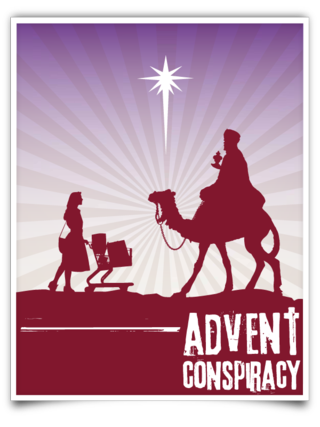
The Advent Conspiracy is an initiative meant to raise as much money as possible to supply clean water to everyone on Earth, regardless of their geographical location, culture, race, ethnicity, religion or sexual orientation. How is that money raised? Well, people are encouraged to spend less money on Christmas—for example, making gifts or decorations instead of buying them—and giving what would have been spent on the holiday to the Advent Conspiracy.

This is something big. It’s something heroic and awesome and way better than buying stuff that will spend 99.97% of its existence gathering dust on a shelf or in a closet. It takes a little self-sacrifice, true, but it changes the world. The coffee mug or DVD or fancy shoes you choose not to buy becomes safe, pure water for one or three or ten people for the rest of their lives.

I don’t usually like churchy videos, but this one about the Advent Conspiracy is pretty cool.

More information about the Advent Conspiracy can be found here.

Have a wonderful, warm, meaningful, exciting Christmas season!

A note for those who are wondering about the fate of my typewriter monkeys: The airport administrators assure me that my monkeys are on their way to Montevideo and should arrive within a few days. I think they’re currently somewhere over the Indian Ocean at this moment. They had better get back soon. Typing out these posts myself is hard work.

39. Coffee (and Other Things for Which I’m Thankful)

I’m thankful for coffee. I think there may actually have been three trees in the Garden of Eden—the Tree of the Knowledge of Good and Evil, the Tree of Life and the Coffee Tree—and God in his mercy allowed Adam and Eve to enjoy the Coffee Tree even after they had forfeited their right to the others.

All right, that apocryphal bit of Bible trivia is completely fictitious. Probably. Even so, coffee is a blessing of God and something for which I’m very thankful. It’s not the only thing. There are a lot of things for which I thank God. Since tomorrow is Thanksgiving, this seems like a good time to mention a few of them.

I’m thankful for my friends, who brighten my existence.

I’m thankful for tea, which is every bit as heavenly and delicious as coffee.

I’m thankful for Bethel College and the financial aid that has allowed me to graduate.

I’m thankful for J.R.R. Tolkien, C.S. Lewis, G.K. Chesterton and all the other wonderful authors whose first and middle names are always initialed.

I’m thankful for the daily necessities of life, which God has never failed to provide for me.

I’m thankful for storytelling and creative writing, without which life wouldn’t be one half so interesting.

I’m thankful for humor, without which life wouldn’t be one half so tolerable.

I’m thankful for my family and relatives, who have put up with me patiently for more than twenty-one years.

I’m thankful for a God who makes things right.

For what are you thankful? Let us know in the comments!

34. About Solidarity

When I was in high school, I had a teacher named Mr. Quiring. He was a dignified, solemn gentleman, like one of the Old Testament patriarchs without a beard, who taught upper-level English classes. It took me a few months to realize that he had a wicked sense of humor, which he expressed in short, intense bursts. He was the teacher who, during a lesson about the infinitive form of verbs, leapt from a chair and shouted, “To infinitives and beyond!

I owe Mr. Quiring a good deal. He was part of my inspiration to study English Education. He introduced me to much of literature. He encouraged me to participate in a writing competition in which I later earned first place, earning a college scholarship and some prize money. (I only competed because Mr. Quiring offered automatic As to any of his students who participated—I never imagined I would actually win the competition!)

Although I knew him for only two years, Mr. Quiring did more than almost anyone else in the world to guide and inspire me.

There was one other way in which Mr. Quiring influenced me. He led a prayer ministry called Solidarity every Thursday that prayed for the persecuted Church: Christians who are mistreated because of their faith in Christ.

When I first heard about Solidarity, I was pretty skeptical. Sure, Christians were tossed to lions and murdered by gladiators nineteen centuries ago, but they’re not persecuted in our modern, civilized age.

Are they?

I began attending Solidarity. Every week, Mr. Quiring would distribute copies of news reports, and we would read—in shocked, saddened silence we would read.

Christians are persecuted.

Christians are mocked, marginalized, robbed, raped, tortured, arrested, imprisoned and killed, simply because they’ve chosen to follow Jesus.

It seemed vague and uninteresting to me at first. True, people are being persecuted halfway across the world. How does that have to do with me?

It took time, but I gradually realized three things.

First, persecuted Christians are real people. They may seem unreal, like characters in novels or extras in movies, but persecuted Christians are living human beings with hopes, fears, plans, dreams and quirks.

Second, the problem of persecution isn’t going to go away if we ignore it. I’m ashamed to say it, but I’m really good at pretending problems don’t exist. They do exist, and something needs to be done about them.

Third, and hardest to accept, Christians are supposed to help each other. Christians in America are supposed to help Christians in the rest of the world. We’re not somehow exempt from this responsibility. We might not be able to go personally to visit imprisoned pastors in China or grieving widows in Somalia, but we can sometimes give money—and we can always pray. Even if we don’t have two pennies to rub together, we can pray for those who are persecuted.

We shouldn’t pray for persecuted Christians to make ourselves feel more righteous or less guilty. We should pray for persecuted Christians because they need our prayers. To be more precise, they need God’s answers to our prayers.

I have another blog, titled Solidarity in memory of Mr. Quiring’s prayer ministry, that posts brief summaries of persecution cases every two weeks, along with links to the news sources and suggestions on how to pray for the victims. Solidarity is meant to be an easy, practical way to stay informed and to pray.

If you’re a follower of Christ, please consider checking out the Solidarity blog and praying for the victims whose cases it reports every two weeks.

God bless you!

31. The Art of Blundering Hopefully

I like gloomy characters. Well, I like gloomy fictional characters; gloomy characters aren’t nearly as likable in real life as they are in fiction. There’s something strangely endearing about pessimists and their pessimism, so long as I don’t have to deal with them personally.

Puddleglum from C.S. Lewis’s The Silver Chair is one of my favorites. “Good morning Guests,” he says to the protagonists after they spend the night in his home. “Though when I say good I don’t mean it won’t probably turn to rain or it might be snow, or fog, or thunder. You didn’t get any sleep, I daresay.”

Then there’s Marvin the Paranoid Android from The Hitchhiker’s Guide to the Galaxy by Douglas Adams, and Eeyore from the Winnie-the-Pooh books by A.A. Milne, and Bernard Walton from the Adventures in Odyssey radio series, and a dozen more delightfully depressing characters from all sorts of stories.

The problem with pessimism is that it’s not nearly so pleasant in real life. It’s difficult to put up with pessimists—and it’s much worse to be a pessimist.

Some time ago I realized something important. (I was actually going to write about it weeks ago, but decided not to post too many serious reflections in a row.) What I realized was simple—so simple I couldn’t believe I had overlooked it for so long.

I had become a pessimist. Not a nice, lovable pessimist like Puddleglum or Eeyore, but a genuine, depressed pessimist.

I suspect my long, dark Thursday Afternoon of the Soul, a year and a half of intense depression and anxiety, had conditioned me to expect only the worst. I expected the worst from myself, wrestling with insecurity and self-doubt. I expected the worst from life, living in anxiety of whatever difficulties lay ahead. I expected the worst from God, struggling to believe he could really be as gracious, loving and generous as he claims. Every trial confirmed my belief that life was a dreary business, and every blessing made me suspect there were strings attached.

Since recognizing my tendency toward pessimism, I’ve been working to perfect the fine art of blundering hopefully.

We don’t have to live in perpetual fear of the future. It holds difficulties, true, but it also holds blessings. It’s certainly no good worrying about the difficulties. We can only deal with them as they come. In the meantime our business is to trust God and do our best: believing that his grace is greater than our mistakes, trusting that he will walk with us through our difficulties, holding on to his promise that his love endures forever—to wit, blundering hopefully.

So I’m doing my best not to burden myself with guilt for past mistakes or live in fear of future ones. By faith I blunder onward, trusting that God’s grace is sufficient for me.

God’s grace is sufficient for you too, in case you were wondering.

29. The Turnspike Emails: Halloween

The practice of intercepting diabolical correspondence was made famous by C.S. Lewis, who published under the title The Screwtape Letters a collection of missives from the demon Screwtape to his nephew Wormwood. The publication (by humans) of diabolical correspondence actually has its roots in earlier centuries; an example can be found in Letters from Hell, a series of epistles from a damned soul, collected and published by Valdemar Adolph Thisted in the nineteenth century. The following letter—or email, to be precise—purports to be from the demon Turnspike to his colleague Goreflak. Due to the sensitive nature of the material in this email, TMTF cannot release further information concerning the method by which it was obtained.*

My dear Goreflak,

Your ignorance is appalling. When I read your last email I could not help but cringe at your evaluation of the holiday the humans call Halloween. It is not an occasion for supernatural activity, as you seem to think—at least not typically. You young devils are all the same, eager for sensational witchcraft and spectacular sinfulness, when our most effective work is much subtler.

We seldom use human-possession or dark magic anymore. Have you failed to see the problem of manifesting our power in supernatural ways? Imagine for a moment that you are an atheist in America. What would you think if you witnessed a table lift itself in the air and spin around, or a demon-possessed person speaking in a tongue? It would be dashed hard to remain an atheist!

We were able to get away with sensational displays of power in antiquity because pagans readily acknowledged the existence of the supernatural. But in these days, when faith of any kind is becoming less common, to commit ourselves to any sort of overt supernatural activity is to give ourselves away.

Do not make the mistake of thinking that we have forgotten Halloween. By no means! My dear devil, Halloween is one of our great triumphs.

First, we have made the humans numb to the very idea of the darker side of the supernatural. They dress up as witches and go begging for candy; they make ghosts out of tissue paper; they bake cookies in the shape of vampires. Every kind of ghoul and devil, from the foulest phantom of their imaginations to the evilest demon of our own kind, is made innocent, even cute, by the holiday of Halloween.

Second, we have managed to eclipse All Saints’ Day. This wretched holiday was before your time, my dear devil, so you are probably unfamiliar with it. All Saints’ Day was a celebration of the Enemy’s most valuable servants, those vile men and women known vulgarly as saints, whose lives were abhorrent to Our Father Below. Year after year the Enemy’s people celebrated dangerous fools like Paul and Augustine and Patrick, until we could no longer allow it. We began to exaggerate Halloween, the day before All Saints’ Day, in an effort to draw attention from the Enemy’s saints to the specters of our own kind. We were utterly successful. The saints of All Saints’ Day are largely forgotten, while the monsters and demons of Halloween are celebrated year after year.

Third, and finally, Halloween has become a celebration of consumerism and commercialism: two behaviors Our Father encourages among the humans. Millions of dollars are spent on candy and decorations and all the multifarious paraphernalia associated with the holiday. Halloween has also become an occasion for horror movies, Our Father’s contribution to the medium the humans call filmmaking. Some of the films released around Halloween are quite delicious. Nothing amuses me quite like watching humans be ripped apart in the Saw films.

You asked in your last email whether there were anything inherently evil in Halloween. The answer, I regret to inform you, is no. Many humans celebrate the holiday—costumes, candy, decorations and all—and manage to enjoy precisely those things we dislike: innocent fun, loving fellowship and benevolent generosity. Halloween is, however, a holiday more easily twisted to our purposes than, let us say, Christmas. (We are making excellent progress with Christmas, but I will save my thoughts upon the subject for another email.) Do not assume Halloween automatically corrupts human beings, my dear devil. It is up to you to make sure it does.

On an unrelated note, I am very glad the Head of our department has finally authorized use of the Internet for correspondence between demons. Emails are so much more convenient than parchment and blood.

I trust you are making good progress with your Patient, and expect a full report as soon as possible.

Your affectionate colleague,

Turnspike

*For the record: This email is completely fictitious, as are The Screwtape Letters and Letters from Hell. Demons do not really send emails; at least, not of that we know.

28. The Bend in the Road

I really like Anne of Green Gables. Although I don’t usually enjoy sentimental stories about little girls growing up, there’s something about the book that strikes a chord with me. It could be that Anne Shirley (whose first name must never be spelled without the e) and her friend Matthew Cuthbert are delightful characters. It could be that Anne of Green Gables paints a beautiful picture of a simpler time, a time without Facebook or cell phones, when people took time to talk to each other and read books for the fun of it.

Whatever the reason, Anne of Green Gables is a favorite of mine.

One of my favorite moments in the book comes in one of the final chapters. Anne’s future plans, which had seemed so certain, are suddenly thrown into serious question. Rather than give up in despair, Anne decides to regard her misfortune as an adventure: “My future seemed to stretch out before me like a straight road. I thought I could see along it for many a milestone. Now there is a bend in it. I don’t know what lies around the bend, but I’m going to believe that the best does.”

My own plans for Life After College were pretty straightforward until a few months ago. I was going to apply for a job at my old high school in Ecuador, teach English and write novels until retiring and settling in California or Florida. Everything was neatly planned, and I didn’t doubt for a moment that things would work out precisely as I wanted them to.

Then my application to the high school was turned down. My future plans were no longer crystal clear, unless that crystal happened to be an especially foggy variety of quartz. I was discouraged for a little while, but it finally occurred to me that not knowing exactly what the future holds is kind of exciting. Terrifying, yes, but also kind of exciting.

I’ve been student teaching for the last eleven weeks, struggling to survive grading, lesson planning, sleep deprivation, faculty meetings, miscellaneous paperwork and the actual business of standing in front of students and teaching them things. It was like walking through thick fog: it was hard to see far behind or ahead, to think about the past or speculate about the future. Day by day all I could see was the road right in front of me.

Yesterday was my last day of student teaching. I’ve a few weeks of seminars and paperwork and whatnot, but I’m almost done with college. It was a little strange to emerge from the fog of student teaching and realize there’s still a long road ahead of me. Like Anne Shirley’s road, it isn’t straight. There’s a bend in it, and I haven’t the slightest idea of what’s waiting for me beyond it.

But I’m not worried. The Lord has led me this far, and I know he will continue to lead me to wherever he wants me to be. As the old hymn says, ’tis grace that brought me safe thus far and grace will lead me home.

I just hope there are coffee shops along the way.

A note for those who know me personally and are wondering what my immediate plans are: I will be leaving Bethel College toward the end of November and staying with my parents and younger brother in Uruguay. I intend to search for a teaching position in South America, work seriously on a couple of novels, improve my Spanish, drink lots of coffee and spend time with my beloved family.

26. A Lesson from My Students

My monkeys and I now have a Twitter account. I suppose it was only a matter of time. Is it possible to tweet using typewriters?

I’m just a week away from finishing student teaching. I still have a few weeks of paperwork and seminars and whatnot, but seven days from this moment I’ll have finished my work in the classroom. The last ten weeks have been stressful, rewarding, exhausting and interesting.

Especially interesting has been my time with the MEC students, kids whom the school considers at-risk—in danger of dropping out of classes due to misbehavior or failing grades. I felt rather apprehensive about working with at-risk kids, but some of them turned out to be pretty awesome. Granted, others turned out not to be awesome at all. Most of them fell somewhere in between, alternating between diligence and laziness, respect and disrespect, cooperation and insubordination.

Friday was my last day in the MEC classroom; in the week to come I’ll be phasing out of my other classes. I was reflecting upon my time with the MEC students, and it occurred to me that working with at-risk students presented two major frustrations.

First was when the MEC students refused to accept the consequences of their actions. They would break a rule half a dozen times, ignoring all warnings, and whine about the unfairness of it all when they finally received the penalty for their misbehavior.

Second was when the MEC students complained about school: it was boring to read a short story, stupid to learn vocabulary instead of playing games on the computer, impossible to sit and work quietly for forty-five minutes. No matter how often we tried to explain that school is not pointless, that they need a high school diploma to qualify for most jobs, that they can’t spend the rest of their lives living with their parents and playing video games—in short, that school is actually meant to help them—they wouldn’t listen.

It would be pretty easy to judge the MEC students, except for one little point. It occurred to me a day or two ago that I do the exact same thing.

If I have a bad day, I tend to feel put upon. I wonder grumpily why God lets unpleasant things happen to me. What I forget is that many of those unpleasant things are the consequences of my own mistakes, and many more of those unpleasant things are actually helping me in the long run. Yes, I might feel tired and unfocused all day, but it’s because I was up so late the night before watching trailers on YouTube. True, I might be totally worn out by a rough day of student teaching, but it’s teaching me to handle the responsibilities of being an English teacher.

Not all bad things are the result of my own mistakes, but some are. Not all bad things are part of the painful process by which God makes me a better person, but some are. Instead of grumbling and groaning and griping, I need to endure patiently.

That’s a lesson from my at-risk students, and a lesson I hope they can learn too.

24. Cleaning Out Your Bible

Today’s post was written by my friend Robby Rasbaugh, renowned at Bethel College for his awesome hair and love for people. Check out his blog for profound and humorous insights into life at Bethel College, IN!

I fondly remember my pilgrimage to Israel a few summers ago with Bethel College, IN. I got the rare opportunity to climb sacred mountains, swim in the Sea of Galilee, walk the same trails that Jesus walked, and eat an authentic Israeli falafel, which I highly recommend (the falafel as well as the Israel experience).

Throughout the expedition, our group encountered a few live archeology sites. You could see the archaeologists hard at work, carefully excavating the dirt, examining the terrain, and measuring and documenting everything. A lot of historic artifacts, left intact for thousands of years and untouched by human hands, were finally discovered and used to learn more about ancient civilization.

If I wanted to, I could turn this into a beautifully woven sermon illustration about how if you dig deep enough into God’s Word, you’ll discover hidden treasures of deep insight and unfathomable knowledge. I could go on about how through careful study and examination of the Scriptures, you can unearth nuggets of profound truth for your spiritual life. But that’s a post for another day. I’m talking about cleaning out your Bible. Because over time, the average Christian’s Bible accumulates a certain amount of junk, transforming it into a holy time capsule littered with hidden artifacts from your spiritual past.

Here are the top three things Bible veterans are most likely to find hiding in their Bibles when they do choose to do a little excavation.

Ancient Church Bulletins

For some reason, you felt compelled on a certain obscure Sunday three years ago to stick the bulletin in the pocket of your Bible cover. There really was no significance tied to that Sunday. It was just like any other Sunday bulletin where you only sketched in half of the sermon fill-in-the-blanks before giving up, but did a good job at filling in all the os and bs and other bubble letters. Even with all the clues in the ancient bulletin, there’s not a chance in Sheol that you’ll be able to remember what your pastor spoke about that Sunday. Yet it is probably safe to assume that your church praise team did “Mighty to Save” for worship that day, considering that song was all the rage back in 2008. [Sniff] Sorry, I just had a moment of nostalgia.

Jesus Bookmarks

Maybe it features the Ten Commandments chiseled on stone tablets and embellished with lightning bolts. Maybe it has a Christian acronym that was totally rad in the 90s, like W.W.J.D. or F.R.O.G. Maybe it’s in the shape of a cross with an inspirational verse and dark clouds eclipsing brilliant rays of sunshine. No matter what it looks like, the question remains: How did this elusive Jesus bookmark stay hidden in your Bible for so long? It probably got buried in the Minor Prophets years ago, deep in the neglected part of your Bible somewhere near Habakkuk (which is a great book by the way).

Money

Am I the only one who does this? Do other Christians ever hide money in their Bibles with the intention of forgetting it’s there and finding it later? In the past, I know I’ve surreptitiously tucked a few bucks in my Bible, secretly wishing that God would multiply them when I wasn’t looking; that my money would grow thirty, sixty or a hundredfold what was sown, and that I would discover it in a season of need and praise God from whom all blessings flow.

What about you? What do you find when you clean out your Bible? Let us know in the comments!

19. So, Um… What Do You Think Being a Hero Is All About?

I don’t generally search for profound wisdom in webcomics—especially not webcomics about video games.

Imagine my surprise, then, when I was reading my favorite webcomic way back in March and realized its writer had stumbled upon pretty much the most important lesson ever.

Brawl in the Family is a delightful webcomic by a couple of guys named Matt and Chris. It’s a funny, quirky take on video game characters, and I think it’s pretty awesome.

In one comic, two teachers are asked by their students, “So, um…what do you think being a hero is all about?”

The first teacher, a villain, replies, “Well, to put it simply: ambition.” He adds, “Remember, you are capable of great things.”

The second teacher, a kindly gentleman, replies, “Well, to put it simply: sacrifice.” He adds, “It is not about you. It is about everyone else.”

It is not about you. It is about everyone else.

I happen to be student teaching at the moment, and it’s so easy to become centered on myself. I have to survive the stress of teaching classes and grading papers. I have to keep up with the paperwork for my college’s Education Department. I have to be a good teacher.

It’s also so easy to become self-centered in regard to my writing. I want to become a successful novelist. I want to have a great blog. I want my writing to be excellent.

I is such a little word, but it represents so much. Ambition. Dreams of glory. Delusions of grandeur.

I’m ashamed to say it, but I become self-centered. Then things happen that jerk me back to reality. One of those things happened yesterday.

Yesterday we held parent/teacher conferences at my school. My supervising teacher and I had been assigned to hold conferences with the parents of our MEC students. The MEC students are the at-risk kids, the kids with low grades and behavior problems—the kids in danger of being expelled. For nearly eight hours, my supervising teacher, other teachers and I held conference after conference with the parents and guardians of our students.

Some of these parents and guardians were bright, cheerful and polite. Some were not. One came in with whiskey on her breath. Another came uncomfortably close to exploding into a fit of rage. Almost all of them told us directly or indirectly that they didn’t have much control over their kids, and a few of them maintained an attitude of nonchalance.

They didn’t seem to care that their children were failing classes or causing trouble. One mother was obviously in denial that her son is a borderline sociopath. Another mother cheerfully admitted to being aware of the fact her son smokes marijuana.

It was tragic. It was also very convicting. These are the students with whom I work almost every day—and I get so wrapped up in my plans and ambitions and personal projects that I forget how much my students need a loving, patient, diligent teacher.

It is not about me. It is about everyone else.

Jesus said the same thing when someone asked him about the great commandments—God’s greatest charge to humankind—the ultimate meaning of human life. Jesus replied, “‘Love the Lord your God with all your heart and with all your soul and with all your mind.’ This is the first and greatest commandment. And the second is like it: ‘Love your neighbor as yourself.’”

Webcomics, even webcomics about video games, can impart great wisdom.

It is not about you. It is about everyone else.

17. Rampant and Irresponsible Capitalization

Christians like to capitalize things.

Don’t believe me? Let’s have a bet. Wait, we probably shouldn’t gamble about something related to Christianity. (I’m pretty sure there’s a passage in Hebrews that forbids gambling about religion.) How about I dare you instead of placing a bet? All right, I dare you to go to church next Sunday and see how many Christian words are capitalized.

A lot of people—even some non-Christians—capitalize divine pronouns (pronouns used to refer to God) in order to show reverence or respect. C.S Lewis, a man for whom I have utmost admiration, capitalized divine pronouns. He also capitalized Heaven and Hell because they are places, like London or New York City, and should therefore be capitalized as proper nouns.

C.S. Lewis was consistent in his capitalizations and could give good reasons for them. It seems many people, however, are guilty of rampant and irresponsible capitalization. I may just be cynical, and I’m definitely a literary snob, but it seems sometimes as though American Christians capitalize words related to Christianity just to make them seem holier.

For example, hymns and worship songs never refer to God and his mercy. It’s evidently more holy to capitalize the divine pronoun and refer to God and His mercy. And if we capitalize mercy, which is a divine attribute, it makes the hymn or worship song even holier. I mean, God and His Mercy is clearly holier than God and his mercy, isn’t it?

So sermons are full of Grace, Goodness, Predestination, Prophecy, Agape, Apostles, Epistles, Pre-Millennialism, Mid-Millennialism, Post-Millennialism and the Millennium Falcon. All right, maybe not that last one. At least not in any sermons I’ve heard.

Anyway, there have come to be so many capitalizations that capitalization is becoming meaningless.

If a word is capitalized, there should be a good reason for it. I capitalize Gospel to distinguish the good news of Jesus Christ from the music genre. I capitalize Church to set apart the worldwide community of God’s people from the fancy building down the street. I capitalize Prophets to differentiate between a section of the Old Testament and the plural form of a common noun.

Unlike C.S. Lewis, I don’t capitalize heaven or hell or divine pronouns. There’s absolutely nothing wrong with capitalizing these words, but it doesn’t seem necessary. I don’t think God cares much about capitalization. He cares more about love and obedience and mercy.

Should divine pronouns and spiritual words be capitalized? Should there be more sermons about the Millennium Falcon? Let us know in the comments!