157. I Am Not a Jedi

I am not a Buddhist, Muslim, Hindu, Sikh, Rastafarian, Pastafarian, Shintoist or Jedi.

(Jediism is apparently a minor modern religion. Who knew?)

I feel obliged to reaffirm my faith in Christ because I recently replaced Christianity with Faith in this blog’s tagline. Christianity is a pleasantly specific word. Faith is vague, generic and ambiguous. It can be used to describe almost anything.

Honestly, I rather like Christianity. It’s a splendid word.

Why the change?

Well, Christianity is quite a mouthful. Seriously, it has five syllables. Replacing it with a shorter word like Faith makes for a catchier tagline.

More significantly, I once pointed out that Christianity has taken on some unpleasant connotations. It’s often associated with irritating, vaguely religious stuff. Consider “inspirational” Christian books, which inspire me to sigh and roll my eyes. Think of Christian parodies of commercial logos. Don’t even get me started on Christian video games.

To wit, many people associate Christianity with religious clutter that doesn’t have any meaningful connection to God or faith or grace.

This blog isn’t about vaguely religious stuff.

TMTF is a blog about everything that interests, fascinates, puzzles, amuses and amazes me. It’s how I share my passion for things about which I’m passionate: literature, video games, cartoons, writing—and faith.

I don’t like religious clutter. I don’t consider myself an evangelical Christian, but merely an orthodox one. TMTF isn’t a religious blog, but merely one about God and faith… and a lot of other stuff.

C.S. Lewis described mere Christianity: the Christian faith with all the unnecessary stuff stripped away. During his life on earth, the Lord Jesus had some harsh things to say about the religious traditions that had been tacked on to the teachings God gave Israel. I doubt he’s pleased with some of the things we’ve tacked on to Christianity.

That’s why I’ve changed this blog’s tagline. TMTF won’t change—at any rate, not more than usual. It shall continue to be often silly, sometimes serious, hardly ever religious and always merely Christian.

156. Workplace Conversations

I work in a home for gentlemen with mental and physical disabilities. (I’ve given them false names in this blog post to protect their privacy.) As months have passed, I’ve taken part in many interesting conversations. Some of them make sense. A surprising number do not.

“Mummies,” exclaims Mark Twain, pointing to the cupboard.

I pretend to shiver in fright. “M-M-M-Mummies?”

“You fraid oh mummies?”

“Yes.”

Mark Twain grins. “Why?”

“B-B-B-Because they want to eat my nose.”

This brief dialogue (and variations thereof) occurs, on average, half a dozen times during each of my shifts. I suppose Mark Twain considers it his duty to warn me of the bloodthirsty spooks lurking in my workplace.

Charles Dickens is another gentleman with whom I have strange conversations. I gave him a coloring book for Christmas. Five minutes later, he stomped up to me and held it out.

“See wha I got?” he inquired.

“I see,” I said. “Who gave you that?”

“I dunno,” he replied gravely. “Somebody did.”

Charles Dickens has dementia and tends to talk in circles. Our conversations consist of the same questions and answers repeated endlessly.

Every now and then, however, these predictable dialogues are interrupted by something unexpected.

“You got a girlfriend?” he inquired one morning. It’s one of his usual questions.

“No girlfriend.”

This answer didn’t seem to satisfy him. “How many you got?” he demanded suddenly. “Fourteen?”

I sometimes ask him about animals.

“Tell me, Charlie. What noise does a dog make?”

“Bow wow,” he replies, grinning.

“Very good, Charlie. How about a cat?”

“Meow meow.”

“How about a pig?”

“Oink oink.”

“How about a lobster?”

He beams. “Mau mau,” he says with gusto.

It’s challenging to carry on conversations with some of the gentlemen with whom I work. Jules Verne, who suffers from depression, tries to stay cheerful by talking to himself. “I’m having a good day,” he says tearfully. “Nobody likes a grouch.”

Anton Chekhov doesn’t speak, but occasionally growls and yowls like Chewbacca. (He does a much better Chewbacca impression than I.) Victor Hugo mumbles rapidly in either English or Russian—I’m still not sure which. He’s also rather deaf. We often communicate through simple sign language, such as pantomiming the act of drinking coffee.

Just a few nights ago I had the most unexpected conversation yet. Edgar Allan Poe, an elderly gentleman with dementia, was sitting at the kitchen table as I worked in the kitchen. It was late. Everyone else was in bed.

His dementia sometimes causes him to act aggressively. On several occasions he has hit, kicked or bitten me. (It’s not every day I get bitten by a senior citizen.) He curses and mutters death threats during his aggressive moments. When he’s calm, he hardly speaks. He just sits quietly.

As I worked, I was careful to keep a wary eye on him.

“Easter’s coming,” he observed suddenly, breaking a long silence.

Edgar Allan Poe loves holidays, so his statement wasn’t unusual.

“It sure is,” I said.

“That’s when Jesus rose from the dead.”

I paused a moment in surprise. “That’s right,” I said at last. “Do you know Jesus, Ed?”

He smiled a toothless smile. “Yup.”

“Me too,” I said. “Me too.”

Edgar Allan Poe is on hospice care because of his declining mental and physical condition. The nurses aren’t sure how much longer he has left.

I believe God, who is usually more gracious than we think, is merciful in judging those like Edgar Allan Poe who can’t understand concepts like faith or salvation. All the same, my brief conversation with Edgar Allan Poe left me with an odd sense of peace.

Whether discussing my fear of mummies, the Resurrection of Christ or my (apparently complicated) love life, it’s often delightful to chat with the gentlemen in my workplace.

It’s certainly never boring.

146. Grace Makes Sense

I’ve been meaning to write this post for a long time. The reason I’ve put it off is that it’s an important post, and those are always the hardest to write.

Occasionally, when I think I’ve discovered some amazing spiritual insight, I glance at one of C.S. Lewis’s books and realize he discovered it first. Since it’s hard to write blog posts about important things like grace, I’ll let Lewis handle the introduction.

Take it away, Jack!

Thus, in one sense, the road back to God is a road of moral effort, of trying harder and harder. But in another sense it is not trying that is ever going to bring us home. All this trying leads up to the vital moment at which you turn to God and say, “You must do this. I can’t.”

I know God has saved me by grace, but that hasn’t stopped me from trying to be good enough.

Then, some time ago, I began to understand.

I’m not good enough.

I’ve never been.

I shan’t ever be.

That’s okay.

God doesn’t expect me to be good enough. Nowhere in the Bible does God say, “Unless you meet my standards, I won’t love you.” I don’t deserve God’s love. Grace is a gift, and it’s finally making sense. I don’t have to earn anything.

Of course, that doesn’t mean I can stop trying to be good.

To quote C.S. Lewis again, living by grace doesn’t mean merely trying to do good things,

But trying in a new way, a less worried way. Not doing these things in order to be saved, but because He has begun to save you already. Not hoping to get to Heaven as a reward for your actions, but inevitably wanting to act in a certain way because a first faint gleam of Heaven is already inside you.

God isn’t commanding me to be good enough. He’s asking me to give him my best. When—not if but when—my best isn’t good enough, his grace covers the rest.

Christmas began as a celebration of Christ’s birth. Christ was born to die. He died and rose again to give us life, not to burden us with impossible demands. At its heart, Christmas is a celebration of grace.

We’re not good enough, but we don’t have to be. God’s grace is good enough, and that’s what matters. We must give him our best. The rest is up to him.

Happy Christmas, dear reader!

142. Moments of Pure Awesome

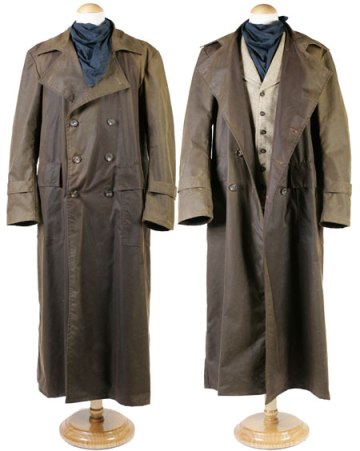
I recently decided I wanted a duster. What is a duster, you ask?

This, dear reader, is a duster:

Dusters

Isn’t it neat? Take just a moment, dear reader, to bask in its majesty.

My longing to own this particular overcoat began a few days ago, when I checked Wikipedia to find out what sets apart dusters from trench coats. (Dusters are distinct for having a slit up the back to the level of the waist, which allows them to be worn comfortably on horseback.)

Like most overcoats, dusters are cool. Neo from The Matrix wears a duster. Vash the Stampede wears a duster. Most gunslingers in Westerns wear dusters. Seriously, dusters are awesome. I even mentioned one in my last post.

Before continuing, I must make one thing clear: I haven’t accumulated much stuff in twenty-two years of moving from place to place. No matter where I’ve gone, however, I’ve kept one thing: a tendency to be neat and organized. When it comes to my possessions, I generally keep an accurate mental inventory of what I have and where I have it.

It was with great surprise, then, that I opened my hall closet a couple of days ago—fewer than twenty-four hours after deciding I wanted a duster—and found one.

I was puzzled. How in blazes did I acquire a duster? From where had it come? How long had it been hanging unnoticed in my closet?

Then I remembered. Some relatives had given me a bundle of used clothes a couple of months before. I’d hung them up in my hall closet without really looking at them, which is how I had overlooked that they had given me a freaking duster.

To say I am excited is a staggering understatement. Without paying a cent, I have acquired a warm duster that fits comfortably and billows satisfactorily when I walk against the breeze. (The coat probably looks silly, like I’m wearing a brown canvas tent, but that’s not the point—it makes me feel cool, which is what matters.)

When I found a duster hanging in my hall closet, it was a Moment of Pure Awesome.

There have been moments throughout my life, Moments of Pure Awesome, when it felt as though God were patting me on the shoulder and saying, “There, there, you’re going to be all right.”

In the worst months of my Thursday Afternoon the Soul, a year and a half of severe depression, I spent a week camping and traveling with my family in California. It was an unexpectedly perfect week, seven days of sunshine, peace and laughter: seven days peppered with Moments of Pure Awesome.

When I was struggling to find a publisher for The Trials of Lance Eliot—and beginning to wonder whether writing books was worth the trouble—I received a package from a creative writer whom I had met only once. It was filled with letters. A class of grade school kids had read a manuscript of mine and wanted to share what they liked about it. It was another Moment of Pure Awesome.

In my penultimate semester of college, two friends presented me with a beautiful sketch of Uncle Iroh: one of my favorite fictional characters. The gift was a random, wonderful act of kindness. On that night many months ago, my friends gave me something more than a picture: a Moment of Pure Awesome.

I could go on for many, many paragraphs, but I’ll conclude with two brief thoughts.

Dusters are really cool, and I’m thankful for a God who gives us Moments of Pure Awesome.

141. Let’s Make Better Christian Video Games

It’s a bitter truth, but we must face it bravely.

Christian video games stink.

Almost without exception, Christian video games are cheap knockoffs of mainstream video games. Christians have made superb contributions to practically every other medium in the world—art, music, literature, film—but not video games.

Why is this?

Well, there are lots of reasons. Video games require money to make, and Christians are a minority demographic in the video game industry. It’s more profitable to make games for larger audiences. More to the point, most Christian video games seem to be made by developers with good intentions, microscopic budgets and practically no experience. The fact that Christian video games tend to be derivative, preachy and poorly designed doesn’t help.

Perhaps the greatest problem is that Christian game developers often focus too much on the message of the games. (This may sound blasphemous, but please hear me out.) Other media can focus primarily on message and succeed, but video games are different.

Video games are built upon gameplay, the way a player interacts with the game. Elements like story, theme and message are secondary. The Mario games, which are amazing, feature the same story over and over again: rescue the princess from the bad guy. Many excellent games have no message—they’re simply entertaining. Even games like Portal and Bioshock with clever plots, deep themes and well-developed characters work only because they are fun to play. For a video game to have a compelling message, it must first have good gameplay.

That’s where Christian video games seem to fail. No matter how good their messages, these games are too flawed for any gamer to care. A video game must succeed as a video game before it can succeed as anything else.

How can we fix Christian video games? Listen up, Christian video game developers. (You all read this blog, right?) I’ve got some suggestions for you.

Focus on gameplay. Don’t preach. Let the game captivate the player with its excellence before introducing profound messages. Put together an adequate budget before starting development. Work with experienced developers. Did I already advise you not to preach? Borrow—but don’t steal—elements from other games. Get lots of feedback. Market your game cleverly and extensively to both Christian and mainstream demographics.

You still need ideas? All right, here are a few concepts for Christian video games that might actually be worth playing. When you make one of these games, just list me in the credits as Creative Consultant.

Underground

Genres: action-adventure, open world, stealth

Influences: Assassin’s Creed series, Metal Gear Solid series

It is the dawn of the fourth century A.D. Diocletian, Emperor of Rome, has intensified the persecution of Christians: burning sacred texts, leveling church buildings and brutally executing Christian leaders. In this time of terror and darkness, a young Christian—let’s call him Socrates—volunteers to be a courier, delivering urgent messages and carrying out secret missions for underground churches.

Underground would borrow much from Assassin’s Creed with its emphasis on historical details, roaming a vast environment and sneaking around without getting caught by the bad guys.

Unlike Assassin’s Creed, the focus of the game wouldn’t be assassination. Socrates would parkour his way around Rome and the surrounding country: clambering over rooftops, creeping through sewers, clinging to the undersides of chariots and generally getting from Point A to Point B without getting caught. (Socrates would also avoid detection by hiding in clay jars, Solid Snake-style.) Since the early church frowned upon murder, killing an enemy would be an instant Game Over. Socrates would have to find creative, nonlethal methods for incapacitating his foes.

Add a story rife with intrigue, betrayal and excitement, and Underground could work.

Pilgrim’s Progress

Genres: RPG, action-adventure

Influences: Legend of Zelda series, Final Fantasy XII, God of War series

The plot of John Bunyan’s classic allegory is perfect for a video game: an unlikely hero sets out on a quest, receives a sword, fights monsters, traverses dangerous environments and finally reaches a happy ending.

Pilgrim’s Progress would give players the choice of playing as either Christian or Christiana. Setting out from the City of Destruction, the player would follow a mostly linear path through exotic locales like the Slough of Despond and the Valley of the Shadow of Death, defeating enemies, solving puzzles and collecting treasures along the way. The ultimate goal? The Celestial City, a place of safety and rest.

The game would include RPG elements like experience points and leveling up, and equipment could be upgraded. Special weapons and tools would be used for combat and puzzle-solving. (Who wouldn’t want to use the Staff of Moses to cross a heretofore impassible river, or the Light of the Word to illuminate a dark cavern?) Progress would be recorded at Save Points. These would also provide a feature called Pilgrim’s Journal, which would allow the player to revisit areas explored previously. (This feature would keep the player from physically backtracking, which is antithetical to the plot of Pilgrim’s Progress.)

The story would have to be tweaked a bit, of course. Although there are one or two “boss battles” in the original allegory, I suggest adding more. For example, there really ought to be a final boss battle right before the player crosses the River of Death to reach the Celestial City. Perhaps Christian (or Christiana) could confront his (or her) greatest fear or worst temptation or something.

Gun for Hire

Genres: third-person shooter, adventure

Influences: Resident Evil 4, Ace Attorney series

Daniel Grey is a private investigator whose tiny office is a mess. A worn duster is draped over the back of his chair. Across his desk are scattered a revolver, a fedora, a Bible and a cup of coffee. When a businessman comes begging him to recover his kidnapped daughter, Grey has only one condition: “Nobody dies.”

As a third-person shooter, Gun for Hire would have plenty of shooting. Grey would venture into some pretty shady places, and bullets would fly. As with Underground, however, killing an enemy would mean an instant Game Over. The game would challenge the player to find creative uses for firearms. When shot, certain pipes would vent clouds of steam to blind foes. A well-aimed bullet would bring a shelf crashing down on an unsuspecting criminal, and shattering a dog’s chain would set it free to chase away potential threats. Of course, a pragmatic player could simply shoot to injure enemies, or knock them out with a blackjack and leave them tied up in a closet.

The game would also focus on investigation, allowing players to examine areas for clues. Important things—facts, documents and miscellaneous items—would be filed away as clues. Aligning the right clues would lead to conclusionsClues and conclusions would be used as keys to unlock answers in conversations with suspects, eventually leading to each mystery’s solution. Gun for Hire would balance exploration and shooting with investigation and perhaps a few puzzles.

The cases in Gun for Hire would be part of an overarching story involving a criminal conspiracy. The game would be set in a big city, probably in the early twentieth century. Daniel Grey would be a Wanderer-Hero with a strong faith, a kind heart, a quick wit and a tragic past. (Why does he drink so much coffee? Is he sublimating a craving for drugs or liquor into a harmless addiction, or simply using the buzz of caffeine to distract himself from some painful memory?) Strong gameplay, clever writing and good acting could make Gun for Hire a great game.

Will some experienced developer please make a good Christian video game? Someone? Anyone?

138. Advent Conspiracy Again

Colored lights. Holiday music. Television specials. Peppermint-flavored everything. Coca-Cola commercials.

The Christmas season is here, and along with it comes another opportunity to do something awesome.

I wrote last year about the Advent Conspiracy, an initiative inspired by three simple facts.

1. Americans spend $450 billion on Christmas every year.

2. Lack of clean water kills more people every day than almost anything else on Earth.

3. The estimated cost to make clean water available to everyone on Earth is about $20 billion—roughly 4.5% of how much Americans spend on Christmas every single year.

A few years ago, someone asked the question: What if we spent a little less on Christmas stuff and gave the extra money to projects that provide clean water?

Those shoes and DVDs and extra holiday decorations and all the other stuff that spends most of its existence gathering dust in a closet or on a shelf—these things can become life, health and hope for people in poor countries.

I usually dislike churchy videos, but this one is amazing. Watch it. Go on, I’ll wait for you.

There’s nothing wrong with giving and receiving Christmas presents. (I’ve already purchased one or two gifts for family members.) The challenge of the Advent Conspiracy isn’t to stop spending money for Christmas, but to spend less on stuff and more on people in need.

We don’t have to give up our Christmas traditions. Quite the opposite! I think it’s time we add new traditions to our celebration of Christmas: spending less, donating more, giving water, saving lives.

The Advent Conspiracy is dedicated to providing clean water, but its principles can be applied to other good causes. The hungry, the homeless and the brokenhearted need our money as much as the thirsty. Where we give doesn’t matter as much as whether we give.

This Christmas, we can rescue people from poverty, thirst and sickness. This Christmas, we can change the world—or we can buy more stuff for ourselves. It’s our choice.

More information about the Advent Conspiracy can be found here.

Have a truly glorious Christmas season!

134. When I Have No Words

I’m usually a cheerful, silly person, and I generally write cheerful, silly blog posts. To quote Louisa May Alcott, “I can only say that it is a part of my religion to look well after the cheerfulnesses of life, and let the dismals shift for themselves.” There is a time, however, to be serious.

Today’s post is a serious one.

There are times when I have no words. I’m good at using words. (In fact, I probably use too many of them.) There are times, however, when words fail me. I sometimes want to scream and holler and wave my fists, but I never do. (These behaviors are generally frowned upon.) Instead, I sit down and spend a few minutes feeling old and tired.

Yesterday was the International Day of Prayer for the Persecuted Church. Do you know what else happened yesterday? Christians in Nigeria mourned the slaughter of their loved ones. Christians in Eritrea languished in pitch-black prison cells. Christians in India struggled to survive as refugees, and at least one Christian in the United States of America spent a few minutes sitting down and feeling old and tired.

After giving it a lot of thought, I realized there are basically three things I want to say about religious persecution.

First, it exists.

Over several years, I’ve read hundreds of reports of persecution against Christians. Hundreds. There were hundreds I didn’t read, and God knows how many incidents were simply never reported.

Some of these cases were complicated. In Nigeria, for example, the attacks carried out by Islamist radicals in past months were not directed toward Christians exclusively, but toward anyone who violated the Islamist ideal of sharia law.

Then there were the simple cases—the tragically simple cases. I remember Nurta Mohamed Farah, a Somali teen who was shot to death simply for choosing to embrace Christianity. There have been so many cases in which Christians were targeted specifically because of their faith.

Religious strife sometimes blurs together with politics and economics, but one fact remains: Christians suffer for following Christ.

The second thing I want to say about religious persecution is that it’s wrong. It is wrong. Innocent people are arrested, abducted, beaten, tortured, raped or murdered, and why? They choose to believe in a loving God. That’s it. They pray and sing and worship and invite others to join them. That’s their crime, and so many suffer for it.

Religious persecution can’t be denied, and it mustn’t be tolerated.

This brings me to the third thing I want to say.

Jesus Christ once said, “So in everything, do to others what you would have them do to you.” If we were persecuted, we would certainly want others to care for us. Since others are persecuted, it’s up to us to care for them.

What can we do?

Keeping informed is a good place to start. (I have a blog, Solidarity, that posts summaries of persecution cases every two weeks.) Spreading awareness helps. Donations to humanitarian organizations like Voice of the Martyrs support victims of persecution. I believe prayer matters most of all.

There are times when I have no words. Today wasn’t one of them. I’ve written quite a number of words today, and I hope they make a difference.

130. Grace? What’s That?

Just because I know something doesn’t mean I understand it. I sometimes know things without really knowing them.

God’s grace—his patient, undeserved help—is greater than my faults. I know that. Sometimes, however, when my life gets a little rough, it’s hard for me to know it. Grace is easy to acknowledge, but so hard to understand.

Last week was a rough one. I considered providing an exhaustive list of reasons why, but I’ll spare my readers the nasty details. By the time I awoke on Saturday morning, I felt truly awful.

Do you know who else spent a lot of time feeling truly awful? The Apostle Paul. He had it rough. Dash it all, did he have it rough. Paul was repeatedly mistreated, flogged, imprisoned and shipwrecked. He suffered from hunger, cold, sleep deprivation and unbearable stress. These are just a few of the sufferings he mentions in his letters, and there were probably some he didn’t mention.

Out of all these afflictions, Paul found one truly insufferable. He called it a thorn in his flesh. Whatever it was, Paul hated it. “Three times I pleaded with the Lord to take it away from me,” he wrote. The Apostle Paul, the legendary missionary, couldn’t take it anymore. He pleaded with God again and again to take away his problem.

At last, God replied, “My grace is sufficient for you, for my power is made perfect in weakness.”

I hate being weak. I’m a faulty, imperfect person adrift in a faulty, imperfect world, and I don’t like it. My usual response is to try to be perfect—or at least, to try to be good enough.

I’m not good enough. I’ve never been, and I’ll never be. I have rough weeks. I get tired and sick and worried and depressed. I make mistakes. No matter how I try, I can’t fit my life into clean, tidy little boxes.

On Saturday, I came closer to understanding something I’ve known for a long time. God’s grace is greater than my mistakes and weaknesses. When I’m not perfect, God is. When I can’t go on, God carries me.

That gives me hope.

I try to wrap up these spiritual blog posts with neat little lessons, but not this time. I haven’t resolved anything. After years of struggling with the same problems, I keep struggling. I’ve written blog posts about these issues and related ones—the same problems again and again and again and again.

I’ve been making mistakes for twenty-two and a half years. If God hasn’t given up on me yet, I mustn’t give up on myself—and I certainly mustn’t give up on him.

I sometimes don’t understand God’s grace, and I often don’t feel it. There are days and weeks when the universe seems particularly empty of meaning, peace or hope.

Even so, I believe God’s grace is sufficient for me. My business isn’t to be good enough, but to trust and to hope and to persevere.

Do I understand God’s grace?

No.

Does it often seem absent?

Yes.

Do I believe God’s grace is always there, and always sufficient for me?

Yes, yes I do.

124. A Battle Won by Surrender

It’s only a matter of time before most of my personal struggles become blog posts.

My readers may not appreciate the posts in which I confess my faults and pour out my woes, but I write them anyway. Writing about my struggles helps me to organize my thoughts.

Besides, personal posts are cathartic to write, and I hope some reader somewhere finds them encouraging—or at the very least, amusing. You may not learn from my mistakes, but you’re welcome to laugh at them.

I often overthink and overanalyze things, cluttering my mind with useless thoughts and pointless worries. My obsessive-compulsive tendency to think too much has wasted a ridiculous amount of time—not as much as, say, YouTube, but a considerable amount nonetheless.

My circumstances are sometimes beyond my control. My feelings are often beyond my control. As a neat, tidy, logical, organized, borderline obsessive-compulsive person, I hate not having control over any part of my life. I think my chronic compulsion to overthink things is an involuntary attempt to extend the illusion of control over my entire life.

I don’t have complete control over my life, but I know someone who does.

In the end, life is too full of mysteries and subtleties and complexities for me to comprehend it fully. Sometimes, I must stop trying to understand life and simply live, trusting God and blundering hopefully onward.

Worry is a paradox, really. It’s the one problem that goes away when it’s ignored. Thinking about worry only makes it worse. The only way to win the battle is to stop fighting.

Now if you’ll excuse me, I have some living to do.

119. God’s Fool

A couple of weeks ago, a coworker informed me quite seriously that our workplace is haunted.

I laughed and told her I think I’d have noticed by now if the bogeyman, the Slenderman or any other kind of spook were lurking in our workplace.

Later in the evening, the garbage compactor went off by itself.

“See?” said my coworker, smiling nervously. “Nobody’s in that room. How do you explain that?”

“If I were a vengeful spirit,” I replied, “I think I’ve have better things to do than activate garbage compactors.”

The incident made me laugh at the time, but it later made me think seriously about the things we believe. My coworker believes our workplace is haunted. It would be easy for me to scoff at her beliefs, but I happen to believe in an invisible, all-powerful, everlasting God.

What sets apart my beliefs from hers? What’s the difference between faith and superstition?

The answer, of course, is evidence. There’s much more evidence to support the existence of God than there is to suggest dark spirits have taken possession of the garbage compactor in my workplace.

Many people don’t agree. I recently read an article claiming science will someday eliminate the need for God. The theory of intelligent design is frowned upon by many scientists. Naturalistic evolution is the de facto explanation for the origin of human life.

Honestly, both sides offer compelling arguments. No matter what atheists may say, there’s certainly evidence for God. Regardless of what Christians will tell you, there’s certainly evidence for atheism. To quote C.S. Lewis, an atheist who converted reluctantly to Christianity, “Now that I am a Christian I do have moods in which the whole thing looks very improbable; but when I was an atheist I had moods in which Christianity looked terribly probable.”

In the end, casting one’s lot with one side or the other isn’t just a matter of reason, logic and evidence. It’s a matter of faith, even for atheists.

There are things I don’t understand about the Christian faith, even though I’ve tried. Regardless, I’ve chosen Christianity. Based on the evidence, it makes sense. I speak not only of scientific, archeological and historical evidence, but also of the evidence of changed lives.

Some months ago, I wrote about gangster pastors: men who have been miraculously transformed from violent, drug-addicted criminals into loving husbands, fathers and church leaders. I know these men personally. I’ve heard numerous accounts of miraculous events. Most powerfully, I know many people whose lives are marked by something, a loving graciousness that goes far beyond mere altruism or friendly disposition.

For me, the best evidence is my own life. Ten years ago, I was a selfish, dishonest, insecure jerk. Eight years ago, I turned my life over to Jesus Christ. Today, while I’m not perfect, I’m a much, much better person than I was.

In the eight years I’ve been a Christian, I’ve seen too many answers to prayer, too many transformed lives and too many unbelievable circumstances for me to pretend it’s all just a series of coincidences—just as it’s possible for ten rolls of a die to yield only sixes, but my first guess is that the gambler who rolls ten sixes in a row is probably using a loaded die.

I’m sure some of my readers are nodding their heads and exclaiming, “Yes, yes.” Some of my readers are probably shaking their heads and saying, “This guy’s deluded,” and a few may have stopped reading once I switched topics from the Slenderman to the Christian faith.

Christians are sometimes considered foolish, and that’s fine. Christ’s own family thought he was out of his mind. (To those who believed he was just a Jewish carpenter, some of the things Jesus said and did must have seemed pretty strange.) The Apostle Paul, who wrote nearly half the New Testament, was accused of insanity.

If I’m crazy for being a man of faith, at least I’m in good company. If I’m a fool, at least I have the consolation of being God’s fool.

I’m not quite sure why I decided to compose this blog post. The subjects of faith, atheism and superstition (and the Slenderman) have been on my mind recently, and I suppose I just wanted to share my thoughts.